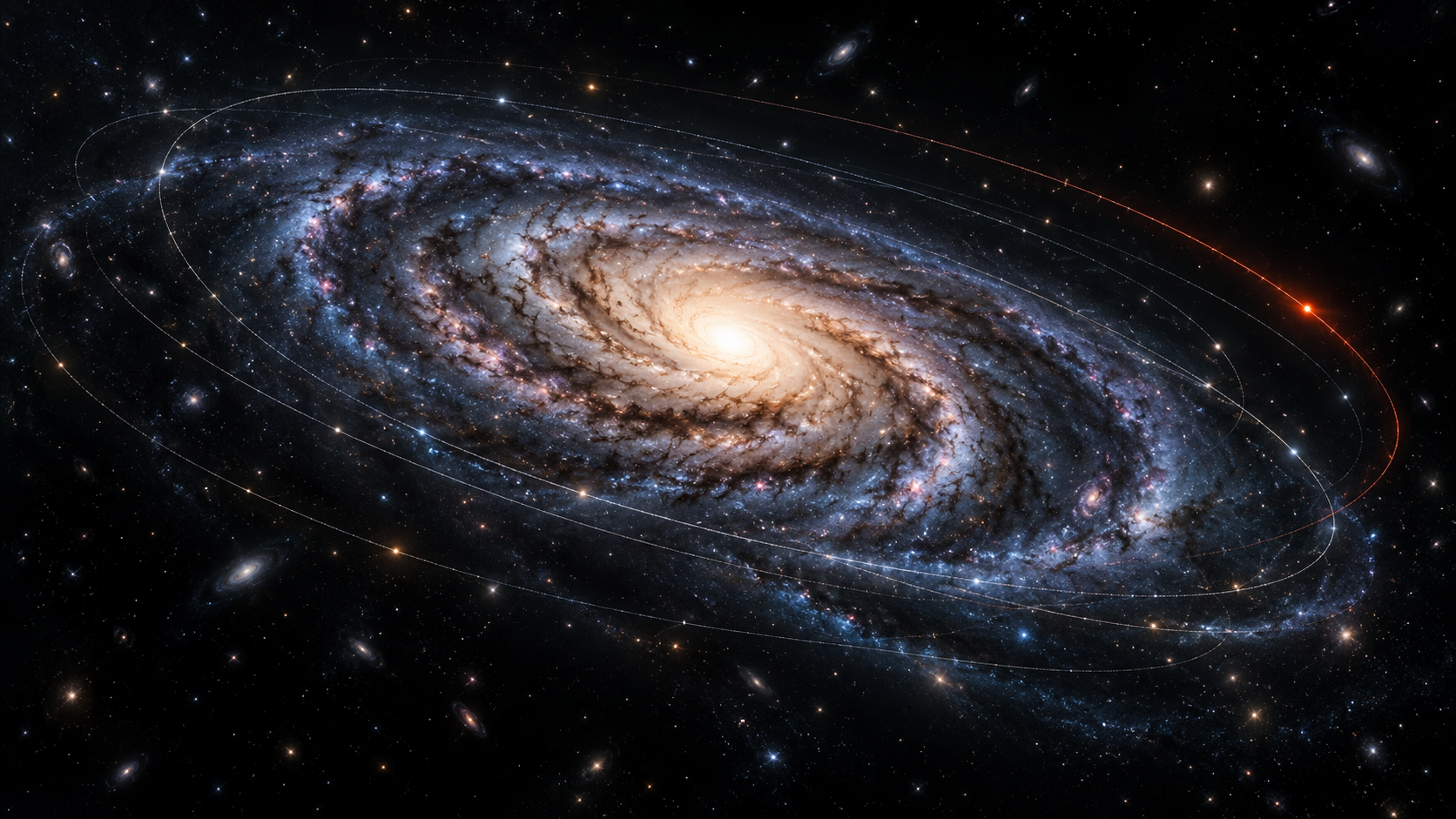
How a 1983 alternative to dark matter grew from a simple low-acceleration rule into one of the longest-running debates in modern astrophysics
A galaxy presents a strange problem if we calculate its motion using only the matter we can see. Far from the bright central regions, stars and gas often orbit faster than the visible mass seems capable of holding together under ordinary Newtonian gravity. The standard explanation is that galaxies sit inside much larger halos of invisible matter. We call it dark matter.
In 1983, Israeli physicist Mordehai Milgrom proposed another possibility. Instead of immediately adding unseen mass, he asked whether the laws used to calculate motion might behave differently under conditions that had barely been tested directly. In particular, he focused on systems where gravitational accelerations are extraordinarily small. His suggestion became known as Modified Newtonian Dynamics, or MOND. In the original paper, Milgrom explicitly considered whether a modified form of dynamics could reproduce the observed motions of galaxies without requiring large amounts of hidden mass.
The basic proposal was surprisingly compact. Above a certain acceleration, ordinary Newtonian physics should work as usual. Far below that acceleration, the relationship between gravitational force and motion would change. From this one assumption came predictions about flat galaxy rotation curves, the relationship between galaxy mass and orbital speed, low surface brightness galaxies, and other patterns that astronomers could compare with observations.
That simplicity is part of the reason MOND has remained scientifically interesting. It is also where the complications begin.
Milgrom was careful about this from the beginning. His original mathematical prescription was presented as an effective working formula, not a complete physical theory. He explicitly wrote that a fuller theory was still needed even in the nonrelativistic regime. Over the following decades, researchers developed more complete versions of the idea, including modified-gravity formulations, QUMOND, and relativistic theories capable of addressing questions such as gravitational lensing and cosmology.
That history makes MOND more interesting than the usual description of it as simply “an alternative to dark matter.” The real question is broader. Galaxies display an unusually close connection between the matter we can observe and the gravitational acceleration inferred from their motions. MOND says that connection may be telling us something about the law of gravity itself. The standard dark matter picture says it can emerge from the relationship between ordinary matter, dark matter halos, and galaxy formation.
More than forty years after Milgrom’s proposal, that question is still being tested.
In this blog, we’ll cover:
1. What Is Modified Newtonian Dynamics (MOND)?
The Basic Idea Behind MOND
Modified Newtonian Dynamics is a proposal that the familiar relationship between gravity and motion changes when gravitational acceleration becomes extremely weak.
Newton’s laws work extraordinarily well across an enormous range of familiar situations. They describe falling objects, planetary orbits, spacecraft trajectories, and much of the motion we encounter in the Solar System. The difficulty appears when the same equations are applied to galaxies using only their visible matter.
Consider a star orbiting far from the center of a galaxy. If most of the galaxy’s mass were concentrated in the stars and gas we can observe, its orbital velocity should eventually decline as the star moves farther from the central mass. Instead, galaxy rotation curves often remain approximately flat. Stars and gas continue moving at speeds that, under ordinary Newtonian calculations, imply more gravitational mass than astronomers can directly see.
The standard interpretation adds dark matter. A galaxy is assumed to be embedded in a much larger halo of invisible material whose gravity supplies the missing attraction.
MOND begins from a different premise. Perhaps the calculation of gravity itself changes when acceleration becomes small enough.
Milgrom’s original proposal can be expressed conceptually in two regimes. At relatively large accelerations, MOND must reproduce ordinary Newtonian dynamics. At extremely small accelerations, the effective gravitational behavior becomes stronger than the Newtonian acceleration calculated from the visible mass alone. In his original paper, Milgrom described the low-acceleration limit approximately as:
a2/a0 ≈ gN
where a is the actual acceleration, gN is the acceleration Newtonian gravity predicts from the observed mass, and a0 is a new constant with the dimensions of acceleration.
Rearranging that low-acceleration relation gives the more familiar form:
a ≈ √(gNa0)
The important point is not the algebra itself. It is what the equation changes.
If the Newtonian gravitational field becomes extremely weak, MOND predicts that an object can experience more effective acceleration than conventional Newtonian gravity from the visible matter would provide. An astronomer interpreting the same motion strictly through Newtonian physics would conclude that additional unseen mass must be present.
MOND instead asks whether at least part of that apparent extra gravity comes from the law governing the motion.
That difference is fundamental. Dark matter changes the amount and distribution of gravitating matter. MOND changes the relationship between visible matter and the gravitational motion it produces.
Mordehai Milgrom and the 1983 Proposal
Milgrom introduced the idea in a series of papers published in The Astrophysical Journal in 1983.
The first paper established the general proposal. The motivation was the longstanding missing-mass problem in galaxies and larger systems. Milgrom noted that conventional dynamical mass estimates depend on assumptions about gravity and inertia that had been tested extremely well in laboratories and the Solar System, but not under every physical condition encountered in galaxies. Galactic accelerations can be many orders of magnitude smaller than those common in familiar tests of mechanics.
That opened an unusual possibility.
Rather than assuming that a large amount of matter had escaped observation, Milgrom explored whether Newton’s second law, gravity, or some combination of the two might cease to have its familiar form in this low-acceleration regime.
The proposal was not simply designed to make rotation curves flatter by adjusting gravity at large distances. Milgrom specifically centered the modification on acceleration. That distinction matters because acceleration depends on both the mass of a system and the position of the orbiting object. MOND therefore does not switch on at one universal distance such as 5,000 or 50,000 light-years from the center of every galaxy.
Instead, the transition depends on whether the local gravitational acceleration has fallen toward the characteristic scale a0.
The companion galaxy paper developed the implications of this assumption in much greater detail. Among the consequences were asymptotically flat rotation curves and a close relationship between a galaxy’s mass and its characteristic rotational velocity. These were not separate additions to the idea. They followed from the low-acceleration behavior Milgrom had proposed.
This is one reason the 1983 papers still matter when evaluating MOND today. It is easy to look at modern galaxy data, fit a mathematical relation, and then construct an explanation afterward. A stronger scientific test asks what a proposal said before the relevant observations became available or precise enough to test it.
Later sections will examine which MOND claims genuinely qualify as successful prior predictions and which depend more heavily on later model choices.
MOND Is a Framework, Not Just One Equation
One of the easiest ways to misunderstand MOND is to treat the original algebraic formula as if it were the entire theory.
Milgrom did not do that.
In his first paper, he explicitly described the equation as an effective working formula with limited applicability. He distinguished between at least two broad possibilities. The modification might involve inertia, meaning the relationship between force and acceleration changes. Alternatively, gravity itself might be modified so that matter produces a different gravitational field in the low-acceleration regime.
That distinction became increasingly important.
A simple algebraic rule can work well for a test particle moving in a highly symmetric gravitational field, but a physical theory has to do much more. It should tell us what happens in arbitrary systems containing many interacting bodies. It should conserve energy and momentum. It should give a consistent gravitational potential. Eventually, it should also fit into a relativistic description capable of handling light, gravitational lensing, cosmology, and other effects outside the domain of Newtonian mechanics.
Researchers therefore developed different theoretical realizations of the MOND idea.
Bekenstein and Milgrom later produced a nonlinear modified-gravity formulation derived from an action. Milgrom’s QUMOND, introduced in 2010, provided another complete nonrelativistic modified-gravity formulation. It involves solving linear differential equations combined with a nonlinear algebraic step and retains the standard conservation laws that follow from an action.
There are also relativistic theories inspired by MOND. Perhaps the best-known historically is Jacob Bekenstein’s TeVeS, short for Tensor-Vector-Scalar theory. It was designed in part to extend MOND-like behavior into a framework that could address gravitational lensing and relativistic phenomena. Bekenstein’s theory uses a metric together with dynamical scalar and vector fields, rather than treating Milgrom’s original formula as a complete description of gravity.
So when scientists say they are “testing MOND,” the wording requires some care.
Sometimes they are testing a broad empirical prediction shared by MOND models, such as the appearance of a characteristic acceleration scale in galaxy dynamics. In other situations, they are testing a specific modified-gravity implementation. And some observations, particularly cosmological or relativistic ones, depend heavily on the particular underlying MOND theory being considered.
MOND is therefore better understood as a paradigm or framework centered on low-acceleration dynamics, with several mathematical theories developed to implement it.
That distinction will become increasingly important once we reach galaxy clusters, gravitational lensing, cosmology, and wide binary stars.
The Acceleration Scale a₀
The defining quantity in MOND is the characteristic acceleration a0.
Modern galaxy analyses commonly place it around:
a0 ≈ 1.2 × 10⁻¹⁰ m s−2
For comparison, this is an extraordinarily weak acceleration. It is not something normally encountered in laboratory mechanics or in the inner Solar System.
The THINGS analysis of high-quality galaxy rotation curves, for example, obtained a median value of:
a0 = (1.22 ± 0.33) × 10−8 cm s−2
which is equivalent to approximately 1.22 × 10⁻¹⁰ m s−2.
The role of a0 is easiest to understand by thinking of three broad regimes.
When gravitational acceleration is much larger than a0, MOND is constructed to approach ordinary Newtonian behavior. This is why a viable MOND formulation cannot simply produce obvious deviations throughout the Solar System.
When acceleration becomes comparable to a0, the transition between Newtonian and MOND behavior occurs. Different MOND formulations can describe this transition using somewhat different interpolation functions.
When acceleration becomes much smaller than a0, the system enters what is usually called the deep-MOND regime. Here the effective acceleration approaches the approximate square-root relation described earlier.
This one acceleration scale appears repeatedly in galaxy phenomenology. The modern Radial Acceleration Relation, for instance, finds a close connection between acceleration inferred from galaxy rotation curves and acceleration expected from the observed baryonic matter across thousands of measurements. The SPARC analysis used 2,693 points from 153 galaxies spanning widely different masses, sizes, morphologies, and gas fractions.
That observation by itself does not prove that MOND is the correct explanation. The relationship between baryonic matter and galaxy dynamics is an empirical result. MOND interprets the characteristic acceleration as something fundamental in the law governing gravity or motion. Dark matter models seek to explain why galaxy formation produces a similarly tight relationship between visible matter, dark halos, and observed acceleration.
But the existence of the scale is central to understanding why MOND has remained part of the discussion.
The theory began with a simple suggestion: below an extremely small acceleration, the rules may change.
2. Why Was MOND Proposed?
The Missing Mass Problem
MOND did not begin as an attempt to replace a successful explanation for no reason. It grew out of a real observational problem that had been developing for decades.
When astronomers observe a galaxy, they can estimate how much ordinary, or baryonic, matter it contains. Stars contribute most of the visible light, while radio observations can reveal large reservoirs of atomic gas. Once the distribution of this matter is estimated, Newtonian gravity can be used to calculate how strongly it should pull on stars and gas moving through the galaxy.
The problem is that the observed motion is often too fast for the visible matter alone.
This discrepancy can be described as a missing mass problem. If Newtonian gravity is correct on galactic scales, then the motions imply that galaxies contain considerably more gravitating mass than can be accounted for by their visible stars and gas.
The same broad problem appears in other astronomical systems, including galaxy clusters, although the details differ from one scale to another. By the time Milgrom proposed MOND in 1983, astronomers had strong reasons to think that something was missing from calculations based only on visible matter.
There were two broad ways to interpret the discrepancy.
One possibility was that the equations were correct but the inventory of matter was incomplete. In that case, large quantities of invisible matter had to exist.
The other possibility was more radical: perhaps the matter estimates were not the main problem. Perhaps the gravitational or dynamical laws being applied to these systems were incomplete under conditions of extremely weak acceleration.
MOND developed from the second possibility.
Why Galaxy Rotation Curves Became a Problem
Galaxy rotation curves provide one of the clearest ways to see the missing-mass problem.
A rotation curve plots the orbital speed of stars or gas against their distance from the center of a galaxy. If most of a galaxy’s mass were concentrated in the luminous inner regions, then once an orbiting object moved well beyond most of that mass, its behavior should begin to resemble an object orbiting a central mass.
For circular motion, the required centripetal acceleration is related to the gravitational acceleration by:
v2/r = G M/r2
Rearranging this gives:
v = √(GM/r)
If the amount of enclosed mass has mostly stopped increasing, this relation predicts that orbital velocity should decline with increasing distance.
That is approximately what happens in the Solar System. The outer planets orbit the Sun more slowly than the inner planets because they are farther from the mass that dominates the gravitational field.
Galaxies often behave differently.
Beyond much of the visible stellar disk, measured rotation speeds frequently remain approximately constant rather than following the expected Keplerian decline. These are the famous flat galaxy rotation curves.
The discrepancy is not simply that a galaxy rotates quickly. The problem is that the shape and amplitude of the observed rotation curve cannot generally be reproduced from the visible distribution of stars and gas using ordinary Newtonian gravity alone.
This is where additional gravity seems to be required.
The Dark Matter Explanation
The standard explanation keeps Newtonian gravity, and General Relativity more broadly, while adding matter that does not emit or absorb enough electromagnetic radiation for astronomers to see it directly.
In galaxies, this additional component is usually represented as an extended dark matter halo surrounding the visible disk.
The halo changes the mass distribution dramatically. Although the amount of visible matter may level off at large radii, the enclosed dark matter can continue increasing. As a result, an orbiting star can maintain a high velocity even far beyond the region where most of the visible light is concentrated.
Conceptually, the explanation is straightforward:
The gravity appears stronger because there is more mass than we can see.
Dark matter is not supported only by galaxy rotation curves. It is also part of the standard cosmological framework used to explain observations involving galaxy clusters, gravitational lensing, the cosmic microwave background, and the formation of large-scale structure. Those larger-scale successes become important later when comparing MOND with the standard cosmological model.
But galaxy observations revealed something that made the problem especially interesting. The missing gravity did not seem completely independent of the visible matter.
Patterns in galaxy dynamics appeared closely connected to the amount and distribution of baryonic matter. That connection became one of the central motivations for taking MOND seriously.
Milgrom’s Alternative Question
Milgrom approached the problem from the opposite direction.
Instead of asking, “How much unseen mass must be added to reproduce this motion?”, he asked what would happen if the usual laws of dynamics stopped having exactly their Newtonian form when acceleration became extremely small.
This mattered because the gravitational accelerations encountered in the outer regions of galaxies are tiny compared with accelerations commonly tested in laboratories or within much of the Solar System.
Milgrom introduced a characteristic acceleration, now usually written as a₀, and proposed that ordinary dynamics should be recovered when acceleration is much greater than this scale. When acceleration falls far below it, the behavior should change.
The proposal was deliberately constructed so that it would not overturn Newtonian physics where Newtonian physics was already known to work extremely well.
The unusual part was the choice of acceleration as the quantity controlling the transition.
MOND was therefore not simply saying that gravity becomes stronger at a particular distance from the center of every galaxy. It suggested that a new dynamical regime appears when the gravitational acceleration becomes sufficiently weak.
That one decision produces many of MOND’s characteristic predictions.
3. How Does MOND Work?
The Newtonian Regime
MOND has to reproduce Newtonian gravity under ordinary high-acceleration conditions. Otherwise, it would immediately conflict with a vast amount of successful physics.
When the gravitational acceleration g is much greater than the characteristic acceleration a₀, MOND approaches:
g ≈ gN
Here, gN is the gravitational acceleration calculated from the baryonic matter using Newtonian gravity.
In this regime, MOND does not produce a large modification. A planet, spacecraft, or laboratory object experiencing relatively strong gravitational acceleration should therefore behave almost exactly as conventional physics predicts.
This recovery of Newtonian behavior is essential. A modified-gravity theory cannot simply improve galaxy rotation curves while destroying the successful description of the Solar System.
The Deep-MOND Regime
The behavior changes when acceleration becomes much smaller than a₀.
In this limit, often called the deep-MOND regime, the approximate relation becomes:
g ≈ √(gNa0)
This equation has an important consequence.
Suppose Newtonian gravity predicts an extremely small acceleration. Instead of simply accepting that value, MOND produces an effective acceleration given by the square root of the Newtonian acceleration multiplied by a₀.
At sufficiently low acceleration, this value is larger than gN.
From the viewpoint of someone analyzing the system with Newtonian gravity, the additional acceleration would look as though extra mass were present.
MOND interprets the same observation differently. The apparent excess gravity comes from the altered law rather than necessarily from a halo of unseen matter.
What Happens Below a₀
It is easy to describe MOND as though gravity suddenly changes when an object crosses a precise boundary at a₀, but that is not generally how practical MOND formulations work.
The change is gradual.
At accelerations much greater than a₀, the behavior is effectively Newtonian.
Near a₀, the system enters a transition region.
Far below a₀, the deep-MOND relation becomes a good approximation.
The characteristic value inferred from galaxy observations is roughly:
a0 ≈ 1.2 × 10⁻¹⁰ m s−2
This is an extremely weak acceleration.
That scale helps explain why MOND can have large effects in the outskirts of galaxies while remaining much less conspicuous in environments where gravitational accelerations are stronger.
Why MOND Uses an Acceleration Scale Instead of a Distance Scale
A crucial feature of MOND is that there is no single distance at which the modification must begin for every object.
Consider two systems with very different masses. A star and a galaxy can both eventually reach the low-acceleration regime, but they will do so at enormously different distances.
For an isolated mass M, we can define a characteristic MOND radius approximately as:
rM = √(GM/a0)
The larger the mass, the farther away one must generally travel before its Newtonian gravitational acceleration falls near a₀.
This is why MOND is fundamentally different from a rule such as “gravity changes beyond 10,000 light-years.”
A fixed distance would have difficulty accounting for systems of dramatically different masses. An acceleration scale allows the transition distance to adjust naturally with the mass of the system.
This also creates the possibility of testing MOND outside galaxies. A much smaller system can reach low internal accelerations if its components are separated by a sufficiently large distance. Wide binary stars are one example, and they become important later in this article.
The Role of the Interpolating Function
Real astronomical systems do not exist only in the extreme Newtonian or extreme deep-MOND limits. Many observations probe the transition between them.
MOND therefore uses an interpolating function, usually represented by the Greek letter μ, to connect the two regimes.
A common way of writing the relation is:
μ(g/a0) g = gN
The function must behave differently in the two limits.
When acceleration is high, μ approaches 1, giving ordinary Newtonian gravity.
When acceleration is very low, μ approaches the ratio g/a₀, producing the deep-MOND behavior.
The exact shape of the transition is not completely specified by those limits. Different interpolation functions can therefore be tested against galaxy data and Solar System constraints.
This freedom is important. It means that the broad MOND principle is more specific than an arbitrary curve fit, because its high- and low-acceleration behavior are constrained, but it does not uniquely determine every detail of the transition.
4. What Did MOND Predict About Galaxies?
Flat Galaxy Rotation Curves
Flat rotation curves were one of the observations that motivated Milgrom’s original proposal, so they should not be described as an independent prediction discovered afterward.
However, once the low-acceleration rule is adopted, the flat behavior follows naturally.
For a star in a circular orbit:
g = v2/r
In the deep-MOND regime, combining circular motion with the MOND acceleration law leads to:
Vf4 = G M a0
Notice what has disappeared from the final expression: radius.
The asymptotic circular velocity depends on the mass and constants, but not on how far away the orbiting object is. The velocity therefore approaches a constant instead of continuing to decline with distance.
That is the mathematical origin of the flat rotation curve in the deep-MOND limit.
Low-Surface-Brightness Galaxies
Low-surface-brightness galaxies became an especially useful test because their visible matter is spread over a relatively large area.
Two galaxies can contain similar total amounts of baryonic matter while distributing that mass very differently. If one is compact, its internal accelerations can remain relatively high over much of the visible galaxy. If the other spreads its mass thinly over a larger disk, its internal gravitational accelerations can be much smaller.
MOND therefore predicts that surface density matters.
Low-surface-brightness galaxies should enter the MOND regime more strongly, even at locations that are not exceptionally far from their centers. Under a Newtonian interpretation, they should consequently appear especially dominated by dark matter.
That behavior was a genuine consequence of the acceleration-based formulation. The theory did not require each galaxy to be assigned an arbitrary distance at which invisible matter suddenly took over.
Instead, the magnitude of the apparent mass discrepancy followed the local acceleration.
This is an important distinction because low-surface-brightness galaxies provided a way to test the idea in systems very different from the bright spiral galaxies that initially motivated MOND.
The Connection Between Visible Matter and Orbital Motion
MOND also predicts a close relationship between the distribution of baryonic matter and the shape of a galaxy’s rotation curve.
In a dark-matter picture, the observed velocity reflects the combined gravitational influence of baryons and the dark halo. In MOND, the gravitational field is calculated directly from the baryonic distribution and the modified dynamical law.
That creates a strong expectation: structures in the visible mass distribution should leave corresponding structures in the observed motion.
A concentration of stars or gas that changes the Newtonian gravitational field should also alter the MOND prediction.
Astronomers have long noted that bumps and features in baryonic distributions can correspond to features in rotation curves. This close coupling is sometimes discussed through what is known as Renzo’s rule, the empirical observation that features in a galaxy’s luminosity profile often have counterparts in its rotation curve.
This does not, by itself, prove MOND. Dark matter and baryons interact during galaxy formation, so correlations between them are also possible in dark-matter models.
The importance lies in how naturally such a connection emerges from the MOND prescription. The visible matter directly determines the Newtonian field from which the modified gravitational behavior is calculated.
Why Predictions Made Before Observations Matter
Claims about MOND predictions need to be handled carefully.
Milgrom did not begin with no information about galaxies. The asymptotic flatness of rotation curves and the general slope associated with the Tully-Fisher relation helped motivate the original form of the theory.
Those observations therefore cannot fairly be counted as completely independent predictions.
What happened afterward is more interesting.
Once Milgrom fixed the low-acceleration behavior, the same framework implied several additional regularities. It predicted how the apparent mass discrepancy should depend on acceleration and surface density, how low-surface-brightness galaxies should behave, and how mass should relate to asymptotic rotation speed.
The scientific value comes from the restriction imposed by the theory.
A model that is adjusted after every new observation can explain almost anything. A model that fixes a relationship first and then encounters new classes of systems is easier to test.
Some later observations matched MOND’s expectations remarkably well. Others, especially at the scales of galaxy clusters and cosmology, proved much more difficult.
Both sides of that history matter.
5. The Baryonic Tully-Fisher Relation
From the Original Tully-Fisher Relation to Baryonic Mass
In 1977, R. Brent Tully and J. Richard Fisher identified a strong empirical relationship between the luminosity of a spiral galaxy and its rotation velocity.
Brighter spiral galaxies tend to rotate faster.
That original relation used luminosity as a practical measure of a galaxy’s visible content. But luminosity is not the same thing as mass. Different populations of stars can produce different amounts of light for the same stellar mass, and faint galaxies can contain a substantial fraction of their baryonic matter in gas rather than stars.
A more physically direct version therefore uses baryonic mass.
Baryonic mass includes the ordinary matter measured in stars and gas:
Mb = Mstars + Mgas
When this total is compared with a galaxy’s flat rotation velocity, the result is known as the Baryonic Tully-Fisher Relation, or BTFR.
MOND’s Mb ∝ Vf4 Prediction
In the deep-MOND regime, circular motion gives:
Mb = Vf4/(G a0)
This means:
Mb ∝ Vf4
This is one of MOND’s most important galaxy-scale results.
The slope is not freely selected for each galaxy. Once the deep-MOND law is adopted, the fourth-power relationship follows from it.
The normalization is connected to G and a₀.
That creates a much stronger test than merely asking whether MOND can draw a curve through individual rotation data.
Why Gas-Rich Galaxies Are Important Tests
One major uncertainty in galaxy mass estimates comes from converting starlight into stellar mass.
Astronomers observe luminosity directly, but the amount of mass represented by that light depends on the stellar population. Different assumptions about the ages, chemical compositions, and distribution of stars affect the estimated stellar mass-to-light ratio.
Gas-rich galaxies reduce this problem.
If a galaxy contains more baryonic mass in gas than in stars, much of its baryonic mass can be estimated from gas observations with less dependence on uncertain stellar population models.
This makes gas-dominated galaxies particularly useful for testing the BTFR.
Their positions on a baryonic mass versus rotation velocity plot are less easily moved by adjusting assumptions about stellar mass.
In McGaugh’s analysis of gas-rich rotating galaxies, the MOND line was already strongly constrained by previous measurements. The gas-rich galaxies therefore provided a test of whether a different class of systems would land in the predicted region without individually tuning the MOND relation to each one.
What the Observations Show
The gas-rich galaxy samples examined by McGaugh were consistent with a fourth-power BTFR.
The study found that these systems followed the relation expected from MOND across a range extending to substantially lower masses than the bright spiral galaxies used in earlier calibrations.
The observed scatter was also small enough to be consistent largely with observational uncertainties.
This result should still be described carefully.
The BTFR is an empirical relationship. Its existence does not automatically tell us which physical explanation is correct.
MOND produces the fourth-power relation naturally from its deep-acceleration law. In the standard cosmological framework, the same observational relation has to emerge from galaxy formation inside dark matter halos, including the complicated interaction of gas, star formation, feedback, and halo structure.
Modern galaxy-formation models have become far more sophisticated than early dark-matter models. The relevant comparison is therefore not whether dark matter can produce a Tully-Fisher-like trend at all. It is whether a complete model can reproduce its slope, normalization, small scatter, and behavior across different kinds of galaxies.
The BTFR remains important because any successful explanation of galaxy dynamics has to account for all of those features together.
6. Testing MOND With Real Galaxy Rotation Curves
The THINGS Galaxy Survey
A theory can reproduce broad scaling relations and still fail when confronted with the detailed structure of individual galaxies.
That makes high-quality rotation curves an important test.
The THINGS survey, short for The HI Nearby Galaxy Survey, obtained high-resolution observations of neutral atomic hydrogen in nearby galaxies. Hydrogen emits a characteristic radio signal that allows astronomers to trace gas motion well beyond much of the bright stellar disk.
Gentile, Famaey, and de Blok selected 12 THINGS galaxies for a detailed MOND analysis. They excluded systems where obvious non-circular motions or complicated gas structures could make the interpretation unreliable.
This was useful because the sample covered galaxies with different luminosities while providing detailed rotation curves and relatively well-constrained baryonic mass distributions.
The test was therefore more demanding than simply checking whether the outermost velocity was high or low.
MOND had to reproduce the shape of the rotation curve across radius.
How a MOND Rotation-Curve Prediction Is Calculated
The starting point is the matter astronomers can observe.
Gas can be mapped from radio observations. Stellar light is measured, often using infrared observations that provide a relatively stable tracer of stellar mass.
The stellar luminosity still has to be converted into mass using a mass-to-light ratio.
From the resulting distribution of stars and gas, astronomers calculate the Newtonian gravitational field gN.
MOND then relates this baryonic Newtonian field to the predicted actual gravitational acceleration.
Once g(R) is known at a particular radius, the predicted circular speed follows from:
V(R) = √(g(R)R)
The predicted curve can then be compared point by point with the observed rotation curve.
There are still uncertainties.
Galaxy distance matters. Inclination matters because astronomers observe a projected velocity and must infer the actual rotational velocity. Stellar mass-to-light ratios also matter.
A serious test therefore has to distinguish between genuine theoretical freedom and ordinary observational uncertainty.
The Simple and Standard Interpolating Functions
The THINGS analysis compared two widely used choices for the transition between Newtonian and MOND behavior.
Defining:
x = g/a0
the standard interpolating function is:
μ(x) = x/(√(1 + x2))
The simple interpolating function is:
μ(x) = x/(1 + x)
Both recover the required limiting behavior, but they transition differently.
The standard function changes more sharply between regimes. The simple function makes a more gradual transition and gave better galaxy fits in several comparisons in the THINGS analysis.
However, the simple function in its unmodified form has problems when extended into much stronger gravitational fields such as those relevant to precise Solar System tests. That is an important reminder that an interpolation function that performs well for galaxies cannot automatically be assumed to work unchanged in every environment.
The Measured Value of a₀
If a₀ represents a universal acceleration scale, it should not need a completely different value for every galaxy.
The THINGS analysis therefore examined the values preferred by the different galaxy rotation curves.
For the standard interpolation function, the median was:
a0 = (1.27 ± 0.30) × 10−8 cm s−2
For the simple function, the median was:
a0 = (1.22 ± 0.33) × 10−8 cm s−2
These values are close to the acceleration scale found in earlier galaxy studies.
That consistency matters because a₀ is supposed to describe a common physical transition, not serve as an arbitrary fitting parameter chosen independently for every object.
Where the Fits Work Well
With a₀ fixed near the common value and galaxy distances constrained by independent measurements, most of the selected THINGS galaxies produced good MOND fits.
The authors identified three main exceptions in their constrained-distance analysis.
Two of them, NGC 2976 and NGC 7793, were also difficult to fit well using conventional Newtonian dark-matter models in the comparison they discussed. That makes them less straightforward as clean tests of MOND because problems with the assumed circular motion or mass modelling can affect both frameworks.
The remaining case, NGC 3198, was more interesting.
It had long been regarded as a particularly useful galaxy for testing MOND because of its extended, well-measured rotation curve.
NGC 3198 and Other Difficult Cases
The MOND prediction for NGC 3198 did not match the observed rotation curve as comfortably as most galaxies in the selected THINGS sample when the preferred acceleration scale and independently measured distance were imposed.
The fit could be improved by changing the assumed distance or by using a somewhat lower value of a₀.
But that does not automatically remove the tension.
If a theory repeatedly requires independent measurements to move toward preferred values, those adjustments themselves become part of the test.
The authors therefore treated NGC 3198 as an important benchmark rather than hiding it as an inconvenient outlier.
This is how a useful scientific test should work. A galaxy that resists a successful model can tell us whether the problem lies in observational assumptions, the specific MOND formulation being used, or the underlying theory itself.
Prediction Versus Curve Fitting
Descriptions of MOND sometimes swing between two extremes.
One side says MOND predicts galaxy rotation curves with essentially no freedom.
The other says MOND is simply fitted to every galaxy after the data are known.
Neither description is sufficiently precise.
The baryonic mass distribution is observed, and a₀ is intended to be universal. Those features make MOND strongly constrained.
But practical rotation-curve analyses still involve uncertainties in stellar mass-to-light ratios, distance, inclination, non-circular motion, gas distributions, and the chosen interpolation function.
A strong MOND test therefore asks how much freedom was actually allowed in a particular analysis.
That distinction becomes even more important when moving from individual rotation curves to a relationship found across thousands of measurements.
7. The Radial Acceleration Relation
What g_obs and g_bar Mean
The Radial Acceleration Relation, usually shortened to RAR, compares two quantities that are calculated independently.
The first is the observed centripetal acceleration inferred from a galaxy’s rotation curve:
gobs = V2(R)/R
The second is gbar, the gravitational acceleration predicted from the observed baryonic matter.
This comes from the measured distributions of stars and gas rather than from the observed rotation speed.
That independence is crucial.
If the two quantities were simply different rearrangements of the same measurement, a correlation would not be surprising.
Instead, one comes from galaxy motion and the other from the distribution of visible matter.
The SPARC Galaxy Database
The RAR analysis used galaxies from SPARC, the Spitzer Photometry and Accurate Rotation Curves database.
SPARC combines high-quality galaxy rotation curves with infrared photometry at 3.6 micrometers.
Infrared light is useful because it traces the older stellar population relatively well and reduces some of the uncertainties associated with estimating stellar mass from optical light.
The full SPARC database contains 175 disk galaxies. The 2016 RAR study used 153 rotationally supported galaxies that met the analysis requirements.
These galaxies span a wide range of properties.
Some are massive and bright.
Others are faint and gas rich.
Some have high central surface densities.
Others are diffuse low-surface-brightness systems.
That diversity makes the resulting relation much harder to dismiss as a peculiarity of one narrow galaxy class.
2,693 Measurements Across 153 Galaxies
The analysis contained 2,693 individual radial measurements from the 153 galaxies.
Each point compares gobs with gbar at a particular radius.
Despite major differences among the galaxies, the points follow a tight common relation.
At high baryonic accelerations, gobs approaches gbar, meaning visible matter can account for much of the gravitational field.
At low baryonic accelerations, the observed acceleration increasingly exceeds the Newtonian expectation from the baryons.
The transition is smooth.
The reported residual width around the fitted relation was about 0.11 dex, while the overall root-mean-square scatter was about 0.13 dex. The authors estimated that known observational uncertainties and expected variations in stellar mass-to-light ratio could account for most of that scatter.
In other words, there was little room in that analysis for a large amount of additional intrinsic scatter.
Why the Relation Is So Important
The RAR compresses several familiar galaxy phenomena into one relationship.
It includes the fact that outer galaxy rotation curves are often approximately flat.
It connects with the Baryonic Tully-Fisher Relation.
It reflects the tendency for low-surface-brightness galaxies to show larger apparent mass discrepancies.
Most importantly, it shows that the apparent need for additional gravity is closely connected to the acceleration predicted by the baryonic matter.
This is why the RAR matters regardless of which theory ultimately explains it.
Any successful model of galaxy formation and dynamics has to reproduce the observed coupling.
It is not enough simply to produce galaxies containing dark matter, or simply to produce flat rotation curves.
The theory must explain why the apparent contribution usually attributed to dark matter is so systematically related to the baryonic gravitational field.
MOND’s Interpretation
From the MOND perspective, the RAR looks familiar because a close relationship between gN and the actual acceleration was built into the framework from the beginning.
The empirical RAR fit identifies a characteristic acceleration of roughly:
g† ≈ 1.2 × 10⁻¹⁰ m s−2
This is strikingly close to the acceleration scale long associated with MOND.
That does not mean the empirical fitting parameter g† should automatically be treated as proof that a₀ is a fundamental constant of nature.
The RAR is an observation.
MOND is one theoretical interpretation of that observation.
The distinction is important because the data remain the same even if a different physical mechanism eventually explains them.
How Dark Matter Models Approach the Same Relation
In the standard cosmological picture, galaxies form inside dark matter halos.
The distribution of baryons is then shaped by many processes, including gas cooling, star formation, stellar feedback, galactic outflows, mergers, and the gravitational response of the dark halo.
These processes can create correlations between baryonic structure and the total gravitational field.
Modern simulations have made substantial progress in reproducing galaxy scaling relations, including RAR-like behavior. The question is therefore not whether dark-matter models are capable of producing a correlation.
The harder question is why the relation is as regular as observed across galaxies with very different histories, masses, surface densities, and gas fractions.
From a MOND perspective, the relation is close to a direct law connecting baryonic acceleration with actual acceleration.
From a dark-matter perspective, it is an emergent result of galaxy formation within halos.
The same data therefore sit near the center of two very different interpretations.
8. From an Empirical Rule to a Theory of Gravity
Why Milgrom’s Original Formula Was Not Enough
Milgrom himself warned that the original MOND prescription should not be mistaken for a complete theory.
The simple algebraic formula works particularly well as a description of highly symmetric systems and circular motion, but fundamental physics demands more.
A complete theory must specify how gravitational fields are generated in arbitrary three-dimensional systems.
It must preserve quantities such as energy, momentum, and angular momentum.
It must handle interactions among multiple bodies consistently.
And if it is meant to replace or modify gravity more fundamentally, it eventually has to connect with relativity.
The original algebraic MOND rule cannot accomplish all of that by itself.
Taken literally as a universal force prescription, it can fail to respect ordinary conservation laws in general configurations.
That problem motivated the development of more complete formulations.
Modified Inertia Versus Modified Gravity
Milgrom recognized two broad possibilities from the beginning.
One possibility is modified inertia.
In this picture, the gravitational field could remain conventional, but the relationship between force and the resulting motion would change at low accelerations.
This modifies the dynamics of the moving object.
The other possibility is modified gravity.
Here, ordinary inertia remains intact, but the gravitational field generated by a given distribution of matter differs from the Newtonian prediction under low-acceleration conditions.
The two ideas can produce similar behavior in simple situations while differing in more complicated systems.
Most practical numerical work on MOND has focused on modified-gravity formulations because they can be expressed through gravitational field equations and solved for complex mass distributions.
Conservation Laws and the Need for a Complete Theory
Conservation laws are not optional details.
Momentum conservation ensures that an isolated system cannot accelerate itself without exchanging momentum with something else.
Energy conservation prevents physical systems from gaining or losing energy arbitrarily.
Angular momentum conservation controls rotational motion.
A theory derived from a suitable action principle can preserve these quantities through its underlying symmetries.
This was one of the major steps beyond Milgrom’s original working formula.
Instead of specifying only a relation between two accelerations, later MOND theories were constructed from actions and gravitational potentials.
This allowed MOND to become a field theory rather than merely an empirical recipe for circular galaxy orbits.
AQUAL
In 1984, Jacob Bekenstein and Mordehai Milgrom introduced an important nonrelativistic field formulation usually called AQUAL, short for Aquadratic Lagrangian theory.
Instead of using the ordinary linear Newtonian Poisson equation, AQUAL replaces it with a nonlinear gravitational field equation.
Its basic form is:
∇·[ μ(|∇Φ|/a0) ∇Φ ] = 4πGρ
Here, Φ is the gravitational potential and ρ represents the matter density.
In highly symmetric systems, AQUAL reproduces the familiar algebraic MOND relation.
But because it is derived from an action, it has the structure needed to maintain the usual conservation laws.
AQUAL also makes one of MOND’s unusual consequences unavoidable: the gravitational field becomes nonlinear. The field produced by one system cannot always be treated as entirely independent of a larger external field surrounding it.
That leads directly to the External Field Effect discussed in the next section.
QUMOND
Milgrom introduced another nonrelativistic formulation in 2010 known as QUMOND, or quasi-linear MOND.
QUMOND is designed to be computationally simpler than solving the fully nonlinear AQUAL equation directly.
The basic strategy begins by solving the familiar Newtonian Poisson equation for the observed matter. The resulting Newtonian gravitational field is then used to construct a modified source, after which another Poisson equation produces the MOND potential.
The equations being solved are linear differential equations, although the relationship used to construct the effective source is nonlinear.
This makes QUMOND particularly useful for numerical calculations involving complicated systems.
AQUAL and QUMOND agree with the usual MOND relation in highly symmetric cases, but they are not identical theories in every geometry. Their differences provide another reminder that “MOND” can refer to a general phenomenological idea or to a particular theory implementing that idea.
What “Phantom Dark Matter” Means in MOND
MOND literature sometimes uses the phrase phantom dark matter.
The term can sound more mysterious than it is.
Imagine that MOND correctly describes a galaxy, but an astronomer insists on interpreting the resulting gravitational field using ordinary Newtonian gravity.
The astronomer would calculate how much mass would be needed to generate that field.
The inferred mass would exceed the actual baryonic mass used in the MOND calculation.
The difference can be represented mathematically as an effective density distribution.
That is phantom dark matter.
It does not mean that MOND predicts a new invisible substance called phantom matter.
It means that a Newtonian interpretation of a MOND gravitational field would make it appear as though an additional dark mass distribution were present.
This concept is useful because it allows researchers to compare MOND gravitational fields with the equivalent dark matter distributions a Newtonian observer would infer.
9. The External Field Effect
Why an External Gravitational Field Can Matter
In Newtonian gravity, a uniform external gravitational field accelerates every part of a small system in essentially the same way.
If Earth and everything on Earth are freely falling together in the same external field, that uniform acceleration does not significantly change the internal gravitational behavior of objects relative to one another. Only variations in the external field across the system, known as tidal effects, become locally important.
Some modified-gravity versions of MOND behave differently because their field equations are nonlinear.
The internal behavior of a low-acceleration system can depend on the larger gravitational field in which the system is embedded.
This is called the External Field Effect, or EFE.
A small system that would be deeply in the MOND regime if completely isolated can behave more Newtonian if it sits inside a sufficiently strong external gravitational field.
This makes MOND fundamentally different from simply surrounding every galaxy with an equivalent spherical dark matter halo.
MOND and the Strong Equivalence Principle
The External Field Effect is connected to the Strong Equivalence Principle.
In General Relativity, the strong equivalence principle implies, roughly speaking, that the outcome of a local gravitational experiment in a freely falling system should not depend on where that experiment is being performed in an external gravitational field, apart from tidal effects.
Modified-gravity MOND theories such as AQUAL can violate this principle.
Their internal dynamics can retain information about the external gravitational environment.
This is scientifically useful because it creates a potential observational distinction.
A theory is easier to test when it predicts something that competing explanations do not naturally predict in the same form.
Why the External Field Effect Is a Distinctive Test
Ordinary galaxy rotation curves are powerful evidence, but there is an interpretive problem.
Both MOND and dark matter can generate additional gravitational effects compared with visible matter alone.
The External Field Effect provides a different kind of test.
Suppose two otherwise similar galaxies have different surrounding gravitational environments.
A modified-gravity MOND theory predicts that their internal low-acceleration dynamics can differ because of those environments.
The relevant effect is not simply ordinary tidal distortion.
It is a consequence of the nonlinear gravitational law itself.
This makes the EFE a potentially distinctive signature of MOND-type modified gravity.
The word potentially matters. Galaxies in different environments can also differ because of formation history, interactions, stripping, gas loss, and other astrophysical processes. A convincing EFE test therefore has to separate the specific MOND prediction from more ordinary environmental effects.
Evidence From SPARC Galaxies
A major test was carried out by Kyu-Hyun Chae and collaborators using the SPARC galaxy sample.
They compared galaxy rotation curves with independent estimates of the gravitational fields produced by each galaxy’s larger-scale environment.
The authors reported evidence that galaxies in stronger external fields showed the type of low-acceleration deviation expected from the MOND External Field Effect.
Their analysis included a blind statistical test of 153 SPARC galaxies and reported an EFE signal at more than four standard deviations in that analysis.
They also identified individual high-quality galaxies in which their fitted external-field parameter could be compared with environmental estimates.
An erratum later corrected environmental-field estimates for six SPARC galaxies because of positioning and indexing errors. The authors stated that the median environmental field and their overall scientific conclusions were unchanged, although details involving some individual galaxies were revised.
That correction is important to include because the evidence should be described as it actually developed, not only as it appeared in the first version of the paper.
Why the Result Is Still Debated
A reported statistical detection does not automatically settle a question this complicated.
Galaxy rotation curves depend on distance, inclination, stellar mass estimates, gas distributions, non-circular motions, and assumptions about the gravitational model.
Environmental gravitational fields also have to be reconstructed from observations of surrounding matter, introducing additional uncertainty.
There is also a broader interpretive problem. Environmental effects are not exclusive to MOND. Galaxies in dense regions experience interactions and different evolutionary histories. The scientific question is whether the particular pattern seen in the data matches the MOND EFE better than those alternatives.
For this reason, the Chae result is best described as reported evidence for the External Field Effect, not as a universally accepted detection proving MOND.
A decisive EFE measurement would be extremely important because it would test a consequence of MOND that goes beyond simply reproducing ordinary rotation curves.
10. The Relativity Problem
Why Newtonian MOND Cannot Explain Everything
Even a perfect theory of galaxy rotation curves would not be a complete theory of gravity.
Milgrom’s original work was nonrelativistic. It dealt with systems where velocities are low compared with the speed of light and gravitational fields are weak enough that Newtonian-style calculations can be useful.
But gravity governs much more than the motion of stars.
It affects light.
It shapes the expansion of the Universe.
It influences the growth of large-scale structure.
It must remain consistent with precision tests of General Relativity.
A serious alternative theory therefore needs a relativistic completion.
This became one of the biggest theoretical challenges facing MOND.
Gravity Also Affects Light
Light has no rest mass, yet gravity bends its path.
General Relativity explains this because matter and energy curve spacetime, and light follows trajectories through that curved geometry.
The effect produces gravitational lensing.
Massive galaxies and galaxy clusters can distort, magnify, or multiply the images of more distant objects behind them. Weak gravitational lensing can also statistically map gravitational fields over large regions.
A purely nonrelativistic MOND rule about the acceleration of massive particles cannot by itself tell us how light should behave.
That means galaxy dynamics and gravitational lensing cannot be treated as completely separate problems.
A viable relativistic MOND theory has to explain both using one consistent gravitational framework.
The Gravitational Lensing Problem
Early attempts to make MOND relativistic encountered a difficult problem.
Some scalar-field generalizations could reproduce MOND-like behavior for slowly moving matter, but they did not produce enough gravitational lensing if no dark matter was included.
The reason is technical but important.
In relativity, the path of light depends on the spacetime metric, not merely on the Newtonian gravitational potential that controls slow-moving particles.
A theory can therefore modify the motion of stars successfully while still predicting the wrong amount of light bending.
Other proposed formulations encountered problems involving causality, preferred reference frames, or Solar System constraints.
MOND therefore needed more than a relativistic equation added onto the original formula. It needed a carefully constructed spacetime theory in which matter, light, and gravitational fields behaved consistently.
Why Cosmology Requires a Relativistic Theory
The problem becomes even larger when we move from galaxies to the Universe as a whole.
A cosmological theory has to describe the expansion of spacetime.
It must provide a framework for calculating the cosmic microwave background.
It has to describe how tiny early density fluctuations grow into galaxies, clusters, filaments, and voids.
It must also remain consistent with observations of gravitational lensing and the expansion history of the Universe.
The simple MOND acceleration law contains none of that machinery.
This is not a minor technical omission. It is the difference between a useful galaxy-scale phenomenology and a candidate fundamental theory of gravity.
Developing a relativistic version of MOND therefore became essential.
The best-known early attempt was TeVeS.
11. TeVeS and Relativistic MOND
Bekenstein’s Tensor-Vector-Scalar Theory
In 2004, physicist Jacob Bekenstein introduced a relativistic gravitational theory designed to reproduce MOND-like behavior while addressing problems that had limited earlier attempts.
The theory became known as TeVeS, short for Tensor-Vector-Scalar gravity.
The name describes its main gravitational ingredients.
Instead of relying on the spacetime metric alone, TeVeS includes a metric, a dynamical vector field, and a dynamical scalar field.
This additional structure gives the theory enough flexibility to behave differently from General Relativity in the weak-acceleration regime while still approaching familiar gravity under other conditions.
TeVeS was significant because it showed that MOND did not necessarily have to remain only an empirical nonrelativistic rule.
A relativistic framework could, at least in principle, be constructed around the MOND phenomenology.
What the Tensor, Vector, and Scalar Fields Do
The tensor part is associated with the spacetime metric, the mathematical object that describes the geometry of spacetime.
This is the part most closely related to the gravitational metric used in General Relativity.
The vector field introduces a preferred local direction in spacetime while remaining dynamical rather than being inserted as a fixed background structure.
The scalar field supplies another gravitational degree of freedom whose behavior helps generate the MOND-like modification.
Matter does not simply respond independently to all three fields. They combine to construct the physical metric that governs the motion of matter and light.
The full mathematics is considerably more complicated than Milgrom’s original acceleration equation.
That complexity was not added simply for decoration. It was needed to make a relativistic theory capable of addressing phenomena that the original MOND rule could not describe.
Recovering Newtonian Gravity
Any viable MOND theory has to return to familiar gravitational physics where MOND effects should be small.
TeVeS was constructed with such a limit.
In the nonrelativistic, relatively high-acceleration regime, the theory can approach Newtonian behavior.
This is essential because the same theory that describes galaxies must avoid producing large unexplained deviations in well-tested gravitational environments.
Bekenstein also examined its post-Newtonian behavior and showed that, for suitable parameter choices, the theory could satisfy important Solar System constraints known at the time.
The existence of this limit made TeVeS much more than an equation designed only for galactic rotation curves.
Recovering MOND at Low Acceleration
At weak acceleration, TeVeS can produce MOND-like dynamics.
The scalar field contributes in such a way that the effective gravitational behavior changes from the Newtonian regime toward the MOND regime.
This allows the same relativistic framework to contain two limits.
At high acceleration, familiar Newtonian behavior is recovered.
At sufficiently low acceleration, MOND-like behavior emerges.
That was precisely the sort of theoretical bridge MOND had lacked.
The original empirical relation was no longer being asked to serve as the complete gravitational theory by itself.
Gravitational Lensing in TeVeS
One of TeVeS’s most important achievements was addressing gravitational lensing.
Earlier relativistic MOND attempts often produced too little lensing because their modifications affected matter differently from the way observations required light to respond.
TeVeS uses its physical metric so that light deflection responds to the same broader gravitational structure responsible for particle dynamics.
In Bekenstein’s original analysis, a system whose dynamics were successfully described by MOND could produce lensing comparable to what General Relativity would predict if an appropriate dark matter halo were included.
This was a major conceptual step.
It meant that modified gravity could no longer be dismissed simply by saying that MOND deals with star motions but has nothing to say about light.
A relativistic MOND theory could make lensing predictions.
Whether those predictions remain successful across every astronomical environment is a separate observational question.
Why TeVeS Was an Important Step, Even If It Was Not the Final Answer
TeVeS did something important even without becoming a universally accepted final theory of MOND.
It demonstrated that a relativistic theory could be constructed that recovered MOND-like dynamics, approached Newtonian behavior in another limit, and treated gravitational lensing within the same framework.
That changed the theoretical discussion.
MOND no longer had to be considered only as Milgrom’s original nonrelativistic formula.
But TeVeS also introduced considerable theoretical freedom. It contains additional fields, parameters, and a free function. Cosmology remains more complicated than the behavior of isolated galaxies, and constructing a theory that simultaneously satisfies galaxy dynamics, lensing, structure formation, the cosmic microwave background, and modern gravitational constraints is much harder than fitting rotation curves.
Later researchers therefore developed other relativistic MOND-inspired theories rather than treating the original TeVeS construction as the final answer.
That distinction is important for the rest of this article.
A failure of one specific relativistic MOND theory does not automatically erase the empirical galaxy relations that motivated MOND. At the same time, successful galaxy phenomenology does not automatically establish that a complete relativistic theory exists.
The next major tests force MOND beyond the environment where it performs most naturally, ordinary galaxies, and into galaxy clusters, gravitational lensing, and cosmology.
12. Where MOND Struggles: Galaxy Clusters
Why Clusters Are Different From Spiral Galaxies
MOND is most successful when applied to the internal dynamics of galaxies. Galaxy clusters are a much harder test.
A galaxy cluster is not simply a larger version of a spiral galaxy. It is a gravitationally bound system containing hundreds or even thousands of galaxies, a large amount of extremely hot gas, and a gravitational field extending over millions of light-years.
In fact, most of the directly observed ordinary matter in a rich cluster is not contained in the stars of its galaxies. It is found in the intracluster medium, a vast reservoir of gas heated to millions of degrees. Because this gas emits X-rays, astronomers can measure its temperature and density and use those measurements to estimate the gravitational field required to keep it bound.
That gives researchers several independent ways to estimate a cluster’s mass.
They can examine the motions of its galaxies.
They can analyze the temperature and pressure of its X-ray emitting gas.
They can measure gravitational lensing of background galaxies.
A viable theory of gravity has to make these different measurements agree.
MOND helps with the discrepancy, but unlike its performance in many individual galaxies, it does not make the missing-mass problem disappear.
The Residual Missing-Mass Problem
When MOND is applied to galaxy clusters, the required dynamical mass becomes smaller than it would be under an ordinary Newtonian analysis without dark matter.
But there is still too little observed baryonic matter to account for the gravitational field.
This is usually called the residual missing-mass problem of MOND.
Cluster analyses summarized in the MOND literature find that, on average, roughly twice as much mass can be required as is directly observed, even after the MOND modification is included.
The discrepancy is not distributed evenly throughout the cluster.
It tends to be most severe in the central regions.
That is particularly awkward for a simple MOND explanation because the accelerations near cluster centers are often around or even somewhat above a₀. MOND’s modification should therefore be less dramatic there than in the very low-acceleration outskirts.
Yet this is where a substantial mass discrepancy remains.
The same problem appears when clusters are studied using gravitational lensing rather than only the temperature of their hot gas.
So the cluster problem cannot simply be dismissed as a peculiarity of one observational technique.
Why MOND Does Not Remove All Missing Mass in Clusters
MOND strengthens the effective gravitational response in low-acceleration environments.
That works extremely well for many galaxies because the size of the apparent mass discrepancy correlates strongly with acceleration.
Clusters are different.
Even after applying the MOND gravitational enhancement, the gravitational field inferred from observations remains stronger than the known baryons can produce.
This creates an uncomfortable situation.
One of the original attractions of MOND was that galaxy dynamics could often be explained without surrounding each galaxy with a large halo of non-baryonic dark matter.
Clusters appear to demand an additional component anyway.
The amount required is much smaller than the conventional dark matter budget inferred from Newtonian gravity, but it is not zero.
This means a MOND cosmology cannot simply consist of ordinary visible matter plus Milgrom’s original acceleration law and consider the missing-mass problem solved everywhere.
Something else is needed.
Possible Missing Baryons
The least radical possibility is that some of the required cluster mass is ordinary baryonic matter that has not yet been adequately detected.
This is not unreasonable in principle.
Astronomers already know that detecting all baryonic matter in the Universe is difficult. Matter can exist in diffuse gas that is challenging to observe, and cluster environments contain gas across a wide range of temperatures and densities.
MOND researchers have therefore considered whether the central missing mass could consist partly of undetected baryons.
One proposal involves dense clouds of cold gas.
If enough such clouds existed, they could add gravitational mass without producing the same observational signatures as the hot X-ray gas.
But this cannot simply be assumed.
A viable missing-baryon explanation has to answer several questions. The required material must exist in sufficient quantity, survive in the extreme environment of a galaxy cluster, remain consistent with observations at other wavelengths, and reproduce the spatial distribution of the inferred missing mass.
At present, missing baryons remain a possible ingredient rather than a demonstrated solution to the MOND cluster problem.
Neutrinos and Other Additional Matter
Another possibility is more ironic for a theory often described as an alternative to dark matter.
MOND may still require some form of non-baryonic matter.
Older MOND cluster models explored ordinary neutrinos with masses near the experimental limits considered at the time. Because neutrinos interact only weakly with ordinary matter, a sufficiently massive neutrino population could contribute additional gravitational mass in large systems such as clusters.
Other models considered heavier sterile neutrinos or related forms of hot dark matter.
The appeal is that such particles would behave differently from standard cold dark matter.
They could cluster on the large scales of galaxy clusters while contributing much less to the internal dynamics of individual galaxies, leaving MOND responsible for the galaxy-scale phenomenology.
That creates a hybrid picture:
MOND explains why galaxies follow their characteristic acceleration relations, while an additional matter component helps supply the remaining mass in clusters and perhaps cosmology.
This is scientifically possible, but it changes the simplest version of the original story. MOND would no longer eliminate unseen matter entirely. It would instead reduce the amount required and change the role that unseen matter plays.
The specific neutrino proposals discussed in older MOND literature should also be understood historically. They were candidate solutions, not detections of a cluster neutrino component.
Does the Cluster Problem Falsify MOND?
Galaxy clusters are one of the strongest unresolved problems for MOND, but saying that they automatically falsify every MOND theory goes too far.
There are several logically different possibilities.
The original MOND prescription may fail at cluster scales.
There may be additional baryonic material that has not been adequately detected.
Some non-baryonic matter may exist even in a MOND universe.
The simple MOND relation may be only the low-energy limit of a more complicated theory whose additional fields contribute significantly in clusters.
Or some combination of these possibilities may be required.
What can be said more firmly is that the basic galaxy-scale MOND formula is not sufficient by itself to explain galaxy clusters.
That is an important limitation.
A theory that performs impressively for spiral galaxy rotation curves but requires new ingredients when confronted with clusters has not yet provided one universal explanation of the missing-mass problem.
The cluster problem therefore does not erase MOND’s galaxy-scale successes. But it prevents those successes from being treated as a complete theory of cosmic gravity.
13. MOND and Gravitational Lensing
Why Lensing Is a Critical Test of Gravity
Galaxy motions tell us how gravity affects matter.
Gravitational lensing tells us how gravity affects light.
That distinction matters enormously.
When light from a distant galaxy passes near a massive object, the path of that light can be bent by spacetime curvature. Depending on the geometry, the foreground object can magnify, stretch, distort, or even produce multiple images of the more distant source.
Because the amount of distortion depends on the gravitational field, lensing gives astronomers another way to map where gravitating mass appears to be located.
A modified-gravity theory cannot succeed merely by reproducing the velocities of stars while making the wrong prediction for light.
It has to explain both.
This was one reason the development of relativistic MOND theories such as TeVeS was so important.
Galaxy-Scale Lensing
At the scale of individual galaxies, relativistic MOND theories can produce significantly more lensing than would be inferred from the visible baryons using General Relativity without dark matter.
In TeVeS, for example, the fields responsible for MOND-like dynamics also contribute to the physical metric experienced by light.
This allows a galaxy whose stellar motion appears to require additional gravity to produce correspondingly enhanced lensing.
That is an important theoretical achievement.
It means MOND is not restricted to saying that stars move differently while photons somehow remain governed by an unrelated gravitational potential.
A relativistic theory can tie both phenomena together.
Observationally, galaxy-scale lensing is still not a trivial test. Stellar mass estimates, galaxy environments, external fields, and the exact relativistic theory all affect the prediction.
But there is no general principle saying that MOND-like gravity cannot produce gravitational lensing.
The harder problems appear at cluster scales.
Cluster-Scale Lensing
Clusters can act as enormous gravitational lenses.
Weak lensing maps distortions in many background galaxies and provides a statistical reconstruction of the gravitational field.
Strong lensing occurs when the alignment is particularly favorable, producing arcs or multiple images.
When MOND is applied to these systems, the same residual-mass problem encountered with X-ray gas reappears.
The modified gravitational law strengthens the lensing effect, but in many clusters it still does not provide enough gravitational field from the observed baryons alone.
A famous example is the Bullet Cluster, a system in which two galaxy clusters have collided.
The hot gas, which contains much of the directly observed baryonic mass, was slowed by interaction during the collision. The galaxies, being much more widely separated objects, passed through with less resistance.
Weak-lensing reconstructions show major gravitational-lensing peaks displaced from the main concentration of hot gas and lying closer to the collisionless galaxy populations.
Within standard cosmology, this is naturally interpreted as evidence for collisionless dark matter that passed through the collision along with the galaxies.
For MOND, the situation is more complicated.
Modified gravity can change the relationship between baryonic matter and the lensing field, but simple MOND calculations still require additional gravitational contributions to reproduce the Bullet Cluster lensing map.
Why Relativistic MOND Matters Here
The Bullet Cluster illustrates why discussing “MOND” without specifying the theory can become misleading.
Milgrom’s original equation does not tell us how photons travel through spacetime.
A relativistic MOND theory contains additional gravitational fields, and those fields can potentially contribute to the lensing signal.
In some relativistic constructions, vector or scalar fields can behave in ways that make the effective gravitational field differ significantly from what a simple static MOND calculation would suggest.
This leaves several possibilities.
Residual cluster mass could be supplied by additional baryonic material.
A neutrino-like or other dark component could contribute.
Additional relativistic gravitational fields could produce part of the lensing signal.
Different mechanisms could operate together.
The difficulty is not merely finding something that can reproduce one lensing map. A successful theory has to explain why the required distribution develops naturally during the collision and why related cluster observations are reproduced consistently.
That remains difficult.
The Bullet Cluster therefore should not be presented as a single observation that mathematically disproves all possible versions of MOND.
But neither should it be presented as a solved MOND success.
It exposes the same basic weakness already seen in ordinary clusters: MOND’s simple galaxy-scale phenomenology is not enough.
The Difference Between Explaining Motion and Explaining Light Deflection
This distinction is easy to miss.
A galaxy rotation curve measures the motion of matter.
Gravitational lensing measures the path of light.
In Newtonian physics, these problems can appear closely related because both are associated with a gravitational potential.
In a relativistic theory, however, light propagation depends on the structure of spacetime itself.
A theory could therefore reproduce the apparent force acting on slowly moving stars and still predict the wrong amount of light deflection.
That is exactly why early attempts to make MOND relativistic encountered difficulties.
TeVeS and later theories were designed partly to solve this problem.
For any proposed MOND theory, the question is therefore not only:
Can it reproduce galaxy dynamics?
It must also answer:
Does the same theory correctly predict lensing, without adding unrelated assumptions for every new system?
Once the problem is framed that way, cosmology becomes unavoidable.
14. Can MOND Explain Cosmology?
The Expansion of the Universe
The original MOND formula says almost nothing about the Universe as a whole.
It describes a relationship between acceleration and gravity in the low-acceleration regime. Cosmology requires something far more complete.
A cosmological model has to describe the changing scale of the Universe, the density of matter and radiation, the evolution of gravitational fields, and the growth of structure over billions of years.
That requires a relativistic theory.
Relativistic MOND models can be constructed with expansion histories that resemble the successful expansion history used in standard cosmology.
But MOND as a general paradigm does not uniquely predict one expansion history.
Different relativistic implementations contain different fields, parameters, and functions.
Some can include a cosmological constant or an effective dark-energy component. Others generate cosmic acceleration in different ways.
This flexibility means that matching the observed expansion history is possible, but it also means the basic MOND law alone does not tell us exactly what cosmological expansion should look like.
The Cosmic Microwave Background
The cosmic microwave background, or CMB, is one of the hardest tests for any alternative to the standard cosmological model.
The CMB is radiation left from the early Universe. Tiny variations in its temperature preserve information about density fluctuations, baryons, radiation, gravity, and the material that later formed galaxies and clusters.
Its angular power spectrum contains a sequence of acoustic peaks.
In standard cosmology, cold dark matter plays an important role because it does not interact with photons the way ordinary baryonic matter does.
Before recombination, baryons and photons were tightly coupled. Cold dark matter could begin forming gravitational potential wells without participating in those acoustic oscillations in the same way.
That changes the relative heights of the CMB peaks.
A simple MOND universe containing only baryons does not automatically reproduce that behavior.
Early no-cold-dark-matter MOND-inspired cosmological calculations therefore had difficulty reproducing the detailed CMB spectrum, particularly the relative amplitudes of the higher acoustic peaks.
This became one of the strongest cosmological challenges for MOND.
The Matter Power Spectrum
The matter power spectrum describes how matter is distributed across different length scales.
Rather than asking only whether the Universe contains galaxies and clusters, the power spectrum measures how strongly matter fluctuations occur as a function of scale.
A successful cosmological model has to reproduce the observed pattern.
A baryon-dominated universe naturally begins with strong baryon acoustic features. If those features survived unchanged to the present day, they could leave a matter power spectrum very different from what is observed.
MOND complicates this simple argument because its equations are nonlinear.
Different scales can interact, and mode mixing can weaken or erase some initially strong features.
Relativistic MOND theories can introduce additional fields that further change the growth of perturbations.
That means there is no single universal “MOND matter power spectrum.”
The result depends heavily on the relativistic theory underneath the galaxy-scale law.
This is both an opportunity and a problem.
It provides ways to build cosmological models that fit observations, but it reduces the predictive power of MOND as a standalone empirical rule.
Structure Formation Without Standard Cold Dark Matter
Cold dark matter provides an important advantage in standard cosmology.
Because it does not couple strongly to radiation, it can begin building gravitational structure while ordinary baryonic matter remains coupled to photons in the early Universe.
After recombination, baryons can fall into the gravitational potential wells that dark matter has already created.
Without cold dark matter, structure formation initially appears more difficult.
MOND changes the situation because gravity becomes effectively stronger in sufficiently weak-acceleration environments.
Once the Universe reaches conditions where MOND-like behavior becomes important, density fluctuations can grow rapidly.
This makes it possible for structures to form earlier than they would under ordinary baryonic Newtonian gravity.
In some MOND cosmological calculations, this rapid growth helps produce galaxies and massive structures relatively early.
That initially sounds like an advantage.
But the same mechanism creates another problem.
The Risk of Producing Too Much Structure
If gravity becomes substantially stronger once the MOND regime is reached, density fluctuations can grow very quickly.
The challenge may therefore shift from:
How do we form enough structure without cold dark matter?
to:
How do we prevent structure from growing too much?
Earlier MOND cosmological simulations found cases where models normalized to the fluctuations seen in the CMB produced roughly too much structure by the present epoch.
The size of the discrepancy depended on the assumed cosmology and the underlying theory, so this result should not be treated as a universal prediction of every relativistic MOND model.
But it illustrates the difficulty.
MOND can accelerate structure formation so efficiently that the theory has to control that growth carefully.
This is very different from fitting a galaxy rotation curve.
Why Cosmology Is Much Harder Than Galaxy Rotation Curves
A galaxy rotation curve can often be calculated from a measured baryonic mass distribution and a relatively compact MOND prescription.
Cosmology requires much more.
The theory must describe:
the homogeneous expansion of the Universe,
linear perturbations,
the CMB,
the matter power spectrum,
nonlinear structure formation,
gravitational lensing,
galaxy clusters,
and gravitational-wave propagation.
All of those phenomena must emerge from one relativistic framework.
This is why MOND’s success in galaxies cannot simply be extrapolated to cosmology.
The problem is not that galaxy evidence becomes irrelevant.
It is that a fundamental theory has to explain both the galaxy regularities and the large-scale Universe.
For many years, MOND-inspired theories struggled to do both at once.
A newer relativistic model changed that discussion considerably.
15. A New Relativistic MOND Theory
The Skordis-Złośnik Proposal
In 2021, Constantinos Skordis and Tom Złośnik presented a new relativistic gravitational theory designed to recover MOND behavior while addressing several of the problems that had affected earlier relativistic versions.
The theory was built to satisfy a demanding set of requirements.
It should recover General Relativity and Newtonian gravity under appropriate high-acceleration conditions.
It should reproduce MOND in the weak-acceleration regime.
It should generate appropriate gravitational lensing.
It should remain compatible with the observed speed of gravitational waves.
And, critically, it should reproduce major cosmological observations such as the CMB and the matter power spectrum.
That last requirement is what made the proposal especially significant.
Earlier MOND theories could often reproduce galaxy phenomenology while struggling with cosmology.
Skordis and Złośnik attempted to put both regimes inside the same framework.
Reproducing MOND-Like Behavior in Galaxies
The theory contains additional gravitational degrees of freedom beyond those of General Relativity.
Its construction includes scalar and vector components whose behavior changes according to the physical regime.
In quasistatic systems such as galaxies, the theory can recover the MOND gravitational equation in the low-acceleration limit.
At stronger accelerations, it approaches ordinary Newtonian behavior.
The characteristic transition still involves the MOND acceleration scale a₀.
For an isolated mass M, the approximate transition radius can again be written as:
rM ≈ √(GNM/a0)
Inside the appropriate high-acceleration region, Newtonian behavior dominates.
At sufficiently weak acceleration, MOND-like behavior emerges.
This allows the theory to preserve the central galaxy-scale phenomenology that motivated MOND in the first place.
Reproducing the Cosmic Microwave Background
The major difference appears in cosmology.
Skordis and Złośnik constructed the cosmological behavior of their additional gravitational degrees of freedom so that, on the relevant scales, they can play a role similar to the gravitational role normally associated with dark matter.
This does not mean the theory secretly inserts conventional cold dark matter particles.
Instead, the additional fields in the gravitational theory contribute to the evolution of cosmological perturbations.
The authors showed that the resulting model can reproduce the observed CMB angular power spectrum on linear cosmological scales.
That matters because the CMB had been one of the most persistent weaknesses of earlier MOND cosmologies.
The result demonstrates that MOND-like galaxy behavior and an acceptable CMB spectrum are not mathematically incompatible in every relativistic theory.
That is a narrower, but more defensible, conclusion than saying MOND has now solved cosmology.
The Matter Power Spectrum
The same theory was also tested against the linear matter power spectrum.
The authors demonstrated a fit comparable to the relevant observed cosmological spectrum while retaining MOND behavior in galaxies.
This addresses another long-standing concern.
A successful theory has to produce the correct amount of structure not simply at one scale but across a wide range of wavelengths.
The new gravitational fields can behave effectively like an additional cosmological component during periods when structure is growing.
In that sense, the distinction between “modified gravity” and “dark matter” becomes less visually simple than the original 1983 debate might suggest.
A theory can contain no conventional cold dark matter particle and still possess gravitational degrees of freedom that perform some of the cosmological functions normally assigned to dark matter.
What the Theory Solves
The Skordis-Złośnik construction demonstrates several important things.
A relativistic MOND theory can be built that returns to the appropriate high-acceleration limit.
It can reproduce MOND-like galaxy phenomenology.
It can accommodate gravitational lensing.
Its tensor gravitational waves can propagate at the speed of light.
And it can reproduce the CMB and matter power spectrum on linear cosmological scales.
Those achievements remove the simple claim that every relativistic MOND theory must necessarily fail the major linear cosmological tests.
They also show how much MOND has changed since 1983.
The modern question is no longer whether one algebraic acceleration rule can be stretched to explain the entire Universe.
It is whether a deeper relativistic theory can naturally produce that rule in galaxies while satisfying every other gravitational test.
What It Does Not Yet Establish
A successful fit to the CMB and linear matter power spectrum is not the same thing as a complete cosmological theory confirmed across every scale.
The Skordis-Złośnik paper itself describes its construction as phenomenologically motivated and discusses the need for a more fundamental theoretical grounding.
Important questions remain.
The nonlinear evolution of cosmic structure is more complicated than the linear regime.
Galaxy clusters remain difficult.
Detailed lensing configurations still need to emerge naturally.
The full range of precision cosmological constraints has to be tested.
The stability and behavior of the theory must remain acceptable outside the specific regimes already studied.
And a deeper explanation for why the theory should take this particular mathematical form is still desirable.
So the 2021 result is important for a specific reason.
It shows that a major obstacle once thought potentially fatal to relativistic MOND, reproducing both galaxy phenomenology and key linear cosmological observables, can be overcome in at least one constructed theory.
It does not establish that this particular theory is the final description of gravity.
16. Gaia Wide Binaries: A Test Much Closer to Home
What Is a Wide Binary Star System?
Most MOND evidence comes from galaxies.
Wide binary stars offer a way to test extremely weak gravity much closer to the Solar System.
A binary system consists of two stars gravitationally bound to one another.
Some binaries are extremely compact. Their stars orbit each other at distances comparable to the scale of the Solar System.
A wide binary can be separated by thousands or even tens of thousands of astronomical units.
One astronomical unit, or AU, is approximately the average distance between Earth and the Sun.
At those enormous separations, the gravitational attraction between two roughly solar-mass stars becomes extremely weak.
That makes wide binaries interesting for MOND.
Why Wide Binaries Enter the MOND Acceleration Regime
For a binary with total mass M and separation r, Newtonian gravity predicts an internal acceleration approximately equal to:
gN = GM/r2
As r increases, that acceleration falls rapidly.
The separation at which the Newtonian acceleration becomes comparable to a₀ is roughly:
rM = √(GM/a0)
For stars with masses roughly comparable to the Sun, this transition occurs at separations of several thousand AU.
That places many observable wide binaries directly in the acceleration range where MOND predicts departures from ordinary Newtonian behavior.
Why Dark Matter Should Barely Affect Their Internal Orbits
This is what makes the wide-binary test particularly attractive.
A galaxy rotation curve can always raise the question of dark matter.
A wide binary is different.
In the standard model, the pair sits inside the Milky Way’s dark matter halo, but the halo’s gravitational field changes only very slightly across a separation of a few thousand AU.
That means ordinary Galactic dark matter should not provide a large extra differential gravitational force between the two stars.
Galactic tides, nearby stars, hidden companions, and other environmental effects still matter.
But there is no miniature dark matter halo expected around each wide binary that would naturally imitate the galaxy rotation-curve problem.
If the relative orbital velocities of wide binaries systematically depart from Newtonian predictions at approximately a₀, that would therefore be unusually interesting.
It would point toward a change in gravitational dynamics rather than the conventional galaxy-halo explanation.
What MOND Predicts for Their Relative Velocities
Newtonian orbital velocity scales approximately as:
vN ≈ √(GM/r)
For wide binaries in the Solar neighborhood, MOND predictions must also account for the External Field Effect caused by the gravitational field of the Milky Way.
That prevents the pair from behaving like a completely isolated deep-MOND system.
Even with the Galactic external field included, several MOND calculations predict that sufficiently wide binaries should orbit somewhat faster than Newtonian gravity predicts.
A commonly discussed signal is roughly a 20 percent increase in characteristic relative orbital velocity once the separation becomes comparable to or exceeds the MOND radius.
That is large enough in principle to be detected statistically.
The problem is that astronomers cannot simply watch one wide binary complete its orbit.
At these separations, orbital periods can be hundreds of thousands or even millions of years.
Researchers instead have to examine large populations of binaries and compare their instantaneous relative velocities with statistical predictions.
That is where the disagreement begins.
17. The Gaia Wide-Binary Controversy
Studies Reporting a MOND-Like Signal
The European Space Agency’s Gaia mission transformed the wide-binary test.
Gaia measures stellar positions, parallaxes, proper motions, brightnesses, and, for many stars, radial velocities with extraordinary precision.
Its later data releases made it possible to construct large samples of candidate wide binaries and estimate both their projected separations and relative motion.
Several analyses reported evidence for a transition away from Newtonian behavior at separations of a few thousand AU.
Studies associated with Kyu-Hyun Chae and Xavier Hernandez, using different statistical approaches, found that the high-acceleration binaries behaved in accordance with Newtonian expectations while the lowest-acceleration systems showed higher characteristic velocities.
These authors interpreted the enhancement as being broadly consistent with MOND under the Galactic External Field Effect.
Other research groups looking at closely related Gaia data reached the opposite result.
The wide-binary test therefore became less a question of whether Gaia had enough stars and more a question of exactly how those stars should be selected and analyzed.
The 2024 Critical Review
In 2024, Xavier Hernandez, Kyu-Hyun Chae, and A. Aguayo-Ortiz published a detailed review of the conflicting Gaia wide-binary studies.
Their review argued that several analyses reporting Newtonian behavior contained methodological problems.
One criticism concerned the treatment of observational errors.
Another concerned whether the samples included a sufficiently deep high-acceleration, Newtonian region that could be used as an internal calibration.
The authors also examined how nuisance parameters for hidden companions, orbital eccentricities, and line-of-sight contamination were fitted.
They argued that some combinations of those assumptions could absorb a real MOND signal and make the result appear Newtonian.
In their synthesis of the studies they considered reliable, binaries at projected separations below roughly a few thousand AU behaved Newtonian, while systems at larger separations were consistent with an effective low-acceleration enhancement.
They described the result as roughly equivalent to replacing G with an effective gravitational strength around:
Geff ≈ (1.5 ± 0.2)G
in the low-acceleration wide-binary regime they analyzed.
That is the authors’ interpretation of the evidence.
It did not end the dispute.
Studies Favoring Newtonian Gravity
Other groups have constructed Gaia wide-binary samples and found no convincing transition to MOND-like behavior.
Their concern is that wide binaries are unusually vulnerable to contamination.
A pair of stars can appear to have an unexpectedly high relative velocity for many reasons unrelated to modified gravity.
One star may secretly be an unresolved close binary.
Two stars may only appear to form a physical binary because of projection.
The pair may have been disturbed by another star.
Measurement errors can move systems through velocity and separation bins.
The true three-dimensional orbital geometry is generally not fully known.
Researchers favoring Newtonian interpretations have argued that once these effects are carefully modeled or removed, the supposed MOND enhancement becomes much weaker or disappears.
This methodological disagreement became even sharper with a major 2026 analysis.
The 2026 Quality-Control Analysis
In 2026, Stephen Cookson, Indranil Banik, Kareem El-Badry, Will Sutherland, Zephyr Penoyre, Charalambos Pittordis, and Cathie Clarke published a study built around a proposed quality framework for the wide-binary gravity test.
Their approach emphasized stricter sample selection and systematic checks for contamination.
The analysis used Gaia DR3 to construct a high-purity sample within roughly 130 parsecs of the Sun, covering projected separations from about 1,000 to 30,000 AU.
The authors examined the normalized relative-velocity distribution as the binaries moved from the Newtonian regime toward and beyond the MOND transition scale.
MOND under the assumptions they tested predicts a step-like increase of about 20 percent in characteristic orbital velocity.
They did not find that step.
Instead, their selected sample remained approximately consistent with a flat Newtonian expectation across the relevant separation range.
The authors concluded that their results favored Newtonian gravity over the MOND prediction they tested.
They also re-examined earlier analyses reporting a MOND signal and argued that inadequate treatment of projection, unresolved binaries, sample quality, and binning choices could create an apparent velocity enhancement.
This is a direct disagreement with the 2024 interpretation.
Hidden Tertiary Stars
One of the hardest problems is that a “binary” may actually contain three stars.
Imagine two stars separated by 10,000 AU.
One of those visible stars may itself have a much fainter companion orbiting only a few AU away.
Gaia may not always resolve that inner pair.
The motion caused by the hidden companion can then alter the measured proper motion of the visible star.
Researchers might interpret that additional velocity as part of the wide binary’s orbit.
That produces exactly the kind of effect that makes the pair appear to be moving too quickly.
Hidden companions are therefore dangerous because their bias is not symmetrical.
They tend to increase apparent relative velocities.
This means contamination from unresolved tertiary stars can mimic the direction of the signal expected from MOND.
Researchers use several methods to reduce this problem, including Gaia’s astrometric quality indicators, color-magnitude diagrams, radial-velocity measurements, and statistical modeling of unresolved companions.
No method identifies every hidden system perfectly.
Projection Effects
Gaia observes the sky from one location.
What astronomers directly measure is therefore a projection of a three-dimensional binary orbit.
A pair that appears to be separated by 10,000 AU on the plane of the sky may have a larger true three-dimensional separation.
The measured motion is also projected.
The binary’s orientation, orbital phase, and eccentricity all affect the velocity we happen to observe.
A statistical analysis must account for this geometry.
Different treatments of the projection from three dimensions into observed sky coordinates can shift the inferred velocity distribution.
That matters because the expected MOND signal itself is only at the level of tens of percent.
A modest systematic error can therefore compete directly with the effect researchers are trying to measure.
Astrometric Errors
Gaia’s precision is extraordinary, but the wide-binary experiment is also extraordinarily demanding.
The orbital velocities involved can be only a few hundred meters per second.
Small uncertainties in proper motion, parallax, or distance can therefore matter.
There is another subtle problem.
The stars in a candidate pair lie at slightly different positions and possibly slightly different distances from the observer.
Converting their measured angular motions into physical velocities requires careful treatment of that geometry.
Noise can also move binaries between statistical bins.
A correct analysis therefore has to propagate observational uncertainties through the entire calculation rather than comparing noisy data with unrealistically noise-free models.
This particular issue became one of the main points of disagreement between the 2024 critical review and some of the Newtonian analyses it criticized.
Sample Selection
The result can also change depending on which binaries are allowed into the sample.
Researchers have to decide:
how far from the Sun the sample should extend,
what range of separations should be included,
how strict the parallax and proper-motion uncertainties should be,
which Gaia astrometric-quality values are acceptable,
how to reject stars likely to contain unresolved companions,
how to remove chance alignments and flybys,
and whether the sample includes enough high-acceleration binaries to establish a Newtonian baseline.
Stricter cuts reduce contamination.
But they also reduce the number of binaries available for statistical analysis.
Looser cuts increase sample size but risk admitting systems whose unusual velocities have nothing to do with gravity.
There is no completely cost-free choice.
The 2026 quality-framework paper argues that high-purity selection should take priority because most important contaminants push measured velocities upward and can therefore imitate MOND.
The 2024 review argues that some aggressive modeling and selection choices in Newtonian-favoring studies can instead suppress or misinterpret a genuine low-acceleration signal.
Those are competing methodological claims, not merely different philosophical preferences.
Why Similar Gaia Data Can Produce Different Conclusions
This is perhaps the most useful lesson from the wide-binary controversy.
The disagreement is not primarily about whether Gaia measured the positions of the stars correctly.
Researchers largely begin with the same spacecraft and overlapping stellar catalogs.
The disagreement enters through the analysis pipeline.
A typical wide-binary study has to move through several stages:
candidate pair identification,
contamination removal,
stellar mass estimation,
three-dimensional geometry,
velocity calculation,
treatment of measurement uncertainty,
modeling of hidden companions,
assumptions about eccentricity,
statistical binning,
and comparison with Newtonian and MOND predictions.
Small decisions at several of these stages can accumulate.
That is why published analyses have produced statistical claims pointing strongly in opposite directions.
As of the supplied 2024 and 2026 studies, the wide-binary test should therefore not be presented as a settled detection of MOND or as an uncontested final rejection.
The newer 2026 quality-controlled analysis reports no MOND-like enhancement and directly challenges several previous positive results. The 2024 review, using a different methodological assessment, argues that earlier Newtonian conclusions were themselves biased.
The important point is that this test has moved beyond a vague theoretical suggestion.
MOND and Newtonian gravity make measurably different predictions for these systems.
The remaining question is whether the observational and statistical systematics can be controlled well enough for the difference to become decisive.
That makes wide binaries one of the most interesting current tests of low-acceleration gravity.
18. MOND Versus Dark Matter
What MOND Explains Well
After moving through rotation curves, the Baryonic Tully-Fisher Relation, the Radial Acceleration Relation, galaxy clusters, lensing, cosmology, and wide binaries, it becomes clear that MOND and dark matter are not simply two interchangeable ways of fitting the same observations.
Their strongest results occur in different places.
MOND is particularly successful at describing regularities inside galaxies.
Given the distribution of baryonic matter in many rotationally supported galaxies, MOND connects that matter to the observed dynamics through a characteristic acceleration scale. The same basic framework relates several phenomena that might otherwise appear separate: flat outer rotation curves, larger apparent mass discrepancies in low-surface-brightness galaxies, the Baryonic Tully-Fisher Relation, and the Radial Acceleration Relation.
The remarkable part is not merely that MOND can produce additional gravitational acceleration.
A dark matter halo can do that too.
The more interesting feature is that the additional acceleration appears closely tied to the distribution and gravitational field of the baryons.
The Radial Acceleration Relation illustrates this particularly well. Across thousands of measurements in very different galaxies, the acceleration inferred from rotation curves follows a tight relationship with the acceleration calculated from the observed baryonic matter.
That empirical relationship exists regardless of whether MOND ultimately provides the correct explanation.
MOND’s strength is that a relationship of this general form is close to what the framework was designed to produce.
What Dark Matter Explains Well
Dark matter has a different advantage.
It is not primarily a theory invented to reproduce individual galaxy rotation curves. Cold dark matter is part of a much larger cosmological framework.
In the standard ΛCDM model, the Universe contains ordinary baryonic matter, cold dark matter, radiation, and a cosmological constant represented by Λ.
Within that framework, cold dark matter contributes to gravitational structure without coupling strongly to electromagnetic radiation.
This makes it particularly effective in early-Universe cosmology.
Cold dark matter helps explain how density fluctuations can begin growing while ordinary matter is still strongly coupled to radiation. It plays an important role in reproducing the acoustic structure of the cosmic microwave background and provides the gravitational scaffolding from which large-scale cosmic structure can develop.
The same framework can be used to model galaxy clusters, large-scale gravitational lensing, the distribution of galaxies, and the matter power spectrum.
This is where the comparison with MOND becomes asymmetric.
MOND began with galaxy-scale phenomenology and has had to expand outward toward relativistic gravity and cosmology.
ΛCDM begins with a cosmological model that performs very successfully on large scales and has to explain in detail how galaxies emerge within that framework.
Both therefore face their more difficult questions when moving away from the scale where their explanatory structure is most direct.
Galaxy-Scale Strengths of MOND
MOND’s galaxy-scale strength can be summarized by the appearance of regularity.
If every galaxy were embedded in a dark matter halo with an independent formation history, one might initially expect considerable variation in the relationship between its visible matter and its total gravitational field.
Instead, galaxies display strikingly ordered behavior.
The asymptotic rotational velocity is closely related to total baryonic mass.
The size of the apparent mass discrepancy correlates strongly with acceleration.
Diffuse galaxies show larger discrepancies than compact galaxies in a way connected to their lower internal accelerations.
Detailed structures in baryonic mass distributions can be reflected in rotation curves.
The RAR places galaxies of very different sizes, masses, surface brightnesses, and gas fractions along a common acceleration relation.
None of these observations by themselves demonstrate that gravity has been modified.
But together they create a demanding target for any theory of galaxy formation.
MOND treats much of this order as a direct consequence of a dynamical law.
The acceleration generated by the baryons and the observed acceleration are tightly related because the theory says they should be.
That is difficult to ignore even if one ultimately favors dark matter.
Cosmological Strengths of ΛCDM
The strongest case for cold dark matter appears when the scale becomes much larger.
ΛCDM provides one framework for the expansion history of the Universe, the cosmic microwave background, primordial fluctuations, the growth of structure, and the distribution of matter on large scales.
One of its most important successes is that the acoustic pattern of the CMB can be calculated using a Universe containing baryons, radiation, cold dark matter, and dark energy.
The matter power spectrum and large-scale structure can then be connected to the same initial conditions.
Cold dark matter also provides a comparatively straightforward interpretation of systems such as merging galaxy clusters.
In the Bullet Cluster, for example, collisionless dark matter can pass through the collision with the galaxies while much of the hot baryonic gas is slowed by interactions. That naturally produces a separation between the dominant hot gas and major lensing concentrations.
MOND-inspired theories can attempt to reproduce such systems, but the explanation usually becomes more complicated and may require additional matter or additional gravitational fields.
This contrast explains why simply saying that MOND fits galaxies does not displace ΛCDM as the standard cosmological model.
A replacement must eventually reproduce the full collection of cosmological observations as well.
Where Each Framework Needs Additional Physics
Neither side of the comparison consists of one perfectly simple equation explaining every observation without further physics.
For ΛCDM, the existence of dark matter particles is inferred gravitationally, but their microscopic identity is not established by the astronomical observations discussed here.
Galaxy formation also involves baryonic processes that are difficult to model.
Gas cools.
Stars form.
Supernovae and stellar winds inject energy.
Black holes can drive powerful outflows.
Galaxies merge.
Dark matter halos respond to changes in their baryonic contents.
All of these processes can affect the final relationship between visible matter and total gravitational acceleration.
This creates an important challenge: the same cosmological framework that performs extremely well on large scales must reproduce the unexpectedly regular relationships observed inside galaxies.
MOND has the opposite problem.
Its galaxy phenomenology is comparatively economical, but additional theoretical structure becomes necessary once the framework is extended to lensing, galaxy clusters, gravitational waves, and cosmology.
Clusters retain a residual missing-mass problem.
Relativistic versions require additional fields.
Cosmological models can require gravitational degrees of freedom that perform some of the functions normally assigned to dark matter.
The modern MOND versus dark matter debate is therefore not simply about whether nature contains “extra matter” or “different gravity.”
Some relativistic MOND theories contain additional fields that behave in dark-matter-like ways cosmologically.
Some dark matter models depend on complex interactions between baryons and halos to generate MOND-like galaxy regularities.
The boundary between the two ideas can become less sharp than the original debate suggests.
Why This Is Not a Simple Winner-Loser Debate
It is tempting to turn the subject into a contest.
If MOND successfully predicted one galaxy relation, then dark matter must be wrong.
If MOND has difficulty with clusters or the CMB, then every MOND result must be irrelevant.
Neither conclusion follows.
An observation does not stop existing because one interpretation has problems elsewhere.
The Radial Acceleration Relation remains an empirical relationship regardless of whether it is ultimately explained by modified gravity, galaxy formation inside dark matter halos, new interactions in the dark sector, or something not yet developed.
Likewise, the cosmological success of ΛCDM does not make the baryon-acceleration coupling inside galaxies uninteresting.
A complete theory has to account for both.
The fairest comparison is therefore not:
Which theory has no problems?
Neither satisfies that standard.
The more useful question is:
Which framework can explain the greatest range of observations with assumptions that remain independently testable and mutually consistent?
At present, ΛCDM is the standard cosmological framework because of its broad large-scale success.
MOND remains scientifically important because it identified galaxy-scale regularities that any successful theory of galaxies and gravity must explain.
The next step is to ask what observations could actually distinguish the alternatives more decisively.
19. What Would Actually Confirm or Rule Out MOND?
Better Rotation-Curve Measurements
More galaxy rotation curves are useful, but quantity alone will not settle the MOND debate.
Thousands of galaxy measurements already establish that the relationship between baryonic matter and observed acceleration is highly regular.
The strongest future tests would target cases where competing theories make clearly different predictions.
That means improving independent measurements of galaxy distances, inclinations, stellar mass-to-light ratios, and gas distributions.
These quantities matter because uncertainty in any one of them can make an apparent theoretical failure disappear or make a successful fit look more impressive than it really is.
Particularly valuable galaxies are those whose baryonic mass distributions create distinctive predicted features in the rotation curve.
If a gravitational law predicts the location and magnitude of those features before the detailed velocity data are examined, the test becomes much harder to dismiss as flexible curve fitting.
The universality of a₀ is another important issue.
If increasingly precise galaxy observations required substantially different acceleration scales in otherwise comparable systems, a simple universal MOND law would face serious difficulty.
If the same acceleration scale continued to appear across independent classes of galaxies, the empirical case for a fundamental acceleration scale would become stronger.
Cleaner External Field Effect Tests
The External Field Effect could provide a more distinctive test.
Ordinary dark matter models can reproduce enhanced gravity in galaxies.
They do not generically predict the specific MOND statement that a system’s internal low-acceleration dynamics depend on an approximately uniform external gravitational field in the way modified-gravity MOND theories do.
That makes environmental comparisons particularly interesting.
A strong test would require galaxies whose external gravitational fields can be estimated independently and whose internal dynamics are measured precisely.
The prediction should ideally be specified before selecting the galaxies that appear to match it.
Researchers would then ask whether otherwise comparable systems behave differently according to their gravitational environments in the manner required by a particular MOND theory.
The reported SPARC External Field Effect is suggestive, but it is not sufficient by itself to close the case.
Independent analyses, different galaxy samples, improved environmental maps, and alternative statistical methods would make the result more convincing.
If a distinctive EFE appeared repeatedly at the predicted strength and could not be reproduced by ordinary environmental processes, it would create a serious challenge for conventional gravity with standard dark matter.
If increasingly precise tests failed to find the effect where a specified MOND theory requires it, that particular theory would be strongly constrained.
More Precise Wide-Binary Samples
Wide binaries have an unusual advantage because they probe the MOND acceleration regime without relying on galaxy dark matter halos.
That makes them potentially one of the cleanest tests available.
But the current controversy shows that obtaining a low gravitational acceleration is not enough.
The sample also has to be clean.
Future observations need better identification of unresolved close companions, more complete radial velocities, improved astrometry, accurate stellar masses, and careful treatment of three-dimensional geometry.
The test should include systems well inside the Newtonian regime and systems well into the proposed MOND regime.
That provides an internal comparison rather than relying only on absolute normalization.
Under the MOND model tested by the 2026 quality-framework study, a convincing detection would not simply consist of slightly larger velocities at large separation.
It would require the characteristic transition expected near the MOND radius and a subsequent behavior consistent with the specific MOND prediction rather than a continuously increasing trend that could arise from contamination.
Conversely, a sufficiently large, demonstrably clean sample that remained Newtonian throughout the acceleration range where a specified MOND theory predicts a substantial deviation would be powerful evidence against that theory.
The emphasis has to remain on specified MOND theory.
Because MOND now refers to a family of theoretical implementations, excluding one prediction is not automatically equivalent to disproving every conceivable modified-gravity model.
Galaxy Cluster Mass Measurements
Galaxy clusters remain one of the places where MOND is under the greatest pressure.
A decisive improvement would come from combining several independent mass tracers in the same clusters.
X-ray observations measure the hot intracluster gas.
Galaxy motions probe the gravitational potential dynamically.
Weak and strong lensing map the gravitational field using background light.
Additional observations constrain the stellar and gaseous baryonic inventory.
A successful MOND theory should explain all of these with one consistent gravitational framework and one physically justified distribution of any additional matter or fields.
If every well-measured cluster systematically required an extra component whose amount and distribution were effectively indistinguishable from ordinary dark matter halos, the motivation for replacing dark matter at those scales would weaken considerably.
If, instead, improved observations revealed a predictable MOND relation between the baryonic distribution and the residual gravitational field, the cluster problem might become a clue rather than a failure.
At present, the residual missing mass cannot simply be ignored.
Relativistic Tests and Gravitational Lensing
Any candidate fundamental MOND theory must survive tests that the original 1983 formula was never designed to address.
It must predict how light bends.
It must explain strong and weak gravitational lensing.
It must remain consistent with Solar System tests.
It must propagate gravitational waves correctly.
It must remain stable mathematically.
It must explain relativistic systems without introducing pathologies that are absent in General Relativity.
This is where testing MOND as a broad empirical law and testing a specific relativistic theory become different tasks.
A galaxy rotation curve may support Milgrom-like phenomenology while simultaneously ruling out one relativistic implementation.
The fate of TeVeS illustrates this distinction.
TeVeS showed that a relativistic MOND theory capable of gravitational lensing could be built. Later constraints, including those involving gravitational-wave propagation, created problems for its original form.
That did not make the galaxy acceleration relations vanish.
It meant the underlying relativistic theory had to be reconsidered.
The same standard should be applied to newer proposals.
Cosmological Predictions Made Before the Data
Cosmology provides perhaps the hardest test because modern cosmological datasets are extremely precise and a flexible theory can contain enough parameters to reproduce observations after those observations are known.
A stronger test would begin with a fully specified relativistic MOND theory.
Researchers would determine its parameters using one set of observations.
The theory would then make predictions for independent data that had not been used to construct or calibrate it.
Those predictions could involve the CMB, gravitational lensing, the growth of structure, the matter power spectrum, cluster abundance, or other cosmological observables.
The key is that the theory should not be rebuilt after every failed comparison.
Skordis and Złośnik have already demonstrated that a relativistic MOND-inspired theory can reproduce the CMB and matter power spectrum on linear cosmological scales.
The harder task is extending that success across nonlinear structure formation and the full collection of precision tests without continually adding unrelated mechanisms.
A theory becomes more compelling when the same ingredients explain new observations without being redesigned for each one.
The Importance of Independent Replication
Some of the strongest disputes discussed in this article involve the same data being analyzed by different groups.
That is not a failure of science.
It is one of the ways difficult measurements are eventually understood.
The External Field Effect and Gaia wide binaries are good examples.
A result becomes much more persuasive when independent researchers, using different methods and samples, obtain compatible answers.
Replication is especially important when the expected signal is comparable in size to possible systematic errors.
The strongest future MOND test would therefore have several characteristics at once.
It would make a quantitatively specific prediction.
It would use data not selected because they already appeared to support the theory.
The main observational uncertainties would be measured independently.
Competing explanations would make detectably different predictions.
And independent teams would reproduce the result.
MOND does not need another ambiguous anomaly.
It needs a test in which the low-acceleration prediction is difficult to imitate.
20. Why MOND Still Matters
MOND’s Strongest Scientific Contribution
Even if MOND eventually turns out not to be the fundamental theory of gravity, its scientific contribution would not disappear.
Its most important achievement may be identifying the degree of regularity hidden inside the galaxy missing-mass problem.
Before MOND, it was possible to describe the problem mainly as missing mass.
Galaxies rotated too quickly, therefore some mass was unseen.
Milgrom’s proposal changed the question.
He suggested that the discrepancy appeared systematically when gravitational acceleration fell toward a particular scale.
That idea led researchers to look at galaxy dynamics in a different way.
The resulting empirical relationships are now part of the observational problem that every successful model must confront.
The Baryonic Tully-Fisher Relation is not simply a statement that galaxies rotate.
The Radial Acceleration Relation is not simply a statement that galaxies contain missing gravity.
They show that visible matter and observed dynamics are connected with surprising regularity.
MOND placed that regularity at the center of the problem.
The Meaning of the Acceleration Scale a₀
The recurring acceleration scale remains one of the most intriguing parts of the story.
Its characteristic value is approximately:
a0 ≈ 1.2 × 10⁻¹⁰ m s−2
The striking point is not simply that astronomers can fit one number to galaxy data.
It is that an acceleration of roughly this magnitude appears in several related aspects of galaxy dynamics.
MOND treats a₀ as a fundamental scale separating ordinary Newtonian behavior from the modified regime.
A dark matter interpretation has to explain why galaxy formation produces a corresponding acceleration scale in the coupling between baryons and total gravity.
Those are very different explanations of the same observational regularity.
At present, the existence of the empirical acceleration scale is much more secure than any single explanation for why it exists.
That distinction is essential.
An Empirical Law, a Theory of Gravity, or Something Else?
The word MOND is now used for several related but distinct ideas.
It can mean the empirical observation that galaxy dynamics change systematically around a characteristic acceleration.
It can mean Milgrom’s original modification of Newtonian dynamics.
It can mean a modified-inertia theory.
It can refer to modified-gravity theories such as AQUAL or QUMOND.
It can refer more broadly to relativistic theories designed to reproduce MOND phenomenology.
Those meanings should not be collapsed into one.
The empirical galaxy relation could survive even if a particular MOND theory fails.
A relativistic MOND theory could fail a cosmological test without showing that the Radial Acceleration Relation is unreal.
Conversely, the existence of the RAR does not demonstrate that AQUAL, QUMOND, TeVeS, or another particular theory is fundamentally correct.
There is also a third possibility.
MOND-like behavior may eventually emerge from physics that is not accurately described as either conventional cold dark matter or a simple modification of gravity.
Dark matter could possess interactions or collective properties that create an effective acceleration relation.
Modified gravity could coexist with some amount of unseen matter.
A deeper theory might produce what currently look like two competing descriptions as different approximations of the same underlying physics.
The observations do not yet tell us which possibility is correct.
The Question That Remains Open
More than forty years after Milgrom’s proposal, the central mystery is not simply whether astronomers have detected enough mass.
The harder question is why galaxy dynamics know so much about the baryonic matter.
If conventional cold dark matter is responsible, galaxy formation must generate the observed baryon-gravity coupling with remarkably little scatter.
If MOND is responsible, the acceleration law must ultimately arise from a consistent relativistic framework capable of explaining clusters, lensing, gravitational waves, and cosmology.
Both possibilities carry substantial theoretical obligations.
That is why MOND remains scientifically relevant.
Not because every version of it has succeeded.
Not because dark matter has failed.
But because the empirical patterns that motivated MOND have not gone away.
Conclusion
Does MOND Reveal New Gravity, or Is It Revealing Something Unexpected About Dark Matter and Galaxies?
MOND began in 1983 with a relatively simple question.
What if the missing-mass problem in galaxies was not entirely a problem of missing matter?
Milgrom proposed that dynamics might change below an extremely small acceleration scale. From that idea came a framework capable of connecting several features of galaxy behavior with one quantity, a₀.
Over the following decades, the proposal became much more than its original formula.
AQUAL gave modified gravity a consistent nonrelativistic field formulation.
QUMOND made many calculations easier.
TeVeS demonstrated that relativistic MOND and gravitational lensing could be placed in the same theoretical framework.
Newer theories have shown that MOND-like galaxy behavior can coexist with successful fits to important cosmological observations such as the CMB and linear matter power spectrum.
At the same time, the difficulties are substantial.
Galaxy clusters retain a residual missing-mass problem.
Relativistic formulations require additional fields and theoretical structure.
Cosmology is far less uniquely predicted than galaxy dynamics.
The External Field Effect remains contested observationally.
Gaia wide binaries have produced directly contradictory conclusions depending on sample construction and statistical treatment, with a recent quality-controlled analysis finding no MOND-like velocity enhancement.
The evidence therefore does not support a simple ending in which MOND has either defeated dark matter or been rendered irrelevant.
ΛCDM remains the standard cosmological framework because it connects an extraordinary range of large-scale observations within one successful model.
But MOND continues to expose an important weakness in any incomplete understanding of galaxies: their gravitational behavior is tightly organized around the baryonic matter and a characteristic acceleration scale.
If dark matter is the answer, then explaining that organization is part of explaining dark matter.
If modified gravity is the answer, then explaining clusters and cosmology is part of explaining MOND.
The deepest result of the debate may therefore be the question it has forced astrophysics to confront.
Why should the gravitational field inferred in a galaxy be so closely predictable from the ordinary matter that we can actually see?
Until that connection has a convincing physical explanation, MOND remains more than a historical alternative to dark matter.
It remains a clue.
What we call missing may sometimes be something we have not learned how to understand.