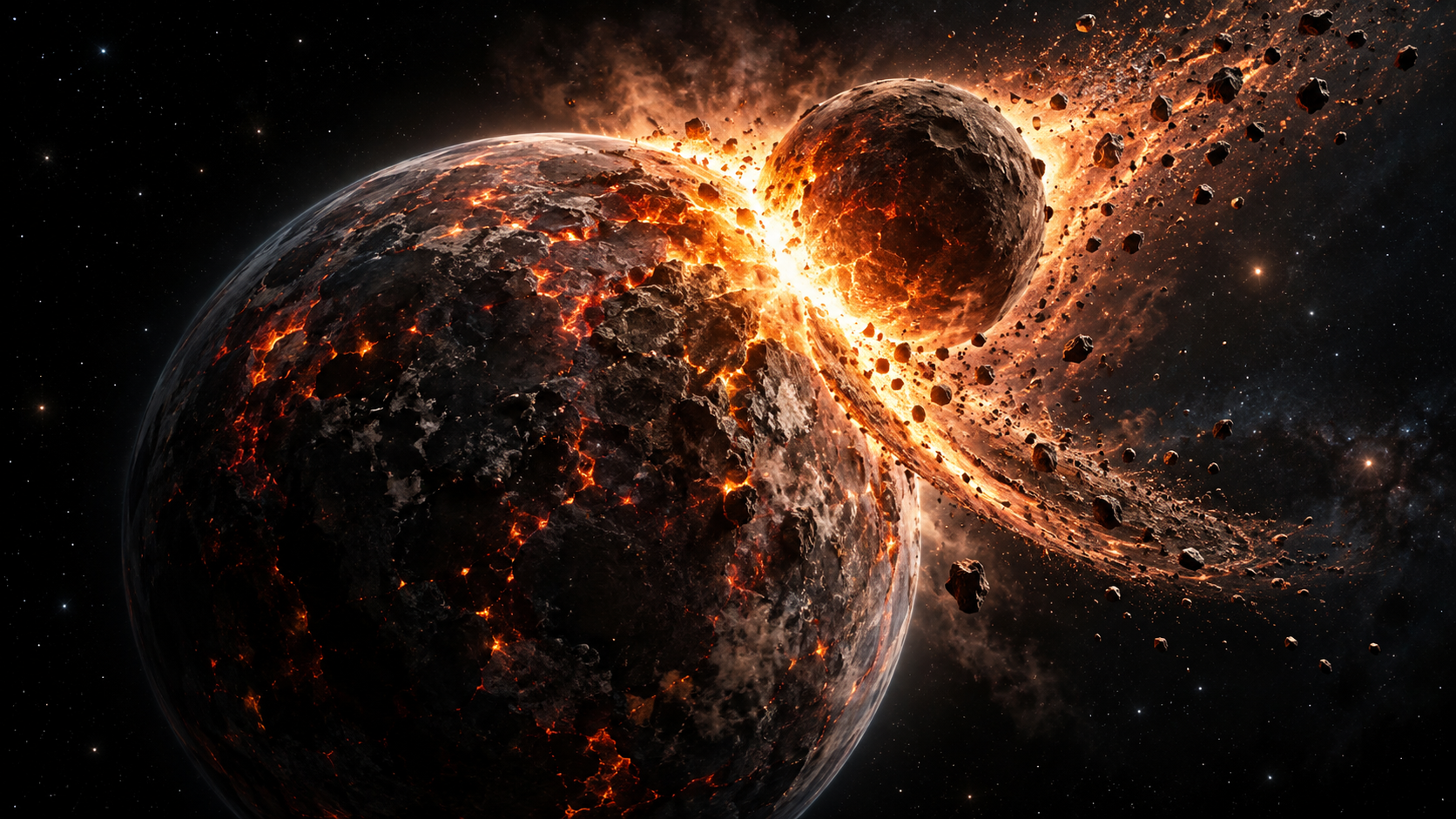
Over 4.5 billion years ago, our solar system was a chaotic place filled with young planets and smaller celestial bodies. Among them was Theia, a Mars-sized planet that collided with the early Earth in a massive impact. This event, known as the Giant Impact Hypothesis, is believed to explain how the Moon was formed. But this collision did more than just create the Moon , it also shaped the Earth into the planet we know today.
The collision with Theia is one of the most important events in Earth’s history. By studying this event, scientists learn about:
- How the Moon formed, and how it stabilizes Earth’s climate and tides.
- How Earth’s structure and resources, like gold and uranium, were influenced by this impact.
- How violent collisions helped shape not just Earth but other planets in our solar system.
This crash tells us about the dramatic events that shaped our world and made it the unique home for life it is today.
In this blog, we’ll cover:
1. The Birth of Theia & the Early Solar System
Chaos in the Early Solar System
Over 4.5 billion years ago, the early solar system was a chaotic and violent place. Planets were forming from swirling clouds of gas, dust, and debris left over from the Sun’s birth. These young, growing planets, called protoplanets, frequently collided with one another as they migrated and pushed for space in the solar system. It was an era of cosmic construction and destruction, where massive impacts played a key role in shaping the planets we see today.
Theia’s Role
In the midst of this cosmic chaos, a protoplanet named Theia emerged. Scientists believe Theia either shared Earth’s orbit or formed close by in the same region of space. As Theia grew, its gravitational pull brought it closer and closer to Earth. This set the stage for one of the most significant events in Earth’s history: a collision that would forever change the planet and lead to the creation of the Moon.
Fun fact: Theia was named after the Greek Titaness Theia, the mother of Selene, the goddess of the Moon, symbolizing its role in the Moon’s creation.
2. The Giant Impact Hypothesis: What Happened?
The Impact Event
Theia collided with the young Earth in a catastrophic event. The collision unleashed an immense amount of energy, equivalent to billions of nuclear explosions, melting vast portions of both Theia and Earth. This violent impact wasn’t just a surface crash , it reshaped Earth’s structure and sent molten material hurtling into space.
Debris and Molten Rock
The force of the collision ejected a massive amount of debris, composed of molten rock and vaporized material from both Theia and Earth. This debris formed a fiery, glowing ring around Earth, much like the rings of Saturn, except it was made of molten rock and dust rather than ice. This ring was temporary, as gravity began to pull the debris together.
Moon Formation
Over the next few million years, the debris merged under the influence of gravity, gradually forming the Moon. Scientists believe this process, known as accretion, explains why the Moon shares a similar isotopic composition to Earth’s mantle. The Moon’s formation stabilized Earth’s rotation, influencing its tilt and creating predictable cycles like tides, which play a vital role in Earth’s climate and the evolution of life.
3. The Evidence Behind the Theory
Isotopic Similarities
One of the strongest pieces of evidence for the Giant Impact Hypothesis lies in the Moon’s composition. Studies show that the Moon’s isotopic chemical fingerprint , is nearly identical to that of Earth’s mantle. This similarity suggests that the Moon was formed from material ejected during the collision, rather than being a captured object from elsewhere in space.
Computer Simulations
Advanced computer simulations of planetary impacts provide further support for this theory. These models recreate the dynamics of a Mars-sized planet like Theia colliding with early Earth. The results closely match what we observe today: a massive debris ring forming around Earth that gradually coalesces into a Moon-sized body. These simulations also explain the Moon’s orbit and its impact on Earth’s rotation and tilt.
Geological Clues
The aftermath of the collision may have profoundly shaped Earth’s interior. Theia’s impact likely enriched Earth’s core with heavy elements such as gold, platinum, and uranium, elements that are rare in the crust but concentrated deep within the planet. This infusion of heavy materials not only influenced Earth’s geological evolution but also contributed to processes like volcanism and tectonic activity that shaped its surface.
4. The Aftermath: How Theia Shaped Earth
Merging Cores
When Theia collided with Earth, parts of its core may have merged with our planet’s core. This merger contributed to Earth’s dense and dynamic core, which powers the planet’s magnetic field. This magnetic shield protects Earth from harmful solar radiation, making it essential for sustaining life. The collision also redistributed materials within Earth, shaping its internal structure and providing the foundation for a geologically active planet.
Fueling Tectonic Activity
The impact from Theia likely delivered heavy elements like uranium and thorium to Earth’s core. These radioactive elements generate heat, fueling Earth’s tectonic and volcanic activity over billions of years. These processes created continents, mountains, and ocean basins, while volcanic eruptions released gases that helped form Earth’s early atmosphere. Without Theia’s contribution, Earth might not have had the same dynamic geology that supports life today.
A Life-Sustaining Planet
One of the most critical outcomes of the collision was the formation of the Moon. The Moon’s gravitational pull stabilizes Earth’s axial tilt, preventing extreme climate swings and creating relatively consistent seasons. Additionally, the Moon’s influence on tides played a role in shaping early ecosystems, aiding the development of life in Earth’s oceans. Without the Moon, Earth’s environment might have been too unstable to support the complex biosphere we see today.
5. Alternative Theories and Unanswered Questions
While the Giant Impact Hypothesis is the leading explanation for the Moon’s formation, other theories have been proposed over the years:
- Fission Hypothesis: This theory suggests the Moon split off from a rapidly spinning Earth. However, it struggles to explain the Moon’s current orbit and composition.
- Capture Hypothesis: This posits that the Moon was a wandering celestial body captured by Earth’s gravity. However, this would require an incredibly precise set of conditions, making it highly unlikely.
- Co-Accretion Hypothesis: This idea suggests the Moon formed alongside Earth from the same disk of dust and gas. Yet, this fails to explain the distinct similarities between the Moon’s composition and Earth’s mantle.
Challenges to the Giant Impact Hypothesis
Although widely accepted, the Giant Impact Hypothesis isn’t without its uncertainties. Some challenges include:
- Isotopic Similarities: While the Moon and Earth share nearly identical isotopic compositions, Theia’s contribution should have left a more distinct chemical signature. Why this similarity exists remains unclear.
- Debris Distribution: Current models of the collision don’t perfectly explain how the debris formed a single, stable Moon. Some researchers suggest that more advanced simulations might provide better answers.
Questions related to Giant Impact Hypothesis
The Giant Impact Hypothesis raises intriguing questions that scientists are still working to answer:
- The Fate of Theia: Did Theia completely merge with Earth, or do fragments of the planet still orbit the Sun? Some speculate that asteroids or distant celestial bodies could hold clues about Theia’s remnants.
- Unique or Common Event?: Was Earth’s collision with Theia a rare, one-of-a-kind event, or did similar impacts shape other planets in the solar system? Understanding this could help us learn more about planetary formation across the universe.
- Exact Timeline: While scientists believe the collision occurred over 4.5 billion years ago, narrowing down the timeline and sequence of events is still a work in progress.
6. Our connection to Theia
The Moon, said to be born from the collision with Theia, has played a critical role in shaping Earth into a life-sustaining planet.
- Stabilizing Earth’s Axis: The Moon’s gravitational pull helps maintain the stability of Earth’s tilt, preventing dramatic shifts that could have caused extreme climate variations.
- Moderating Tides: The Moon’s influence on Earth’s oceans has created predictable tidal patterns, which may have been crucial for early marine life and the evolution of coastal ecosystems.
- A Habitable Climate: By stabilizing the planet’s rotation, the Moon has contributed to the relatively mild and stable climate that supports life on Earth.
- Heavy Elements: Theia’s core likely merged with Earth’s, delivering essential elements such as gold, platinum, and uranium. These materials play critical roles in Earth’s tectonic activity, magnetic field, and technological advancements.
- Volcanic Activity: Theia’s impact may have kickstarted Earth’s long-term volcanic activity, which has shaped its surface and provided essential gases for the formation of the atmosphere.
- Cosmos: The formation of the Moon and the enrichment of Earth’s core are proof to how interconnected celestial events shape planetary systems.
Conclusion
The collision with Theia reshaped Earth and made it the life-sustaining planet we know today. The Giant Impact Hypothesis not only explains the Moon’s formation but also highlights how celestial events shaped Earth’s geology and climate.
The Moon’s gravitational pull stabilizes Earth’s tilt, moderates tides, and supports a stable climate, all crucial for life. Theia’s impact also enriched Earth with heavy elements like gold and uranium, fueling tectonic activity and creating a dynamic planet.
While much has been learned, questions remain, what happened to Theia, and did similar events shape other planets?
Sometimes, it takes chaos to shape a masterpiece.