Introduction
The doors slide open in Mumbai, Minneapolis, or Madrid, and you recognize the place before you have even found reception.
There is that smell.
Sharp, clean, faintly sweet, with the unmistakable sting of alcohol somewhere underneath. It may be stronger near a nurses’ station and almost disappear in a lobby, but the basic impression is strangely familiar.
Hospitals do not literally smell identical. Still, the resemblance is not imaginary.
Inside a hospital, dozens of chemicals are constantly entering the air. Alcohol evaporates from hand sanitizer. Cleaning products leave traces behind on freshly wiped surfaces. Medicines, disinfectants, building materials, medical procedures, and even the people moving through the building add their own odors.
A study of a large French teaching hospital measured more than 40 volatile organic compounds in its indoor air. Alcohols were among the most dominant, especially ethanol and isopropanol, alongside acetone, ethers, fragrances, and compounds associated with cleaning and medical activity.
That explains part of the smell.
But chemistry alone does not explain why it feels so recognizable.
For one person, the smell of disinfectant can suggest cleanliness and safety. For another, exactly the same smell can bring back an operation, a frightening diagnosis, or hours spent waiting beside someone who was ill. Someone entering from outside may notice the odor immediately, while a nurse working a long shift may barely register it.
Hospital smell is therefore more than a mixture of chemicals. It is also something shaped by memory, repetition, expectation, and experience.
So this blog follows three questions.
What exactly are we smelling?
Why can hospitals thousands of miles apart smell so strangely similar?
And why can the same odor make one person feel reassured while making another uncomfortable before a doctor has even spoken?
The first question turns out to have a surprisingly measurable answer.
In this blog, we’ll cover:
1. What Exactly Are You Smelling?
There is no single chemical responsible for “hospital smell.”
What reaches your nose is a constantly changing mixture produced by hand sanitizer, disinfectants, cleaning products, medicines, medical procedures, building materials, and people.
But if we had to begin with one ingredient, alcohol would be the obvious place.
1.1 Why Does Hospital Air Smell Like Alcohol?
In March 2012, researchers sampled the air inside a 1,952-bed teaching hospital in Rennes, France.
They did not limit themselves to an operating room or laboratory. They sampled six very different parts of the hospital: the reception hall, a patient room, a nursing area, a parasitology and mycology laboratory, a post-anesthesia care unit, and an endoscope-disinfection unit.
The results showed just how strongly alcohol shapes hospital air.
Ethanol was by far the most abundant compound they measured, averaging about 928 micrograms per cubic meter. Isopropanol averaged about 48 micrograms per cubic meter. At its highest measured point, ethanol reached roughly 3,956 micrograms per cubic meter.
Those numbers are easier to understand when you think about what happens inside a hospital all day.
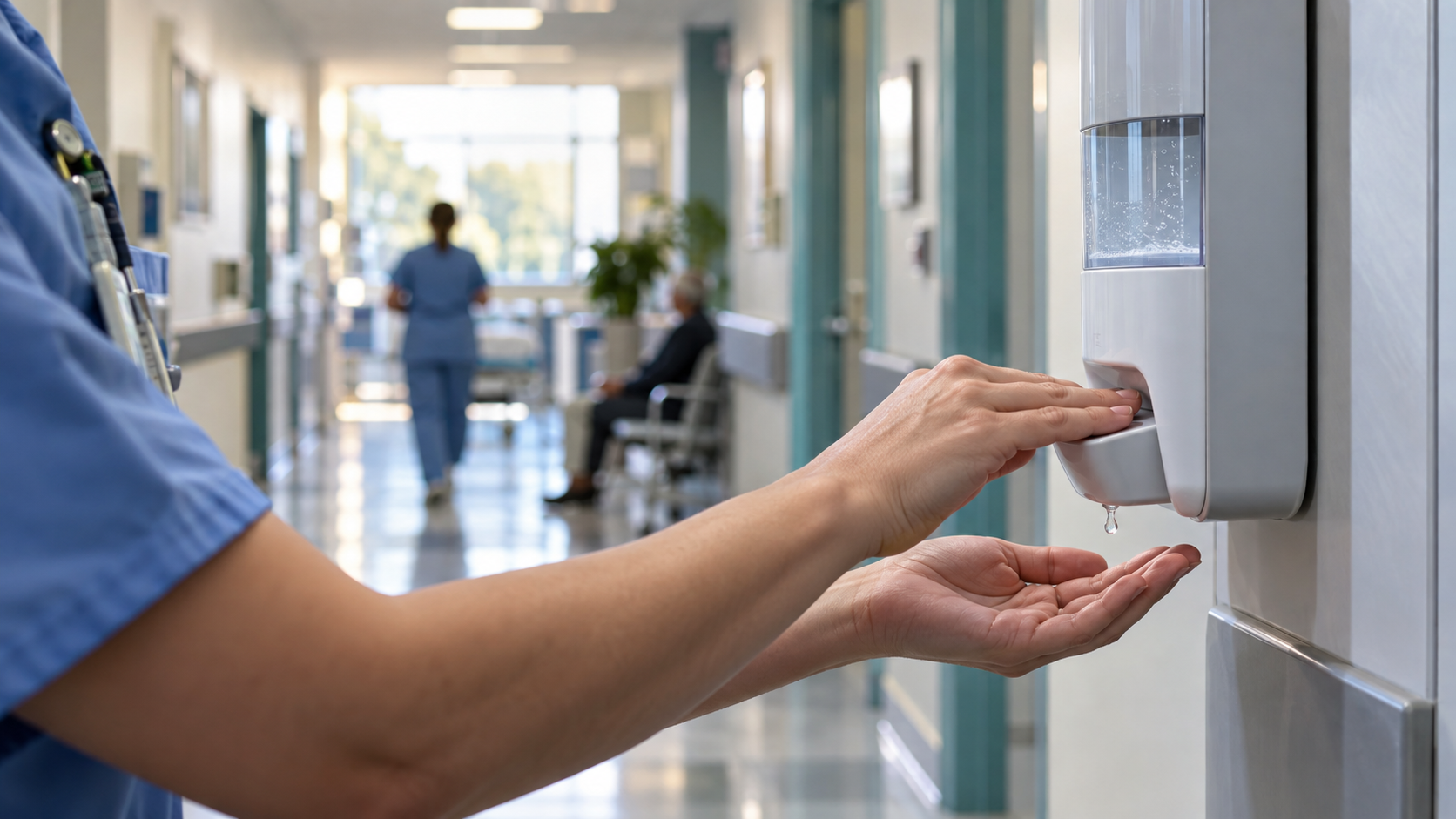
A nurse presses a sanitizer dispenser.
A doctor rubs alcohol across both hands.
A technician cleans their hands before moving to the next task.
Within seconds, some of that alcohol begins evaporating into the surrounding air.
One use contributes very little. But hospitals repeat that action hundreds or thousands of times across patient rooms, corridors, nursing stations, laboratories, and treatment areas.
The researchers also found that alcohol concentrations changed considerably over time. Their explanation was straightforward: the levels followed the intensive use of alcohol-based hand rubs.
In other words, part of the hospital smell is simply hygiene becoming airborne.
1.2 What Makes Up the Rest of the “Clean” Smell?
Alcohol is only the loudest part of the mixture.
Hospitals also rely on several other families of cleaning and disinfecting chemicals, including chlorine compounds, phenolics, and quaternary ammonium compounds.
The French study detected a much wider mixture in the air, including acetone, aldehydes, ethers, hydrocarbons, and terpenes.
One of the more familiar compounds was limonene.
Limonene is associated with a citrus-like scent and is commonly used in fragranced cleaning products. Its presence offered a useful clue about how quickly the smell of a hospital can change.
In the post-anesthesia care unit, researchers measured limonene at around 30 micrograms per cubic meter during periods when surfaces were being cleaned and disinfected. Outside those cleaning periods, it was not consistently detected there.
So that faint citrus note you sometimes notice in a freshly cleaned corridor may not be part of the hospital’s permanent smell at all.
It can appear when someone starts cleaning and fade again afterward.
That means the smell of “clean” is not fixed. It changes through the day as people sanitize their hands, wipe surfaces, disinfect equipment, and move through different routines.
1.3 What Is Hiding Underneath the Disinfectant?
Not everything in hospital air comes from cleaning.
Researchers also detected anesthetic gases.
Sevoflurane and desflurane appeared in the post-anesthesia care unit, which was hardly surprising. These gases are used during surgery, so traces around recovering patients make sense.
More interestingly, sevoflurane was also detected in a regular patient room.
The researchers suggested a simple explanation. Patients who had recently undergone surgery may have continued exhaling small amounts of anesthetic after leaving post-operative care.
Then there are the smells produced by people themselves.
A later study of hospital waiting areas surveyed 258 participants about the odors they noticed around them. Researchers identified nine main categories: alcohol, disinfectants, drugs, food, human-body odors, a fishy smell, dust, tobacco, and gasoline.
The three most prominent were drugs, disinfectants, and human bodies.
That gives us a better way to understand the famous hospital smell.
It is not one scent sprayed through the ventilation system.
It is an overlap.
Evaporating hand sanitizer. Freshly cleaned surfaces. Medicines. Traces of medical procedures. Building materials. Human bodies. Air moving all of them through the same space.
Your nose receives that complicated mixture at once.
It does not identify ethanol, limonene, acetone, disinfectant, medicine, and anesthetic one by one.
It gives the whole mixture a simpler name.
Hospital.
2. Does the Lobby Smell Like the ICU?
You might expect the strongest hospital smell to stay close to operating rooms, patient wards, and treatment areas.
But hospital air does not respect those boundaries.
In the French teaching hospital study, researchers deliberately sampled very different spaces, from a post-anesthesia care unit to the main reception hall. What they found suggests that the familiar smell of a hospital belongs partly to the building as a whole, not just to rooms where medicine is being practiced.
2.1 Why Does the Smell Reach Places With No Patients?
The reception hall was chosen as the comparison site because no direct healthcare activities were taking place there. In theory, it should have provided a relatively clean baseline against which the clinical areas could be measured.
Instead, its overall chemical profile was not significantly different from the hospital’s other sampling locations.
That does not mean every room contained exactly the same chemicals at exactly the same levels. Some compounds were clearly connected to particular activities. Anesthetic gases, for example, were more closely associated with surgical care.
But many of the compounds responsible for the broader hospital smell were not confined to one ward.
Alcohol-based hand rubs are used throughout the building. Cleaning products are used in public as well as clinical spaces. Air circulates through corridors and ventilation systems. Staff, patients, and visitors constantly move between rooms.
So the smell you notice near the front entrance does not necessarily have to travel all the way from an ICU.
Some of it is already being created there.
2.2 Why Does the Smell Change by the Hour?
Hospital smell is also not chemically frozen in place.
The researchers found substantial changes in alcohol concentrations between sampling periods. Their likely explanation was the repeated use of alcohol-based hand rubs.
That means the smell can follow activity more closely than architecture.
A burst of hand-sanitizer use can temporarily add more alcohol to the air. Cleaning a surface can introduce another set of compounds. As those chemicals evaporate and disperse, their concentrations fall again.
So two visits to the same corridor may not smell exactly alike.
The room has not changed.
What people are doing inside it has.
3. When Hospitals Smelled of Death
Today, a sharp chemical smell can make a hospital seem clean.
For much of medical history, smell carried almost the opposite message.
Before modern infection control, hospitals had to contend with infected wounds, decaying tissue, bodily fluids, and conditions such as hospital gangrene. Physicians could see that foul-smelling environments were often associated with sickness and death.
What they could not yet see were the microorganisms involved.
So for many doctors, the smell itself became part of the explanation.
3.1 What Did Hospitals Smell Like Before Disinfectant?
Before germ theory became established, one of the most influential explanations for disease was the theory of miasma.
Miasma meant harmful or polluted air. Foul odors from sewage, rotting matter, infected wounds, and crowded environments were believed to carry disease.
From a nineteenth-century perspective, this was not an absurd observation. Disease often did appear where sanitation was poor, and those places often smelled terrible.
The mistake was confusing a warning sign with the cause.
For doctors working before microorganisms were understood, bad air was not simply unpleasant.
It could be dangerous.
3.2 How Did a Doctor Use His Nose as a Lab Test?
In the 1840s, Ignaz Semmelweis noticed something disturbing at Vienna General Hospital.
The maternity ward staffed by physicians had a mortality rate about three times higher than the ward staffed by midwives.
That difference was difficult to explain through miasma alone. The women were giving birth in the same hospital and living under broadly similar conditions, yet their chances of dying were dramatically different.
Then, in 1847, Semmelweis’s colleague Jakob Kolletschka died after being accidentally cut during an autopsy. The illness and bodily changes resembled those seen in women dying from childbed fever.
Semmelweis began to suspect that physicians were carrying something from corpses to living patients.
He did not know about bacteria in the modern sense, so he could not identify exactly what that “something” was.
Instead, one of his clues was smell.
After trying other washing methods, Semmelweis turned to chlorinated lime, a substance also used at the time for purposes such as whitening paper and cleaning stables. He found that it removed the lingering odor of cadaveric material from doctors’ hands.
To Semmelweis, removing the smell suggested that the dangerous material, which he thought of as a kind of poison, had also been removed.
He required doctors and medical students to disinfect their hands before examining patients.
The change was extraordinary. In 1848, mortality in his ward fell from 18.27 percent to 1.27 percent.
Yet his explanation met resistance. Semmelweis was dismissed from his position at Vienna General Hospital in 1849, years before germ theory gained broad acceptance. He died in 1865 after being committed to an asylum.
He had no microscope result proving what was on a doctor’s hands.
But smell had helped point him toward the problem.
3.3 Why Did Lister Turn to a Chemical Used on Sewage?
A few decades later, Joseph Lister approached infection with a new advantage.
Louis Pasteur’s work was helping establish that microorganisms could cause putrefaction. Lister began asking whether wounds could be protected from those organisms.
One chemical caught his attention: carbolic acid, now called phenol.
Carbolic preparations were already being used to control putrefaction and offensive odors in sewage. During the nineteenth century, including the period around London’s notorious Great Stink of 1858, chemical deodorization had become part of attempts to deal with foul-smelling waste.
Lister learned about carbolic acid being used in sewage treatment and began experimenting with it on surgical wounds.
By the 1860s, he was applying carbolic acid to wounds and dressings. His antiseptic system later extended to instruments, hands, and the operating environment.
Eventually came one of the most recognizable images of early antiseptic surgery: the carbolic spray.
The device released a fine mist of phenol around the operating area. Contemporary descriptions recalled a yellow haze and a strong, sickly sweet, tar-like odor.
The operating room was beginning to acquire a new smell.
Not the smell of decay, but the smell of chemicals fighting it.
3.4 How Did a Side Effect Become a Symbol?
The smell itself was never the medicine.
Carbolic acid worked because of its antiseptic properties. Chlorinated lime mattered because it reduced contamination. The chemical odor was simply something that accompanied those practices.
But people experience medicine through their senses as well as through science.
For generations, foul smells had signaled decay, dirty air, and danger. Antiseptic medicine gradually introduced a different sensory pattern. Strong chemical odors began appearing wherever doctors were actively trying to prevent infection.
Over time, the association changed.
A chemical smell could suggest that a surface had been disinfected, that hands had been cleaned, or that a room had been prepared for medical care.
The modern “hospital smell” was never deliberately invented.
It grew out of the fight against the smells that came before it.
4. Why Mumbai and Minneapolis Smell Alike
Hospitals in different countries may use different brands, suppliers, and cleaning routines, but modern infection control has pushed many of them toward the same basic chemistry.
That is one reason a hospital thousands of miles from home can still smell oddly familiar.
4.1 Who Wrote the Global Rulebook?
Once germ theory changed medicine’s understanding of infection, hygiene became something that could be standardized.
Organizations such as the World Health Organization and national public-health agencies developed guidance for hand hygiene, disinfection, sterilization, and infection control. Hospitals did not all begin using one identical product, but they increasingly relied on the same families of chemicals.
Alcohol became especially important for hand hygiene.
That matters to smell because ethanol and isopropyl alcohol evaporate quickly. When the same basic chemicals are used across healthcare systems, they create one of the few sensory features that hospitals around the world can share.
4.2 What Is the WHO “Recipe”?
The WHO took standardization one step further by publishing two recommended formulas for locally produced alcohol-based hand rub.
Formulation 1 is ethanol-based. Formulation 2 uses isopropyl alcohol.
The idea was practical. A hospital or healthcare system that could not reliably buy commercial sanitizer could produce an effective hand rub locally using a standardized formula and commonly available ingredients.
A 2026 review by Hiroki Saito and colleagues shows how far that approach traveled. The researchers examined 31 studies from 19 countries covering locally produced hand rub between 2006 and 2023.
Of the 22 studies involving production inside healthcare facilities, 12, about 55 percent, used WHO’s ethanol-based Formulation 1 or a modified version of it.
Different country. Different hospital. Very similar alcohol evaporating into the air.
4.3 Did COVID Make Hospitals Smell More Alike?
COVID-19 accelerated the pattern.
Eighteen of the 31 studies in the review, about 58 percent, were connected to the pandemic. Hospitals suddenly needed far more hand sanitizer at the same time that global supply chains were under pressure.
Local production became a practical solution.
That does not mean COVID made every hospital smell identical. But it did push healthcare facilities in many countries toward the same standardized alcohol formulas at roughly the same moment.
A global health emergency produced, among many more important consequences, a small sensory one as well.
5. So Why Isn’t It Identical Everywhere?
If hospitals are drawing from the same infection-control playbook, why can one still smell different from another?
Because standards travel, but ingredients and habits remain local.
5.1 What Local Notes Sneak In?
The Saito review contains some surprisingly specific examples.
An Indian formulation modified the WHO recipe with rose extract. A hospital-produced gel in El Salvador used 62 percent ethanol with an added citrus aroma. Another Indian formulation combined isopropyl alcohol with herbal extracts that included neem, lemon, ginger, and tulsi.
Even the alcohol itself could have a local origin.
A project in Mali produced ethanol from sugar cane for a WHO-style hand rub. The review also described a Ugandan product made with locally sourced sugar-cane ethanol.
These differences are small compared with the basic disinfecting chemistry, but smell is extremely sensitive to small additions.
Two hospitals may both use alcohol-based sanitizer while one carries a citrus note, another a floral one, and another mostly smells like plain ethanol.
The global recipe develops a local accent.
5.2 How Do Everyday Products Shape the Smell?
The boundary between a medical product and an everyday hygiene product can also vary by country.
During the COVID-19 pandemic, for example, researchers in Turkey examined commercial colognes because many contained substantial amounts of ethanol. The products tested ranged widely in alcohol content, from about 38 to 99 percent by weight.
A familiar household fragrance could suddenly overlap with the smell of infection control.
This is why “hospital smell” is better understood as a family of related smells rather than one universal formula.
5.3 Has Anyone Actually Studied the Smell?
Surprisingly little research has asked whether people actually like how these products smell.
Of the 31 studies in Saito’s review, 12 evaluated some kind of sensory or user characteristic, such as appearance, skin feel, texture, or smell.
Only six evaluated smell itself.
That is a useful limit to keep in mind. We know quite a bit about what goes into hospital air. We know much less about how those ingredients combine into the smell people remember.
6. The One-Synapse Shortcut
Chemistry explains what enters the nose.
It does not explain why that smell can suddenly bring back a hospital room from ten years ago.
For that, we have to follow the signal into the brain.
6.1 Why Does Smell Hit Emotion So Quickly?
Smell has an unusually direct relationship with brain regions involved in emotion and memory.
Odor molecules activate receptor neurons in the nose, which send signals into the olfactory bulb. From there, neurons project directly to several brain regions, including parts of the amygdala, which helps process emotional significance.
This is the basis of the popular “one-synapse shortcut” description. More precisely, the olfactory bulb has direct, monosynaptic connections with parts of the amygdala. The smell receptors themselves first connect with neurons in the bulb.
The important point is that olfaction is wired differently from senses such as vision and hearing. Smell does not depend on the same initial thalamic relay before reaching its primary cortical targets.
That gives odor an unusually close route into systems involved in emotion.
And once emotion enters the picture, memory is not far behind.
6.2 Why Do Smell Memories Feel So Vivid?
Rachel Herz and colleagues tested this connection using brain imaging.
In a small fMRI study, five women were presented with odors and visual cues connected to personally meaningful memories. When a significant memory was triggered by its odor, activity in the amygdala and hippocampal region was stronger than for the other cues.
The emotional response was also strongest for the personally meaningful smell.
This fits a larger body of research showing that odor-evoked autobiographical memories often feel unusually emotional and can produce a strong sense of being transported back to the original event.
That experience is sometimes called the “Proust effect,” after Marcel Proust’s famous description of memories returning through the taste and aroma of a madeleine dipped in tea.
The smell does not necessarily make the memory more accurate.
It can make remembering feel more immediate.
6.3 Why Do Smell Memories Show Up Uninvited?
Another experiment shows how quickly this can happen.
Mohamad El Haj and colleagues asked 28 people with mild Alzheimer’s disease and 30 healthy controls to retrieve personal memories under three conditions: with an odor, with music, or without either cue.
For the healthy control group, memories appeared after an average of about 7.4 seconds following an odor. Without a sensory cue, the average was about 20.3 seconds.
The same pattern appeared in the Alzheimer’s group, about 14.5 seconds with odor compared with 31.1 seconds in the control condition.
The researchers also found evidence that ordinary deliberate retrieval relied more on executive control, while odor-cued retrieval did not show the same relationship.
Sometimes a smell does not ask you to search your memory.
It seems to open the memory for you.
7. Why the Same Smell Brings Dread or Calm
This is where hospital smell becomes personal.
The molecules entering two people’s noses can be identical. Their reactions do not have to be.
A smell acquires meaning partly through what has happened around it before.
7.1 What Did the Clove-Oil Experiment Show?
Dental offices provide one of the clearest examples.
Eugenol is a compound found in clove oil and has long been used in dental materials. It also produces a distinctive smell that can linger in a dental office.
In 1999, researchers Olivier Robin and colleagues tested whether that smell produced different emotional reactions depending on people’s previous experiences with dental care.
Participants were divided into fearful and non-fearful dental groups. They smelled eugenol along with two control odors, pleasant-smelling vanillin and unpleasant-smelling propionic acid.
The researchers also recorded six measures of the autonomic nervous system, including electrodermal, cardiovascular, and respiratory responses. Those patterns were then classified according to six basic emotion categories.
The split appeared specifically with eugenol.
Participants without dental fear rated it as pleasant, and their physiological patterns were mainly associated with happiness and surprise. Fearful participants rated exactly the same odor as unpleasant, with patterns more closely associated with fear, anger, and disgust.
The control odors did not produce the same difference between the two groups.
Nothing about the eugenol molecule had changed.
What changed was the history attached to it.
7.2 Can Anxiety Change the Smell Itself?
Past experience is not the only factor. Your emotional state in the present can alter odor perception too.
In a 2013 fMRI experiment, researchers induced anxiety in participants and then examined how they processed odors that had initially been rated as neutral.
After anxiety increased, those neutral smells were judged as more unpleasant and took longer to detect.
The brain’s response changed as well. Activity increased in areas involved in olfactory and emotional processing, and functional connections between the amygdala and the olfactory system became stronger.
The researchers were not showing that anxiety physically changed the odor.
They were showing something more subtle: anxiety changed how the brain processed the same sensory information.
7.3 Why Do Patients Sometimes Experience the Smell More Negatively?
The hospital waiting-room research found a similar pattern outside the laboratory.
Participants who reported poorer health perceived odors as more concentrated while also reporting lower comfort and preference. Patients and their companions, overall, also responded more negatively to the waiting-room smell than some other people in the facility.
That makes sense in context.
A disinfectant odor can mean “clean” when you are simply walking through a building.
When you are waiting for a diagnosis, treatment, or someone you care about, the same smell arrives with much more attached to it.
8. Does the Smell Change What You Do?
Smell does more than trigger memories.
Sometimes, it can quietly influence what people think about and how they behave, even when they are not consciously paying attention to the odor.
That makes the hospital smell interesting for another reason. It may not simply tell us that a place is clean. It may help create the expectation of cleanliness.
8.1 Can a Cleaner’s Scent Make You Tidier?
In 2005, researchers Rob Holland, Merel Hendriks, and Henk Aarts tested what happened when people were exposed to the smell of a citrus-scented cleaning product without being told why it was there.
Across three experiments, the scent made cleaning-related ideas easier to bring to mind.
But the most interesting result involved behavior.
During an eating task, participants exposed to the cleaner scent kept their immediate surroundings cleaner than participants who had not been exposed to it.
Afterward, checks showed that they were unaware that the smell had influenced them.
The experiment was not conducted in a hospital, so it cannot tell us that disinfectant automatically makes hospital visitors behave differently.
What it does show is that a familiar cleaning odor can carry learned meaning strongly enough to influence behavior without becoming the focus of our attention.
Sometimes the nose is participating before we realize it.
8.2 Why Does “Clean” Smell Like Trust?
Hospital waiting-room research suggests that context matters just as much as the odor itself.
Visitors generally tolerated smells such as disinfectants and medicines because they seemed appropriate for a hospital. Disinfectant could even signal cleanliness.
But there was a limit.
As the concentration of odors increased, comfort and preference tended to decrease. Strong disinfectant smells and human-body odors were associated with more negative reactions.
So the relationship is not simply “more disinfectant smell equals more trust.”
A faint chemical note can fit our idea of a clean hospital.
Too much of it can become another source of discomfort.
9. Why Nurses Stop Smelling It
Walk into a hospital after spending the day outside and the smell may seem immediate.
Stay there long enough, and something changes.
The chemicals may still be in the air. Your brain and sensory system simply stop treating them as new information.
This process is called olfactory adaptation.
9.1 How Fast Does the Nose Tune Out a Smell?
It can begin remarkably quickly.
In laboratory experiments, Pamela Dalton and Charles Wysocki asked participants to repeatedly smell one of two test odors.
The perceived intensity dropped rapidly.
For both test substances, adaptation reached a stable level after only about 15 seconds of continued exposure.
Once the odor was removed, this short-term effect disappeared quickly, with perception recovering within a few minutes.
That is the fast version of adaptation.
Living or working around the same smell every day produces something much more persistent.
9.2 What Happens After Weeks of Exposure?
Dalton and Wysocki then moved the experiment into people’s homes.
Participants lived with one of two fragrances continuously for two weeks while researchers measured how sensitive they remained to it.
The change was easy to notice.
During the first week, participants reported being able to smell the fragrance for as long as an hour after entering the room.
By the second week, some noticed it for only about 15 minutes. Most reported that it disappeared from awareness after just one or two minutes.
The odor itself had not disappeared.
Visitors who had not been living with it still noticed it readily.
The amount of exposure also mattered. Five participants who spent more than 70 hours a week around the odor showed significant adaptation after only one week. People with less exposure generally needed two weeks before the same pattern became significant.
One of the test odors was commonly described as piney, woody, medicinal, heavy, and, importantly, “disinfectant.”
The study did not test nurses or hospital workers directly.
But it helps explain a familiar experience in hospitals. Someone entering the building may immediately notice the chemical smell, while a person who spends long shifts surrounded by it may barely register that it is there.
9.3 Why Does It Take So Long to Come Back?
Long-term adaptation also did not disappear immediately when exposure stopped.
One week after the home fragrance was removed, only two of the eight participants had completely recovered their previous sensitivity.
After two weeks, four had recovered fully or beyond their original baseline. Three still had not fully recovered, and one had shown no recovery.
Half the group, in other words, had still not returned to their original level of sensitivity after two weeks without regular exposure.
The researchers also mentioned preliminary follow-up work suggesting that full recovery could sometimes take as long as four weeks.
The nose can adapt quickly.
After prolonged exposure, however, it may take much longer to completely reset.
10. The Memory Smells Stronger Than the Room
There is an odd contradiction at the center of hospital smell.
People often describe it as unforgettable.
Yet when researchers talk to people actually inside hospitals, the smell can be surprisingly absent from their descriptions.
10.1 Stenslund’s Puzzle
Research discussed by healthcare historian Anette Stenslund highlights this contradiction.
People can have vivid memories of “hospital smell,” sometimes years after an experience.
But when Stenslund spoke with patients while they were actually inside hospital environments, many seemed barely aware of the smell around them.
That does not necessarily mean their memories were false.
Several things may be happening at once.
Adaptation can reduce awareness during long exposure. Patients may also have more urgent things demanding their attention, such as pain, treatment, waiting, or conversations with staff.
Later, however, smell can become one of the details that represents the whole experience.
The odor may become clearer in memory than it ever felt in the room.
10.2 Is Hospital Smell Partly Imagined?
“Imagined” is probably the wrong word.
The chemicals are real.
But what we call “hospital smell” is more than a chemical measurement.
Researchers writing about the sensory history of healthcare describe it as both an embodied experience and a symbolic construction. There can be a gap between the chemicals actually present, what someone notices at the time, and what they later remember.
Even the word “chemical” carries its own sensory meaning. One proposed system for classifying odors includes “chemical” among ten broad smell categories, alongside categories such as floral and citrus.
So hospital smell exists in two places at once.
It is in the air.
And it is in what we have learned that the air means.
11. Is the Smell Good for Anyone?
By now, the hospital smell has acquired two very different roles.
It can signal cleanliness and safety.
It can also cause discomfort, revive unpleasant memories, or simply become overwhelming.
That raises a practical question. Should hospitals keep smelling this way?
11.1 Is Hospital Air Safe to Breathe?
The French hospital study offers some reassurance, with an important limitation.
For every compound the researchers measured, concentrations were below levels known to be harmful to humans.
But the researchers were cautious about treating that as the end of the question.
Hospital air did not contain one chemical in isolation. It contained a complicated mixture of alcohols, ketones, aldehydes, hydrocarbons, terpenes, anesthetic gases, and other volatile compounds.
Healthcare workers may breathe that mixture repeatedly for years.
The study therefore called for more research into long-term exposure to combinations of chemicals rather than looking only at one compound at a time.
So the findings were reassuring about the concentrations measured in that hospital.
They were not a declaration that every hospital atmosphere, under every condition, is automatically harmless.
11.2 Can Hospitals Design a Better Smell?
Some hospitals have already experimented with the idea.
Healthcare environments have tried reducing unwanted odors, distributing preferred fragrances through airflow systems, and placing plants in waiting areas.
Researchers have also investigated whether pleasant scents can reduce anxiety in medical settings. Work cited in research on healthcare environments found that orange essential oil had a positive effect on anxiety in dental offices.
But replacing disinfectant smell with another fragrance creates its own questions.
Would lavender, citrus, or flowers make everyone more comfortable?
Probably not.
A scent that relaxes one person may annoy another. Fragrance can also acquire its own associations through experience, just as disinfectant does.
That suggests the goal may not be to create a hospital that smells “nice.”
A better goal may be to understand smell as part of healthcare design in the first place.
We already design hospitals around what people see, hear, touch, and navigate.
The nose belongs in that conversation too.
12. What the Hospital Smell Teaches
The strange thing about hospital smell is that nobody appears to have designed it as a signature.
It emerged.
Alcohol evaporated from cleaned hands. Disinfectants replaced the odors of contamination. Standardized hygiene practices spread across countries. Patients and visitors attached memories to those chemicals. Staff gradually stopped noticing them.
Over time, the side effect became part of the identity of the place.
Three ideas stand out.
First, a sensory identity does not always have to be intentionally designed. Hospitals became recognizable partly through the repeated chemistry of keeping people safe.
Second, the meaning of a smell does not live entirely inside the molecule. Eugenol can feel pleasant to one person and frightening to another. Disinfectant can suggest cleanliness, illness, safety, or loss depending on what someone has experienced around it.
And third, buildings are experienced with more than the eyes.
Architects and healthcare designers think carefully about lighting, color, acoustics, materials, signage, and movement. Smell is usually less visible in that process, but it can influence comfort, memory, attention, and how a space is interpreted.
The smell of a hospital began as chemistry.
What made it recognizable was everything humans attached to it.
Conclusion
The hospital smell feels universal because much of modern medicine is built on repeated routines: sanitized hands, disinfected surfaces, standardized cleaning, and chemicals chosen to control infection.
But the smell itself was never designed as a brand.
It emerged from practice.
Over time, alcohol, disinfectants, medicines, cleaning agents, and human presence blended into something people could recognize almost instantly. Then memory added another layer. The same scent could come to mean safety, fear, waiting, recovery, loss, or relief depending on what happened around it.
That is what makes hospital smell so unusual. It is both physical and personal, measurable in the air but interpreted through experience.
Medicine did not invent a signature scent on purpose.
It created one by repeating the work of cleanliness until the air itself became recognizable.
What we call the hospital smell is really the residue of thousands of small attempts to make a dangerous place safer.