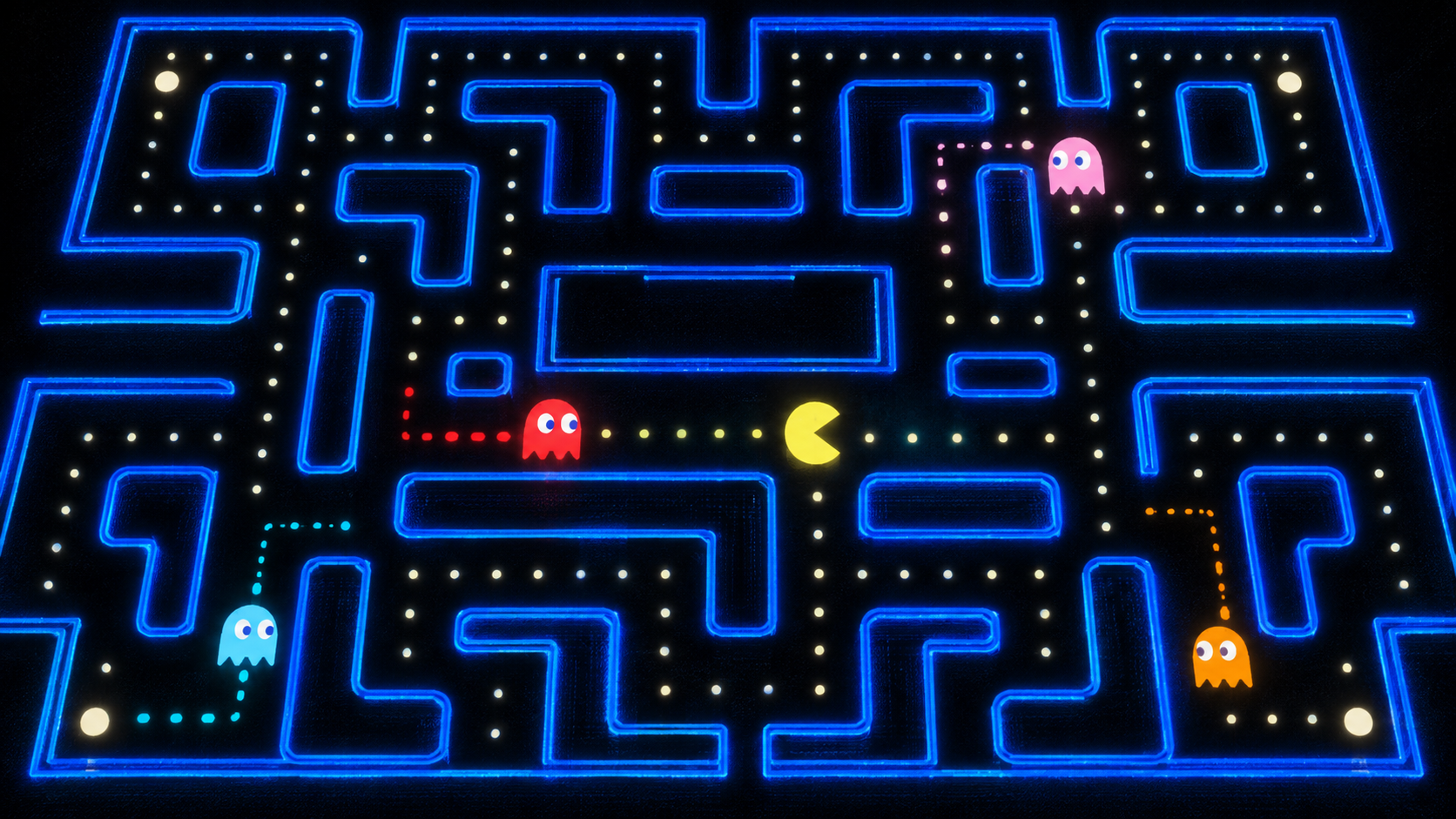
Pac-Man, launched by Namco in 1980, is an arcade classic that redefined the gaming landscape with its innovative gameplay and widespread cultural impact. Unlike many games of its time, which were centered around violence or sports, Pac-Man introduced a colorful, universally appealing design that attracted players of all ages and genders. Beyond its engaging mechanics, a key element of its success was the sophisticated AI governing the four ghosts. Their distinct personalities and strategies created a dynamic challenge that continues to captivate gamers.
Pac-Man’s ghost AI marked a milestone in gaming history, demonstrating how artificial intelligence could elevate gameplay and enhance user experience. The simplicity of its algorithms, combined with their profound impact, paved the way for future advancements in NPC (non-player character) behavior. By exploring the intricacies of Pac-Man’s AI, we gain insight into the origins of intelligent design in games and how it has shaped the industry.
In this blog, we’ll cover:
1. Origins and Foundation of Pac-Man AI
The Birth of Pac-Man (1980)
Pac-Man was the brainchild of Japanese game designer Toru Iwatani, who sought to create a game that broke away from the violence-centric themes dominating arcades at the time. Released by Namco in 1980, Pac-Man was envisioned as a game that could appeal to a wider audience, including women and families. Iwatani was inspired by the universal love of food and eating, which is why the game centered around a character munching through dots in a maze. The addition of the four ghosts introduced dynamic challenges, elevating the game beyond a simple “eat-and-avoid” premise.
Breaking Gaming Norms
When Pac-Man launched, the arcade gaming landscape was saturated with space shooters like Space Invaders and Asteroids. These games catered primarily to male players and revolved around themes of destruction. Pac-Man’s introduction of bright colors, simple controls, and non-violent gameplay was a stark departure. This unique approach not only attracted a broader audience but also demonstrated that gaming could be more than just a test of reflexes — it could also be fun, strategic, and inclusive.
The Concept of Ghost Personalities
One of Iwatani’s most groundbreaking decisions was to give the ghosts distinct behaviors and personalities. Unlike enemies in other games, which often followed random or linear patterns, Pac-Man’s ghosts were programmed with specific AI logic:
- Blinky (Red): The aggressive chaser who relentlessly follows Pac-Man.
- Pinky (Pink): The ambusher who anticipates Pac-Man’s movements.
- Inky (Cyan): The unpredictable wildcard whose path is influenced by both Pac-Man’s and Blinky’s positions.
- Clyde (Orange): The quirky ghost who alternates between chasing Pac-Man and wandering aimlessly.
This innovation gave each ghost a unique role, forcing players to adapt their strategies based on which ghosts were nearby. It also imbued the game with a level of depth and replayability unmatched by its contemporaries.
By combining a fresh premise with innovative AI, Iwatani crafted a game that was not only entertaining but also timeless, setting a new benchmark for creativity in game design.
2. The Four Ghosts: Personalities and Behaviors
The brilliance of Pac-Man lies not only in its maze design and gameplay but also in the distinct personalities and behaviors of its four ghostly antagonists. Each ghost is programmed with unique AI, creating a dynamic challenge that has captivated players for decades.
Blinky (Red Ghost): The Persistent Chaser
AI Programming: Blinky is the most aggressive of the ghosts, programmed to chase Pac-Man directly. His path is determined by Pac-Man’s current position, making him the most predictable yet relentless threat.
“Cruise Elroy” State: As the player consumes more dots in the maze, Blinky’s speed increases, entering a state nicknamed “Cruise Elroy.” This escalation heightens the tension, forcing players to act quickly and strategically.
Gameplay Impact: Blinky’s persistence often drives players into making hasty decisions, leading them into more challenging scenarios.
Pinky (Pink Ghost): The Strategic Ambusher
AI Programming: Unlike Blinky, Pinky doesn’t target Pac-Man’s current position. Instead, it attempts to predict Pac-Man’s movements and position itself four tiles ahead in the direction Pac-Man is facing.
Challenges for Players: Pinky’s ambush tactics require players to think several steps ahead. Navigating corners or doubling back quickly can help outwit this clever foe.
Gameplay Impact: Pinky’s strategic behavior introduces a layer of complexity, as players must account for both their current and future positions to avoid getting cornered.
Inky (Cyan Ghost): The Unpredictable Wildcard
AI Programming: Inky’s movement is the most complex of the group. It takes into account both Blinky’s and Pac-Man’s positions to determine its path. This results in erratic and seemingly random behavior, making it hard to predict where Inky will go next.
The Element of Surprise: Inky’s unpredictable patterns often catch players off-guard, especially in tight spaces. His behavior forces players to remain vigilant and adaptive throughout the game.
Gameplay Impact: By adding an element of chaos, Inky ensures no two games feel the same, maintaining the replayability of Pac-Man.
Clyde (Orange Ghost): The Unpredictable Wanderer
AI Programming: Clyde alternates between chasing Pac-Man when he’s far away and retreating to a designated corner of the maze when he gets too close. This peculiar behavior makes Clyde the least threatening yet the most confusing ghost.
Balancing the Game: Clyde’s randomness creates opportunities for players to regroup, but his sudden shifts in behavior can also disrupt carefully planned strategies.
Gameplay Impact: Clyde’s behavior ensures a mix of relief and unpredictability, keeping players on their toes without overwhelming them.
Why the Ghosts’ AI Matters
The distinct personalities and behaviors of Blinky, Pinky, Inky, and Clyde are more than just programming feats; they represent a deliberate effort to make Pac-Man engaging, challenging, and endlessly replayable. By blending persistence, strategy, unpredictability, and randomness, the ghosts create a dynamic ecosystem that tests players’ reflexes and strategic thinking, ensuring that Pac-Man remains a timeless classic.
3. The AI Mechanics: How the Ghosts Work Together
The Pac-Man ghosts , Blinky, Pinky, Inky, and Clyde. Are more than just independent entities. Their individual behaviors are programmed to complement one another, creating a layered challenge. The alternating Chase Mode and Scatter Mode form the core of this dynamic AI system, ensuring that players face constantly shifting scenarios.
Chase Mode: Actively Pursuing Pac-Man
In Chase Mode, all four ghosts are programmed to target Pac-Man using their unique AI behaviors:
- Blinky relentlessly chases Pac-Man’s current position, applying constant pressure.
- Pinky predicts Pac-Man’s movements, aiming to cut him off and set up ambushes.
- Inky factors in both Blinky’s and Pac-Man’s positions, creating unpredictable movement patterns.
- Clyde alternates between chasing Pac-Man and retreating to a corner, introducing randomness.
This mode puts the player in a high-stakes situation where each move can lead to triumph or disaster. The ghosts’ coordinated pursuit ensures that no single strategy is foolproof.
Scatter Mode: Retreating to Specific Corners
To give players a breather, the AI switches to Scatter Mode after a set interval. In this mode:
- Each ghost retreats to its designated corner of the maze:
- Blinky heads to the top-right.
- Pinky moves to the top-left.
- Inky retreats to the bottom-right.
- Clyde goes to the bottom-left.
In Scatter Mode, ghosts temporarily stop targeting Pac-Man, providing a brief window of relief for players to regroup, plan, and collect more dots.
This periodic shift creates a dynamic pacing system, alternating between moments of intense pursuit and temporary calm.
Coordinated Challenges: The Power of Combined Behaviors
The brilliance of the Pac-Man ghost AI lies in how the ghosts’ individual behaviors align to create a cohesive and evolving challenge:
- Tactical Coordination: While Blinky’s direct chase forces Pac-Man to move, Pinky’s ambush strategy and Inky’s unpredictability complicate escape routes. Meanwhile, Clyde’s erratic wandering adds an element of surprise.
- Emergent Gameplay: The interplay between Chase and Scatter Modes prevents the game from becoming monotonous, keeping players engaged and testing both reflexes and strategic thinking.
- Adaptive Difficulty: As the game progresses, the ghosts’ speed and transitions between modes become faster, increasing the intensity and demanding quicker decision-making.
The Genius of Ghost AI Dynamics
By alternating between Chase and Scatter Modes and leveraging the unique behaviors of each ghost, Pac-Man delivers a gameplay experience that is equal parts challenging and rewarding. This blend of individual AI mechanics and coordinated group dynamics ensures that every round feels fresh, unpredictable, and thrilling. It’s a masterclass in how simple programming principles can create timeless gameplay.
4. The Role of AI in Game Design
The AI behind Pac-Man is a remarkable example of how simple, well-designed algorithms can create a deeply engaging experience. For its time in the 1980s, the ghost AI was groundbreaking, combining simplicity with subtle complexity to craft an enduring classic.
Innovative AI for the 1980s: Simplicity and Brilliance
During an era when game design was limited by hardware constraints, Pac-Man’s ghost AI stood out for its ability to deliver varied and strategic gameplay:
- Efficient Programming: Each ghost followed relatively simple rules, but their combined behaviors created emergent gameplay that felt dynamic and challenging.
- Distinct Personalities: Assigning unique behaviors to Blinky, Pinky, Inky, and Clyde was a novel approach, making the AI feel more alive and intentional compared to the straightforward patterns of earlier arcade games.
This innovative design allowed Pac-Man to achieve depth and replayability within the confines of 1980s technology.
Target Tiles: Pre-Determined Points for Movement
The AI for each ghost is built around the concept of “target tiles.” These are specific positions on the game map that influence the ghosts’ behavior:
- Blinky: Always targets Pac-Man’s exact location, creating constant pressure.
- Pinky: Aims for a tile slightly ahead of Pac-Man’s current position, predicting where he might go next.
- Inky: Uses a combination of Blinky’s position and Pac-Man’s location to calculate its target tile, resulting in erratic movement.
- Clyde: Targets Pac-Man when far away but retreats to a corner when close, balancing aggression and randomness.
This reliance on target tiles keeps the ghosts’ movements logical and deliberate, yet unpredictable when combined.
Patterns and Predictability: Balancing Logic and Chaos
To prevent monotony, Pac-Man balances predictable ghost behaviors with randomness:
- Chase and Scatter Modes: The alternating behaviors add rhythm to the game, ensuring players can strategize while still feeling under pressure.
- Subtle Predictability: While each ghost has a defined algorithm, their movements can feel unpredictable due to how their paths overlap or intersect.
- Adaptive Complexity: As players progress, the ghosts’ speed increases, and patterns become harder to exploit, escalating the difficulty.
This balance between predictability and randomness keeps the gameplay exciting and prevents it from becoming overly repetitive.
Player Engagement: Escalating Difficulty
The AI design is central to keeping players invested, with escalating challenges that test both skill and strategy:
- Learning Curve: Early levels allow players to observe and learn ghost patterns, building confidence and engagement.
- Dynamic Challenges: As levels progress, the ghosts’ speed and mode-switching frequency create a rising sense of urgency.
- Replayability: The combination of strategic depth and dynamic AI behaviors encourages players to return, striving for higher scores and better strategies.
AI’s Enduring Impact on Game Design
The Pac-Man ghost AI exemplifies how thoughtful programming can elevate a game from a simple concept to a cultural phenomenon. By blending pre-determined patterns with emergent behaviors, it set a benchmark for how AI can enhance gameplay. Decades later, the principles behind Pac-Man’s AI remain relevant, influencing modern game design and proving that simplicity, when executed well, can achieve timeless brilliance.
5. Cultural Impact of Pac-Man’s Ghosts
The ghosts of Pac-Man; Blinky, Pinky, Inky, and Clyde, are more than just characters in a video game; they have become cultural icons. Their unique personalities, vibrant designs, and engaging AI behaviors have cemented their place in gaming history and beyond, influencing pop culture and inspiring countless developers.
The Ghosts as Icons
The four ghosts are instantly recognizable symbols of Pac-Man’s legacy. Each ghost’s distinct personality and role have contributed to their lasting appeal:
- Universal Recognition: The ghosts’ vibrant colors and expressions make them easily identifiable across generations.
- Character Depth: Their individualized behaviors gave them identities that set them apart from generic enemies in other arcade games of the time.
- Timeless Appeal: Even decades after Pac-Man’s release, the ghosts remain synonymous with gaming nostalgia and innovation.
Their iconic status goes hand-in-hand with the game itself, making them inseparable from Pac-Man’s enduring charm.
Merchandise and Media
The ghosts have transcended the boundaries of the game, becoming global symbols in various forms of merchandise and media:
- Toys and Collectibles: From plush toys to action figures, the ghosts have appeared in countless products that appeal to gamers and collectors alike.
- Appearances in Media: They have featured in movies, TV shows, and advertisements, reinforcing their cultural significance. For example, the Pixels movie showcased them as central figures in a narrative celebrating retro games.
- Branding: The ghosts have been used in marketing campaigns for everything from snacks to fashion, leveraging their universal recognition to promote products.
This cross-media presence has amplified their cultural impact, making them more than just gaming characters, they are enduring symbols of fun and creativity.
AI’s Influence on Game Development
The innovative AI behind the ghosts has left a profound impact on game design, inspiring developers to create more engaging and dynamic gameplay experiences:
- Character-Driven AI: The concept of assigning distinct personalities to enemies became a foundational idea for character-driven games. Titles like The Legend of Zelda and Metal Gear Solid incorporated similar principles to make adversaries feel alive.
- Dynamic Gameplay: The alternating modes of the ghosts , chase and scatter — introduced a rhythm to gameplay that many future games adopted. The balance between predictable patterns and emergent behaviors influenced stealth and survival game mechanics.
- AI as a Selling Point: The AI sophistication in Pac-Man highlighted how intelligent design could enhance a game’s appeal, paving the way for modern AI-driven characters like NPCs in open-world games.
The ghosts’ AI served as a blueprint for developers looking to balance challenge, engagement, and variety in gaming experiences.
A Legacy Beyond the Maze
The cultural impact of Pac-Man’s ghosts is undeniable. Blinky, Pinky, Inky, and Clyde have moved beyond their roles as in-game adversaries to become symbols of gaming’s creativity and innovation. Their influence can be seen in modern game design, merchandising, and pop culture, proving that even the simplest concepts, when executed brilliantly, can leave a lasting legacy. These ghosts will forever haunt the halls of gaming history, a testament to Pac-Man’s groundbreaking achievements.
6. Lessons from Pac-Man’s AI Design
The AI design in Pac-Man is a masterclass in achieving complexity through simplicity. By combining straightforward programming with a deep understanding of player psychology, the game delivered a timeless experience that continues to inspire game developers worldwide.
Keep It Simple, Yet Effective
The genius of Pac-Man’s AI lies in its simplicity. Each ghost follows basic, rule-based behaviors that create dynamic challenges when combined:
- Straightforward Rules: Each ghost operates on a few clear directives, such as targeting specific tiles or alternating between chase and scatter modes.
- Emergent Complexity: Despite their simple programming, the interactions between the ghosts and the player create endless variations, ensuring the gameplay never feels repetitive.
- Resource Efficiency: Designed for the limited hardware of the 1980s, the AI showcases how powerful results can emerge from efficient programming.
This balance of simplicity and depth makes Pac-Man a study in how less can be more in game design.
Balancing AI Personalities
One of Pac-Man’s most innovative features was assigning distinct behaviors to each ghost, creating a dynamic challenge:
- Diverse Threats: Blinky’s relentless pursuit, Pinky’s ambush tactics, Inky’s unpredictability, and Clyde’s randomness offer players a range of challenges.
- Strategic Variety: The mix of behaviors forces players to adapt, preventing the game from becoming monotonous.
- Emotional Engagement: The ghosts’ personalities make them memorable adversaries, giving players a sense of accomplishment when outsmarting them.
This approach highlights the importance of variety in adversary behavior to sustain player interest and immersion.
Incorporating Fun and Strategy
Pac-Man seamlessly combines engaging gameplay with strategic depth, making it enjoyable for players of all skill levels:
- Accessible Mechanics: The game is easy to pick up, with intuitive controls and clear objectives.
- Strategic Depth: The AI’s predictable patterns allow skilled players to develop advanced strategies, such as memorizing ghost paths and mastering timing.
- Replay Value: The escalating difficulty, combined with the ghosts’ varied behaviors, ensures a fresh experience with every playthrough.
The blend of fun and strategy underscores the importance of balancing accessibility with challenge in game design.
Takeaways for Modern Game Design
The lessons from Pac-Man’s AI design are as relevant today as they were in 1980:
- Simplicity Drives Engagement: Even basic mechanics can create profound experiences when combined thoughtfully.
- Varied Adversary Behaviors Are Crucial: Differentiating enemy behaviors keeps gameplay dynamic and engaging.
- Challenge and Fun Can Coexist: Games that encourage strategic thinking while remaining enjoyable achieve lasting appeal.
By focusing on these principles, Pac-Man set a gold standard for game design, proving that great gameplay is built on a foundation of thoughtful AI and player-centric design.
Conclusion
The AI behind Pac-Man’s ghosts represents a revolutionary achievement in gaming history. These simple yet effective algorithms not only elevated gameplay but also redefined what artificial intelligence could achieve in an era constrained by technological limitations. Each ghost’s distinct personality and behavior added depth, strategy, and unpredictability, creating a dynamic experience that has endured for decades.
The significance of Pac-Man’s ghost AI lies in its enduring legacy. By demonstrating how nuanced programming could breathe life into virtual characters, the game set the foundation for future advancements in game design.
The Legacy Continues
Pac-Man’s ghost AI has left an indelible mark on both gaming and artificial intelligence. It stands as a masterclass in how to harness the power of simplicity to create something extraordinary. As technology advances and AI continues to evolve, Pac-Man remains a timeless reminder that innovation, when paired with thoughtful design, can resonate far beyond its original intent, shaping industries and captivating audiences for decades to come.
Ghosts only win when you stop moving. Keep chasing your goals, even when the path seems unclear.