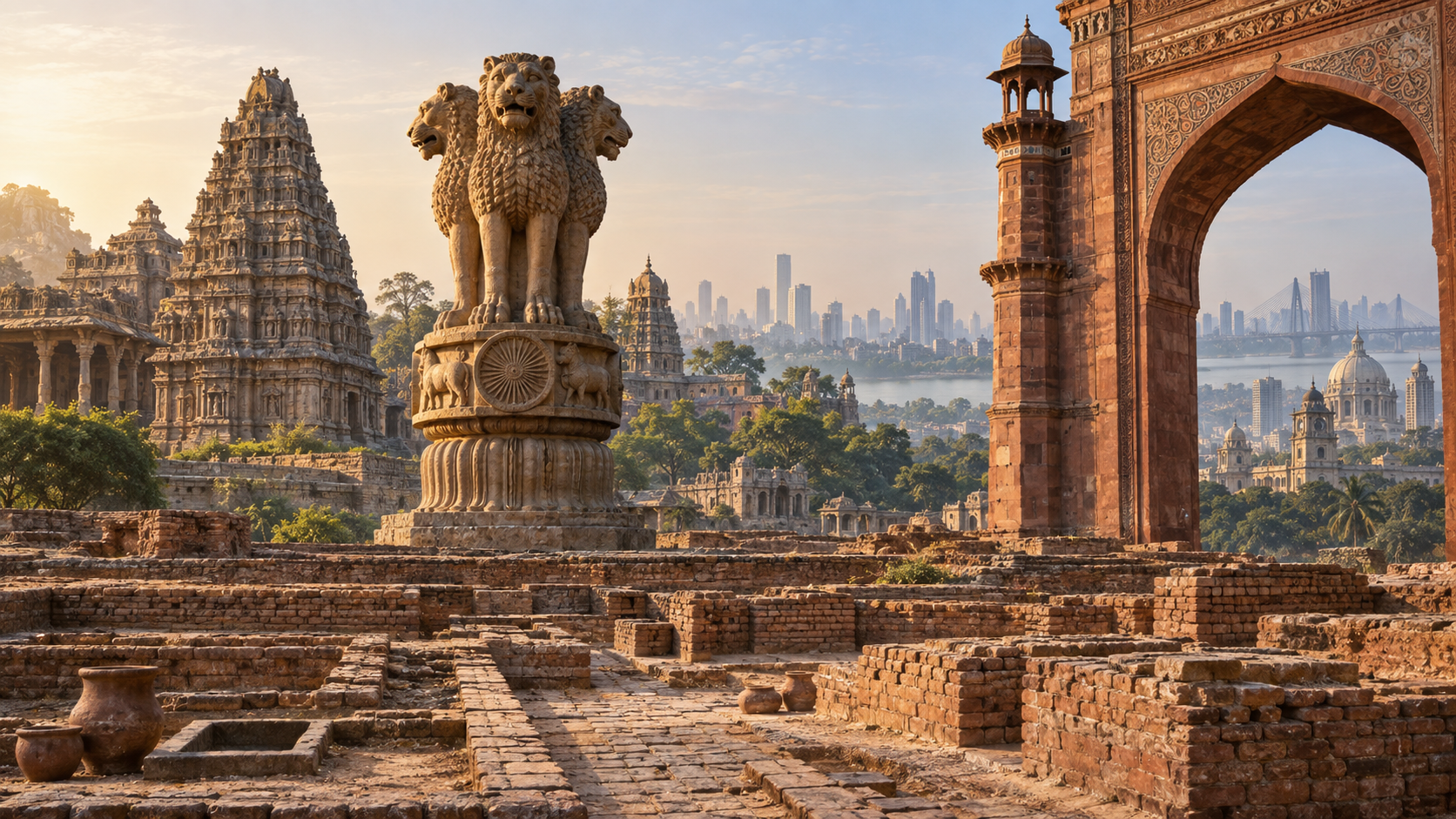
How to read this article. This article is divided into seven chronological parts, with individual chapters for civilizations, empires, dynasties and kingdoms. Use “Browse the history” below to jump straight to any part or chapter. Chapters are ordered by the starting date given in the text, from earliest to latest; their histories often overlap. Century-only and approximate dates remain approximate. The modern India chapter covers 1947–2023.
India’s history reaches far beyond its empires. This single-page journey begins with early human settlement and the Indus Valley Civilization, follows the rise and fall of kingdoms and dynasties across the subcontinent and its connected regions, and continues through colonial rule, independence and modern India. Across 110 historical chapters, followed by a chapter on independent India, it explores rulers and everyday people, governance and warfare, trade, belief, art and architecture.
Before you begin: empires, dynasties and sultanates
Before we dive into the stories of India’s historical empires, it’s helpful to distinguish between the three types of political structures:
Empire:
An empire is a large political unit where one ruler controls an extensive, culturally diverse territory, often encompassing various regions and peoples. Empires are marked by their vast size, strong centralized authority, and capacity to unify different ethnic and linguistic groups under one political entity.
Example: The Maurya Empire
Dynasty:
A dynasty is a line of hereditary rulers, typically within an empire, who come from the same family. Dynasties often represent continuity in leadership and are marked by shared administrative practices, policies, and cultural developments passed down through generations.
Example: The Gupta Dynasty
Sultanate:
A sultanate is a territory ruled by a sultan, typically a Muslim ruler, often involving a state or kingdom within a larger region. Sultanates in India were known for introducing Islamic governance structures and architectural styles, blending local and foreign influences in art, law, and culture.
Example: The Delhi Sultanate
What was daily life like for these ancient people? How did they construct their homes, fortify cities, and immortalize their legacies in symbols and myths? We’ll delve into their daily routines, the tools they crafted, and the stories they told - myths, legends, and symbols that reveal a civilization deeply connected to nature, spirituality, and art.
What each historical chapter explores
- Early Days and Historical Context - Understanding the origins and the initial development of each empire and kingdom.
- Origin and Foundation - Tracing how each empire was established and the regions they occupied.
- Reasons for Emergence - Analyzing the factors that led to the rise of these powerful entities.
- All Rulers/Leadership - A detailed look at the leaders who shaped the course of each empire.
- Administrative and Political Structure - Insight into how governance and administration were structured.
- Wars and Conflicts - The key battles, rivalries, and conflicts that defined their power.
- Regional Connections - The influence and interactions with neighboring territories and regions.
- International Connections - Exploring trade, alliances, and conflicts beyond local borders.
- Spiritual and Religious Influence - The impact of religion and spirituality on society and governance.
- Cultural and Technological Contributions - Innovations and cultural developments during each period.
- Social Structure and Society - Understanding the daily life and societal norms within each empire.
- Economic System and Trade Networks - The economic foundations and trade dynamics that sustained these civilizations.
- Laws, Policies, and Reforms - The legal framework and reforms that shaped each kingdom’s governance.
- Spiritual/Religious Leaders and Philosophers - The influential thinkers and spiritual figures of the time.
- Cultural and Literary Contributions - The literature, art, and cultural advancements that emerged.
- People and Daily Life - A look into the lifestyle, customs, and routines of the inhabitants.
- Architectural and Monumental Legacy - The monuments and architectural marvels left behind.
- Notable Stories, Legends, and Myths - The legendary tales and myths associated with each era.
- Notable Symbols and Artifacts - The symbols and artifacts that continue to hold significance today.
- Decline and Fall - The reasons and events that led to the decline of these powerful empires.
- Prominent People - (Non-Rulers) Connected with the Empire
Part I: Earliest civilizations and kingdoms
Origins before 1 CE. Chapters are placed by their starting dates; later events remain within each chapter.
The Early Foundations
The story of India begins long before the establishment of its grand empires. Archaeological evidence suggests that humans first arrived on the Indian subcontinent around 70,000 years ago. The early inhabitants were hunter-gatherers, living off the abundant natural resources provided by the diverse ecosystems. Over time, they settled in various regions, forming small communities and developing rudimentary agricultural practices.
The most notable early civilization was the Indus Valley Civilization (c. 3300–1300 BCE), which thrived in the northwestern regions of the subcontinent, in present-day Pakistan and northwest India. Cities like Harappa and Mohenjo-Daro were remarkable for their advanced urban planning, drainage systems, and architecture, indicating a highly organized society with social, economic, and religious structures. This civilization laid some of the earliest foundations of urban and social life in India.
How Humans Came to India
The Arrival of Early Humans in India
The history of India begins well before the rise of empires, stretching back to the prehistoric era when early humans first migrated into the subcontinent. The earliest evidence of human habitation in India is found in the Soan Valley and Potwar Plateau regions (in present-day Pakistan), dating back to nearly 2 million years ago. These early inhabitants, part of the Homo erectus species, lived in small groups, primarily as hunter-gatherers.
By around 65,000 years ago, Homo sapiens - the ancestors of modern humans - began migrating into India from Africa. They moved through coastal routes, settling along the Indian subcontinent’s vast rivers and coastlines. These early groups developed distinct tools, art, and burial practices, marking the beginning of India’s rich cultural heritage. Over time, these hunter-gatherer societies gradually transitioned into settled agricultural communities, particularly in regions like the Ganges and Indus river valleys.
The Neolithic Revolution
The Neolithic period in India, roughly from 7000 BCE onwards, saw the development of farming communities in places like Mehrgarh (modern-day Pakistan) and Burzahom (Kashmir). These early agrarian societies cultivated crops like barley, wheat, and lentils, and domesticated animals such as cattle and goats. The shift to agriculture led to the formation of small, settled villages and the development of pottery, which became a crucial aspect of Neolithic life.
This period also witnessed the construction of basic mud-brick houses and the beginnings of social structures that would later evolve into more complex communities. The increase in food production led to population growth, specialization of labor, and the first steps toward urbanization.
The Harappan (Indus Valley) Civilization
Around 3300 BCE, one of the world’s earliest urban civilizations - the Indus Valley Civilization (IVC) - emerged in northwestern India and Pakistan. The IVC, or Harappan Civilization, developed in the fertile Indus River basin and its tributaries. This civilization is known for its advanced cities like Harappa and Mohenjo-Daro, characterized by well-planned streets, sophisticated drainage systems, and impressive architecture.
The Harappans engaged in extensive trade, both internally and with distant lands like Mesopotamia, exporting goods such as cotton, beads, and pottery. This urban culture thrived until around 1900 BCE when it began to decline due to a combination of climatic changes, shifts in river courses, and possibly the arrival of new groups into the region.
The Indo-Aryans: Migration and Influence
Who Were the Indo-Aryans?
Around 1500 BCE, the Indo-Aryan people migrated into the Indian subcontinent from Central Asia, specifically from the steppes around the Caspian Sea. The Indo-Aryans were a branch of the larger Indo-European family of people, and their migration into India is a significant event in the region’s early history. Their arrival marked the beginning of the Vedic Age, a period that laid the foundation for much of Indian culture, language, and religion.
Cultural and Linguistic Impact
The Indo-Aryans brought with them their language, an early form of Sanskrit, which would become the foundation for many later Indian languages and literary traditions. The Rigveda, composed during this period, is one of the oldest texts in the world and provides valuable insight into the Indo-Aryan society, religion, and way of life.
The Indo-Aryans were primarily pastoralists when they first arrived, with their wealth measured in cattle. They gradually settled along the river valleys of northern India, particularly the fertile plains of the Ganges and Yamuna rivers. Over time, they transitioned from a nomadic lifestyle to a more settled agricultural and urban society, integrating with and influencing the local populations, some of whom were descendants of the Harappan people.
Religious and Social Structures
The Indo-Aryans contributed significantly to the development of early Hinduism. Their religious practices centered around fire sacrifices (yajnas) and the worship of gods like Indra (god of thunder and war), Agni (fire god), and Varuna (guardian of cosmic order). The priestly class, known as Brahmins, held considerable power as they were responsible for conducting these rituals and preserving sacred knowledge.
Socially, the Indo-Aryans established a system that would later evolve into the caste system, with distinct roles such as Brahmins (priests), Kshatriyas (warriors), Vaishyas (merchants and farmers), and Shudras (laborers). This stratification of society played a critical role in shaping the social dynamics of ancient India.
The Expansion and Integration of Indo-Aryan Tribes
The Indo-Aryans did not come as a single group but rather as waves of tribes who settled across various regions of northern India. Tribes like the Purus, Bharatas, and Kurus formed alliances, conflicts, and migrations that shaped the political and social landscape. The Vedic texts mention several of these tribes, highlighting their interactions, struggles for dominance, and eventual integration.
Legacy of the Indo-Aryans
The arrival and settlement of the Indo-Aryans significantly influenced the course of Indian history. They laid the foundations for the development of key aspects of Indian civilization, including language, religion, and social organization. Over time, the Vedic culture spread across the Indian subcontinent, evolving into classical Hinduism and contributing to the formation of future Indian empires and societies.
In summary, the early days of India saw the gradual transition from prehistoric hunter-gatherer societies to settled agricultural communities, culminating in the rise of the Indus Valley Civilization and, later, the integration of Indo-Aryan migrants. These developments laid the groundwork for the emergence of powerful kingdoms and empires, shaping the cultural and historical identity of the Indian subcontinent.
Indus Valley Civilization (3300 BCE - 1300 BCE)
The history of India is one of the longest and most profound in human civilization. When we explore the dawn of Indian civilization, we encounter the Indus Valley Civilization (IVC), a culture so advanced and mysterious that even today, researchers are piecing together the life, administration, and intricacies of this ancient society. The Indus Valley Civilization, flourishing between 3300 BCE and 1300 BCE, stands as the earliest known urban culture in South Asia and one of the world’s oldest civilizations. This chapter will unravel the various aspects of this magnificent civilization, providing an in-depth view of its historical context, rise, and eventual decline.
Early Days and Historical Context
Before the Indus Valley Civilization took shape, small hunter-gatherer communities thrived in the fertile plains of the Indus and Ghaggar-Hakra rivers. Over time, these communities evolved into settled agricultural societies, laying the foundation for urban centers like Harappa and Mohenjo-Daro. By 3300 BCE, these cities emerged, characterized by advanced planning, complex structures, and an organized way of life.
As you imagine those early days, think of vast stretches of land bustling with people skilled in agriculture, irrigation, and craftsmanship. They established settlements that didn’t merely consist of huts but were developed with standardized, baked-brick houses, drainage systems, and granaries. This level of sophistication, unparalleled at the time, marked the Indus Valley as a significant urban civilization.
Origin and Foundation
The Indus Valley Civilization, one of the world’s earliest urban civilizations, emerged around 3300 BCE in what is now modern-day Pakistan and northwest India. The civilization developed along the fertile plains of the Indus River and its tributaries, encompassing the regions of Sindh, Punjab (in both Pakistan and India), and parts of Gujarat. Major cities like Harappa and Mohenjo-daro became centers of advanced urban planning, demonstrating early forms of social organization and technological innovation. The civilization’s origin is believed to be tied to the gradual settling of agricultural communities, who capitalized on the region’s river systems for irrigation and trade, creating a thriving and interconnected society.
Reasons for Emergence
What triggered the rise of the Indus Valley Civilization? Geography played a significant role. The civilization thrived in the fertile plains watered by the Indus River, providing abundant resources and a suitable climate for agriculture. The availability of natural resources like minerals, timber, and fertile land enabled early communities to create a stable economic base, leading to population growth and social complexity.
External influences from neighboring regions, such as Mesopotamia, may have also played a part, introducing trade practices, technologies, and cultural exchanges that helped shape the early civilization’s development.
Rulers and Leadership
Interestingly, the Indus Valley Civilization remains an enigma when it comes to leadership. Unlike other ancient civilizations with clear monarchs or dynasties, the Indus Valley has no known kings, pharaohs, or warlords. Instead, the governance system appeared decentralized, with power likely distributed among different regions or groups.
Archaeological evidence suggests that the cities operated under a form of collective or civic administration rather than a centralized authority. The presence of similar building patterns, weights, and measures across cities indicates a shared system of governance or standardized rules, but the absence of grand palaces or royal tombs leaves many questions unanswered.
Administrative and Political Structure
The Indus Valley Civilization was remarkable for its urban planning and organization. Cities like Harappa and Mohenjo-Daro were built with meticulous grid systems, advanced drainage systems, and large granaries, pointing to a highly organized society. The consistent layout and architecture across various settlements suggest that some form of administrative planning and management existed.
The administrative centers, possibly located in larger cities, might have coordinated activities such as agriculture, trade, and construction projects. However, the lack of monumental architecture associated with political leaders indicates that power was more likely distributed among a class of elites or councils rather than concentrated in the hands of a single ruler.
Wars and Conflicts
Surprisingly, there is limited evidence of wars or conflicts during the Indus Valley period. The cities do not show signs of fortifications or military structures, which suggests that the society was relatively peaceful or relied on diplomacy and trade rather than military dominance. This absence of conflict raises intriguing questions about how the civilization maintained order and security.
This peaceful nature may have contributed to its longevity, as the cities flourished for nearly a thousand years. However, it also raises questions about how they managed external threats or internal disputes.
Regional Connections
The Indus Valley Civilization was not isolated. It had regional connections with communities across the Indian subcontinent, including settlements along the Saraswati and Ghaggar-Hakra rivers. These connections facilitated the exchange of goods, ideas, and cultural practices, promoting a cohesive identity across the civilization’s expansive territory.
Archaeological findings suggest that these connections extended into areas like Gujarat and Maharashtra, showcasing the civilization’s influence beyond the core cities of Harappa and Mohenjo-Daro.
International Connections
The Indus Valley Civilization was a hub of international trade. Evidence suggests that it maintained strong trade links with Mesopotamia, Oman, and the Persian Gulf. Artifacts such as seals, pottery, and precious stones found in distant lands indicate the civilization’s active participation in long-distance trade networks.
For example, Mesopotamian records mention a distant trading partner called “Meluhha,” believed to be the Indus Valley. This highlights how the civilization was not only connected but also influential in the larger ancient world economy.
Spiritual and Religious Influence
Religious practices in the Indus Valley are shrouded in mystery, but artifacts like the famous seals depict figures resembling later deities from Hinduism, such as a proto-Shiva figure sitting in a yogic posture. This hints at early spiritual beliefs centered around nature, fertility, and possibly the worship of animals and mother goddesses.
The Great Bath at Mohenjo-Daro suggests ritualistic bathing, a practice that might have carried spiritual significance and influenced later religious customs in Indian society. Though we lack definitive texts or temples, these relics provide glimpses into a civilization where spirituality was intertwined with daily life.
Cultural and Technological Contributions
The Indus Valley Civilization was advanced in its technological and cultural contributions. It introduced techniques in metallurgy, such as bronze-making, and sophisticated craftwork like bead-making, pottery, and seal carving. Their urban planning, featuring precise grid layouts and advanced drainage systems, showcased their architectural and engineering prowess.
The civilization also contributed culturally through its art, particularly the iconic seals that often depicted animals, mythological creatures, and religious symbols. These artifacts serve as a cultural legacy, providing insights into the symbolism and aesthetics of the era.
Social Structure and Society
Social life in the Indus Valley Civilization was structured yet egalitarian in many ways. Unlike other ancient societies, there is no evidence of extreme social hierarchy or monumental royal tombs, indicating a society that might have valued collective governance.
The evidence of standardized weights and measures points to an emphasis on trade and commerce, suggesting that merchants and craftsmen held important positions within society. However, the nature of the caste system or social stratification remains largely unknown due to the undeciphered script.
Economic System and Trade Networks
Trade was the lifeblood of the Indus Valley economy. The civilization had a sophisticated trade network, both internally and externally. Agricultural surplus, handicrafts, and minerals were traded across cities and beyond the borders of the subcontinent.
Dockyards like Lothal in Gujarat served as trading hubs, indicating the civilization’s expertise in maritime commerce. This vast network facilitated not only economic prosperity but also cultural exchanges with neighboring civilizations.
Laws, Policies, and Reforms
The laws and policies of the Indus Valley Civilization are challenging to decode due to the absence of written legal texts, unlike the Hammurabi Code of Mesopotamia. However, archaeological evidence suggests that the society operated under a standardized system. The uniformity of weights and measures across the civilization indicates that trade regulations were enforced consistently, ensuring fair commerce.
The civic organization of cities such as Harappa and Mohenjo-Daro, with well-planned streets and advanced drainage systems, also points to regulations governing urban planning and public health. The presence of public baths and wells suggests a focus on hygiene, indicating an early form of civic governance that prioritized community welfare. These rules and systems reflect an organized and disciplined society, even if the specifics remain unknown.
Spiritual/Religious Leaders, Philosophers, and Famous People
While there are no known names of specific leaders, philosophers, or religious figures from the Indus Valley Civilization due to the lack of deciphered texts, artifacts give us some clues. The seals and statues discovered in the region portray figures in meditative poses or surrounded by animals, which hint at spiritual practices and possible early forms of yogic traditions.
The “Priest-King” statue found at Mohenjo-Daro, a bearded figure with a headband and robe, is often speculated to be a representation of a spiritual or political leader. However, without inscriptions to confirm this, such interpretations remain speculative.
Cultural and Literary Contributions
Although the civilization’s script remains undeciphered, the art and artifacts speak volumes about their cultural contributions. The seals, which often depict animals like bulls, elephants, and mythical creatures, showcase the civilization’s artistic and symbolic richness. These images may have conveyed stories, commercial details, or religious beliefs.
Pottery, sculptures, and jewelry found in excavations also reflect a sophisticated aesthetic sense, indicating a culture that valued beauty and craftsmanship. The civilization’s absence of monumental writings like those of Egypt or Mesopotamia leaves its literary contributions in mystery, but the widespread use of seals suggests they might have documented aspects of life, trade, and administration through symbols.
People and Daily Life
Life in the Indus Valley Civilization was likely centered around agriculture, trade, and craftsmanship. Most people lived in brick houses arranged in well-planned streets, indicating a comfortable urban life compared to other contemporary civilizations. The use of advanced drainage and sewage systems implies a high regard for cleanliness and public health.
Agriculture formed the backbone of daily life, with crops like wheat, barley, and cotton being cultivated. The people also engaged in livestock farming, raising animals such as cattle, sheep, and goats. Craftsmanship was highly developed, with evidence of skilled workers producing pottery, beadwork, and metal objects. Women likely played essential roles in domestic work, weaving, and pottery.
Architectural and Monumental Legacy
The architectural legacy of the Indus Valley Civilization is marked by its urban planning excellence. Cities like Mohenjo-Daro and Harappa were designed with a grid system, wide roads, and elaborate drainage networks - features that were far ahead of their time. The Great Bath at Mohenjo-Daro is an iconic structure that demonstrates their advanced engineering skills and communal focus on ritualistic practices, possibly linked to spiritual purification.
Residential buildings were built using uniform baked bricks, showcasing a standardized construction technique. Public granaries and wells reveal a civilization prepared to manage food supplies and public utilities effectively. The uniformity across various cities indicates that architectural norms and guidelines were likely enforced by local authorities, underscoring the civilization’s organizational prowess.
Notable Stories, Legends, and Myths
Given that the script of the Indus Valley Civilization remains undeciphered, there are no recorded myths or legends from this era. As a result, this section has no available information.
Notable Symbols and Artifacts
The artifacts of the Indus Valley Civilization are not just remnants of a bygone era; they carry profound significance:
- Seals: Hundreds of seals have been discovered, often featuring animals like bulls, tigers, and the mythical “unicorn.” These seals, possibly used for trade, also hold clues about religious and cultural practices.
- The Great Bath: This massive structure in Mohenjo-Daro is believed to have been used for ritual bathing, emphasizing the importance of water and purification in their society.
- Statues: The “Priest-King” and other small figurines, including those representing women, might symbolize important figures, deities, or everyday people. These provide insight into the clothing, jewelry, and aesthetics valued by the civilization.
These symbols and artifacts continue to fascinate historians and archaeologists, hinting at a society rich in symbolism and culture.
Decline and Fall
The decline of the Indus Valley Civilization around 1900 BCE remains one of the greatest mysteries of ancient history. Several theories have been proposed:
- Environmental Changes: Geological evidence suggests shifts in river patterns, particularly the drying up of the Saraswati (Ghaggar-Hakra) River, which may have led to agricultural decline and forced populations to migrate.
- Floods: Floods caused by changes in the Indus River’s course could have damaged cities and agricultural fields, contributing to the civilization’s gradual decline.
- Invasion: Some scholars once believed that the civilization was overrun by Indo-Aryans; however, there is little evidence of widespread violence or conflict to support this theory.
Ultimately, the decline was likely due to a combination of environmental and social factors that disrupted the economic and agricultural stability of the region, leading to the abandonment of major cities.
Fun Fact: India derives its name from the Indus River, which was central to the Indus Valley Civilization. The word “India” comes from the ancient Persian word for the Indus - Hindus, which later evolved to “Indos” in Greek, and eventually “India.” This ancient civilization’s association with the Indus River laid the foundation for the country’s name, connecting modern India to its ancient roots.
Purus (c. 1500 BCE - 800 BCE)
Early Days and Historical Context
The Purus were an ancient Vedic tribe mentioned prominently in the Rigveda, existing between approximately 1500 BCE and 800 BCE. They occupied the region around the Sarasvati River (likely in modern-day Haryana and Punjab, India). The Purus were one of the main groups of the Indo-Aryan people and played a significant role in the formation of early Vedic society.
Origin and Foundation
The Purus are considered one of the earliest Indo-Aryan tribes to settle in the Indian subcontinent, following their migration from Central Asia. They established themselves in the northwestern plains of India, along the banks of the Sarasvati and other rivers. The Rigveda often references the Purus in the context of their conflicts with other tribes, like the Bharatas, and their interactions with neighboring groups.
Reasons for Emergence
The Purus emerged as a powerful tribe due to their strategic location near fertile river plains and their ability to dominate smaller, neighboring tribes. Their strong military traditions and leadership helped them maintain control over the region and exert influence over the evolving Vedic society.
All Rulers/Leadership
There are few specific rulers of the Purus mentioned in historical records, but some prominent leaders include:
- King Sudas: Originally associated with the Bharatas but later identified with the Purus, he led them in the famous Battle of the Ten Kings.
- King Puru: Often cited as an ancestral figure of the Puru tribe.
Details about other rulers remain scarce due to the mythological and fragmentary nature of the Vedic texts.
Administrative and Political Structure
The Purus had a clan-based administrative structure, common among early Vedic tribes. The king, or raja, led the tribe with the support of a council of elders known as the sabha or samiti. Decision-making often involved tribal assemblies, reflecting an early form of participatory governance. The political power was tied closely to military strength and the tribe’s ability to dominate or form alliances with neighboring groups.
Wars and Conflicts
The Purus are best known for their involvement in the Battle of the Ten Kings, a significant conflict described in the Rigveda. This battle involved a coalition of ten tribes against King Sudas, who led the Purus and their allies to victory. The conflict was primarily over control of territory and resources in the fertile regions of the Sarasvati River basin.
Regional Connections
The Purus were part of a complex network of Vedic tribes in the region, often forming alliances or engaging in conflicts with groups like the Bharatas, the Druhyus, and the Yadus. These regional interactions influenced the cultural and political dynamics of the early Vedic period.
International Connections
The Purus had indirect international connections through the Indo-Aryan migration routes and their contacts with other Indo-European tribes that migrated into the Indian subcontinent. Their interactions with neighboring tribes, some of whom were remnants of earlier Indus Valley inhabitants, also suggest cultural exchanges.
Spiritual and Religious Influence
The Purus were closely linked to the early Vedic religion, which involved the worship of deities like Indra, Agni, and Varuna. They contributed to the formation of Vedic rituals and hymns, some of which are preserved in the Rigveda. Their leaders were often seen as intermediaries between the gods and the people, enhancing their spiritual authority.
Cultural and Technological Contributions
The Purus contributed to early Vedic culture, particularly in the development of Sanskrit hymns and rituals. They played a crucial role in the oral tradition of preserving sacred texts. Technologically, they utilized iron tools for agriculture and warfare, enhancing their military and economic power.
Social Structure and Society
The society of the Purus was organized around a clan system with the varna (caste) divisions becoming increasingly prominent. The society was patriarchal, with kings and priests (Brahmins) holding high status. Warriors (Kshatriyas) were valued for their role in protecting the tribe, while commoners (Vaishyas) and laborers (Shudras) formed the rest of the society.
Economic System and Trade Networks
The Purus practiced agriculture and animal husbandry, particularly cattle rearing, which was a primary measure of wealth in Vedic society. Their location along river routes facilitated trade with neighboring tribes, and they likely traded agricultural products, livestock, and crafted goods.
Laws, Policies, and Reforms
The Purus adhered to Vedic laws, which were not codified but passed down through oral tradition. These laws emphasized loyalty to the tribe, the importance of sacrificial rituals, and the protection of social order based on caste divisions. Reforms or policies, if any, were likely linked to maintaining control over the territory and managing alliances or conflicts with neighboring tribes.
Spiritual/Religious Leaders and Philosophers
The Rigveda mentions Vedic priests like Vasistha and Visvamitra, who may have been associated with the Purus at different points in time. These priests were instrumental in developing early Vedic thought and rituals, influencing the spiritual and philosophical development of the tribe.
Cultural and Literary Contributions
The Purus are central to the Rigvedic hymns, contributing significantly to early Vedic literature. The hymns they composed form a substantial part of the Rigveda, which is one of the oldest texts in the world. Their literary contributions laid the foundations for the later development of Vedic and classical Sanskrit literature.
People and Daily Life
Life among the Purus revolved around agriculture, cattle rearing, and participating in religious ceremonies. Society was largely rural, with small settlements along the rivers. The Vedic emphasis on sacrificial rituals and hymns influenced daily activities, and people’s lives were closely tied to seasonal cycles and agricultural practices.
Architectural and Monumental Legacy
There is no significant architectural legacy left by the Purus, as early Vedic culture did not emphasize monument building. Their settlements were primarily made of wood and mud, leaving little trace. The emphasis was more on maintaining sacred fires and spaces for rituals rather than constructing lasting edifices.
Notable Stories, Legends, and Myths
The Battle of the Ten Kings is the most famous legend associated with the Purus, highlighting their military prowess and leadership in Vedic lore. This battle illustrates the tribe’s importance in early Vedic society and their role in shaping the political landscape of ancient India.
Notable Symbols and Artifacts
There are no specific artifacts directly linked to the Purus that have survived to modern times. The primary legacy of the Purus is preserved in the hymns of the Rigveda, which serve as symbolic records of their beliefs, values, and society.
Decline and Fall
The decline of the Purus came as other tribes, particularly the Bharatas and later the Kurus, rose to prominence. The Purus eventually merged or were absorbed into these tribes, contributing to the formation of the larger Kuru kingdom, which became the focal point of the later Vedic period.
Prominent People
No prominent non-ruler individuals from the Purus are recorded in the historical texts. The Purus are primarily known for their conflicts with other Vedic tribes and their place within the broader narratives of early Indian history, especially as mentioned in the Rigveda.
Kuru Kingdom (c. 1200 BCE - 450 BCE)
Early Days and Historical Context
The Kuru Kingdom was one of the most influential and earliest Vedic states that emerged around 1200 BCE. It occupied the fertile region of the Ganges-Yamuna Doab, corresponding to parts of modern-day Haryana and Delhi in India. The kingdom is prominently featured in Vedic literature, and it was instrumental in transitioning from the early Vedic period to the later Vedic and even Upanishadic period. The Kurus laid the groundwork for social, religious, and political structures that shaped the future of the Indian subcontinent.
Origin and Foundation
The Kuru Kingdom was founded by the amalgamation of the Bharata and Puru tribes. It is believed that the unification of these tribes occurred after the Battle of the Ten Kings, which established the Kurus as the dominant power in the region. The Kurus established their capital at Hastinapura, which became a central hub for Vedic learning, culture, and politics.
Reasons for Emergence
The Kurus emerged as a dominant force due to their strategic geographical position and their ability to unify smaller tribes. The fertile lands along the Yamuna and Ganges rivers provided them with agricultural wealth, while their military strength helped them expand their influence over other tribes and regions. They also succeeded in unifying cultural and religious practices, making them the torchbearers of Vedic tradition.
All Rulers/Leadership
The Kuru lineage is detailed in several Vedic and Puranic texts. Some notable rulers include:
- King Parikshit: Considered one of the early rulers, Parikshit established the Kuru dynasty and helped consolidate its power.
- King Janamejaya: Grandson of Arjuna from the Mahabharata, Janamejaya played a significant role in expanding the Kuru kingdom’s influence and continued the Vedic traditions.
- Shantanu: A later Kuru king known for his role in the Mahabharata; his reign marked a period of political stability.
- Bhishma: Although not a king himself, Bhishma was a central figure in the Kuru dynasty, respected as a statesman and warrior.
- Dhritarashtra and Pandu: Brothers who ruled jointly; their reign led to the events of the Mahabharata and the subsequent conflict that led to the kingdom’s fragmentation.
Administrative and Political Structure
The Kuru Kingdom had a hierarchical system, with the king, or raja, at the top, supported by a council of ministers and Vedic priests (Brahmins). The kingdom was divided into smaller administrative units managed by local chieftains. The Kurus are known for formalizing the rajasuya (royal consecration) ceremony, which reinforced the king’s power through Vedic rituals. The Kurus also began the trend of samantas (feudal lords) who pledged allegiance to the king in return for protection.
Wars and Conflicts
The Kuru Kingdom engaged in several conflicts, primarily to expand and secure their territory:
The Battle of the Ten Kings consolidated their power in the region after defeating rival tribes.
Conflicts with neighboring tribes like the Panchalas and Matsyas were common, often fought over control of land and resources.
The Kurukshetra War, depicted in the Mahabharata, was a legendary civil war between the Kauravas and Pandavas, two branches of the Kuru family. While mythologized, it symbolizes the internal conflicts that led to the kingdom’s eventual fragmentation and decline.
Regional Connections
The Kurus had strong regional connections with neighboring kingdoms like the Panchalas, Matsyas, and Chedis. Alliances and marriages were common among these kingdoms, particularly through the Vedic practice of swayamvara (a form of marriage). These connections not only strengthened their political influence but also facilitated the spread of Vedic culture.
International Connections
There are no direct references to international connections in the early Vedic period of the Kuru Kingdom. However, their influence extended over northern India, influencing the cultures and political systems of other emerging tribes and states. The Kurus also had indirect connections through the migration of other Indo-Aryan tribes and their interactions with pre-existing local cultures.
Spiritual and Religious Influence
The Kuru Kingdom played a pivotal role in codifying and formalizing Vedic practices. The kingdom became a center for the composition of Vedic hymns and rituals, particularly under King Parikshit and his successors. They promoted the yajna (sacrificial rituals) and other Vedic practices, which strengthened the role of Brahmins and established them as spiritual authorities. The Kurus also laid the foundation for Dharma (righteousness and moral order), which became a key concept in Indian philosophy.
Cultural and Technological Contributions
The Kurus contributed significantly to early Indian culture:
The Kuru-Panchala School of thought became influential in Vedic learning.
They formalized social and ritual practices, influencing the later development of Hinduism.
Technologically, they utilized iron tools for agriculture, expanding their agricultural output and thereby their economy.
Social Structure and Society
The Kuru society was organized around the varna system (caste system), which became more defined during their rule. Brahmins (priests) and Kshatriyas (warriors) held high status, with the king and his court being primarily composed of these groups. Vaishyas (merchants) managed trade and agriculture, while Shudras (laborers) occupied the lowest social tier. The kingdom emphasized Ashrama (stages of life) and Dharma as part of social conduct, which guided the people’s way of life.
Economic System and Trade Networks
The economy of the Kuru Kingdom was based on agriculture, with the fertile lands of the Yamuna and Ganges rivers providing abundant harvests. They engaged in trade with neighboring tribes and regions, exchanging agricultural products, livestock, and iron tools. The Kurus also had access to resources like iron and copper, allowing them to develop metalworking skills that boosted their economy and military capabilities.
Laws, Policies, and Reforms
The Kuru Kingdom formalized early Vedic laws that governed their society, focusing on Dharma and Rita (cosmic order). They emphasized adherence to Vedic rituals and duties according to one’s caste and stage of life. The kingdom also initiated administrative reforms, organizing its territory into smaller units managed by local chieftains to ensure better control and resource management.
Spiritual/Religious Leaders and Philosophers
The Kurus had prominent Vedic sages like Vyasa and Vasistha associated with their kingdom. Vyasa, the author of the Mahabharata, is said to have resided in the Kuru court. His teachings and writings laid the foundation for later Vedic and philosophical thought. These spiritual leaders greatly influenced the religious and philosophical trajectory of the Kurus.
Cultural and Literary Contributions
The Kuru Kingdom was central to the development of Vedic literature. It was during their reign that significant parts of the Rigveda, Samaveda, and other Vedic texts were composed and compiled. The Kurus were instrumental in organizing these oral traditions into structured forms, setting the stage for later classical Sanskrit literature.
People and Daily Life
Life in the Kuru Kingdom was organized around agriculture, cattle rearing, and Vedic rituals. The society was predominantly rural, with settlements centered around agricultural activities. Festivals and sacrificial rituals played an essential role in daily life, reflecting the kingdom’s emphasis on religious and spiritual observances. The concept of ashrama (life stages) guided individuals through different phases, from education to family life and finally to spiritual pursuits.
Architectural and Monumental Legacy
The Kuru Kingdom does not have significant surviving architectural remains, as much of the early Vedic period relied on wood and temporary structures. However, their capital, Hastinapura, became an iconic city in Indian lore. The Kurus’ emphasis was more on creating spaces for rituals rather than constructing monumental architecture.
Notable Stories, Legends, and Myths
The Kuru Kingdom is central to the epic Mahabharata, which chronicles the conflict between the Kauravas and Pandavas, descendants of the Kuru dynasty. This epic, while partly mythological, provides insight into the values, social structure, and political life of the time. The Mahabharata also serves as a moral guide, with the teachings of Bhagavad Gita becoming one of the most significant spiritual texts in Indian philosophy.
Notable Symbols and Artifacts
There are no specific artifacts directly linked to the Kurus that have been discovered archaeologically. However, the Mahabharata and the hymns of the Rigveda serve as cultural artifacts, reflecting the beliefs, values, and history of the Kuru period.
Decline and Fall
The decline of the Kuru Kingdom is attributed to internal strife and the infamous Kurukshetra War, which fragmented the dynasty. After the conflict, the kingdom lost its unified power, and the capital, Hastinapura, suffered damage, leading to its decline. The later rise of the Panchala Kingdom and other neighboring states further weakened the Kurus, ultimately leading to their absorption into other emerging kingdoms.
Prominent People
Drona - A prominent figure from the Mahabharata, Drona was a master of military arts and the royal teacher (guru) for the Kuru princes. His skills and teachings shaped the warriors of the Kuru kingdom, including the Pandavas and Kauravas.
Vidura - Another key figure in the Mahabharata, Vidura was known for his wisdom and loyalty to the Kuru dynasty. He served as an advisor and was renowned for his righteousness and impartiality, often standing as a voice of reason in the Kuru court.
Matsya Kingdom (c. 1200 BCE - 6th century BCE)
Early Days and Historical Context
The Matsya Kingdom was an ancient state located in the northwest region of the Indian subcontinent, corresponding to parts of present-day Rajasthan, specifically the Alwar and Jaipur districts. It is one of the sixteen Mahajanapadas (great realms) mentioned in ancient Indian texts like the Mahabharata and the Buddhist Jatakas. The kingdom was largely agrarian and played a role in the Vedic and early Buddhist periods, serving as an important region in the cultural and political landscape of early India.
Origin and Foundation
The Matsya Kingdom is believed to have been founded by King Virata, who established his capital at Viratanagara(modern-day Bairat in Rajasthan). According to the Mahabharata, the Matsya people were descendants of the Yadavas. The kingdom was located in a strategically important area, with access to the fertile plains of the northwest and the central region, providing it with a steady agricultural base and opportunities for trade.
Reasons for Emergence
The Matsya Kingdom emerged due to its fertile land and its strategic position between the central and northern regions of India. The kingdom’s location allowed it to become a center of agriculture and trade, which, combined with its warrior culture, enabled it to maintain autonomy and influence among neighboring states. The presence of the Matsya in the Mahabharata also suggests that the kingdom had significant regional power during its time.
All Rulers/Leadership
The rulers of the Matsya Kingdom are not comprehensively documented in historical texts, but the most notable among them is:
King Virata: The most well-known ruler, King Virata, is prominently featured in the Mahabharata as the protector of the Pandavas during their exile. He is portrayed as a just and powerful king, respected by his subjects and his neighboring states.
Administrative and Political Structure
The Matsya Kingdom had a monarchical system of governance with the king at the center of political and administrative activities. The king was supported by a council of ministers and warriors who helped manage the kingdom’s affairs. The kingdom likely adhered to a Vedic model of governance, where the Brahmins held spiritual authority and advised the king on religious matters, while the Kshatriyas, or warrior class, maintained military and administrative responsibilities.
Wars and Conflicts
The Matsya Kingdom is known for its military conflicts and alliances:
The Matsya were involved in several regional conflicts with neighboring kingdoms like the Kurus and the Panchalas. These conflicts were often over territorial disputes or influence in the northern plains.
In the Mahabharata, the Matsya army, led by King Virata, allied with the Pandavas during the Kurukshetra War. The kingdom’s support was crucial for the Pandavas, as it provided them with shelter and military aid.
Regional Connections
The Matsya Kingdom had strong connections with neighboring kingdoms such as the Kuru, Panchala, and Surasena. Marriages and alliances were common, especially during the time of King Virata, who forged strong political ties with these neighboring states. These connections allowed the Matsya to maintain a balance of power in the region and protect their autonomy against larger empires.
International Connections
There is limited evidence of international connections for the Matsya Kingdom. However, due to its location, it likely had indirect contact with distant tribes and cultures through trade routes passing through northern India. The kingdom’s agricultural and artisan products may have reached other regions, but there are no records of direct international diplomacy or trade agreements.
Spiritual and Religious Influence
The Matsya Kingdom was influenced by early Vedic practices, which played a central role in their religious life. Brahmins held a significant position within the society and guided the kingdom’s spiritual practices. Rituals, sacrifices, and the worship of Vedic deities were common. Later, during the Buddhist period, the kingdom may have also come under the influence of Buddhist thought, as it was geographically close to the regions where Buddhism was spreading.
Cultural and Technological Contributions
Culturally, the Matsya Kingdom contributed to the Vedic tradition:
The kingdom supported Vedic rituals and ceremonies, which were integral to maintaining its spiritual and social order.
The Matsyas are also associated with advancements in agriculture, utilizing irrigation methods to cultivate the fertile lands of their region, contributing to their economic stability.
Social Structure and Society
The Matsya society adhered to the traditional varna (caste) system, with Brahmins, Kshatriyas, Vaishyas, and Shudras forming the social hierarchy. The king and his family belonged to the Kshatriya class and upheld warrior traditions, while Brahmins served as spiritual leaders and advisors. The society was primarily agrarian, and agriculture was the mainstay of the economy, supplemented by cattle rearing and small-scale trade.
Economic System and Trade Networks
The economy of the Matsya Kingdom was based on agriculture, with fertile lands supporting crops like barley and wheat. The kingdom also engaged in trade with neighboring regions, exchanging agricultural produce and cattle. While not as commercially advanced as some other contemporary states, the Matsya’s economic stability was critical for sustaining its population and military strength.
Laws, Policies, and Reforms
The Matsya Kingdom likely adhered to Vedic laws and norms, which were based on the principles of Dharma (duty and righteousness). The king was seen as the protector of Dharma, ensuring justice and the well-being of his subjects. There is no detailed record of specific policies or reforms from this period, but the kingdom’s governance was structured to maintain social harmony and agricultural productivity.
Spiritual/Religious Leaders and Philosophers
There are no specific spiritual or religious leaders directly associated with the Matsya Kingdom. However, as a part of the Vedic culture, the kingdom would have had influential Brahmins who performed rituals and guided the spiritual and moral life of the kingdom.
Cultural and Literary Contributions
The Matsya Kingdom is mentioned in several ancient texts like the Mahabharata and the Puranas. The epic stories of King Virata and his alliance with the Pandavas provide cultural and moral lessons that reflect the values and beliefs of the society at the time. These contributions are part of the larger Vedic and epic tradition of early Indian literature.
People and Daily Life
Life in the Matsya Kingdom revolved around agriculture, cattle herding, and Vedic rituals. Villages were the main centers of population, with most people involved in farming activities. Festivals and religious ceremonies were integral to daily life, and the people followed Vedic traditions, worshiping deities like Indra, Agni, and other gods from the early Vedic pantheon.
Architectural and Monumental Legacy
There are no significant surviving architectural monuments directly attributed to the Matsya Kingdom, as most early structures were made of perishable materials like wood. However, the area around modern-day Bairat (the ancient Viratanagara) has yielded remains of later-period Buddhist stupas and monasteries, suggesting the continuity of the site as a cultural and religious center.
Notable Stories, Legends, and Myths
The most notable legend associated with the Matsya Kingdom is found in the Mahabharata, where King Virata provides refuge to the Pandavas during their exile. The story portrays Virata as a noble and generous ruler, showcasing the kingdom’s values of hospitality and loyalty. The Matsya Kingdom’s role in the epic war of Kurukshetra, although secondary, highlights its strategic importance and its alliances with powerful neighboring kingdoms.
Notable Symbols and Artifacts
No specific artifacts or symbols have been identified from the Matsya Kingdom due to the lack of archaeological findings specific to this period and region. However, ancient texts and epic narratives serve as cultural artifacts, providing insights into the kingdom’s history, values, and influence.
Decline and Fall
The decline of the Matsya Kingdom is not precisely documented, but it is believed that the kingdom gradually lost prominence due to the rise of neighboring powers like the Magadha and Panchala kingdoms. By the 6th century BCE, the Matsya Kingdom had either been absorbed into larger neighboring states or fragmented into smaller units, fading from the central historical narrative of ancient India.
Prominent People
The Matsya Kingdom does not have any recorded prominent figures outside its rulers. The kingdom’s history and role primarily appear in the Mahabharata, focusing on its alliances and its strategic significance during the Kurukshetra War.
Sindhu Kingdom (c. 1200 BCE - 6th century BCE)
Early Days and Historical Context
The Sindhu Kingdom, named after the Sindhu River (modern-day Indus River), was located in the northwestern region of the Indian subcontinent, corresponding to present-day Sindh in Pakistan. The Sindhu Kingdom held a crucial geographical position as it lay along the river, which was vital for agriculture and trade. It is mentioned in ancient Vedic texts and epics such as the Rigveda and the Mahabharata, indicating its significance in the early Vedic era.
Origin and Foundation
The Sindhu Kingdom likely originated as a collection of tribal clans settled along the fertile banks of the Sindhu River. The kingdom’s foundation is rooted in the region’s rich agricultural base, which sustained its early inhabitants. The Sindhu people were associated with the early Aryan settlers who migrated into the Indian subcontinent. The kingdom’s existence along a major river provided it with a strategic advantage in terms of both trade and defense.
Reasons for Emergence
The emergence of the Sindhu Kingdom can be attributed to the region’s fertile land and its strategic position along the river, which allowed for prosperous agriculture and trade. As the Aryan migration settled into the region, the Sindhu people organized themselves into a kingdom, taking advantage of the region’s resources and its position as a trade hub connecting the Indian subcontinent with Central Asia and beyond.
All Rulers/Leadership
The rulers of the Sindhu Kingdom are not thoroughly documented in early texts. However, the Rigveda refers to Sindhu chiefs who governed the region. These rulers were likely clan leaders who held power over smaller territories within the kingdom, forming a loose confederation rather than a unified monarchy.
Administrative and Political Structure
The Sindhu Kingdom likely operated under a tribal system of governance. Local chiefs, who were leaders of various clans settled along the river, governed smaller regions within the kingdom. These chiefs may have come together for common defense or trade interests, forming a tribal confederation rather than a centralized kingdom. The early Aryan influence is visible in their organization, where the Kshatriyas (warrior class) played a dominant role in governance and defense.
Wars and Conflicts
The Sindhu Kingdom had conflicts with neighboring tribes and kingdoms:
The Aryan tribes that migrated into the region sometimes engaged in skirmishes for control over fertile land and water resources.
In the Mahabharata, the Sindhu people were depicted as participating in battles, suggesting their involvement in regional conflicts. The kingdom supported the Kauravas in the great war of Kurukshetra, indicating its alliances and political strategies.
Regional Connections
The Sindhu Kingdom maintained connections with other nearby kingdoms and tribes, such as the Gandhara, Madra, and the Kuru Kingdoms. These connections were primarily through trade and occasional alliances. Due to its strategic location along the river, Sindhu served as a link between the Indian subcontinent and regions beyond, such as Persia and Central Asia.
International Connections
The Sindhu Kingdom’s position along the Indus River allowed it to become a key player in international trade. Goods like textiles, grains, and handicrafts were exchanged with regions to the west, including Persia and Mesopotamia. The river was a crucial trade route, connecting the Indian subcontinent to Central Asian and Persian markets. Although no formal diplomatic records exist, these interactions likely influenced the kingdom’s economy and culture.
Spiritual and Religious Influence
The Sindhu Kingdom was influenced by early Vedic traditions, as evidenced by references in the Rigveda. The Sindhu River itself was considered sacred and was worshipped as a deity. The kingdom adhered to Vedic rituals, and Brahmins likely held significant power as spiritual leaders. The early religious life of the Sindhu Kingdom revolved around natural elements, reflecting the influence of Vedic practices that emphasized nature and sacrificial rituals.
Cultural and Technological Contributions
The Sindhu Kingdom contributed to early Vedic culture:
Vedic hymns in the Rigveda mention the Sindhu region, indicating its cultural and spiritual importance.
The kingdom also played a role in the early riverine agriculture practices that sustained its population. Innovations in irrigation and farming along the Sindhu River helped establish a stable agricultural economy, influencing future civilizations in the region.
Social Structure and Society
The society in the Sindhu Kingdom followed a varna (caste) system similar to other Vedic communities:
- Brahmins: The priestly class performed rituals and served as spiritual guides.
- Kshatriyas: The warrior and ruling class maintained governance and defended the kingdom.
- Vaishyas: The merchant and agricultural class engaged in farming, trade, and commerce.
- Shudras: The laboring class provided services and supported the economic activities of the higher classes.
Daily life in the Sindhu Kingdom was centered around agriculture, worship of river deities, and trade, reflecting the integration of Aryan and local customs.
Economic System and Trade Networks
The economy of the Sindhu Kingdom was predominantly agrarian, with the fertile plains along the river supporting crops like wheat and barley. The kingdom also engaged in trade with neighboring regions and further afield, using the Sindhu River as a primary trade route. Textiles, agricultural products, and handicrafts were among the goods traded, supporting the kingdom’s economy and its position as a trade hub in ancient India.
Laws, Policies, and Reforms
The Sindhu Kingdom likely adhered to Vedic laws, which were based on the concept of Dharma (righteousness). These laws governed social order, emphasizing the roles of different varnas in maintaining balance. The kingdom’s rulers and Brahmins enforced these laws, ensuring justice and order in society. However, specific legal reforms or policies are not documented in historical texts.
Spiritual/Religious Leaders and Philosophers
While there are no individual spiritual leaders specifically associated with the Sindhu Kingdom, the region was influenced by Vedic Brahmins who performed religious rituals and guided the kingdom’s spiritual practices. These priests played a significant role in maintaining Vedic traditions and reinforcing the sacred status of the Sindhu River in religious life.
Cultural and Literary Contributions
The Sindhu Kingdom is mentioned in the Rigveda, one of the oldest known literary sources in the world, highlighting its cultural significance in early Indian civilization. The river hymns and references to the Sindhu people contribute to the Vedic literary tradition, showcasing the region’s integration into the broader Aryan cultural sphere.
People and Daily Life
The people of the Sindhu Kingdom lived primarily as farmers, traders, and warriors. Villages along the river thrived on agriculture, while trade along the Sindhu River brought prosperity. The Sindhu River was central to daily life, providing water, transportation, and religious significance. Festivals and rituals dedicated to the river and Vedic deities formed an important aspect of community life.
Architectural and Monumental Legacy
There are no surviving architectural remains directly attributed to the Sindhu Kingdom. However, the region later became the site of major urban developments, such as those found in Mohenjo-Daro and Harappa, although these are associated with the earlier Indus Valley Civilization. The Sindhu Kingdom’s legacy is more connected to its river and its influence on subsequent civilizations rather than monumental architecture.
Notable Stories, Legends, and Myths
The Sindhu Kingdom is primarily known through its association with the Rigveda, where it is described as a prosperous and sacred region. In the Mahabharata, the Sindhu people are depicted as allies of the Kauravas during the Kurukshetra War. These stories reflect the kingdom’s integration into the epic narratives of early Indian literature, emphasizing its strategic and cultural importance.
Notable Symbols and Artifacts
No specific symbols or artifacts are directly linked to the Sindhu Kingdom due to the scarcity of archaeological evidence from this period in the region. The river itself, however, remains a powerful symbol, representing the kingdom’s identity and its role in early Vedic culture.
Decline and Fall
The decline of the Sindhu Kingdom is not clearly documented. It is believed that as larger empires like Magadha and Gandhara rose in prominence, the Sindhu Kingdom lost its autonomy or was absorbed into these emerging powers. By the 6th century BCE, the region’s significance waned as it became part of larger geopolitical dynamics in ancient India.
Vanga Kingdom (c. 1100 BCE - 4th century BCE)
Early Days and Historical Context
The Vanga Kingdom was located in the eastern part of the Indian subcontinent, covering what is now modern-day Bangladesh and the southeastern regions of West Bengal, India. The kingdom is one of the earliest references in ancient Indian literature, including the Mahabharata, where it is mentioned as a prosperous maritime region. The area was known for its fertile lands and access to coastal trade routes, making it a significant economic hub.
Origin and Foundation
The foundation of the Vanga Kingdom is tied to early Indo-Aryan migrations and the development of small states in the eastern Gangetic plains. The kingdom is believed to have emerged around 1100 BCE, evolving as one of the prominent regional powers in the eastern Indian subcontinent. The fertile deltaic region of the Ganges played a key role in its growth.
Reasons for Emergence
Vanga’s emergence was primarily due to its strategic coastal location, which facilitated maritime trade and commerce. The region’s access to the sea allowed for interactions with Southeast Asia and other distant lands. The fertile land and abundant resources also attracted settlers, who contributed to the kingdom’s expansion and prosperity.
All Rulers/Leadership
Several rulers are mentioned in ancient texts and literature as leaders of the Vanga Kingdom, though much of their history remains fragmented. The most notable ones include:
- King Samudrasena: Mentioned in the Mahabharata as a ruler of Vanga during the epic era. He is known for joining alliances and engaging in battles alongside other kingdoms.
- Prince Vanga: Believed to be the founder of the kingdom according to local legends, with the territory named after him.
- Bhagadatta: Although primarily associated with the Kamarupa region, Bhagadatta had influence over the Vanga territories during his time.
Administrative and Political Structure
The Vanga Kingdom was organized as a monarchy, with kings holding central power supported by a council of ministers and local chieftains. Due to its strategic maritime position, the kingdom likely had a strong naval force to protect its trade interests. The kingdom’s administration focused on managing agriculture, trade, and maintaining alliances with nearby regions.
Wars and Conflicts
Vanga often found itself involved in conflicts with neighboring kingdoms such as Kalinga, Anga, and Magadha, mainly due to competition over trade routes and territorial expansion. The kingdom is mentioned in the Mahabharata as participating in the Kurukshetra War, indicating its active military role during ancient times.
Regional Connections
Vanga maintained strong relations with nearby regions like Anga and Kalinga. Due to its strategic location, the kingdom engaged in alliances and rivalries to secure trade and influence. The interactions often involved both diplomatic and military engagements.
International Connections
Vanga was one of the earliest Indian kingdoms to engage in maritime trade with Southeast Asian countries, particularly with regions like present-day Thailand, Myanmar, and Indonesia. The coastal trade network helped Vanga flourish economically, spreading its influence beyond the Indian subcontinent.
Spiritual and Religious Influence
The Vanga region was a melting pot of various religious influences. Early Vedic traditions played a role in its spiritual life, and later, the influence of Buddhism and Jainism also spread through its territories due to its connections with Magadha and other regions.
Cultural and Technological Contributions
Vanga was known for its contributions to maritime technology, particularly shipbuilding. The kingdom’s coastal expertise led to the development of advanced boats and ships, which facilitated long-distance trade. The culture of Vanga was also marked by a blend of indigenous and Aryan influences, visible in its art and craftsmanship.
Social Structure and Society
The social structure of Vanga was hierarchical, like most kingdoms of the time. It was primarily based on a caste system that organized people into classes ranging from the ruling elite to merchants and agricultural workers. The society was predominantly agrarian, supported by a thriving merchant class due to the region’s involvement in trade.
Economic System and Trade Networks
The Vanga Kingdom’s economy was predominantly agrarian, with rice cultivation as the main agricultural activity. The kingdom’s coastal position and fertile lands allowed it to develop a robust trade network, exchanging goods like spices, textiles, and grains with Southeast Asia and other parts of India. The port cities of Vanga became bustling centers of commerce.
Laws, Policies, and Reforms
Information on specific laws and policies in Vanga is limited, but it can be inferred that the kingdom had rules regulating trade, land ownership, and maritime activity. The rulers likely implemented policies to secure and protect trade routes and alliances with neighboring states.
Spiritual/Religious Leaders and Philosophers
The Vanga Kingdom does not have widely known spiritual leaders or philosophers specifically associated with it. However, due to its proximity to Magadha, it is likely that the teachings of Gautama Buddha and Mahavira spread into the region, influencing its religious and spiritual landscape.
Cultural and Literary Contributions
While specific literary works from the Vanga Kingdom are not well-documented, the region’s participation in epic narratives like the Mahabharata suggests that it was culturally significant. The kingdom’s coastal and maritime culture also played a role in influencing the broader artistic and literary traditions of eastern India.
People and Daily Life
The daily life of the people in Vanga revolved around agriculture, trade, and maritime activities. As a coastal kingdom, fishing and shipbuilding were also significant occupations. The society was diverse, with a mix of indigenous communities and settlers who contributed to its rich cultural tapestry.
Architectural and Monumental Legacy
The architectural legacy of the Vanga Kingdom remains largely unrecorded, as much of its structures may have been made from perishable materials or have been lost over time. However, it is believed that the kingdom had well-organized port cities and possibly temples dedicated to early Vedic and local deities.
Notable Stories, Legends, and Myths
The most notable reference to Vanga is found in the Mahabharata, where it is mentioned as a kingdom involved in various alliances and conflicts. The stories of its rulers, like King Samudrasena, also form part of its mythological heritage.
Notable Symbols and Artifacts
There are no specific symbols or artifacts uniquely attributed to the Vanga Kingdom that have survived into modern times. Any such items would have likely been part of its maritime or agricultural culture.
Decline and Fall
The decline of the Vanga Kingdom began around the 4th century BCE, likely due to increasing pressure from neighboring powers like Magadha. The expansion of the Nanda and later Maurya Empires into eastern India led to the absorption of Vanga, diminishing its independence and merging it into the larger empires that followed.
Nishada Kingdom (c. 10th century BCE - 6th century BCE)
Early Days and Historical Context
The Nishada Kingdom was one of the early tribal kingdoms mentioned in ancient Indian texts, including the Mahabharata and the Ramayana. Situated in the central and eastern regions of India, roughly corresponding to parts of modern-day Madhya Pradesh and Chhattisgarh, the Nishada Kingdom was known for its forested terrain and tribal communities. The Nishadas were considered indigenous people, often depicted as forest dwellers who lived outside the mainstream Vedic society.
Origin and Foundation
The Nishada Kingdom likely emerged as a confederation of tribal communities that inhabited the forested regions of central India. Unlike other early kingdoms formed around river valleys or fertile plains, the Nishada Kingdom’s foundation was rooted in its dense forests, where its people thrived as hunters, gatherers, and later as agriculturalists. The Nishadas are described in ancient texts as skilled archers and hunters, integral to the kingdom’s identity and survival.
Reasons for Emergence
The emergence of the Nishada Kingdom is attributed to its strategic location in the forested regions of central India, which provided natural defenses and abundant resources. The Nishadas organized themselves into a kingdom to protect their territories from encroaching Aryan tribes and other neighboring kingdoms. Their survival skills, knowledge of the terrain, and expertise in archery allowed them to establish a semi-autonomous region, distinct from the more centralized and settled kingdoms of the northern plains.
All Rulers/Leadership
The Nishada Kingdom was likely ruled by tribal chiefs. The most famous ruler mentioned in the epics is King Nala, a celebrated figure in the Mahabharata known for his wisdom and valor. Another notable leader was Guha, the tribal chief who played a crucial role in aiding Lord Rama during his exile in the Ramayana. These rulers were both legendary and symbolic, representing the valor and nobility of the Nishada people.
Administrative and Political Structure
The Nishada Kingdom operated under a tribal system of governance, where the chief, often the most capable warrior and leader, held authority over the tribe. The society was organized into smaller tribal units, each led by a local chief who pledged loyalty to the central ruler. Decision-making was communal, involving the elders and warriors of the tribe. The kingdom’s political structure emphasized unity and defense, vital for surviving in a challenging environment and defending against external threats.
Wars and Conflicts
The Nishada Kingdom was often involved in conflicts:
The Nishadas frequently defended their territory against expanding Aryan tribes who sought to extend their influence into central India.
In the Mahabharata, the Nishada warriors participated in the battles and skirmishes, showing their integration into the broader geopolitical struggles of the time.
Their warrior skills and strategic use of the forested terrain allowed them to maintain their independence for several centuries.
Regional Connections
The Nishada Kingdom maintained regional connections with other tribal and settled kingdoms, such as the Vidarbha and Kosala kingdoms. These relationships were often through alliances formed for mutual defense against common threats like Aryan expansion. The Nishadas, while distinct in their lifestyle and culture, occasionally engaged with neighboring kingdoms, participating in trade and warfare.
International Connections
There is limited evidence of the Nishada Kingdom’s international connections due to its tribal and forest-based nature. However, the kingdom’s location in central India made it a potential point of interaction between northern and southern regions of the Indian subcontinent, acting as a buffer zone between these different cultural and economic spheres.
Spiritual and Religious Influence
The Nishada Kingdom had its own spiritual practices, often centered around nature worship and tribal deities associated with the forest and wildlife. Although they were considered outside the Vedic fold by Aryan settlers, the Nishadas played a significant role in Vedic epics like the Mahabharata and the Ramayana, where their leaders were portrayed as righteous and noble. Their spirituality was deeply rooted in their connection with nature, with practices reflecting their forest-dwelling lifestyle.
Cultural and Technological Contributions
The Nishada people contributed significantly to archery and hunting techniques, which were renowned in ancient Indian texts. They also developed survival skills suited for forest life, which included knowledge of herbal medicine, wildlife tracking, and sustainable agriculture practices in dense forested areas. Their expertise in these fields influenced the broader Indian subcontinent’s understanding of the natural world and survival tactics.
Social Structure and Society
The society in the Nishada Kingdom was organized around tribal clans, with the chief or head of the tribe holding the highest status. Social roles were clearly defined, with warriors, hunters, and gatherers playing essential roles in maintaining the community’s well-being. Unlike the hierarchical caste system of the Aryan kingdoms, the Nishada society was more egalitarian, focusing on collective responsibility and survival rather than rigid social stratification.
Economic System and Trade Networks
The Nishada Kingdom’s economy was based on a combination of hunting, gathering, and subsistence agriculture. They cultivated crops suited to the forested regions and traded forest products like honey, herbs, and animal skins with neighboring tribes and kingdoms. The Nishadas may have engaged in limited trade with Aryan settlements to exchange goods and resources, though this interaction was likely minimal due to cultural and social differences.
Laws, Policies, and Reforms
The Nishada Kingdom’s laws were based on tribal customs and traditions rather than a codified system. Elders and chiefs enforced these customs, ensuring that disputes were resolved through a communal approach. Punishments and judgments were likely based on the principles of maintaining harmony and survival within the tribe, reflecting their focus on unity and collective well-being. Specific reforms or documented laws from this period are not available.
Spiritual/Religious Leaders and Philosophers
The Nishada Kingdom does not have specific records of individual spiritual leaders or philosophers. However, their tribal chiefs, like King Nala and Guha, often held spiritual significance as they were seen as protectors of the land and the people. Their role extended beyond governance to include spiritual guidance, linking the community’s well-being with the sacred nature of their forested homeland.
Cultural and Literary Contributions
While the Nishada Kingdom may not have left behind written records or literary contributions, its influence is evident in the Ramayana and the Mahabharata. The stories of Guha aiding Rama and King Nala’s trials and wisdom became integral to these epic narratives, reflecting the Nishadas’ cultural and moral values. These tales portrayed the Nishadas as honorable and capable people, integrating them into the broader Indian epic tradition.
People and Daily Life
Daily life in the Nishada Kingdom revolved around forest-based activities:
- Hunting and gathering: The people depended on the forest for food, medicine, and materials for shelter.
- Agriculture: They practiced shifting agriculture, growing crops suited to the forest environment.
- Community living: The tribes lived in close-knit communities where collective efforts were essential for survival. Rituals and festivals celebrating nature and the forest deities were central to their social and spiritual life.
Architectural and Monumental Legacy
The Nishada Kingdom, being a forest-based society, did not leave behind significant architectural monuments. Their dwellings were likely temporary or semi-permanent structures made from natural materials like wood and leaves, suitable for their environment. As such, the kingdom’s architectural legacy remains largely undocumented.
Notable Stories, Legends, and Myths
The Nishada Kingdom is most famously represented in Indian epics:
In the Mahabharata, King Nala of the Nishadas is depicted as a wise and virtuous ruler, known for his love story with Damayanti.
In the Ramayana, Guha, the Nishada chief, offers his assistance to Lord Rama during his exile, showcasing the Nishadas’ nobility and loyalty.
These stories highlight the kingdom’s significance in ancient Indian cultural and spiritual narratives, portraying the Nishadas as noble and valorous people who played critical roles in these epic events.
Notable Symbols and Artifacts
Due to the lack of archaeological evidence and the forest-dwelling nature of the Nishada people, no specific symbols or artifacts are directly linked to their kingdom. Their legacy primarily lives on through the tales in the epics rather than physical objects or relics.
Decline and Fall
The decline of the Nishada Kingdom is not clearly documented, but as the Aryan influence expanded and more centralized kingdoms like Magadha emerged, the tribal territories like Nishada either integrated into these larger entities or were pushed further into the forest regions. By the 6th century BCE, the kingdom likely lost its autonomy, becoming a smaller, less influential part of the expanding northern Indian empires.
Ekalavya - A notable figure from the Mahabharata, Ekalavya was a Nishada prince renowned for his exceptional skills in archery. Despite being denied formal training by Dronacharya, the royal teacher of the Kuru princes, Ekalavya practiced diligently on his own, using a clay statue of Drona as his inspiration.
When Dronacharya discovered Ekalavya’s remarkable skill, he felt threatened that this self-taught archer could surpass his royal students, particularly Arjuna. In an act that tested Ekalavya’s loyalty, Dronacharya asked for guru dakshina (a traditional offering to a teacher) and demanded Ekalavya’s right thumb, knowing it would permanently impair his archery abilities. Without hesitation and out of respect, Ekalavya severed his thumb and offered it to Dronacharya, showcasing his deep respect and humility. This act of self-sacrifice not only demonstrated Ekalavya’s unwavering dedication but also underscored the tragic cost of his commitment, marking his story as a symbol of loyalty, sacrifice, and the complex social dynamics of the time.
Chedi Kingdom (c. 7th century BCE - 5th century BCE)
Early Days and Historical Context
The Chedi Kingdom was one of the prominent Mahajanapadas (great kingdoms) mentioned in ancient Indian texts like the Mahabharata and Puranas. It existed roughly between the 7th and 5th centuries BCE, and its territory was located in present-day Madhya Pradesh, around the region between the Yamuna and Narmada rivers. Chedi was part of the 16 Mahajanapadas listed in Buddhist and Jain texts, indicating its importance during this period in early Indian history.
Origin and Foundation
The origin of the Chedi Kingdom is traced back to the epic Mahabharata, which mentions it as one of the oldest ruling dynasties in ancient India. The kingdom is believed to have been founded by the descendants of King Chitraketu, an ancestor of the Pandavas and Kauravas. This lineage ties Chedi to the Kuru dynasty, indicating its ancient and noble heritage. The capital of Chedi was Suktimati (sometimes identified as present-day Rewa), which served as its political and cultural hub.
Reasons for Emergence
The emergence of the Chedi Kingdom can be attributed to its strategic geographical position, lying between the trade routes that connected central India with northern and southern regions. This location facilitated commerce and the movement of goods, which likely strengthened its economy and political influence. Additionally, its ancient lineage and connection to prominent Kshatriya dynasties helped establish its authority and significance in the region.
All Rulers/ Leadership
King Vasu Uparichara - Legendary founder of the Chedi dynasty, known for his divine association with Indra and his flying chariot.
King Shishupala - Most famous ruler of Chedi, contemporary of Lord Krishna, and key figure in the Mahabharata. His rivalry with Krishna led to his eventual demise.
Dhrishtaketu - Son of Shishupala, allied with the Pandavas in the Kurukshetra War, and known for his valor.
Sahadeva (of Chedi) - An earlier ruler mentioned in epic texts, not to be confused with the Sahadeva of the Pandavas.
Kritavarma - Another lesser-known ruler of the Chedi Kingdom referenced in some Puranic accounts.
Administrative and Political Structure
The Chedi Kingdom followed a monarchical system, with the king as the central authority, holding both political and military power. The administration was hierarchical, with the king at the apex, supported by a council of ministers and local nobles. These ministers were responsible for various domains such as law, trade, and defense, ensuring efficient governance. The king was also advised by brahmins and scholars who played a significant role in statecraft and diplomacy. Local governance was likely managed by appointed chieftains and village headmen, who collected taxes and maintained order, ensuring the king’s decrees were followed across the kingdom.
Wars and Conflicts
The Chedi Kingdom was involved in several conflicts, both defensive and offensive, as a part of its expansionist and survival strategies. The most notable conflict associated with Chedi is found in the Mahabharata, where King Shishupala, the most famous Chedi ruler, engaged in a long-standing feud with Lord Krishna. Shishupala’s alliance with other kingdoms such as Magadha, Kalinga, and others shows that Chedi was deeply entangled in the political and military dynamics of the era, constantly vying for dominance in the region. The kingdom’s military might was displayed in various battles, often forming alliances to confront mutual enemies.
Regional Connections
The Chedi Kingdom maintained strategic regional connections with nearby Mahajanapadas, such as Kuru, Magadha, and Vatsa. These connections were established through alliances, intermarriages, and diplomatic ties, which helped the kingdom maintain its influence. The Chedi rulers also engaged in collaborative military campaigns and trade agreements, ensuring a steady exchange of goods and resources between neighboring territories.
International Connections
There is limited evidence of the Chedi Kingdom’s direct international connections. However, its location along ancient trade routes implies some degree of interaction with other distant cultures, particularly through intermediaries like Magadha or Avanti. This indirect contact would have influenced Chedi’s economy and exposed it to goods and ideas from regions beyond India, although these connections were likely less pronounced than those of larger Mahajanapadas like Magadha.
Spiritual and Religious Influence
The Chedi Kingdom had a significant spiritual and religious presence, with Hinduism being the primary faith. Temples and rituals dedicated to various deities, particularly Vishnu, were prominent, as seen in the legends of King Shishupala’s enmity with Krishna, an avatar of Vishnu. Brahmins played an essential role in religious practices and state governance, acting as advisors and ensuring the kingdom adhered to dharma (righteous duty). The religious significance of the Chedi region is also mentioned in ancient texts, hinting at its spiritual relevance in early Indian history.
Cultural and Technological Contributions
Chedi contributed to the cultural and technological landscape of ancient India. The kingdom is known for its involvement in early Vedic rituals and practices, which were integral to the cultural development of the region. Suktimati, the capital, was a hub for learning, with scholars and priests gathering to discuss philosophy, astronomy, and other sciences of the time. The kingdom also saw advancements in ironwork and agriculture, leveraging its fertile lands along the riverbanks.
Social Structure and Society
The Chedi society was structured around the traditional varna system, consisting of brahmins (priests and scholars), kshatriyas (warriors and rulers), vaishyas (traders and merchants), and shudras (laborers and artisans). The kshatriya class, particularly the ruling family, held significant power, while the brahmins influenced religious and cultural matters. The vaishyas engaged in trade and commerce, contributing to the kingdom’s economy, while the shudras supported agriculture and craftsmanship. Chedi society was patriarchal, with the king and nobility holding prominent roles, though some epics mention the influential role of royal women in alliances and diplomacy.
Economic System and Trade Networks
The Chedi Kingdom’s economy was predominantly agrarian, relying on the fertile lands around the Suktimati river. Agriculture, including the cultivation of grains and other crops, was a primary source of livelihood. The kingdom also participated in regional trade, exporting surplus produce, metalwork, and crafts. The strategic location of Chedi allowed it to become a nexus of trade routes connecting northern and southern India, facilitating commerce. Merchants and traders from Chedi were known to engage in long-distance trade, linking their economy with other Mahajanapadas.
Laws, Policies, and Reforms
The Chedi Kingdom followed the traditional Dharmashastra system, where laws were based on ancient texts and governed by the king with the advice of brahmins and ministers. These laws covered various aspects of life, including marriage, property, commerce, and criminal justice. King Shishupala’s reign was marked by a focus on consolidating power, but there is little evidence of significant legal reforms. Governance was guided by customary laws and the principles of dharma, emphasizing order, hierarchy, and religious duties.
Spiritual/Religious Leaders and Philosophers and Famous People
King Shishupala: The most notable figure associated with the Chedi Kingdom, Shishupala was both a political and spiritual personality, as his life intertwined with the spiritual narrative of Lord Krishna in the Mahabharata. His story highlights the influence of rulers on both political and religious spheres in Chedi.
Other spiritual leaders or philosophers from Chedi are not well-documented. The kingdom’s history, as seen in epic texts, tends to focus more on its royal lineage and less on individual sages or philosophers.
Cultural and Literary Contributions
The Chedi Kingdom is frequently mentioned in ancient texts like the Mahabharata, where its legends, particularly those surrounding King Shishupala, contributed significantly to Indian mythology and literature. The kingdom was also involved in the preservation and dissemination of Vedic rituals, contributing to the cultural framework of ancient India. The Chedi region likely fostered the oral tradition of storytelling, with bards and poets recounting tales of the kingdom’s heroes and religious figures.
People and Daily Life
The daily life of Chedi’s people revolved around agriculture, trade, and religious practices. Farmers formed the backbone of society, cultivating crops like barley and wheat. Merchants and artisans were also crucial, producing goods for local use and trade. The brahmins conducted religious rituals, while the kshatriyas engaged in governance and military duties. Life in Chedi was closely linked to the seasons and religious festivals, which involved elaborate ceremonies and communal gatherings. Society valued honor, loyalty, and adherence to one’s dharma, reflecting the traditional values of early Indian kingdoms.
Architectural and Monumental Legacy
The architectural legacy of the Chedi Kingdom remains largely unexplored due to the lack of physical evidence and archaeological findings. However, ancient texts suggest that the capital city, Suktimati, was fortified and had palatial buildings typical of Mahajanapadas. Temples dedicated to Vishnu and other deities likely dotted the landscape, reflecting the religious devotion of the Chedi people. While few remnants of these structures have been discovered, they would have been built with materials available at the time, such as wood and mud-brick.
Notable Stories, Legends, and Myths
The most prominent legend from the Chedi Kingdom is the story of King Shishupala as described in the Mahabharata. According to the epic, Shishupala was born with three eyes and four arms, and a divine prophecy predicted that he would be killed by Lord Krishna. Despite being given 100 chances for forgiveness by Krishna, Shishupala’s continued antagonism ultimately led to his death at the hands of the deity during Yudhishthira’s Rajasuya sacrifice. This tale highlights themes of fate, rivalry, and divine justice central to Chedi’s legacy in Indian mythology.
Notable Symbols and Artifacts
There are no well-documented symbols or artifacts directly attributed to the Chedi Kingdom that have survived to the present day. Most of what is known about Chedi comes from literary sources rather than physical relics, making it challenging to identify unique artifacts linked to the kingdom.
Decline and Fall
The decline of the Chedi Kingdom occurred around the 5th century BCE, likely due to increased pressure from neighboring Mahajanapadas such as Magadha and Vatsa. The kingdom’s strategic location, once an advantage, also made it a target for expansionist ambitions. As these larger powers grew, Chedi struggled to maintain its independence. The defeat of key rulers, internal strife, and loss of alliances led to the gradual absorption of Chedi into the expanding territories of neighboring kingdoms, marking the end of its prominence in ancient Indian history.
Prominent People
There are no specific non-ruler individuals recorded from the Chedi Kingdom. The Chedi’s historical records are focused on their conflicts and alliances, with no significant mention of notable figures beyond their rulers.
Magadha Kingdom (c. 684 BCE - 322 BCE)
Early Days and Historical Context
Magadha, located in the present-day state of Bihar in northeastern India, emerged as one of the most powerful and influential kingdoms in ancient India. Its early history is intertwined with myth and legend, with mentions in ancient texts such as the Mahabharata and Ramayana. Magadha’s rise began during the 7th century BCE as it expanded from a small territory into a formidable kingdom under the early rule of the Haryanka and Shishunaga dynasties. The kingdom’s strategic location along the fertile plains of the Ganges River, combined with its rich natural resources like iron and timber, gave it a crucial advantage in agriculture, trade, and military strength. Magadha’s influence gradually extended to surrounding regions, shaping the political, economic, and cultural landscape of northern India.
Origin and Foundation
The foundation of Magadha can be traced back to its early rulers, most notably King Brihadratha, who is considered the founder of the kingdom. However, the real consolidation of power began under the Haryanka dynasty around the 6th century BCE. The kingdom’s capital, initially at Rajagriha (modern-day Rajgir), became a prominent center of power. Rajagriha was strategically situated amidst a series of hills, providing natural defenses and control over trade routes that linked northern India with eastern territories. Over time, Magadha’s control expanded, and the capital eventually moved to Pataliputra (modern-day Patna), which grew into a major hub of political and economic activity, laying the groundwork for the kingdom’s future dominance.
Reasons for Emergence
Magadha’s emergence as a dominant power was not accidental; it was the result of several factors working in its favor:
- Geographical Advantage: Its location in the Ganges basin offered fertile land for agriculture, ensuring a stable and prosperous economy. The presence of the Son and Ganges rivers also facilitated transportation and trade.
- Iron Resources: The availability of iron in the region allowed the kingdom to produce advanced weaponry, aiding in military conquests and the defense of its territories.
- Political Alliances and Marriages: Early Magadhan rulers forged alliances through strategic marriages and diplomatic ties with neighboring tribes and kingdoms, which consolidated their power and influence.
- Strategic Military Tactics: The Magadhan rulers were known for their military prowess, expanding their territory through a combination of diplomacy and conquest. The use of war elephants became a hallmark of their military strength, giving them an edge over rival kingdoms.
All Rulers/Leadership
Magadha saw several important dynasties and rulers who shaped its trajectory:
Brihadratha Dynasty: The earliest known rulers of Magadha. King Brihadratha is said to have established the kingdom.
Haryanka Dynasty (c. 684–413 BCE): Under kings like Bimbisara (c. 543–491 BCE) and Ajatashatru (c. 491–461 BCE), Magadha expanded significantly. Bimbisara is credited with extending the kingdom’s borders through military conquests and strategic marriages.
Shishunaga Dynasty (c. 413–345 BCE): The Shishunaga dynasty, founded by King Shishunaga, took over after the fall of the Haryankas. They continued the expansion of Magadha and transferred the capital to Pataliputra.
Nanda Dynasty (c. 345–322 BCE): The Nandas, known for their wealth and power, further expanded the kingdom’s influence. However, their reign was marked by excess and unpopularity, eventually leading to their downfall when Chandragupta Maurya overthrew them, marking the beginning of the Mauryan Empire.
Administrative and Political Structure
Magadha’s political structure evolved as its influence grew:
- Monarchical System: The kingdom was ruled by monarchs who wielded significant power and authority. The king was the supreme military commander, lawmaker, and protector of the state.
- Centralized Administration: Magadha developed a centralized system of governance with the king at the helm, supported by a council of ministers and officials who managed various aspects of the kingdom, including taxation, trade, and military affairs.
- Vassal States and Territories: As Magadha expanded, it incorporated neighboring kingdoms as vassal states, often retaining their rulers but demanding tribute and allegiance.
Wars and Conflicts
Magadha’s rise was marked by numerous conflicts:
- Conquest of Anga: Under King Bimbisara, Magadha annexed the neighboring kingdom of Anga (modern-day Bihar and Bengal), significantly boosting its economic and military strength.
- Conflict with the Licchavis: Ajatashatru, Bimbisara’s son, waged a long war against the Licchavi republic, employing innovative military tactics such as fortifications and war chariots.
- Rivalry with Kosala: Magadha had a longstanding rivalry with the Kingdom of Kosala. While Bimbisara initially forged an alliance through marriage, later conflicts under Ajatashatru’s rule saw battles for dominance in the region.
Regional Connections
Magadha maintained close relationships with neighboring kingdoms and republics, such as the Vajji confederacy and the Kashi and Kosala kingdoms. These interactions were marked by both alliances and rivalries, as Magadha sought to expand its territory and influence. The region’s rich natural resources and strategic position along trade routes allowed Magadha to interact extensively with nearby territories.
International Connections
Although primarily a regional power, Magadha’s influence extended beyond the Indian subcontinent through its participation in long-distance trade. Goods such as textiles, metals, and spices from Magadha reached distant lands via trading networks that connected India with Central Asia, the Middle East, and Southeast Asia. This helped integrate Magadha into a broader network of commercial and cultural exchanges.
Spiritual and Religious Influence
Magadha played a significant role in the development and spread of major religions:
- Buddhism: Magadha was the heartland of early Buddhism. King Bimbisara and his successor Ajatashatru were patrons of Gautama Buddha. The first Buddhist council was held in Rajagriha, solidifying Magadha’s role in the propagation of Buddhist teachings.
- Jainism: Magadha was also a significant center for Jainism, with Lord Mahavira spending much of his life in the region. The kingdom provided refuge for Jain monks and supported their spiritual endeavors.
Cultural and Technological Contributions
Magadha’s advancements included:
- Urban Planning: The development of Rajagriha and later Pataliputra showcased early examples of urban planning, with streets laid out in grid patterns and advanced drainage systems.
- Weaponry and Warfare: Magadha’s use of war elephants and iron weaponry demonstrated technological prowess that set it apart from its contemporaries.
Social Structure and Society
Magadha’s society was structured with distinct classes:
- Nobility and Warrior Class: The ruling elite and warriors held significant power, often owning large tracts of land and commanding respect.
- Merchants and Artisans: As the kingdom expanded and trade flourished, merchants and artisans became influential, contributing to the kingdom’s wealth.
- Peasants and Laborers: The majority of the population consisted of peasants who worked the fertile lands of the Ganges plains, supporting the kingdom’s agrarian economy.
Economic System and Trade Networks
Magadha’s economy was predominantly agrarian, but its strategic location along the Ganges allowed it to become a major hub for trade. The kingdom traded goods such as grains, metals, textiles, and spices, which were transported along river routes and land-based trading networks. The wealth generated from these activities fueled the kingdom’s growth and military campaigns.
Laws, Policies, and Reforms
Magadhan kings implemented policies to strengthen their rule, such as standardizing measures, taxes, and land ownership systems. However, specific legal codifications from this era are not well documented.
Spiritual/Religious Leaders and Philosophers
- Gautama Buddha: The Buddha, whose teachings originated in this region, influenced the spiritual and philosophical landscape of Magadha.
- Mahavira: As the 24th Tirthankara of Jainism, Mahavira’s presence in Magadha contributed to the spread of Jain philosophy.
Cultural and Literary Contributions
Magadha’s prominence as a religious and cultural center attracted scholars, leading to the production of early Buddhist and Jain texts. However, specific literary works attributed solely to the Magadhan period are sparse.
People and Daily Life
The citizens of Magadha experienced a dynamic life influenced by its agricultural prosperity, bustling trade activities, and spiritual growth. Life in the cities was vibrant, with markets, religious centers, and political hubs being central to daily activities.
Architectural and Monumental Legacy
- Rajagriha’s Fortifications: Early Magadhan kings built stone walls around Rajagriha, showcasing their architectural skills and concern for defense.
- Stupas and Monasteries: As a Buddhist center, numerous stupas and monasteries were established, serving as spiritual and community centers.
Notable Stories, Legends, and Myths
- The Story of Ajatashatru: One of the most dramatic tales from Magadha’s history involves Ajatashatru, who famously imprisoned and possibly killed his own father, King Bimbisara, to seize the throne. His ambition and subsequent rule are remembered for both his ruthlessness and his contributions to the kingdom’s expansion. Despite his controversial rise to power, Ajatashatru later became a patron of Buddhism and played a key role in its early growth, hosting the first Buddhist council in Rajagriha.
- The Legend of Jarasandha: Magadha’s ancient lineage is linked to the legendary figure Jarasandha, a powerful king mentioned in the Mahabharata. Jarasandha is portrayed as a formidable warrior who challenged the Pandavas and allied with many other kings. His story adds a mythical dimension to Magadha’s early history, showing the kingdom as a significant power even in the epic’s narrative. His duel with Bhima, where the latter eventually killed him by splitting his body in two, is one of the prominent tales in Indian mythology.
- The Buddhist and Jain Connections: Both Gautama Buddha and Lord Mahavira spent significant time in Magadha, and their life stories are intertwined with the kingdom. The tales of their teachings and the conversion of kings, like Bimbisara, to Buddhism are part of Magadha’s spiritual heritage. These narratives emphasize the kingdom’s openness to new philosophies and its role as a hub for intellectual and spiritual discourse.
Notable Symbols and Artifacts
- The Remains of Rajagriha and Pataliputra: Archaeological excavations at Rajagriha and Pataliputra have unearthed several artifacts, including fortification walls, stone pillars, and remnants of early Buddhist stupas, offering insight into Magadha’s architectural and cultural legacy. The ruins reflect the kingdom’s historical significance and its role in early urban development in India.
- The Bodhi Tree: Although not an artifact of Magadha itself, the Bodhi Tree under which Buddha attained enlightenment is located in Bodh Gaya, within the Magadhan region. It stands as a powerful symbol of Magadha’s spiritual and historical influence. The original tree has a deep historical connection, and its saplings were later sent to other regions, symbolizing the spread of Buddhism from Magadha.
- War Implements and Iron Tools: Remnants of iron tools and weapons, which were instrumental in Magadha’s military conquests, have been found in archaeological sites. These artifacts highlight the technological advancements of the time and the role of iron in establishing the kingdom’s military strength.
Decline and Fall
The decline of the Magadha kingdom was gradual and occurred in several phases:
- Internal Conflicts: The latter rulers of the Haryanka and Shishunaga dynasties faced internal dissension, leading to weakened control and instability. The frequent change of dynasties, as seen when the Shishunaga dynasty replaced the Haryankas, created political fragmentation.
- Rise of the Nanda Dynasty: The Nanda dynasty emerged by overthrowing the Shishunagas around 345 BCE. Although the Nandas initially expanded the kingdom’s power, their rule was characterized by heavy taxation and unpopular policies, leading to widespread dissatisfaction among the people and nobility.
- Chandragupta Maurya’s Coup: The final fall of the Magadha kingdom as an independent entity came when Chandragupta Maurya, with the assistance of the strategist Chanakya, overthrew the Nanda dynasty in 322 BCE. This marked the end of Magadha’s early dynastic period and the beginning of the Mauryan Empire. Chandragupta’s rise was seen as a liberation from the oppressive rule of the Nandas, and it ushered in a new era of centralized power, administration, and expansion beyond the Ganges valley.
Prominent People
Gautama Buddha (563 BCE - 483 BCE) - A significant figure associated with Magadha, he founded Buddhism and delivered many teachings in the region. Although not directly involved in the political sphere, his influence reshaped the spiritual and philosophical landscape of Magadha and much of ancient India.
Mahavira (599 BCE - 527 BCE) - The 24th Tirthankara of Jainism, Mahavira was also active in Magadha, where he preached his doctrines of non-violence and asceticism, leaving a lasting impact on the spiritual life of the region.
Haryanka Dynasty (544 BCE - 413 BCE)
Early Days and Historical Context
The Haryanka Dynasty, founded in 544 BCE, is one of the earliest known dynasties in the Indian subcontinent and a critical part of ancient Magadha’s history. Established in the Magadha region (modern-day Bihar), the dynasty marked the beginning of a powerful kingdom that eventually gave rise to the Mauryan and Gupta Empires. The Haryankas laid the foundation for an era of economic prosperity and cultural development, elevating Magadha into a significant political power.
Origin and Foundation
The Haryanka Dynasty was founded by King Bimbisara, who ascended to the throne around 544 BCE. The dynasty’s origins are closely tied to the Magadha region, which was strategically located along the fertile banks of the Ganges River. This positioning provided both agricultural wealth and access to trade routes. Bimbisara is credited with consolidating the Magadha kingdom and establishing its political supremacy in northern India.
Reasons for Emergence
The emergence of the Haryanka Dynasty can be attributed to Magadha’s geographic advantages, the ambitions of its early rulers, and the kingdom’s flourishing economy. Magadha’s fertile lands and access to resources such as iron gave the kingdom a technological and military edge. Additionally, Bimbisara’s diplomatic alliances and strategic conquests enabled the Haryanka Dynasty to expand its influence in the surrounding regions.
All Rulers/Leadership
- Bimbisara (544 BCE - 492 BCE): The founder of the dynasty, known for his diplomatic acumen and military strategy.
- Ajatashatru (492 BCE - 460 BCE): Bimbisara’s son, known for his expansionist policies and conflicts with neighboring kingdoms like Kosala and Vaishali.
- Udayin (460 BCE - 444 BCE): Ajatashatru’s son, credited with moving the capital of Magadha to Pataliputra (modern-day Patna).
Subsequent rulers include minor kings who presided over a period of decline, culminating in the overthrow of the dynasty around 413 BCE.
Administrative and Political Structure
The Haryanka Dynasty established a centralized administrative structure, with the king as the supreme authority. The capital city of Rajagriha (now Rajgir) was the administrative center during the early period, later moved to Pataliputra by King Udayin. The dynasty maintained local governance through a system of vassal states and appointed governors, strengthening their hold over the Magadha region. A sophisticated bureaucracy helped manage resources, taxes, and trade.
Wars and Conflicts
The Haryanka Dynasty was marked by notable conflicts, particularly under Ajatashatru. His wars with the neighboring kingdom of Kosala and the republican state of Vaishali were significant. Ajatashatru employed innovative war technology, such as catapults and fortified chariots, to expand Magadha’s territory. His military campaigns enabled Magadha to dominate neighboring states, establishing the groundwork for future expansion.
Regional Connections
The Haryanka Dynasty maintained regional alliances through strategic marriages and diplomacy. Bimbisara’s marriage to a Kosala princess strengthened ties with the Kosala kingdom, although Ajatashatru’s later conflicts with Kosala strained these alliances. These regional relationships underscored the Haryanka Dynasty’s influence in Northern India’s political landscape.
International Connections
While the Haryanka Dynasty primarily engaged with regional Indian states, indirect international connections arose through trade. The expansion of Magadha facilitated access to trade routes that connected India to Central Asia and the Middle East, bringing goods and ideas into the region.
Spiritual and Religious Influence
The Haryanka Dynasty is closely linked to the development of Buddhism and Jainism. Bimbisara, a notable patron of the Buddha, provided land for Buddhist monasteries and frequently engaged in discussions with him. Ajatashatru also played a pivotal role, as he hosted the First Buddhist Council at Rajagriha after the Buddha’s death. The dynasty’s patronage of religious figures fostered an environment where both Buddhism and Jainism could flourish.
Cultural and Technological Contributions
Technologically, the Haryanka period saw advancements in warfare and fortifications, particularly under Ajatashatru. Culturally, the dynasty’s support for Buddhism and Jainism led to the creation of religious texts, sculptures, and architecture. These contributions laid the groundwork for Magadha’s transformation into a center of learning and spiritual wisdom.
Social Structure and Society
Society in the Haryanka Dynasty was stratified, with the king and his administration at the top, followed by nobles, warriors, merchants, and farmers. A strong agrarian economy underpinned social life, with communities organized around village councils. Religious tolerance allowed various communities, including Buddhists, Jains, and followers of Vedic traditions, to coexist peacefully.
Economic System and Trade Networks
The Haryanka Dynasty’s economy was heavily reliant on agriculture, facilitated by Magadha’s fertile lands. Trade networks developed, linking Magadha to neighboring states and extending to more distant regions. The administration imposed taxes on agriculture and trade, which bolstered the kingdom’s economy and funded its military campaigns.
Laws, Policies, and Reforms
Although detailed records of laws from the Haryanka Dynasty are limited, the administration likely followed a system based on customary law and royal decrees. Village councils and local officials played a role in dispute resolution, ensuring stability in rural areas. Bimbisara and Ajatashatru introduced administrative policies that strengthened governance.
Spiritual/Religious Leaders and Philosophers
- Buddha: Bimbisara’s contemporary and an influential figure in Magadha. His teachings deeply impacted the spiritual landscape of the kingdom.
- Mahavira: Another spiritual figure who taught in the Magadha region, shaping Jain philosophy and practices.
These figures influenced society, attracting followers and laying foundations for both religions.
Cultural and Literary Contributions
The Haryanka Dynasty’s patronage of Buddhism and Jainism contributed to the development of religious literature and philosophy. The early Buddhist texts, including parts of the Tripitaka, were likely composed during this period, preserving Buddha’s teachings and the cultural heritage of ancient India.
People and Daily Life
Daily life in the Haryanka Dynasty was centered around agriculture, trade, and religious activities. The majority of the population lived in villages, working as farmers, artisans, and traders. Religion played a significant role, with festivals, rituals, and community gatherings shaping the social fabric of the time.
Architectural and Monumental Legacy
Under the Haryanka Dynasty, early Buddhist structures and monasteries emerged, particularly in Rajagriha. Simple architectural styles characterized these structures, laying the groundwork for the more elaborate Buddhist stupas and monuments that followed in later periods.
Notable Stories, Legends, and Myths
The Haryanka Dynasty is rich in stories, particularly related to King Bimbisara’s interactions with the Buddha. According to Buddhist texts, Bimbisara became one of the Buddha’s earliest patrons, even providing a monastery for him and his disciples. This alliance is a central element of Buddhist lore, highlighting the king’s significant role in Buddhism’s early development.
Notable Symbols and Artifacts
Artifacts from the Haryanka Dynasty include coins, pottery, and tools that reflect Magadha’s economic and cultural activities. Excavations at Rajagriha have uncovered relics associated with early Buddhist monasteries, representing the dynasty’s legacy in religious history.
Decline and Fall
The decline of the Haryanka Dynasty began with political instability and internal conflicts. Following Udayin’s reign, the dynasty weakened, and internal dissension eroded its authority. Eventually, the last Haryanka ruler was overthrown by the Shishunaga Dynasty, marking the end of Haryanka rule in 413 BCE.
Vijaya Dynasty (543 BCE - 505 BCE)
The Vijaya Dynasty, an early Indian dynasty, is considered foundational in the history of Sri Lanka. Its origins, though shrouded in legend and ancient texts, mark a significant period of early Indian political and cultural influence beyond the mainland. Here’s an in-depth exploration of the Vijaya Dynasty and its legacy.
Early Days and Historical Context
The Vijaya Dynasty’s story begins with the migration of Prince Vijaya and his followers from Northern India (possibly Bengal or Odisha) to Sri Lanka around 543 BCE. The historical records about this migration are primarily found in Sri Lankan chronicles like the Mahavamsa, which, while blending myth and history, provide a glimpse into the dynasty’s roots. At the time, the region was a patchwork of indigenous communities with limited centralized power, making it ripe for Vijaya’s influence.
Origin and Foundation
The origin of the Vijaya Dynasty traces back to Prince Vijaya’s migration from the Vanga region of Northern India, an area corresponding to modern-day Bengal and Odisha. According to the Mahavamsa, an ancient Sri Lankan chronicle, Vijaya and his 700 followers were exiled due to his unruly behavior and eventually sailed to the island of Lanka, now known as modern-day Sri Lanka. Upon arrival, Vijaya allied with local communities and established the kingdom of Tambapanni in the northwest region of the island. This settlement laid the foundation for the Sinhalese civilization, marking the beginning of Sri Lanka’s recorded history and political development.
Reasons for Emergence
The Vijaya Dynasty emerged as a result of both political exile and the search for new opportunities. Prince Vijaya’s arrival in Sri Lanka and his subsequent alliances with local tribes and leaders were instrumental in establishing control over the region. The fertile lands, strategic coastal position, and the availability of resources provided a favorable environment for building a kingdom. The unification of local tribes under Vijaya’s leadership laid the foundation for the Sinhalese state.
All Rulers/Leadership
- Vijaya (543 BCE - 505 BCE): The founder and most notable ruler of the dynasty, Prince Vijaya established the kingdom and married Kuveni, a local queen. His leadership marked the beginning of the Sinhalese identity in Sri Lanka. However, towards the end of his reign, Vijaya abandoned Kuveni and married a princess from the Pandyan Kingdom in South India, further solidifying ties with Indian states.
- Successors: After Vijaya’s death, his nephew Panduvasdeva became the ruler. This transfer of power signifies a continuation of the dynasty’s connection with the Indian mainland and the preservation of its influence in Sri Lanka.
Administrative and Political Structure
The political structure under the Vijaya Dynasty was monarchic, with the king holding absolute authority. However, the administration also reflected Indian influences, with an organized system of governance comprising advisors and regional chieftains who supported the king. Vijaya’s strategic alliances with local leaders and marriage to a princess from the Pandyan Kingdom were part of a diplomatic approach to consolidating power.
Vijaya established the capital at Tambapanni (near modern-day Mannar) and created a centralized administration, focusing on uniting various tribes and regions under his control. The political system, though rudimentary, laid the groundwork for subsequent rulers to build upon.
Wars and Conflicts
While the Mahavamsa suggests that Vijaya faced initial resistance from local tribes upon his arrival, the extent of warfare and conflict remains unclear due to the blend of myth and history in ancient texts. Vijaya’s approach appears to have involved strategic alliances and integration rather than outright conquest. The unification of the island under his rule indicates a period of consolidation and relative stability, which helped establish a long-lasting political entity.
Regional Connections
The Vijaya Dynasty’s roots in Northern India ensured a continued cultural and political connection between the Indian mainland and Sri Lanka. Vijaya’s marriage alliance with the Pandyan Kingdom illustrates a diplomatic strategy aimed at forging regional ties. This connection facilitated trade, cultural exchange, and the migration of new settlers, contributing to the cultural evolution of early Sri Lankan society.
International Connections
While primarily connected to India, the Vijaya Dynasty also had early maritime links with Southeast Asia. The strategic coastal location of their settlements enabled contact with traders from regions such as Southeast Asia and the Persian Gulf. This network would later expand as subsequent Sri Lankan kingdoms capitalized on Sri Lanka’s position on the ancient maritime trade routes.
Spiritual and Religious Influence
The Vijaya Dynasty predated the introduction of Buddhism to Sri Lanka, which became significant later. However, evidence suggests that early forms of animistic and nature-based worship were prevalent. The influence of Indian Vedic and Brahmanical traditions also likely accompanied Vijaya’s settlers, shaping local spiritual practices.
Vijaya himself is not directly associated with promoting any particular religion, but his descendants eventually embraced and promoted Buddhism, fundamentally transforming Sri Lanka’s spiritual landscape.
Cultural and Technological Contributions
The Vijaya Dynasty played a key role in the development of Sri Lankan culture:
- Language: The Sinhalese language evolved during this period, drawing heavily from early Prakrit languages brought by Indian settlers.
- Irrigation: Early irrigation systems initiated by Vijaya’s administration were crucial for agriculture, laying the foundation for the more sophisticated water management systems of later Sri Lankan civilizations.
- Craftsmanship: Pottery and metalwork also flourished, indicating a transfer of technology from the Indian mainland.
Social Structure and Society
The social structure was influenced by a blend of local tribal customs and Indian caste systems. The early society under Vijaya likely followed a patriarchal model, with the king at the top, supported by warriors, craftsmen, and farmers. The assimilation of indigenous tribes into a structured kingdom suggests a complex but integrated social framework that combined local customs with Indian traditions.
Economic System and Trade Networks
The economy under the Vijaya Dynasty was primarily agrarian, relying on rice cultivation and livestock farming. The coastal location of their kingdom facilitated fishing and trade with neighboring regions, particularly Southern India. The early trade networks established during this period laid the groundwork for Sri Lanka’s emergence as a crucial node in ancient maritime trade routes.
Laws, Policies, and Reforms
There are no detailed records of specific laws from the Vijaya Dynasty. However, the centralized administrative system and the uniformity in settlement patterns indicate the existence of policies that governed land use, trade, and social conduct. The foundation of administrative structures during Vijaya’s rule likely set precedents for laws and policies that later monarchs would formalize.
Spiritual/Religious Leaders, Philosophers, and Famous People
No specific religious leaders or philosophers are recorded from the Vijaya Dynasty era. The focus of this period was primarily on establishing political control and societal integration rather than spiritual or philosophical development. Therefore, this section has no available information.
Cultural and Literary Contributions
The early Sinhalese language development during the Vijaya Dynasty represents a key literary contribution. While there are no known literary works directly linked to this period, the roots of the Sinhalese script and oral traditions likely began to form during Vijaya’s reign. The use of Prakrit, influenced by Northern Indian settlers, played a significant role in shaping the early linguistic and cultural identity of Sri Lanka.
People and Daily Life
Daily life during the Vijaya Dynasty revolved around agriculture, community living, and craftsmanship. The society was organized around small settlements, with houses built from local materials like timber and thatch. People were involved in farming, fishing, and trading with Indian regions, while others engaged in pottery and metalwork, hinting at a diversified economy.
Architectural and Monumental Legacy
The Vijaya Dynasty’s architectural legacy is minimal, with no major monuments or large-scale constructions attributed directly to this period. The capital city, Tambapanni, featured early urban planning with simple structures suited to the local environment. As no monumental architecture from this period survives, this section reflects limited information.
Notable Stories, Legends, and Myths
The Mahavamsa recounts the story of Prince Vijaya’s arrival and his encounters with the local queen, Kuveni. This legend, though partly mythological, is a foundational narrative in Sri Lankan history, symbolizing the merging of indigenous and migratory influences that formed early Sinhalese identity.
Notable Symbols and Artifacts
There are no known symbols or significant artifacts directly linked to the Vijaya Dynasty. Given the early stage of settlement and limited archaeological evidence, this section has no available information.
Decline and Fall
The Vijaya Dynasty did not collapse; rather, it transformed as Vijaya’s successors established stronger political structures. His nephew Panduvasdeva continued the dynasty, which evolved and adapted, eventually laying the foundation for the arrival and expansion of Buddhism in later centuries.
Shishunaga Dynasty (c. 413 BCE - 345 BCE)
Early Days and Historical Context
The Shishunaga Dynasty ruled over Magadha, a region located in present-day Bihar, northeastern India, between approximately 413 BCE and 345 BCE. It emerged following the decline of the Haryanka Dynasty and was a precursor to the Nanda Empire. This dynasty marked a period of consolidation and expansion in Magadha, establishing it as a major power in northern India.
Origin and Foundation
The Shishunaga Dynasty was founded by Shishunaga, who was initially a viceroy or an official under the Haryanka rulers. After the last Haryanka king, Nagadasaka, faced a rebellion due to his unpopular rule, Shishunaga seized the opportunity and took over the throne, establishing his own dynasty. His capital was initially at Rajagriha, which he later shifted to Pataliputra (modern-day Patna).
Reasons for Emergence
The rise of the Shishunaga Dynasty was primarily a result of internal strife within the Haryanka Dynasty. Shishunaga capitalized on the dissatisfaction among the populace and military factions, positioning himself as a leader capable of restoring stability and expanding the territory. His ability to gain the support of the military and local nobility was crucial in his rise to power.
All Rulers/Leadership
The Shishunaga Dynasty had a few notable rulers:
- Shishunaga: The founder of the dynasty, known for his military campaigns and expansionist policies.
- Kalashoka (also known as Kakavarna): Shishunaga’s successor, who continued his father’s policies and oversaw the Second Buddhist Council. He later moved the capital to Pataliputra.
The dynasty saw its decline shortly after Kalashoka’s reign, with a series of minor rulers leading to instability, eventually paving the way for the rise of the Nanda Empire.
Administrative and Political Structure
The Shishunaga Dynasty had a relatively centralized administrative system, similar to its predecessors. The king held absolute power, supported by a network of ministers and local administrators who managed provinces. The move of the capital to Pataliputra under Kalashoka’s rule helped centralize administration, making it easier to control the vast territories of Magadha.
Wars and Conflicts
Shishunaga engaged in military campaigns to expand Magadha’s influence over neighboring regions. One significant conflict involved the Avanti kingdom, which was absorbed into Magadha, further strengthening the empire. This conquest solidified Magadha’s dominance in northern India. However, later conflicts during Kalashoka’s rule and the rise of internal divisions weakened the dynasty.
Regional Connections
The Shishunaga Dynasty’s expansionist policies enabled them to establish connections with various regions across northern India, particularly with kingdoms like Vatsa and Kosala. These connections were not always peaceful, as the dynasty sought to dominate and control these regions. The incorporation of Avanti was a major achievement that extended Magadha’s influence westward.
International Connections
The Shishunaga Dynasty’s focus remained largely regional, with its influence primarily extending within the Indian subcontinent. There is little evidence to suggest significant international connections or diplomatic relations beyond its territorial expansion, although trade routes likely brought indirect connections with distant lands like Persia and Central Asia.
Spiritual and Religious Influence
The Shishunaga Dynasty played a crucial role in supporting and patronizing Buddhism and Jainism, which were gaining prominence during this period. The Second Buddhist Council, held in Vaishali during Kalashoka’s reign, is one of the most significant events associated with this dynasty. The council aimed to resolve disputes within the Buddhist monastic community, indicating the dynasty’s involvement in religious matters.
Cultural and Technological Contributions
The dynasty’s contributions to culture and technology are relatively modest compared to later empires, but the establishment of Pataliputra as a capital laid the groundwork for its development as a cultural and political hub. The shift in the capital and the support of religious councils fostered intellectual and cultural exchanges, helping Buddhism and other traditions thrive.
Social Structure and Society
Under the Shishunaga Dynasty, society was structured around the traditional caste system, with Brahmins occupying significant roles as advisors and priests. The kingdom also supported emerging merchant and artisan classes, especially with the increasing urbanization around Pataliputra. The society was diverse, blending various cultural and religious elements as Magadha expanded its territory.
Economic System and Trade Networks
The economic system of the Shishunaga Dynasty relied heavily on agriculture, which was the backbone of its economy. The move of the capital to Pataliputra, strategically located near the Ganges River, enhanced trade and commerce, allowing the dynasty to control important trade routes. The integration of regions like Avanti further bolstered economic prosperity through the inclusion of new resources and markets.
Laws, Policies, and Reforms
The Shishunaga rulers established policies that focused on consolidation and centralization. These policies included the redistribution of conquered territories to loyal officials, ensuring administrative control over the expanded empire. There are limited records of specific laws or reforms introduced by the Shishunagas, but their emphasis on centralization was evident.
Spiritual/Religious Leaders and Philosophers
Kalashoka’s patronage of Buddhism, especially the organization of the Second Buddhist Council, highlights the religious dimension of the dynasty’s influence. Buddhist leaders and monks of the period likely found support and patronage under his rule, although no specific spiritual or religious leaders directly linked to the Shishunaga Dynasty are prominently recorded in history.
Cultural and Literary Contributions
While the Shishunaga Dynasty’s direct contributions to literature are not well documented, its support for Buddhism and Jainism likely encouraged the production of religious texts and teachings. The Second Buddhist Council is significant, as it aimed to settle disputes in monastic practices, contributing to the evolution of Buddhist literature and doctrine.
People and Daily Life
The daily life of people under the Shishunaga Dynasty would have been influenced by agriculture, trade, and urban development. As Pataliputra grew into a bustling city, the population included a mix of traders, artisans, farmers, and administrators. Religious diversity was prominent, with Buddhism, Jainism, and Brahminical practices coexisting within the empire.
Architectural and Monumental Legacy
There is limited archaeological evidence directly attributed to the Shishunaga Dynasty, as much of their architectural achievements were likely overshadowed by subsequent rulers. However, the shift of the capital to Pataliputra under Kalashoka set the foundation for the city’s future grandeur. The dynasty’s contribution to urban planning and early infrastructure projects played a role in shaping the city’s development.
Notable Stories, Legends, and Myths
One notable legend associated with the Shishunaga Dynasty is the account of Shishunaga’s rise from a viceroy to a king, overthrowing the Haryanka ruler. Kalashoka’s involvement in organizing the Second Buddhist Council also adds a layer of historical significance to the dynasty’s legacy, blending fact with spiritual tradition.
Notable Symbols and Artifacts
There are no specific symbols or artifacts from the Shishunaga Dynasty that have been discovered or identified in modern times. However, the legacy of Pataliputra as a center of power and the site of the Second Buddhist Council serves as an enduring symbol of their influence.
Decline and Fall
The decline of the Shishunaga Dynasty occurred under the later rulers following Kalashoka. A series of weaker successors led to political instability and the eventual weakening of the dynasty’s hold over Magadha. This decline paved the way for the rise of the Nanda Dynasty, as Mahapadma Nanda took advantage of the chaos and overthrew the last Shishunaga king to establish his rule.
Tolava Kingdom (c. 4th century BCE - 3rd century BCE)
Early Days and Historical Context
The Tolava Kingdom, believed to have existed in the southern part of India, specifically in regions of present-day Andhra Pradesh, Karnataka, and Tamil Nadu, is a lesser-documented kingdom from ancient Indian history. References to the Tolavas appear mainly in ancient Indian literature and inscriptions, marking them as a distinctive entity within the Dravidian cultural framework. The kingdom was part of a vibrant tapestry of South Indian realms that contributed to the region’s unique cultural and political development.
Origin and Foundation
The origins of the Tolava Kingdom remain somewhat obscure, with few archaeological artifacts or inscriptions available to clarify their establishment. They are thought to be among the early Dravidian-speaking peoples in southern India, forming regional powers in response to emerging political dynamics. The Tolavas likely gained prominence through controlling local resources and trade routes, maintaining autonomy within a landscape of competing small kingdoms.
Reasons for Emergence
The Tolava Kingdom’s rise can be attributed to its strategic location in the southern Indian peninsula. Positioned along important land and river routes, the Tolavas capitalized on regional trade in resources like spices, gemstones, and textiles. These natural resources, along with fertile lands for agriculture, allowed the kingdom to establish itself economically and politically, even amid competing local powers.
All Rulers/Leadership
The names of specific rulers of the Tolava Kingdom are not well-preserved in historical records. The kingdom likely operated with a localized monarchical system or possibly regional chieftains under a central ruler. Leadership was probably shared among influential clans, a common feature of smaller kingdoms in early South India.
Administrative and Political Structure
The Tolava administration is thought to have followed the Dravidian model, with a king or chieftain overseeing governance, supported by a council of advisors and local chieftains. Villages had local governance structures that managed day-to-day affairs, taxes, and agriculture, maintaining allegiance to the kingdom’s central authority. The region likely relied on a decentralized administrative style that allowed local leaders substantial influence.
Wars and Conflicts
Conflicts involving the Tolava Kingdom would have included skirmishes with neighboring kingdoms in South India. Competing for resources and influence, the Tolavas likely defended their territory against neighboring regional powers, particularly during the Mauryan Empire’s expansion southward, which created waves of resistance and alliances among smaller kingdoms.
Regional Connections
The Tolava Kingdom maintained regional connections with other South Indian realms, fostering trade and occasional military alliances. As a participant in the Dravidian political and cultural network, Tolava shared linguistic, cultural, and economic exchanges with nearby kingdoms, which strengthened regional coherence and identity.
International Connections
Although direct international connections are limited, the Tolava Kingdom was indirectly connected to broader trade networks across the Indian Ocean, linking South India to Southeast Asia, Sri Lanka, and the Middle East. Trade routes brought exotic goods, including spices, pearls, and textiles, from South India to the international market, where the Tolava region benefited as a supplier.
Spiritual and Religious Influence
Tolava society likely practiced Hinduism with regional Dravidian deities and folk traditions. Rituals honoring ancestral spirits and nature played a significant role in Tolava spiritual life. Temples dedicated to Hindu gods, along with regional Dravidian deities, were focal points of religious activity, promoting a synthesis of Hinduism and local traditions.
Cultural and Technological Contributions
The Tolava Kingdom contributed to early South Indian art and architecture, with temples and sculptures reflecting Dravidian influences. Craftsmanship in textiles and jewelry was a significant part of Tolava culture, and regional art forms, including dance and music, flourished under their patronage.
Social Structure and Society
Tolava society was hierarchical, with a structured division among the nobility, warriors, traders, artisans, and agricultural workers. The societal framework emphasized community roles, with each class contributing to the kingdom’s economy and culture. Strong family and clan bonds defined Tolava social structure, creating a sense of unity and identity.
Economic System and Trade Networks
Tolava’s economy centered on agriculture, trade, and craftsmanship. With fertile lands and access to trade routes, the kingdom traded goods such as textiles, pearls, and spices. Regional trade within South India and connections to broader networks contributed to the kingdom’s prosperity, as local markets facilitated economic growth.
Laws, Policies, and Reforms
Few documented laws exist from the Tolava Kingdom, but like other Dravidian societies, local customs and community guidelines likely formed the basis of governance. Judicial matters may have been handled by village councils, with decisions rooted in customary law and social norms that emphasized justice and community welfare.
Spiritual/Religious Leaders and Philosophers
No specific spiritual leaders from the Tolava Kingdom are recorded in historical texts, though regional priests and temple administrators likely played a key role in religious life. Local religious leaders would have maintained temples, performed rituals, and upheld the spiritual practices of Tolava society.
Cultural and Literary Contributions
Tolava contributions to literature are not extensively recorded, but oral traditions and regional folklore likely thrived, preserving myths, stories, and values unique to the kingdom. These tales would have been passed down through generations, contributing to the broader Dravidian cultural heritage.
People and Daily Life
Daily life in the Tolava Kingdom revolved around agriculture, craft, and trade. Villagers engaged in farming, while artisans produced textiles, jewelry, and pottery. Communities participated in religious festivals and observed regional rituals, while trade connections brought diverse influences to daily life.
Architectural and Monumental Legacy
The architectural legacy of the Tolava Kingdom includes early Dravidian temple designs, with simple yet elegant structures reflecting regional styles. These temples, often adorned with carvings and sculptures, served as cultural centers and showcased Tolava craftsmanship.
Notable Stories, Legends, and Myths
While specific Tolava legends are not well-documented, the kingdom likely had its own myths and tales that reflected the Dravidian worldview, celebrating the natural world and ancestral spirits. These stories would have been integral to Tolava cultural identity, embodying values and ideals unique to their society.
Notable Symbols and Artifacts
Artifacts from the Tolava Kingdom are limited, but regional tools, pottery, and temple carvings suggest a society skilled in craftsmanship. These artifacts symbolize Tolava’s contribution to South Indian cultural heritage, highlighting their artistic and religious practices.
Decline and Fall
The Tolava Kingdom gradually declined as larger South Indian powers, such as the Mauryas and later the Satavahanas, expanded their influence. The Tolavas may have been absorbed into these larger empires, diminishing their political independence. However, the cultural legacy of the Tolavas persisted within the Dravidian cultural framework.
Prominent People
Tolava Chieftains: While specific names remain unknown, Tolava chieftains played pivotal roles in preserving the kingdom’s autonomy and identity. They upheld the traditions, laws, and customs of Tolava society and were key figures in their resistance against larger empires. These leaders, though not widely recorded, are commemorated as the protectors of Tolava heritage and identity.
Nanda Empire (345 BCE - 322 BCE)
Early Days and Historical Context
The Nanda Empire was one of the most powerful and influential dynasties of ancient India, reigning from 345 BCE to 322 BCE. It was centered in the Magadha region, which corresponds to parts of present-day Bihar in northeastern India. The Nandas rose to power following the decline of the Shishunaga Dynasty and became a formidable force, expanding their territory and centralizing control across much of northern India.
Origin and Foundation
The Nanda Empire was founded by Mahapadma Nanda, who is considered the first emperor of the dynasty. According to historical records, Mahapadma Nanda came from humble origins and rose to power by overthrowing the last king of the Shishunaga Dynasty. His ambition and military prowess allowed him to establish the Nanda rule, centralizing administration and extending the empire’s reach significantly.
Reasons for Emergence
The rise of the Nanda Empire was fueled by a combination of military strength and strategic consolidation of power. Mahapadma Nanda’s aggressive expansionist policies and successful military campaigns enabled the kingdom to unify and control a vast portion of the Indian subcontinent, stretching from the Gangetic plains to the western and southern regions. The Nandas’ use of elephants in warfare and efficient administration also played a crucial role in their rapid emergence.
All Rulers/Leadership
The following rulers and significant figures were part of the Nanda Dynasty:
- Mahapadma Nanda: The founder of the Nanda Dynasty, known as “Ekarat” (the sole ruler). He was responsible for expanding the empire and establishing a centralized administrative system.
- Dhana Nanda: The last ruler of the Nanda Dynasty, who succeeded Mahapadma Nanda. His reign was marked by wealth and power but also by internal strife, leading to dissatisfaction among the people and the army, which contributed to the dynasty’s downfall.
Administrative and Political Structure
The Nanda Empire was known for its centralized and efficient administrative structure. Mahapadma Nanda established a powerful bureaucracy, with officials overseeing various provinces and territories. The Nandas collected high taxes, amassing wealth that allowed them to maintain a large army, including war elephants. Their centralized governance and military power helped them control vast territories, ensuring the empire’s stability and prosperity for a time.
Wars and Conflicts
The Nandas were involved in numerous military campaigns to expand and consolidate their empire. Mahapadma Nanda fought against neighboring kingdoms like the Kalingas, Vangas, and others in northern India, defeating them and incorporating their territories into the empire. However, under Dhana Nanda, the internal conflicts and the rise of discontent among the military led to instability, making the empire vulnerable to external threats like the invasion by Chandragupta Maurya.
Regional Connections
The Nanda Empire maintained complex relations with neighboring regions, often engaging in both alliances and conflicts. The empire’s reach extended into many regions of northern and central India, making it a dominant force. The Nandas also maintained influence over territories that extended southward, connecting them with other powerful states and kingdoms.
International Connections
While the Nanda Empire’s primary focus was on internal consolidation and expansion within the Indian subcontinent, there are accounts suggesting that it had indirect connections with foreign lands through trade. With the empire controlling important trade routes, there was likely interaction with distant regions like Persia and Central Asia. The Persian influence might have contributed to certain administrative practices in the Nanda regime.
Spiritual and Religious Influence
The Nandas were followers of Hinduism, and their rule is often associated with the support of Brahminical traditions. Temples and religious structures were supported, and various Hindu deities were worshiped within their domains. However, their centralized power and high taxation led to some unrest among the populace, including religious groups.
Cultural and Technological Contributions
The Nanda Empire contributed to the cultural and technological landscape of ancient India through its support of the arts and its advanced administrative techniques. The Nandas’ efficient tax collection system and use of a bureaucratic framework helped pave the way for the Mauryan Empire’s later developments. They also invested in infrastructure projects, including roads and irrigation systems that improved agricultural productivity.
Social Structure and Society
The society under the Nanda Empire was structured around a caste system, with the ruling class and Brahmins at the top. The wealth generated from trade and taxes led to a flourishing merchant class. However, the heavy taxation imposed by the Nandas caused unrest among the lower classes and peasantry, who often bore the brunt of these policies. The society was also characterized by a mix of indigenous and Aryan cultures.
Economic System and Trade Networks
The Nanda Empire’s economy was robust, based on agriculture, taxation, and trade. The Nandas were known for their vast wealth, which they accumulated through high taxes on agriculture and commerce. Trade routes connecting different regions within India flourished under their rule, enhancing the economic integration of the empire. The Nandas’ capital, Pataliputra (modern-day Patna), became a major economic and political hub.
Laws, Policies, and Reforms
The Nanda rulers, especially Mahapadma Nanda, implemented centralized laws and policies to strengthen the empire’s control. High taxation was a significant aspect of their economic policy, which, while effective in accumulating wealth, led to dissatisfaction among the people. The laws aimed at maintaining order and controlling provincial territories ensured the centralization of power in the hands of the emperor.
Spiritual/Religious Leaders and Philosophers
While specific spiritual or religious leaders directly associated with the Nanda Dynasty are not well-documented, the influence of Brahminical traditions and Vedic rituals was prominent during their reign. The Nandas are believed to have supported Brahmins and their religious practices to legitimize their rule.
Cultural and Literary Contributions
The Nanda Empire’s contributions to literature and culture are not extensively recorded, but their support for Hindu rituals and practices likely encouraged literary activity centered around the Vedic tradition. The empire’s capital, Pataliputra, was an intellectual hub where scholars, philosophers, and traders from various parts of the subcontinent gathered, facilitating cultural exchanges.
People and Daily Life
The daily life of people in the Nanda Empire was influenced by agriculture, trade, and administrative duties. The empire’s centralized taxation system ensured that most people were engaged in agricultural and mercantile activities. The society was diverse, with merchants, craftsmen, and farmers coexisting with the ruling and administrative classes.
Architectural and Monumental Legacy
The Nanda Dynasty was known for its infrastructure projects, particularly in Pataliputra. While there are limited physical remnants of their architecture, the city itself was an early example of urban planning and development. It became an influential capital with roads, administrative buildings, and possibly fortifications that demonstrated the Nandas’ architectural prowess.
Notable Stories, Legends, and Myths
The most notable story linked to the Nanda Dynasty is their overthrow by Chandragupta Maurya, which led to the foundation of the Maurya Empire. The dramatic rise and fall of Dhana Nanda, the last Nanda ruler, are intertwined with legends, particularly involving the political strategist Chanakya, who played a crucial role in the dynasty’s downfall.
Notable Symbols and Artifacts
There are no specific artifacts directly associated with the Nanda Dynasty that have survived to modern times. The influence of their administrative systems and city planning, particularly in Pataliputra, however, are indicative of their legacy.
Decline and Fall
The decline of the Nanda Empire occurred under Dhana Nanda’s rule. His policies, particularly high taxation and centralization, led to widespread dissatisfaction. This unrest, coupled with internal power struggles, weakened the empire’s stability. Chandragupta Maurya, with the guidance of Chanakya, capitalized on this instability, leading to the Nanda Dynasty’s fall and the rise of the Maurya Empire in 322 BCE.
Prominent People
Chanakya (Kautilya) - An influential advisor and strategist during the Nanda period, Chanakya was instrumental in the downfall of the Nanda dynasty and the rise of the Mauryan Empire. Known for his political acumen and authorship of the Arthashastra, his strategies and wisdom continue to be studied and revered in Indian history.
Maurya Empire (322 BCE - 185 BCE)
Early Days and Historical Context
The Maurya Empire, established in 322 BCE by Chandragupta Maurya, marked a significant turning point in Indian history. This period followed the retreat of Alexander the Great’s forces, leaving a power vacuum in the northwestern regions of the Indian subcontinent. The Mauryan Empire rose from the remnants of the weakened Nanda Dynasty, which was overthrown by Chandragupta with the help of his mentor and advisor, Chanakya (Kautilya). Chanakya, a Brahmin scholar, and strategist was pivotal in formulating a plan to unify India under one rule, inspired by his vision of a strong, centralized state to counter foreign invasions and regional fragmentation. The early days of the empire were marked by strategic alliances, military conquests, and the creation of a centralized administration based in Pataliputra (modern-day Patna, Bihar). This era signified the emergence of India’s first large-scale empire, with influence extending from the Hindu Kush mountains in the west to the Bengal region in the east, and from the Himalayas in the north to the Deccan Plateau in the south.
Origin and Foundation
The foundation of the Maurya Empire was laid by Chandragupta Maurya, who, with Chanakya’s guidance, united a fragmented subcontinent. The duo began their journey in the northwest, capitalizing on the power vacuum left by Alexander’s retreat. They forged alliances with local tribes and utilized guerrilla tactics to defeat the remnants of the Macedonian garrisons. Following this, they moved eastward, where Chandragupta successfully overthrew Dhanananda, the last ruler of the Nanda Dynasty, in 322 BCE. The empire’s origin is deeply intertwined with the strategic brilliance of Chanakya, who not only provided military guidance but also formulated the administrative and economic policies that would shape the Mauryan state. The capital, Pataliputra, became the political, military, and economic heart of the empire, symbolizing the consolidation of power and the beginning of a new era in Indian governance.
Reasons for Emergence
The rise of the Maurya Empire was driven by a combination of geopolitical, social, and economic factors. The collapse of the Nanda Dynasty due to internal corruption and mismanagement created an opportunity for a new power. The retreat of Alexander’s forces also left Greek satraps weakened, making it easier for a unified Indian force to reclaim these territories. Chanakya’s vision of a united India, free from foreign influence, was central to the empire’s emergence. He believed that a centralized state would not only protect against invasions but also stabilize the economy through efficient tax collection, agricultural development, and the establishment of trade routes. Moreover, the desire to establish a single, powerful state that could provide security and prosperity was a motivating factor for various regions to come under Mauryan rule.
All Rulers/Leadership
- Chandragupta Maurya (322 BCE - 298 BCE): The empire’s founder, Chandragupta was instrumental in unifying northern India and establishing a centralized administration. His reign set the foundation for future expansion and prosperity.
- Bindusara (298 BCE - 272 BCE): Chandragupta’s son, he expanded the empire further into southern India. Known as Amitraghata (Slayer of Enemies), he consolidated the territories his father had acquired, ensuring internal stability.
- Ashoka the Great (272 BCE - 232 BCE): The most celebrated ruler, Ashoka expanded the empire to its greatest extent, encompassing almost the entire subcontinent. His transformation after the Kalinga War, where he embraced Buddhism, led to significant social and religious changes.
- Dasharatha (232 BCE - 224 BCE): Ashoka’s grandson, Dasharatha ruled a diminished empire. His reign marked the beginning of a gradual decline, as regional governors gained power.
- Samprati (224 BCE - 215 BCE): Attempted to stabilize the empire and is known for promoting Jainism, but his efforts were limited due to growing internal strife.
- Shalishuka (215 BCE - 202 BCE): His reign was plagued by internal conflicts and external threats, leading to further fragmentation of the empire’s territories.
- Devavarman (202 BCE - 195 BCE): His short and uneventful reign saw the continued decline of the empire’s influence and territorial control.
- Shatadhanvan (195 BCE - 187 BCE): Struggled to maintain control over the increasingly rebellious regions, as the empire’s centralized power continued to weaken.
- Brihadratha (187 BCE - 185 BCE): The last Mauryan ruler, Brihadratha was assassinated by his general Pushyamitra Shunga, who founded the Shunga Dynasty, marking the end of the Maurya Empire.
Administrative and Political Structure
The Mauryan Empire developed a sophisticated administrative system that was unparalleled in ancient India. The empire was divided into provinces, each governed by a Kumara (royal prince) or Mahamatya (senior official) responsible for maintaining law and order, collecting taxes, and overseeing trade and infrastructure. Pataliputra, the capital, was the empire’s political hub and housed the emperor’s court and central administration. The bureaucracy was structured into various departments:
- Revenue and Taxation: Managed land taxes, trade duties, and other state income sources. Tax collectors ensured that agricultural produce, which formed the economic backbone, was efficiently collected.
- Military Administration: The Mauryan army was large and well-organized, consisting of infantry, cavalry, chariots, and war elephants. The Senapati (commander-in-chief) led the military forces and was a central figure in both defense and expansion efforts.
- Spies and Intelligence: As detailed in the Arthashastra, the Mauryan Empire maintained an extensive network of spies to monitor internal and external threats. This intelligence system was critical in ensuring the emperor’s control over distant provinces and detecting plots against the state.
Wars and Conflicts
The Maurya Empire engaged in numerous military campaigns to expand and secure its territories:
- The Nanda Conquest: Chandragupta’s initial campaign against the Nanda Dynasty was crucial in establishing the Mauryan Empire. The overthrow of Dhanananda with Chanakya’s strategic acumen set the stage for Mauryan expansion.
- Wars with Seleucus I (305 BCE): Following Alexander’s departure, Chandragupta clashed with Seleucus I Nicator, one of Alexander’s generals. The conflict ended in a treaty where Seleucus ceded territories west of the Indus, including Arachosia and Gedrosia, to Chandragupta in exchange for war elephants, establishing a diplomatic alliance.
Kalinga War (c. 262 BCE - 261 BCE): Under Ashoka, the empire fought the infamous Kalinga War. Despite its eventual victory, the war was devastating, resulting in massive loss of life. This led Ashoka to adopt Buddhism and renounce military aggression, profoundly altering the empire’s focus from conquest to the spread of Dharma.
Regional Connections:
The Maurya Empire was a sprawling dominion that maintained strategic relationships with various regions within the Indian subcontinent. Under Chandragupta, alliances were forged with regional rulers and tribal leaders in the northwestern territories to consolidate power and stabilize borders. These connections allowed the Mauryas to integrate the diverse cultures and peoples under a centralized administrative system. With Bindusara’s reign, the empire expanded southward, establishing ties with the Deccan kingdoms. Although these regions retained some degree of autonomy, they were integrated through marriage alliances and military garrisons to maintain the Mauryan influence. Ashoka’s rule further solidified these regional connections as he embraced the spread of Buddhism, uniting the culturally and religiously diverse provinces under a common ideological framework.
His efforts to spread Dharma (Buddhist principles) across the empire created a sense of unity and moral cohesion among the different regions. The provincial governors (Kumaras or Mahamatyas) stationed in strategic locations like Ujjain and Taxila were crucial in managing these connections, ensuring that the central authority of Pataliputra remained intact. Furthermore, the network of roads, such as the Uttarapatha, facilitated communication and trade between these regions, fostering economic and political ties that strengthened the unity of the Mauryan state.
International Connections
The Maurya Empire was not only significant within the Indian subcontinent but also established diplomatic and trade relationships with foreign powers. One of the earliest and most notable connections was with the Hellenistic world. Following the Treaty of 305 BCE with Seleucus I Nicator, Chandragupta exchanged ambassadors and gifts, marking a diplomatic alliance that benefited both empires. Seleucus sent his envoy, Megasthenes, to Pataliputra, where he documented his observations in Indica, providing valuable insight into Mauryan society and governance. This alliance also facilitated the exchange of goods like spices, textiles, and elephants, which were highly valued in the Hellenistic world. Ashoka, too, maintained international connections but with a focus on spreading Buddhism rather than political alliances.
He sent emissaries to places such as Sri Lanka, Egypt, Greece, and Southeast Asia, spreading Buddhist teachings and building relationships beyond the Indian subcontinent. These missions, often led by monks and scholars, helped establish cultural and religious links that persisted long after the decline of the Maurya Empire. Through these international connections, the Mauryas positioned themselves as a significant power in both Eastern and Western spheres of influence, showcasing their diplomatic prowess and global vision.
Spiritual and Religious Influence
The Maurya Empire was a crucial period for spiritual and religious development in India. Initially, the empire was rooted in traditional Vedic and Brahmanical traditions, but it underwent a major transformation under Ashoka. After the brutal Kalinga War, Ashoka renounced violence and embraced Buddhism, becoming one of history’s most iconic patrons of the religion. His conversion had profound implications, as he not only adopted Buddhist principles personally but also made them the state’s moral and ethical framework. Ashoka’s edicts, inscribed on pillars and rocks across the empire, promoted values such as non-violence (Ahimsa), compassion, tolerance, and respect for all religions. These inscriptions, written in local dialects and languages such as Prakrit, were designed to be accessible to the general populace, spreading Buddhist principles far and wide.
Ashoka also sponsored the construction of stupas, viharas (monasteries), and other religious structures, creating a network of spiritual centers that connected various regions. The spread of Buddhism under Ashoka’s rule extended beyond India’s borders, influencing societies in Sri Lanka, Central Asia, and Southeast Asia. The Mauryan Empire, thus, played a pivotal role in shaping the spiritual landscape of India and beyond, leaving a lasting legacy of Buddhist influence.
Cultural and Technological Contributions
The Maurya Empire was a period of significant cultural and technological advancements. The centralized nature of the empire allowed for the standardization of weights, measures, and coinage, which facilitated trade and commerce across the vast territory. The construction of an extensive road network, including the Grand Trunk Road, improved connectivity between different regions, enhancing communication, trade, and governance. Art and architecture also flourished under the Mauryas, particularly during Ashoka’s reign. He commissioned the construction of pillars inscribed with edicts, the most famous being the Ashoka Pillar at Sarnath, which remains a symbol of India’s heritage. These pillars, made from polished sandstone, featured intricate carvings and architectural precision, demonstrating the advanced stone-cutting techniques of the time. In addition to pillars, stupas like the one at Sanchi were built, showcasing the development of Buddhist architecture. The Mauryan period also saw advancements in metallurgy, particularly in the crafting of iron tools and weapons, which contributed to both agricultural productivity and military strength. The empire’s promotion of Buddhism also led to cultural exchanges, with monks and scholars traveling across Asia, bringing back knowledge and contributing to the empire’s intellectual and spiritual wealth.
Social Structure and Society
The Mauryan social structure was hierarchical but somewhat fluid due to the empire’s vast and diverse territories. At the top were the Brahmins and Kshatriyas, who held positions of religious and political power. The Vaishyas were engaged in trade, agriculture, and commerce, benefiting from the Mauryan emphasis on economic prosperity and expansion of trade networks. The Shudras, forming the laboring class, played a crucial role in the empire’s agricultural and infrastructure projects. The Mauryan Empire, especially under Ashoka, promoted a more inclusive and equitable society through the propagation of Buddhist values such as non-violence, compassion, and respect for all living beings. Ashoka’s policies encouraged the welfare of not just the nobility but also commoners, animals, and nature.
Women’s status, while still subordinate to men in many aspects, saw some improvement. They participated in religious and cultural activities, and Ashoka’s inscriptions reflect a concern for the protection and welfare of women. The Mauryan society also had a diverse population due to the vast empire that included numerous tribes, cultures, and traditions. This diversity was reflected in the art, literature, and architectural styles found across the empire, showing a synthesis of various regional influences.
Economic System and Trade Networks
The Maurya Empire had a robust and sophisticated economic system that was primarily agrarian but also heavily dependent on trade. Agriculture was the backbone of the economy, and the state played a central role in its regulation. Land revenue was collected in the form of taxes, usually amounting to a quarter of the produce, and this revenue was essential for maintaining the empire’s vast administrative and military machinery. The empire also developed a significant internal trade network, with cities like Taxila, Ujjain, and Pataliputra acting as major commercial hubs. These cities were connected by an extensive road system, which facilitated the movement of goods such as spices, textiles, precious stones, and metals. In addition to internal trade, the Maurya Empire engaged in international commerce, trading with regions such as Persia, Central Asia, the Mediterranean, and Southeast Asia. Goods like ivory, gemstones, and silk were exported, while horses, gold, and other luxury items were imported. The Mauryan state also standardized weights and measures and issued punch-marked silver coins, which facilitated trade across the empire and with foreign merchants, showcasing an advanced understanding of economics and finance.
Laws, Policies, and Reforms
The Mauryan Empire had a comprehensive legal and administrative system, primarily influenced by the Arthashastra, an ancient treatise written by Chanakya. This text laid out guidelines for governance, law, and economics, emphasizing the importance of a centralized authority and the maintenance of a strong state. The empire’s legal code focused on justice and order, with severe punishments for crimes such as theft, corruption, and treason. Ashoka’s reign marked a shift in policy following his embrace of Buddhism; he introduced reforms promoting non-violence (Ahimsa), welfare programs, and the humane treatment of prisoners and animals. His Dharma policies, inscribed on stone edicts, aimed to foster moral conduct, religious tolerance, and social welfare across the empire. These policies included the construction of hospitals for people and animals, the planting of medicinal herbs, and the digging of wells and rest houses along trade routes to aid travelers. The legal and administrative reforms under the Mauryas demonstrated a blend of strict governance with a focus on public welfare, showcasing a sophisticated and multifaceted approach to statecraft.
Spiritual/Religious Leaders and Philosophers and Famous People
The Maurya Empire is notable not only for its rulers but also for the influential spiritual and intellectual figures who shaped its religious and philosophical landscape. Chanakya (or Kautilya), the mastermind behind Chandragupta’s rise to power, is the most prominent figure. He authored the Arthashastra, a comprehensive treatise on statecraft, economics, and military strategy, which became the guiding text for governance during the Mauryan reign. Chanakya’s influence was so significant that his policies and strategies laid the foundation for the Mauryan state’s success, ensuring Chandragupta’s control over a vast and diverse territory.
Another key figure was Ashoka, whose transformation after the Kalinga War led him to embrace Buddhism and become a major promoter of the faith. Though primarily known as a ruler, Ashoka also played the role of a spiritual leader, influencing millions with his edicts advocating non-violence, compassion, and Dharma. He was responsible for sending Buddhist missionaries to Sri Lanka, Central Asia, and Southeast Asia, facilitating Buddhism’s spread far beyond the Indian subcontinent. Other Buddhist monks and scholars, such as Mahadeva and Moggaliputta-Tissa, also played crucial roles in religious debates and the propagation of the faith, helping Ashoka organize the Third Buddhist Council to resolve doctrinal disputes and purify the Buddhist Sangha (community).
Cultural and Literary Contributions
The Mauryan period saw significant contributions to Indian culture, particularly in the fields of literature, art, and architecture. The Arthashastra by Chanakya, written during this period, remains one of the most influential works on statecraft and economics. It provides a detailed account of governance, military strategies, and economic policies, showcasing the Mauryan intellectual tradition. Additionally, Buddhist texts and inscriptions flourished under Ashoka’s patronage, with his edicts inscribed in Prakrit, Greek, and Aramaic on rocks and pillars across the empire. These inscriptions not only served as records of his reign but also acted as moral and ethical guides for the people, spreading Buddhist principles.
In art and architecture, the Mauryas pioneered the use of polished stone, a departure from the earlier wooden structures. The most iconic architectural contributions are the Ashoka pillars, like the one at Sarnath, crowned with the Lion Capital, which is now India’s national emblem. These pillars, inscribed with Ashoka’s edicts, combined both artistic elegance and spiritual significance. Stupas, such as the ones at Sanchi and Bharhut, were built as monuments to house Buddhist relics, becoming centers of religious activity and pilgrimage. The construction of these stupas marked the beginning of monumental stone architecture in India, influencing subsequent architectural styles in the subcontinent.
People and Daily Life
The daily life of the people during the Maurya Empire varied widely depending on their social status, region, and occupation. The majority of the population was engaged in agriculture, benefiting from the empire’s emphasis on irrigation and land management, which ensured high agricultural productivity. Farmers cultivated crops such as wheat, barley, rice, and sugarcane, contributing to the economic stability of the empire. Artisans and craftsmen also played an essential role, producing textiles, pottery, metalwork, and jewelry, which were in demand both within the empire and in foreign markets.
Urban centers like Pataliputra, Taxila, and Ujjain thrived as hubs of commerce and culture, bustling with merchants, scholars, and officials. These cities were characterized by organized street layouts, drainage systems, and public buildings, reflecting the empire’s focus on infrastructure. The Mauryan society was diverse, comprising multiple ethnicities, languages, and cultural traditions, all coexisting under a centralized administration. Ashoka’s emphasis on Dharma also impacted the social structure, promoting compassion, tolerance, and respect for all beings. This was evident in policies aimed at public welfare, such as hospitals, roads, and rest houses. Women, while often confined to domestic roles, were also involved in religious and economic activities, though their status and rights remained largely subordinate to men.
Architectural and Monumental Legacy
The Maurya Empire left a profound legacy in Indian architecture and monuments, setting the stage for the development of Indian art in subsequent periods. One of the most iconic contributions is the Ashokan pillars, found across the empire. These pillars, made from single pieces of polished sandstone, are not only remarkable for their craftsmanship but also for the inscriptions they bear, which provide insight into Ashoka’s rule and his Buddhist-inspired policies. The Lion Capital of the Ashoka Pillar at Sarnath, with its intricately carved lions, has become a symbol of India’s heritage and serves as the country’s national emblem.
Another significant architectural contribution from this era is the stupa, particularly the Great Stupa at Sanchi. Originally commissioned by Ashoka, the stupa was built to enshrine the relics of the Buddha and became a major pilgrimage site. These stupas featured gateways (toranas) and railings decorated with detailed carvings depicting the life of the Buddha and Jataka tales. The emphasis on religious and monumental architecture during the Mauryan period not only demonstrated the empire’s spiritual focus but also its expertise in stonework and construction techniques. The influence of Mauryan architecture persisted, inspiring Buddhist and Hindu temples in later centuries.
Notable Stories, Legends, and Myths
The Maurya Empire is intertwined with many stories and legends, some of which highlight the cunning and intelligence of its leaders. One of the most well-known legends is the tale of how Chanakya met Chandragupta Maurya. It is said that Chanakya, insulted by the Nanda king, vowed to overthrow him and wandered the kingdom in search of a suitable ruler. He discovered Chandragupta, a young and ambitious boy, and trained him in the arts of warfare, statecraft, and diplomacy. Together, they orchestrated the downfall of the Nanda Dynasty and laid the foundation for the Mauryan Empire.
Ashoka’s transformation story is another legendary account, chronicling how the horrors of the Kalinga War led him to renounce violence and embrace Buddhism. The legend goes that Ashoka, upon witnessing the mass slaughter and devastation he had caused, felt deep remorse and sought a path of peace and compassion. This transformation marked him as Dharmashoka (the righteous Ashoka) and led to his lifelong dedication to spreading Buddhism and building welfare institutions.
Notable Symbols and Artifacts
The Maurya Empire left behind several symbols and artifacts that continue to be significant today. The Lion Capital of Ashoka, which once topped the Ashokan Pillar at Sarnath, is the most iconic. This symbol, featuring four lions standing back-to-back, has become the national emblem of India, representing strength, courage, and unity. Another significant symbol is the Wheel of Dharma (Dharmachakra), also depicted on the Lion Capital, symbolizing the spread of Buddhist teachings.
Ashoka’s edicts, inscribed on rocks and pillars, are other notable artifacts from this period. These inscriptions are crucial for understanding the policies, administration, and moral principles of the Maurya Empire. They provide a rare glimpse into the thoughts and motivations of an ancient ruler, particularly Ashoka’s emphasis on non-violence, animal welfare, and religious tolerance. The stupas, especially the Great Stupa at Sanchi, are also key artifacts, showcasing the architectural prowess and spiritual devotion of the period.
Decline and Fall
The decline of the Maurya Empire began shortly after the death of Ashoka. His successors, though numerous, lacked his vision and administrative ability, leading to fragmentation and internal dissent. The vast size of the empire made it difficult to control, and regional governors (Kumaras and Mahamatyas) started asserting more independence, weakening central authority. The empire faced threats from external forces as well; for instance, the Greek invasion led by Demetrius I of Bactria capitalized on the political instability of the later Mauryas.
The last ruler of the Maurya Empire, Brihadratha, was assassinated by his general, Pushyamitra Shunga, in 185 BCE, who subsequently founded the Shunga Dynasty. This marked the end of the Mauryan reign and the fragmentation of the Indian subcontinent into smaller kingdoms and regional powers. Despite its decline, the Mauryan legacy persisted, influencing later empires like the Gupta Dynasty, particularly in administrative structure and Buddhist patronage.
Prominent People
Chanakya, also known as Kautilya or Vishnugupta, was the most influential non-ruler associated with the Maurya Empire. A brilliant strategist, economist, and philosopher, Chanakya authored the Arthashastra, a text that outlined detailed strategies for governance, war, and diplomacy. His role in mentoring Chandragupta Maurya was pivotal, as he orchestrated the fall of the Nanda Dynasty and the rise of the Mauryan Empire. Chanakya’s policies laid the foundation for the administrative and economic systems that sustained the empire’s vast territories. His influence extended beyond Chandragupta’s reign, as his teachings continued to shape the policies of subsequent rulers, including Ashoka. Chanakya remains a symbol of wisdom, shrewdness, and political acumen in Indian history.
A few notable quotes by Chanakya from his work Arthashastra and other attributed texts, which highlight his wisdom and insights:
“Before you start some work, always ask yourself three questions - Why am I doing it, What the results might be, and Will I be successful. Only when you think deeply and find satisfactory answers to these questions, go ahead.”
“A person should not be too honest. Straight trees are cut first and honest people are screwed first.”
“As soon as the fear approaches near, attack and destroy it.”
“Education is the best friend. An educated person is respected everywhere. Education beats the beauty and the youth.”
“Once you start working on something, don’t be afraid of failure and don’t abandon it. People who work sincerely are the happiest.”
Satyaputra Kingdom (3rd century BCE - 3rd century CE)
Early Days and Historical Context
The Satyaputra Kingdom, an enigmatic entity mentioned in ancient Indian texts, thrived around the 3rd century BCE through the 3rd century CE. Known primarily through references in Ashoka’s edicts and some Buddhist texts, the Satyaputra Kingdom was part of the broader political landscape in southern India. Despite limited direct evidence, its significance is inferred from its interactions with larger empires and its geographical placement within the ancient Dravidian heartland.
Origin and Foundation
The origins of the Satyaputra Kingdom are not well-documented. Its name, “Satyaputra,” translates to “Sons of Truth,” possibly indicating a society with a strong emphasis on integrity and adherence to cultural traditions. Based in the southern regions of India, it likely consisted of small, regional chieftaincies that united under a common identity, solidifying its place as a recognized kingdom by the time Ashoka recorded its existence.
Reasons for Emergence
The Satyaputra Kingdom likely emerged in response to the need for political unity among smaller chieftaincies in southern India. This unity was essential for maintaining autonomy amidst the expanding influence of larger northern empires, such as the Mauryas. The Satyaputra Kingdom’s formation allowed for increased regional stability, enabling trade and cultural exchange within the region.
All Rulers/Leadership
The exact lineage of Satyaputra rulers is obscure due to a lack of records. Historical references primarily mention the kingdom collectively rather than detailing individual rulers. The kingdom’s leaders were likely local chieftains or clan heads who maintained autonomy while recognizing a collective identity.
Administrative and Political Structure
The Satyaputra Kingdom likely had a decentralized structure, with regional chiefs and village leaders exercising local control. The lack of centralized power in this era meant that the Satyaputras depended on a network of alliances and regional governance to maintain order. Local assemblies or councils may have been involved in decision-making, similar to other South Indian kingdoms of the time.
Wars and Conflicts
There is no record of major wars or conflicts involving the Satyaputra Kingdom. It is possible that they avoided confrontation by remaining diplomatically neutral with neighboring powers like the Mauryas. This non-aggressive approach likely contributed to their relative obscurity in historical texts.
Regional Connections
The Satyaputra Kingdom maintained close connections with neighboring kingdoms in South India. Their alliances and interactions with nearby chieftaincies and kingdoms helped consolidate their standing in the region, facilitating trade, cultural exchange, and collective defense mechanisms.
International Connections
While not as prominent in international trade as some other South Indian kingdoms, the Satyaputra Kingdom likely engaged in limited trade with seafaring merchants from Southeast Asia and possibly the Mediterranean, given South India’s overall involvement in maritime commerce. Their coastal positioning would have afforded them access to these international trade networks.
Spiritual and Religious Influence
The Satyaputra Kingdom, like many South Indian societies, was likely influenced by indigenous Dravidian spiritual practices as well as emerging Vedic traditions. Elements of ancestor worship, animism, and early Hindu beliefs would have permeated their spiritual landscape, blending with local customs and rituals to create a unique religious identity.
Cultural and Technological Contributions
Although limited records make it difficult to detail the Satyaputra Kingdom’s cultural contributions, they likely participated in the larger Dravidian cultural tradition, contributing to local art forms, language, and ritual practices. Their society may have developed early forms of Dravidian architecture and artistic expression, as was common in contemporary South Indian kingdoms.
Social Structure and Society
The Satyaputra Kingdom’s society was organized in a clan-based structure, with local chiefs at the top of the hierarchy. The society likely adhered to social roles and norms rooted in both Dravidian and Vedic traditions, where clan loyalty and agricultural practices were highly valued. Their social fabric would have been close-knit, emphasizing community interdependence and respect for lineage.
Economic System and Trade Networks
Agriculture was likely the backbone of the Satyaputra economy, with farming communities sustaining local production. Trade with neighboring South Indian kingdoms brought goods like spices, textiles, and metals into Satyaputra markets. Coastal trade may have introduced foreign goods on a smaller scale, enriching the kingdom’s local economy.
Laws, Policies, and Reforms
The Satyaputra Kingdom’s legal and administrative policies would have been informed by local customs and traditions, with community-based justice systems led by clan heads or regional chieftains. While no specific records of their legal systems survive, it’s likely that they adhered to oral traditions of justice, settling disputes through consensus or council decisions.
Spiritual/Religious Leaders and Philosophers
There is no known record of prominent spiritual or religious leaders specifically associated with the Satyaputra Kingdom. However, the kingdom would have had local priests and community leaders guiding traditional rituals and customs integral to their spiritual life.
Cultural and Literary Contributions
The Satyaputras may have contributed to early Dravidian oral literature, passing down stories and traditions that reflected the values and history of their community. Although none of these works have been directly linked to them, they would have participated in the cultural and literary richness of the Dravidian landscape.
People and Daily Life
Daily life in the Satyaputra Kingdom was rooted in agrarian practices, with most people involved in farming, fishing, and small-scale trade. Community gatherings and festivals would have played an essential role in social cohesion. They celebrated seasonal harvests and religious rituals, bringing people together to reinforce community bonds.
Architectural and Monumental Legacy
Though no major monuments or architectural achievements from the Satyaputra Kingdom have survived, they may have constructed simple stone and wooden structures for religious and communal purposes. The lack of enduring architectural artifacts limits the information on their construction practices.
Notable Stories, Legends, and Myths
The Satyaputra Kingdom is relatively silent in terms of myths or legends, though they would have shared the larger cultural narratives common to South Indian kingdoms. It’s possible that their tales of clan loyalty, local heroes, and agricultural prosperity were passed down orally.
Notable Symbols and Artifacts
There are few known symbols or artifacts specifically associated with the Satyaputra Kingdom. Their legacy is mostly inferred from Ashokan inscriptions and broader South Indian traditions, indicating that their material culture was likely absorbed into that of the surrounding regions.
Decline and Fall
The Satyaputra Kingdom’s decline is as shrouded in mystery as its origins. It likely dissolved in the 3rd century CE due to pressures from expanding neighboring powers or internal fragmentation. As larger kingdoms like the Satavahanas and Cheras consolidated power in South India, the Satyaputras may have been assimilated or displaced by these larger entities.
Prominent People
No prominent individual figures or philosophers are directly attributed to the Satyaputra Kingdom, as records are scarce. However, their mention in Ashokan inscriptions suggests that they held some significance in the political framework of the time. They may have had influential local leaders who managed alliances and upheld their community’s traditions.
Kalinga Kingdom (c. 265 BCE - 4th century CE)
Early Days and Historical Context
The Kalinga Kingdom, located in present-day Odisha and parts of Andhra Pradesh, played a crucial role in ancient Indian history. Known for its strategic location along the eastern coast, Kalinga developed into a prosperous and powerful maritime kingdom. The fertile plains and coastal access fostered an economy rich in agriculture and trade. Kalinga’s significance is often highlighted in historical texts due to its fierce resistance against the Maurya Empire, culminating in the famous Kalinga War.
Origin and Foundation
The origins of the Kalinga Kingdom are deeply rooted in regional myth and legend, with references found in ancient texts like the Mahabharata and Vayu Purana. According to some traditions, the kingdom was established by descendants of King Kalinga, believed to be a son of King Bali, a mythical ruler. The kingdom’s identity as an independent entity became evident as it resisted external dominance, marking its reputation as a fiercely autonomous region.
Reasons for Emergence
Kalinga emerged as a prominent kingdom due to its geographical advantage along trade routes connecting India to Southeast Asia. The fertile land provided agricultural surplus, and its coastal location supported trade networks that connected Kalinga with regions in Sri Lanka, Burma, and beyond. These factors fostered economic growth, establishing Kalinga as a formidable maritime power.
All Rulers/Leadership
Kalinga was ruled by several powerful dynasties over time, though records are sparse. However, historical accounts suggest the kingdom was likely governed by local chieftains and later monarchs who upheld Kalinga’s autonomy until the Mauryan invasion. After the Kalinga War, Ashoka’s Maurya dynasty absorbed it temporarily, but it regained independence after his reign.
Administrative and Political Structure
Kalinga’s administration was likely centered around a monarchical system with regional chieftains and village councils. The king held supreme authority, but regional leaders managed local governance, collecting taxes, and maintaining law and order. The political structure was organized to promote regional autonomy while ensuring allegiance to the monarch.
Wars and Conflicts
The most famous conflict involving Kalinga is the Kalinga War (c. 261 BCE), waged by Emperor Ashoka of the Maurya Empire. This brutal war left an indelible mark on Indian history, as Kalinga’s fierce resistance and the high casualty count reportedly led to Ashoka’s transformation into a proponent of Buddhism and non-violence. After the war, Kalinga came under Mauryan rule for a brief period before regaining autonomy.
Regional Connections
Kalinga was known for its strong regional alliances and connections with neighboring kingdoms like the Vanga and Magadha. These alliances fostered both trade and cultural exchange, strengthening its influence in eastern India.
International Connections
Kalinga’s coastal position enabled extensive maritime trade with regions such as Southeast Asia, Sri Lanka, and Burma. These trade networks fostered cultural exchange, as Kalinga’s influence reached distant shores, contributing to the spread of Indian culture, art, and architecture abroad.
Spiritual and Religious Influence
Kalinga was a center of Hinduism, with many temples dedicated to deities like Shiva and Vishnu. Following the Kalinga War, Buddhism also gained a foothold in the region, and Kalinga became an important center for Buddhist teachings, particularly during the Maurya period.
Cultural and Technological Contributions
Kalinga was renowned for its maritime technology, particularly its shipbuilding expertise. The kingdom contributed significantly to Indian architecture and temple-building styles, with later dynasties emulating these methods. Kalinga was also known for its artistic achievements in sculpture, metalwork, and textiles.
Social Structure and Society
Kalinga society was hierarchically structured, with a clear division among royals, nobility, traders, artisans, and laborers. The merchant class was highly regarded due to its contribution to Kalinga’s economy through trade. The social structure encouraged specialized skills, particularly in crafts and maritime trade.
Economic System and Trade Networks
The economy of Kalinga was highly diversified, including agriculture, trade, and craftsmanship. Known for its high-quality textiles, jewels, and spices, Kalinga exported these goods along with rice and salt. Its strategic coastal position made it a key player in regional trade networks, particularly with Southeast Asia.
Laws, Policies, and Reforms
While specific laws from Kalinga are not well-documented, the region likely had a code of conduct similar to other Indian kingdoms, focusing on justice, tax collection, and social welfare. The integration of Buddhism after Ashoka’s conquest may have introduced reforms promoting non-violence and ethical governance.
Spiritual/Religious Leaders and Philosophers
Post-Kalinga War, Buddhism gained prominence, with many monks and teachers spreading its teachings. Ashoka’s influence helped establish several Buddhist stupas and monasteries in Kalinga, attracting religious scholars and monks to the region.
Cultural and Literary Contributions
Kalinga’s maritime legacy influenced Indian folklore, emphasizing bravery and exploration. Literature from Kalinga, although largely lost, is thought to have included religious hymns and maritime epics celebrating the kingdom’s voyages and trade relations.
People and Daily Life
People in Kalinga led lives intertwined with the sea, with many involved in fishing, shipbuilding, and trade. Agriculture was also a major occupation, with rice being a staple crop. Daily life was marked by religious observance and the celebration of festivals, particularly those linked to the sea and harvest.
Architectural and Monumental Legacy
Kalinga was known for its unique temple architecture, with the construction of intricately carved stupas and temples. The influence of Kalinga’s architecture is particularly evident in the later temples of Odisha, including the iconic Jagannath Temple.
Notable Stories, Legends, and Myths
The legend of the Kalinga War has been deeply embedded in Indian folklore as a tale of valor and resilience. Kalinga’s resistance against Ashoka is celebrated as a symbol of bravery, while Ashoka’s transformation after witnessing the war’s brutality is often cited as a moral turning point.
Notable Symbols and Artifacts
Notable artifacts from Kalinga include relics of Ashoka’s edicts, some of which were carved on rocks and pillars in the region. These inscriptions remain as enduring symbols of Ashoka’s moral and religious transformation after the Kalinga War.
Decline and Fall
The Kalinga Kingdom saw a gradual decline post-Maurya period as smaller dynasties ruled it until it eventually became part of the Gupta Empire. Though the region retained cultural significance, it lost political prominence as other powers emerged.
Rahud Dynasty (c. 2nd century BCE - 1st century BCE)
Early Days and Historical Context
The Rahud Dynasty, which existed from the 2nd century BCE to the 1st century BCE, is a lesser-known dynasty in ancient Indian history. Primarily mentioned in ancient texts and inscriptions, the Rahud Dynasty emerged in a period marked by regional conflicts and the expanding influence of larger empires. This dynasty is known to have maintained control over a region in western or northwestern India, serving as an important player within the political landscape of the Indian subcontinent.
Origin and Foundation
The origins of the Rahud Dynasty are not extensively documented, but it is believed to have been founded by rulers who capitalized on the power vacuum created by the decline of larger empires, such as the Mauryan Empire. The dynasty’s foundation was likely rooted in regional chieftaincies and local rulers uniting to form a centralized authority. Geographically, the dynasty’s influence may have extended across present-day Rajasthan or Gujarat.
Reasons for Emergence
The Rahud Dynasty arose as a response to the decline of larger empires, especially the Mauryas. With the dissolution of Mauryan control, regional powers found opportunities to establish their influence and sovereignty. The Rahud Dynasty likely emerged as one of these localized powers, striving to consolidate resources and secure its position amidst shifting alliances and territorial competition.
All Rulers/Leadership
Information on the rulers of the Rahud Dynasty is sparse. Due to limited records, specific names and details about the dynasty’s leadership remain unknown. However, it’s probable that the rulers came from a lineage of chieftains or warrior-kings who maintained control over their territories through both military and diplomatic means.
Administrative and Political Structure
The Rahud Dynasty’s administration would have been similar to other regional dynasties, likely featuring a decentralized structure with local chieftains overseeing individual territories. Power was possibly distributed among family members or loyal allies who administered various regions. Decision-making was likely managed through a council or advisory body, helping to maintain internal stability and regional influence.
Wars and Conflicts
The Rahud Dynasty may have faced conflict from neighboring states attempting to expand their territory. Additionally, the dynasty likely engaged in skirmishes or defensive strategies against aggressive regional powers. However, specific accounts of wars or battles involving the Rahud Dynasty remain unknown, suggesting that they may have prioritized diplomatic neutrality or operated within a relatively peaceful zone.
Regional Connections
The Rahud Dynasty likely maintained connections with neighboring kingdoms and chieftaincies. Alliances were crucial to their survival and allowed them to establish trade routes and partnerships that supported their economy and political stability. These connections also fostered cultural exchange and ensured that they were not isolated within the broader Indian subcontinent.
International Connections
Due to limited historical records, there is no clear evidence of direct international connections for the Rahud Dynasty. However, given their likely geographical location in northwestern India, it is plausible they indirectly interacted with regions involved in Central Asian and Hellenistic trade routes, which were prominent in the period.
Spiritual and Religious Influence
The Rahud Dynasty likely followed local religious practices, potentially embracing early Hindu traditions and incorporating regional deities into their spiritual practices. Additionally, the religious landscape during this time saw increasing diversity, with influences from Jainism and Buddhism possibly affecting the spiritual life of the dynasty’s citizens.
Cultural and Technological Contributions
The Rahud Dynasty likely contributed to local art and culture through patronage of regional craftsmanship and the promotion of artistic endeavors. Specific technological advancements or innovations are not attributed to the dynasty, but it is plausible they supported agricultural or construction techniques suited to their region’s needs.
Social Structure and Society
The social structure of the Rahud Dynasty would have been organized around traditional hierarchy, with the ruling class at the top, followed by warriors, artisans, traders, and agrarian communities. Society placed importance on clan affiliations and loyalty to local leaders, contributing to a cohesive social fabric within the kingdom.
Economic System and Trade Networks
Agriculture likely formed the backbone of the Rahud Dynasty’s economy, with fertile lands supporting crop cultivation. Trade with nearby kingdoms provided essential goods like metals, textiles, and spices, facilitating economic exchanges and enhancing their resource base. Coastal access or river networks may have further boosted trade opportunities, connecting them with other Indian regions.
Laws, Policies, and Reforms
No specific legal codes from the Rahud Dynasty have survived. Governance was likely informed by customary laws, with the ruling elite acting as arbitrators in legal matters. Judicial decisions were based on local traditions, and any legal reforms were likely small-scale and implemented to maintain social order and stability.
Spiritual/Religious Leaders and Philosophers
The Rahud Dynasty has no known prominent spiritual or religious leaders. However, it is plausible that local priests or scholars provided guidance on spiritual matters, possibly influencing religious practices and community rituals within the kingdom.
Cultural and Literary Contributions
No specific literary contributions from the Rahud Dynasty have been documented. However, as a dynasty rooted in Indian culture, they may have supported the preservation of oral traditions, local storytelling, and folk songs that reflected their values and history.
People and Daily Life
People in the Rahud Dynasty led agrarian lives, primarily engaged in farming, craftsmanship, and trade. The close-knit communities valued kinship ties, and daily life was influenced by traditional customs and practices. Festivals, religious rituals, and community gatherings would have punctuated the social life of the Rahud people.
Architectural and Monumental Legacy
There are no known surviving monuments from the Rahud Dynasty, which suggests that their architectural efforts may have been modest or constructed from materials that have not withstood time. Simple stone structures, temples, and forts may have been part of their architectural heritage, though none have been explicitly attributed to them.
Notable Stories, Legends, and Myths
There are no specific legends or myths associated with the Rahud Dynasty. However, they would have shared in the broader mythological traditions of ancient India, embracing stories of deities, heroes, and regional folklore that enriched their cultural heritage.
Notable Symbols and Artifacts
Due to limited archeological findings, there are no specific symbols or artifacts linked to the Rahud Dynasty. Artifacts from this period may exist, but without inscriptions or specific markers, direct association with the Rahud Dynasty remains speculative.
Decline and Fall
The Rahud Dynasty is believed to have declined by the 1st century BCE. It may have faced pressure from expanding powers, such as the Shakas or later Indo-Greek rulers. Internal challenges, combined with external threats, likely led to their assimilation or replacement by more dominant neighboring forces.
Prominent People
There are no prominent individuals specifically recorded from the Rahud Dynasty. The limited historical documentation about the dynasty suggests that it operated under a more collective leadership model, with regional leaders contributing to the overall governance rather than prominent individuals standing out in the records.
The Rahud Dynasty remains an intriguing example of a regional power that thrived in ancient India. Its history, though faint in documentation, reflects the complex and often fragmented political landscape of the time.
Mahameghavahana Dynasty (2nd century BCE - 1st century CE)
Early Days and Historical Context
The Mahameghavahana Dynasty flourished in the ancient Kalinga region, covering present-day Odisha, parts of Andhra Pradesh, and West Bengal. This dynasty is particularly known for its most celebrated ruler, King Kharavela, who expanded Kalinga’s influence significantly through his military prowess and religious patronage. The dynasty emerged after the decline of the Maurya Empire, asserting regional power and influencing the socio-religious landscape of Eastern India.
Origin and Foundation
The Mahameghavahana Dynasty claimed an ancient lineage with connections to the Chedi Kingdom. They rose to prominence in the Kalinga region, and their establishment signified the resurgence of local dynasties in Eastern India. The dynasty’s rulers promoted both Jainism and Hinduism, contributing to the cultural diversity of the region.
Reasons for Emergence
Following the Maurya Empire’s decline, the Mahameghavahanas capitalized on Kalinga’s strategic position along the eastern coast, leveraging trade routes and regional resources. They aimed to restore Kalinga’s prominence, which had waned since its subjugation by Emperor Ashoka in the 3rd century BCE, and to create a robust socio-political entity.
All Rulers / Leadership
- Mahameghavahana: The founder and initial ruler, he established the dynasty’s rule in Kalinga.
- Kharavela: The most renowned Mahameghavahana king, celebrated for his extensive campaigns, cultural patronage, and support for Jainism.
- Vadukha: Successor to Kharavela, though his reign is less documented, he likely continued the dynasty’s consolidation of power.
Administrative and Political Structure
The Mahameghavahana Dynasty maintained a centralized monarchy with the king at the helm, supported by ministers and local governors. This structure allowed effective governance over Kalinga’s diverse territories. Inscriptions from the period indicate well-organized bureaucracy and strong control over administrative divisions, particularly in resource-rich areas.
Wars and Conflicts
Kharavela’s reign is marked by military campaigns and territorial expansions. He launched several successful expeditions against neighboring kingdoms, including Magadha, Satavahanas, and possibly Indo-Greek territories. Kharavela’s campaigns established Kalinga as a dominant force, restoring its power after the losses during Ashoka’s rule.
Regional Connections
The Mahameghavahanas had robust regional interactions, particularly with the Satavahanas and kingdoms in Central India. They maintained trade and cultural ties with Southern and Eastern India, leveraging these connections for both commercial gain and diplomatic alliances.
International Connections
Kalinga’s coastal position facilitated international trade, connecting the dynasty to Southeast Asia, Sri Lanka, and perhaps the Mediterranean through maritime routes. These interactions enriched the dynasty’s economy and influenced the spread of both Hindu and Jain beliefs.
Spiritual and Religious Influence
The Mahameghavahana Dynasty is especially significant for its promotion of Jainism. King Kharavela’s dedication to Jainism is well-documented, and he actively promoted the faith, constructing temples and supporting Jain monks. Hindu practices were also respected, with temples and rituals supported by the dynasty.
Cultural and Technological Contributions
Under Kharavela’s patronage, Kalinga saw a cultural renaissance. Jain art and architecture flourished, and his inscriptions, such as the Hathigumpha inscription, remain valuable historical records. This era also saw advancements in sculpture and temple architecture that would influence later styles in Eastern India.
Social Structure and Society
Kalinga’s society under the Mahameghavahanas was stratified, with a prominent merchant class driving the economy. The emphasis on religious pluralism, particularly Jainism, fostered a diverse social fabric, and the dynasty’s policies encouraged harmonious coexistence among different faiths.
Economic System and Trade Networks
The dynasty’s economy was sustained by agriculture, trade, and control over coastal routes. Kalinga became a bustling hub for the exchange of goods, including textiles, spices, and semi-precious stones, which were traded with Southeast Asian kingdoms and across the Indian Ocean.
Laws, Policies, and Reforms
Kharavela implemented policies that promoted religious freedom, economic prosperity, and social welfare. Inscriptions suggest efforts to alleviate poverty and improve public infrastructure, including roads, irrigation systems, and temples, enhancing the quality of life for his subjects.
Spiritual/Religious Leaders and Philosophers
The Mahameghavahana Dynasty saw the rise of several prominent Jain monks and religious leaders who were instrumental in propagating Jainism throughout Kalinga. These monks influenced Kharavela and left a lasting impact on the region’s spiritual landscape.
Cultural and Literary Contributions
The Hathigumpha inscription, carved by Kharavela, is among the earliest known examples of written records in Eastern India. It provides a glimpse into the dynasty’s achievements, policies, and cultural outlook. Jain literature and other inscriptions from this period enriched the cultural heritage of Kalinga.
People and Daily Life
Life under the Mahameghavahana Dynasty was marked by agriculture, trade, and religious activities. With increased trade, urban centers prospered, and people enjoyed cultural activities, festivals, and temple rituals. Jain festivals gained prominence alongside traditional Hindu celebrations, reflecting the era’s religious diversity.
Architectural and Monumental Legacy
The Mahameghavahanas left a significant architectural legacy, with the Udayagiri and Khandagiri caves near Bhubaneswar standing as iconic examples of Jain architecture. These caves, adorned with carvings, depict various religious and cultural themes, illustrating the dynasty’s dedication to art.
Notable Stories, Legends, and Myths
The story of King Kharavela’s conquests and his dedication to Jainism is legendary in Kalinga’s history. His military achievements and religious devotion have become symbolic of Kalinga’s resilience and cultural richness, inspiring later dynasties and rulers in the region.
Notable Symbols and Artifacts
The Hathigumpha inscription and the Udayagiri and Khandagiri caves are notable artifacts from this period, symbolizing the dynasty’s artistic achievements and religious devotion. Coins and sculptures from the era also highlight the Mahameghavahanas’ contributions to Eastern Indian art.
Decline and Fall
After Kharavela’s reign, the Mahameghavahana Dynasty gradually declined due to pressure from neighboring kingdoms and internal instability. The Satavahanas eventually extended their influence into Kalinga, marking the end of the Mahameghavahanas’ rule by the 1st century CE.
Prominent People
King Kharavela
Kharavela was a notable patron of Jainism and a formidable ruler who revitalized Kalinga’s influence in Eastern India. Known for his extensive conquests and religious patronage, Kharavela’s reign left a lasting impact on the cultural and religious landscape of Kalinga.
“As the rain-bearing clouds nourish the fields, so must the ruler bring welfare and peace to his people.”
Shunga Empire (185 BCE - 73 BCE)
Early Days and Historical Context
The Shunga Empire emerged after the fall of the Maurya Empire, marking a significant period in ancient Indian history. It was founded by Pushyamitra Shunga, who was originally a general in the Mauryan army. The Shunga period is characterized by political upheaval, religious transformation, and the revival of Brahmanical traditions. It is considered a transitional period from the dominance of Buddhism during the Mauryan era to the resurgence of Brahmanical traditions and practices, including the promotion of Vedic rituals and sacrifices. The Shunga Empire played a vital role in shaping the political and cultural landscape of North India.
Origin and Foundation
The Shunga Empire was founded by Pushyamitra Shunga in 185 BCE after he assassinated the last Mauryan emperor, Brihadratha Maurya, during a military parade. Pushyamitra established himself as the ruler and revived the Brahmanical order, promoting Hinduism over Buddhism. The Shunga dynasty mainly controlled central and northern India, with its capital at Pataliputra (modern-day Patna). The empire extended its influence across regions that included present-day Bihar, Uttar Pradesh, and parts of central India.
Reasons for Emergence
The Shunga Empire emerged due to the growing dissatisfaction with the Mauryan rule, particularly under its later rulers. The assassination of Brihadratha Maurya by Pushyamitra was fueled by the decline in the strength and influence of the Mauryan Empire, along with a shift towards Brahmanical revivalism. Pushyamitra aimed to restore the prominence of Brahmanism and Hinduism, which had been overshadowed by Buddhism during Ashoka’s reign. This revival of Brahmanical dominance was a key reason for the establishment of the Shunga dynasty.
All Rulers/Leadership
Pushyamitra Shunga (185 BCE - 149 BCE) - The founder and most significant ruler of the Shunga Empire. He is known for reviving Brahmanism and resisting invasions from Indo-Greeks and other foreign forces.
Agnimitra (149 BCE - 141 BCE) - Son of Pushyamitra, he is known from the play Malavikagnimitram by Kalidasa. He maintained the stability of the empire.
Vasujyeshtha (141 BCE - ? BCE) - Successor of Agnimitra; little is known about his reign.
Bhadraka (dates unknown) - Not much detailed information is available about him.
Bhagabhadra (dates unknown) - Known from inscriptions and coins, including the Heliodorus pillar.
Other rulers followed, but historical records become increasingly scarce as the dynasty weakened.
Administrative and Political Structure
The Shunga Empire retained much of the administrative structure of the Mauryan Empire, including the use of local governors and officials to manage territories. The empire was centralized with the king holding supreme power, supported by a council of ministers. The Shungas put emphasis on military strength and Brahmanical religious practices. They maintained a large army and a network of spies, similar to the Mauryan administrative system. However, they favored Brahmins over other groups, unlike the Mauryan policy of religious tolerance.
Wars and Conflicts
The Shunga period was marked by several military conflicts:
- Conflict with the Indo-Greeks: The Shunga Empire faced invasions from the Indo-Greek Kingdom, particularly under Menander I (Milinda). Pushyamitra is believed to have successfully repelled these invasions, securing the northern territories.
- Internal Revolts: Various local revolts occurred, as some regions resisted the central authority of the Shungas. The empire managed to suppress these, but such revolts weakened the central power over time.
- Kalinga and Southern Territories: The Shungas also faced conflicts in the south with the Satavahanas, although details are limited.
Regional Connections
The Shunga Empire maintained relations with various neighboring regions:
- Satavahanas: While they were rivals, they also engaged in trade, and there were periods of peaceful coexistence.
- Indo-Greeks: Although there were hostilities, there were also diplomatic exchanges, as evidenced by inscriptions like the Heliodorus pillar.
- Kalinga: The Shungas interacted with the Kalinga kingdom, balancing alliances and conflicts.
International Connections
The Shunga Empire had limited international reach compared to the Mauryans. However, it did interact with the Indo-Greeks, sometimes through conflicts and other times through trade and diplomacy. The Indo-Greek ambassador Heliodorus, who came to the court of Bhagabhadra, signifies such connections. These exchanges indicate a cultural blend and influence from Hellenistic culture during this period.
Spiritual and Religious Influence
The Shungas were ardent supporters of Brahmanism and Hinduism, promoting Vedic traditions and rituals. Pushyamitra Shunga revived the Ashvamedha (horse sacrifice) to reassert Brahmanical authority. While the Shungas were less supportive of Buddhism, evidence shows that Buddhist practices continued in some regions. Notable is the fact that, despite the decline of Buddhism in Shunga-held territories, Buddhist art and monuments, such as the stupa at Bharhut, were developed during their reign.
Cultural and Technological Contributions
The Shunga Empire was a significant period for the development of Indian art and culture:
- Stupa Construction: The Shunga period saw the development of stupas like those at Sanchi and Bharhut, which became important centers of Buddhist art.
- Sculpture: The Shunga style of sculpture, seen in pillars and railings of stupas, laid the foundation for later Indian art traditions.
- Literature: This period saw the works of early Sanskrit dramatists, and the promotion of classical Sanskrit literature and learning.
Social Structure and Society
The Shunga Empire emphasized a hierarchical social structure based on Varna (caste) systems, particularly favoring Brahmins. The empire reinforced Brahmanical values and rituals. Society was organized into various occupational groups, and the patronage of Brahmins led to the construction of temples and the performance of elaborate rituals. However, this focus led to the marginalization of certain communities that had thrived during the Mauryan era, particularly Buddhists.
Economic System and Trade Networks
The Shunga economy relied heavily on agriculture, as well as trade and crafts. The empire controlled important trade routes connecting the Ganges valley to the north and south. Cities like Pataliputra and Ujjain became economic hubs. The Shungas also facilitated trade with Central Asian and Hellenistic kingdoms. Artisans and merchants were important members of society, and their work in crafts such as sculpture and textiles flourished during this period.
Laws, Policies, and Reforms
The Shungas revived many Brahmanical laws and policies, prioritizing the Brahmins in society. They imposed laws that reinforced social hierarchy, giving special privileges to higher castes. The empire also encouraged traditional Hindu rituals and sacrifices, aiming to restore the prominence of the Brahmanical order that had diminished during the Mauryan period.
Spiritual/Religious Leaders and Philosophers
The Shunga Empire saw the rise of Brahmanical scholars and spiritual leaders who promoted Hinduism and Vedic rituals. There were also influential Buddhist scholars in regions where Buddhism persisted despite reduced royal patronage. The period maintained a diverse spiritual landscape, though with an emphasis on Brahmanical revival.
Cultural and Literary Contributions
The Shunga period contributed significantly to Indian art and literature:
- Literature: The works of early Sanskrit dramatists like Kalidasa may have had roots in this era.
- Art: The art of stupa railings and pillar carvings flourished during the Shunga period, particularly at Bharhut and Sanchi.
- Education: The period saw the continued development of early educational centers, where texts on medicine, mathematics, and other sciences were studied.
People and Daily Life
Daily life during the Shunga period was deeply influenced by the caste system and Brahmanical practices. Society was organized around agricultural activities, trade, and crafts. Festivals, religious rituals, and sacrifices played a significant role in the lives of the people. Brahmins held a dominant social and religious position, while other communities and religious groups like Buddhists had reduced influence compared to the Mauryan period.
Architectural and Monumental Legacy
The architectural contributions of the Shunga Empire are mainly visible in:
- Stupas: Stupas such as those at Bharhut and Sanchi were developed and embellished during this period. These structures are significant for their intricate carvings depicting Jataka tales and other religious narratives.
- Temples: The Shungas also constructed early Hindu temples, although they were modest in comparison to later periods.
Prominent People
Heliodorus
Heliodorus was a Greek ambassador from the Indo-Greek Kingdom who came to the Shunga court. He is famous for erecting the Heliodorus Pillar in Vidisha, dedicating it to the deity Vasudeva (an early form of Vishnu). This gesture symbolizes the deep cultural and religious exchange between the Indo-Greek and Indian civilizations during the Shunga period.
Patanjali
Patanjali, a prominent scholar and grammarian, is believed to have lived during the Shunga period. He authored significant works like the Mahabhashya, a commentary on Panini’s grammar, and the Yoga Sutras, which are foundational texts for yoga philosophy. His contributions to grammar and spirituality greatly influenced Indian culture and education.
“Yoga is the calming of the fluctuations of the mind.”
Pushyamitra Shunga
Though primarily the founder and ruler of the Shunga Empire, Pushyamitra’s influence extends beyond governance. He supported various cultural and spiritual movements, including the revival of Vedic rituals. His role in protecting and nurturing the cultural heritage of his time makes him a prominent figure beyond his reign.
“A ruler must guard both the kingdom’s borders and its spiritual essence.”
Satavahana Dynasty (1st century BCE - 3rd century CE)
Early Days and Historical Context
The Satavahana Dynasty emerged as one of the most significant dynasties in South India, ruling a considerable portion of the Deccan region after the fall of the Mauryan Empire. This dynasty was pivotal in shaping early South Indian culture, language, and politics. The Satavahanas, who claimed descent from the legendary Ikshvaku lineage, brought stability to the Deccan after the fragmentation of central power under the Mauryas.
Origin and Foundation
Founded around the 1st century BCE, the Satavahana Dynasty likely originated in what is now Maharashtra. The dynasty’s founders were indigenous leaders who capitalized on the power vacuum left by the decline of the Mauryan Empire. Early inscriptions suggest that the Satavahanas initially ruled as local chieftains and gradually rose to power to unify large parts of the Deccan Plateau.
Reasons for Emergence
The Satavahanas emerged as a response to the weakened political structures in the Deccan following the Mauryan decline. Their local support base and strategic marriage alliances enabled them to consolidate power. The Deccan’s mineral resources, especially in Maharashtra and Andhra Pradesh, also strengthened their economic position, supporting their military ambitions and political stability.
All Rulers/Leadership
- Simuka Satavahana: The dynasty’s founder who established its rule and began territorial expansion.
- Satakarni I: Known for military conquests and expanding Satavahana influence across the Deccan.
- Hala: Famous for patronizing Prakrit literature, particularly the Gatha Saptashati.
- Gautamiputra Satakarni: A renowned Satavahana ruler credited with restoring Satavahana power and defeating the Western Kshatrapas.
- Vasishthiputra Pulumavi: Oversaw territorial consolidation and engaged in diplomatic relations with the Kushans.
- Yajna Sri Satakarni: One of the last powerful rulers, known for reviving the Satavahana’s political strength and stability.
Administrative and Political Structure
The Satavahanas followed a centralized administrative structure with the king as the ultimate authority. They utilized an efficient system with provinces overseen by appointed governors or local chiefs loyal to the dynasty. The Satavahanas introduced matrilineal elements in their administration, evident from the prominence of queen mothers, a feature unique to South Indian dynasties. They issued coins featuring inscriptions in Prakrit, signaling an organized economic system.
Wars and Conflicts
The Satavahanas faced numerous conflicts, particularly against the Western Kshatrapas. Gautamiputra Satakarni was instrumental in reclaiming territories from them, a significant victory in Satavahana history. Additionally, the Satavahanas clashed with the Shaka rulers to maintain dominance over the Deccan Plateau and Maharashtra, leading to numerous military confrontations over the dynasty’s three-century-long rule.
Regional Connections
The Satavahanas maintained strong connections within the Deccan region, collaborating with local chiefs and tribal leaders to reinforce their rule. They strategically positioned themselves in the trade centers of Maharashtra, Andhra Pradesh, and Karnataka, thus consolidating their political influence. These regional networks were crucial in stabilizing and expanding their territory.
International Connections
Satavahana rulers encouraged maritime trade, fostering connections with Southeast Asia and the Roman Empire. Ports along the western coast, like Sopara and Baruch, became bustling trade centers, where Roman goods such as wine and olive oil were exchanged for Indian spices, cotton, and gemstones. Their participation in this trade network contributed significantly to the Deccan’s wealth and facilitated cultural exchanges with other ancient civilizations.
Spiritual and Religious Influence
The Satavahanas supported various religious traditions, including Buddhism and Brahmanism. Many Satavahana rulers funded Buddhist monasteries and cave temples, such as the Ajanta and Karla caves, fostering an environment of religious tolerance. This era also witnessed the flowering of Mahayana Buddhism, with several Satavahana queens patronizing Buddhist monks and teachers.
Cultural and Technological Contributions
The Satavahana Dynasty is credited with significant contributions to South Indian art, architecture, and literature. Their support for rock-cut architecture led to the creation of Buddhist caves, stupas, and viharas across the Deccan region. Additionally, the dynasty contributed to the development of Prakrit literature, particularly under King Hala, who compiled the Gatha Saptashati, a collection of 700 Prakrit poems.
Social Structure and Society
Satavahana society reflected a blend of indigenous Deccan traditions and Vedic customs, including the unique matrilineal system that recognized maternal lineage. Social organization involved caste distinctions, with prominent roles for traders and artisans due to the flourishing economy. Despite these divisions, the Satavahana era promoted religious tolerance, with Hindus and Buddhists coexisting peacefully.
Economic System and Trade Networks
The Satavahana economy was driven by agriculture, mining, and trade. They exploited the region’s rich iron and copper resources, essential for crafting tools and weapons. Coastal trade along the Arabian Sea connected them to the Roman Empire, bringing prosperity through the export of spices, gems, pearls, and textiles. These thriving trade networks established the Satavahanas as key economic players in ancient India.
Laws, Policies, and Reforms
The Satavahanas established policies to regulate trade and maintain social order, possibly based on existing regional customs and influenced by Vedic law. They issued coins to standardize trade and promoted the Prakrit language to unify administration. Although there is little direct information about Satavahana laws, their focus on trade and regional governance indicates an organized system emphasizing economic prosperity.
Spiritual/Religious Leaders and Philosophers
- Acharya Nagarjuna: A prominent Buddhist philosopher associated with Mahayana Buddhism, who flourished under Satavahana patronage.
- Hala Satakarni: Known for his literary contributions, particularly the Gatha Saptashati, reflecting the era’s cultural depth.
Cultural and Literary Contributions
The Satavahana Dynasty left an enduring legacy in literature and art. Hala’s Gatha Saptashati, written in Prakrit, captures the daily life, emotions, and landscape of the Deccan in poetic form. Buddhist iconography and architecture flourished, leaving behind intricate sculptures and frescoes that continue to inspire South Indian art.
People and Daily Life
People in the Satavahana Empire lived diverse lifestyles, with agrarian communities, traders, and artisans forming the backbone of society. The Deccan’s vibrant trade environment promoted a multicultural setting, where Indian, Roman, and Southeast Asian influences blended. Religious festivals and daily rituals reflected the era’s spiritual openness, with Buddhism and Hindu practices coexisting harmoniously.
Architectural and Monumental Legacy
The Satavahanas are renowned for their contribution to rock-cut architecture. Monuments such as the Karla and Ajanta caves demonstrate their support for Buddhism and showcase detailed carvings, stupas, and viharas. These sites remain among India’s most iconic architectural achievements and continue to draw admiration for their historical and spiritual significance.
Notable Stories, Legends, and Myths
One legend recounts the battle between Gautamiputra Satakarni and the Western Kshatrapas, where the Satavahana king reclaimed ancestral lands and restored his dynasty’s pride. This tale is celebrated in Satavahana inscriptions and highlights the era’s resilience in the face of external threats, symbolizing the dynasty’s dedication to regional stability.
Notable Symbols and Artifacts
Coins issued by the Satavahanas, often featuring Prakrit inscriptions and images of dynastic symbols, are among the most significant artifacts from the period. These coins served as both economic tools and representations of the dynasty’s authority. Excavations at Satavahana sites have also uncovered pottery, tools, and relics associated with their cultural and economic life.
Decline and Fall
The Satavahana Dynasty began to decline in the 3rd century CE due to external invasions and internal divisions. Pressure from the Western Kshatrapas and rising powers in South India weakened Satavahana authority. Over time, regional governors gained independence, fragmenting the dynasty’s holdings. By the end of the 3rd century CE, the Satavahana Dynasty dissolved, marking the end of an era in the Deccan.
Prominent People
Acharya Nagarjuna: A revered Buddhist philosopher and monk, Nagarjuna is credited with founding the Madhyamaka school of Mahayana Buddhism. His teachings had a profound impact on Buddhist philosophy, exploring the concept of emptiness.
Quote: “There is nothing in the world that is not, in itself, of the nature of emptiness.”
Hala Satakarni: Known not only as a ruler but as a poet, Hala’s work in compiling the Gatha Saptashati remains a lasting legacy of his era. His verses provide insight into the cultural life of the time and reflect the dynasty’s patronage of literature.
Quote: “Life, like poetry, is to be lived, not simply understood.”
Apracharajas (c. 1st century BCE - 1st century CE)
Early Days and Historical Context
The Apracharajas, also known as the “Apracharajas Dynasty,” were a regional power that flourished in the 1st century BCE to the 1st century CE in the northwestern regions of ancient India, particularly in modern-day Pakistan and Afghanistan. Their rise coincided with a period of diverse cultural and political exchanges due to the influence of Greek, Persian, and Central Asian rulers. The Apracharajas dynasty existed in the Gandhara region, an area known for its distinct blend of Greek and Indian art and cultural practices.
Origin and Foundation
The Apracharajas Dynasty likely originated from a local tribal lineage within the Gandhara region, inheriting influence from Greek, Indo-Scythian, and Indo-Parthian cultures. The term “Apracharajas” suggests “kings of the Apraca,” a tribe in the Swat Valley and surrounding areas. This dynasty began as a local rule and gained prominence amidst the complex interactions between the Hellenistic and Indian cultures. Its foundation is often attributed to regional chieftains or warrior clans who formed a cohesive ruling structure.
Reasons for Emergence
The emergence of the Apracharajas can be linked to the political fragmentation that followed the decline of larger empires, such as the Indo-Greek and Indo-Scythian rulers. The Apracharajas likely capitalized on this void to assert control in the Gandhara region, stabilizing local governance while accommodating the influences of Hellenistic and Central Asian cultures. They used the period’s cultural diversity to establish their authority in the region.
All Rulers/Leadership
The Apracharajas were led by a series of rulers, though not all names are clearly documented. Notable kings include Indravarman and his successor, Aspavarman, who issued inscriptions and coins that reflect the dynasty’s prominence and authority. These rulers are known primarily through numismatic evidence and inscriptions, which demonstrate their influence over trade and cultural exchange in the region.
Administrative and Political Structure
The Apracharajas maintained a unique administrative structure that blended local tribal governance with Hellenistic influences. They governed through a feudal or clan-based system, relying on alliances with local chieftains and using kinship ties to stabilize their rule. Political power was likely decentralized, allowing tribal leaders autonomy in exchange for loyalty and military support.
Wars and Conflicts
The Apracharajas Dynasty’s military efforts included defense against invasions by neighboring empires and securing trade routes within the region. Though specific battles are not well-documented, the Apracharajas likely engaged in skirmishes with neighboring Indo-Scythian and Indo-Parthian kingdoms, protecting their borders and trade routes essential for economic stability.
Regional Connections
The Apracharajas were strategically connected with the Gandhara and Swat Valley regions, engaging in regional alliances to consolidate power. Their position in Gandhara made them integral to cultural exchanges between the Indian subcontinent and Central Asia, enhancing their influence within the broader regional framework.
International Connections
The Apracharajas held connections with neighboring Hellenistic and Central Asian cultures. This was evident in their coinage, which displayed both Greek and Kharosthi inscriptions, and their adaptation of Greek-influenced artistic styles. These international connections allowed them to participate in trade networks extending to the Silk Road, interacting with Greek, Persian, and Central Asian merchants.
Spiritual and Religious Influence
Buddhism played a significant role in the spiritual life of the Apracharajas, as they contributed to Buddhist art and supported monasteries in the region. They also encouraged a syncretic spiritual environment where Buddhist, Greek, and indigenous Indian beliefs coexisted. This influence is evident in Buddhist stupas and the blending of iconographic elements from various traditions.
Cultural and Technological Contributions
The Apracharajas contributed to the development of Greco-Buddhist art, especially through sculptures and architectural works. They facilitated the blending of Greek and Indian artistic styles, especially in depicting Buddha in human form, a style that later became influential across Asia. This period also saw advancements in numismatics, with coins reflecting both Greek and Indian influences.
Social Structure and Society
The social structure under the Apracharajas was influenced by both local tribal systems and Hellenistic customs. Society comprised local tribes, Buddhist monks, artisans, and merchants. Social norms blended traditional Indian caste-based distinctions with the more fluid class distinctions common to Hellenistic culture, resulting in a dynamic and culturally diverse social environment.
Economic System and Trade Networks
The economy of the Apracharajas was heavily reliant on trade, especially along routes that connected the Indian subcontinent to Central Asia and the Hellenistic world. The Gandhara region’s strategic location allowed them to benefit from trade in silk, spices, gemstones, and other luxury goods. Their coinage, a blend of Greek and Indian symbols, facilitated trade by enhancing monetary standardization.
Laws, Policies, and Reforms
While specific laws of the Apracharajas are not recorded, they likely adhered to a combination of customary tribal laws and Hellenistic influences. Governance would have included policies that promoted trade, religious harmony, and the protection of cultural sites. Legal judgments were probably influenced by local customs and Buddhist principles.
Spiritual/Religious Leaders and Philosophers
The Apracharajas likely patronized several Buddhist monks and scholars, supporting the construction of Buddhist monasteries and stupas in Gandhara. Prominent Buddhist teachers and monks may have resided within their kingdom, contributing to the spiritual and intellectual life of the time, although specific names are not recorded.
Cultural and Literary Contributions
The Apracharajas contributed to the flourishing of Greco-Buddhist art and literature. Through Buddhist texts and the preservation of local folklore, they enriched the cultural landscape. The Gandhara region became an important center for translating Buddhist teachings into Greek, contributing to Buddhist literature’s expansion beyond the Indian subcontinent.
People and Daily Life
Daily life in the Apracharajas Dynasty reflected the cultural diversity of the Gandhara region. Citizens engaged in agriculture, trade, and craftsmanship, producing unique Greco-Buddhist art. The people enjoyed various religious festivals and artistic expressions, drawing from Greek, Buddhist, and local traditions, which created a rich tapestry of cultural practices.
Architectural and Monumental Legacy
The Apracharajas Dynasty contributed to the architectural legacy of Gandhara through Buddhist stupas and monasteries that combined Indian and Greek architectural styles. Famous sites, such as the stupas in Taxila and Swat Valley, reflect their impact. These structures later became prominent pilgrimage sites and influenced Buddhist art and architecture across Asia.
Notable Stories, Legends, and Myths
The Apracharajas are not specifically associated with notable legends or myths, but they shared in the larger mythological traditions of Gandhara. This region’s Buddhist and Hellenistic fusion gave rise to stories and symbols that influenced the art and folklore of Central Asia.
Notable Symbols and Artifacts
Artifacts from the Apracharajas Dynasty include coins bearing Greek and Kharosthi inscriptions and Buddhist stupas with Greco-Buddhist sculptures. These artifacts reveal the syncretic culture of the dynasty and its openness to multiple cultural influences.
Decline and Fall
The Apracharajas Dynasty likely declined in the early 1st century CE due to pressure from the expanding Kushan Empire, which absorbed Gandhara and the surrounding regions. The Kushans brought new cultural influences to Gandhara, overshadowing the Apracharajas, who gradually faded from historical prominence.
Prominent People
No specific prominent figures from the Apracharajas Dynasty are recorded outside the ruling family, reflecting the dynasty’s local nature and limited documentation. Buddhist monks and artisans who contributed to Greco-Buddhist art likely influenced the cultural heritage of the region, though individual names remain unknown.
The Apracharajas Dynasty played an essential role in the cultural evolution of Gandhara, fostering a unique blend of Greek, Buddhist, and indigenous influences. Their contributions to art, architecture, and trade left a lasting legacy, particularly through Greco-Buddhist art, which continued to impact Asian cultures long after the dynasty’s decline.
Kanva Dynasty (75 BCE - 30 BCE)
Early Days and Historical Context
The Kanva Dynasty rose to power in the final decades of the 1st century BCE, succeeding the Shunga Empire. Vasudeva, the founder, was originally a minister in the Shunga court and orchestrated a coup to end the Shunga rule. Though it ruled for a brief period, the Kanva Dynasty marked a significant shift in North Indian politics by establishing a Brahmin-led dynasty. During this time, the Deccan and Southern India experienced cultural and economic advancements, setting a broader stage of influence that impacted regions beyond their reign.
Origin and Foundation
Vasudeva Kanva founded the Kanva Dynasty after overthrowing the last Shunga ruler, Devabhuti, who was rumored to have lost favor due to his negligence. Vasudeva’s ascent to power demonstrated a return to governance grounded in Brahminical traditions. His rule began with the intention of stabilizing Northern India and addressing the divisions that had developed during the latter Shunga period. This Brahmin lineage ruled primarily from Magadha, a region of considerable strategic and cultural importance.
Reasons for Emergence
The Kanva Dynasty emerged out of dissatisfaction with the Shunga rulers, whose governance had increasingly been marred by internal strife and perceived moral decay. Vasudeva, along with his supporters, aimed to restore stability, ethics, and a strong administrative framework to the region. The Kanvas sought to revive principles aligned with the traditional Brahmin values, strengthening their appeal among those who longed for political order and ethical leadership.
All Rulers/Leadership
- Vasudeva Kanva (75 BCE - 66 BCE): Founder and the first Kanva ruler, known for his decisive overthrow of the Shunga rule.
- Bhumimitra (66 BCE - 52 BCE): Son of Vasudeva, he continued his father’s policies and maintained relative stability.
- Narayana (52 BCE - 40 BCE): Third ruler, faced increasing opposition from regional powers.
- Susarman (40 BCE - 30 BCE): Last ruler, his reign saw the end of the Kanva Dynasty due to mounting pressure from the Satavahanas, leading to the dynasty’s downfall.
Administrative and Political Structure
The Kanva Dynasty continued many of the administrative frameworks established by the Shungas, with a focus on Brahminical values. The rulers delegated responsibilities to regional officials, maintaining an organized system of governance. Their administration was largely feudal, with local chieftains exercising considerable autonomy under the nominal oversight of the Kanva rulers. As Brahmins, the Kanva kings were known for their patronage of Vedic rituals and religious ceremonies, reinforcing Brahminical dominance in the region.
Wars and Conflicts
The Kanvas were not deeply involved in large-scale military campaigns. Their brief rule was more focused on maintaining internal stability rather than expanding their territory. However, near the end of their reign, they faced growing resistance from the Satavahanas of the Deccan, who ultimately played a role in overthrowing the dynasty.
Regional Connections
The Kanva Dynasty primarily interacted with surrounding regions, including Kalinga and the emerging powers of the Deccan. Their influence was mainly in Northern and Central India, although they did not manage to establish significant alliances with other regional powers.
International Connections
Unlike previous dynasties, the Kanvas had limited international interactions. Their rule was brief, and their focus lay more on consolidating control within Northern India. The lack of substantial trade or diplomatic relationships beyond the subcontinent limited their international presence.
Spiritual and Religious Influence
As Brahmins, the Kanva rulers were dedicated patrons of Vedic rituals and Brahminical traditions. They supported the revival of Vedic practices that had declined during the Shunga rule, emphasizing Hindu rituals and temple construction. The Kanvas are often credited with reinforcing the importance of religious orthodoxy and Brahminical dominance in the region.
Cultural and Technological Contributions
The Kanva Dynasty had a modest impact on cultural development, focusing more on preserving existing cultural and religious norms. While their contributions to architecture and literature were limited, they continued to support the preservation of Vedic texts and rituals. Their influence in technological advancement was minimal, given their short reign and primary focus on stabilizing the region.
Social Structure and Society
The Kanva rule reinforced the traditional social structure with Brahmins at the top of the hierarchy. Their governance furthered the caste system, emphasizing Brahminical supremacy. The society of this period saw a renewed emphasis on Vedic rituals and orthodox practices, which impacted the daily lives and spiritual practices of the populace.
Economic System and Trade Networks
The economy under the Kanvas primarily relied on agriculture, with regional trade limited to neighboring territories. Since the Kanva rule was relatively short and localized, there was little time to establish expansive trade networks. However, they managed internal trade within Northern India, ensuring stability in their economic practices.
Laws, Policies, and Reforms
The Kanva rulers maintained policies that aligned with traditional Brahminical ideals. They encouraged the practice of dharma, emphasizing lawfulness and order. While they didn’t implement significant legal reforms, they upheld the Vedic law codes and ensured justice through established Brahminical guidelines.
Spiritual/Religious Leaders and Philosophers
The Kanva period saw the continued influence of Vedic scholars and Brahmin priests who dominated religious discourse. Although no prominent spiritual figures are directly linked to the Kanva Dynasty, the religious landscape retained the essence of orthodox Vedic practices, supported by Brahmin scholars.
Cultural and Literary Contributions
While the Kanvas did not significantly contribute to new literary works, they upheld the preservation of existing Vedic texts. The focus remained on traditional recitations and the practice of sacred texts rather than creating new literature or patronizing arts outside the religious sphere.
People and Daily Life
The people of the Kanva period lived according to a traditional Brahminical societal structure, where daily life was governed by Vedic norms. Religious ceremonies, temple visits, and Vedic rituals were integral to society. The caste system was strictly observed, affecting the roles and interactions of individuals across the region.
Architectural and Monumental Legacy
The Kanva Dynasty did not make notable architectural contributions, focusing more on spiritual and religious continuity than monumental building projects. Their legacy primarily involved temple construction on a small scale, consistent with the Vedic revival of their time.
Notable Stories, Legends, and Myths
The Kanva Dynasty does not feature prominently in myths or legends due to its brief and relatively unremarkable rule. Their historical records focus mainly on the political and religious changes they brought rather than mythical accounts.
Notable Symbols and Artifacts
No significant artifacts or symbols remain from the Kanva period. Their emphasis on continuity over innovation meant they did not leave behind unique artifacts.
Decline and Fall
The Kanva Dynasty came to an end around 30 BCE when it was overthrown by the Satavahana Empire. Susarman, the last Kanva ruler, failed to maintain control in the face of mounting opposition from Satavahana forces. This marked the return of regional independence and the end of Brahmin rule in Magadha.
Prominent People
Vasudeva Kanva
Vasudeva was the founder and key figure of the Kanva Dynasty. His role in overthrowing the Shungas established him as a capable political leader, aiming to restore Brahminical authority in the region.
Part II: Early historic and classical states
Origins 1–499 CE. Chapters are placed by their starting dates; later events remain within each chapter.
Kushan Empire (30 CE - 375 CE)
Early Days and Historical Context
The Kushan Empire, which flourished between 30 CE and 375 CE, originated from the Yuezhi nomadic people of Central Asia who gradually settled in the region of Bactria (modern-day Afghanistan and Tajikistan) after being pushed westward by other tribes. The Kushans eventually expanded into Northern India, creating a vast and culturally rich empire that spanned Central Asia, Northern India, and parts of China. They became renowned for their strategic position along the Silk Road, which facilitated cultural exchanges and trade between the Roman Empire, China, and India.
Origin and Foundation
The Kushans were one of the five tribes of the Yuezhi Confederation. Their foundation as an empire began under the leadership of Kujula Kadphises, who unified these tribes and expanded his influence over Bactria and the Gandhara region. The Kushans set up their capital initially at Kapisa (near Kabul) and later shifted to Purushapura (modern-day Peshawar), which became a vital cultural center.
Reasons for Emergence
The Kushans’ strategic location along the Silk Road and their ability to integrate diverse cultures made them a powerful economic and cultural force. They were motivated to establish a stable empire due to the lucrative trade opportunities between East and West and the promise of wealth from controlling major trade routes. Their military capabilities and alliances with other Central Asian tribes helped secure their dominance.
All Rulers / Leadership
Kujula Kadphises (c. 30–80 CE): Founder of the Kushan Empire, established the dynasty’s foothold in Bactria and Gandhara.
Vima Kadphises (c. 90–100 CE): Expanded the empire into Northern India and promoted trade with the West.
Kanishka I (c. 127–150 CE): Considered the greatest Kushan ruler, he consolidated the empire, expanded further into India, and patronized Buddhism.
Huvishka (c. 151–190 CE): Continued the legacy of cultural patronage and maintained stability.
Vasudeva I (c. 190–230 CE): The last significant Kushan ruler; his reign marked the beginning of the empire’s decline.
Administrative and Political Structure
The Kushans maintained a structured and efficient administration with a monarchy at the core. Their administration was known for being inclusive, accommodating Greek, Persian, and Indian influences. They utilized a feudal system in which local chieftains retained some autonomy but remained loyal to the Kushan emperor. Taxation from trade routes and agriculture supported their governance.
Wars and Conflicts
The Kushan Empire engaged in wars with neighboring kingdoms, such as the Parthian Empire and later with the Sasanian Empire to the west. They also faced challenges from local Indian kingdoms as they expanded further into the subcontinent. However, through diplomacy and alliances, they managed to maintain stability and control over their territories until their decline.
Regional Connections
The Kushans maintained strong regional connections with Central Asia, including the Bactrian region and parts of China. They also engaged with Indian territories and frequently interacted with local rulers, promoting a syncretic culture that fused Central Asian and Indian elements, particularly in art and religion.
International Connections
The Kushan Empire’s position on the Silk Road established them as major players in international trade, especially with the Roman Empire, China, and Persia. They traded luxury items like silk, spices, and precious stones, with Roman glassware and Chinese silk being popular imports. These connections not only brought wealth but also facilitated cultural exchange, leading to the spread of Buddhism into China.
Spiritual and Religious Influence
Kanishka I, in particular, was a major patron of Buddhism, which flourished under his reign. He convened the Fourth Buddhist Council in Kashmir, which was instrumental in codifying Buddhist doctrines and promoting the Mahayana branch. The Kushans also embraced Hinduism and Zoroastrianism, creating a spiritually diverse empire.
Cultural and Technological Contributions
The Kushans were known for their contributions to the arts, especially Greco-Buddhist art, which combined Hellenistic, Persian, and Indian influences. This style became a distinct artistic genre in Gandhara, producing iconic depictions of the Buddha in human form. They also made advancements in coinage, issuing coins with Greek, Indian, and Persian deities, which reflected the multicultural nature of their empire.
Social Structure and Society
Kushan society was hierarchical yet multicultural, with Greek, Persian, and Indian influences seen in their art, language, and religion. Buddhism’s popularity encouraged a shift toward compassion and non-violence, particularly in northern regions. Society consisted of nobles, artisans, traders, and a large agricultural base, benefiting from the economic boom brought by Silk Road trade.
Economic System and Trade Networks
The Kushan Empire’s economic system was heavily trade-oriented, with the Silk Road acting as its economic backbone. The wealth generated from the trade routes allowed them to maintain a prosperous and stable economy, promoting urban development and infrastructure. Agricultural production in the fertile Indus Valley also contributed to their economy.
Laws, Policies, and Reforms
The Kushans implemented policies that encouraged trade and religious freedom. They established a fair taxation system to ensure the smooth operation of commerce. Their legal system reflected a blend of Central Asian and Indian influences, accommodating various communities under their rule.
Spiritual/Religious Leaders and Philosophers
Kanishka I is credited with promoting key Buddhist scholars such as Ashvaghosha and Nagarjuna, who made significant contributions to Buddhist philosophy. Ashvaghosha was known for his literary works, and Nagarjuna founded the Madhyamaka school of Mahayana Buddhism, both of whom played influential roles in expanding Buddhist thought.
Cultural and Literary Contributions
The Kushans were patrons of art and literature. Ashvaghosha, a Buddhist philosopher and poet, wrote several texts, including the Buddhacarita (Acts of the Buddha), which remains an important literary and religious work. Kanishka’s promotion of Mahayana Buddhism also led to the development of new Buddhist scriptures and artistic expressions.
People and Daily Life
Daily life in the Kushan Empire was vibrant and diverse, with bustling trade routes and marketplaces in cities like Mathura and Purushapura. People were engaged in various professions, including farming, craftsmanship, and trade. The influence of multiple cultures resulted in a rich tapestry of religious practices and community festivals.
Architectural and Monumental Legacy
The Kushans left behind significant architectural contributions, including monasteries, stupas, and sculptures, particularly in the Gandhara and Mathura regions. They pioneered the iconic human representation of the Buddha in art, establishing an enduring legacy in Buddhist iconography. The Kanishka Stupa in Peshawar, a monumental structure, symbolized their dedication to Buddhism.
Notable Stories, Legends, and Myths
One notable legend is about Kanishka’s miraculous robe, which was believed to have divine properties. This story symbolized Kanishka’s religious significance and the empire’s dedication to Buddhism. His reign was often mythologized as a golden age of Buddhism, during which the religion experienced growth and spread across Asia.
Notable Symbols and Artifacts
Kushan coinage is particularly famous, depicting Greek, Persian, Indian, and Buddhist deities, reflecting the empire’s multiculturalism. The Kanishka Casket, a relic container believed to hold the remains of the Buddha, symbolizes the Kushan dedication to Buddhism and their cultural patronage.
Decline and Fall
The decline of the Kushan Empire began in the 3rd century CE, primarily due to external pressures from the Sasanian Empire in the west and internal divisions. By the 4th century, they lost significant territory to the Gupta Empire in India, and their political influence waned, marking the end of their control over the Indian subcontinent.
Prominent People
Kanishka I
Kanishka I is one of the most well-known rulers of the Kushan Empire, celebrated for his patronage of Buddhism, cultural contributions, and leadership. His reign saw the expansion of Buddhism and the flourishing of Greco-Buddhist art.
“Faith is my robe, compassion my alembic, and wisdom my weapon.”
Western Satraps (35 CE - 405 CE)
Early Days and Historical Context
The Western Satraps, also known as the Kshatrapas of Western India, were a significant ruling dynasty that emerged in the 1st century CE. Initially serving as regional governors under the Indo-Scythians, they eventually carved out an independent kingdom. The Satraps controlled a large part of present-day Gujarat, Maharashtra, Rajasthan, and parts of Madhya Pradesh, with their rule overlapping the Gupta Empire to the east. They were known for their prosperous trade, cultural contributions, and resilience against neighboring powers.
Origin and Foundation
The Western Satraps originated from Indo-Scythian roots and were established by Chashtana, their first known ruler, around 35 CE. Chashtana was initially appointed as a governor under the Indo-Scythians but later declared independence, establishing his own dynasty. Ujjain and later Barygaza (modern Bharuch) served as important capitals, from which they governed.
Reasons for Emergence
The Western Satraps emerged as a dominant force as the Indo-Scythian power waned. By asserting independence from Indo-Scythian rulers, the Satraps took control over vital trade routes along the western coast of India, which were crucial for international trade with the Roman Empire, Central Asia, and the Arabian Peninsula. This economic advantage helped them maintain control and resist neighboring empires.
All Rulers / Leadership
Chashtana (c. 35 CE - 78 CE): Founder and a pivotal figure in establishing the Satrap’s independence.
Rudradaman I (c. 130 CE - 150 CE): One of the most prominent rulers, he expanded and consolidated Satrap territories and issued significant inscriptions.
Rudrasimha I, Rudrasena I, Vijayasena, Damasena, and Bhartridaman: Later rulers who continued to uphold and expand the dynasty.
Rudrasimha II (c. 305 CE - 388 CE): Saw the dynasty’s zenith but also faced challenges from the Gupta Empire.
Administrative and Political Structure
The Western Satraps adopted an administrative structure similar to the Achaemenid and Indo-Scythian models, with rulers holding the title “Satrap,” meaning governor. They managed their territories through a mix of central governance and local rule by trusted officials, effectively maintaining control over vast lands and multicultural populations. Coinage and inscriptions provided consistency and helped unify their domains.
Wars and Conflicts
The Satraps often clashed with neighboring powers, including the Satavahanas to the south and later the Gupta Empire to the east. Rudradaman I’s reign is marked by his significant victory over the Satavahana king Gautamiputra Satakarni, which established his military prowess. In the 4th century, the Guptas under Chandragupta II waged successful campaigns against the Satraps, eventually bringing an end to their rule.
Regional Connections
The Western Satraps maintained connections with neighboring regions, especially through trade. Their relations with the Satavahanas and Guptas were largely competitive but varied depending on political needs. These connections, however, were not purely conflict-driven, as the Satraps often engaged in trade and cultural exchanges with their neighbors.
International Connections
The Western Satraps were deeply involved in international trade, especially with the Roman Empire, which valued Indian goods such as spices, textiles, and gems. Ports like Bharuch served as key hubs for commerce, linking India to global networks. Roman coins found in Western Satrap territories highlight the strength of these connections.
Spiritual and Religious Influence
The Western Satraps were primarily followers of Hinduism, especially Shaivism, but they were also influenced by Buddhism and Jainism. Rudradaman I, for instance, promoted Hinduism and sponsored the repair of the Sudarshana Lake, an important hydraulic project. They respected religious diversity, allowing different spiritual traditions to flourish under their rule.
Cultural and Technological Contributions
The Western Satraps contributed significantly to Indian culture, especially in numismatics. Their coins were known for their inscriptions in Brahmi and Kharosthi scripts, which reflect Indo-Scythian, Indian, and Persian influences. The Satraps also contributed to infrastructure, promoting irrigation and urban development in the western regions of India.
Social Structure and Society
Society under the Satraps followed a hierarchical order influenced by Hindu varna (caste) principles. However, their rule saw a blend of Indo-Scythian and local customs, resulting in a society that included traders, artisans, and a powerful merchant class, essential for sustaining the trade-driven economy.
Economic System and Trade Networks
Economically, the Satraps were robustly connected to major trade routes, facilitating trade between India, the Roman Empire, and Southeast Asia. Their port cities became crucial for maritime trade, making the Western Satraps one of the wealthiest and economically integrated dynasties in ancient India.
Laws, Policies, and Reforms
The Western Satraps maintained a law system based on traditional Hindu principles, supplemented by local laws that addressed specific issues related to trade and commerce. Their policies emphasized the regulation of trade routes and the protection of merchants, which fostered economic growth.
Spiritual/Religious Leaders and Philosophers
No specific religious leaders or philosophers are directly associated with the Western Satraps. However, their reign allowed existing Hindu, Buddhist, and Jain traditions to thrive, fostering a multi-faith environment.
Cultural and Literary Contributions
The Western Satraps made significant contributions to literature and inscriptions. Rudradaman I’s Junagadh inscription is one of the earliest known Sanskrit inscriptions, marking a shift from the Prakrit language and setting a precedent for Sanskrit as a formal language for royal proclamations.
People and Daily Life
Daily life under the Satraps was influenced by trade, agriculture, and religion. The population comprised merchants, farmers, craftsmen, and a sizable warrior class. Temples and marketplaces served as central social spaces, and festivals played an essential role in community life.
Architectural and Monumental Legacy
The Satraps left behind significant architectural projects, most notably the repair of the Sudarshana Lake under Rudradaman I’s sponsorship, which supported agricultural prosperity. Their construction efforts included forts, temples, and infrastructure that reinforced their rule.
Notable Stories, Legends, and Myths
Legends surrounding the Western Satraps, particularly Rudradaman I, celebrate their resilience and military prowess. Stories emphasize Rudradaman’s conquests and his patronage of culture, establishing him as a powerful and enlightened ruler of his time.
Notable Symbols and Artifacts
Coins are among the most notable artifacts from the Western Satraps. These coins bore Greek and Indian symbols, depicting rulers’ portraits and various deities, signifying a blend of Greek, Persian, and Indian artistic styles. The Junagadh rock inscription is another prominent artifact showcasing their linguistic contributions.
Decline and Fall
The decline of the Western Satraps began in the late 4th century when they faced increasing pressure from the Gupta Empire. Chandragupta II waged successful campaigns against the Satraps, ultimately annexing their territories around 405 CE. This marked the end of their rule and the beginning of Gupta dominance in western India.
Prominent People
Rudradaman I
Rudradaman I was a pivotal figure in the Western Satrap Dynasty, known for his administrative skills, military conquests, and cultural patronage. His Junagadh inscription showcases his achievements and is one of the earliest royal Sanskrit inscriptions, underscoring his impact on literature and governance.
“By might of arms, by force, he won territories…He inflicted no pain, he inspired no terror.”
Kalabhra Dynasty (3rd century CE - 6th century CE)
Early Days and Historical Context
The Kalabhra Dynasty ruled parts of South India, particularly the Tamil regions, from the 3rd to the 6th century CE. Known as the “Dark Age” of South India by some historians due to limited inscriptions and records from this period, the Kalabhras’ rule disrupted the established order of traditional dynasties like the Cholas, Cheras, and Pandyas. Their rise introduced changes in religious and social practices, challenging the dominant Brahmanical and Hindu orders that had previously governed the Tamil region.
The Kalabhra Dynasty, which ruled parts of southern India from the 3rd to the 6th century CE, is one of the more enigmatic dynasties in Indian history due to the scarcity of records and inscriptions about them. This dynasty emerged during a period often referred to as the “Kalabhra Interregnum” in Tamil history, disrupting the rule of well-established Tamil dynasties like the Cheras, Cholas, and Pandyas. The Kalabhra period is described by ancient Tamil literature as one of turmoil and transformation, as they replaced long-standing rulers and introduced new cultural, social, and religious practices, particularly favoring Buddhism and Jainism over the dominant Hindu practices of the time.
Origin and Foundation
The Kalabhras’ origin is not well documented, and their foundation remains somewhat mysterious. They are often described as nonconformist rulers who possibly originated from the uplands of the Deccan or even beyond the traditional boundaries of the Tamil country. While much of their background remains speculative, they were likely from a tribal or non-traditional background, which may explain their approach to governance and religious reform.
The origins of the Kalabhra Dynasty are largely shrouded in mystery, with few clear historical records documenting their rise. Some scholars believe that the Kalabhras were a northern or central Indian tribe that migrated southwards, whereas others argue that they were indigenous to the Tamil region and gained power locally. Despite the uncertainties, the Kalabhras were able to establish control over the Tamil country by ousting traditional Tamil dynasties. The foundations of their rule challenged the traditional structures in the region, bringing about a shift in the social and religious landscape.
Reasons for Emergence
The Kalabhras emerged due to various socio-political factors, including internal discontent with the existing feudal order. The oppressive systems of land ownership and the influence of the Brahmanical order may have led to resentment among the common people, setting the stage for a power shift. The Kalabhras, possibly advocating a more inclusive society, capitalized on this unrest to establish their rule.
The rise of the Kalabhra Dynasty is often attributed to internal conflicts and weakened structures within the existing Tamil dynasties, particularly the Cheras, Cholas, and Pandyas. The Kalabhras took advantage of this instability to assert their influence, disrupting the long-standing control of these dynasties. They likely capitalized on the discontent among certain social groups, such as the Jain and Buddhist communities, who saw them as allies in resisting the Brahminical dominance of the time. Their rise reflects a period of social change in Tamil Nadu, with shifts in both power dynamics and religious affiliations.
All Rulers / Leadership
Specific rulers of the Kalabhra Dynasty are not well recorded, and this lack of documentation contributes to the enigma surrounding them. The Kalabhras likely ruled as a collective or in a decentralized manner, focusing more on disrupting traditional dynasties than establishing a rigid, centralized rule.
Administrative and Political Structure
The Kalabhra administration was distinct in its approach, as they appear to have implemented policies that supported Buddhism and Jainism, promoting egalitarian ideals over traditional caste-based hierarchy. This structure differed significantly from the monarchies they displaced and likely operated with local leaders rather than a single dominant ruler.
The Kalabhra administration likely disrupted the established feudal structure, favoring more centralized governance and restructuring the landholding and revenue systems. The Kalabhras are said to have supported Jainism and Buddhism, redirecting patronage away from the Brahmins, who traditionally held significant influence in the Tamil dynasties. This shift in administrative priorities may have been intended to consolidate power among diverse groups and maintain control over the Tamil region. However, details about the exact nature of their administrative structure remain speculative due to the limited primary sources available.
Wars and Conflicts
The Kalabhras came into power through confrontations with the established Chola, Chera, and Pandya dynasties. This period saw intense conflicts as these dynasties struggled to regain their territories from the Kalabhras. However, due to limited records, the specifics of these wars and the Kalabhras’ military strategies remain unclear.
The Kalabhra Dynasty’s takeover of Tamil Nadu likely involved conflicts with the traditional Tamil dynasties, including the Cheras, Cholas, and Pandyas. These established dynasties, weakened by internal strife, struggled to resist the Kalabhras’ incursion. Over time, the Kalabhras’ rule faced resistance from local forces who sought to restore the older dynasties, leading to conflicts that would ultimately drive the Kalabhras out by the 6th century. Later Tamil literature often characterizes the Kalabhras as usurpers and foreign oppressors, indicating a deep-rooted resentment toward their rule among the Tamil population.
Regional Connections
The Kalabhras primarily focused on the Tamil region and had limited connections with other areas. Their influence was relatively confined within South India, where they disrupted the established powers but did not engage extensively in alliances with neighboring regions.
The Kalabhra Dynasty’s rule primarily focused on the Tamil regions, though they may have also exerted influence over parts of Kerala and Karnataka. Their rise disrupted the long-standing political landscape of South India, particularly impacting the Tamil heartland. The Kalabhras’ promotion of Buddhism and Jainism created connections with other Indian regions where these religions were prominent, possibly fostering alliances or trade relationships. However, their focus remained largely regional, aiming to establish control over Tamil Nadu amidst the shifting political dynamics of the time.
International Connections
The Kalabhra Dynasty did not maintain notable international connections, focusing on regional dominance and reforms within South India. However, by promoting Buddhism and Jainism, they indirectly linked themselves with the broader cultural sphere of Indian Buddhism, which had international connections through trade and pilgrimage routes across Asia.
Due to the limited historical records available, little is known about any specific international connections the Kalabhra Dynasty may have had. However, their support for Buddhism and Jainism could have opened cultural ties with regions in South and Southeast Asia where these religions had established roots, such as Sri Lanka and Southeast Asian kingdoms. These religious affiliations might have encouraged some level of intellectual and religious exchange with other Buddhist and Jain centers, though direct evidence of such interactions remains unclear.
Spiritual and Religious Influence
The Kalabhras are noted for promoting Buddhism and Jainism, challenging the Brahmanical traditions prevalent in the Tamil region. Their encouragement of these religions supported a more egalitarian societal model, appealing to various communities discontented with the rigid caste hierarchy. This shift in religious influence left a lasting impact, as Jainism and Buddhism gained significant followers during this time.
One of the most distinguishing aspects of the Kalabhra Dynasty was its patronage of Buddhism and Jainism, which disrupted the dominant Hindu practices in Tamil Nadu. The Kalabhras were supportive of Jain and Buddhist institutions, leading to the growth of these religions in the Tamil region. This support included patronage of Jain monasteries and Buddhist stupas, which served as centers for learning and spirituality. The Kalabhra period is often considered a golden age for Jain and Buddhist literature in Tamil Nadu, with numerous works produced in these traditions. Their religious influence marked a significant departure from the Brahminical traditions previously supported by the Tamil dynasties.
Cultural and Technological Contributions
Although specific technological contributions are not recorded, the Kalabhra period saw cultural changes, particularly in religious and philosophical thinking. Their support of Buddhism and Jainism led to the construction of monasteries and educational institutions, fostering an intellectual atmosphere that questioned orthodox Hindu practices.
The Kalabhra period saw a flourishing of Jain and Buddhist literature in Tamil Nadu, with important contributions to Tamil poetry, philosophy, and ethics. Texts such as the Silappatikaram, a Tamil epic believed to have been influenced by Jain philosophy, likely gained prominence during this time. Although the Kalabhras left few architectural or technological innovations, their cultural legacy is evident in the religious literature that emerged during their rule. By promoting Jain and Buddhist scholarship, the Kalabhras played a role in diversifying the intellectual landscape of Tamil Nadu and enriching Tamil literature.
Social Structure and Society
The Kalabhras encouraged a more egalitarian social structure, promoting communities that had been marginalized under the caste-based hierarchy. Their support of Buddhism and Jainism appealed to these groups, contributing to a society that was less rigidly stratified than before, at least during their rule.
The Kalabhra Dynasty’s rule introduced changes to the social structure in Tamil Nadu, challenging the Brahmin-dominated hierarchy and supporting the Jain and Buddhist communities. The Kalabhras’ policies likely weakened the traditional caste-based system, as they redirected patronage away from the Brahmins and towards non-Hindu religious groups. Their rule encouraged a more inclusive environment for religious minorities and fostered a unique social landscape in Tamil Nadu. However, this shift was met with resistance from the traditional elites, and later literature portrays the Kalabhras as foreign oppressors, reflecting the social tensions their rule provoked.
Economic System and Trade Networks
Economically, the Kalabhras focused on agriculture and internal trade. Their reign possibly saw a shift in land ownership patterns as they promoted monastic establishments and redistributed land, reducing the hold of traditional elites. While external trade continued, the emphasis was on internal stability and self-sufficiency.
The Kalabhra Dynasty maintained an agrarian economy, with agriculture as the primary source of revenue. They likely restructured the landholding system, reducing the power of local chieftains and redistributing land to support their administrative needs. Trade networks in Tamil Nadu continued to function, with goods like spices, textiles, and precious stones exchanged both locally and with other regions. The Kalabhras’ control over Tamil Nadu’s fertile lands contributed to the region’s economic stability, although their focus on non-Brahminical patronage may have caused some disruptions to traditional economic structures.
Laws, Policies, and Reforms
The Kalabhras implemented policies that favored religious minorities, particularly Buddhists and Jains, and possibly introduced laws that reduced the influence of the Brahmanical elites. They are thought to have restructured land distribution in favor of monastic orders, thereby weakening the traditional feudal lords.
The Kalabhras are believed to have implemented policies that supported Buddhist and Jain institutions while diminishing Brahminical influence. These reforms may have included land grants to Jain and Buddhist monasteries, as well as restructuring revenue collection to benefit non-Hindu religious communities. Such policies were likely intended to consolidate the Kalabhras’ authority, though they also created social tensions. The later portrayal of the Kalabhra period as one of oppression suggests that their reforms were not well received by the traditional Tamil elites, particularly the Brahmins, who later viewed their rule as a disruption of Tamil norms.
Spiritual/Religious Leaders and Philosophers
Religious leaders from the Buddhist and Jain traditions were highly influential during this period, with monks and scholars enjoying state support. This support encouraged spiritual and intellectual discourse that broadened religious understanding in the region.
The Kalabhra period witnessed the rise of Jain and Buddhist philosophers and scholars who contributed to Tamil literature and religious discourse. Jain monks and scholars, in particular, gained prominence under Kalabhra patronage, producing ethical and philosophical works that enriched Tamil thought. These religious leaders played an essential role in promoting Jain and Buddhist values, advocating for principles of non-violence, compassion, and moral integrity. The Kalabhras’ support for these figures left a lasting impact on Tamil Nadu’s religious landscape, especially in fostering religious diversity and philosophical exploration.
Cultural and Literary Contributions
While literary contributions from the Kalabhra period are scarce, they are credited with encouraging Buddhist and Jain literature. The support for these religions likely spurred the production of texts and philosophical treatises that enriched South Indian intellectual traditions.
The Kalabhra Dynasty is remembered for its contributions to Tamil literature, particularly through the promotion of Jain and Buddhist works. This period saw the creation of literary texts that emphasized moral themes, such as the Naladiyar, a Jain anthology of ethical verses. Other important works like Silappatikaram and Manimekalai, both influenced by Jain and Buddhist thought, likely flourished during the Kalabhra era. These literary achievements enriched Tamil culture and introduced new religious and philosophical ideas, marking the Kalabhra period as a transformative phase in Tamil literary history.
People and Daily Life
The Kalabhras promoted a more inclusive social environment, which would have impacted daily life positively for marginalized communities. The populace had greater access to religious institutions and a more flexible social system, contributing to a more diverse cultural landscape in daily practices and beliefs.
Daily life under the Kalabhra rule was influenced by the shift towards Jain and Buddhist practices. Religious institutions became centers for education, community gatherings, and intellectual exchange. Agriculture remained central to daily life, with farmers cultivating rice, millets, and pulses. Artisans and traders continued to contribute to the economy, though the Kalabhras’ rule brought about changes in social structure, with the Brahmins losing some of their traditional authority. The Kalabhra period introduced a unique mix of cultural practices that defined the daily life of Tamil Nadu’s people during this era.
Architectural and Monumental Legacy
Few architectural remains are directly attributed to the Kalabhra Dynasty, as much of their legacy was erased or absorbed by later dynasties. However, they are believed to have contributed to the establishment of Buddhist and Jain structures, which, though later transformed or replaced, initially served as centers for religious practice and learning.
Unlike other dynasties that left extensive architectural legacies, the Kalabhra Dynasty left few surviving monuments. However, Jain and Buddhist sites in Tamil Nadu, including some cave temples, are believed to have received patronage during this period. The focus on Jainism and Buddhism likely influenced the design of religious sites, with simpler architectural styles suited to ascetic values. While there are no grand temples directly attributed to the Kalabhras, their support for Jain and Buddhist structures contributed to the preservation of these faiths in Tamil Nadu.
Notable Stories, Legends, and Myths
The Kalabhra period has few specific legends, but their rule itself became somewhat mythical in Tamil history, often referred to as a disruptive era that contrasted starkly with the stable reigns of the Cholas, Cheras, and Pandyas. Later records depict them as antagonistic, though this may reflect the bias of restored dynasties.
The Kalabhra Dynasty is often characterized in Tamil literature as a period of disruption and oppression, with later texts portraying the Kalabhras as “evil” or foreign usurpers. This perception likely reflects the resentment of traditional Tamil elites who saw the Kalabhras as intruders who disrupted the established social order. However, in Jain and Buddhist accounts, the Kalabhra period is depicted more positively as a time of religious tolerance and literary growth. These contrasting narratives reveal the complex legacy of the Kalabhra Dynasty in Tamil history.
Notable Symbols and Artifacts
Artifacts from the Kalabhra period are scarce, primarily due to the erasure of their cultural symbols by succeeding rulers. Inscriptions and relics indirectly related to Buddhist and Jain influences during their era provide glimpses into their religious leanings and administrative policies.
Artifacts from the Kalabhra period are rare, but Tamil literary works like Naladiyar, Silappatikaram, and Manimekalai serve as enduring symbols of their cultural legacy. These texts, deeply influenced by Jain and Buddhist philosophies, reflect the moral and ethical values promoted during the Kalabhra era. Inscriptions in cave temples and early Jain manuscripts from Tamil Nadu also provide insight into the religious and cultural landscape fostered by the Kalabhras, highlighting their contribution to Tamil literature and philosophy.
Decline and Fall
The Kalabhra Dynasty declined in the 6th century CE as the re-emergent Pandya, Chola, and Chera dynasties reclaimed their territories. The Kalabhra rule was eventually overthrown, likely due to concerted efforts by these traditional powers to restore the previous socio-political order.
The decline of the Kalabhra Dynasty began in the 6th century, as the traditional Tamil dynasties - particularly the Pallavas and Pandyas - regained power. These dynasties led a resurgence that reinstated Hindu practices and re-established the Brahminical social order. By the 7th century, the Kalabhras had been largely driven out of Tamil Nadu, with the region returning to the control of its traditional rulers. The Kalabhras’ fall marked the end of their brief yet impactful reign, but their influence on Tamil literature and religious diversity endured.
All Rulers/Leadership
Due to limited historical sources, individual rulers of the Kalabhra Dynasty remain largely unknown, with no detailed records of specific kings or their reigns. The Kalabhras are instead remembered collectively for their influence over the Tamil region during the so-called Kalabhra Interregnum. Although precise information on their rulers is scarce, inscriptions and literary sources from later dynasties describe the Kalabhras as oppressive, possibly due to their support of non-Hindu faiths. Their leadership period is marked by efforts to establish a new socio-political order, albeit one that would eventually face resistance and give way to the restored rule of the traditional Tamil dynasties.
Prominent People
Due to the scarcity of records, individual leaders of the Kalabhra Dynasty are largely unknown. However, the era’s notable figures were likely Jain and Buddhist scholars who thrived under Kalabhra patronage.
Authors of the Naladiyar
The Naladiyar, a Jain anthology of moral verses, reflects the ethical values promoted during the Kalabhra period. This text stands as a testament to the influence of Jain thought on Tamil literature, emphasizing virtues such as humility, compassion, and self-discipline.
Influence on the Silappatikaram
Although not directly associated with the Kalabhras, the Silappatikaram, a Tamil epic with Jain influences, gained prominence during this period. It reflects the cultural and religious impact of Jain and Buddhist thought fostered under the Kalabhras.
Vakatakas of Nandivardhana (3rd century CE - 5th century CE)
Early Days and Historical Context
The Vakatakas of Nandivardhana were a significant dynasty in ancient India, ruling from the 3rd century CE to the 5th century CE. This dynasty controlled large parts of the Deccan region, with territories encompassing present-day Maharashtra, Madhya Pradesh, and parts of Chhattisgarh. The Vakatakas emerged during a period of political fragmentation, following the decline of the Satavahanas, and established themselves as one of the prominent powers in central India. They played a crucial role in the political, cultural, and religious development of the Deccan, leaving an enduring legacy that influenced the history of early medieval India.
Origin and Foundation
The Vakataka Dynasty was founded by Vindhyashakti, a local chieftain who established the dynasty in the Nandivardhana region (near present-day Nagpur in Maharashtra). Vindhyashakti’s origins are somewhat obscure, but he is believed to have been of Kshatriya heritage, which strengthened his legitimacy as a ruler. The dynasty claimed descent from the Matsya Purana lineage, tracing their ancestry to the sage Vashishtha, thus reinforcing their authority. Vindhyashakti’s successors expanded the dynasty’s control over central India, laying the foundation for a powerful kingdom that would later become a cultural and religious center in the Deccan.
Reasons for Emergence
The Vakatakas emerged as a response to the power vacuum left by the decline of the Satavahana Empire in the Deccan. Vindhyashakti capitalized on the political fragmentation of the region, unifying territories under his rule and asserting independence. The dynasty’s strategic location in central India allowed them to control vital trade routes and engage with neighboring kingdoms. Through alliances, territorial expansion, and a centralized administration, the Vakatakas consolidated power, establishing themselves as a dominant force in the Deccan and positioning themselves as allies of the influential Gupta Empire in northern India.
All Rulers/Leadership
The Vakataka Dynasty produced several notable rulers who expanded their kingdom and contributed to its prosperity:
Vindhyashakti (r. c. 250–270 CE): The founder of the dynasty, who established Vakataka power in central India.
Pravarasena I (r. c. 270–330 CE): Known for his military conquests and the expansion of the Vakataka territory, he is considered the first great Vakataka ruler.
Rudrasena I (r. c. 330–355 CE): Maintained the stability and expansion achieved by his predecessors, reinforcing the dynasty’s influence in the region.
Prithivishena I (r. c. 355–380 CE): Known for his cultural patronage, he continued the dynasty’s close alliance with the Gupta Empire.
Rudrasena II (r. c. 380–385 CE): Strengthened the dynasty through his marriage to Prabhavatigupta, the daughter of Chandragupta II of the Gupta Empire, marking an important alliance.
Prabhavatigupta, the daughter of Chandragupta II, effectively ruled as regent for her sons after Rudrasena II’s death, bridging the Vakataka and Gupta dynasties and contributing to the cultural and political exchange between the two empires.
Administrative and Political Structure
The Vakatakas implemented a centralized administrative structure, with the king as the supreme authority. The kingdom was divided into provinces governed by royal appointees, who oversaw tax collection, law enforcement, and military recruitment. Local administration was carried out by village assemblies, which handled community issues, agricultural management, and resource distribution. The Vakataka administration also maintained a council of ministers to advise the king on matters of state. This structure allowed the dynasty to maintain effective control over a vast and diverse territory, promoting stability and prosperity in the Deccan.
Wars and Conflicts
The Vakatakas engaged in several military campaigns to expand and defend their territories. Under Pravarasena I, the dynasty extended its control over much of central India, including parts of the Satavahana and Andhra regions. The dynasty’s alliance with the Gupta Empire reinforced its military position and helped maintain stability in the Deccan. Although the Vakatakas experienced internal succession conflicts, their strategic alliances and military capabilities allowed them to defend their territories effectively. These campaigns established the Vakatakas as a powerful and respected kingdom in the region.
Regional Connections
The Vakatakas maintained strong regional connections, especially through alliances with neighboring dynasties. Their marriage alliance with the Gupta Empire, one of India’s most powerful dynasties, significantly enhanced their influence. The marriage of Rudrasena II to Prabhavatigupta brought the two dynasties closer, resulting in cultural exchanges and a strengthening of Vakataka power in central India. The Vakatakas also maintained friendly relations with other Deccan kingdoms, such as the Kadambas and the Ikshvakus, fostering an environment of political cooperation that supported stability in the region.
International Connections
While the Vakatakas were primarily focused on regional affairs, they indirectly participated in international trade networks that connected India to Southeast Asia and the Middle East. Their control over trade routes in the Deccan facilitated the exchange of goods such as textiles, spices, and precious stones. This trade brought economic prosperity to the Vakataka kingdom, and the wealth generated from these exchanges supported their cultural and religious patronage. Though not directly involved in foreign diplomacy, the dynasty’s economic engagement with international markets contributed to cultural exchange and economic growth in the Deccan.
Spiritual and Religious Influence
The Vakatakas were devout patrons of Hinduism, particularly Shaivism, and their rulers actively promoted Hindu rituals, temple construction, and religious ceremonies. Pravarasena I performed the Ashvamedha (horse sacrifice), a ritual reserved for powerful kings, to assert his authority. The dynasty’s support for Hinduism strengthened the cultural and religious identity of the Deccan region. They also respected other religious traditions, including Jainism and Buddhism, fostering a spiritually diverse and inclusive society. Their religious patronage contributed to the growth of Hindu practices and established the Vakataka kingdom as a center of religious devotion in the Deccan.
Cultural and Technological Contributions
The Vakataka Dynasty made significant contributions to art, architecture, and literature, fostering a cultural environment that influenced the Deccan for centuries. They supported the construction of temples, sculptures, and other artistic projects, which displayed a blend of Gupta and Deccan styles. The dynasty’s support for Sanskrit literature encouraged scholarly activities and intellectual development. Additionally, their cultural influence extended to technological advancements in construction, especially in temple architecture. Their patronage of the arts created a legacy that shaped the cultural identity of the Deccan and left an enduring impact on Indian art and architecture.
Social Structure and Society
Society under the Vakatakas was organized around the traditional Hindu varna system, with Brahmins occupying prominent roles as advisors, priests, and scholars. The agrarian economy relied on farmers, artisans, and traders, who provided the economic foundation of the kingdom. Temples served as cultural and religious centers, hosting festivals, rituals, and social gatherings. The dynasty encouraged social cohesion through support for Hindu practices and the promotion of a stable, agrarian society. This structured social order allowed the Vakataka kingdom to maintain a cohesive and prosperous community, balancing traditional values with economic productivity.
Economic System and Trade Networks
The Vakataka economy was primarily agrarian, with the fertile Deccan plains supporting rice, millet, and other crops. Control over trade routes in central India allowed the Vakatakas to participate in regional and international trade, exporting goods like textiles, spices, and gemstones. Trade brought wealth into the kingdom, funding the dynasty’s religious and cultural patronage. The Vakataka rulers collected taxes on agriculture and trade, ensuring a steady revenue stream that supported public works and temple construction. This combination of agriculture and trade created a prosperous economy, strengthening the dynasty’s influence in the Deccan.
Laws, Policies, and Reforms
The Vakatakas followed Hindu law and rajdharma (royal duty), with policies focused on justice, public welfare, and religious patronage. The king’s court served as the highest judicial body, while local assemblies managed community disputes and agricultural issues. Land grants to Brahmins and temples were common, promoting religious activities and education. The dynasty’s laws and policies supported agricultural development and encouraged social harmony. Their adherence to Hindu principles reinforced the dynasty’s legitimacy, promoting stability and prosperity throughout their territory.
Spiritual/Religious Leaders and Philosophers
The Vakataka Dynasty was associated with Hindu priests, scholars, and religious leaders who played central roles in court and society. Their support for Shaivite and Vaishnavite scholars promoted Hindu philosophy, with religious leaders guiding the king on spiritual matters and presiding over temple ceremonies. The Vakatakas’ religious patronage attracted prominent Brahmins and scholars who contributed to the intellectual and spiritual life of the kingdom, enriching the Deccan’s religious landscape. The dynasty’s emphasis on religious devotion influenced later dynasties and strengthened the role of Hinduism in central India.
Cultural and Literary Contributions
The Vakataka rulers made notable contributions to Sanskrit literature and the arts, encouraging the creation of religious and literary texts. Their court supported poets, philosophers, and scholars who produced works that enriched Indian intellectual culture. Prithivishena I and Prabhavatigupta’s rule, in particular, fostered a vibrant cultural atmosphere that valued literature and scholarship. The dynasty’s support for the arts and literature helped establish the Deccan as a center of learning and creativity, and their contributions to literature and religious art left a lasting legacy in Indian culture.
People and Daily Life
Life in the Vakataka kingdom revolved around agriculture, trade, and religious activities. Farmers cultivated staple crops, while artisans produced textiles, pottery, and metal goods for both local use and trade. Temples were central to social life, hosting festivals, religious ceremonies, and community gatherings. The Vakatakas’ support for religious and cultural activities fostered a cohesive society that valued tradition, religious observance, and intellectual pursuits. The stability provided by the dynasty’s rule allowed people to lead a prosperous and culturally enriched life in the Deccan.
Architectural and Monumental Legacy
The Vakatakas are celebrated for their architectural achievements, particularly in temple construction. Their architectural style combined Gupta influences with regional Deccan elements, resulting in unique temple designs that influenced later dynasties. Prabhavatigupta, during her regency, promoted temple building and the arts, leaving a lasting impact on Deccan architecture. While many of their structures have not survived, the Vakatakas’ contributions to temple architecture inspired future dynasties, including the later Chalukyas, who built upon the Vakatakas’ style in their own architectural projects.
Notable Stories, Legends, and Myths
Legends surrounding the Vakataka Dynasty emphasize their role as devout patrons of Hinduism and champions of Deccan culture. One popular tale recounts Pravarasena I’s Ashvamedha sacrifice, symbolizing his authority and devotion to dharma. Prabhavatigupta’s regency is also celebrated as a period of cultural and religious growth, where she bridged the Gupta and Vakataka traditions. These stories highlight the dynasty’s commitment to Hindu values and their dedication to promoting cultural and spiritual life in the Deccan.
Notable Symbols and Artifacts
Artifacts from the Vakataka period include inscriptions, coins, and temple sculptures that reflect the dynasty’s religious devotion and cultural achievements. Inscriptions document royal decrees, land grants, and religious donations, providing insights into governance and values. Coins bearing symbols of Hindu deities highlight the dynasty’s commitment to Hinduism, while sculptures and temple carvings showcase their artistic skill. These artifacts offer a glimpse into the Vakatakas’ contributions to art, religion, and governance, preserving their legacy in the cultural history of India.
Decline and Fall
The Vakataka Dynasty declined in the late 5th century due to a combination of succession issues, internal conflicts, and external pressures from neighboring powers. The loss of strong central leadership led to a fragmentation of their territory, and rival kingdoms, including the Kalachuris and the early Chalukyas, began to encroach on Vakataka lands. By the 6th century, the dynasty had effectively dissolved, and its territories were absorbed by emerging powers in the Deccan. Despite their decline, the Vakatakas’ cultural, architectural, and religious contributions left a lasting impact on Indian history.
Prominent People
Pravarasena I
Pravarasena I is remembered as the first great Vakataka ruler, known for his military conquests and his Ashvamedha sacrifice, symbolizing his authority and dedication to dharma.
“A king’s strength lies in both valor and devotion, as he guards his realm and honors the divine.”
Prabhavatigupta
As regent, Prabhavatigupta promoted cultural exchange and religious patronage, bridging Gupta and Vakataka traditions and fostering a period of growth.
“In wisdom and nurture, a ruler weaves the cultural tapestry of her kingdom.”
Abhira Dynasty (c. 203 CE - 315 CE)
Early Days and Historical Context
The Abhira Dynasty rose to prominence around 203 CE after the decline of the Western Satraps in western India. The Abhiras, an ancient pastoral and warrior community, were initially considered a semi-nomadic tribe with strongholds in Gujarat, Maharashtra, and parts of Rajasthan. Over time, they transformed from a migratory tribe to a governing power, influencing Western India’s political landscape. Their rule came at a time of great cultural and economic change, bridging the gap between the classical age and later regional empires.
Origin and Foundation
The origins of the Abhira Dynasty lie in the southwestern regions of India, primarily in the areas of Gujarat and Maharashtra, where the Abhiras initially settled. They seized power after the decline of the Kshatrapas, particularly around the region of Nasik and their stronghold at Pratishthana (modern-day Paithan in Maharashtra). Scholars suggest that the Abhiras’ rise was facilitated by the weakening of local powers, which allowed them to establish their kingdom in the heart of the Deccan.
Reasons for Emergence
The decline of the Western Satraps provided a power vacuum that the Abhiras were quick to fill. Their established military might, strategic location, and control over trade routes helped them to assert authority in the region. They aimed to secure agricultural lands, encourage trade, and stabilize their hold over territories to create a lasting power base.
All Rulers / Leadership
While little detailed information exists on specific rulers of the Abhira Dynasty, some texts mention Ishwarsena as a prominent Abhira leader. He is believed to have founded the dynasty and established a stable administration. His descendants are thought to have carried forward his legacy until the decline of the dynasty in the early 4th century CE.
Administrative and Political Structure
The Abhira Dynasty followed a monarchical system of governance with a strong emphasis on military prowess. They upheld regional traditions and allowed a degree of local autonomy, especially in peripheral regions. The rulers maintained stability through alliances with nearby dynasties, and their administration focused on securing trade routes and managing agricultural lands efficiently.
Wars and Conflicts
The Abhiras faced ongoing conflicts with local tribes and neighboring dynasties to maintain their territories. They often clashed with remnants of the Western Satraps and other emerging powers in the Deccan. These skirmishes were crucial in cementing their authority over Maharashtra and adjacent regions.
Regional Connections
The Abhira Dynasty had strong connections with surrounding regions, including alliances with local chieftains in Maharashtra and parts of Rajasthan. These ties allowed them to manage the region effectively, balancing control between core territories and outer areas that required less direct oversight.
International Connections
While the Abhiras were not major players on the international stage, their territories were part of a network that facilitated trade with the Roman Empire via coastal ports along Gujarat and Maharashtra. These connections fostered a stable economy and a cultural exchange that brought in new goods, ideas, and influences.
Spiritual and Religious Influence
The Abhiras were known for their respect toward Hinduism, particularly for deities like Shiva and Krishna. The dynasty’s rulers encouraged religious tolerance, allowing the worship of various Hindu gods and supporting local traditions. Their cultural contributions are reflected in temple art and inscriptions that honor Hindu deities.
Cultural and Technological Contributions
The Abhiras contributed to regional culture by patronizing Hindu temples and facilitating the development of local art forms, which included metalwork and stone carvings. These contributions served to enrich the region’s cultural landscape, influencing the Deccan’s artistic development in the coming centuries.
Social Structure and Society
Abhira society was structured around their warrior heritage, with a significant portion of the population engaged in pastoral and agricultural activities. A caste-based structure influenced by traditional Hindu practices shaped social norms, while trade and military service offered social mobility within the kingdom.
Economic System and Trade Networks
The Abhira Dynasty’s economy was centered on agriculture and trade. They controlled several trade routes, including coastal ports, which allowed them to import luxury items and raw materials. Their strategic position contributed to a robust economy, bolstered by trade in spices, textiles, and other goods.
Laws, Policies, and Reforms
The Abhiras followed Hindu customs and laws, implementing policies that encouraged trade and agriculture. While few records detail specific reforms, their governance likely included customary laws to regulate society, promote stability, and encourage economic growth.
Spiritual/Religious Leaders and Philosophers
Though there are no records of specific religious leaders or philosophers associated with the Abhira Dynasty, the dynasty is known to have fostered Hinduism and allowed religious practices to thrive within their territory. Their devotion to Shiva and Krishna significantly influenced local religious expression.
Cultural and Literary Contributions
While there is limited literary record from the Abhiras, their support of Hindu practices likely included the preservation of religious texts and local stories through oral traditions. These contributions helped maintain cultural continuity in the region.
People and Daily Life
Life in the Abhira Kingdom was influenced by agriculture and trade, with local festivals and religious practices playing a significant role. As a pastoral society, cattle and livestock held economic importance, shaping the daily lives of the people and creating a connection between the populace and their rulers.
Architectural and Monumental Legacy
Although the Abhira Dynasty didn’t leave behind monumental architecture, they contributed to temple patronage in Maharashtra. Some early temple sites, dedicated to Shiva and Vishnu, bear remnants of their influence, reflecting their dedication to Hinduism.
Notable Stories, Legends, and Myths
The Abhiras are sometimes mentioned in Hindu epics, such as the Mahabharata, where they are depicted as a fierce warrior tribe. Legends often portray them as loyal and powerful, with tales that highlight their valor in regional conflicts and their loyalty to Hindu deities.
Notable Symbols and Artifacts
The artifacts from the Abhira period primarily include coins bearing local symbols and inscriptions, which were instrumental in promoting regional stability. These coins, often depicting Hindu deities, symbolize their cultural heritage and the dynasty’s role in the broader context of Indian history.
Decline and Fall
The Abhira Dynasty gradually declined by the early 4th century CE as regional powers, including the Gupta Empire, rose to prominence. Internal challenges and external pressures from emerging kingdoms led to their eventual dissolution, ending their rule over Western India and allowing other dynasties to take control.
Prominent People
Ishwarsena
As the reputed founder of the Abhira Dynasty, Ishwarsena played a key role in establishing Abhira rule in western India. His leadership marked the beginning of Abhira influence in the region, fostering an era of cultural integration and economic stability that shaped the subsequent history of Maharashtra and Gujarat.
“Faith in our land’s strength is the anchor that shall see our legacy endure.”
Ikshvaku Dynasty (c. 220 CE - 3rd century CE)
Early Days and Historical Context
The Ikshvaku Dynasty, believed to have roots in the legendary Solar dynasty, emerged around 220 CE in the Andhra region. This dynasty rose to power following the decline of the Satavahanas and established itself in present-day southern India, particularly around Andhra Pradesh. They were among the earliest local dynasties to rule over the Krishna-Guntur region, asserting independence and shaping the cultural and political landscape in the Deccan. The Ikshvakus were known for their devotion to Buddhism and played a pivotal role in the spread of Buddhism in the south.
Origin and Foundation
The Ikshvaku Dynasty, named after the legendary King Ikshvaku from Hindu mythology, established its stronghold at Vijayapuri, near the Krishna River in Andhra Pradesh. While they claimed descent from the Solar dynasty of Ayodhya, their roots in Andhra Pradesh were independent of these earlier Northern dynasties. This unique blend of local governance and mythological lineage strengthened their rule and earned them both legitimacy and reverence among the populace.
Reasons for Emergence
The fall of the Satavahana Empire created a power vacuum in the Deccan, enabling regional chieftains to rise. The Ikshvakus took advantage of this, establishing a distinct identity with their support for Buddhism and substantial patronage for local art and architecture. Their strategic location in the Krishna-Guntur region also granted them control over key trade routes.
All Rulers / Leadership
The Ikshvaku Dynasty saw notable rulers, including:
- Vashishtiputra Santamula I: The founder of the dynasty, Santamula I, consolidated Ikshvaku power in Andhra Pradesh and was known for his extensive patronage of Buddhist institutions.
- Vashishtiputra Rudrapurusha: Another prominent ruler, he continued the legacy of supporting Buddhism, further enhancing the dynasty’s cultural contributions.
- Ehuvula Santamula II: The last significant ruler, Santamula II is remembered for his contributions to Buddhist architecture, though his reign marked the gradual decline of the dynasty.
Administrative and Political Structure
The Ikshvakus followed a centralized monarchy, similar to other South Indian dynasties, with the king holding supreme authority. They implemented a well-structured administrative system with governors managing various regions, especially areas vital for trade. They emphasized regional governance to maintain stability and foster loyalty from the diverse populace.
Wars and Conflicts
While there are few detailed records of military campaigns, the Ikshvakus maintained their territories through occasional conflicts with neighboring powers and local chieftains. These conflicts were crucial in asserting their authority, particularly over strategic areas along the Krishna River.
Regional Connections
The Ikshvakus had strong cultural ties with the region of Andhra Pradesh and neighboring areas, such as Karnataka and Telangana. They facilitated trade and cultural exchanges that enriched the Deccan’s heritage and maintained relations with local chieftains to strengthen their influence.
International Connections
The Ikshvakus played a role in fostering overseas trade, with maritime routes along the eastern coast connecting them to Southeast Asia and beyond. These international ties enabled the dynasty to import luxury goods and influence regional culture, notably contributing to the spread of Buddhism.
Spiritual and Religious Influence
The Ikshvakus were ardent patrons of Buddhism, a rarity among early South Indian dynasties. Their support extended to building stupas, viharas, and temples, fostering a Buddhist resurgence in Andhra Pradesh. However, they were also tolerant of Hinduism, supporting Hindu practices alongside their Buddhist affiliations.
Cultural and Technological Contributions
The dynasty contributed significantly to Buddhist architecture and art. Their support resulted in the construction of numerous stupas and monasteries, particularly at sites like Nagarjunakonda and Amaravati, which became centers of Buddhist learning and artistic expression.
Social Structure and Society
Ikshvaku society was hierarchical, following caste-based norms but also embracing Buddhist principles that promoted social welfare. The ruling class and merchants played significant roles, while the dynasty’s Buddhist inclinations encouraged ethical conduct and promoted welfare-driven policies.
Economic System and Trade Networks
The Ikshvaku economy was robust, with agriculture as the mainstay, supplemented by thriving trade networks. Vijayapuri’s strategic location along the Krishna River allowed the dynasty to control vital trade routes, fostering commerce in textiles, spices, and gems, which were traded as far as Southeast Asia.
Laws, Policies, and Reforms
Ikshvaku policies were influenced by Buddhist values, focusing on social welfare, religious tolerance, and infrastructure development. While detailed legal texts are sparse, their policies likely encouraged trade, social harmony, and ethical governance.
Spiritual/Religious Leaders and Philosophers
During the Ikshvaku reign, many prominent Buddhist monks and scholars resided in Nagarjunakonda, fostering Buddhist philosophy and teaching. These scholars spread the teachings of Buddhism and attracted pilgrims and learners from across the region.
Cultural and Literary Contributions
The Ikshvakus contributed to Buddhist literature, preserving and transmitting teachings through their patronage of monasteries and libraries. The cultural milieu encouraged Buddhist writings, which influenced later South Indian Buddhist traditions.
People and Daily Life
Daily life under the Ikshvakus was marked by agriculture, trade, and religious observances. Festivals, Buddhist rituals, and social gatherings shaped community life, while the strategic location of the dynasty’s capital facilitated trade and interaction with diverse cultural influences.
Architectural and Monumental Legacy
The Ikshvakus left a rich architectural legacy, with stupas and monasteries at Nagarjunakonda and Amaravati. These structures, adorned with intricate carvings, depict the Buddha’s life and serve as key remnants of the dynasty’s Buddhist heritage.
Notable Stories, Legends, and Myths
The Ikshvaku Dynasty is often connected to the legendary Solar dynasty in Hindu mythology, believed to be descended from the sun god Surya. While the dynasty in Andhra Pradesh was distinct, this connection added an aura of divine legitimacy to their rule.
Notable Symbols and Artifacts
Artifacts from the Ikshvaku period include intricately carved sculptures, coins bearing Buddhist symbols, and inscriptions in Brahmi script. These artifacts, especially those from Nagarjunakonda, are valuable sources of historical and cultural information about the dynasty.
Decline and Fall
The Ikshvaku Dynasty’s decline began after the reign of Santamula II, with increased pressure from rival kingdoms. The Pallavas and other emerging powers in the region gradually encroached on Ikshvaku territory, leading to the dynasty’s end in the late 3rd century CE.
Prominent People
Vashishtiputra Santamula I
Santamula I was the founder of the Ikshvaku Dynasty and is remembered for his extensive patronage of Buddhism. His reign saw significant contributions to Buddhist institutions and culture in Andhra Pradesh.
“We preserve the faith and the heritage, so that light may dwell even in the darkest times.”
Vakataka Dynasty (250 CE - 500 CE)
Early Days and Historical Context
The Vakataka Dynasty flourished in central and southern India from the 3rd to the 5th century CE. Emerging shortly after the decline of the Satavahana Dynasty, the Vakatakas were among the foremost dynasties to unify the Deccan region, encompassing parts of modern-day Maharashtra, Madhya Pradesh, and Telangana. Their rule contributed significantly to political unity, cultural advancements, and patronage of the arts in the region. The Vakatakas are also known for their alliances with other dynasties, particularly the Gupta Empire, which helped shape their legacy.
Origin and Foundation
The dynasty was founded by Vindhyashakti I, whose name reflects reverence for the Vindhya mountain range, indicating a symbolic connection to regional power. Not much is known about Vindhyashakti’s early rule, but the dynasty quickly grew under his successors, establishing a stronghold in Vidarbha (central India). The Vakatakas positioned themselves as legitimate successors of the Satavahanas and claimed Kshatriya lineage, earning respect from their contemporaries.
Reasons for Emergence
The power vacuum left by the Satavahana decline allowed regional powers like the Vakatakas to assert independence and dominate central India. Their emergence was further fueled by the need to stabilize and unify the Deccan, enhancing trade and agriculture. Their alliance with the Gupta Empire through marriage also secured their position as a powerful dynasty.
All Rulers / Leadership
Vindhyashakti I (c. 250–270 CE): Founder and the first ruler.
Pravarasena I (c. 270–330 CE): Expanded the kingdom and is considered one of the most prominent Vakataka rulers.
Rudrasena I (c. 330–355 CE): Continued expansion and strengthened the dynasty’s power.
Prithivishena I (c. 355–380 CE): Known for consolidating and stabilizing the kingdom.
Rudrasena II (c. 380–385 CE): Married into the Gupta family, strengthening political alliances.
Pravarasena II (c. 420–450 CE): Established the city of Pravarapura (modern-day Mansar).
Narendrasena (c. 450–475 CE): Last prominent ruler; faced challenges from external forces.
Prithivishena II (c. 475–500 CE): The final ruler; dynasty declined due to invasions and internal strife.
Administrative and Political Structure
The Vakatakas maintained a centralized monarchy with the king at the helm of administrative and military duties. The empire was divided into provinces, each governed by royal appointees, typically members of the extended royal family. The Vakatakas also relied on village councils for local governance, promoting a semi-autonomous administrative system that balanced central authority with regional autonomy.
Wars and Conflicts
The Vakatakas frequently clashed with neighboring dynasties, particularly the Kadambas and later the Chalukyas. However, their strategic alliance with the Gupta Empire helped them withstand threats and maintain stability. The Vakatakas successfully expanded their domain through military campaigns, though the decline began when internal strife and external invasions weakened their power.
Regional Connections
The Vakatakas established strong regional ties with neighboring dynasties in southern and central India. Through diplomacy and marital alliances, particularly with the Gupta Empire, the Vakatakas cemented their influence over the Deccan Plateau and maintained stability in the region.
International Connections
The Vakataka Dynasty itself had limited direct international connections, but their alliance with the Guptas allowed them access to broader trade networks. Indirect connections through Gupta-held territories enabled the flow of goods and cultural exchange with regions as far as Southeast Asia and the Mediterranean.
Spiritual and Religious Influence
The Vakatakas were ardent followers of Shaivism but also extended patronage to other Hindu sects, as well as Buddhism. They built several temples and monasteries, promoting religious pluralism within their territory. Their support for Shaivism and other faiths helped spread these beliefs across central India.
Cultural and Technological Contributions
The Vakataka Dynasty is renowned for its contributions to art and architecture, particularly their patronage of the Ajanta Caves, which were extensively decorated with intricate Buddhist murals under Vakataka patronage. The dynasty also promoted Sanskrit literature and intellectual pursuits, contributing to cultural advancements in the Deccan.
Social Structure and Society
The Vakatakas maintained a traditional Hindu social structure, but their rule fostered relative equality and stability within society. Artisans, merchants, and scholars thrived, reflecting a well-developed economy and societal organization. The dynasty’s rule encouraged religious and cultural diversity, which became a hallmark of their governance.
Economic System and Trade Networks
The Vakataka economy was largely agrarian, with a focus on producing staple crops, spices, and textiles. The dynasty controlled key trade routes that facilitated commerce between the north and south, enhancing their economic strength. They collected taxes primarily from agricultural produce, with additional income from regional trade.
Laws, Policies, and Reforms
The Vakatakas implemented a legal system based on Hindu dharma, with respect for local customs. Their policies emphasized fair governance and encouraged social welfare projects like irrigation, temple construction, and public works. The dynasty’s policies promoted trade and agriculture, benefiting their subjects economically and culturally.
Spiritual/Religious Leaders and Philosophers
The Vakatakas patronized several Brahmin scholars and sages, though no specific spiritual leaders are distinctly associated with the dynasty. Their patronage of Shaivism and Buddhism attracted religious teachers who contributed to the spiritual life of the kingdom.
Cultural and Literary Contributions
The Vakatakas were patrons of Sanskrit literature, encouraging scholars and poets to contribute to religious and secular works. Their patronage of the arts at Ajanta helped immortalize Buddhist teachings and stories through murals, offering insights into the religious and cultural practices of the time.
People and Daily Life
The people of the Vakataka Empire enjoyed relative prosperity and cultural richness, thanks to the stable governance and flourishing economy. Temples and festivals were integral to community life, and art and learning were respected pursuits. Society was diverse, with a harmonious coexistence of multiple faiths and communities.
Architectural and Monumental Legacy
The most notable architectural achievement of the Vakataka Dynasty is their patronage of the Ajanta Caves. These caves, with their detailed murals and sculptures, are a testament to the dynasty’s devotion to art and religion, illustrating Buddhist teachings, myths, and daily life.
Notable Stories, Legends, and Myths
One of the prominent legends from the Vakataka Dynasty is the story of Pravarasena II, who built the city of Pravarapura (now Mansar), which became an administrative and cultural center. The city’s ruins reveal extensive planning, and stories describe it as a marvel of its time.
Notable Symbols and Artifacts
Artifacts from the Vakataka period include inscriptions, coins, and murals at Ajanta, which bear their royal seal and symbolize their patronage of Buddhism. The dynasty’s coins often featured symbols associated with Shaivism, highlighting their devotion.
Decline and Fall
The Vakataka Dynasty began to decline in the late 5th century due to internal conflicts and external pressures from rising dynasties like the Chalukyas. The weakening of central authority led to fragmentation, and by 500 CE, the dynasty had lost its dominance in the Deccan.
Prominent People
Pravarasena II
Pravarasena II, a later ruler of the dynasty, is renowned for his patronage of the Ajanta Caves and the establishment of Pravarapura. His cultural contributions and dedication to architecture left an enduring legacy in Indian art and urban planning.
Vindhyashakti Dynasty (250 CE - 270 CE)
Early Days and Historical Context
The Vindhyashakti Dynasty was one of the earliest dynasties in the Deccan region of India, and it laid the foundation for what would later become the Vakataka Dynasty. Centered around the Vidarbha region, located in present-day Maharashtra, this dynasty emerged in a period marked by the decline of the Satavahana Empire, which had controlled much of the Deccan. The Vindhyashakti Dynasty played a crucial role in re-establishing political stability and regional governance in this area.
Origin and Foundation
The dynasty was founded by Vindhyashakti, whose name signifies reverence for the Vindhya mountain range. He claimed Kshatriya heritage, which strengthened his legitimacy as a ruler in the region. Vindhyashakti’s leadership and regional alliances helped lay the groundwork for later Vakataka rulers to consolidate their power and expand their influence.
Reasons for Emergence
The Vindhyashakti Dynasty rose to prominence to fill the power vacuum left by the declining Satavahanas. This provided an opportunity for Vindhyashakti to establish his authority and influence over the Deccan, unifying regions that had become fragmented. The dynasty’s emergence brought renewed stability and structure to the Vidarbha region, which had been in political disarray.
All Rulers / Leadership
Vindhyashakti (250 CE - 270 CE): The only known ruler of the Vindhyashakti Dynasty. Although his reign was relatively short, his leadership laid the foundation for the powerful Vakataka Dynasty, which would continue to rule for several centuries.
Administrative and Political Structure
The Vindhyashakti Dynasty established a rudimentary but effective political system that focused on centralized governance in the Vidarbha region. Vindhyashakti maintained control through alliances with local chiefs and rulers, ensuring loyalty and stability. His administrative setup influenced the subsequent Vakataka Dynasty, which built on his approach to regional governance.
Wars and Conflicts
Records of wars and conflicts involving the Vindhyashakti Dynasty are limited, as Vindhyashakti’s rule was brief. However, minor skirmishes with neighboring chieftains and local rulers were likely, as Vindhyashakti sought to consolidate his territory and secure his rule over Vidarbha.
Regional Connections
The Vindhyashakti Dynasty maintained relationships with other regional powers in central and southern India. These alliances were strategic and helped secure Vindhyashakti’s position. His connections with nearby territories laid a foundation for his successors in the Vakataka Dynasty to foster similar alliances.
International Connections
The Vindhyashakti Dynasty primarily focused on regional influence rather than international connections. The Deccan region was, however, part of broader trade routes that connected India with the Roman Empire, Southeast Asia, and beyond, although direct participation by this dynasty in international trade remains unrecorded.
Spiritual and Religious Influence
The Vindhyashakti Dynasty, like many early dynasties in India, was influenced by Hindu traditions. Vindhyashakti was likely a follower of Shaivism, as was common in the Deccan region. His dynasty promoted Hindu beliefs, which remained a significant spiritual influence during the subsequent Vakataka period.
Cultural and Technological Contributions
Although Vindhyashakti’s reign was brief, his dynasty contributed to the continuity of culture in the Deccan region. He promoted local art forms, religious practices, and societal structures, which influenced the Vakataka Dynasty’s later cultural developments.
Social Structure and Society
The social structure during the Vindhyashakti period was influenced by Hindu principles, with a stratified society that included warriors, priests, merchants, and laborers. Vindhyashakti’s rule likely followed traditional social norms, emphasizing loyalty to the ruler and adherence to regional customs.
Economic System and Trade Networks
The Vindhyashakti Dynasty relied primarily on agriculture and local trade to sustain its economy. Situated in a fertile region, the dynasty benefitted from trade routes linking the Deccan with northern and southern India. Vindhyashakti’s rule encouraged local trade, providing a foundation for economic growth in the Deccan.
Laws, Policies, and Reforms
Specific laws or reforms under Vindhyashakti are not well-documented, but he likely followed Hindu dharma-based governance principles. His rule emphasized stability and order, establishing a foundational legal structure that allowed the Deccan region to thrive under his successors.
Spiritual/Religious Leaders and Philosophers
No prominent spiritual or religious leaders are directly associated with Vindhyashakti’s brief reign, though Hindu spiritual traditions likely influenced his governance.
Cultural and Literary Contributions
The Vindhyashakti Dynasty was relatively modest in terms of literary contributions due to its brief existence. However, its cultural influence on subsequent dynasties, particularly the Vakatakas, ensured that local literature and cultural expression continued to thrive in the Deccan.
People and Daily Life
Daily life during the Vindhyashakti Dynasty was centered around agriculture, trade, and religious observances. Society was influenced by local customs and Hindu traditions, with temples and festivals likely playing a significant role in community life.
Architectural and Monumental Legacy
There are no surviving architectural monuments specifically attributed to the Vindhyashakti Dynasty. However, their early governance paved the way for the architectural achievements of the Vakataka Dynasty, which became prominent patrons of art and architecture in the Deccan.
Notable Stories, Legends, and Myths
Though there are no specific legends directly associated with Vindhyashakti, his legacy is intertwined with the rise of the Vakataka Dynasty, which his descendants expanded and strengthened. His name symbolizes strength and resilience, drawing inspiration from the Vindhya mountains.
Notable Symbols and Artifacts
No specific artifacts or symbols are associated with the Vindhyashakti Dynasty. However, inscriptions and records from the Vakatakas often reference Vindhyashakti, honoring him as the progenitor of their lineage.
Decline and Fall
The Vindhyashakti Dynasty transitioned smoothly into the Vakataka Dynasty, led by Vindhyashakti’s descendants. The peaceful shift from one dynasty to the next reflects a stable transition rather than a decline, as Vindhyashakti’s successors expanded their influence and established a lasting legacy.
Prominent People
Vindhyashakti
Vindhyashakti was the founder of the dynasty and the symbolic figure from whom the Vakatakas traced their lineage. Known for his leadership in the Vidarbha region, Vindhyashakti is remembered for stabilizing the Deccan after the fall of the Satavahanas and establishing a foundation for future generations.
Pallava Dynasty (275 CE - 897 CE)
Early Days and Historical Context
The Pallava Dynasty emerged in the southern region of India, around what is now Tamil Nadu, during the 3rd century CE. Originally considered minor local rulers, the Pallavas rose to prominence by consolidating power and expanding their influence through both warfare and strategic alliances. They are known for shaping early Tamil and Dravidian culture, leaving a lasting impact on art, architecture, and religious practices. The dynasty’s timeline aligns with the transition of India into the classical period, marked by advancements in temple construction, religious discourse, and cultural achievements.
Origin and Foundation
The Pallavas are believed to have started as feudatories under the Satavahanas before declaring independence and forming their own kingdom. Their lineage is often debated, with some historians suggesting they had connections with the Nagas and others proposing a possible North Indian origin. Nonetheless, by the 4th century CE, they had firmly established themselves as a powerful force in southern India. The Pallava rulers took on Sanskritized titles, signifying their connections with Brahmanical traditions and their desire to establish a classical South Indian legacy.
Reasons for Emergence
The Pallavas’ rise can be attributed to their strategic geographic location, which enabled them to control crucial trade routes. By establishing a stronghold in Kanchipuram, they controlled an influential cultural and economic center. Their focus on constructing large temple complexes and their alliances with influential religious leaders helped to secure their position as respected and revered rulers, propelling them into a powerful dynasty over the centuries.
All Rulers/Leadership
Some of the most notable rulers of the Pallava Dynasty include:
Simhavishnu (r. 560–580 CE) - Credited with expanding the Pallava influence beyond their initial territory.
Mahendravarman I (r. 600–630 CE) - Known for his patronage of the arts and the shift from Jainism to Shaivism.
Narasimhavarman I (r. 630–668 CE) - A renowned warrior king who defeated the Chalukya ruler Pulakeshin II, earning the title “Mamallan.”
Rajasimha (r. 700–728 CE) - Oversaw significant developments in architecture, especially in Kanchipuram.
Administrative and Political Structure
The Pallavas had a well-organized administration that divided their kingdom into provinces managed by local governors. They implemented a sophisticated revenue system primarily based on land tax. Their governance promoted local autonomy, encouraging local governance structures, including village assemblies. This approach fostered regional loyalty while maintaining centralized control.
Wars and Conflicts
The Pallavas frequently clashed with the Chalukyas, with whom they shared a fierce rivalry. Notable battles include the Pallava-Chalukya wars, where Narasimhavarman I defeated Pulakeshin II and avenged earlier Pallava losses. These conflicts defined much of South Indian political dynamics for centuries, as both dynasties vied for supremacy.
Regional Connections
The Pallavas maintained close relations with regional Tamil states and influential religious centers. Their support for Shaivism helped solidify ties with religious communities in Tamil Nadu, elevating Kanchipuram into a major center of Shaiva worship.
International Connections
The Pallavas engaged in extensive maritime trade with Southeast Asia, notably with the Khmer Empire and the Srivijaya Kingdom. These interactions influenced Southeast Asian art and architecture, as Pallava designs found their way into temples and monuments far beyond India’s borders.
Spiritual and Religious Influence
The Pallavas played a significant role in promoting Shaivism and Vaishnavism. They supported religious scholars and were instrumental in the development of Tamil temple architecture. Mahendravarman I’s conversion from Jainism to Shaivism underscored the dynasty’s alignment with Hinduism, influencing the spiritual direction of South India.
Cultural and Technological Contributions
The Pallava Dynasty was pivotal in advancing Dravidian architecture. They introduced rock-cut temples, which evolved into intricate stone temples, especially notable at Mahabalipuram. These advancements set the foundation for South Indian temple architecture that flourished in subsequent centuries.
Social Structure and Society
Pallava society was stratified, with the king and Brahmins occupying elite roles. However, the kingdom also encouraged learning and culture across social strata. Village assemblies played a role in governance, highlighting the Pallavas’ respect for local autonomy within their administrative framework.
Economic System and Trade Networks
The Pallava economy was predominantly agrarian, with a well-developed system of land grants. Trade, both inland and maritime, flourished under their rule, especially through Kanchipuram, a key trade hub connecting India with Southeast Asia. Artisanship, especially stone carving, became an important part of the economy due to temple-building projects.
Laws, Policies, and Reforms
The Pallavas issued land grants, a practice that strengthened religious institutions and encouraged agricultural expansion. Their legal policies promoted land rights, especially for temples, shaping the socio-political landscape of the region.
Spiritual/Religious Leaders and Philosophers
The Pallavas were closely associated with several Tamil Shaiva and Vaishnava saints, who inspired the Bhakti movement, emphasizing personal devotion over ritualistic worship. Their patronage supported these spiritual leaders, helping to spread the Bhakti ideals.
Cultural and Literary Contributions
Under Pallava rule, Sanskrit and Tamil literature flourished. They contributed to the development of early Tamil poetry, particularly religious hymns, and are credited with popularizing the Grantha script, which later influenced scripts in Southeast Asia.
People and Daily Life
Life in the Pallava Empire was vibrant, with temple festivals, music, dance, and an emphasis on religious and cultural practices. The temple acted as a social center, where people from various walks of life engaged in community gatherings and celebrations.
Architectural and Monumental Legacy
The Pallavas’ architectural legacy is immortalized in the monuments of Mahabalipuram, which are UNESCO World Heritage Sites today. These include the Shore Temple and the rock-cut “Descent of the Ganges” bas-relief, showcasing their innovative temple construction methods and artistic finesse.
Notable Stories, Legends, and Myths
One of the popular legends surrounding the Pallavas is about Narasimhavarman I, who avenged his father’s defeat by defeating the Chalukya king Pulakeshin II. This victory cemented Narasimhavarman’s place as one of the Pallava Empire’s greatest rulers, and he was revered as “Mamallan” (The Great Wrestler).
Notable Symbols and Artifacts
The rock-cut temples at Mahabalipuram stand as powerful symbols of the Pallava Dynasty. The intricate sculptures and architectural innovations highlight their devotion to art and their commitment to leaving a lasting cultural legacy.
Decline and Fall
The Pallava Dynasty eventually declined due to the rise of the Cholas and Pandya kings, who chipped away at Pallava territories. By the 9th century, their power had waned, and the Cholas took over their legacy, although Pallava contributions to art, religion, and culture continued to influence the South.
Prominent People
Appar (Tirunavukkarasar)
A revered Tamil Shaiva poet-saint, Appar was a significant figure during the Pallava period, known for his devout hymns to Shiva. He originally followed Jainism but converted to Shaivism after a profound spiritual experience, greatly influencing the Bhakti movement and Tamil literature.
“True devotion needs no place or time; it is within.”
Mahendravarman I
Known both as a ruler and a playwright, Mahendravarman I penned Mattavilasa Prahasana, a satirical Sanskrit play, highlighting his literary prowess. His shift from Jainism to Shaivism exemplified the religious transition of his time, shaping Pallava support for Shaivism.
“To embrace laughter is to understand life.”
Manikkavacakar
Although slightly postdating the Pallava Dynasty, Manikkavacakar is associated with the spiritual fervor sparked by the Pallavas. His devotional hymns in the Tiruvasagam to Lord Shiva remain some of the most cherished Tamil Shaiva literature.
“Love for the divine transcends words and reason.”
Dandin
Dandin, a renowned Sanskrit scholar and author, was linked to the Pallava court and is best known for his work Dashakumaracharita, celebrated for its literary style and narrative complexity.
“Words have the power to sculpt the contours of human thought.”
Bodhidharma
The semi-legendary Buddhist monk Bodhidharma is often associated with the Pallava period, credited with bringing Zen Buddhism to China. His teachings on meditation and martial arts impacted both Indian and East Asian spiritual traditions.
“Seek not outwardly; the truth is within.”
Huna Kingdom (4th century CE - 6th century CE)
Early Days and Historical Context
The Huna Kingdom, also known as the Hephthalites or White Huns, was a Central Asian dynasty that played a significant role in Indian history between the 4th and 6th centuries CE. Originating from Central Asia, the Huns were a nomadic group known for their military prowess and invasions. They initially established themselves in regions of present-day Afghanistan before expanding into India, where they impacted several North Indian kingdoms, contributing to the fragmentation of the Gupta Empire.
Origin and Foundation
The Hunas originated from the Central Asian steppe region, believed to be connected with the Xiongnu and Hephthalite confederations. As a warrior society, they migrated southward, penetrating the Indian subcontinent through the northwest passes. Their initial settlements in Gandhara allowed them to launch invasions into Northern India.
Reasons for Emergence
The Hunas’ entry into India was fueled by the weakening of the Gupta Empire, which allowed them to expand rapidly. Their military advantage, especially their skills in mounted archery, made them formidable opponents. Economic ambitions and the desire to control trade routes in North India also played a role in their expansion.
All Rulers / Leadership
- Toramana: The first significant Huna ruler in India, known for establishing Huna rule in parts of Northern India and extending influence over regions of Punjab and Gujarat.
- Mihirakula: Toramana’s son, a notorious and ruthless ruler who led aggressive campaigns across Northern India, especially against the Gupta territories. His actions, particularly his persecution of Buddhists, left a lasting impact.
Administrative and Political Structure
The Huna Kingdom operated with a decentralized structure, often retaining local governance in conquered territories but enforcing loyalty to Huna overlords. Local rulers or allies were allowed to govern under Huna supremacy, ensuring a mix of direct and indirect rule across their territories.
Wars and Conflicts
The Hunas were highly militaristic and frequently clashed with existing Indian powers, including the Guptas, the Aulikaras, and other smaller kingdoms. The most notable conflict was Mihirakula’s campaign against the Gupta Empire, where he ravaged Northern India, destabilizing established kingdoms and contributing to political fragmentation.
Regional Connections
The Hunas maintained relationships with Central Asian and Persian empires, reflecting their origins and alliances with various nomadic and settled cultures of the region. Their interactions with Central Asian kingdoms facilitated cultural exchanges and the spread of certain Central Asian customs into Northern India.
International Connections
As part of a broader nomadic confederation, the Hunas were well-connected with other Central Asian entities. These connections, especially with the Sassanian Empire, influenced their tactics and administrative methods. They also indirectly affected Indian trade with Persia and Central Asia due to their control over significant trade routes.
Spiritual and Religious Influence
The Hunas were initially followers of Central Asian religious practices, likely influenced by Zoroastrianism and indigenous Central Asian beliefs. However, over time, some Hunas adopted aspects of Hinduism and Buddhism. Mihirakula’s rule was infamous for its religious persecution, especially towards Buddhists, which led to cultural shifts and resistance in Indian territories.
Cultural and Technological Contributions
Despite their reputation as a destructive force, the Hunas introduced certain Central Asian styles of dress, weaponry, and art to Northern India. The presence of Huna culture in India is also evident in art styles that blend Indian and Central Asian motifs.
Social Structure and Society
Huna society was hierarchical, with a warrior class at the top. The integration of Hunas into Indian society was met with resistance, and they were often viewed as foreign occupiers. However, over time, intermarriages and political alliances helped integrate them into North Indian society.
Economic System and Trade Networks
The Hunas controlled strategic trade routes connecting India with Central Asia, facilitating the movement of goods, particularly silk, spices, and gemstones. This control allowed them to benefit economically from taxes levied on merchants and traders passing through their territory.
Laws, Policies, and Reforms
While the Hunas did not impose a unified legal system, they enforced policies that ensured their dominance. They maintained a strong military presence and imposed taxes on their subjects. Huna rule was marked by limited statecraft but harsh policies that reinforced their control over conquered lands.
Spiritual/Religious Leaders and Philosophers
The Hunas did not produce prominent spiritual leaders or philosophers in India, given their focus on conquest and dominance. Their rule was marked by religious persecution rather than philosophical or spiritual contributions, particularly under Mihirakula’s rule.
Cultural and Literary Contributions
The Hunas left limited cultural or literary contributions, as their time in India was marked primarily by conquest and conflict. However, their presence is noted in Indian literary sources like the Puranas and historical texts that describe their incursions and influence.
People and Daily Life
Life under Huna rule was challenging for local populations, as their dominance led to social upheaval and frequent conflicts. Despite this, Indian society persisted with agricultural activities, trade, and religious practices, though under a climate of fear and resistance in some regions.
Architectural and Monumental Legacy
The Hunas did not build significant architectural structures in India. Their focus on conquest rather than cultural establishment meant that they left few physical monuments. However, some sculptures and reliefs reflect a fusion of Central Asian and Indian artistic styles introduced during their period.
Notable Stories, Legends, and Myths
The Hunas’ presence in India inspired various legends, often portraying them as fierce invaders. Stories about Mihirakula, for instance, cast him as a brutal ruler who oppressed Buddhist communities and disrupted the peace of Northern India, contributing to his feared reputation.
Notable Symbols and Artifacts
Coins minted by the Hunas, often featuring their Central Asian styles, remain as important artifacts. These coins bear inscriptions and images that combine Indian and Central Asian influences, reflecting the cross-cultural interactions of the time.
Decline and Fall
The decline of the Huna Kingdom began in the late 6th century as Indian dynasties, including the Gupta remnants and regional powers like the Yashodharman of Malwa, resisted Huna dominance. Yashodharman’s victory over Mihirakula weakened the Huna influence in India, leading to their eventual decline and absorption into the regional kingdoms.
Prominent People
Mihirakula
Mihirakula, son of Toramana, is one of the most notorious figures from the Huna Kingdom. Known for his brutal campaigns and persecution of Buddhists, Mihirakula’s reign is a stark reminder of the challenges Indian society faced under Huna rule.
“Power can be wielded with mercy, yet it is in fear that one finds control.”
Nal Dynasty (4th century CE - 5th century CE)
Early Days and Historical Context
The Nal Dynasty, which ruled during the 4th and 5th centuries CE, was a lesser-known but culturally rich dynasty in ancient India. This dynasty primarily established itself in the Dakshina Kosala region, corresponding to parts of modern-day Chhattisgarh and Odisha. The Nal rulers were contemporaries of the Gupta Empire, operating in a period marked by significant cultural, religious, and political developments across the Indian subcontinent. Despite being relatively small, the Nal Dynasty played a role in influencing regional culture and politics.
Origin and Foundation
The Nal Dynasty originated in the Dakshina Kosala region, and its establishment was likely driven by local leaders asserting independence amid the weakening influence of larger empires like the Guptas. The dynasty’s foundation reflects the complex tapestry of small and regional kingdoms that contributed to India’s diverse political landscape during this period.
Reasons for Emergence
The emergence of the Nal Dynasty can be attributed to the fragmentation of power in Central India, which provided opportunities for local leaders to establish independent rule. The geographic isolation of the region also allowed the Nals to thrive without immediate threat from larger dynasties, enabling them to consolidate power locally and influence regional culture and society.
All Rulers / Leadership
The historical records of the Nal rulers are limited, but inscriptions and archaeological evidence suggest they had a lineage of kings who were instrumental in consolidating and maintaining power in the Dakshina Kosala region. The most prominent ruler was Vyaghraraja, who expanded the kingdom and strengthened its political presence.
Administrative and Political Structure
The Nals administered their kingdom with a semi-feudal structure, emphasizing local governance and regional control. Local chieftains and nobles played significant roles, and the dynasty maintained control through a loyal network of smaller leaders who helped to administer the far-reaching parts of their domain. The capital was likely fortified and served as a political center, supporting regional leaders and military forces.
Wars and Conflicts
The Nals faced several conflicts with neighboring kingdoms, particularly as they tried to expand their influence. Their region was frequently contested by surrounding kingdoms, and while records of extensive wars are scarce, the Nals maintained a defensive posture to protect their territory. The Hunas and the Guptas were potential threats, given their aspirations in the region.
Regional Connections
The Nal Dynasty maintained connections with surrounding kingdoms, such as those in central and eastern India. Their political alliances and conflicts helped shape the power dynamics in Central India. Relations with neighbors, while sometimes strained, contributed to the exchange of culture and goods, integrating the Nal Kingdom into the broader regional economy.
International Connections
Due to their geographic isolation, the Nals had minimal international influence, focusing primarily on regional affairs. However, indirect influence from trade networks linked to the Gupta Empire might have facilitated some level of contact with the outside world, although no significant international impact is recorded.
Spiritual and Religious Influence
The Nal Dynasty supported Hinduism, particularly the worship of Vishnu, as indicated by regional inscriptions. Temples and shrines were built to honor Hindu deities, and the dynasty contributed to the region’s religious landscape by supporting priests and religious institutions, reflecting their commitment to Hindu spiritual traditions.
Cultural and Technological Contributions
Though relatively small, the Nal Dynasty made contributions to local art and architecture, particularly through temple-building efforts. These structures, influenced by Gupta art and regional styles, featured carvings and sculptures depicting Hindu deities. The architectural style prevalent in Nal temples became a foundation for later regional architectural advancements.
Social Structure and Society
The society under the Nal Dynasty followed a hierarchical structure typical of ancient Indian kingdoms, with a caste-based social system. Brahmins held significant influence due to their religious role, and the warrior class was vital to maintaining control over the kingdom. Artisans and traders were also present, contributing to the local economy.
Economic System and Trade Networks
The Nal economy was based on agriculture, and the fertile land in Dakshina Kosala supported crops like rice and wheat. Additionally, the kingdom engaged in local trade with nearby regions, exchanging agricultural produce, textiles, and artisanal goods. The dynasty’s access to trade routes indirectly connected them to larger networks spanning India.
Laws, Policies, and Reforms
Specific laws from the Nal Dynasty are not well-documented, but they likely followed traditional Indian legal principles based on Dharmashastra. Governance emphasized local autonomy, allowing village councils and local leaders to play a role in decision-making and conflict resolution.
Spiritual/Religious Leaders and Philosophers
While no prominent religious leaders from the Nal Dynasty are recorded, the dynasty’s focus on Hinduism and temple construction suggests the influence of Brahmin priests who guided religious and social affairs.
Cultural and Literary Contributions
The Nal Dynasty’s contributions to literature are minimal, but their emphasis on temple art and sculptures provided a cultural heritage that influenced subsequent dynasties in the region. The Nals helped preserve Hindu cultural practices, particularly those surrounding temple worship and deity representation.
People and Daily Life
Life in the Nal Dynasty revolved around agriculture, religious rituals, and local trade. Villages and towns thrived in a largely agrarian setting, with people engaging in farming, artisanal crafts, and religious activities. Hindu festivals and rituals were integral to daily life, reinforcing social bonds within the community.
Architectural and Monumental Legacy
The architectural legacy of the Nal Dynasty is seen in their Hindu temples, which, although modest in scale compared to Gupta structures, reveal an affinity for local styles. These temples featured carvings and iconography inspired by Hindu mythology and served as places of worship and community gathering.
Notable Stories, Legends, and Myths
The Nal Dynasty’s history is less preserved in legends, given their regional prominence. However, their devotion to Hinduism and temple construction has left traces of their impact on local folklore, where rulers are sometimes remembered for their religious contributions.
Notable Symbols and Artifacts
Artifacts from the Nal Dynasty include temple carvings and coins that reflect their local craftsmanship and religious devotion. These items reveal a blending of Gupta influence with regional styles, showcasing their distinctive cultural identity.
Decline and Fall
The Nal Dynasty began to decline in the late 5th century due to pressure from neighboring dynasties and internal challenges. The consolidation of power by the Vakatakas and other emerging powers in Central and Southern India likely contributed to the fall of the Nal Dynasty. By the 5th century CE, the Nals had been absorbed into the political framework of stronger neighboring kingdoms.
Prominent People
Vyaghraraja
Vyaghraraja was one of the most prominent rulers of the Nal Dynasty, known for expanding and consolidating the kingdom. Under his rule, the dynasty’s influence reached its peak in the Dakshina Kosala region, where he promoted Hinduism and supported temple-building efforts, leaving a lasting religious and cultural legacy.
South Kosala Kingdom (4th century CE - 7th century CE)
Early Days and Historical Context
The South Kosala Kingdom emerged during the 4th century CE in the region that today corresponds to parts of modern Chhattisgarh and Odisha in eastern-central India. This kingdom was initially a part of the ancient Dakshina Kosala region, often mentioned in early Indian texts as a culturally and economically significant area. Its strategic location made it a prominent center for trade and religious activities. South Kosala saw various rulers, with the Panduvamsi Dynasty eventually coming to dominate, leaving a lasting legacy in regional history through religious patronage and monumental architecture.
Origin and Foundation
The South Kosala Kingdom was established as part of the greater Kosala region, which itself had historical significance in ancient Indian texts and epics. Over time, as the larger Kosala region divided, South Kosala developed its own identity. The Panduvamsi Dynasty was instrumental in establishing South Kosala as a distinct political entity by consolidating local territories and exerting influence over the region.
Reasons for Emergence
The emergence of the South Kosala Kingdom can be attributed to the political fragmentation in Central India during the post-Gupta period. As larger empires such as the Gupta Empire weakened, regional leaders seized the opportunity to establish their own dominions. The fertile land and significant trade routes in the area provided a solid economic foundation for South Kosala’s rulers to build a stable and influential kingdom.
All Rulers / Leadership
The most prominent rulers of the South Kosala Kingdom were from the Panduvamsi Dynasty. Mahashivagupta Balarjuna was one of the most notable rulers, known for his efforts to expand and fortify the kingdom. Under his leadership, South Kosala grew in stature, economically and culturally, with Mahashivagupta Balarjuna remembered for his patronage of temples and religious institutions.
Administrative and Political Structure
The South Kosala Kingdom’s administrative structure followed the traditional model of Indian monarchies of the time. The king served as the central authority, supported by a network of ministers and regional governors. Local governance played an essential role, with village heads and council members responsible for daily administration. The administrative style allowed for localized governance while keeping the monarchy’s authority intact.
Wars and Conflicts
South Kosala faced conflicts with neighboring kingdoms, especially as other regional powers sought to expand their territories. It engaged in periodic skirmishes with the Vakataka and Chalukya dynasties. These conflicts, however, were largely regional and did not significantly destabilize the kingdom. Instead, these rivalries contributed to the political and military development of South Kosala, prompting it to fortify its borders.
Regional Connections
South Kosala maintained strong connections with nearby kingdoms, particularly with the Vakataka and Chalukya dynasties, both allies and adversaries at times. The kingdom’s location facilitated interactions with regions in central and southern India, fostering cultural exchanges that influenced South Kosala’s art, architecture, and religious practices.
International Connections
While South Kosala was primarily focused on regional affairs, indirect international influence reached it through trade routes and interactions with larger Indian empires that had connections to Southeast Asia and beyond. These influences occasionally permeated South Kosala’s culture, particularly in art and religious iconography.
Spiritual and Religious Influence
Hinduism was the dominant religion in South Kosala, with rulers like Mahashivagupta Balarjuna being ardent followers of Lord Shiva. Temple-building activities flourished during his reign, contributing to the religious landscape of the kingdom. The region also saw influences from Buddhism, which had been significant in Central India, though Hindu worship remained more prevalent.
Cultural and Technological Contributions
The South Kosala Kingdom made notable contributions to regional art and architecture, particularly through temple construction. The architectural style showcased detailed carvings and iconography associated with Hindu deities. These temples served as both religious centers and symbols of the kingdom’s prosperity and devotion. Additionally, the Panduvamsis promoted the development of local craftsmanship, supporting artisans and stonemasons.
Social Structure and Society
The social structure in South Kosala was caste-based, with Brahmins holding significant religious and social influence. The warrior class supported the kingdom’s defense, while artisans and farmers sustained the economy. Society in South Kosala was closely tied to religious practices, with festivals and temple rituals playing an integral role in daily life.
Economic System and Trade Networks
Agriculture formed the economic foundation of South Kosala, supported by the fertile lands of the region. Rice, wheat, and various other crops were cultivated. Trade was also an important aspect, with the kingdom’s location enabling it to act as a commercial hub linking the central and southern parts of India. Local artisans and traders contributed to the kingdom’s economy, exchanging goods with neighboring regions.
Laws, Policies, and Reforms
Specific records of the South Kosala legal code are sparse, but it likely followed the traditional Hindu laws based on Dharmashastra. Village councils handled local governance, ensuring order and justice, while higher matters were under the purview of the king’s court. The kingdom emphasized maintaining social harmony and reinforcing dharma, the moral and social order.
Spiritual/Religious Leaders and Philosophers
While no specific religious leaders from the South Kosala Kingdom are widely recorded, the kingdom supported Brahmin priests and scholars, who guided spiritual practices. Temples and religious institutions had a significant impact on the people’s lives, as priests facilitated rituals and religious education.
Cultural and Literary Contributions
The South Kosala Kingdom contributed to Indian art through its temple carvings and sculptures. Literary contributions were modest but significant, with inscriptions and religious texts detailing the region’s devotion to Hindu gods. South Kosala’s rulers encouraged artistic expression, creating a cultural heritage that influenced later dynasties in the region.
People and Daily Life
Daily life in South Kosala centered around agriculture, religious festivals, and trade. People engaged in farming, craftsmanship, and religious worship. Temple festivals and ceremonies were vital social events, bringing the community together. The kingdom’s cultural life reflected a blend of spiritual devotion and community-oriented living.
Architectural and Monumental Legacy
South Kosala is noted for its unique temple architecture, with structures dedicated to Hindu deities, especially Shiva. Temples featured intricate stone carvings and a distinctive architectural style that emphasized local craftsmanship. These temples became centers for both worship and community gatherings, leaving a legacy that endures in regional heritage.
Notable Stories, Legends, and Myths
South Kosala’s history is interwoven with Hindu myths and legends, particularly those associated with Lord Shiva and Vishnu. These legends were reflected in temple iconography, with depictions of mythological events carved into the stonework, emphasizing the kingdom’s religious devotion.
Notable Symbols and Artifacts
Artifacts from South Kosala primarily include temple carvings, inscriptions, and coins bearing the symbols of Hindu deities. These items reveal the kingdom’s religious devotion and craftsmanship, showcasing the artistic skill that flourished under the Panduvamsi rule.
Decline and Fall
The decline of South Kosala began in the late 6th century, as surrounding kingdoms, including the Chalukyas and other emerging powers in the Deccan, sought to expand their territories. Internal challenges and weakened leadership made it difficult for the Panduvamsis to maintain control. By the 7th century CE, South Kosala was absorbed by larger regional powers, marking the end of the dynasty.
Prominent People
Mahashivagupta Balarjuna
One of the most prominent figures from South Kosala, Mahashivagupta Balarjuna was a powerful and influential king who expanded the kingdom’s influence. Known for his devotion to Hinduism, particularly to Shiva, he supported temple-building and strengthened the kingdom’s cultural identity. His legacy is remembered through the temples and inscriptions that still bear his name.
Aulikaras (4th century CE - 6th century CE)
Early Days and Historical Context
The Aulikaras dynasty emerged around the 4th century CE in the Malwa region of central India, corresponding to parts of modern Madhya Pradesh. This dynasty, one of the lesser-known but culturally significant ruling powers, controlled key territories in central India during a period marked by political fragmentation after the decline of the Gupta Empire. The Aulikaras rose to power in the vacuum left by the Guptas and played a crucial role in maintaining regional stability, along with promoting Hinduism, especially the worship of Vishnu and Shiva.
Origin and Foundation
The Aulikara Dynasty is believed to have been founded by Yashodharma, one of the most prominent rulers, who established control over the Malwa region. Although little concrete information about the early origins of the Aulikaras exists, inscriptions and copper plates from their rule indicate their status as a powerful and influential regional dynasty. The dynasty’s foundation reflects a time when regional chieftains were vying for control over central Indian territories, previously held by the Guptas.
Reasons for Emergence
The decline of the Gupta Empire created opportunities for regional powers like the Aulikaras to assert control and influence in central India. The fertile lands of Malwa, along with its strategic position, made it an attractive location for establishing a new dynasty. Additionally, their rise can be attributed to the political vacuum and weakened central authority, which allowed local rulers to consolidate territories and establish autonomous rule.
All Rulers / Leadership
The Aulikara rulers included a succession of kings who extended the dynasty’s influence throughout Malwa and beyond. The most notable ruler was Yashodharma, remembered for his military prowess and administrative strength. Yashodharma’s achievements brought fame to the dynasty and allowed the Aulikaras to exert influence over a considerable part of central India.
Administrative and Political Structure
The Aulikaras followed a traditional monarchical system, where the king held supreme authority. The administration was likely organized into various tiers, with regional governors and local officials responsible for maintaining order. Land grants to Brahmins and temples were common, as were policies that promoted social welfare. This system ensured local governance while reinforcing the central authority of the monarchy.
Wars and Conflicts
Under Yashodharma’s leadership, the Aulikaras waged successful campaigns against regional rivals, including the Huns, who had attempted to expand into Indian territories. Yashodharma’s victory over the Huns was a significant military achievement, reinforcing the Aulikaras’ position as a powerful force in the region. These conflicts demonstrated the dynasty’s military capabilities and contributed to the kingdom’s stability and influence in central India.
Regional Connections
The Aulikaras maintained strong connections with neighboring kingdoms and other dynasties in central India. As a regional power, they interacted diplomatically with neighboring rulers and engaged in military alliances or rivalries. These connections helped the Aulikaras secure their territories and expand their influence across the Malwa region.
International Connections
The Aulikaras’ international connections were limited but influenced by interactions with foreign entities, particularly the Huns. The defeat of the Huns by Yashodharma is significant, as it curtailed foreign invasions in the region and allowed the dynasty to maintain relative independence. Indirect connections to other cultures, mainly through trade, also helped introduce foreign influences in art and religion.
Spiritual and Religious Influence
The Aulikaras were devout followers of Hinduism, with a strong inclination towards Vaishnavism and Shaivism. Temples dedicated to Vishnu and Shiva were constructed under their patronage. The rulers promoted religious tolerance and supported Brahmins through grants and gifts, fostering an environment where Hindu worship and learning flourished.
Cultural and Technological Contributions
The Aulikaras contributed to regional art and architecture, particularly through temple building and inscriptions. They also supported the preservation of Hindu texts and philosophies. These contributions helped cultivate a strong cultural identity within Malwa, fostering a lasting heritage in religious and cultural expressions.
Social Structure and Society
The society under Aulikara rule was organized around a caste-based system, with Brahmins and Kshatriyas holding significant influence. The dynasty’s support for Brahmins and religious institutions strengthened their social role, while artisans and merchants contributed to the economy. The kingdom’s social structure was deeply tied to religious observances and rituals.
Economic System and Trade Networks
The Aulikara economy was primarily agrarian, with agriculture forming the backbone of the kingdom’s economic stability. Trade flourished along regional routes that connected Malwa to other parts of India, and the dynasty encouraged commercial activities. The administration’s support of local trade and temple construction also benefited the economy, creating jobs and facilitating the exchange of goods and services.
Laws, Policies, and Reforms
The Aulikaras likely followed Dharmashastra-based laws, reflecting traditional Hindu legal practices. The rulers’ grants to temples and Brahmins indicate policies supportive of religious and social welfare. Reforms included land donations to promote agricultural development, as well as incentives for temple-building, which strengthened the kingdom’s cultural and economic infrastructure.
Spiritual/Religious Leaders and Philosophers
While specific religious leaders from the Aulikara period are not well-documented, the dynasty’s strong patronage of Brahmins and temples encouraged religious learning and spiritual guidance. Brahmins, as spiritual guides, played a key role in both society and administration, ensuring that Hindu philosophy and values shaped the kingdom’s cultural and social policies.
Cultural and Literary Contributions
The Aulikaras are known for their inscriptions, which reflect the dynasty’s devotion to Hindu deities and its support for Brahmins. These inscriptions contribute to India’s early epigraphic heritage and provide valuable insights into the religious and political landscape of central India during the Aulikara period.
People and Daily Life
The daily life of people in the Aulikara kingdom revolved around agriculture, religious observances, and local crafts. Temples were central to community life, serving as places of worship and social gatherings. The kingdom’s policies supported the welfare of its people, fostering a sense of community underpinned by shared religious values.
Architectural and Monumental Legacy
The Aulikaras contributed to regional architecture, particularly through the construction of Hindu temples and shrines. These structures often featured intricate carvings and iconography dedicated to Hindu deities. While few structures remain today, the architectural style influenced later temple designs in central India.
Notable Stories, Legends, and Myths
Although specific legends are not well-documented, Yashodharma’s victory over the Huns became a notable episode in the dynasty’s history, often celebrated as a defining moment. This victory is remembered as a significant event that reinforced the kingdom’s power and resilience.
Notable Symbols and Artifacts
Artifacts from the Aulikara period include inscriptions and temple relics that highlight the dynasty’s devotion to Hinduism. Coins bearing symbols of Hindu deities were also used, signifying the kingdom’s religious leanings and cultural heritage.
Decline and Fall
The decline of the Aulikaras is attributed to internal strife and external pressures from neighboring dynasties like the later Gupta rulers and the rise of the Maitrakas. As central Indian politics grew more complex, the Aulikara Dynasty gradually lost power, eventually being absorbed by more dominant regional forces by the 6th century CE.
Prominent People
Yashodharma A legendary figure and the most celebrated Aulikara ruler, Yashodharma is best known for his military achievements, particularly his victory over the Huns, which secured the kingdom’s stability. His reign marked a period of prosperity, religious dedication, and architectural growth, establishing the Aulikaras as a respected dynasty in central India.
Gupta Empire (c. 320 CE - 550 CE)
Early Days and Historical Context
The Gupta Empire, often celebrated as the “Golden Age of India,” emerged in the early 4th century CE. It marked a period of great cultural, scientific, and political achievements. The Gupta dynasty began after the fall of the Kushan Empire in northern India and saw a consolidation of territories across the northern and central regions. Unlike the Mauryas before them, who focused heavily on administration and military expansion, the Guptas emphasized cultural prosperity, fostering arts, science, and trade, making this era a high point in Indian civilization. This empire set standards in many fields that influenced neighboring countries and generations to come.
Origin and Foundation
The Gupta Empire was founded by Sri Gupta, whose rule was likely in the latter half of the 3rd century. His successors, including his son Ghatotkacha and grandson Chandragupta I, expanded their territory significantly. However, it was Chandragupta I’s marriage to Kumaradevi, a Licchavi princess, that strengthened their rule. This alliance helped consolidate the Gupta dynasty’s control and positioned them as a powerful regional authority. By 320 CE, the Guptas had a firm foundation in northern India, setting the stage for their successors to usher in a golden age.
Reasons for Emergence
The Gupta Empire rose at a time when India was divided among small kingdoms, each vying for power. The weakening of the Kushans and the disintegration of the Satavahana Dynasty allowed the Guptas to step into a power vacuum. With effective governance, strategic alliances (such as Chandragupta I’s marriage into the Licchavi dynasty), and efficient military strategies, the Guptas unified much of northern India, securing trade routes and establishing a centralized rule that promoted economic and cultural prosperity.
All Rulers/Leadership
- Sri Gupta: The founding ruler, who laid the groundwork for the dynasty.
- Ghatotkacha: The son of Sri Gupta, he continued his father’s work, securing their territory.
- Chandragupta I: Expanded the empire significantly through strategic alliances.
- Samudragupta: Known as the “Napoleon of India,” he further expanded the empire through military campaigns and secured India’s trade routes.
- Chandragupta II: Ushered in the Golden Age, overseeing significant cultural and economic prosperity.
- Kumaragupta I: Maintained the empire’s strength and stability; known for building universities and encouraging scholarship.
- Skandagupta: Defended the empire from the invading Huns, but his reign marked the beginning of the Gupta decline.
Administrative and Political Structure
The Gupta Empire established a highly efficient administrative structure with a decentralized system of governance. Local leaders and governors administered individual regions, but the central authority retained ultimate control. This system was complemented by the Mantriparishad, or council of ministers, which advised the king on important matters. The Guptas maintained diplomatic relations and expanded influence through matrimonial alliances, creating a network of political stability.
Wars and Conflicts
The Guptas expanded through both diplomatic alliances and military conquest. Samudragupta, known for his successful campaigns, subdued numerous kingdoms from the northern Himalayas to the southern region, solidifying Gupta rule across diverse terrains. Chandragupta II fought against the Saka (Shaka) kings of western India, successfully expanding into western and central India. However, near the end of the empire, Skandagupta faced invasions by the Huns, whose attacks weakened the empire’s defenses and economy, contributing to its decline.
Regional Connections
The Gupta Empire connected and influenced a vast region spanning from northern to central India. With control over key territories, they facilitated trade and cultural exchanges across regions, contributing to the spread of Indian art, literature, and religion throughout their empire and beyond. They were also notable for encouraging regional diversity within a unified administrative system, fostering growth across various areas.
International Connections
The Gupta Empire was well-integrated into international trade networks, especially along the Silk Road, which connected India with Central Asia, the Middle East, and Europe. The empire traded goods like spices, textiles, and precious gems, making India a vital player in global trade. Additionally, diplomatic relations and exchanges with the Roman Empire, Southeast Asia, and China helped spread Gupta culture, particularly Indian Buddhism and Hinduism, influencing distant lands.
Spiritual and Religious Influence
The Gupta period was a pinnacle for both Hinduism and Buddhism. It was during this time that Hinduism solidified its practices, with the worship of Vishnu and Shiva gaining prominence. The Gupta rulers were generally Hindu but were tolerant and supportive of other religions, especially Buddhism and Jainism. Their patronage led to the construction of monumental temples and stupas, including the famous Ajanta and Ellora caves, showcasing India’s rich spiritual and artistic heritage.
Cultural and Technological Contributions
The Gupta Empire is renowned for its contributions to various fields, including mathematics, astronomy, and medicine. Aryabhata and Varahamihira, mathematicians of this period, made pioneering contributions; the concept of zero, the decimal system, and advancements in algebra and trigonometry emerged. In literature, Kalidasa, a celebrated Sanskrit poet, authored works such as Abhijnanasakuntalam, which remain influential. This era also witnessed breakthroughs in metalwork, particularly the iron pillar of Delhi, which stands rust-free even today.
Social Structure and Society
Gupta society was structured around the varna system, with Brahmins, Kshatriyas, Vaishyas, and Shudras. However, this era allowed greater social mobility due to economic prosperity. The status of women varied, with urban areas granting more freedom in education and professional roles. The Guptas were known for promoting education, with institutions like Nalanda and Takshashila becoming centers of learning and attracting scholars from far and wide.
Economic System and Trade Networks
The Gupta Empire’s economy was highly prosperous, driven by agriculture, trade, and crafts. With a stable currency system, including gold, silver, and copper coins, they promoted trade internally and externally. International trade along the Silk Road flourished, with goods like cotton, spices, and ivory reaching distant markets. The thriving economy provided the resources to support the empire’s expansive projects, including temples, universities, and artistic endeavors.
Laws, Policies, and Reforms
The Guptas implemented laws that supported trade, social order, and cultural practices. The legal system was based on Manusmriti principles, though reforms under Gupta kings allowed for some regional adaptations. The administration promoted religious tolerance, facilitated fair taxation, and built infrastructure like roads and waterways, enhancing trade and connectivity within the empire.
Spiritual/Religious Leaders and Philosophers
The Gupta period saw the emergence of great religious scholars like Vasubandhu and Asanga, who were instrumental in spreading Mahayana Buddhism. These philosophers developed significant religious and philosophical texts that shaped Buddhist teachings in India and influenced Central Asia. Additionally, Hindu philosophers and scholars contributed to texts on law, spirituality, and social order, reinforcing religious and philosophical advancements.
Cultural and Literary Contributions
The Gupta Empire’s literary contributions include the renowned works of Kalidasa and Bhasa in Sanskrit. Kalidasa’s Shakuntala and Meghaduta are literary treasures, while Bhasa’s plays enhanced classical Sanskrit drama. The Gupta era also produced important religious texts like the Puranas and Dharma-shastras, which codified Hindu practices. These contributions established Sanskrit literature as a classical language, influencing centuries of literature and drama.
People and Daily Life
The Guptas enjoyed an affluent lifestyle with festivals, art, music, and religious activities. Daily life was organized around occupations, and people took pride in their crafts and professions. While urban life saw vibrant markets and academic hubs, rural life was based on agriculture, with villages being the backbone of the economy. Social mobility was somewhat limited, but advancements in arts and scholarship provided avenues for intellectual growth.
Architectural and Monumental Legacy
The Gupta Empire’s architecture is known for its development of Nagara-style temples, characterized by a simple but enduring design. Iconic structures include the Dashavatara Temple in Deogarh and the Ajanta and Ellora cave complexes. These monuments feature intricate carvings and are vital for understanding Hindu iconography. The Iron Pillar of Delhiis another testament to their metalwork skills, displaying advanced metallurgy that remains corrosion-resistant even today.
Notable Stories, Legends, and Myths
The Guptas are associated with tales of heroism, wisdom, and devotion, particularly through Kalidasa’s work and religious stories that highlight their reverence for Hindu gods. Stories like those of Chandragupta II and his famed “Nine Gems” (Navaratnas), a group of scholars including Kalidasa, reflect the era’s cultural richness.
Notable Symbols and Artifacts
Notable artifacts from the Gupta period include coins depicting Gupta kings and religious symbols, temple carvings, and Buddhist statues. The coins minted during this period, adorned with figures of deities and rulers, illustrate the empire’s cultural and religious inclinations. Sculptures and carvings from this period set the standard for Indian art and influenced later Asian art forms.
Decline and Fall
The decline of the Gupta Empire began after Skandagupta’s reign (c. 455–467 CE) due to constant threats from external invasions and internal administrative challenges. The most significant threat came from the Hephthalites (White Huns), who invaded northern India, causing devastation to the empire’s economic and military structure. These invasions weakened the empire’s control over its territories, leading to a loss of revenue and diminishing influence over their vassal states. Furthermore, the lack of strong successors and a stable central authority led to internal fragmentation, with regional governors gaining more autonomy. By the mid-6th century, the empire had fractured into smaller kingdoms, bringing an end to one of India’s most prosperous periods.
Prominent People
Aryabhata
Aryabhata, one of the most distinguished scholars of the Gupta period, was an astronomer and mathematician known for his groundbreaking work in mathematics and astronomy. He introduced the concept of zero, calculated the value of pi (π) with remarkable accuracy, and proposed that the Earth rotates on its axis. His work, Aryabhatiya, laid the foundation for future astronomical studies in India and beyond.
“The Earth, revolving on its axis, produces the apparent movement of the stars, a groundbreaking idea that led many to reconsider the universe’s workings.”
Kalidasa
Kalidasa, regarded as one of the greatest Sanskrit poets and dramatists, was a prominent figure in the Gupta court. His works, like Shakuntala, Meghaduta, and Raghuvamsa, are celebrated for their poetic expression and emotional depth. He is credited with raising Sanskrit literature to unprecedented artistic heights.
“The clouds are the messengers between separated lovers; they travel freely over mountains, forests, and rivers, bearing messages of longing and hope.”
Varahamihira
Another luminary of the Gupta period, Varahamihira was an astronomer, mathematician, and astrologer. His contributions include the Brihat Samhita, an encyclopedic work covering a range of subjects from astronomy to architecture. Varahamihira’s insights into natural sciences and astrology were highly valued during his time.
“There is no branch of knowledge in which one cannot find a gem of wisdom.”
The Gupta Empire’s golden age was brought to life by these exceptional individuals, whose contributions in the realms of science, literature, and philosophy helped shape Indian intellectual history for generations to come.
Kadamba Dynasty (345 CE - 540 CE)
Early Days and Historical Context
The Kadamba Dynasty was one of the earliest native dynasties of Karnataka, breaking from the tradition of local governance by lesser chieftains under larger empires. Established in 345 CE, it emerged as a strong, independent kingdom with its roots in the Deccan region, primarily around modern-day Karnataka and parts of Maharashtra. The Kadambas were known for their role in laying the groundwork for future governance and administration in southern India. Their contributions to the political and cultural landscape of the region have cemented them as a significant early dynasty in Indian history.
Origin and Foundation
The founder of the Kadamba Dynasty, Mayurasharma, was originally a Brahmin scholar from Talagunda. A dispute with the Pallava administration reportedly motivated Mayurasharma to abandon his scholarly life and take up arms, eventually forming a kingdom that could stand independently against larger powers like the Pallavas. The dynasty’s name, “Kadamba,” originates from the Kadamba tree, which was sacred to Mayurasharma’s family and also symbolized their resilience.
Reasons for Emergence
The Kadamba Dynasty emerged in response to growing resentment toward the Pallava rule over the Deccan region. The rigid caste restrictions imposed on Brahmins, combined with Mayurasharma’s personal grievances, pushed him to revolt and establish a separate political entity. The Kadambas also sought to revitalize local culture, religious traditions, and administrative practices distinct from Pallava influence.
All Rulers / Leadership
- Mayurasharma (345–365 CE): Founder and the first ruler of the Kadamba Dynasty.
- Kangavarma (365–390 CE): Expanded the kingdom and consolidated power.
- Bhagiratha (390–415 CE): Maintained peace and stability within the empire.
- Raghu (415–435 CE): His rule was marked by political alliances.
- Kakusthavarma (435–455 CE): Established alliances through marriage with prominent dynasties like the Guptas.
- Santivarma (455–485 CE): Known for consolidating internal administration.
- Krishnavarma I (485–525 CE) and Krishnavarma II (525–540 CE): Final rulers who saw the gradual decline of the dynasty’s influence.
Administrative and Political Structure
The Kadambas established a structured administration that balanced centralized control with regional autonomy. The kingdom was divided into provinces and districts managed by royal appointees, while local councils provided input on regional matters. The dynasty is also noted for being one of the first to appoint royal officials, known as “Amatyas,” who assisted the king in governance.
Wars and Conflicts
The Kadamba Dynasty frequently clashed with the Pallavas, against whom they initially revolted. However, they managed to hold their ground and defended their territories effectively. Later rulers formed strategic alliances to ensure stability, especially with neighboring dynasties like the Guptas, to stave off aggression from other Deccan powers.
Regional Connections
Kadamba rulers fostered alliances with local dynasties, enabling them to consolidate their rule across Karnataka. Their marriage alliances with the Gupta Empire furthered political ties, allowing the Kadambas to exert influence over surrounding regions.
International Connections
Though relatively limited in overseas trade, the Kadamba kingdom maintained indirect links through neighboring empires that had maritime connections, particularly with the Southeast Asian kingdoms. Local traders often benefited from goods that passed through the Deccan on their way to or from coastal markets.
Spiritual and Religious Influence
The Kadambas were patrons of Shaivism and Vedic rituals but also encouraged other Hindu sects. They respected the Brahminical social structure and provided patronage for Brahmin scholars. This era also saw the construction of temples and public spaces for ritual practices.
Cultural and Technological Contributions
The Kadambas contributed to architecture, literature, and education. They were instrumental in developing the Kadamba script, which influenced the writing systems used in Karnataka and Tamil Nadu. This script formed a basis for the modern Kannada and Telugu scripts.
Social Structure and Society
The Kadamba society followed a traditional Vedic hierarchy, emphasizing the Brahminical order. However, as a warrior family from a Brahmin background, the Kadamba dynasty symbolized a bridge between the Brahmin and Kshatriya roles, gradually becoming a model for Brahmin rulers in the Deccan.
Economic System and Trade Networks
The economy of the Kadamba Dynasty was largely agrarian, with fertile lands for rice, grains, and spices. Additionally, the dynasty maintained trade routes to connect with inland and coastal markets, facilitating a steady influx of goods. Revenue was collected primarily through land taxes.
Laws, Policies, and Reforms
Kadamba rulers developed a legal system based on Vedic principles but adapted it to local customs and traditions. Their policies promoted temple construction and supported the agricultural economy through irrigation projects. Trade and commerce laws were established to oversee the emerging markets within their territory.
Spiritual/Religious Leaders and Philosophers
Though there were no particularly prominent spiritual leaders from the dynasty itself, the Kadamba rulers were known for their patronage of Brahmin scholars who were instrumental in spreading Vedic practices and Shaivism throughout the region.
Cultural and Literary Contributions
The Kadambas were patrons of Sanskrit and Prakrit literature. Their development of the Kadamba script significantly influenced subsequent Indian scripts. Their court attracted scholars and poets who composed works in honor of the rulers and the gods, contributing richly to southern Indian literature.
People and Daily Life
Daily life under the Kadamba rule was centered around agrarian communities. The population was largely made up of farmers, craftsmen, and traders who benefited from the stable rule. Festivals, religious ceremonies, and temple gatherings were common, reflecting a rich cultural and spiritual life.
Architectural and Monumental Legacy
The Kadambas were known for their distinct temple architecture, which later inspired the Hoysala and Chalukya styles. Temples from this era, such as those at Halasi and Banavasi, exhibit early signs of Dravidian architecture, with stepped pyramidal towers and intricate stonework.
Notable Stories, Legends, and Myths
One prominent legend is the story of Mayurasharma’s transformation from a Brahmin scholar to a warrior king. This tale not only underscores the Kadambas’ unique place in history but also exemplifies the struggle for identity and autonomy against larger powers.
Notable Symbols and Artifacts
The Kadamba tree was a prominent symbol of the dynasty, often linked to the family’s lineage and resilience. Additionally, inscriptions in the Kadamba script found in temples and monuments remain key artifacts from their rule.
Decline and Fall
The Kadamba Dynasty’s decline began in the early 6th century as the Chalukyas rose to power. The weakening central authority and challenges from neighboring dynasties gradually eroded their influence. By 540 CE, the Chalukyas had overtaken the Kadambas, marking the end of their rule in the region.
Prominent People
Mayurasharma
The founder and a remarkable figure, Mayurasharma is celebrated as a Brahmin who transformed into a warrior and established the Kadamba Dynasty. His defiance of the Pallavas symbolized the assertion of regional independence and set a precedent for other local powers.
“In the face of oppression, the warrior arises within the scholar.”
Western Ganga Dynasty (350 CE - 1000 CE)
Early Days and Historical Context
The Western Ganga Dynasty emerged in the 4th century CE and is considered one of the earliest and longest-lasting dynasties of South India. The dynasty was named after the Ganga river, symbolizing their spiritual reverence, though it should not be confused with the Ganges river in northern India. The Ganga Dynasty primarily ruled over present-day Karnataka, with its influence extending to parts of Tamil Nadu. This period in South India was characterized by the rise of other major dynasties, including the Kadambas and Pallavas, with whom the Gangas initially contended. Known for their patronage of Jainism and Hinduism, the Gangas made significant cultural and architectural contributions, including iconic temples and monuments.
Origin and Foundation
The Western Ganga Dynasty is traditionally believed to have been founded by Konganivarman Madhava around 350 CE. The Gangas claimed descent from the Ikshvaku clan, adding a mythological dimension to their lineage. Konganivarman established his base in Kolar, Karnataka, which allowed the dynasty to expand its influence across southern Karnataka and parts of Tamil Nadu. By strategically positioning themselves, the Gangas created a buffer between the Pallavas in the south and the Chalukyas in the north. The dynasty laid the foundations for a stable rule, earning respect as a regional power while navigating alliances and conflicts with neighboring dynasties.
Reasons for Emergence
The Western Ganga Dynasty emerged as a response to the political fragmentation of southern India, marked by the weakening of early dynasties like the Satavahanas. The geographical advantage of their territory provided the Gangas with a natural fortress in the Deccan highlands, allowing them to consolidate power gradually. Their allegiance to religious practices and dedication to regional stability resonated with local elites, who supported their rise. Moreover, the Gangas capitalized on their strategic location to mediate between powerful neighbors like the Pallavas and Chalukyas, creating a politically advantageous position that fostered their emergence as a lasting dynasty.
All Rulers/Leadership
The Western Ganga Dynasty saw a succession of significant rulers who contributed to its political stability, cultural prosperity, and religious patronage:
Konganivarman Madhava (r. c. 350–370 CE): The founder who established the Ganga rule in Karnataka.
Madhava II (r. c. 370–430 CE): Consolidated power in the region, laying a stable administrative foundation.
Durvinita (r. c. 495–535 CE): Known for his military prowess and cultural patronage, particularly in Jainism and Sanskrit literature.
Sripurusha (r. c. 726–788 CE): Expanded the dynasty’s influence and established ties with the Pallavas.
Rachamalla II (r. c. 870–907 CE): Maintained stability during a period of Chola and Rashtrakuta expansion.
Rachamalla IV (r. c. 975–985 CE): The last significant ruler before the dynasty’s gradual decline, under whom the dynasty faced pressures from the Cholas.
These rulers contributed to the dynasty’s legacy by supporting religious and cultural institutions, while navigating the complex regional dynamics of the Deccan.
Administrative and Political Structure
The Ganga administration followed a monarchical system with the king as the central authority, assisted by ministers and regional officials. Their governance relied on a feudal system where local chieftains managed territories in exchange for allegiance and military support. The administration included revenue collection, land grants, and the promotion of agrarian development. The Gangas granted land to Brahmins, temples, and Jain monasteries, reinforcing religious institutions. They also maintained a military structure to protect the kingdom from external invasions. The feudal structure and support for religious communities helped maintain internal stability and fostered loyalty among local chiefs.
Wars and Conflicts
The Western Gangas were engaged in various conflicts with neighboring powers like the Pallavas, Chalukyas, and later the Rashtrakutas. Sripurusha, one of the prominent Ganga rulers, successfully defended the kingdom against invasions, notably in his conflicts with the Pallavas. The Gangas initially maintained cordial relations with the Chalukyas, but rising tensions later led to military confrontations. The dynasty’s later years saw growing pressure from the Cholas, who expanded northward and eventually subdued the Gangas, contributing to the dynasty’s decline. The Gangas’ ability to balance alliances and military defense contributed to their resilience over several centuries.
Regional Connections
The Western Gangas maintained strong regional connections with neighboring dynasties through strategic alliances, often formalized through marriage and mutual defense agreements. Their alliances with the Chalukyas provided stability and secured their northern borders. The Gangas also maintained relationships with the Pallavas, which enabled a cultural exchange that enriched both regions. Their connections with the Tamil region influenced the architecture and religious practices of the Gangas, fostering a shared cultural heritage in South India. These alliances allowed the Gangas to retain influence and navigate regional rivalries effectively.
International Connections
The Western Gangas primarily focused on regional influence and had limited direct international connections. However, the dynasty’s patronage of Jainism facilitated indirect cultural exchanges with regions where Jainism was practiced, including parts of Southeast Asia. Additionally, trade routes through Ganga territories enabled the flow of goods from southern India to the Middle East, enhancing the dynasty’s economic wealth and bringing foreign merchants into contact with the Ganga kingdom. Though not actively engaged in international diplomacy, the Gangas contributed to India’s broader trade network through their economic policies.
Spiritual and Religious Influence
The Western Gangas were renowned patrons of Jainism and Hinduism. Their support for Jainism distinguished them from other dynasties in South India, with rulers like Durvinita and Sripurusha funding Jain monasteries and scholars. This patronage led to the establishment of Jain centers of learning and worship, particularly in Shravanabelagola, which became a significant site for Jain pilgrimage. The dynasty also supported Shaivism and Vaishnavism, contributing to temple construction and religious festivals. The coexistence of multiple faiths under the Ganga rulers fostered a spirit of religious tolerance and cultural inclusivity in their kingdom.
Cultural and Technological Contributions
The Western Ganga Dynasty made substantial contributions to art, architecture, and literature. Their most celebrated architectural achievement is the colossal monolithic statue of Bahubali at Shravanabelagola, a testament to their devotion to Jainism. The Gangas promoted Kannada and Sanskrit literature, with Durvinita supporting the translation of Sanskrit texts into Kannada. The dynasty also contributed to advancements in irrigation, constructing tanks and reservoirs that enhanced agricultural productivity. Their focus on art, language, and technological innovation enriched the cultural landscape of Karnataka, leaving a lasting legacy in South Indian history.
Social Structure and Society
Society under the Gangas was organized along traditional varna lines, with Brahmins enjoying respected roles due to the dynasty’s support for Hinduism and Jainism. Farmers and artisans formed the majority, supported by irrigation initiatives that boosted agrarian production. The Gangas granted land to Brahmins, temples, and Jain monasteries, reinforcing the social hierarchy while promoting religious scholarship. Jain monks and scholars held prominent positions and were active in public life. This patronage fostered a harmonious society where religious diversity and social stability coexisted, creating a unique cultural blend.
Economic System and Trade Networks
The Western Ganga economy was largely agrarian, with a focus on rice, sugarcane, and cotton cultivation, supported by irrigation projects. The dynasty’s strategic location along trade routes allowed it to facilitate commerce between South India, the Deccan, and coastal regions, generating wealth through tariffs and taxes. The Gangas exported textiles, precious stones, and spices, which found markets in Southeast Asia and the Middle East. Their economic prosperity enabled the dynasty to sponsor temple construction, literature, and public works, underscoring the wealth and stability that characterized their rule.
Laws, Policies, and Reforms
The Gangas’ legal system was influenced by Hindu dharma and Jain principles, emphasizing justice, order, and religious values. The rulers enacted policies to encourage agricultural growth and public welfare, including land grants to Brahmins, temples, and monasteries. Land revenue was the primary source of income, with some taxes allocated to maintaining religious institutions. The dynasty’s policies reflected a commitment to ethical governance and social stability, fostering an environment where agriculture, trade, and culture could thrive. These policies contributed to the long-lasting impact of the Gangas on South Indian society.
Spiritual/Religious Leaders and Philosophers
The Western Ganga Dynasty supported prominent Jain scholars and ascetics, particularly at Shravanabelagola, a center for Jain philosophy and spiritual discourse. The Jain monk Acharya Bhadrabahu and his disciple Chandragupta Maurya (founder of the Mauryan Empire) are associated with this site, linking the Gangas to a larger Jain spiritual tradition. Hindu Brahmins also held significant roles as advisors and religious counselors. The dynasty’s patronage of both Jain and Hindu religious leaders contributed to an intellectually vibrant environment where philosophical discussions and religious teachings flourished.
Cultural and Literary Contributions
The Western Gangas contributed significantly to Kannada and Sanskrit literature. Rulers like Durvinita supported scholars and poets, commissioning translations of Sanskrit texts into Kannada, which enriched the region’s literary heritage. The dynasty’s inscriptions, written in Kannada and Sanskrit, provide valuable insights into their history, society, and religious practices. Their patronage extended to religious literature, where Jain and Hindu scriptures received royal support. These contributions helped establish Kannada as a literary language, furthering the cultural development of Karnataka and South India.
People and Daily Life
Life under the Gangas was agrarian, with villages and towns supporting a mix of farmers, artisans, and traders. Temples and monasteries served as social centers, where festivals and religious observances brought communities together. Jain and Hindu practices shaped the daily lives of the people, with regular worship and pilgrimages being common. Military service was also prominent, as the Gangas maintained a strong defense to protect against external threats. The Gangas’ emphasis on agriculture and trade supported a prosperous daily life, enriched by the dynasty’s focus on religious and cultural expression.
Architectural and Monumental Legacy
The Western Ganga Dynasty is best known for its monumental contributions to Jain architecture. The most famous structure from their reign is the 57-foot monolithic statue of Bahubali at Shravanabelagola, which remains one of the world’s tallest free-standing monolithic statues. Additionally, the Gangas built Jain and Hindu temples with elaborate sculptures and intricate carvings, particularly in regions like Talakad and Kolar. Their architecture reflects a distinctive style that emphasizes harmony between nature and spirituality, leaving a legacy of religious monuments that continue to be celebrated.
Notable Stories, Legends, and Myths
The most celebrated legend of the Ganga Dynasty is the story of Bahubali, a Jain prince who attained spiritual enlightenment. The statue of Bahubali at Shravanabelagola symbolizes this tale, depicting his meditative penance. Other stories recount the dynasty’s founding, with Konganivarman establishing Ganga rule through divine intervention. Local folklore emphasizes the Gangas’ dedication to protecting religious practices and fostering spiritual values. These stories highlight the dynasty’s role as patrons of Jainism and Hinduism, embodying their commitment to religious devotion and cultural preservation.
Notable Symbols and Artifacts
Artifacts from the Western Ganga period include stone sculptures, inscriptions, and coins featuring Hindu and Jain symbols. The Bahubali statue is a significant symbol of the dynasty’s devotion to Jainism, representing peace and renunciation. Inscriptions found in temples and public spaces document the dynasty’s achievements and religious contributions, offering insights into their governance and cultural priorities. These artifacts preserve the Ganga Dynasty’s religious and artistic heritage, providing a glimpse into their spiritual and social values.
Decline and Fall
The Western Ganga Dynasty began to decline in the 10th century as they faced increasing pressure from the Cholas, who expanded into their territory. By the end of the 10th century, the Cholas defeated the Gangas, absorbing their territories into the Chola Empire. The dynasty’s internal struggles and external threats further weakened their position. Despite their fall, the legacy of the Gangas lived on through their contributions to Jainism, architecture, and culture, which continued to influence South India for centuries.
Prominent People
Durvinita
Durvinita is remembered for his military achievements and support for literature. His encouragement of Kannada and Sanskrit works enriched the region’s intellectual life, making him a celebrated figure in Ganga history.
“Knowledge and strength are the twin pillars of a prosperous kingdom.”
Sripurusha
Sripurusha defended the kingdom from external threats, ensuring the stability and growth of the Ganga Dynasty. He is commemorated for his patronage of Jainism and his efforts to protect the dynasty’s cultural values.
“A ruler’s duty is not only to protect but to nurture the faith and welfare of his people.”
Kamarupa Kingdom (350 CE - 1140 CE)
Early Days and Historical Context
The Kamarupa Kingdom, flourishing from 350 CE to 1140 CE, was one of the earliest and most enduring kingdoms in eastern India. It encompassed the fertile Brahmaputra Valley in present-day Assam, along with parts of Bengal, Bhutan, and Arunachal Pradesh, creating a unique cultural and political sphere distinct from the neighboring empires of northern India. This region was protected naturally by the Himalayan mountains to the north and dense forests and rivers that surrounded its territories, providing Kamarupa with both a geographic advantage and a certain degree of isolation from other Indian political entities. The kingdom was a land of remarkable cultural diversity, merging local indigenous traditions with mainstream Hindu practices, especially under the influence of Shaivism, Shaktism, and Vaishnavism. This fusion defined Kamarupa’s social and spiritual landscape, making it a place where gods and local spirits were worshiped side by side.
The Varman dynasty initially established Kamarupa, consolidating power by unifying local tribes and strengthening ties with neighboring regions through strategic alliances. By the 6th century, under the rule of Bhaskaravarman, Kamarupa rose to significant prominence, recognized as an independent kingdom with diplomatic ties to other influential Indian powers like Harsha’s empire in northern India. This early establishment, followed by centuries of relative peace and isolation, allowed Kamarupa to develop a rich cultural heritage that included advancements in temple architecture, literature, and spiritual practices that remain influential in Assam’s identity today.
Origin and Foundation
The foundation of the Kamarupa Kingdom is attributed to King Pushyavarman, the progenitor of the Varman dynasty, around 350 CE. Legend has it that the Kamarupa rulers descended from the Yaduvanshi lineage of Lord Krishna, a connection that not only reinforced their Hindu roots but also lent divine legitimacy to their rule. According to myth, the kingdom derived its name from an episode involving Kamadeva, the god of love, who was reduced to ashes by Shiva but later resurrected in this region - hence, the name “Kamarupa,” meaning “form of love.” This mythology imbued Kamarupa with a unique spiritual significance that influenced its culture and religious practices for centuries.
Geographically, the kingdom spanned the Brahmaputra Valley in Assam, extending into parts of modern-day West Bengal, Bhutan, and Arunachal Pradesh. Pragjyotishpura, near present-day Guwahati, is believed to have been the early capital, a city known for its temples, vibrant markets, and cultural vibrancy. The landscape provided fertile land for agriculture and abundant natural resources, fostering economic self-sufficiency and independence. This strategic and bountiful location along the Brahmaputra River enabled the kingdom to control important trade routes, bringing wealth and foreign goods that further enriched its culture. Pushyavarman and his successors skillfully leveraged these resources, incorporating surrounding tribes and establishing a centralized administration that laid a strong foundation for future growth.
The Varman dynasty’s control over Kamarupa persisted for nearly 300 years until the 7th century, after which power transferred to the Mlechchha and later the Pala dynasties, each continuing to expand and consolidate Kamarupa’s influence across Assam and neighboring regions. The establishment of Kamarupa as a stable and secure kingdom, rooted in both military strength and spiritual identity, laid the groundwork for a distinctive Assamese culture that would continue to develop over the centuries.
Reasons for Emergence
The emergence of the Kamarupa Kingdom as a regional power was facilitated by its advantageous geographic positioning and the political vacuum left by the diminishing power of ancient tribal federations. Situated in the lush, fertile valley of the Brahmaputra River, the kingdom benefitted from an abundance of natural resources and agricultural land that allowed it to sustain a large population and a thriving economy. The mountainous terrain to the north and dense forests to the east and south created natural barriers that provided protection from frequent invasions, allowing the kingdom to develop relatively undisturbed.
Pushyavarman, the kingdom’s founder, capitalized on these favorable conditions by uniting local tribes under a central rule. This consolidation was not merely administrative; it was cultural as well, with Hinduism serving as a unifying factor that merged indigenous animistic traditions with mainstream Vedic practices. The adoption of Hinduism provided the rulers with religious legitimacy, while strategic marriages and alliances with local chieftains helped integrate different tribal groups into the kingdom’s fabric. Furthermore, Kamarupa’s location along key trade routes facilitated commerce with northern India and Southeast Asia, providing additional resources and strengthening its economy. These combined factors allowed Kamarupa to emerge as a powerful kingdom in the northeast, known for both its cultural richness and military resilience.
All Rulers/Leadership
The Kamarupa Kingdom was ruled by three major dynasties - the Varmans, the Mlechchhas, and the Palas. These dynasties collectively governed Kamarupa for nearly eight centuries, shaping its political and cultural identity:
Pushyavarman (r. c. 350–374 CE): The founder of the Varman dynasty, who established Kamarupa as a stable, independent kingdom.
Mahendravarman (r. c. 470–494 CE): Strengthened the kingdom by expanding its territories and consolidating power.
Bhaskaravarman (r. c. 600–650 CE): Known as Kamarupa’s most prominent ruler, he allied with Harsha of Kannauj and elevated Kamarupa’s status in northern India.
Harshavarman (r. c. 725–745 CE): From the Mlechchha dynasty, he fortified the kingdom’s defenses and promoted temple construction.
Jayapala (r. c. 900–920 CE): Another Mlechchha ruler who expanded Kamarupa’s influence and protected it from external threats.
Ratnapala (r. c. 920–960 CE): The founder of the Pala dynasty in Kamarupa, who enhanced the kingdom’s wealth through trade.
Each ruler played a vital role in maintaining Kamarupa’s sovereignty, supporting religious institutions, and encouraging cultural growth. This succession of dynasties left a strong legacy that shaped Assam’s unique cultural and religious landscape.
Administrative and Political Structure
The Kamarupa Kingdom was governed through a centralized monarchical system, with the king as the apex authority, supported by ministers and regional chieftains. The kingdom was divided into administrative units, each managed by local chiefs or governors who reported directly to the king. This semi-feudal arrangement allowed for efficient administration over the extensive and often remote territories. The king’s authority was reinforced by land grants to Brahmins, temples, and monasteries, integrating religious institutions into the political framework and ensuring loyalty to the crown.
The Brahmaputra River served as a major transportation and communication artery, facilitating governance over distant areas and linking regional centers. Land taxes and trade levies contributed to the kingdom’s revenue, which funded public works, temple construction, and military defense. The administrative system allowed Kamarupa to maintain internal stability, support religious practices, and respond effectively to external threats, ensuring the kingdom’s longevity and prosperity.
Wars and Conflicts
The Kamarupa Kingdom was largely protected from external invasions due to its geographic location, but it did face periodic conflicts with neighboring states and hill tribes. Bhaskaravarman, for instance, allied with Emperor Harsha of Kannauj, which brought Kamarupa into regional conflicts with the Gauda Kingdom in Bengal. Additionally, Kamarupa had to defend its borders against Tibetan tribes and other northeast Indian groups. Despite these occasional threats, the kingdom’s natural defenses, including rivers and mountains, provided a strategic advantage that minimized the risk of large-scale invasions, enabling Kamarupa to maintain stability and focus on cultural development.
Regional Connections
Kamarupa maintained significant regional connections, particularly with neighboring powers such as the Gupta Empire, the Pala Empire, and the Gauda Kingdom of Bengal. Bhaskaravarman’s alliance with Harsha helped Kamarupa secure its borders and extend its influence into northern India. These regional alliances facilitated trade and the exchange of ideas, which contributed to Kamarupa’s prosperity and cultural enrichment. The kingdom’s influence also reached into parts of Bengal and Orissa, establishing Kamarupa as a respected and connected power in eastern India.
International Connections
Kamarupa’s position along trade routes linking India to Southeast Asia allowed it to engage in indirect international trade. Goods like silk, spices, and ivory flowed through Kamarupa, linking it to Southeast Asian and Tibetan markets. These trade connections contributed to the kingdom’s prosperity and cultural richness, exposing Kamarupa to foreign goods and ideas. Although Kamarupa did not pursue formal international diplomacy, its role in facilitating trade connected it to a broader economic network that reached across Asia.
Spiritual and Religious Influence
The Kamarupa Kingdom became a major center for Hinduism, particularly Shaivism and Shaktism, while also incorporating indigenous practices. Temples dedicated to Shiva and Vishnu were built, and the ruling class patronized Brahmins and scholars, reinforcing Hindu traditions. The Kamakhya Temple in Guwahati, dedicated to the goddess Kamakhya, became one of the most important religious sites in Kamarupa and a major pilgrimage center. Bhaskaravarman’s support of both Hinduism and Buddhism demonstrated the kingdom’s spiritual inclusivity, which was integral to its identity and cultural appeal.
Cultural and Technological Contributions
The Kamarupa Kingdom contributed significantly to Assamese culture, particularly in art, architecture, and language. Temple architecture in Kamarupa showcased intricate designs that combined Indian and local styles, as seen in the Kamakhya Temple and the ruins at Madan Kamdev. The kingdom’s support for Sanskrit and Prakrit literature encouraged the development of religious and philosophical texts. Kamarupa’s rulers also implemented irrigation systems to support agriculture, ensuring food security for the population. These cultural and technological advancements shaped Assamese identity and left a lasting legacy in the region.
Social Structure and Society
Kamarupa society was structured along traditional Hindu varna lines, with Brahmins holding significant influence due to the kingdom’s emphasis on Hinduism. Most of the population engaged in agriculture, with the Brahmaputra Valley providing fertile land for rice and other crops. Temples and monasteries served as social and religious centers, hosting festivals and rituals that strengthened social cohesion. The kingdom’s respect for both Hindu and indigenous traditions fostered a diverse society that valued both spiritual practices and social harmony.
Economic System and Trade Networks
Kamarupa’s economy relied heavily on agriculture, with the Brahmaputra Valley’s fertile plains supporting rice, sugarcane, and other crops. The kingdom’s strategic position along trade routes connected it to markets in northern India, Bengal, and Southeast Asia, allowing for the exchange of goods like silk, ivory, and spices. Trade levies and agricultural taxes contributed to the kingdom’s revenue, which funded temple construction and public works. This economic prosperity allowed Kamarupa to invest in cultural and religious projects, enhancing its status in the region.
Laws, Policies, and Reforms
The laws of Kamarupa were based on Hindu dharma, with an emphasis on justice, social order, and religious observance. The rulers granted land to Brahmins, temples, and monasteries, integrating Hindu principles into governance. Policies supporting agriculture and trade encouraged economic stability, while irrigation projects and land distribution fostered public welfare. These laws and policies promoted social cohesion, reinforcing the kingdom’s dedication to ethical governance and public prosperity.
Spiritual/Religious Leaders and Philosophers
The rulers of Kamarupa supported Hindu priests, Brahmins, and scholars who guided the kingdom’s spiritual life. Religious leaders, especially those associated with the Kamakhya Temple, advised the court and performed rituals central to the kingdom’s identity. Although few specific philosophers are recorded, inscriptions and temple records indicate the royal support of religious scholarship. This spiritual patronage fostered an environment of intellectual and religious discourse, reinforcing Kamarupa’s cultural and spiritual legacy.
Cultural and Literary Contributions
Kamarupa’s contributions to Sanskrit and Prakrit literature were significant, with scholars composing texts on philosophy, astrology, and law under royal patronage. Temples constructed during this period often featured detailed inscriptions and carvings that depicted Hindu mythology and regional folklore. The dynasty’s support for literature and the arts enriched Assamese culture, laying the groundwork for a lasting legacy in the region’s history.
People and Daily Life
Daily life in Kamarupa centered around agriculture, temple activities, and trade. The fertile Brahmaputra Valley supported farming communities, while trade along the kingdom’s rivers linked it to other parts of India and Southeast Asia. Temples served as community hubs for festivals and gatherings. The blending of Hindu and indigenous practices defined daily life, fostering a culturally rich environment where spiritual devotion and social engagement were paramount.
Architectural and Monumental Legacy
The architectural achievements of the Kamarupa Kingdom are among its most enduring legacies, showcasing a distinctive blend of Indian and indigenous Assamese styles that still influence temple design in the region today. The Kamakhya Temple in Guwahati stands as one of the most significant and revered monuments in the kingdom, dedicated to the goddess Kamakhya, an incarnation of Shakti. The temple is unique in its structure, with intricate stone carvings depicting scenes from Hindu mythology, as well as iconography that honors local deities, reflecting a synthesis of Hindu and native religious beliefs.
Beyond Kamakhya, Kamarupa’s architectural accomplishments include the temple ruins at Madan Kamdev, which house intricately carved statues and sculptures that showcase the artistic refinement of the period. These temples were often built on elevated terrains, such as hilltops, integrating natural landscapes with the sacred architecture, a style that became distinctive to the region. Stone inscriptions found in these temples provide valuable historical insights into Kamarupa’s social, political, and religious life. Additionally, the architectural techniques, including terracotta ornamentation and unique structural frameworks, influenced temple construction across Assam, creating a legacy that would inspire generations of artisans.
Notable Stories, Legends, and Myths
The Kamarupa Kingdom is deeply entwined with a variety of myths and legends that highlight its spiritual importance and its rulers’ divine connections. One of the most prominent legends is associated with the goddess Kamakhya, who, according to local lore, represents the ‘Yoni’ or creative force of the goddess Shakti. This legend, which involves the death and rebirth of Kamadeva, god of love, at the hands of Shiva, underscores Kamarupa as a region embodying divine femininity and creative power. The Kamakhya Temple, named after the goddess, became a focal point of tantric worship and attracted pilgrims, tantrics, and devotees from across India.
Another story recounts the tale of Bhaskaravarman, one of Kamarupa’s most celebrated kings, and his alliance with Emperor Harsha of Kannauj. This alliance, forged during a time of northern Indian consolidation, elevated Kamarupa’s status, making it a key player in regional politics and underscoring Bhaskaravarman’s diplomatic skills. Legends from Kamarupa often highlight the kingdom’s resilience and the sanctity of its land, emphasizing its status as a divine realm protected by the gods and blessed with prosperity. These stories fostered a strong cultural identity that continues to influence Assamese folklore and spiritual practices.
Notable Symbols and Artifacts
The Kamarupa Kingdom left behind an array of symbols and artifacts that reflect its cultural and religious achievements. The most prominent artifact is the Kamakhya Temple itself, which has long been a symbol of divine femininity and tantric practices in Assam. The temple complex, along with stone sculptures and carvings of the goddess Kamakhya, remains a powerful emblem of Kamarupa’s spiritual legacy. Additionally, artifacts such as stone inscriptions found at various temple sites document royal decrees, religious donations, and victories, providing historical records of the kingdom’s rulers and their devotion to Hinduism.
Coins issued during the reigns of Kamarupa kings depict Hindu deities and sacred symbols like the lotus and conch shell, reinforcing the rulers’ dedication to religious ideals. Terracotta figurines and pottery discovered in archaeological sites within the kingdom further illustrate daily life and artistic sensibilities. The architectural style, particularly the construction techniques and design elements used in temple building, serve as symbolic representations of the region’s spiritual beliefs and remain influential in Assamese temple architecture to this day. These artifacts not only preserve Kamarupa’s cultural heritage but also offer insight into the beliefs, values, and aesthetics that defined the kingdom.
Decline and Fall
The decline of the Kamarupa Kingdom began in the early 12th century, as external pressures and internal conflicts weakened its stability. The last dynasty to rule Kamarupa was the Pala dynasty, which faced continuous challenges from neighboring powers, particularly from the rise of the Sena dynasty in Bengal and the Ahom invaders from the east. These pressures destabilized the kingdom’s administrative structure, and the Pala rulers struggled to maintain control over the outlying regions. The kingdom’s internal cohesion was further undermined by rebellions from local chieftains who sought autonomy, leading to a fragmentation of power.
The final blow to Kamarupa came with the invasion of the Ahoms in the 13th century. The Ahoms, a powerful group from Southeast Asia, gradually took control of Assam, eventually establishing their own kingdom and replacing the rule of Kamarupa. The Pala dynasty’s inability to defend the kingdom from both external invasions and internal strife resulted in the end of Kamarupa as an independent power. However, Kamarupa’s cultural and religious legacy endured, influencing the spiritual practices and architectural styles of Assam well into the following centuries. Its fall marked a significant shift in the political landscape of the region, but its cultural contributions continued to resonate throughout Assam and beyond.
Prominent People
Pushyavarman
Pushyavarman, the founder of the Kamarupa Kingdom and the Varman dynasty, is celebrated for unifying the region and establishing a kingdom that would endure for nearly eight centuries. His consolidation of power along the Brahmaputra Valley laid the foundation for Kamarupa’s growth and cultural development. His role as the dynasty’s founder is honored in Assamese history, and his legacy as a unifier and a protector of indigenous traditions and Hindu practices continues to be revered in the region.
“A king’s strength lies in uniting his people, as the rivers converge to give life to the valley.”
Bhaskaravarman
Bhaskaravarman, perhaps the most illustrious ruler of Kamarupa, was known for his diplomatic acumen, military prowess, and dedication to Hinduism. His alliance with Emperor Harsha brought Kamarupa into the broader political sphere of northern India, elevating its status among contemporary kingdoms. Bhaskaravarman is also remembered for his patronage of art and learning, and his support of both Hindu and Buddhist practices. His reign marked a golden age for Kamarupa, during which it flourished as a center of culture and spirituality.
“In the strength of knowledge and the grace of alliances, a kingdom finds its truest power.”
Ratnapala
Ratnapala, the founder of the Pala dynasty in Kamarupa, was instrumental in restoring the kingdom’s stability and expanding its wealth through trade. His support for Hindu and local practices further solidified Kamarupa’s unique religious culture, and he is remembered for his contributions to temple construction and economic prosperity. Ratnapala’s efforts to strengthen the kingdom through both trade and diplomacy made Kamarupa a resilient and prosperous realm during his reign.
“Trade and devotion are the twin pillars upon which a prosperous kingdom rests.”
Varman Dynasty (350 CE - 650 CE)
Early Days and Historical Context
The Varman Dynasty, ruling from 350 to 650 CE, was the first historical dynasty to unify and govern large parts of Assam, specifically in the region of Kamarupa, an ancient kingdom in present-day northeastern India. This dynasty’s rise coincided with significant political and cultural developments across the Indian subcontinent, and they were contemporaries of other powerful Indian dynasties like the Guptas. The Varman rulers played a crucial role in establishing Assam as an influential kingdom by expanding their territory, building strategic alliances, and developing Kamarupa’s unique cultural identity, which blended Vedic traditions with local customs and practices.
Origin and Foundation
The Varman Dynasty is believed to have originated from the local Kshatriya clans of Assam, though they claimed descent from Naraka, a mythological king connected to the gods Vishnu and Shiva, to assert divine legitimacy. The dynasty’s founder, Pushyavarman, established his rule over Kamarupa around 350 CE. He consolidated various smaller tribes and regions in Assam under his authority, marking the foundation of the Varman Dynasty. Pushyavarman and his successors worked to strengthen Kamarupa through strategic marriages and alliances with regional powers, helping establish the Varmans as the first prominent dynasty of Assam.
Reasons for Emergence
The emergence of the Varman Dynasty was a response to the need for political unification in Assam, a region with diverse tribes and local rulers. The decline of centralized power after the fall of the Mauryas and the shifting power dynamics of the early centuries CE created an opportunity for the Varmans to consolidate regional control. The fertile Brahmaputra Valley supported agriculture, providing an economic foundation for the Varman rulers. Pushyavarman and his successors used this economic stability to establish a cohesive kingdom, reinforced by military campaigns and alliances, which enabled them to extend their influence and unify Assam.
All Rulers/Leadership
The Varman Dynasty produced several prominent rulers who contributed to the consolidation, expansion, and cultural growth of Kamarupa:
Pushyavarman (r. c. 350–374 CE): The founder of the dynasty, who initiated the Varman rule in Kamarupa and established alliances with neighboring kingdoms.
Samudravarman (r. c. 374–398 CE): Strengthened the dynasty’s position and maintained friendly relations with the Gupta Empire.
Bhaskaravarman (r. c. 600–650 CE): The last and most celebrated Varman ruler, known for his friendship with Harsha of Kannauj and his significant contributions to cultural and intellectual life.
Bhaskaravarman was the most illustrious of the Varman rulers, marking the peak of the dynasty’s influence. His close alliance with Harsha, one of the most powerful kings in northern India, helped enhance Kamarupa’s prestige and provided opportunities for cultural exchange and diplomatic engagement.
Administrative and Political Structure
The Varman Dynasty established a centralized administration with the king as the supreme authority, supported by ministers, regional governors, and local chieftains. Kamarupa was divided into provinces managed by royal appointees who oversaw tax collection, law enforcement, and public welfare. Village councils played a role in local administration, handling agricultural production and resource distribution. This structure allowed the Varman rulers to maintain control over their expanding kingdom while accommodating the local autonomy of Assam’s various tribal communities. The dynasty’s administrative system laid the groundwork for Kamarupa’s governance, blending Vedic traditions with indigenous practices.
Wars and Conflicts
The Varman rulers often engaged in conflicts to defend their kingdom and expand their influence. Pushyavarman and his successors faced resistance from regional chieftains and occasionally from external invaders. However, Bhaskaravarman, the last prominent ruler, maintained a relatively peaceful relationship with neighboring kingdoms, partly due to his strong alliance with Harsha. His diplomatic relationship with Harsha allowed Kamarupa to avoid significant conflicts and provided Bhaskaravarman with an opportunity to focus on cultural and administrative development. The Varman Dynasty’s military campaigns helped consolidate Assam’s territories and defend against potential threats from northern India and Tibet.
Regional Connections
The Varman Dynasty maintained active regional connections with neighboring Indian kingdoms, including the Guptas and later the Pushyabhutis under Harsha. Early Varman rulers like Samudravarman recognized the Gupta Empire’s supremacy, aligning with them through alliances. Bhaskaravarman’s friendship with Harsha further strengthened Kamarupa’s regional influence, bringing cultural and political stability. These alliances allowed the Varman Dynasty to integrate Kamarupa into the broader cultural landscape of India, facilitating trade, religious exchange, and mutual protection against external threats.
International Connections
While primarily focused on regional affairs, the Varman Dynasty indirectly engaged with broader trade networks, linking Assam to Southeast Asia and Tibet through the ancient Silk Route. These trade routes brought valuable goods, such as silk, spices, and medicinal plants, to Assam and connected Kamarupa to international markets. These exchanges enriched Kamarupa’s economy and exposed the region to new cultural influences, which the Varman kings adopted in their court traditions, religious practices, and architectural styles. Bhaskaravarman’s diplomatic connections extended Kamarupa’s reach, indirectly linking the kingdom to the international world.
Spiritual and Religious Influence
The Varman Dynasty was a devout patron of Hinduism, supporting both Shaivism and Vaishnavism as major religions in Assam. They built temples dedicated to Shiva, Vishnu, and other Hindu deities, contributing to the spread of Hinduism in the region. The Varmans promoted Vedic rituals while also incorporating local animistic beliefs, creating a syncretic religious culture unique to Assam. Bhaskaravarman, in particular, is credited with supporting Hindu scholars and priests, fostering a religious environment that blended Vedic practices with indigenous Assam traditions, which helped shape the region’s spiritual identity.
Cultural and Technological Contributions
The Varman Dynasty is known for its contributions to architecture, literature, and art, establishing a foundation for Assam’s unique cultural identity. They promoted temple architecture that integrated local styles with Vedic influences, particularly in stone carvings and intricate woodwork. Court patronage of Sanskrit literature and inscriptions supported the spread of written knowledge and the preservation of regional history. The dynasty also contributed to agricultural technology, including advancements in irrigation that supported the fertile Brahmaputra Valley. Their innovations in construction, literature, and agriculture enriched Kamarupa’s cultural and technological heritage, laying a foundation for future dynasties.
Social Structure and Society
Varman society followed a social structure rooted in the traditional Hindu varna system, though with significant local variations. Brahmins held prominent positions as advisors, priests, and scholars, while the warrior and merchant classes played essential roles in defense and trade. The agrarian community formed the economic backbone, with farmers and artisans providing resources and goods for the kingdom. Temples served as social centers, and religious festivals and rituals created cohesion among the people. The Varman kings encouraged the integration of various local tribes, fostering a harmonious society that balanced Vedic norms with indigenous Assamese customs.
Economic System and Trade Networks
The economy of the Varman Dynasty was primarily agrarian, with the fertile Brahmaputra Valley supporting rice cultivation and other crops. Kamarupa’s location on trade routes connected Assam to northern India, Southeast Asia, and Tibet, facilitating the exchange of silk, spices, and other goods. The dynasty levied taxes on trade, generating revenue that funded temple construction and public works. The Varmans’ control over these trade routes enriched Kamarupa and contributed to economic stability, allowing the kingdom to prosper and support cultural patronage. Trade, agriculture, and river transportation combined to create a thriving economic system under the Varman rulers.
Laws, Policies, and Reforms
The Varman rulers followed the principles of rajdharma (royal duty), grounded in Hindu law and local traditions. They enacted policies that emphasized justice, agricultural development, and religious patronage, creating stability and promoting community welfare. Village councils played an essential role in local governance, managing land distribution and resolving disputes. Land grants to Brahmins and temples strengthened the Varmans’ connection to Hinduism, while their support for agricultural policies enhanced food production. These policies reinforced social harmony, helped manage resources, and solidified the Varman Dynasty’s authority.
Spiritual/Religious Leaders and Philosophers
The Varman Dynasty was closely associated with Hindu scholars and religious leaders, particularly Shaivite and Vaishnavite priests. These spiritual leaders advised the court, performed religious ceremonies, and promoted the spread of Hindu philosophy in Assam. Bhaskaravarman’s alliance with Harsha facilitated cultural exchanges that brought prominent scholars to Kamarupa, enhancing the intellectual and spiritual environment. The Varmans’ support for Brahmin scholars and Vedic rituals reinforced Hindu practices in Assam, helping shape the kingdom’s spiritual landscape. The integration of local religious customs created a unique synthesis of Vedic and Assamese beliefs.
Cultural and Literary Contributions
The Varman Dynasty played an essential role in supporting Sanskrit literature and inscriptions that recorded the history and achievements of Kamarupa. Bhaskaravarman, in particular, was a patron of Sanskrit learning, inviting scholars to his court and fostering a vibrant literary culture. The dynasty’s inscriptions, carved on temple walls and stone pillars, documented royal decrees, religious donations, and notable events. This literary activity helped preserve Kamarupa’s history and laid the foundation for the development of Assamese culture. The Varmans’ commitment to literature and inscriptions contributed significantly to Assam’s cultural legacy.
People and Daily Life
Daily life in the Varman kingdom revolved around agriculture, trade, and temple activities. Farmers cultivated rice and other crops along the Brahmaputra, while artisans produced goods for local markets. Temples served as centers for social life, hosting festivals, religious ceremonies, and community gatherings. The people of Kamarupa observed Vedic rituals, local animistic practices, and celebrated seasonal festivals, creating a cohesive society where cultural and spiritual traditions played a central role. The Varmans fostered a stable environment, allowing the people to lead a life closely connected to the land and their beliefs.
Architectural and Monumental Legacy
The Varman Dynasty contributed to Assam’s architectural heritage, particularly through temple construction. Their temples, such as those dedicated to Shiva and Vishnu, displayed a blend of Vedic and local styles, incorporating intricate stone carvings and wooden structures. These temples often featured depictions of Hindu deities and motifs, creating a distinctive architectural style unique to Kamarupa. The dynasty’s architectural contributions laid the groundwork for Assam’s temple architecture, influencing future construction techniques and design elements. The Varman temples remain a testament to the dynasty’s devotion to Hinduism and their artistic vision.
Notable Stories, Legends, and Myths
Legends surrounding the Varman Dynasty emphasize their divine descent from the lunar line, linking them to Naraka, a semi-mythical ruler believed to be an incarnation of Vishnu. This connection reinforced the Varmans’ legitimacy and their role as protectors of Hindu dharma. Bhaskaravarman’s alliance with Harsha is also celebrated in Assamese folklore, symbolizing Kamarupa’s prominence in India’s political landscape. These stories highlight the Varmans’ ideals of piety, loyalty, and dedication to Hindu tradition, reinforcing their legacy in the cultural memory of Assam.
Notable Symbols and Artifacts
Artifacts from the Varman period include inscriptions, coins, and temple sculptures that reflect their religious devotion and cultural achievements. Inscriptions on temple walls document royal decrees and religious donations, providing insights into the dynasty’s administration and values. Coins bearing symbols of Hindu deities reinforce the dynasty’s commitment to Hinduism, while stone carvings and icons from temples showcase artistic skill. These artifacts preserve the legacy of the Varman Dynasty and offer a glimpse into the spiritual and cultural life of ancient Assam.
Decline and Fall
The decline of the Varman Dynasty began in the mid-7th century due to increasing internal challenges and external pressures. After Bhaskaravarman’s death, the kingdom faced threats from neighboring regions, and succession disputes weakened the central authority. By the early 8th century, the dynasty had been succeeded by the Mlechchha Dynasty, which took over Kamarupa’s governance. Despite their decline, the Varman Dynasty left a lasting legacy through their architectural contributions, cultural patronage, and the spread of Hinduism in Assam, setting the stage for future dynasties.
Prominent People
Bhaskaravarman
Bhaskaravarman is the most celebrated ruler of the Varman Dynasty, known for his alliance with Harsha and his contributions to culture, religion, and diplomacy.
“In wisdom and alliance, a king’s strength shines brightest.”
Pushyavarman
As the founder of the dynasty, Pushyavarman laid the foundation for Varman rule, unifying Assam and establishing a lasting legacy.
“To unite is to build a kingdom; to build is to endure.”
Vishnukundina Dynasty (420 CE - 624 CE)
Early Days and Historical Context
The Vishnukundina Dynasty was a prominent power in the Deccan region, primarily ruling over areas that include present-day Andhra Pradesh and parts of Telangana. Established around the 5th century CE, the dynasty is known for its contribution to Hinduism, particularly Vaishnavism, and its role in shaping the socio-political landscape of Southern India during a period of frequent conflicts among regional powers.
Origin and Foundation
The Vishnukundinas likely originated as a local warrior clan before gaining influence and establishing their dominance in the region. The dynasty’s name, “Vishnukundina,” suggests a connection to the Hindu deity Vishnu, aligning them with Vaishnavism. They rose to power following the decline of the Vakatakas in the Deccan, asserting control over strategic territories and establishing a capital at Amaravati.
Reasons for Emergence
With the decline of the Vakataka dynasty and the fragmentation of other regional powers, the Vishnukundinas seized the opportunity to fill the power vacuum. They unified the area, particularly around the Krishna and Godavari river valleys, securing economic resources and asserting their religious and cultural influence.
All Rulers / Leadership
- Madhava Varma I: The founder of the dynasty, he expanded their territory and established the Vishnukundina lineage.
- Madhava Varma II: An influential ruler who consolidated power and set the foundations for the dynasty’s golden age.
- Indra Varma: Known for his military campaigns, expanding the dynasty’s borders.
- Govinda Varma I: A relatively peaceful ruler, focusing on internal administration.
- Madhava Varma III: Reached the zenith of power, bolstering the dynasty’s cultural and religious impact.
- Vikramendra Varma I: Known for his patronage of the arts and architecture.
- Govinda Varma II: The last significant ruler, after which the dynasty started to decline.
Administrative and Political Structure
The Vishnukundinas established a centralized monarchy, with the king wielding absolute authority supported by ministers and local governors. The empire was divided into smaller provinces governed by local chieftains under the king’s control. Their political structure facilitated efficient administration, ensuring control over vast agricultural and trade regions.
Wars and Conflicts
The Vishnukundinas engaged in frequent conflicts with neighboring powers, particularly the Pallavas, Kadambas, and other South Indian dynasties. These wars often centered around territorial expansion and resource control. Their military campaigns were integral to the dynasty’s growth, allowing them to secure valuable trade routes and mineral-rich areas.
Regional Connections
The Vishnukundinas maintained strong regional ties with other Southern and Eastern Indian powers. They likely had alliances with the Chalukyas, assisting in the stability of the Deccan plateau. These connections facilitated cultural exchanges and ensured a balanced political dynamic in Southern India.
International Connections
The dynasty’s location allowed it to engage in limited maritime trade along the eastern coast of India. Ports along the Krishna and Godavari rivers facilitated trade with Southeast Asia, influencing regional prosperity and enabling cultural exchanges with kingdoms abroad.
Spiritual and Religious Influence
The Vishnukundinas were ardent patrons of Hinduism, particularly Vaishnavism. Their devotion is evident in the temples and inscriptions that remain today. The dynasty contributed significantly to the spread of Vaishnavism in the Deccan region, establishing temples and supporting Brahmanical rituals.
Cultural and Technological Contributions
The Vishnukundinas contributed to temple architecture and artistic traditions in the Deccan. They developed distinctive temple styles, blending elements from Northern and Southern architectural forms, which later influenced Andhra’s temple design. Their inscriptions offer valuable historical records of the era.
Social Structure and Society
Society under the Vishnukundinas was stratified, with a notable emphasis on Brahmanical order. The priestly class enjoyed considerable influence due to the dynasty’s patronage of Hinduism. The merchant class flourished due to the thriving trade, and artisans contributed to the period’s architectural and cultural advancements.
Economic System and Trade Networks
The dynasty’s economy was supported by agriculture, particularly rice, and trade. The Krishna and Godavari rivers served as crucial trade routes, facilitating domestic and international trade, with goods like textiles, precious stones, and spices exchanged with nearby regions and foreign traders.
Laws, Policies, and Reforms
The Vishnukundinas implemented policies that encouraged religious practices and supported the agricultural economy. They likely had a code of laws that upheld social order, emphasizing caste-based governance aligned with Brahmanical principles.
Spiritual/Religious Leaders and Philosophers
Religious leaders, particularly Vaishnava Brahmins, held significant influence in the court and society. These religious figures promoted Hindu texts, rituals, and Vaishnavism, leaving a lasting impact on the spiritual landscape of the region.
Cultural and Literary Contributions
The dynasty’s inscriptions, written in both Sanskrit and regional dialects, are valuable literary sources that document political events, religious endowments, and social customs. The Vishnukundinas also encouraged learning and cultural expression, leading to a proliferation of religious and philosophical works.
People and Daily Life
People in the Vishnukundina Dynasty engaged in farming, trade, and religious activities. The merchant and artisan classes contributed to a thriving economy, while festivals and temple rituals marked daily life. The society reflected Hindu values, with Vaishnavism becoming a prominent cultural influence.
Architectural and Monumental Legacy
The Vishnukundinas are known for their temples, particularly the shrines dedicated to Vishnu. They constructed numerous rock-cut temples and structures that blend North and South Indian styles. The temples near the Krishna river are some of the earliest examples of Deccan temple architecture.
Notable Stories, Legends, and Myths
There are several stories about the Vishnukundina rulers’ devotion to Vishnu. One legend tells of Madhava Varma III’s vision of Vishnu, which inspired him to construct temples and spread Vaishnavism across his kingdom. Such legends highlight the dynasty’s religious fervor.
Notable Symbols and Artifacts
The Vishnukundinas’ coinage, often adorned with Hindu symbols, is a significant artifact from the era. Additionally, their inscriptions and temples serve as historical records of their rule and cultural inclinations.
Decline and Fall
The dynasty began to decline in the 6th century CE, facing challenges from the Chalukyas and Pallavas. Weak leadership and repeated invasions weakened the dynasty, and by the early 7th century, the Vishnukundinas had lost their territory, marking the end of their reign.
Prominent People
Madhava Varma III
A highly respected ruler, Madhava Varma III is remembered for his contributions to Hinduism, particularly Vaishnavism. His architectural patronage and military achievements elevated the dynasty’s standing in the Deccan.
“In worship and rule, may a king’s dedication be as unyielding as the river’s path, unwavering in purpose.”
Part III: Early medieval kingdoms
Origins 500–999 CE. Chapters are placed by their starting dates; later events remain within each chapter.
Pushyabhuti Dynasty (500 CE - 647 CE)
Early Days and Historical Context
The Pushyabhuti Dynasty, also known as the Vardhana Dynasty, rose to prominence in northern India between 500 CE and 647 CE, governing the region from their capital at Sthaneshvara (modern-day Thanesar in Haryana). The dynasty reached its zenith under Harsha Vardhana, its most celebrated ruler, who unified much of northern India and became a symbol of enlightened rule. This period marked a transition in Indian history, as regional powers filled the vacuum left by the Gupta Empire’s decline. The Pushyabhutis helped stabilize northern India, contributing to a flourishing of culture, religion, and administration that brought prosperity and influence to their kingdom.
Origin and Foundation
The origins of the Pushyabhuti Dynasty are somewhat obscure, though they were likely a local Kshatriya lineage based in Thanesar. The dynasty’s founder, Pushyabhuti, consolidated control over a small region in Haryana around the early 6th century, building a loyal base among local nobility. This initial consolidation set the stage for future expansion under his successors. The family claimed descent from the solar lineage of Kshatriyas, which helped establish their legitimacy and reinforced their rule. Successive kings expanded their influence, laying the foundation for Harsha’s eventual rise as one of India’s most powerful monarchs.
Reasons for Emergence
The emergence of the Pushyabhuti Dynasty can be attributed to the regional power vacuum following the Gupta Empire’s fall, which left northern India fragmented and vulnerable to internal and external threats. The Pushyabhutis consolidated power in Thanesar, strategically positioned along key trade routes and fertile lands that supported a strong agrarian economy. Their expansion was also aided by skillful diplomacy and military alliances. Harsha’s diplomatic skills in particular unified northern India and brought stability to the region, establishing the Pushyabhutis as a major political force.
All Rulers/Leadership
The Pushyabhuti Dynasty included several notable rulers who laid the foundation for Harsha’s eventual achievements:
Pushyabhuti (r. c. early 6th century CE): The founder of the dynasty, who established the family’s base in Thanesar.
Prabhakaravardhana (r. c. early 6th century CE): Strengthened the kingdom and expanded its territory, becoming a prominent figure in northern India.
Rajyavardhana (r. c. early 7th century CE): Harsha’s elder brother, who was briefly king before his untimely death.
Harsha Vardhana (r. 606–647 CE): The most celebrated ruler, who unified northern India, expanded his influence across the subcontinent, and promoted Buddhism and cultural achievements.
Harsha Vardhana’s reign marked the dynasty’s golden age, with a flourishing of culture, diplomacy, and governance that defined his legacy as one of India’s great monarchs. His close association with Buddhism and his alliance with scholars and poets like Banabhatta contributed to his lasting reputation.
Administrative and Political Structure
The Pushyabhuti Dynasty implemented a centralized administration with the king as the supreme authority. The kingdom was divided into provinces governed by royal appointees who oversaw revenue collection, military recruitment, and judicial matters. Local administration was carried out by village assemblies that managed agriculture, trade, and resource distribution. Harsha himself frequently traveled to monitor governance across his vast territory. He maintained a council of ministers, including scholars and regional leaders, who advised him on matters of state. This administrative structure allowed Harsha to maintain control over a vast area, ensuring stability and the efficient functioning of his government.
Wars and Conflicts
The Pushyabhutis engaged in several conflicts to expand and defend their territories, especially during Harsha’s rule. After his brother Rajyavardhana’s assassination by the Malwa king, Harsha avenged his brother and ascended the throne. He launched successful campaigns against neighboring regions, including Kannauj, Bengal, and Orissa, consolidating much of northern India under his rule. One notable conflict was his attempt to expand southward, which was halted by Pulakeshin II of the Chalukya dynasty in a famous encounter on the Narmada River. This encounter set the boundary between the northern and southern kingdoms, marking the limits of Harsha’s influence.
Regional Connections
The Pushyabhutis maintained strong regional connections through alliances with neighboring kingdoms, such as the Maitrakas of Vallabhi and the rulers of Bengal and Assam. Harsha’s alliance with Bhaskaravarman, the king of Kamarupa (Assam), created a powerful coalition that expanded his influence in eastern India. These alliances fostered a period of relative stability in northern India, enabling trade, cultural exchange, and diplomatic missions. Harsha’s relationships with regional rulers helped strengthen his position and contributed to the peaceful unification of northern India.
International Connections
The Pushyabhuti Dynasty, particularly under Harsha’s rule, engaged with international powers through diplomacy and religious exchange. Harsha welcomed the Chinese pilgrim Xuanzang, who documented his travels across India and wrote extensively about Harsha’s court, religious tolerance, and administration. Harsha’s interactions with Xuanzang highlight the dynasty’s openness to foreign ideas and its connection to the broader Buddhist world. The Pushyabhutis’ interactions with other Buddhist regions in Asia fostered cultural exchanges that enriched India’s intellectual and religious life, establishing the dynasty’s reputation beyond the Indian subcontinent.
Spiritual and Religious Influence
The Pushyabhuti Dynasty was initially a patron of Hinduism, particularly Shaivism, but under Harsha, the dynasty became closely associated with Buddhism. Harsha embraced Mahayana Buddhism and became a significant patron of Buddhist monasteries and scholars, supporting religious institutions across his kingdom. He held large religious assemblies, such as the grand religious council at Prayag, to promote Buddhism and religious tolerance. Harsha’s support for both Hindu and Buddhist traditions helped create a spiritually diverse and inclusive society, reinforcing the dynasty’s legacy as promoters of religious harmony.
Cultural and Technological Contributions
The Pushyabhuti Dynasty contributed significantly to Indian culture, particularly during Harsha’s reign, which saw a flourishing of art, literature, and architecture. Harsha’s court was home to eminent scholars, including Banabhatta, who authored Harshacharita, a biography that provides valuable insights into the king’s life and administration. The dynasty supported the construction of Buddhist stupas and monasteries, which showcased advancements in architectural design and craftsmanship. The dynasty’s cultural patronage enriched India’s literary and artistic heritage, leaving an enduring impact on Indian culture.
Social Structure and Society
Society under the Pushyabhutis followed the traditional Hindu varna system, with Brahmins, Kshatriyas, Vaishyas, and Shudras occupying distinct roles. Brahmins played significant roles in administration and religious rituals, while the Kshatriyas served as warriors and nobility. The Pushyabhutis encouraged an agrarian economy, and farmers and artisans contributed to the kingdom’s prosperity. Harsha’s promotion of Buddhism fostered social cohesion, and his emphasis on religious tolerance allowed diverse communities to coexist peacefully. This societal structure created a balanced, stable kingdom, where religious diversity and agricultural productivity supported a prosperous way of life.
Economic System and Trade Networks
The economy of the Pushyabhuti Dynasty was primarily agrarian, with the fertile plains of northern India supporting extensive agriculture. The dynasty capitalized on trade networks that connected the subcontinent to Central Asia and the Silk Route, facilitating the exchange of goods, such as textiles, spices, and precious stones. Harsha’s diplomatic connections with other kingdoms bolstered trade, and the revenues from agriculture and trade funded public works, temple construction, and educational institutions. This combination of agriculture and trade created a prosperous economy that supported Harsha’s cultural and religious patronage, reinforcing his dynasty’s wealth and influence.
Laws, Policies, and Reforms
The Pushyabhutis followed a system of governance rooted in dharma (justice), emphasizing the welfare of the people and the promotion of religious harmony. Harsha was known for his generous policies, providing food, clothing, and financial aid to the poor. He enacted policies that supported agricultural development, trade, and religious institutions, promoting social harmony and economic growth. Harsha’s council of ministers advised him on policy matters, and his personal involvement in governance ensured effective administration. His emphasis on charity and public welfare reflected a ruler deeply committed to his people’s well-being.
Spiritual/Religious Leaders and Philosophers
The Pushyabhuti Dynasty, especially under Harsha, was associated with prominent Buddhist scholars and religious leaders. Harsha’s close relationship with the Chinese pilgrim Xuanzang brought international renown to the dynasty’s support for Buddhism. Xuanzang described Harsha as a devout Buddhist who sponsored religious assemblies and built monasteries, fostering a vibrant spiritual environment. The dynasty’s promotion of both Buddhism and Hinduism attracted religious leaders who contributed to philosophical debates and the dissemination of Buddhist teachings. This religious inclusivity enriched India’s intellectual life and strengthened the dynasty’s reputation as patrons of spirituality.
Cultural and Literary Contributions
The Pushyabhuti Dynasty made notable contributions to literature, particularly through the works of Banabhatta, whose biography Harshacharita offers invaluable insights into Harsha’s reign. Harsha himself was a playwright, authoring the plays Nagananda, Ratnavali, and Priyadarsika, which reflect themes of compassion, romance, and spiritual devotion. These literary works showcase the dynasty’s sophisticated court culture and intellectual pursuits. The dynasty’s emphasis on literature and the arts helped foster a vibrant cultural environment that celebrated creativity and intellectual achievement, leaving a lasting legacy in Indian literary history.
People and Daily Life
Life under the Pushyabhutis was characterized by agriculture, trade, and religious activities. Farmers cultivated grains, lentils, and spices, supporting the kingdom’s agrarian economy, while artisans produced goods for both local use and trade. Temples and monasteries served as centers for social life, hosting festivals and religious ceremonies. Harsha’s promotion of Buddhism fostered a sense of compassion and tolerance, and his policies supporting public welfare enhanced the lives of his subjects. People observed Hindu and Buddhist festivals, reflecting the religious diversity and vibrant cultural life that defined daily life under the Pushyabhutis.
Architectural and Monumental Legacy
The Pushyabhuti Dynasty contributed to Indian architecture, particularly through the construction of Buddhist monasteries and stupas. These structures displayed intricate carvings and demonstrated advancements in architectural design. Although much of their architectural legacy has been lost over time, accounts from Xuanzang and inscriptions provide evidence of grand monasteries and temples built under Harsha’s patronage. These structures not only showcased the dynasty’s religious devotion but also served as centers for learning and cultural exchange, reinforcing their architectural and spiritual legacy.
Notable Stories, Legends, and Myths
Legends surrounding the Pushyabhuti Dynasty emphasize Harsha’s dedication to Buddhism and his alliance with Xuanzang. One well-known story recounts Harsha’s grand assembly at Prayag, where he distributed his wealth to the poor, symbolizing his compassion and generosity. His unsuccessful southern campaign against Pulakeshin II of the Chalukyas is also remembered as a defining moment in Indian history, marking the boundary between northern and southern powers. These stories highlight Harsha’s ideals of compassion, religious tolerance, and dedication to dharma, reinforcing his legacy as a just and enlightened ruler.
Notable Symbols and Artifacts
Artifacts from the Pushyabhuti period include coins, inscriptions, and Buddhist relics. Coins from Harsha’s reign often depict Hindu symbols, reflecting the dynasty’s religious inclusivity. Inscriptions documenting royal decrees, donations to religious institutions, and accounts of the Prayag assembly provide valuable insights into the dynasty’s values and governance. Xuanzang’s writings about Harsha’s court offer a unique perspective on the dynasty’s cultural and religious life. These artifacts preserve the legacy of the Pushyabhutis, illustrating their achievements and spiritual devotion.
Decline and Fall
The decline of the Pushyabhuti Dynasty began after Harsha’s death in 647 CE, as his kingdom lacked a clear successor. With no strong leadership to maintain his vast empire, the territories he unified began to fragment. The dynasty faced invasions from external powers and internal conflicts, leading to the gradual disintegration of its control over northern India. By the late 7th century, the Pushyabhuti Dynasty had effectively dissolved, marking the end of its rule. Despite their decline, the dynasty’s contributions to culture, religion, and governance left a lasting impact on Indian history.
Prominent People
Harsha Vardhana
Harsha Vardhana is celebrated for his unification of northern India, promotion of Buddhism, and contributions to culture and diplomacy.
“A ruler’s duty lies not only in conquest but in compassion and understanding.”
Banabhatta
Banabhatta, a renowned scholar and Harsha’s court poet, authored Harshacharita, offering an insightful account of the king’s life and times.
“In words and stories, we find the essence of an age and its greatness.”
Kalachuri Dynasty (6th century CE - 12th century CE)
Early Days and Historical Context
The Kalachuri Dynasty, which existed from the 6th to the 12th century CE, was known for its strategic importance in central and western India, particularly in regions that include modern-day Madhya Pradesh, Maharashtra, and parts of Gujarat. This dynasty is often divided into two branches: the Early Kalachuris, based in Mahishmati (now in Madhya Pradesh) and Kalanjara, and the Later Kalachuris of Tripuri (near present-day Jabalpur). Due to their central location, the Kalachuris were well-positioned to influence the subcontinent’s politics, trade, and culture. Their strategic alliances and wars with neighboring dynasties such as the Pratiharas, Rashtrakutas, and Chalukyas reflect the complex and shifting power dynamics of medieval India. Known for patronizing Hinduism and constructing temples, the Kalachuris left an indelible mark on central India’s religious and cultural landscape.
Origin and Foundation
The origin of the Kalachuris is somewhat enigmatic, with various theories suggesting their descent from indigenous tribes or Rajput clans. The dynasty’s founders established themselves in central India, with Mahishmati (associated with the modern city of Mandla in Madhya Pradesh) as their initial capital. By the 10th century, the Kalachuris of Tripuri became prominent, controlling areas around Jabalpur. The shift to Tripuri marked a period of expansion, enabling the Kalachuris to emerge as a regional power. Key figures like King Kokalla I strengthened the dynasty through military campaigns, bringing stability and prestige. Over time, the dynasty grew into a complex political entity, capitalizing on the region’s mineral wealth and strategic location to influence the surrounding kingdoms.
Reasons for Emergence
The Kalachuris rose to prominence through their strategic geographical positioning and the decline of regional rivals, which created opportunities for expansion. Central India was rich in resources such as iron, which supported the Kalachuris’ military aspirations and allowed them to establish an economic base through trade and metallurgy. Their central location also enabled them to exert influence over important trade routes that connected northern and southern India. The weakening of the Gupta and Vakataka empires allowed the Kalachuris to assert control over the fertile plains of central India and become a key political player in the region. Additionally, their patronage of Hinduism helped consolidate their rule, as they gained favor from religious leaders and the general populace.
All Rulers/Leadership
The Kalachuri Dynasty saw several significant rulers who contributed to its expansion and influence in central India:
Krishna Raja (r. c. 550–575 CE): An early ruler who established Kalachuri control over the region and fortified their holdings.
Kokalla I (r. c. 875–925 CE): A powerful king of the Tripuri branch who expanded the dynasty’s territory through military campaigns.
Gangeyadeva (r. c. 1015–1041 CE): Expanded Kalachuri influence into present-day Maharashtra and Orissa, known for military strength.
Karna (r. c. 1041–1073 CE): Known for his extensive conquests, including regions of Gujarat, Rajasthan, and parts of Deccan, consolidating Kalachuri power.
Yashahkarna (r. c. 1073–1125 CE): A later ruler known for his patronage of the arts and temple construction in central India.
These rulers were instrumental in both the dynasty’s expansion and cultural contributions, particularly in the regions of Madhya Pradesh and Maharashtra. Their military conquests, along with alliances with neighboring dynasties, helped solidify Kalachuri influence across central India, shaping the region’s political landscape.
Administrative and Political Structure
The Kalachuri Dynasty developed a semi-feudal administrative structure, with local chieftains and regional governors overseeing smaller territories on behalf of the king. The empire was divided into provinces governed by regional administrators who paid tribute to the central authority. The king retained control over military and economic decisions, with a bureaucracy managing tax collection, law, and land grants. The Kalachuris were known for granting land to Brahmins and temples, fostering support for their rule. Revenue from agriculture and mineral resources formed the economic backbone of the empire. Their administrative structure allowed for local autonomy while ensuring loyalty to the crown, helping maintain stability in the region.
Wars and Conflicts
The Kalachuris were frequently involved in conflicts with neighboring dynasties, including the Pratiharas, Rashtrakutas, Chalukyas, and Paramaras. The kingdom’s central location made it a focal point for both defensive and expansionist campaigns. King Gangeyadeva and Karna led significant military campaigns, expanding Kalachuri territory into Maharashtra, Gujarat, and parts of Orissa. These campaigns often aimed to control the fertile plains and secure trade routes. The Kalachuris’ wars with the Paramaras of Malwa, in particular, were fierce and prolonged, as both dynasties sought supremacy in central India. These conflicts not only solidified the Kalachuris’ military reputation but also maintained their territorial dominance in the region.
Regional Connections
The Kalachuris maintained regional connections through alliances and rivalries with neighboring powers such as the Pratiharas, Rashtrakutas, and Paramaras. The dynasty’s influence extended into present-day Madhya Pradesh, Maharashtra, and parts of Orissa, creating a network of control that facilitated trade and cultural exchange. Their relationships with other kingdoms were fluid, with shifting alliances based on the political landscape. The Kalachuris often used marriage alliances to strengthen ties with neighboring dynasties, creating bonds that would provide both stability and military support. Their regional connections helped the Kalachuris maintain influence across central India, establishing a lasting legacy in the region.
International Connections
While primarily focused on regional dominance, the Kalachuris indirectly engaged in international trade through their control over central Indian trade routes. Their location allowed them to facilitate commerce between northern India, the Deccan, and coastal ports, where goods were traded with the Middle East and Southeast Asia. The Kalachuris’ indirect participation in these trade networks brought economic benefits, exposing the kingdom to foreign goods, ideas, and cultural influences. Although the dynasty did not pursue international diplomacy, its control over these routes contributed to the broader Indian trade network that connected to international markets.
Spiritual and Religious Influence
The Kalachuris were devout patrons of Hinduism, particularly Shaivism, and they supported the construction of numerous temples dedicated to Shiva. Many Kalachuri rulers made significant land grants to Brahmins and religious institutions, which strengthened the influence of Hindu practices in their territory. Temples in central India became centers of religious life, attracting scholars, priests, and pilgrims. This patronage helped consolidate the dynasty’s power, as the rulers were seen as protectors of Hindu dharma, reinforcing their legitimacy among the populace. The Kalachuris’ support for Hinduism left a spiritual imprint on central India, promoting religious practices that would endure for centuries.
Cultural and Technological Contributions
The Kalachuris contributed significantly to central Indian art, architecture, and culture. They commissioned temples that showcased intricate carvings and sculptures, often depicting Hindu deities and mythological scenes. The dynasty is particularly associated with the Elephanta Caves near Mumbai, which contain impressive rock-cut temples dedicated to Shiva. These architectural feats demonstrate the Kalachuris’ mastery of stonework and their devotion to Shaivism. Additionally, the Kalachuris supported Sanskrit literature, encouraging scholars to compose works on Hindu philosophy and law. Their contributions to art, literature, and architecture enriched the cultural heritage of central India, leaving a lasting legacy in the region’s artistic traditions.
Social Structure and Society
Kalachuri society was structured along traditional Hindu varna lines, with Brahmins occupying a prominent role due to the dynasty’s patronage of Hinduism. Agriculture formed the economic backbone of society, with local villages practicing self-sustenance. The kingdom’s mineral resources, especially iron, supported craft industries, attracting blacksmiths and artisans who played a significant role in the economy. Temples served as centers of community life, hosting festivals, rituals, and social gatherings. The Kalachuris’ support for religious practices created a harmonious social environment that integrated different social groups, reinforcing social stability.
Economic System and Trade Networks
The Kalachuri economy relied heavily on agriculture, mineral resources, and trade. The kingdom’s location in central India allowed it to control key trade routes that connected northern and southern India, facilitating the movement of goods such as iron, textiles, and agricultural products. Revenue from agriculture and mining, particularly iron, provided the economic foundation for the dynasty’s public works and military campaigns. The Kalachuris’ control over trade routes enabled them to generate wealth, which they used to fund temple construction and support the arts, reinforcing their legacy as patrons of culture.
Laws, Policies, and Reforms
The Kalachuri rulers implemented a legal system based on Hindu dharma, emphasizing justice, social order, and religious adherence. Land grants to Brahmins and temples were common, integrating Hindu principles into governance. The dynasty’s policies promoted agricultural development, with land grants fostering agricultural expansion and irrigation projects improving productivity. The Kalachuris supported temple construction and religious festivals, ensuring that cultural and religious values were upheld. These laws and policies fostered stability, enabling the dynasty to maintain social cohesion and religious patronage throughout its rule.
Spiritual/Religious Leaders and Philosophers
The Kalachuris patronized Hindu scholars, priests, and philosophers who contributed to the spiritual and intellectual life of the kingdom. Shaivism was particularly influential, with temples dedicated to Shiva serving as centers for religious discourse. Religious leaders played a role in guiding the court’s policies and advising rulers on matters of dharma. Although specific philosophers from this period are not widely documented, inscriptions and temple records indicate that the Kalachuris encouraged the study of Hindu philosophy, reinforcing their commitment to Shaivism and Hindu traditions.
Cultural and Literary Contributions
The Kalachuri Dynasty made significant contributions to Sanskrit literature and Hindu philosophy, with scholars producing works on religion, law, and philosophy under royal patronage. Temples commissioned by the Kalachuris featured inscriptions that recorded royal achievements, religious endowments, and philosophical discourses. These literary and cultural contributions enriched central Indian culture, preserving Hindu teachings and documenting the dynasty’s accomplishments. The Kalachuris’ support for literature and the arts helped shape the intellectual landscape of their kingdom, leaving a cultural legacy that would endure beyond their political rule.
People and Daily Life
Life in the Kalachuri Kingdom revolved around agriculture, trade, and religious activities. Villages were self-sufficient, with farmers cultivating crops like rice, wheat, and lentils. Blacksmiths and artisans produced iron goods, pottery, and textiles, supporting the local economy. Temples served as social and religious hubs, hosting festivals and community gatherings that strengthened social bonds. The Kalachuris’ promotion of Hindu practices and temple worship fostered a sense of communal identity, creating a stable and culturally rich society.
Architectural and Monumental Legacy
The Kalachuris are remembered for their architectural achievements, particularly in temple construction. Notable examples include the Elephanta Caves near Mumbai and the temples of Amarkantak in Madhya Pradesh. These structures feature intricate rock-cut sculptures and iconography dedicated to Hindu deities, reflecting the Kalachuris’ devotion to Shaivism. The temples at Kalinjar Fort and other sites demonstrate their architectural prowess and religious commitment. These monuments remain significant heritage sites, showcasing the dynasty’s contributions to Indian architecture and their legacy in central Indian culture.
Notable Stories, Legends, and Myths
The Kalachuri Dynasty is associated with legends that emphasize their devotion to Hindu deities and their role as protectors of dharma. Stories about King Gangeyadeva’s military prowess and his devotion to Shiva highlight the dynasty’s commitment to both martial and spiritual values. The dynasty’s connection to sacred sites like Amarkantak and Kalinjar Fort reinforced their image as patrons of Hinduism and defenders of holy sites. These legends contribute to the Kalachuris’ legacy as pious rulers dedicated to preserving Hindu traditions.
Notable Symbols and Artifacts
Artifacts from the Kalachuri period include inscriptions, coins, and sculptures that reflect Hindu religious motifs. Coins minted by the Kalachuris often featured symbols of Shiva and traditional Hindu iconography, underscoring their religious devotion. Temple sculptures depicting deities and mythological scenes highlight the dynasty’s artistic achievements. Inscriptions found at temples and historical sites document the dynasty’s accomplishments and religious patronage, providing valuable insights into their governance and cultural priorities.
Decline and Fall
The Kalachuri Dynasty began to decline in the 12th century, facing challenges from neighboring powers, including the Paramaras, Chalukyas, and eventually the Ghurid invasions. Internal conflicts and weak leadership further weakened the kingdom, leading to its gradual fragmentation. By the late 12th century, the Kalachuri territories had been absorbed by rising regional powers, marking the end of their rule. However, the Kalachuris’ contributions to central Indian culture and religion remained influential, leaving a legacy of temples, art, and literature that continued to shape the region.
Prominent People
Kokalla I
Kokalla I was a significant Kalachuri ruler who strengthened the dynasty through successful military campaigns. His expansionist policies laid the foundation for Kalachuri dominance in central India, and his patronage of Hindu temples solidified his reputation as a devout and capable ruler.
“Strength in arms and faith in the divine - these are the twin shields of a king.”
Gangeyadeva
Gangeyadeva expanded the Kalachuri empire further, conquering parts of Maharashtra and Orissa. Known for his devotion to Shiva, he supported temple construction and religious practices, earning respect as a pious warrior-king.
“To rule with honor and to serve the gods - this is the calling of the righteous.”
Jat Kingdoms (6th century CE - 12th century CE)
Early Days and Historical Context
The Jat Kingdoms, which emerged around the 6th century CE and flourished until the 12th century, were established by the Jats, an agrarian community in northern India. The Jats are known for their resilient spirit, egalitarian social structure, and significant influence over the political landscape of northwestern India, particularly in the regions of present-day Haryana, Punjab, Rajasthan, and western Uttar Pradesh. Originating as a pastoral community, the Jats gradually consolidated their power as local rulers, forming smaller kingdoms and clans that played crucial roles in the socio-political structure of early medieval India. By the time the region saw foreign invasions, the Jats had established themselves as influential warriors, known for defending their territories against various incursions by the Arabs, Ghaznavids, and later the Delhi Sultanate.
Origin and Foundation
The Jats are believed to have originated as Indo-Scythian or Indo-Aryan tribes with roots in northwestern India. Historically, they began as a pastoral and agricultural community, known for their affinity with the land and for organizing themselves into clans. The earliest Jat communities were loosely structured, living in semi-nomadic settlements. Over time, they developed an organized socio-political structure, forming ganas (assemblies) that governed through consensus. By the 7th century CE, various Jat clans consolidated power in different regions, eventually forming small independent kingdoms, particularly in the fertile plains of the Yamuna and Sutlej rivers. Their agricultural wealth and strategic positioning helped them sustain their autonomy, laying the foundation for the Jat kingdoms that would rise in prominence during the medieval period.
Reasons for Emergence
The emergence of the Jat Kingdoms can be attributed to their strategic geographical location, social cohesion, and the decline of larger empires in northern India. As pastoralists and agriculturalists, the Jats capitalized on the fertile land of the Punjab and Haryana regions, allowing them to establish a stable agrarian economy. The fragmentation of Gupta rule and the weakening of local powers created a power vacuum that the Jats filled, asserting themselves as independent rulers. Their strong sense of community, combined with a warrior ethos, enabled them to defend their territories from external threats. The Jats’ decentralized clan structure also contributed to their resilience, allowing them to maintain autonomy and protect their interests.
All Rulers/Leadership
The Jat Kingdoms were organized around clan leadership rather than centralized monarchies, with power distributed among various local chieftains and clan heads who acted as leaders for their people. Some notable Jat leaders and clans include:
Maharaja Shalindra (r. 6th–7th century): One of the earliest known Jat rulers, who led his people in the region of Punjab and established a kingdom that promoted agricultural prosperity and social stability.
Raja Harsha of the Bhati Clan (r. 8th century): Ruler in the region near present-day Rajasthan, known for his resistance against invading Arab forces.
Raja Virbhadra (r. 10th century): Led his clan in Haryana, known for his skills in military organization and his efforts to strengthen Jat territories against external threats.
The leadership of the Jat Kingdoms was often collective, with local chiefs making decisions in consultation with clan elders. This unique form of governance contributed to the Jats’ resilience and their ability to maintain social order even in the face of challenges from larger kingdoms.
Administrative and Political Structure
The administrative structure of the Jat Kingdoms was relatively decentralized, reflecting their clan-based organization. Each clan or khap had a leader, usually chosen by consensus among elders, who acted as the chief representative of the clan. These leaders managed land distribution, military defense, and legal matters within their territories. Decision-making was often done through a panchayat or council of elders, who resolved disputes, organized community resources, and maintained law and order. This democratic and inclusive form of governance allowed the Jats to preserve their autonomy and unity, reinforcing their community-oriented values. The political structure also supported an egalitarian ethos, giving a voice to various members within the clan and promoting a strong sense of collective identity.
Wars and Conflicts
The Jat Kingdoms were involved in numerous conflicts, defending their territories from a variety of external forces. The Arab invasions of the 8th century CE saw Jat warriors successfully repelling attacks on Sindh and the Punjab region. Later, during the Ghaznavid invasions, the Jats resisted Mahmud of Ghazni’s forces, using their knowledge of the land and guerrilla tactics to disrupt the invaders’ progress. The decentralized structure of the Jat Kingdoms allowed them to mobilize quickly and defend multiple fronts simultaneously, maintaining a level of autonomy even as larger empires attempted to control the region. These conflicts cemented the Jats’ reputation as fierce defenders of their land, committed to resisting foreign incursions.
Regional Connections
The Jat Kingdoms maintained regional connections through alliances with neighboring Rajput and Gurjar clans. These alliances were reinforced through intermarriage, trade, and mutual defense pacts, creating a network of support among local rulers. The Jats often cooperated with other Hindu kingdoms to protect their lands from external threats. Their connections extended to the agricultural and trade networks within the Punjab and Gangetic plains, enabling them to maintain economic stability and access resources. This regional cooperation helped reinforce their social and political position, enabling them to thrive as a decentralized but influential power.
International Connections
Although the Jat Kingdoms were primarily focused on regional politics, they were indirectly connected to international trade routes passing through the Punjab and Sindh regions. These routes facilitated the exchange of goods such as spices, textiles, and agricultural produce, linking them to markets in Central Asia and the Middle East. The Jats controlled parts of the Indus trade route, benefiting from customs duties and trade with merchants passing through their territories. These trade connections, though not actively pursued, added to their wealth and reinforced their economic independence, allowing them to invest in their communities and protect their lands.
Spiritual and Religious Influence
The Jats were primarily followers of Hinduism, with a strong focus on deities associated with agricultural prosperity and protection, such as Shiva, Vishnu, and local folk deities. Many Jat clans also practiced ancestor worship and had local shrines dedicated to clan deities, reinforcing a sense of unity and continuity. They contributed to the construction of temples and patronized local festivals, which strengthened community bonds. The Jats also displayed a tolerant approach to different religious practices, and their regions included influences from Buddhism and early Jainism, reflecting the cultural diversity of the area. This spiritual and religious environment helped reinforce the Jats’ identity and fostered community solidarity.
Cultural and Technological Contributions
The Jats contributed significantly to the development of agriculture and animal husbandry in northern India. Their expertise in water management and crop rotation helped make the plains of Punjab and Haryana productive, supporting a stable agrarian economy. The Jats also excelled in developing new methods of irrigation, which facilitated large-scale agriculture and increased productivity. Culturally, the Jats contributed to regional music, dance, and oral literature, with folk songs and dances that celebrated their history, customs, and resilience. Their influence in regional arts reflected the pastoral and agrarian themes central to their identity, enriching the cultural landscape of northwestern India.
Social Structure and Society
Jat society was based on a clan system, with each clan or khap managing its own affairs through local assemblies and councils. The Jats maintained an egalitarian social structure compared to other contemporary groups, with a strong sense of brotherhood and community responsibility. Social mobility was possible through merit in battle or agricultural success, allowing members to rise within their clans. Women in Jat society often played active roles in household management and community affairs, contributing to the social cohesion of the clans. The communal lifestyle, centered around farming, cattle herding, and local festivities, created a cohesive society where loyalty to clan and land was highly valued.
Economic System and Trade Networks
The Jat Kingdoms had a primarily agrarian economy, with agriculture as the foundation of their wealth and sustenance. They cultivated grains, pulses, and cash crops like cotton and indigo, which were traded with neighboring regions. The Jats also excelled in cattle rearing and produced dairy products, which added to their economic stability. Trade networks within the Punjab and Gangetic plains connected them to broader markets, enabling the exchange of surplus produce. The Jats controlled key agricultural lands and benefited from the trade of crops and animal products, establishing a self-sufficient and prosperous economy that supported their autonomy.
Laws, Policies, and Reforms
The Jat Kingdoms followed a customary law system that emphasized justice, honor, and collective decision-making. Their panchayats or village councils resolved disputes, managed community resources, and administered justice according to traditional norms. The Jats valued fairness and community welfare, with laws that regulated land ownership, inheritance, and marriage within clans. Land was often distributed based on need and clan agreements, ensuring equitable access to resources. These policies promoted social harmony and reinforced the Jats’ sense of responsibility toward their community, enabling a stable and cohesive society that adhered to shared values.
Spiritual/Religious Leaders and Philosophers
The Jat Kingdoms were influenced by local religious leaders, particularly those associated with agrarian rituals and Hindu practices. Village priests and spiritual elders played a role in officiating rituals related to agriculture, animal husbandry, and seasonal festivals. The Jats respected these spiritual leaders, who reinforced the importance of unity and ethical conduct within the community. Some Jat regions also hosted wandering ascetics and sages, contributing to the spiritual diversity of the area. These spiritual figures played a crucial role in shaping community values and maintaining social cohesion.
Cultural and Literary Contributions
The Jats contributed to the cultural heritage of northern India through folk literature, songs, and oral traditions that celebrated their history and values. Folk songs and ballads recounted the exploits of Jat heroes and reflected the agricultural themes central to their way of life. Storytelling and folk dramas played an important role in preserving Jat history, passing down tales of resilience and valor. This oral tradition, characterized by vibrant language and themes of loyalty and pride, enriched the cultural landscape and preserved the Jats’ collective memory and identity.
People and Daily Life
Daily life in the Jat Kingdoms revolved around agriculture, cattle rearing, and community activities. Families worked collectively in the fields, cultivating crops and tending livestock. Social life was centered around village gatherings, festivals, and religious observances, with strong communal bonds. Men trained in martial skills, prepared to defend their land, while women managed households, participated in agricultural activities, and joined in cultural events. This agrarian lifestyle created a close-knit community that valued hard work, loyalty, and hospitality, reflecting the Jats’ commitment to family and land.
Architectural and Monumental Legacy
The Jats contributed to the architectural heritage of northern India, with structures that reflected their practical and aesthetic sensibilities. They built simple but sturdy forts, temples, and village shrines dedicated to local deities, which served as community centers. Their fortifications were primarily functional, designed to protect against invasions and raids. In later centuries, the influence of Jat architecture evolved, with more elaborate temples and structures, especially as the Jats established themselves as a significant political force in the region. These constructions, although often modest, were symbols of the Jats’ resilience and connection to their land.
Notable Stories, Legends, and Myths
The Jat Kingdoms are steeped in legends of bravery and resistance, with tales of heroic battles against invaders and acts of sacrifice for community honor. One well-known legend recounts the valor of Jat warriors who defended their villages against Mahmud of Ghazni, symbolizing their commitment to protecting their homeland. Stories of Jat heroes, often passed down orally, highlight their courage, loyalty, and fierce determination to maintain their independence. These myths and legends became part of Jat folklore, reinforcing values of unity and resilience among their descendants.
Notable Symbols and Artifacts
Artifacts from the Jat period include agricultural tools, weapons, and pottery that reflect their agrarian lifestyle and martial heritage. Jat weapons, such as swords, spears, and shields, bear engravings and symbols that highlight their warrior identity. Pottery and tools found in Jat settlements showcase their craftsmanship and their practical approach to daily life. Folk art and embroidered textiles from the Jat regions reflect vibrant colors and motifs associated with fertility, prosperity, and strength. These artifacts offer insight into the values and lifestyle of the Jat community, preserving their legacy.
Decline and Fall
The decline of the Jat Kingdoms began with the expansion of the Delhi Sultanate in the 12th century, as Muslim invaders consolidated control over northern India. The decentralized structure of the Jat Kingdoms made them vulnerable to the Sultanate’s military campaigns. Many Jat chieftains were either subdued or forced into tributary relationships with the Sultanate. Over time, the Jats adapted by integrating into larger empires while retaining local influence. Despite the political decline of independent Jat kingdoms, the Jats continued to play a significant role in regional politics, often resisting centralized control and preserving their identity.
Prominent People
Maharaja Shalindra
One of the earliest known Jat rulers, Maharaja Shalindra helped establish the foundations of Jat rule in Punjab, promoting agriculture and social stability within his kingdom.
“In the hands of those who till the soil lies the strength of the land.”
Raja Harsha of the Bhati Clan
A notable Jat ruler, Raja Harsha resisted Arab incursions, exemplifying the Jat spirit of resilience and protection of land and people.
“A kingdom is defended not by walls alone but by the courage of its people.”
Mewar Kingdom (530 CE - 1949 CE)
Early Days and Historical Context
The Mewar Kingdom, one of India’s oldest dynasties, was established around 530 CE in the region of present-day Rajasthan. Known for its capital at Chittorgarh, Mewar was ruled by the Sisodia Rajputs, who trace their ancestry to the legendary Sun God, Surya. Throughout its history, Mewar remained a symbol of Rajput pride, valor, and independence. The kingdom faced numerous invasions, including by the Delhi Sultanate and the Mughals, but its rulers famously upheld Rajput honor, often choosing death over surrender. The Mewar Kingdom became renowned for its unyielding resistance and its role in preserving Rajput culture and identity.
Origin and Foundation
The foundation of the Mewar Kingdom is attributed to Bappa Rawal, an early ruler who is said to have established Mewar’s independence around 728 CE. Mewar’s rulers claimed descent from the Sisodia clan of Rajputs and traced their lineage back to ancient Hindu kings. Chittorgarh, the historic capital, served as a strategic and symbolic center for Mewar, with its massive fortification and rich legacy of Rajput heroism. Over the centuries, Mewar grew in influence and emerged as a powerful Rajput kingdom in northwestern India.
Reasons for Emergence
Mewar’s rise as a powerful kingdom was due to its strategic location, natural defenses, and the fierce independence of its rulers. The Sisodia Rajputs of Mewar cultivated a strong warrior ethos, prioritizing independence and honor. The region’s wealth in resources and trade routes also contributed to Mewar’s emergence as a key player in Rajputana. The kingdom became a bastion of resistance against foreign invaders, fostering a legacy of valor that bolstered its reputation among other Rajput states.
All Rulers/Leadership
The Mewar Kingdom was shaped by a series of iconic rulers who embodied Rajput ideals:
Bappa Rawal (r. 728 CE): Considered the founder of the Sisodia rule in Mewar, he established Mewar’s independence and expanded its territory.
Rawal Ratan Singh (early 14th century): Known for his defense of Chittorgarh against Alauddin Khilji’s siege and the tragic story of Queen Padmini’s jauhar (self-immolation).
Rana Kumbha (r. 1433–1468): Expanded Mewar’s territories, built numerous forts and temples, and enhanced Mewar’s architectural and cultural legacy.
Rana Sanga (r. 1509–1527): Known for his resistance against the Mughals, he was a powerful Rajput king who forged alliances to challenge Babur at the Battle of Khanwa.
Maharana Pratap (r. 1572–1597): The most celebrated ruler of Mewar, renowned for his defiance against Akbar and his guerrilla warfare tactics in the hills of Aravalli.
Rana Raj Singh I (r. 1652–1680): Resisted Aurangzeb’s policies and continued Mewar’s tradition of Rajput independence.
Bhupal Singh (r. 1930–1947): The last Maharana of Mewar, who signed the Instrument of Accession, merging Mewar with independent India in 1949.
Administrative and Political Structure
Mewar’s administration was characterized by a feudal structure, with the Maharana at the center. Nobles and chieftains, or thikanas, held significant power in managing their territories while pledging loyalty to the Maharana. This decentralized structure allowed local autonomy but ensured allegiance to the kingdom’s overall defense. The court included advisors, ministers, and military leaders who assisted in governance. The administrative setup remained traditional, with strong emphasis on Rajput customs and honor.
Wars and Conflicts
Mewar’s history is marked by relentless warfare, defending its autonomy against invaders:
- Siege of Chittorgarh (1303): Led by Alauddin Khilji, this siege resulted in the tragic jauhar by Queen Padmini and the defense of Chittorgarh.
- Battle of Khanwa (1527): Fought between Rana Sanga and Babur, this battle saw the Rajputs attempt to repel the Mughal invasion but ended in Mewar’s defeat.
- Battle of Haldighati (1576): Maharana Pratap’s heroic stand against Akbar’s forces remains legendary in Rajput history, though it ended in a strategic retreat.
- Conflicts with the Mughals: Mewar continued to resist Mughal dominance, especially under rulers like Rana Raj Singh, who resisted Aurangzeb’s policies.
Regional Connections
Mewar held alliances with other Rajput states, often uniting against common enemies like the Mughals. Despite frequent conflicts with neighboring Rajput kingdoms over territory, Mewar was regarded as the epitome of Rajput pride and valor, with other states looking up to its legacy. The kingdom’s relationships with neighboring states like Marwar were both cooperative and competitive, reflecting Rajputana’s complex political dynamics.
International Connections
Mewar’s interactions with foreign powers were largely conflict-driven, especially with the Delhi Sultanate and the Mughals. The kingdom rarely pursued diplomatic connections beyond India, focusing instead on defending its territory. Under British influence, however, Mewar entered into treaties that granted it the status of a princely state within the British Raj, allowing it to retain autonomy in local matters.
Spiritual and Religious Influence
Mewar’s rulers were devout Hindus who promoted traditional practices and revered local deities. Temples and religious festivals were supported by the state, with the Eklingji Temple near Udaipur being a significant spiritual center. The Sisodia Rajputs considered Eklingji (a form of Lord Shiva) as their family deity, emphasizing their spiritual connection with the land. The kingdom’s patronage of temples and religious institutions reinforced Hindu culture and traditions in the region.
Cultural and Technological Contributions
The Mewar Kingdom made lasting contributions to art, architecture, and literature. Rana Kumbha was known for his patronage of architecture, constructing forts, palaces, and temples, including the iconic Kumbhalgarh Fort. Mewar’s court supported poets, scholars, and artists, fostering a vibrant cultural atmosphere. The kingdom also excelled in miniature painting, with distinct styles that reflected the Rajput way of life, values, and spirituality.
Social Structure and Society
Society in Mewar was organized around Rajput values of honor and loyalty. The Sisodia Rajputs upheld a strict code of conduct, emphasizing courage, self-sacrifice, and loyalty. The social structure was feudal, with landholders and nobles enjoying privileges while commoners engaged in agriculture, craftsmanship, and trade. Mewar’s traditions reinforced a strong sense of identity, with the Rajputs regarded as protectors of culture and the land.
Economic System and Trade Networks
Mewar’s economy was largely based on agriculture, with fertile land around Udaipur supporting crops and livestock. Trade flourished within Rajputana and with neighboring regions. Chittorgarh’s strategic location on trade routes allowed Mewar to benefit economically, while fortifications provided security for merchants. Udaipur, later the capital, grew as a trading and cultural center under Mewar’s influence, enhancing the state’s prosperity.
Laws, Policies, and Reforms
Mewar’s rulers adhered to traditional Rajput laws, focusing on justice, honor, and loyalty. The kingdom’s policies reinforced Rajput ideals, with local chiefs handling disputes in their territories. The rulers promoted religious practices, built temples, and supported Hindu customs, embedding a deep sense of cultural continuity. Under British influence, Mewar adopted reforms to modernize administration while preserving its cultural heritage.
Spiritual/Religious Leaders and Philosophers
Mewar attracted saints, sages, and philosophers who contributed to its spiritual landscape. The Eklingji Temple, a significant religious center, attracted followers and scholars. Mewar’s rulers supported Hindu scholars and spiritual leaders, fostering a sense of spiritual duty that aligned with Rajput values of self-sacrifice and devotion.
Cultural and Literary Contributions
The Mewar court was a center for literature and the arts, particularly under rulers like Rana Kumbha. The kingdom’s contributions to Rajput miniature painting and architectural design are well-known, with artistic expressions often centered on themes of valor, love, and devotion. Literary works produced in Mewar include poetry, historical accounts, and religious texts, reflecting the region’s rich intellectual heritage.
People and Daily Life
Life in Mewar was deeply influenced by Rajput customs. The people were engaged in agriculture, trade, and craftsmanship, with artisans producing textiles, jewelry, and weaponry. Religious festivals and local traditions played a central role in daily life, with the population celebrating Hindu festivals with enthusiasm. The Rajput code of honor permeated Mewar’s society, instilling pride in the people for their cultural heritage.
Architectural and Monumental Legacy
Mewar’s architectural legacy includes iconic forts and palaces, such as Chittorgarh Fort and Kumbhalgarh Fort, both UNESCO World Heritage Sites. These forts symbolize Rajput resilience and are marvels of medieval architecture. The City Palace in Udaipur, built by Maharana Udai Singh II, reflects a blend of Rajput and Mughal architectural styles. These monuments are enduring symbols of Mewar’s grandeur and artistic achievements.
Notable Stories, Legends, and Myths
Mewar’s history is rich with legendary tales of heroism and sacrifice. The story of Queen Padmini’s jauhar during Alauddin Khilji’s siege of Chittorgarh is a well-known example of Rajput honor. Another popular legend is Maharana Pratap’s refusal to submit to Akbar, choosing to live in the wilderness and fight for Mewar’s independence. These stories have become integral to Rajput folklore, embodying ideals of bravery and sacrifice.
Notable Symbols and Artifacts
Symbols of Mewar include the Eklingji deity, revered as the protector of Mewar. Artifacts from the kingdom include Rajput weaponry, royal attire, and artwork depicting battles and court life. Mewar’s architectural landmarks, such as the Chittorgarh and Kumbhalgarh forts, are powerful symbols of the kingdom’s resilience and artistic heritage. The Mewar coat of arms, featuring a Sun symbol, represents the dynasty’s claim to descent from the Sun God.
Decline and Fall
The Mewar Kingdom’s power declined with the rise of the Mughal Empire, though it retained its independence through strategic alliances. Under British colonial rule, Mewar became a princely state with autonomy in internal affairs. In 1947, Maharana Bhupal Singh signed the Instrument of Accession, integrating Mewar into independent India. The princely title was officially abolished in 1971, marking the end of Mewar’s royal status but preserving its cultural legacy.
Prominent People
- Bappa Rawal: The founder of the Sisodia dynasty in Mewar, celebrated for establishing Mewar’s independence.
- Rana Kumbha: Known for his architectural contributions and the construction of Kumbhalgarh Fort.
- Rana Sanga: A powerful Rajput king who challenged Babur at the Battle of Khanwa.
- Maharana Pratap: A symbol of Rajput valor, known for his resistance against Akbar and his fierce defense of Mewar.
- Rana Raj Singh I: Resisted Aurangzeb’s policies, maintaining Mewar’s independence.
- Bhupal Singh: The last Maharana of Mewar, who integrated Mewar into independent India, preserving the kingdom’s legacy.
Chalukya Dynasty (Badami, Eastern, and Western) (543 CE - 1190 CE)
The Chalukya Dynasty, spanning the Badami, Eastern, and Western branches, was a significant ruling dynasty in South India. Founded in the 6th century, the Chalukyas brought a new era of architectural marvels, socio-political stability, and cultural prosperity that left a lasting impact on Indian history.
Early Days and Historical Context
The Chalukyas first emerged in the Deccan Plateau, where they rose as a powerful force challenging existing rulers and extending their influence over vast territories. The dynasty’s rule can be categorized into three main branches: the Early Chalukyas of Badami, the Eastern Chalukyas of Vengi, and the Western Chalukyas of Kalyani, each known for its unique contributions and periods of dominance.
Origin and Foundation
Pulakeshin I established the Early Chalukya dynasty at Badami (present-day Karnataka) around 543 CE. His lineage traced back to local chiefs, and the dynasty’s ascent marked a shift from minor chieftains to regional powers. The Chalukyas expanded and solidified their position, using Badami as their capital, until Pulakeshin II extended their reach and prominence across the Deccan.
Reasons for Emergence
The Chalukyas rose to power as local rulers sought stability amidst the shifting political landscape. Their rule united disparate regions, provided a centralized administration, and offered a new level of sophistication in governance. They capitalized on their geographic position in the Deccan, controlling strategic trade routes and unifying culturally rich yet politically fragmented regions.
All Rulers / Leadership
Some of the notable rulers in the Chalukya lineage include:
- Pulakeshin I: The founder, who established the Chalukya rule in Badami.
- Kirtivarman I: Known for expanding the empire and consolidating the newly established dynasty.
- Pulakeshin II: The most famous Chalukya ruler, known for his conquests and resistance against Harsha of North India.
- Vikramaditya I, Vijayaditya I, Kirtivarman II: Successive rulers who maintained and expanded the empire.
- Eastern Chalukya rulers (Vengi): These rulers, including Vishnuvardhana, merged into the Chola lineage through matrimonial alliances.
- Western Chalukya rulers (Kalyani): Known for rulers like Tailapa II and Vikramaditya VI, who restored Chalukya prominence and extended their reach.
Administrative and Political Structure
The Chalukyas established a centralized administration that maintained control through appointed governors and trusted allies across their territories. They operated a feudal system, dividing the empire into various provinces governed by appointed regional chieftains. A well-organized bureaucracy was implemented, ensuring efficient revenue collection, law enforcement, and military readiness.
Wars and Conflicts
The Chalukyas were engaged in numerous wars with neighboring dynasties, including the Pallavas to the south, the Rashtrakutas to the north, and other Deccan powers. Pulakeshin II famously defeated the northern emperor Harsha near the Narmada River, establishing Chalukya supremacy. However, recurring conflicts with the Pallavas resulted in shifting control over regions, with both dynasties exchanging victories and losses.
Regional Connections
The Chalukyas had close connections with neighboring dynasties in the Deccan and South India. They engaged in alliances and marriages with the Kadambas and the Gangas, stabilizing relationships with smaller local powers. The Eastern Chalukyas of Vengi, through marriage, allied with the Cholas, bridging both dynasties and cultures.
International Connections
Although the Chalukyas did not directly engage in foreign conquests, they fostered connections with Southeast Asia indirectly through trade networks. The ports along their territories facilitated trade with Persia, Southeast Asia, and beyond, promoting cultural and commercial exchange.
Spiritual and Religious Influence
The Chalukyas were patrons of Hinduism and supported Shaivism, Vaishnavism, and other Hindu sects. They encouraged temple construction and were known for their tolerance toward Buddhism and Jainism, supporting various monasteries and religious institutions within their territories.
Cultural and Technological Contributions
The Chalukyas were instrumental in the development of Deccan-style temple architecture, with innovations that later influenced other South Indian styles. The Badami Chalukya architecture, known for rock-cut temples, set a foundation for future architectural endeavors. They also supported advancements in science, literature, and the arts, including Sanskrit and Kannada literary works.
Social Structure and Society
Chalukyan society was hierarchical but inclusive, with a system that included Brahmins, Kshatriyas, traders, artisans, and farmers. A focus on trade and agriculture led to a prosperous society, where diverse religious and cultural groups coexisted. The patronage of different religious sects fostered a cosmopolitan environment that valued knowledge and learning.
Economic System and Trade Networks
The Chalukya economy thrived on agriculture, trade, and taxation. Inland and coastal trade flourished, with markets in their territory connecting to regional and international trade routes. The dynasty also minted coins with intricate designs, reflecting their economic strength and artistic sensibility.
Laws, Policies, and Reforms
The Chalukyas implemented policies that balanced centralized control with regional autonomy. They allowed local chieftains considerable freedom, provided they paid regular tribute and supported the king in times of war. These policies enabled efficient governance and allowed the dynasty to maintain control over an extensive territory.
Spiritual/Religious Leaders and Philosophers
The Chalukya period saw the rise of prominent religious leaders and philosophers, including figures associated with the Bhakti movement and scholars from Shaivism and Vaishnavism traditions. Temples became centers of learning, where priests and philosophers developed theological discourses that influenced South Indian religious thought.
Cultural and Literary Contributions
Under the Chalukyas, Sanskrit and Kannada literature flourished. Court poets and scholars produced significant works, including poetry, philosophy, and religious texts. The dynasty promoted the growth of Kannada as a literary language, encouraging compositions that are celebrated to this day.
People and Daily Life
Daily life in the Chalukya period was vibrant, with a society that included various professions, from artisans to merchants. People lived in urban centers around temple complexes, where festivals and rituals played an essential role in social cohesion. Arts, music, and dance were integral to daily life, especially in cultural hubs like Badami and Aihole.
Architectural and Monumental Legacy
The Chalukyas are celebrated for their architectural achievements, notably in Aihole, Badami, and Pattadakal, where they constructed rock-cut and structural temples with intricate carvings. The temples in these regions laid the foundation for later South Indian architectural styles, featuring diverse deities, mythological themes, and innovative designs.
Notable Stories, Legends, and Myths
One of the enduring legends of the Chalukya Dynasty is the tale of Pulakeshin II’s victory over the powerful northern ruler Harsha. This victory established the Chalukyas as a formidable force, gaining them respect across India. The dynasty’s connection with deities and local myths often wove them into the cultural fabric of South India.
Notable Symbols and Artifacts
Artifacts from the Chalukya period include coins, inscriptions, and religious sculptures that showcase their artistic skill and attention to detail. The “Victory Pillars” erected by rulers like Pulakeshin II symbolize the dynasty’s accomplishments in both warfare and governance.
Decline and Fall
The Chalukyas faced continuous challenges from neighboring dynasties, particularly the Rashtrakutas. By the late 12th century, the combined pressures from external attacks and internal dissent led to their decline, with the Western Chalukyas being the last to lose control. Their territories were gradually absorbed by the Rashtrakutas and Hoysalas.
Prominent People
Ravana Charya
Ravana Charya, a notable scholar and religious leader, flourished under the Chalukya patronage. His works contributed to the religious discourse in the region, especially within the Shaiva tradition.
Quote attributed to the Chalukya court:
“Prosperity shall follow where wisdom and valor meet; in the hands of the brave lie the fortunes of kings and kingdoms.”
Gurjara-Pratihara Dynasty (550 CE - 1036 CE)
Early Days and Historical Context
The Gurjara-Pratihara Dynasty, often known simply as the Pratiharas, was established in the 6th century CE amidst a transformative period in Indian history following the decline of the Gupta Empire. Known primarily for their role as protectors of northern India from foreign invasions, especially the Arab incursions, the Pratiharas rose to prominence in regions covering present-day Rajasthan, Madhya Pradesh, Gujarat, and Uttar Pradesh. The dynasty served as a stabilizing force in northern India, mitigating the impact of external threats and fostering a relatively peaceful and prosperous era. Their influence spanned nearly five centuries, establishing them as a formidable political and cultural entity, well-remembered for their contributions to Hindu architecture and patronage of the arts. The Pratiharas also played a critical role in the tripartite struggle with the Palas and Rashtrakutas over the strategically important city of Kannauj, marking their legacy as a cornerstone of early medieval Indian history.
Origin and Foundation
The origins of the Gurjara-Pratihara Dynasty are steeped in both mystery and controversy, with theories suggesting various roots, from indigenous Rajput lineages to Central Asian nomadic tribes. The founder of the dynasty, Harichandra, likely established his rule in southern Rajasthan, uniting small territories into a more cohesive state. The dynasty’s name, “Pratihara,” is thought to mean “door-keeper,” symbolizing their role as defenders against external invasions, particularly those from the west. This legacy continued under rulers like Nagabhata I, who famously defeated the Arab forces in 738 CE. This marked the beginning of the Pratiharas’ rise as the primary military force defending India’s northwest, positioning themselves as “guardians of India” against Islamic expansion.
Reasons for Emergence
The emergence of the Gurjara-Pratiharas as a powerful dynasty was driven largely by geopolitical needs. Following the decline of the Gupta Empire, northern India was vulnerable to external threats, most notably from the Arab armies moving eastward. Situated strategically along the northwest frontier, the Pratiharas found themselves in a prime position to resist these incursions, securing both their prominence and influence. Furthermore, with a weakened central authority, regional powers like the Pratiharas capitalized on the power vacuum to consolidate control over neighboring regions. The Pratiharas’ success in defending their territory against invaders bolstered their legitimacy, allowing them to expand their influence and emerge as a prominent force in Indian politics.
All Rulers/Leadership
The Gurjara-Pratihara Dynasty witnessed a lineage of influential rulers who contributed to its growth and stability. Notable rulers include:
Harichandra: The legendary founder who initiated the Pratihara lineage in Rajasthan.
Nagabhata I (r. c. 730–760 CE): A military strategist who repelled Arab invasions, solidifying the Pratiharas’ reputation as defenders of India.
Vatsaraja (r. c. 780–800 CE): Expanded the empire’s reach into Malwa and parts of the Ganges basin, engaging in early skirmishes with neighboring powers.
Nagabhata II (r. c. 800–833 CE): Known for his victories against the Palas and Rashtrakutas, expanding the empire to its zenith.
Mihira Bhoja (r. c. 836–885 CE): The empire’s most celebrated ruler, who presided over a period of prosperity and expansion, consolidating Pratihara dominance.
Mahendrapala I (r. c. 885–910 CE): Continued the work of Mihira Bhoja, sustaining the empire’s prosperity.
Rajyapala (r. c. 960–1018 CE): His reign marked the beginning of the empire’s decline, especially following Mahmud of Ghazni’s invasions.
Administrative and Political Structure
The Gurjara-Pratiharas established a complex feudal system to maintain control over their vast empire, emphasizing a hierarchical and decentralized administrative model. While the king held supreme authority, the governance relied on a network of regional governors, or samantas, who enjoyed considerable autonomy but pledged allegiance to the central authority. This feudal setup allowed the Pratiharas to manage a diverse realm effectively, balancing local customs with overarching state policies. At the empire’s height, ministers and advisors assisted the king in matters of administration, justice, and military organization. The Pratiharas promoted Hindu values within their judicial system, where Brahminical scholars often influenced decisions. The administrative structure was also significantly supported by a robust military organization, crucial for defending against external invasions and maintaining internal stability. This decentralized approach allowed the Pratiharas to maintain control over distant territories, preserving the unity and coherence of the empire.
Wars and Conflicts
The Pratiharas were deeply embroiled in significant regional conflicts, most notably the tripartite struggle involving the Palas of Bengal and the Rashtrakutas of the Deccan. This protracted conflict, focused on control over the fertile Ganges-Yamuna Doab and the prestigious city of Kannauj, was a recurring theme in early medieval India. The Pratiharas emerged as formidable warriors, especially under rulers like Mihira Bhoja, who led successful campaigns that temporarily established dominance in northern India. Apart from the tripartite struggle, the Pratiharas also played a pivotal role in defending against the Arab invasions, with Nagabhata I successfully repelling the Arab forces around 738 CE. This victory solidified their reputation as protectors of the Indian heartland. However, sustained conflicts with the Rashtrakutas strained resources and weakened the empire, contributing to its eventual decline.
Regional Connections
Regionally, the Gurjara-Pratiharas held sway over vast territories, including parts of present-day Rajasthan, Gujarat, Madhya Pradesh, and Uttar Pradesh. Their regional dominance relied on both military might and diplomatic alliances with neighboring states. They maintained a strategic position in northern India, influencing trade routes and ensuring access to economic resources. The Pratiharas’ rule also fostered a unique regional culture blending local traditions with elements of Gupta heritage. Their capital at Kannauj became a hub of political and cultural activity, attracting scholars, artists, and traders from across the region. This consolidation of power over central and northern India reinforced their status as a dominant regional force, further entrenching their influence across the subcontinent.
International Connections
The Pratiharas, though primarily focused on regional dominance, were aware of the expanding Islamic caliphate and actively engaged in safeguarding India from Arab influence. Their military engagements with Arab invaders secured western trade routes, indirectly facilitating commerce with Central Asia and the Arab world. The Pratiharas also maintained indirect ties with other regional powers like the Tibetan empire and Southeast Asian kingdoms, likely through the exchange of goods and ideas rather than direct diplomacy. While the Pratihara rulers were not expansionists beyond India, their role as defenders of Indian borders contributed significantly to preserving the cultural and economic exchanges that flourished in the subcontinent during the medieval period.
Spiritual and Religious Influence
Hinduism was central to the Pratiharas’ rule, and they emerged as ardent patrons of Hindu traditions, particularly Vaishnavism and Shaivism. The kings sponsored the construction of grand temples and supported religious scholars, reinforcing their image as protectors of dharma. Temples built under the Pratiharas became not only religious centers but also hubs of cultural and social life, where festivals, rituals, and community gatherings occurred. This support for Hindu practices helped to consolidate social unity within the empire, especially in times of external threats. Their patronage led to a flourishing of religious practices and arts, contributing to the vibrancy of Indian spiritual traditions during the medieval era.
Cultural and Technological Contributions
The Pratiharas significantly impacted early medieval Indian art and architecture, especially temple construction. They pioneered the construction of large-scale temples adorned with intricate carvings, primarily in northern and western India. This architectural legacy includes notable sites in Gujarat and Rajasthan, where the Jain temples in Osian stand as enduring symbols of Pratihara artistry. The Pratiharas also contributed to advancements in city planning and irrigation, promoting agricultural productivity and sustaining urban populations. Culturally, they supported the development of Sanskrit literature and maintained a courtly culture that attracted poets, artists, and scholars. This encouragement of cultural pursuits fostered a distinct Pratihara aesthetic that influenced subsequent dynasties across northern India.
Social Structure and Society
The Gurjara-Pratihara society was structured around the traditional varna system, with Brahmins occupying a privileged status due to the kings’ patronage of Hindu practices. Society was predominantly agrarian, with farming being the primary occupation for the majority. The military also held high status, as the Pratiharas relied heavily on warriors to defend their borders. There was some social mobility within the army and administrative roles, allowing individuals of various backgrounds to contribute to the empire’s security and governance. Festivals, temple activities, and religious rituals formed the core of daily life, reflecting the kingdom’s Hindu values. The Pratiharas’ support for Brahminical traditions reinforced social cohesion and strengthened the caste hierarchy.
Economic System and Trade Networks
The economy of the Gurjara-Pratiharas was based primarily on agriculture, supplemented by vibrant trade networks. The empire’s strategic location allowed it to control key trade routes connecting India’s interior with western Asia. This control enabled the Pratiharas to collect revenue through tolls and taxes on merchants, boosting their economic stability. Their successful defense against foreign invasions ensured these trade routes remained active and prosperous. The Pratiharas’ patronage of irrigation projects enhanced agricultural output, sustaining the empire’s agrarian foundation. Trade goods included textiles, spices, and precious metals, which fostered economic interactions with other Indian kingdoms and neighboring regions.
Laws, Policies, and Reforms
The Pratiharas’ laws were heavily influenced by Hindu dharma, emphasizing justice and adherence to religious principles. Their legal system, rooted in Brahminical traditions, regulated social conduct and upheld order through local and regional authorities. The king enacted policies to support agriculture and trade, often granting land to Brahmins and temples as a form of charity and religious duty. Such policies reinforced the social hierarchy and consolidated the king’s image as a just and pious ruler. Military and administrative policies were tailored to safeguard the empire’s extensive borders, ensuring security and stability within the Pratihara realm.
Spiritual/Religious Leaders and Philosophers
Religious leaders and scholars held a prominent position under Pratihara rule, contributing to the dynasty’s identity as defenders of Hindu dharma. Brahmin scholars often advised the king and oversaw temple activities, bolstering the influence of Hinduism in daily governance. Although specific philosophers associated with the dynasty are not widely recorded, it is evident that the Pratiharas supported scholarly pursuits in Hindu philosophy and ritualistic practices. This patronage of Hindu scholars helped reinforce the spiritual fabric of society and played a role in fostering educational and religious institutions within the empire.
Cultural and Literary Contributions
The Pratihara period was marked by a flourishing of Sanskrit literature and scholarly works, supported by the dynasty’s patronage. Court poets and scholars composed poetry, inscriptions, and religious texts, enriching India’s cultural heritage. The Pratiharas’ interest in literature extended to promoting educational centers where Sanskrit was taught. Inscriptions from this period provide valuable insights into the intellectual life of the time, highlighting the dynasty’s dedication to preserving and promoting Hindu philosophy and literature. This cultural support established a strong foundation for future literary developments in northern India.
People and Daily Life
Life under the Pratiharas was marked by a blend of agricultural work and temple-centered social activities. Agriculture formed the basis of the economy, and most people lived in rural communities, with festivals and rituals central to community life. Temples served as social hubs, and military service offered an alternative livelihood for those drawn to protect the empire. Trade brought some economic diversity, and crafts like pottery, metalwork, and textile production thrived. Religion, particularly Hindu practices, influenced daily routines, with regular temple visits, festivals, and rituals providing structure to society’s rhythm.
Architectural and Monumental Legacy
The Pratiharas are renowned for their architectural achievements, particularly in temple construction. Notable examples include the Jain temples at Osian, which exhibit detailed carvings and a unique architectural style. These temples not only served religious purposes but also symbolized Pratihara cultural influence across the region. Pratihara architecture, characterized by intricate stonework and innovative designs, laid the foundation for future North Indian temple architecture, blending aesthetic sophistication with religious devotion.
Notable Stories, Legends, and Myths
Legends surrounding the Pratiharas often emphasize their role as defenders of India from external invasions. Folklore depicts them as warriors with divine support, fulfilling a duty to protect Indian soil from foreign incursions, notably by the Arabs. These legends portray Pratihara rulers as devout kings blessed by the gods, reinforcing the dynasty’s legacy as a bulwark of Hindu culture and sovereignty. Such narratives bolstered their reputation and cemented their image as guardians of Indian
Notable Symbols and Artifacts
Artifacts from the Pratihara period provide valuable insights into their political power, cultural patronage, and religious devotion. Among these, coinage stands out, with many Pratihara coins bearing inscriptions that include the names and titles of rulers, symbolizing their authority and aspirations. The coins often depicted Hindu deities, highlighting the Pratiharas’ dedication to Hinduism and reinforcing their image as protectors of the faith. Temples constructed during this era are among the most significant Pratihara artifacts, with intricate carvings showcasing various Hindu gods and goddesses, which reflect the dynasty’s artistic legacy and religious fervor. Stone inscriptions from temple walls and pillars provide crucial historical records, often detailing lineage, battles, and religious donations. These inscriptions and artifacts are invaluable for understanding the Gurjara-Pratiharas’ contributions to medieval Indian culture and their lasting impact on North Indian temple architecture.
Decline and Fall
The decline of the Gurjara-Pratihara Dynasty began in the 10th century CE due to a combination of internal weaknesses and relentless external pressures. A series of weak rulers contributed to administrative and military fragility, which left the empire vulnerable to invasions by neighboring powers such as the Chandelas, Paramaras, and the rising Rajput clans. The Pratiharas also faced the formidable Mahmud of Ghazni, whose invasions in the early 11th century exacerbated their decline. The costly and prolonged wars with the Rashtrakutas had drained the empire’s resources over time, and the tripartite struggle for control of Kannauj weakened their strategic position. By 1036 CE, the dynasty had fragmented, with regional chieftains declaring independence, marking the end of Pratihara dominance and leading to the emergence of smaller kingdoms across northern India.
Prominent People
Mihira Bhoja
Mihira Bhoja is regarded as one of the greatest rulers of the Pratihara Dynasty. His reign marked the zenith of Pratihara power, characterized by military strength, territorial expansion, and cultural patronage. Mihira Bhoja successfully defended his empire against external threats and brought prosperity to his kingdom. Known for his valor, Bhoja left an enduring legacy as a powerful warrior-king who prioritized the protection and prosperity of his people.
“Let strength and virtue be the armor of a king; they guard his people and his land.”
Rajasekhara
Rajasekhara, a renowned poet and scholar, served at the Pratihara court and significantly influenced Sanskrit literature. His treatise Kavyamimamsa is a cornerstone of classical Indian poetics, detailing the rules and techniques of Sanskrit poetry and aesthetics. As a court poet, Rajasekhara contributed to the cultural legacy of the Pratiharas, leaving a lasting impact on Indian literary traditions.
“Words are vessels of thought, carrying wisdom across ages and minds.”
Shashankas (600 CE - 625 CE)
Early Days and Historical Context
The Shashankas were a brief but influential dynasty in early medieval Bengal, with their rule centered in the region of Gauda, located in present-day West Bengal. Rising to prominence around 600 CE, the Shashankas were led by their founder, King Shashanka, who was one of the earliest recorded independent rulers of Bengal. His reign marked a period of political assertion in Bengal, which had previously been under the influence of the Gupta Empire. During Shashanka’s rule, Bengal began to establish its autonomy and emerge as a significant regional power, setting a precedent for future dynasties in eastern India.
Origin and Foundation
The Shashanka Dynasty was founded by Shashanka himself, a local chieftain who consolidated power in the region of Gauda around 600 CE. Shashanka was likely of warrior origin and rose to power by capitalizing on the declining influence of the Gupta Empire in Bengal and neighboring regions. His strategic location in Gauda allowed him to control key routes and assert dominance over eastern India. Shashanka’s establishment of an independent kingdom set a foundation for Bengal’s distinct political identity, marking him as one of the earliest recorded rulers to unify and govern the region.
Reasons for Emergence
The emergence of the Shashankas as an independent power in Bengal was largely due to the political fragmentation following the decline of the Gupta Empire. As Gupta control weakened in eastern India, local rulers like Shashanka gained the opportunity to assert autonomy. Shashanka’s military prowess and strategic alliances allowed him to consolidate his power and defend his territory from neighboring kingdoms, particularly the Maukharis of Kannauj and Harsha’s growing influence in northern India. His ambition and ability to secure Bengal’s independence set the stage for the region’s later dynasties.
All Rulers/Leadership
The Shashanka Dynasty had a single prominent ruler, Shashanka himself, who established and led the kingdom:
Shashanka (r. c. 600–625 CE): The founder and sole ruler of the dynasty, Shashanka was known for his military campaigns and efforts to consolidate Bengal as an independent kingdom.
Shashanka’s reign was marked by his conflicts with neighboring rulers, his patronage of Hinduism, and his efforts to create a centralized authority in Bengal. His legacy was brief but impactful, as his achievements laid the foundation for future rulers to build on Bengal’s political autonomy.
Administrative and Political Structure
Shashanka established a centralized administration in his kingdom, with Gauda as the capital. His government likely mirrored the administrative practices of the Guptas, with the king at the center of power, supported by ministers and regional governors who managed local governance, revenue collection, and military organization. Shashanka implemented a hierarchical structure to oversee his territory, allowing him to maintain control over a diverse population in Bengal. His centralized administration helped him consolidate power quickly, ensuring stability in a region with a history of political fragmentation.
Wars and Conflicts
Shashanka’s rule was defined by his military conflicts with neighboring powers. He famously clashed with the Maukharis of Kannauj and their successor, King Harsha, one of northern India’s most powerful rulers. Shashanka is known to have opposed Harsha’s expansionist ambitions, defending Bengal against northern incursions. Additionally, he waged campaigns in nearby territories, including parts of Odisha, to expand his influence. Despite facing formidable opponents, Shashanka’s military campaigns showcased his resilience and determination to preserve Bengal’s independence, establishing him as a formidable regional power in early medieval India.
Regional Connections
Shashanka maintained political relationships with neighboring kingdoms, often through strategic alliances and military campaigns. He is believed to have allied with other regional powers to counteract Harsha’s growing influence, such as the Malava king Devagupta, who shared mutual interests in opposing northern incursions. These alliances allowed Shashanka to maintain a balance of power in eastern India, helping protect Bengal’s autonomy. His diplomatic and military connections strengthened his position in regional politics, enabling him to maintain Bengal’s independence amidst powerful neighbors.
International Connections
While Shashanka’s kingdom did not engage in direct international diplomacy, Bengal’s location along key trade routes connected it to broader trade networks in Southeast Asia and the Indian Ocean. These routes facilitated the exchange of goods, such as spices, textiles, and gems, bringing economic prosperity to Shashanka’s kingdom. Although there is limited evidence of direct foreign relations, the kingdom’s involvement in regional trade contributed to cultural exchange and economic growth. Bengal’s participation in international trade would later influence the region’s development, laying the foundation for future engagement with foreign markets.
Spiritual and Religious Influence
Shashanka was a devout Hindu, and he promoted Shaivism as the primary religion in his kingdom. He is known for his patronage of Hindu temples, shrines, and religious institutions, particularly those dedicated to Shiva. Shashanka’s support for Hinduism marked a contrast to the Buddhist patronage of the preceding Gupta and later Pala dynasties, establishing Hinduism as a central aspect of Bengal’s spiritual life. Some historical accounts suggest he may have persecuted Buddhists, though evidence is limited and may reflect later biases. His support for Hinduism reinforced the religion’s presence in Bengal and strengthened the cultural identity of his kingdom.
Cultural and Technological Contributions
Although the Shashanka Dynasty was short-lived, Shashanka’s patronage of Hinduism contributed to Bengal’s early architectural and artistic developments. His support for temple construction helped shape early medieval Bengal’s architectural style, which later dynasties would expand upon. Shashanka’s promotion of religious art and temple construction laid the groundwork for future cultural achievements, leaving a cultural influence that persisted in Bengal’s Hindu heritage. While technological advancements during his reign were limited, his focus on temple architecture influenced the region’s aesthetic and cultural landscape.
Social Structure and Society
Society under Shashanka’s rule was organized around traditional Hindu values, with a strong emphasis on Brahminical authority and the varna system. Brahmins occupied an elevated position as advisors, priests, and religious leaders, reflecting Shashanka’s dedication to Hindu practices. Society in Shashanka’s kingdom was likely agrarian, with farmers, artisans, and merchants forming the backbone of the economy. Temples played a central role in community life, and religious festivals and ceremonies were integral to social life. Shashanka’s promotion of Hindu traditions and hierarchical social order helped reinforce stability in the kingdom.
Economic System and Trade Networks
The economy of Shashanka’s kingdom was primarily agrarian, supported by the fertile lands of Bengal that produced rice, jute, and other crops. Bengal’s location along river and coastal trade routes provided access to regional markets, enhancing trade with Southeast Asia and other parts of India. Shashanka’s control over these routes allowed him to collect revenue from trade, bolstering the kingdom’s economy. This blend of agriculture and trade contributed to economic stability, providing the resources needed to support Shashanka’s military campaigns and religious patronage.
Laws, Policies, and Reforms
Shashanka’s governance was guided by Hindu law and rajdharma (royal duty), with policies emphasizing justice, religious patronage, and social order. His administration supported Hindu temples and religious institutions, reinforcing the cultural importance of Hindu traditions in Bengal. The centralized administration he established allowed for effective tax collection, military organization, and law enforcement. Shashanka’s policies were focused on creating a stable and autonomous kingdom, and his adherence to Hindu principles reinforced his legitimacy as a ruler.
Spiritual/Religious Leaders and Philosophers
Shashanka’s court likely included Hindu priests, scholars, and religious leaders who advised him on spiritual matters and performed rituals at his temples. Although there is limited documentation of specific religious figures associated with his court, his patronage attracted Brahmins and Shaivite scholars who contributed to Bengal’s religious life. These religious leaders played a central role in promoting Hindu values, conducting temple ceremonies, and advising the king, helping reinforce Shashanka’s commitment to Shaivism and Hindu tradition in his kingdom.
Cultural and Literary Contributions
While Shashanka’s reign was brief, his support for Hindu culture laid the foundation for Bengal’s religious identity. Shashanka’s promotion of Sanskrit inscriptions and temple art contributed to Bengal’s cultural development. Although there are few surviving literary works directly attributed to his rule, his focus on religious patronage set a precedent for later dynasties that supported literature and scholarship. His contributions to religious art and temple construction provided an early model for cultural expression in Bengal, influencing the region’s cultural heritage.
People and Daily Life
Life in Shashanka’s kingdom revolved around agriculture, trade, and religious practices. Farmers cultivated rice and other crops, while artisans and merchants supported local markets and regional trade. Temples served as community centers, hosting religious ceremonies, festivals, and social gatherings. Daily life was closely tied to Hindu rituals and seasonal festivals, which were integral to the cultural and spiritual fabric of society. Shashanka’s support for Hinduism shaped the cultural life of his people, creating a cohesive society centered on tradition and devotion.
Architectural and Monumental Legacy
Shashanka’s architectural legacy includes the construction of Hindu temples and shrines dedicated to Shiva, which reflect his devotion to Shaivism. Although few structures from his era have survived, historical records indicate that he initiated temple-building projects that would influence later architectural developments in Bengal. Shashanka’s contributions to temple architecture helped lay the foundation for the region’s unique architectural style, characterized by intricate stone carvings and a focus on religious symbolism. His legacy as a temple patron influenced the region’s architectural heritage, which continued under subsequent Hindu and Buddhist dynasties.
Notable Stories, Legends, and Myths
Legends surrounding Shashanka portray him as a fierce and independent ruler, dedicated to defending Bengal’s autonomy. One well-known tale recounts his resistance against Harsha, symbolizing his commitment to protecting his kingdom from northern influence. Although some sources portray Shashanka as a persecutor of Buddhists, this portrayal is debated by historians and may reflect later biases. These stories emphasize Shashanka’s devotion to Hinduism and his determination to maintain Bengal’s independence, reinforcing his legacy as a ruler who prioritized his kingdom’s sovereignty.
Notable Symbols and Artifacts
Artifacts from Shashanka’s reign include inscriptions and coins that reflect his Hindu devotion and his title as “Mahasamanta” (Great Feudatory), underscoring his authority. Coins from his rule often feature Hindu symbols, and inscriptions record his religious donations and political achievements. These artifacts provide valuable insights into his governance and religious priorities, preserving the legacy of his rule in early medieval Bengal. His emphasis on Hindu symbolism and religious patronage is evident in these items, showcasing his dedication to Shaivism.
Decline and Fall
The Shashanka Dynasty came to an end shortly after Shashanka’s death around 625 CE, as he left no clear successor. His kingdom faced increasing pressure from neighboring powers, particularly Harsha of Kannauj, who sought to expand his influence in eastern India. Without a strong central authority, Bengal fragmented, leading to a period of political instability. Although the Shashanka Dynasty was short-lived, Shashanka’s achievements in unifying Bengal and promoting Hinduism laid the groundwork for future rulers, who would build on his legacy in establishing Bengal’s distinct political and cultural identity.
Prominent People
Shashanka
Shashanka, the sole ruler of the dynasty, is celebrated as the first independent king of Bengal, known for his resistance against northern expansion and his dedication to Hinduism.
“To rule is to protect the spirit of one’s land and its people.”
Rajput Kingdoms (7th century CE - 1947 CE)
Early Days and Historical Context
The Rajput Kingdoms, spanning from the 7th century until India’s independence in 1947, played a central role in shaping the history and culture of northern and western India. Originating from various tribal and warrior clans, the Rajputs formed powerful kingdoms in the regions of present-day Rajasthan, Gujarat, Madhya Pradesh, and parts of Uttar Pradesh and Haryana. The term “Rajput” means “son of a king,” reflecting their noble status and dedication to the warrior ethos, kshatriya dharma. By the 9th century, Rajput clans such as the Chauhans, Solankis, Pratiharas, and Sisodias had established influential kingdoms, building a legacy of military prowess, architectural achievements, and strong adherence to Hindu cultural traditions. Over centuries, the Rajput kingdoms faced invasions by the Ghaznavids, Ghurids, Delhi Sultanate, and Mughals, yet remained resilient, preserving their traditions and autonomy.
Origin and Foundation
The origins of the Rajputs are traced to various sources, with theories suggesting that they were descended from ancient Kshatriyas, as well as from warrior clans who rose to prominence during the decline of the Gupta Empire. Early inscriptions and texts suggest that the Rajput lineage developed from indigenous tribes and chieftains who consolidated their power, especially in the rugged, defendable terrain of Rajasthan. Rajput clans claim divine descent, with some tracing their lineage to the Sun (Suryavanshi), the Moon (Chandravanshi), or fire (Agnivanshi). The Rajputs organized themselves into clans, each led by a raja or maharaja, and formed strategic alliances with other Rajput groups to solidify their power. The Chittor Fort in Mewar and the Amber Fort in Jaipur are early markers of Rajput power and symbolize their emergence as a dominant warrior class.
Reasons for Emergence
The Rajputs emerged as powerful regional rulers due to a combination of strategic geography, military acumen, and loyalty to their warrior traditions. The decline of the Gupta Empire and subsequent fragmentation of north India created a power vacuum, allowing the Rajputs to consolidate territories and form independent kingdoms. Their position in Rajasthan, with its arid, mountainous landscape, offered a natural defense against invasions, enabling the Rajputs to build fortified cities and resist incursions. Furthermore, their adherence to a strict code of honor and loyalty attracted followers, establishing a cohesive society built on kinship, fealty, and warrior ideals. Their control over strategic trade routes through Rajasthan allowed them to amass wealth, further bolstering their political standing.
All Rulers/Leadership
The Rajput kingdoms produced many illustrious rulers, each known for their valor, patronage of the arts, and dedication to protecting Rajput pride and autonomy:
Prithviraj Chauhan (r. 1178–1192 CE): A celebrated warrior who famously resisted Muhammad of Ghor, defending his kingdom against multiple invasions.
Rana Kumbha (r. 1433–1468 CE): Known for his architectural contributions and military victories, he ruled Mewar and built forts across Rajasthan.
Maharana Pratap (r. 1572–1597 CE): A legendary figure in Rajput history who resisted Mughal Emperor Akbar, known for his stand at the Battle of Haldighati.
Raja Man Singh (r. 1589–1614 CE): An influential ruler of Amber, known for his alliance with Akbar, which helped maintain Rajput autonomy.
Raja Sawai Jai Singh II (r. 1699–1743 CE): A visionary ruler of Jaipur, known for his contributions to astronomy and city planning, he founded the city of Jaipur.
These rulers represent the core values of Rajput culture - bravery, loyalty, and a commitment to the defense of their kingdoms. Maharana Pratap and Prithviraj Chauhan are celebrated as symbols of resistance, while rulers like Sawai Jai Singh II exemplify Rajput patronage of science and the arts.
Administrative and Political Structure
The Rajput kingdoms operated under a feudal system, with the king at the apex, followed by a hierarchy of nobles and vassals who held control over local territories. Each Rajput kingdom was divided into jagirs or estates, controlled by feudal lords who owed allegiance to the ruling king or maharaja. This decentralized structure allowed local chieftains considerable autonomy, though they remained loyal to the ruling house. Rajput kings maintained armies and fortified cities to safeguard their territories, often constructing impressive forts that became symbols of power and defense. The Rajput administration emphasized traditional Hindu law and supported village panchayats, enabling a degree of local self-governance. This political structure helped sustain Rajput autonomy and stability, even during times of external pressure.
Wars and Conflicts
The Rajputs were known for their martial prowess and were involved in numerous conflicts to defend their territories and preserve their independence. One of the most famous battles was the Battle of Tarain (1191–1192 CE), where Prithviraj Chauhan defended his kingdom against Muhammad of Ghor. Maharana Pratap’s Battle of Haldighati (1576 CE) against the Mughals stands as a symbol of Rajput resistance, showcasing the fierce determination to remain independent. Other conflicts included battles with the Delhi Sultanate, as well as internal disputes between rival Rajput clans. The Rajputs often engaged in jauhar, a tradition of self-immolation by women and children, to preserve honor in the face of defeat, which became a hallmark of Rajput bravery and sacrifice.
Regional Connections
The Rajput kingdoms maintained strong regional connections through marriage alliances and diplomatic ties with other Rajput clans. These alliances strengthened their political network and facilitated the exchange of culture and resources across regions. By aligning with the Marathas and the Mughals, some Rajput clans preserved their autonomy while also benefiting from political stability. The practice of intermarriage with prominent Rajput families across Rajasthan, Gujarat, and Madhya Pradesh created a web of alliances that allowed the Rajputs to pool their military and economic resources in times of conflict.
International Connections
Although primarily focused on regional matters, the Rajput kingdoms indirectly participated in international trade networks through their control over routes linking India’s interior to Gujarat’s ports. Goods such as textiles, spices, and precious stones flowed through these trade routes to Middle Eastern and Central Asian markets, bringing wealth to the Rajput courts. The Mughal alliance also linked Rajput rulers to the vast Mughal trading networks, exposing them to goods, artistic influences, and architectural styles from Persia, Central Asia, and beyond. Rajput architecture and craftsmanship, particularly in jewelry and textiles, reflect the international influences absorbed through these connections.
Spiritual and Religious Influence
The Rajputs were devout Hindus and played a pivotal role in preserving and promoting Hindu practices and temple traditions. Their patronage extended to temples dedicated to various deities, especially Shiva, Vishnu, and the goddess Durga, who symbolized strength and protection. Rajput kings built grand temples and supported festivals, often incorporating Hindu rituals into their court practices to reinforce their legitimacy as warrior-kings. The Rajputs also respected the Brahmins, who played an advisory role in court and acted as the kingdom’s spiritual guides. This dedication to dharma and temple patronage helped shape the religious landscape of Rajasthan and northern India.
Cultural and Technological Contributions
Rajput culture is celebrated for its contributions to Indian art, literature, and architecture. Rajput forts, including the Chittor Fort, Mehrangarh Fort, and Kumbhalgarh Fort, are architectural marvels renowned for their massive walls, ornate palaces, and intricate carvings. Rajput rulers were patrons of miniature painting, and Rajput art flourished in cities like Jaipur, Udaipur, and Jodhpur, with scenes depicting royal life, hunting expeditions, and religious themes. Rajput literature includes works like Prithviraj Raso, a romanticized chronicle of Prithviraj Chauhan, which became part of the oral tradition. Rajput weapons and armor were known for their craftsmanship, and Rajput rulers encouraged advancements in military technology, including the use of war elephants and sophisticated siege defenses.
Social Structure and Society
Rajput society adhered to a strict hierarchy, with a warrior elite at the top, followed by Brahmins, traders, and artisans. The Rajputs maintained a code of honor that emphasized loyalty, courage, and respect for family traditions. The purdah(veil) system and jauhar practice reflected Rajput values of protecting family honor and dignity. Village life was organized around local panchayats, which managed community affairs, while artisans and farmers played essential roles in the kingdom’s economy. Festivals, religious ceremonies, and hunting expeditions were central to Rajput life, creating a strong communal identity rooted in cultural traditions and loyalty to clan and kingdom.
Economic System and Trade Networks
The Rajput kingdoms relied on agriculture as their primary economic base, with the fertile plains of Rajasthan supporting crops like wheat, barley, and millet. Trade also contributed to the Rajput economy, with caravans passing through Rajasthan’s trade routes, connecting the interior of India to ports in Gujarat. Textiles, especially hand-embroidered garments and silk, were valued Rajput exports, and the kingdom’s artisans produced jewelry and weaponry that were in demand throughout India. Rajput rulers collected revenue from local estates (jagirs) and managed taxes on trade, which helped fund their armies and architectural projects, ensuring the stability and prosperity of their kingdoms.
Laws, Policies, and Reforms
The Rajput kings upheld traditional Hindu law and followed a strict code of justice known as rajdharma, emphasizing fairness and adherence to religious principles. Rajput policies supported temple patronage and land grants to Brahmins and local chieftains, ensuring loyalty and preserving Hindu traditions. Rajput kings maintained regional courts and local councils, allowing village panchayats to handle daily affairs. The jagirdari system granted land rights to nobles in exchange for military service, ensuring that the kingdoms retained control over their territories and mobilized support for defense. These policies reinforced loyalty among subjects, providing Rajput rulers with stability and support in times of conflict.
Spiritual/Religious Leaders and Philosophers
Rajput kingdoms were closely associated with Hindu religious leaders, including priests, saints, and scholars. Bhakti saints such as Mira Bai, a Rajput princess known for her devotion to Krishna, became influential figures within Rajput society, inspiring a legacy of devotion that transcended class. Priests and Brahmins advised Rajput rulers on state matters, including religious rituals and temple management. The Rajput kings’ dedication to Hinduism and reverence for saints and sages reflected their spiritual commitment, reinforcing their role as protectors of dharma and upholders of Hindu values in a time of foreign incursions.
Cultural and Literary Contributions
Rajput patronage extended to literature, with works in Sanskrit and Hindi celebrating heroic and romantic themes. Rajput bards composed epics such as Prithviraj Raso, which recounts the life and battles of Prithviraj Chauhan, and Padmavat, the story of Queen Padmini’s self-sacrifice at Chittor. These epics celebrate Rajput valor, chivalry, and honor, becoming part of India’s oral and literary tradition. Rajput rulers also supported poets, musicians, and artists, fostering a vibrant cultural scene that enriched the courts and left a lasting impact on Indian literature.
People and Daily Life
Rajput society was deeply rooted in tradition, with family and clan loyalty central to daily life. Farmers, artisans, and merchants supported the economy, while warriors and nobles served in the military. Rajput families adhered to strict codes of honor, with women often managing household affairs and participating in cultural rituals. Hunting, festivals, and religious observances were integral to Rajput life, with temples and community gatherings serving as focal points for social interaction. The Rajputs valued hospitality, courage, and devotion, creating a social fabric that emphasized loyalty to family, clan, and kingdom.
Architectural and Monumental Legacy
Rajput architecture is renowned for its grandeur, with iconic forts such as Chittor, Mehrangarh, and Amber showcasing Rajput prowess in fortification and design. These forts feature palaces, temples, and water systems, blending defense with beauty. Rajput palaces like the City Palace in Udaipur and Hawa Mahal in Jaipur are celebrated for their intricate latticework, balconies, and courtyards, symbolizing Rajput aesthetics and grandeur. Temples built under Rajput patronage, such as the Eklingji Temple in Udaipur, exhibit elaborate carvings and artistry, leaving an enduring architectural legacy that embodies the cultural pride of Rajputana.
Notable Stories, Legends, and Myths
Rajput history is rich in legends, such as the story of Prithviraj Chauhan and his battles against Muhammad of Ghor, symbolizing Rajput valor. The tale of Queen Padmini of Chittor, who committed jauhar to avoid capture, exemplifies Rajput honor and sacrifice. Stories of Maharana Pratap’s defiance against the Mughals are celebrated as symbols of resilience and independence. These myths and legends continue to inspire pride and reinforce the Rajput ideals of bravery, loyalty, and honor.
Notable Symbols and Artifacts
Artifacts from the Rajput era include weapons, armor, and jewelry that reflect the craftsmanship and aesthetic of the time. Rajput swords, such as the khanda and talwar, and armor adorned with intricate engravings were symbols of Rajput martial heritage. Coins, inscriptions, and manuscripts from the period document royal decrees and religious donations. The intricate miniature paintings, particularly from the schools of Mewar, Bundi, and Kishangarh, are significant artifacts depicting scenes from court life, battles, and Hindu mythology, showcasing Rajput art’s richness and sophistication.
Decline and Fall
The decline of the Rajput kingdoms began with the rise of the Mughal Empire in the 16th century, which integrated many Rajput rulers into its administration through alliances and marriages. While some Rajput kingdoms retained autonomy, others gradually fell under British influence during colonial rule. The British Raj dissolved most Rajput states, yet many Rajput princes retained ceremonial roles under British oversight. With India’s independence in 1947, the Rajput kingdoms formally ended as political entities, though their cultural and historical legacy remained influential in Indian society.
Prominent People
Maharana Pratap
Maharana Pratap of Mewar is celebrated for his resistance against the Mughals and his determination to maintain Mewar’s independence, symbolizing Rajput courage and resilience.
“Freedom is the breath of life; without it, even the mightiest become weak.”
Prithviraj Chauhan
A heroic figure, Prithviraj Chauhan defended his kingdom against multiple invasions by Muhammad of Ghor, becoming an icon of Rajput valor and sacrifice.
“A true warrior defends his land with every breath, honoring his ancestors and his people.”
Eastern Chalukyas (624 CE - 1070 CE)
Early Days and Historical Context
The Eastern Chalukyas, also known as the Chalukyas of Vengi, established themselves in the Deccan region of India, with their capital at Vengi (present-day Andhra Pradesh). This dynasty was a branch of the more famous Chalukyas of Badami, who sent their prince Pulakeshin II to establish this eastern branch in the 7th century. The Eastern Chalukyas ruled for nearly four centuries, spanning an era of considerable political and cultural development in Andhra Pradesh and adjoining areas. Their strategic location made them key players in Deccan politics, particularly through their interactions with the Cholas, Rashtrakutas, and later, the Chalukyas of Kalyani.
Origin and Foundation
Founded by Kubja Vishnuvardhana in 624 CE, the Eastern Chalukyas were initially a continuation of the Chalukyas of Badami. Pulakeshin II, the reigning king of the Western Chalukyas, dispatched his brother, Vishnuvardhana, to govern the newly conquered eastern regions. Over time, this branch of the Chalukyas became independent and established its own line of rulers. The Eastern Chalukyas retained their connection to the Western Chalukyas, but they soon formed their distinct identity with Vengi as their power center.
Reasons for Emergence
The Eastern Chalukyas emerged due to the Western Chalukyas’ strategic expansion eastward. Vengi, their capital, was located in a fertile and trade-rich region. This economic advantage allowed the Eastern Chalukyas to accumulate wealth and influence, establishing Vengi as a cultural and political hub. The dynasty’s rise also facilitated Andhra Pradesh’s integration into the broader Deccan cultural and political landscape.
All Rulers/Leadership
The Eastern Chalukya Dynasty had a long list of rulers, some of the most significant being:
Kubja Vishnuvardhana I (r. 624–641 CE) - The founder of the dynasty and younger brother of Pulakeshin II.
Vijayaditya I (r. 696–733 CE) - An early ruler who consolidated power and expanded the dynasty’s territories.
Vishnuvardhana IV (r. 770–808 CE) - Played a crucial role in the dynasty’s peak period, strengthening the kingdom’s internal structure.
Gunaga Vijayaditya III (r. 849–892 CE) - A powerful ruler who expanded the kingdom and formed alliances with the Rashtrakutas.
Bhima I (r. 892–921 CE) - Under his rule, the kingdom saw both internal stability and external expansion.
Rajaraja Narendra (r. 1019–1061 CE) - Known for his marriage alliance with the Cholas and his patronage of Telugu literature.
Administrative and Political Structure
The Eastern Chalukyas employed a feudal administrative system, where local governance was delegated to regional chieftains under royal supervision. The king maintained centralized power but allowed local autonomy in rural regions. This system provided stability and made it easier for the Eastern Chalukyas to govern their extensive territory. The administration was highly organized, with a focus on agriculture and efficient revenue collection.
Wars and Conflicts
The Eastern Chalukyas faced numerous conflicts, particularly with the Rashtrakutas, Pallavas, and Cholas. Early rulers sought to defend their territory against the Rashtrakutas. Later, tensions with the Cholas led to intermittent wars, especially during the reign of Rajaraja Narendra. However, alliances, such as through marriage with the Cholas, helped mitigate conflicts and fostered a mutually beneficial relationship in the latter period.
Regional Connections
The Eastern Chalukyas formed strong ties with neighboring South Indian kingdoms. They often allied with the Rashtrakutas and Cholas, using marriage alliances to maintain peace. These alliances enabled cultural and religious exchanges, which enriched the region’s artistic and spiritual landscape.
International Connections
The Eastern Chalukyas maintained trade relations with Southeast Asia, as Vengi was close to coastal trading ports. Their connections with the Cholas further facilitated interactions with Sri Lanka and Southeast Asian kingdoms, leading to an exchange of goods, cultural practices, and religious influences.
Spiritual and Religious Influence
The Eastern Chalukyas were devout followers of Hinduism, particularly of Vaishnavism and Shaivism. They supported temples and religious scholars, making Vengi an important religious center. Patronage extended to Jainism and Buddhism as well, reflecting the pluralistic nature of the dynasty’s spiritual policy.
Cultural and Technological Contributions
The dynasty is credited with early support of Telugu as a literary language, a milestone in the development of Telugu culture. They also contributed to temple architecture, including the development of distinctive styles that influenced later South Indian temples. Their metalwork, inscriptions, and coinage reveal technological sophistication and artistic sensibility.
Social Structure and Society
Society under the Eastern Chalukyas was hierarchical, with Brahmins and Kshatriyas occupying prominent roles. Caste structures were maintained, and a significant emphasis was placed on temple-centered social activities. Village assemblies held importance, reflecting a degree of local self-governance within the empire.
Economic System and Trade Networks
Agriculture was the foundation of the Eastern Chalukyan economy, supported by fertile lands in the Krishna-Godavari delta. Trade, especially through coastal routes, played a vital role in the economy. Vengi’s proximity to the coast allowed for easy access to international trade, which brought wealth and new cultural influences.
Laws, Policies, and Reforms
The Eastern Chalukyas implemented policies that encouraged land grants to temples and Brahmins, promoting religious institutions. Their legal structure supported land rights, property inheritance, and taxation, aligning with dharma-based governance principles. Land grants and records, inscribed on copper plates, reflect their systematic approach to law and governance.
Spiritual/Religious Leaders and Philosophers
The Eastern Chalukyas supported Hindu religious leaders, especially those advocating Vaishnavism and Shaivism. They hosted scholars and spiritual leaders from various sects, reinforcing Vengi’s status as a spiritual center. Notable Jain and Buddhist scholars also found patronage, promoting religious diversity.
Cultural and Literary Contributions
One of the dynasty’s most lasting contributions was to Telugu literature. The court of Rajaraja Narendra supported Nannaya, a prominent poet and scholar who began translating the Mahabharata into Telugu, setting a foundation for classical Telugu literature. This cultural shift toward Telugu influenced the language’s subsequent development and literary tradition.
People and Daily Life
Life under the Eastern Chalukyas revolved around agriculture, temple festivals, and community gatherings. Religion played an integral role, with temples acting as social centers. The people enjoyed a rich cultural life, influenced by both indigenous practices and external cultural exchanges.
Architectural and Monumental Legacy
The Eastern Chalukyas are remembered for their contributions to South Indian temple architecture, including the development of early temple structures that influenced the later Kakatiya and Chola architectural styles. Temples in Vengi and other centers bear testimony to their architectural advancements, featuring intricate sculptures and decorative elements.
Notable Stories, Legends, and Myths
The Eastern Chalukyas have many legends tied to their dynasty, particularly those celebrating their association with Hindu deities. A popular legend highlights their supposed connection to the Sun God, Surya, which reinforced their divine legitimacy as rulers and was used to inspire loyalty among their subjects.
Notable Symbols and Artifacts
Artifacts from the Eastern Chalukyas include temple inscriptions, metalwork, and coinage, particularly featuring deities and symbols of royal power. Their coinage often depicted Hindu motifs, symbolizing their adherence to religious traditions and their authority.
Decline and Fall
The Eastern Chalukyas gradually declined in power due to the growing influence of the Cholas, who ultimately absorbed their territory. By the 11th century, the Eastern Chalukyan line merged into the Chola Dynasty through a series of marriage alliances and territorial conquests, marking the end of their independent rule.
Prominent People
Nannaya Bhattaraka
Nannaya was a renowned Telugu poet and scholar at the court of Rajaraja Narendra. He is celebrated as the Adi Kavi (first poet) of Telugu literature, having started the translation of the Mahabharata into Telugu. His work laid the foundation for Telugu as a classical literary language, cementing his legacy.
“The beauty of language is like the river’s flow; it shapes lands, minds, and futures.”
Rajaraja Narendra
An influential king of the Eastern Chalukyas, Rajaraja Narendra is remembered not only for his political alliances but also for his deep patronage of the arts, especially Telugu literature. His support for Nannaya marked a significant cultural shift, helping to develop and formalize Telugu literary tradition.
“A ruler’s strength is as much in the wisdom of scholars as in the valor of warriors.”
Vengi Chalukyas (624 CE - 1070 CE)
Early Days and Historical Context
The Vengi Chalukyas, also known as the Eastern Chalukyas, ruled the eastern Deccan region of India, primarily in what is today Andhra Pradesh, from 624 CE to 1070 CE. This dynasty was a branch of the larger Chalukya lineage, originally founded by Pulakeshin II of the Western Chalukyas. Following Pulakeshin II’s conquest of the eastern Deccan, the Vengi branch was established to consolidate Chalukya power in the region. The Eastern Chalukyas controlled the fertile Krishna-Godavari delta, a strategically valuable area for trade and agriculture. Throughout their rule, the Vengi Chalukyas played a significant role in shaping the political, cultural, and economic landscape of the eastern Deccan, and their alliances and conflicts with other South Indian dynasties like the Pallavas and the Cholas impacted regional stability and prosperity.
Origin and Foundation
The Vengi Chalukyas trace their origin to the Western Chalukyas, whose king Pulakeshin II expanded his influence by conquering eastern Deccan territories. Pulakeshin appointed his brother Kubja Vishnuvardhana as the first ruler of Vengi around 624 CE, thus establishing a new Chalukya branch in the region. This eastern branch was intended to extend Chalukya influence while maintaining administrative control over the region. The Vengi Chalukyas maintained their capital at Vengi, a strategically located city that controlled trade routes and the fertile agricultural plains. Over generations, they became an autonomous dynasty, asserting their independence while maintaining ties with the Western Chalukyas. Their consolidation in Vengi allowed them to establish a regional identity distinct from the Chalukyas of Badami.
Reasons for Emergence
The Vengi Chalukyas emerged as a significant power due to strategic geographic advantages, abundant natural resources, and their position as an offshoot of the influential Western Chalukyas. The Krishna-Godavari delta was rich in resources and fertile for agriculture, allowing the Eastern Chalukyas to build a prosperous economy. Additionally, their location on the eastern coast opened up trade routes that connected them to Southeast Asia, Sri Lanka, and other regions across the Indian Ocean, bringing wealth and cultural exchanges. Their relationship with the Western Chalukyas provided initial support, which helped the Eastern Chalukyas secure their position before establishing full independence. Their balanced strategy of alliance-building, military capability, and economic strength allowed them to consolidate power in the region effectively.
All Rulers/Leadership
The Vengi Chalukya Dynasty saw many notable rulers, each contributing to the kingdom’s expansion, cultural development, and stability:
Kubja Vishnuvardhana (r. 624–641 CE): The founder of the Eastern Chalukya line, appointed by Pulakeshin II to govern Vengi.
Vijayaditya I (r. 755–772 CE): Known for his successful campaigns to expand the territory and his patronage of Hindu temples.
Vishnuvardhana IV (r. 772–808 CE): Strengthened the kingdom’s defenses and cultural patronage, ensuring a period of relative stability.
Vijayaditya III (r. 848–892 CE): Successfully resisted Pallava invasions and strengthened Vengi’s military capabilities.
Rajaraja Narendra (r. 1019–1061 CE): One of the last significant rulers of the Eastern Chalukyas, known for his political acumen and the promotion of Telugu literature.
Rajaraja Narendra is particularly remembered for his contributions to Telugu culture and literature, marking a cultural high point in Eastern Chalukya history. Each ruler added to the kingdom’s resilience, helping it endure through alliances and defensive strategies amidst rivalries with powerful neighbors like the Pallavas and Cholas.
Administrative and Political Structure
The Eastern Chalukyas implemented a well-organized administrative structure that blended Chalukya governance with local traditions. The king was the supreme authority, with an advisory council consisting of ministers and military leaders who managed the kingdom’s affairs. The territory was divided into provinces, each overseen by a governor responsible for tax collection, justice, and maintaining law and order. Village assemblies held significant influence in local administration, particularly in agricultural management and resource distribution. This decentralized structure allowed the Eastern Chalukyas to manage their vast kingdom efficiently, enabling local authorities to address regional concerns while ensuring loyalty to the central administration in Vengi.
Wars and Conflicts
The Vengi Chalukyas were frequently involved in conflicts with neighboring dynasties, particularly the Pallavas of Kanchipuram and, later, the Cholas of Tamil Nadu. Early in their rule, they clashed with the Pallavas over territorial control in the eastern Deccan, a rivalry that led to periodic battles. As the Chola Empire rose in power, the Eastern Chalukyas became entangled in Chola conflicts, especially during the reign of Vijayaditya III, who successfully defended Vengi from Chola invasions. However, the political situation evolved when the Eastern Chalukyas formed marital alliances with the Cholas, leading to an eventual merging of interests and reduction in hostilities. These wars and alliances with neighboring powers helped shape the Eastern Chalukyas’ legacy as a resilient and adaptable dynasty.
Regional Connections
The Eastern Chalukyas maintained strong regional ties with other South Indian dynasties, including the Pallavas, Cholas, and the Rashtrakutas. While they initially competed with the Pallavas and Cholas, they later formed alliances with the Cholas through marriage, which helped maintain stability and expanded cultural exchange. Their diplomatic approach enabled them to remain relevant amidst regional power struggles, and their relationship with the Western Chalukyas allowed them to draw upon their military and economic resources when needed. These alliances helped them secure their territory and reinforced their influence in the larger political landscape of South India.
International Connections
Situated along the eastern coast, the Vengi Chalukyas had access to maritime trade routes that connected them to Southeast Asia, Sri Lanka, and the Middle East. This strategic position allowed them to engage in trade, exporting agricultural goods, textiles, and spices while importing luxury items and cultural influences. The Vengi Chalukyas’ economic prosperity was partially due to this trade network, which brought wealth into the kingdom and encouraged cultural exchange. The influx of ideas from international contacts contributed to advancements in art, architecture, and religious practices, establishing Vengi as a vibrant center of trade and culture.
Spiritual and Religious Influence
The Vengi Chalukyas were devout patrons of Hinduism, particularly worshipping Vishnu and Shiva. Their support for temple construction and the development of religious institutions was notable, and they contributed to the growth of Hindu religious practices in the eastern Deccan. They built grand temples that became centers for community life, festivals, and spiritual observances, reinforcing their role as protectors of dharma. While predominantly Hindu, the Eastern Chalukyas were also tolerant of Jainism and Buddhism, promoting a culture of religious inclusivity and contributing to the spiritual diversity of the region.
Cultural and Technological Contributions
The Eastern Chalukyas made significant contributions to the fields of architecture, literature, and art. They developed a distinctive architectural style that blended Chalukya and Pallava influences, with temples that displayed intricate carvings and grand structures. The kingdom saw the early development of Telugu literature, supported by Rajaraja Narendra, who is credited with encouraging the translation of Sanskrit epics like the Mahabharata into Telugu. The Eastern Chalukyas also contributed to advancements in irrigation and water management, supporting agriculture in the fertile Krishna-Godavari delta. Their contributions helped shape the cultural and technological landscape of the region, leaving a lasting impact on South Indian art and literature.
Social Structure and Society
Society under the Eastern Chalukyas was organized along the traditional varna system, with Brahmins occupying a prominent role in religious and administrative affairs. The agrarian base supported a large population of farmers, artisans, and traders, contributing to a stable economy. Temples played a central role in social life, serving as community centers that hosted religious ceremonies, festivals, and cultural events. The Eastern Chalukyas encouraged social mobility within the military and administrative sectors, creating opportunities for individuals to rise in status through service to the kingdom. This socially inclusive structure allowed for a cohesive society where people participated actively in community and religious life.
Economic System and Trade Networks
The Eastern Chalukya economy was primarily agrarian, with the Krishna-Godavari delta supporting a rich agricultural base. Rice, cotton, and spices were the main crops, and the kingdom’s wealth grew from the productivity of its fertile lands. Trade was also crucial, with ports along the eastern coast facilitating the exchange of goods with Southeast Asia and the Middle East. The Chalukyas taxed trade, bringing additional revenue that supported their temples, military, and administrative projects. This blend of agriculture and trade created a prosperous economy, establishing Vengi as an important economic hub in the region.
Laws, Policies, and Reforms
The Eastern Chalukyas adhered to traditional Hindu law, with a focus on justice, dharma, and community welfare. The king’s court was the primary judicial body, where disputes were resolved and legal matters were settled according to Hindu principles. Village assemblies played a role in local governance, handling issues related to land distribution, irrigation, and agricultural policies. The Eastern Chalukyas also issued land grants to Brahmins and temples, supporting religious and educational institutions. These policies reinforced social harmony, supported economic growth, and encouraged loyalty among subjects.
Spiritual/Religious Leaders and Philosophers
The Vengi Chalukyas were active patrons of Hindu spiritual leaders and philosophers who influenced religious thought in the region. Brahmin scholars and temple priests held prominent positions, guiding religious practices, rituals, and philosophical discussions at court. Their patronage extended to scholars well-versed in Vedantic and Puranic studies, who produced commentaries and literary works that shaped Hindu philosophy in the eastern Deccan. Additionally, the kingdom saw contributions from Jain and Buddhist scholars, reflecting the dynasty’s religious tolerance. Temple-based philosophers and teachers in Vengi fostered a spiritually diverse atmosphere, which allowed the coexistence of various sects and enriched the intellectual life of the kingdom.
Cultural and Literary Contributions
The Eastern Chalukyas contributed significantly to the development of literature, particularly in the Telugu language, marking a turning point in the cultural history of Andhra Pradesh. Under Rajaraja Narendra, a notable king with a strong literary bent, the Mahabharata was translated into Telugu, promoting the local language and making Sanskrit epics accessible to a wider audience. This period also saw the rise of early Telugu poetry and inscriptions, blending Sanskrit and local influences to create a unique literary tradition. The Eastern Chalukyas supported art and architecture, leaving a legacy of intricately carved temples and religious iconography, which continue to be celebrated as part of South India’s rich cultural heritage.
People and Daily Life
Life under the Vengi Chalukyas was largely centered around agriculture, trade, and temple activities. The fertile plains of the Krishna-Godavari delta allowed for prosperous farming, with rice as the staple crop. Villages were self-sustained communities, and artisans, traders, and farmers played essential roles in supporting the kingdom’s economy. Temples were not only religious centers but also served as hubs for social gatherings, festivals, and cultural activities. People led a life marked by seasonal festivals, religious observances, and community events, creating a cohesive society where daily routines were closely connected to spiritual and agricultural rhythms.
Architectural and Monumental Legacy
The Eastern Chalukyas are celebrated for their architectural contributions, which include temples characterized by a distinct Dravidian style blended with Chalukya elements. Notable examples include the temples at Alampur and Draksharama, which showcase detailed stone carvings, elaborate mandapas (pillared halls), and towering vimanas (temple spires). These temples often depict scenes from Hindu epics and are adorned with intricate sculptures of deities, showcasing the dynasty’s artistic achievements. Their architectural legacy influenced the temple design across Andhra Pradesh and contributed to the Dravidian temple style, setting a foundation for later architectural developments in the region.
Notable Stories, Legends, and Myths
The history of the Vengi Chalukyas is enriched by legends and tales that highlight their role as defenders of dharma and patrons of Hindu culture. One popular legend tells of Rajaraja Narendra’s devotion to the preservation of Hindu texts, inspiring him to commission the translation of the Mahabharata into Telugu. Another tale recounts the kingdom’s alliance with the Cholas through marriage, symbolizing unity and cooperation among South Indian dynasties. These stories emphasize the dynasty’s dedication to cultural preservation and alliances, reinforcing their role as influential players in the historical narrative of South India.
Notable Symbols and Artifacts
Artifacts from the Vengi Chalukya period include inscriptions, coins, and religious sculptures that reflect the kingdom’s Hindu devotion and cultural achievements. Coins issued by the dynasty often feature symbols associated with Hindu deities, underscoring the rulers’ piety and legitimacy. Inscriptions found on temple walls provide insights into royal decrees, donations, and religious endowments. Stone carvings and statues depicting Vishnu, Shiva, and other Hindu deities showcase the artistic skill of the period, while temple pillars and ornamental elements reveal the kingdom’s architectural finesse. These artifacts serve as enduring symbols of the Eastern Chalukyas’ religious and cultural contributions.
Decline and Fall
The decline of the Vengi Chalukyas began with increasing pressure from the Chola Empire and internal succession disputes. The marital alliance between the Eastern Chalukyas and the Cholas initially stabilized relations, but as Chola influence grew, the Eastern Chalukyas struggled to maintain full autonomy. With the rise of the Chola power under rulers like Rajaraja Chola I and Rajendra Chola I, the Eastern Chalukyas gradually became vassals of the Cholas. By the early 12th century, the Eastern Chalukyas had lost most of their independence, and their territory was absorbed into the Chola Empire. Despite their decline, their legacy in art, literature, and architecture left an indelible mark on the cultural history of Andhra Pradesh.
Prominent People
Rajaraja Narendra
Rajaraja Narendra, one of the most celebrated Eastern Chalukya kings, is known for his patronage of Telugu literature and his role in commissioning the Telugu Mahabharata. His reign marked a cultural renaissance, contributing significantly to the growth of Telugu identity.
“In words and deeds, a king’s legacy endures beyond the boundaries of time.”
Vijayaditya III
Vijayaditya III defended the Eastern Chalukya territory against both Pallava and Chola incursions, showcasing his military prowess and commitment to preserving the kingdom’s independence.
“To defend one’s land is the first duty of a ruler; in valor lies the honor of the kingdom.”
Sailendra Dynasty (8th century CE - 11th century CE)
Early Days and Historical Context
The Sailendra Dynasty, ruling from the 8th to the 11th century CE, was one of Southeast Asia’s most influential dynasties, centered primarily in the Indonesian islands of Java and Sumatra. Known for their extensive patronage of Mahayana Buddhism and their architectural contributions, the Sailendras significantly shaped the cultural and religious landscape of the region. Their influence extended beyond the Indonesian archipelago, reaching Cambodia and the Malay Peninsula, making them a dominant force in Southeast Asian maritime trade. The dynasty’s political and cultural prowess is best exemplified by the construction of the Borobudur Temple, one of the world’s largest Buddhist monuments, symbolizing their devotion to Buddhism and their artistic achievements.
Origin and Foundation
The origins of the Sailendra Dynasty are the subject of considerable debate among historians. Some scholars believe the Sailendras originated in the Malay Peninsula and then migrated to Java, while others argue that they were indigenous to Java itself. The dynasty’s name, “Sailendra,” translates to “Lord of the Mountain,” a title that hints at their association with sacred mountains and volcanic regions, common in Javanese cosmology. By the 8th century, the Sailendras had established their rule over central Java, with a strong base in the fertile Kedu Plain. Through marriage alliances and military conquests, they consolidated their influence in Java, eventually extending their reach to Sumatra. The Sailendra Dynasty’s adoption and promotion of Mahayana Buddhism helped to legitimize their rule and distinguish their cultural identity in the region.
Reasons for Emergence
The Sailendra Dynasty emerged as a powerful entity due to their strategic geographical positioning and mastery of trade and political alliances. Java’s central location along key maritime trade routes allowed the Sailendras to control the lucrative spice and silk trade, connecting them to markets in India, China, and the Middle East. Their control over these trade routes brought wealth and resources, enabling them to invest in monumental construction projects and attract religious scholars and artisans from across Asia. Additionally, the dynasty’s commitment to Mahayana Buddhism helped to establish its legitimacy, setting them apart from other regional powers and aligning them with the influential Buddhist networks that spanned Southeast Asia. These factors - geographic advantages, economic strength, and religious patronage - combined to elevate the Sailendras to regional prominence.
All Rulers/Leadership
The rulers of the Sailendra Dynasty were influential figures who expanded the dynasty’s influence and contributed to its cultural and architectural legacy:
Sri Maharaja Panangkaran (r. late 8th century): Known as one of the earliest Sailendra rulers, he promoted Mahayana Buddhism and commissioned the construction of the Kalasan Temple, one of the first major Sailendra architectural projects in Java.
Samaratungga (r. early 9th century): Expanded the Sailendra influence through political alliances and is credited with initiating the construction of the Borobudur Temple.
Pramodhawardhani (r. mid-9th century): Daughter of Samaratungga, she married into the Sanjaya Dynasty, which led to the eventual integration of the Sailendra and Sanjaya dynasties, strengthening the political unity of Java.
Each of these rulers left a significant mark on the dynasty, contributing to its expansion, cultural patronage, and architectural achievements. Samaratungga’s reign, in particular, is remembered for Borobudur’s construction, symbolizing the height of Sailendra influence and their devotion to Buddhism.
Administrative and Political Structure
The Sailendra Dynasty maintained a highly organized administrative structure, with the king holding supreme authority over religious and political affairs. The dynasty relied on a centralized bureaucracy, with regional governors overseeing various provinces. These officials, often members of the royal family or nobility, managed the collection of taxes, trade oversight, and temple maintenance, ensuring that resources were efficiently channeled to sustain the kingdom’s wealth. Religious leaders held considerable influence, given the dynasty’s commitment to Mahayana Buddhism, and monks were often consulted in matters of statecraft. The dynasty’s close relationship with Buddhist religious institutions reinforced their political legitimacy, creating a symbiotic relationship between the state and religious authority.
Wars and Conflicts
The Sailendras engaged in conflicts with neighboring dynasties to consolidate their dominance in the Indonesian archipelago. They clashed with the Sanjaya Dynasty, a Hindu kingdom in central Java, over control of territory and religious influence. This rivalry persisted for decades, with both dynasties vying for supremacy on the island. However, a marriage alliance between the Sailendras and the Sanjayas, orchestrated through the union of Pramodhawardhani and Rakai Pikatan, eventually resolved the conflict, leading to a period of political stability and unity in Java.
The Sailendras also engaged in overseas expeditions, notably in Sri Lanka and the Malay Peninsula, to extend their influence and control trade routes. Their military campaigns were not only aimed at territorial expansion but also at securing Java’s maritime interests, ensuring that the kingdom remained a dominant player in the region’s trade networks.
Regional Connections
The Sailendra Dynasty established extensive regional connections through diplomacy, marriage alliances, and religious exchanges. Their relationship with the Sanjaya Dynasty exemplifies how the Sailendras integrated rival factions into their rule, creating a unified Java under Buddhist and Hindu influences. The Sailendras maintained strong ties with the Srivijaya Empire in Sumatra, which controlled major trade routes in the region. This alliance allowed the Sailendras to secure their position in Southeast Asia and facilitated the exchange of religious and cultural ideas. Additionally, the dynasty’s reputation as patrons of Buddhism attracted scholars and monks from India and other parts of Asia, creating a vibrant cultural network that reinforced their influence across the region.
International Connections
The Sailendra Dynasty’s location along the maritime trade routes of the Indian Ocean allowed them to engage in extensive international trade and diplomatic relations. They maintained connections with major trading partners, including the Tang Dynasty in China and the Pala Dynasty in India. Sailendra envoys regularly visited the Chinese imperial court, strengthening diplomatic ties and facilitating the exchange of goods such as spices, textiles, and ceramics. The dynasty’s commitment to Mahayana Buddhism linked them to the Buddhist world, attracting pilgrims, scholars, and artisans from regions as far as Sri Lanka, Nepal, and Tibet. These international connections brought prestige and wealth to the dynasty, enriching its economy and enhancing its cultural standing in Southeast Asia.
Spiritual and Religious Influence
The Sailendra Dynasty was a devout patron of Mahayana Buddhism, which shaped the spiritual landscape of Java and established the region as a center of Buddhist learning. The dynasty’s support for Buddhism is evident in the construction of monumental temples and monasteries, which became sites of pilgrimage and centers of learning for monks and scholars. The Borobudur Temple, a colossal stupa-mountain complex built during Samaratungga’s reign, exemplifies their devotion to Buddhism. Other significant temples, such as Kalasan and Mendut, were also built under Sailendra patronage, creating a network of sacred sites that reflected the dynasty’s religious influence. This patronage helped cement Java’s position as a spiritual hub, attracting religious practitioners from across Asia and contributing to the spread of Mahayana Buddhism throughout the region.
Cultural and Technological Contributions
The Sailendra Dynasty’s cultural contributions are best exemplified by their achievements in temple architecture, sculpture, and religious art. The construction of Borobudur, a massive mandala-shaped structure adorned with intricate bas-reliefs depicting Buddhist teachings, remains one of the world’s most significant architectural achievements. This structure reflects the dynasty’s mastery of stone masonry and their understanding of Buddhist symbolism. The Sailendras also introduced advanced agricultural techniques, including irrigation systems that supported rice cultivation on Java’s fertile plains. Additionally, they encouraged the production of bronze and stone sculptures, which adorned their temples and depicted scenes from Buddhist cosmology, contributing to the region’s artistic legacy.
Social Structure and Society
Sailendra society was organized around a hierarchical system, with the king and royal family at the top, followed by nobility, artisans, and farmers. Buddhism played a central role in society, with monks and religious scholars holding significant influence and acting as advisors to the court. Agriculture, particularly rice cultivation, was the backbone of the economy, with farmers and laborers supporting the kingdom’s food supply. Artisans, stone carvers, and craftsmen were highly valued, contributing to the dynasty’s architectural projects and artistic endeavors. The Sailendras’ promotion of Buddhism fostered a sense of community and religious unity, integrating spiritual practices into the daily lives of the people and creating a cohesive society that aligned with the dynasty’s values.
Economic System and Trade Networks
The Sailendra Dynasty’s economy was largely based on agriculture, with rice being the primary crop. The fertile plains of Java, combined with advanced irrigation systems, enabled high yields, providing a stable food supply for the kingdom. The dynasty’s control over major maritime trade routes allowed them to participate actively in the lucrative spice trade, connecting them to merchants from India, China, and the Middle East. Trade brought wealth to the dynasty, supporting their monumental construction projects and religious patronage. The dynasty’s wealth and trade networks positioned the Sailendras as a dominant economic force in Southeast Asia, reinforcing their influence and ensuring prosperity.
Laws, Policies, and Reforms
The Sailendra rulers implemented policies that promoted religious patronage, agricultural productivity, and trade. They enacted laws that granted land to Buddhist temples and monasteries, reinforcing the state’s connection to religion and ensuring the preservation of Buddhist teachings. The dynasty’s policies encouraged agricultural development through irrigation projects and land grants, supporting rice production and local economies. Additionally, the Sailendras established favorable conditions for trade, protecting merchants and ensuring the safe passage of goods. These policies created a stable and prosperous environment that allowed the Sailendras to maintain control over their territories and reinforce their religious and cultural influence.
Spiritual/Religious Leaders and Philosophers
The Sailendra Dynasty supported Buddhist scholars, monks, and philosophers, many of whom were instrumental in promoting Mahayana Buddhism. The dynasty attracted religious leaders from India and other parts of Asia, making Java a center of Buddhist scholarship. Monks were encouraged to study and teach in Java, and their presence contributed to the intellectual and spiritual life of the kingdom. The Sailendras’ dedication to Buddhism fostered an environment of learning, where religious philosophy and Buddhist teachings were disseminated, contributing to the spread of Buddhism across Southeast Asia.
Cultural and Literary Contributions
The Sailendras made significant contributions to Southeast Asian literature and art, primarily through Buddhist texts, inscriptions, and temple iconography. They supported the creation of Buddhist manuscripts and inscriptions in Sanskrit and Old Javanese, which recorded religious teachings, royal decrees, and cultural achievements. The dynasty’s emphasis on Buddhist iconography, as seen in the bas-reliefs of Borobudur, depicted scenes from Buddhist sutras and emphasized moral and spiritual themes. This cultural patronage left an enduring impact on Javanese art and literature, shaping the region’s artistic expression and preserving Buddhist philosophy for future generations.
People and Daily Life
Daily life under the Sailendra Dynasty was shaped by agriculture, trade, and religious practices. Farmers worked the fertile lands of Java, cultivating rice and other crops that sustained the kingdom. Artisans, particularly stone carvers and metalworkers, were highly respected for their contributions to temple construction and sculpture. Buddhism influenced daily routines, with festivals, rituals, and temple visits being integral to community life. Merchants traveled along trade routes, contributing to the economy and connecting Java to distant lands. The dynasty’s emphasis on religious observance and temple patronage created a spiritually enriched society, where people’s lives were closely tied to Buddhist teachings.
Architectural and Monumental Legacy
The Sailendra Dynasty’s architectural achievements are best symbolized by the Borobudur Temple, an enormous stone structure that represents the pinnacle of Javanese Buddhist architecture. Built in the shape of a mandala, Borobudur contains thousands of bas-reliefs and over 500 Buddha statues, illustrating the dynasty’s devotion to Buddhism and their mastery of monumental architecture. Other notable structures, such as the Mendut and Pawon temples, also reflect the dynasty’s architectural prowess and their dedication to Buddhist iconography. The Sailendra architectural legacy set a standard for religious monuments in Southeast Asia and remains a significant part of Indonesia’s cultural heritage.
Notable Stories, Legends, and Myths
The Sailendra Dynasty is surrounded by legends that emphasize their connection to Buddhist teachings and their influence over Southeast Asia. One prominent legend centers on the construction of Borobudur, which is said to have been built with the blessings of divine beings who aided the dynasty in completing the temple. Another story tells of the dynasty’s alliance with Srivijaya, symbolizing the unity of Buddhist powers in the region. These legends reflect the dynasty’s religious devotion and their role in establishing a Buddhist cultural legacy that extended beyond Java.
Notable Symbols and Artifacts
Artifacts from the Sailendra period include stone inscriptions, temple reliefs, and sculptures depicting Buddhist deities and scenes from the Buddha’s life. The bas-reliefs of Borobudur, which illustrate stories from Buddhist sutras, serve as some of the most important religious artifacts, embodying the spiritual values of the dynasty. Bronze Buddha statues, temple bells, and religious manuscripts are other notable artifacts from this period, reflecting the dynasty’s commitment to Buddhism. These symbols and artifacts offer valuable insights into the Sailendras’ religious beliefs and their contributions to Southeast Asian art and spirituality.
Decline and Fall
The decline of the Sailendra Dynasty began in the 10th century as they faced increasing competition from the Sanjaya Dynasty and the rising power of Srivijaya. Additionally, political fragmentation and internal challenges weakened the dynasty’s control over Java. By the 11th century, the Sailendras had lost their dominance, with their territories absorbed by the Mataram Kingdom and Srivijaya. Despite their decline, the dynasty’s legacy lived on through their architectural achievements and cultural contributions, particularly Borobudur, which continued to be a site of pilgrimage and spiritual reverence.
Prominent People
Samaratungga
Samaratungga, one of the most celebrated rulers of the Sailendra Dynasty, is remembered for commissioning Borobudur, symbolizing his devotion to Buddhism and cultural patronage. His reign marked the zenith of Sailendra influence in Southeast Asia.
“In stones and statues, we build a world to guide souls to enlightenment.”
Pramodhawardhani
Pramodhawardhani, daughter of Samaratungga, strengthened the dynasty’s legacy by marrying into the Sanjaya Dynasty, fostering unity and stability in Java. Her political acumen helped integrate the Buddhist and Hindu influences that shaped Javanese culture.
“Through unity of faith and people, we find harmony in a world of change.”
Gurjar Chauhans (c. 8th century CE - 12th century CE)
Early Days and Historical Context
The Gurjar Chauhans, who rose to prominence between the 8th and 12th centuries, were one of the most powerful Rajput dynasties in northwestern India, particularly in the regions of Rajasthan and Delhi. Known for their martial tradition and distinct identity as protectors of Hindu dharma, the Chauhans initially ruled as chieftains and later as independent kings, establishing a dominant presence in northern India. By the 11th century, they had emerged as one of the primary Rajput clans defending their territories against the advancing Ghurid forces. The dynasty’s most renowned ruler, Prithviraj Chauhan, became a symbol of Rajput valor and resistance against Islamic invasions, embodying the spirit of the Gurjar Chauhans as defenders of their homeland.
Origin and Foundation
The origins of the Gurjar Chauhans are steeped in both history and legend. They are believed to be of Gurjar descent and part of the Agnivanshi Rajputs, a warrior clan claiming divine origin from a sacrificial fire pit (agnikund) at Mount Abu. This legend, documented in texts such as the Prithviraj Raso, suggests that the Chauhans emerged as one of the four warrior clans created to defend dharma. The Chauhans initially ruled as feudal lords in parts of present-day Rajasthan, gaining control over regions like Ajmer and Sambhar. Over time, they consolidated power, and by the 10th century, they were firmly established as independent rulers with Ajmer as their capital. The Chauhans’ rise as warriors and kings marked the foundation of a dynasty that would become a cornerstone of Rajput history.
Reasons for Emergence
The Gurjar Chauhans rose to prominence due to their strategic location, military skill, and alliances with other Rajput clans. The decline of the Gurjara-Pratihara Empire created a power vacuum in northern India, enabling the Chauhans to consolidate their rule over Rajasthan and expand their influence. Their capital at Ajmer, located near important trade routes and pilgrimage centers, provided economic strength and political visibility. The Chauhans’ commitment to defending Hindu traditions and resisting foreign invasions further strengthened their reputation as warriors, drawing support from local communities. Additionally, their marriage alliances with other Rajput clans fortified their standing in the region, helping them secure allies and expand their territory.
All Rulers/Leadership
The Gurjar Chauhan Dynasty produced many influential rulers, with each contributing to the dynasty’s growth and legacy:
Vasudeva (r. c. 8th century): An early ruler who laid the foundation of Chauhan power in Rajasthan.
Ajayraja I (r. c. 10th century): Expanded the dynasty’s territories and moved the capital to Ajmer, enhancing its strategic and political importance.
Vigraharaja IV (r. c. 1153–1164 CE): Known for his patronage of arts and literature and his successful campaigns that further expanded Chauhan influence.
Prithviraj Chauhan (r. 1178–1192 CE): The last great Chauhan ruler who became famous for his battles against Muhammad of Ghor, including the legendary Battle of Tarain, symbolizing Rajput resistance against foreign rule.
Prithviraj Chauhan, the most celebrated Chauhan king, is remembered for his valor and tragic end, making him a legendary figure in Rajput lore. His reign and resistance against Ghurid forces left an indelible mark on the region’s history, reinforcing the Chauhans’ legacy as valiant warriors and guardians of dharma.
Administrative and Political Structure
The Chauhans organized their kingdom around a feudal system, with a central authority at Ajmer supported by regional lords and chieftains who managed smaller territories. The king held the ultimate authority, overseeing military and political decisions, while regional nobles, known as thakurs, maintained local law and order and collected taxes. Ajmer, the capital, served as the administrative center, where the king’s court managed alliances, revenue collection, and military organization. The Chauhans maintained a structured defense system, with forts and outposts at key locations, ensuring swift mobilization of forces in times of conflict. The administration supported local panchayats, allowing for a level of self-governance among villages, which strengthened loyalty to the central authority.
Wars and Conflicts
The Gurjar Chauhans were frequently engaged in battles with neighboring Rajput clans, as well as with external invaders such as the Ghurids. One of their most notable conflicts was the Battle of Tarain in 1191 CE, where Prithviraj Chauhan successfully defeated Muhammad of Ghor. However, in 1192 CE, during the Second Battle of Tarain, Prithviraj was defeated and captured by Ghurid forces, marking a turning point in Indian history as the Delhi region fell under foreign rule. These battles highlight the Chauhans’ dedication to defending their land and their reluctance to submit to external forces. The tradition of jauhar (mass self-immolation) was practiced among Chauhan women during sieges, symbolizing their commitment to honor and resistance.
Regional Connections
The Chauhans maintained alliances with neighboring Rajput clans, including the Solankis and Paramaras, through strategic marriages and military pacts. These alliances were crucial in maintaining Rajput unity and provided a network of mutual support during times of conflict. Additionally, the Chauhans’ control over Ajmer linked them to significant pilgrimage routes and trade networks, bolstering their economic connections with other northern kingdoms. Their alliances with other Hindu kingdoms underscored a shared cultural and religious ethos, allowing the Rajput clans to collectively resist external invasions and uphold their autonomy.
International Connections
The Gurjar Chauhans did not actively pursue international diplomacy, focusing instead on regional dominance. However, their location along trade routes between Gujarat’s ports and northern India connected them indirectly to international commerce, exposing them to foreign goods and influences. Through these trade routes, luxury items like silk, gemstones, and spices passed through Chauhan territories, adding to their wealth and supporting their patronage of the arts. Although not directly involved in international diplomacy, the Chauhans benefitted from the cultural exchanges and economic wealth that came with trade, which helped them maintain a prosperous kingdom.
Spiritual and Religious Influence
The Chauhans were devout Hindus and patrons of Hindu temples, particularly those dedicated to Shiva and Vishnu. They constructed grand temples in Ajmer and other cities, reinforcing their role as protectors of Hindu dharma. Their dedication to temple patronage and the preservation of Hindu culture fostered religious loyalty among their subjects. Ajmer, under the Chauhans, became a significant center for Hindu worship, with temples and festivals that attracted pilgrims from across the region. The dynasty also respected Brahmins, who served as advisors and officiated religious rituals at court, further embedding Hindu practices into their governance.
Cultural and Technological Contributions
The Gurjar Chauhans made substantial contributions to architecture, literature, and technology. The Ajmer region boasts impressive architectural feats from this period, including temples that exhibit intricate carvings and design elements reflecting the Chauhans’ devotion to Hindu iconography. Under Vigraharaja IV, a prominent patron of the arts, Sanskrit literature and poetry flourished, with texts such as Harakeli Nataka attributed to his reign. The Chauhans were also skilled in military innovation, employing advanced war tactics and constructing fortified outposts across their territories, which showcased their strategic prowess and architectural ingenuity.
Social Structure and Society
The Chauhan society was organized along traditional Hindu varna lines, with the Rajputs at the top, followed by Brahmins, traders, artisans, and farmers. The warrior ethos was central to Rajput life, with boys trained in martial arts and horseback riding from a young age. Women were revered and participated in court rituals and festivals, although they adhered to the purdah system for modesty. Social life revolved around temples, which hosted religious ceremonies, festivals, and communal gatherings. Rajput customs of loyalty, bravery, and respect for family were highly valued, creating a cohesive society where clan allegiance and martial prowess defined the Chauhan identity.
Economic System and Trade Networks
The Chauhan economy was based on agriculture, trade, and tribute collected from regional chiefs. The fertile lands around Ajmer supported the cultivation of grains, lentils, and cotton, which sustained the kingdom’s agrarian base. Additionally, the Chauhans benefitted from trade routes passing through Rajasthan, which connected them to Gujarat’s coastal ports and northern India’s markets. The collection of taxes from traders and local revenue from agriculture funded the Chauhans’ military and architectural projects, enabling them to sustain a prosperous kingdom and support a powerful army.
Laws, Policies, and Reforms
The Chauhan kings followed a code of rajdharma, or royal duty, which emphasized justice, honor, and the protection of Hindu culture. The king’s court in Ajmer served as the highest judicial body, with local courts addressing smaller matters in the villages. Land grants were commonly given to temples and Brahmins, supporting religious institutions and maintaining the dynasty’s connection to Hindu values. Policies favored agricultural development, with land grants to farmers and local chieftains that promoted economic productivity. The Chauhans’ adherence to traditional Hindu law reinforced social order and religious continuity within their kingdom.
Spiritual/Religious Leaders and Philosophers
The Gurjar Chauhan kings were deeply influenced by Hindu religious leaders and Brahmin scholars who served as advisors at court. These spiritual leaders played a significant role in shaping the dynasty’s religious identity and performed rituals that affirmed the king’s role as protector of dharma. The influence of Hindu saints and sages strengthened the Chauhans’ spiritual authority, with their patronage extending to temple construction and support for religious festivals. This religious environment fostered a close relationship between the court and the Hindu community, reflecting the Chauhans’ commitment to upholding Hindu values.
Cultural and Literary Contributions
The Chauhans were patrons of literature, particularly in Sanskrit and Prakrit. Under the rule of Vigraharaja IV, the kingdom experienced a cultural renaissance with the flourishing of poetry and drama. The Harakeli Nataka, a Sanskrit play, is often attributed to Vigraharaja, reflecting the king’s literary interest and his court’s cultural sophistication. The Prithviraj Raso, an epic poem chronicling the life of Prithviraj Chauhan, became an iconic part of Rajput folklore, celebrating themes of heroism, romance, and sacrifice. These literary contributions enriched Indian cultural heritage, perpetuating the Chauhans’ legacy in art and literature.
People and Daily Life
The daily life of people under the Chauhan rule was rooted in agriculture, trade, and religious observances. Farmers cultivated grains, lentils, and cotton, supporting the kingdom’s agrarian economy, while artisans and traders contributed to local commerce and temple construction. Temples played a central role in social life, serving as sites of worship, festivals, and community gatherings. The Rajput code of honor permeated society, emphasizing values such as bravery, loyalty, and devotion to family and clan. The people of the Chauhan kingdom adhered to Hindu rituals, with festivals and ceremonies marking key events in the agricultural calendar and religious life.
Architectural and Monumental Legacy
The Chauhans left a lasting architectural legacy, particularly in Ajmer, where they built temples and fortresses that symbolized their power and devotion. The Taragarh Fort in Ajmer is one of their most prominent constructions, featuring impressive stone walls and gateways designed to withstand sieges. Temples such as the Ajmer Jain Temple and the ruins of early Hindu shrines reflect the Chauhans’ dedication to religious architecture, showcasing intricate stone carvings and motifs that highlight their artistic skill. These monuments remain a testament to the dynasty’s architectural accomplishments and their commitment to preserving Hindu religious heritage.
Notable Stories, Legends, and Myths
The Gurjar Chauhans are central to many legends, particularly the story of Prithviraj Chauhan’s battles with Muhammad of Ghor. According to legend, Prithviraj was captured after the Second Battle of Tarain but used his archery skills to kill Muhammad of Ghor in captivity, guided only by sound. This tale, though partly myth, symbolizes Rajput valor and Prithviraj’s indomitable spirit. The Prithviraj Raso further romanticizes Prithviraj’s life, recounting his love for Sanyogita and his exploits, cementing his place as a heroic figure in Rajput history.
Notable Symbols and Artifacts
Artifacts from the Chauhan period include inscriptions, coins, and temple sculptures that reflect the dynasty’s religious devotion and artistic achievements. Stone inscriptions found in Ajmer document royal decrees and land grants, while coins bear symbols of Hindu deities, indicating the dynasty’s patronage of Hinduism. Temple sculptures depicting scenes from Hindu mythology adorn Chauhan temples, highlighting the dynasty’s craftsmanship and their reverence for Hindu traditions. These artifacts serve as enduring symbols of the Chauhans’ cultural and spiritual legacy.
Decline and Fall
The decline of the Gurjar Chauhan Dynasty began with the defeat of Prithviraj Chauhan at the Second Battle of Tarain in 1192 CE. His loss to Muhammad of Ghor marked the beginning of Muslim rule in northern India, as the Delhi region came under the control of the Ghurids. Following Prithviraj’s capture, the Chauhan kingdom disintegrated, and many Rajput clans retreated into the Aravalli Hills and other fortifications, where they continued to resist external control. Although the Chauhans lost political power, their legacy lived on, with their resistance inspiring future Rajput rulers in their fight against foreign rule.
Prominent People
Prithviraj Chauhan
Prithviraj Chauhan is the most celebrated ruler of the Gurjar Chauhans, known for his bravery and resistance against Muhammad of Ghor. His legendary battles and tragic end made him a symbol of Rajput pride and honor.
“A true warrior’s legacy lies not in victory alone, but in the courage to defend what is sacred.”
Vigraharaja IV
Vigraharaja IV was a patron of the arts and an able ruler who expanded the Chauhan territory and contributed to its cultural development. His support for literature and architecture enriched the cultural heritage of the Chauhan kingdom.
“Through the arts, a king leaves a legacy that outlives the sword.”
Somavamshi Dynasty (8th century CE - 12th century CE)
Early Days and Historical Context
The Somavamshi Dynasty, also known as the Keshari Dynasty, ruled over parts of eastern India, primarily present-day Odisha and parts of Chhattisgarh, from the 8th to the 12th century CE. This dynasty is celebrated for its contributions to temple architecture, religious patronage, and the spread of Odia culture. Emerging during a period of regional fragmentation, the Somavamshis established their capital at Yayatinagara (modern Jajpur) and later shifted to Abhinava Varanasi-Kataka (modern-day Cuttack). The dynasty’s influence extended over a large part of the Kalinga region, where they promoted Hinduism, particularly Shaivism, and initiated large-scale temple construction that laid the foundation for the architectural heritage of Odisha.
Origin and Foundation
The Somavamshi Dynasty claims descent from the mythical “Lunar” or Soma lineage, identifying themselves as descendants of the moon god, Soma. Their founder, Yayati I, established the dynasty’s base in Yayatinagara in the 8th century CE. The Somavamshis likely rose from local chieftains who consolidated power in the aftermath of the Bhauma-Kara decline, asserting themselves as independent rulers. The Kalinga region’s strategic location along the eastern coast allowed the Somavamshis to control trade routes and maintain economic prosperity, helping them establish a stable rule in eastern India. Their connection to the lunar lineage and promotion of Shaivism enhanced their legitimacy and helped solidify their rule.
Reasons for Emergence
The Somavamshi Dynasty emerged as a significant regional power due to a combination of geographic advantage, political acumen, and cultural patronage. Following the decline of the Bhauma-Kara Dynasty, the Somavamshis capitalized on the power vacuum in the Kalinga region to consolidate their authority. The dynasty’s control over fertile land along the Mahanadi River delta supported agriculture and trade, which strengthened their economy. By promoting Shaivism and initiating temple construction, they gained popular support among their subjects. Their skillful management of alliances and strategic marriage ties with local nobility allowed them to maintain regional stability, making them a dominant force in eastern India.
All Rulers/Leadership
The Somavamshi Dynasty had several prominent rulers who expanded their kingdom, supported cultural development, and promoted Hinduism:
Yayati I (r. early 8th century CE): The founder of the Somavamshi Dynasty, who established Yayatinagara as the capital and promoted Shaivism.
Janmejaya I (r. c. 9th century CE): Known for strengthening the kingdom’s administration and initiating early temple construction in the Kalinga region.
Yayati II (r. late 10th century CE): A significant ruler who shifted the capital to Abhinava Varanasi-Kataka and encouraged large-scale temple construction.
Udyotakesari (r. c. 11th century CE): Oversaw an era of stability and artistic flourishing, contributing to the dynasty’s cultural legacy.
Janmejaya II (r. late 11th century CE): The last prominent ruler, under whom the kingdom reached its greatest extent before facing external pressures that led to its decline.
Yayati II is especially remembered for his contributions to Odisha’s architectural heritage, as his reign saw the construction of major temples that remain significant to this day.
Administrative and Political Structure
The Somavamshi Dynasty established a centralized administration led by the king, who held absolute authority over political and military matters. The kingdom was divided into provinces or vishayas, each administered by a governor appointed by the king. Local governance was handled by village assemblies that managed land distribution, tax collection, and community matters, ensuring efficient administration. The dynasty also maintained a council of ministers who advised the king on matters of state. This administrative structure allowed for effective governance across the kingdom, enabling the Somavamshis to maintain stability, manage resources efficiently, and support temple construction projects.
Wars and Conflicts
The Somavamshis engaged in several military campaigns to expand and defend their territory. They frequently clashed with the Kalachuris of Tripuri and the Cholas, who sought control over the Kalinga region. Yayati II led successful campaigns against neighboring powers, consolidating the dynasty’s control over Odisha and expanding its influence. Conflicts with the Eastern Gangas in the later years of the dynasty contributed to its decline, as the Somavamshis struggled to defend their borders against growing regional powers. Despite these challenges, the Somavamshis’ military campaigns under rulers like Yayati II reinforced their reputation as a resilient and influential power in eastern India.
Regional Connections
The Somavamshis maintained regional connections through alliances and diplomatic relationships with neighboring dynasties, including the Kalachuris, Eastern Gangas, and Cholas. They often employed marriage alliances to strengthen ties with regional powers, creating a network of allies that helped secure their position. The Somavamshis’ promotion of Shaivism aligned them with other Shaivite dynasties in the region, reinforcing their cultural influence. Additionally, the dynasty’s control over the Kalinga region’s trade routes allowed them to interact with neighboring territories, facilitating the exchange of goods, cultural practices, and religious ideas.
International Connections
While the Somavamshi Dynasty primarily focused on regional politics, their location along the eastern coast of India connected them to international trade routes, indirectly linking them to Southeast Asia, Sri Lanka, and the Middle East. The kingdom’s ports facilitated trade in spices, textiles, and gems, bringing wealth into the region and allowing cultural exchange. Through these maritime trade connections, the Somavamshis were exposed to artistic and architectural influences from abroad, which inspired some aspects of their temple architecture. Although they did not engage in active diplomacy with foreign powers, the wealth generated from trade strengthened their economy and cultural patronage.
Spiritual and Religious Influence
The Somavamshi Dynasty was a devout patron of Hinduism, particularly Shaivism, which they promoted as the state religion. The dynasty built numerous temples dedicated to Shiva, establishing themselves as protectors of dharma and Hindu tradition in the region. The Somavamshi kings supported Brahmins, granted land for religious purposes, and sponsored temple festivals and rituals. They also respected other Hindu deities, including Vishnu and Durga, reflecting a broader Hindu cultural environment. Their promotion of Shaivism contributed to the spread of Hinduism in Odisha and established the region as a major center for Hindu pilgrimage and temple architecture.
Cultural and Technological Contributions
The Somavamshi Dynasty is credited with significant contributions to temple architecture, which laid the groundwork for the Kalinga architectural style in Odisha. Their temples featured distinct rekha deul (tower) structures with intricately carved exteriors, decorative motifs, and elaborate mandapas (porches). The Mukteshvara Temple in Bhubaneswar, attributed to this period, exemplifies the dynasty’s artistic achievements, showcasing a combination of traditional Hindu iconography and innovative design. The Somavamshis also contributed to advancements in irrigation and water management, supporting agriculture in the Mahanadi delta. Their patronage of the arts, literature, and architecture helped create a culturally rich society that influenced subsequent dynasties in Odisha.
Social Structure and Society
Society under the Somavamshis was structured according to the traditional Hindu varna system, with Brahmins occupying a prominent role in religious and administrative affairs. Farmers, artisans, and traders formed the backbone of the economy, supporting the kingdom’s agricultural and commercial needs. Temples served as focal points for community life, hosting festivals, social gatherings, and religious ceremonies. The Somavamshi rulers encouraged local governance through village assemblies, which allowed for a degree of autonomy and community participation. This structure helped maintain social cohesion and supported the dynasty’s cultural and economic activities, creating a stable and prosperous society.
Economic System and Trade Networks
The economy of the Somavamshi Dynasty was primarily agrarian, with the fertile Mahanadi delta supporting a rich agricultural base. Rice, pulses, and cotton were the main crops, providing sustenance for the population and surplus for trade. The dynasty’s strategic location along the eastern coast allowed them to benefit from maritime trade, exporting agricultural goods, textiles, and crafts to neighboring regions. Their control over inland trade routes further boosted their economy, generating revenue that funded temple construction and administrative expenses. This combination of agriculture and trade created a prosperous economy, establishing the Somavamshis as a wealthy and influential dynasty.
Laws, Policies, and Reforms
The Somavamshis upheld Hindu law and rajdharma (royal duty), emphasizing justice, religious patronage, and community welfare. The king’s court served as the highest judicial authority, while local councils and village assemblies managed disputes and regional affairs. Land grants were a common practice, with the dynasty frequently granting land to temples and Brahmins, strengthening the kingdom’s connection to Hindu traditions. The Somavamshis also encouraged agricultural development, issuing policies that promoted irrigation and resource management. These policies helped ensure social stability, supported economic growth, and reinforced loyalty to the ruling dynasty.
Spiritual/Religious Leaders and Philosophers
The Somavamshis were closely associated with Hindu religious leaders, particularly Shaivite priests, who played a significant role in guiding religious practices and rituals at court. The dynasty’s patronage of temples and religious institutions attracted scholars, philosophers, and Brahmin priests, creating a vibrant intellectual environment. These spiritual leaders contributed to the development of Hindu philosophy and religious practices in Odisha, particularly through temple rituals and the dissemination of religious texts. Their influence helped shape the religious life of the kingdom, fostering a devout and culturally cohesive society that valued spiritual wisdom.
Cultural and Literary Contributions
The Somavamshi Dynasty made notable contributions to Odia culture and literature, supporting the development of regional literary traditions. Their court encouraged the creation of religious texts, inscriptions, and temple art, preserving the history and achievements of the dynasty. The inscriptions on temple walls and pillars provide valuable insights into the era’s social, religious, and political life. These literary and cultural contributions helped shape the identity of the Odia people and laid the foundation for future literary development in the region. The Somavamshi emphasis on temple art and inscriptions fostered a rich cultural heritage that continues to influence Odisha’s traditions.
People and Daily Life
Daily life in the Somavamshi Kingdom revolved around agriculture, trade, and religious activities. Farming communities cultivated rice and other crops, while artisans and craftsmen produced goods for local and regional markets. Temples served as the center of community life, hosting festivals, cultural performances, and religious observances. Village assemblies managed local affairs, fostering a sense of community and shared responsibility. People engaged in seasonal festivals and temple rituals, which were integral to social life, creating a cohesive society where tradition and spirituality were highly valued.
Architectural and Monumental Legacy
The Somavamshi Dynasty’s architectural legacy is evident in the many temples they built, particularly in Bhubaneswar, known as the “City of Temples.” Their contributions to temple architecture are best exemplified by structures like the Mukteshvara Temple, which features the classic rekha deul style with intricate carvings, sculptures, and ornamental motifs. These temples influenced the later Kalinga style, characterized by towering shikhara structures and elaborate exterior decoration. The Somavamshis’ architectural innovations set a precedent for temple construction in Odisha, leaving a lasting impact on the region’s cultural landscape.
Notable Stories, Legends, and Myths
The Somavamshi kings are remembered in regional legends as protectors of dharma and patrons of Hinduism. One prominent tale recounts how Yayati II’s devotion to Shiva inspired him to commission numerous temples dedicated to the god. Another story highlights Janmejaya II’s commitment to defending the kingdom from invaders, symbolizing the dynasty’s dedication to preserving their culture. These stories reflect the Somavamshis’ ideals of piety, bravery, and loyalty, which have become part of the folklore of Odisha, reinforcing the dynasty’s legacy in the region’s cultural memory.
Notable Symbols and Artifacts
Artifacts from the Somavamshi period include temple sculptures, inscriptions, and religious icons that reflect their dedication to Shaivism and their artistic achievements. Stone inscriptions, often found on temple walls, document royal decrees, religious endowments, and temple rituals, providing valuable historical insights. Carved stone images of Shiva, Durga, and other deities adorned temples, showcasing the dynasty’s artistic skill. Decorative elements like toranas (gateway arches) and intricately carved pillars from temples like Mukteshvara exemplify the artistic achievements of the Somavamshi era, preserving their religious and cultural legacy.
Decline and Fall
The decline of the Somavamshi Dynasty began in the late 11th century as they faced increasing pressure from the Eastern Gangas and Kalachuris. The Eastern Gangas, in particular, sought to expand their influence in Odisha, leading to frequent conflicts that weakened the Somavamshis’ control over their territory. Internal challenges, including succession disputes, further destabilized the dynasty. By the early 12th century, the Somavamshi Kingdom had been largely absorbed by the Eastern Gangas, marking the end of their rule. Despite their decline, the Somavamshis’ contributions to Odisha’s temple architecture and cultural heritage continued to influence the region for centuries.
Prominent People
Yayati II
Yayati II, one of the most notable Somavamshi rulers, is remembered for his contributions to temple architecture and his promotion of Shaivism, which helped establish Odisha as a center of Hindu worship.
“In stone and sanctity, the legacy of kings is inscribed for the ages.”
Udyotakesari
Udyotakesari is celebrated for his support of art and literature, fostering a period of cultural flourishing that contributed to the dynasty’s legacy in Odisha.
“In the grace of the arts lies the heart of a kingdom.”
Pala Empire (750 CE - 1174 CE)
Early Days and Historical Context
The Pala Empire was founded in the 8th century CE in Bengal, a time when north India was experiencing political fragmentation following the fall of the Gupta Empire. The region was rife with power struggles and social unrest, leading to the rise of several regional dynasties. The Palas, emerging as a stabilizing force, established control over Bengal and expanded westward into Bihar and parts of Assam. Known for their efficient administration and dedication to Buddhism, the Palas ruled a prosperous and culturally rich empire. Their period also coincided with the Tang Dynasty in China and the Abbasid Caliphate in the Islamic world, enabling the Palas to foster cross-cultural exchanges, trade, and diplomatic ties. The Palas would become a major force in medieval India, distinguished by their patronage of Mahayana Buddhism and contributions to art, education, and international trade.
Origin and Foundation
The Pala Empire’s origins are traced to Gopala, a local chieftain who rose to power through an election by influential leaders and people in Bengal around 750 CE. Gopala’s emergence as a ruler marked the beginning of the Pala dynasty. His rule was soon followed by his son Dharmapala, who expanded the kingdom substantially. Gopala and Dharmapala established a stable government that promoted Buddhism and strengthened the empire’s economic base. This allowed the Pala Dynasty to emerge as one of the primary powers in North India. The term “Pala,” meaning “protector,” became a dynastic suffix for successive rulers, symbolizing their role as protectors of their people and patrons of Buddhist philosophy.
Reasons for Emergence
The Pala Dynasty rose as a response to Bengal’s socio-political instability following the Gupta Empire’s decline. Frequent conflicts among regional chieftains had left the region vulnerable, necessitating a strong ruler to bring order. Gopala’s rise to power was seen as a unifying force; his election by local leaders was a unique democratic moment in medieval Indian history. The Pala kings expanded their influence by strengthening their military and establishing alliances, positioning themselves as defenders of Buddhism against the encroachment of Hindu revivalism. Dharmapala, Gopala’s successor, leveraged the region’s strategic location to control trade routes, further solidifying the dynasty’s importance.
All Rulers/Leadership
The Pala Empire boasted several notable rulers whose governance, military strategies, and patronage of Buddhism shaped the dynasty’s legacy:
Gopala (r. c. 750–770 CE): The founder who stabilized Bengal and established a strong administrative base.
Dharmapala (r. c. 770–810 CE): Expanded the empire significantly, reaching as far as Kannauj, and fostered cultural prosperity.
Devapala (r. c. 810–850 CE): Dharmapala’s successor, known for extending the empire’s borders and enhancing its influence over Bihar and Assam.
Mahipala I (r. c. 988–1038 CE): Revived the empire’s fortunes after a period of decline, focusing on reconstruction and military defense.
Ramapala (r. c. 1070–1120 CE): The last significant ruler, known for his efforts to restore the empire and his association with the epic Ramacharitam.
Each ruler’s contribution helped shape the Pala Empire as a powerhouse of military strength, Buddhist patronage, and artistic achievement.
Administrative and Political Structure
The Palas maintained a centralized administration but allowed regional autonomy, managed by governors known as mahasamantas. The king was the highest authority, supported by a council of ministers who advised on political, economic, and military matters. Local governance was also influenced by Buddhist monasteries, which played significant roles in community organization and social welfare. The Palas organized a sophisticated taxation system and emphasized agrarian expansion to support a growing population. The royal court attracted scholars, artists, and diplomats, positioning the Palas as enlightened rulers who integrated religious and cultural values into their governance. The centralized yet flexible structure allowed the Pala rulers to manage their diverse empire effectively.
Wars and Conflicts
The Palas were frequently engaged in military conflicts, notably with the Gurjara-Pratiharas and the Rashtrakutas, leading to the renowned “tripartite struggle” over the control of Kannauj. This conflict involved three major powers vying for dominance in northern India, and while none could retain lasting control, it underscored the Palas’ regional ambitions. The Palas also faced frequent challenges in maintaining control over Assam and neighboring territories in eastern India. Despite these conflicts, Dharmapala and Devapala secured the empire’s territorial integrity and extended its influence. The military challenges reinforced the Palas’ focus on defense, leading to strategic alliances and the strengthening of their military forces.
Regional Connections
Regionally, the Palas established their dominance across eastern and northern India, holding territories in Bengal, Bihar, and parts of Assam. Their influence extended to neighboring kingdoms, as evidenced by political alliances and shared cultural exchanges. The Pala rulers leveraged Bengal’s fertile lands to create an economically strong base, while their control over strategic areas enabled them to influence regional trade routes. Through intermarriage, diplomatic agreements, and military campaigns, the Palas maintained connections that bolstered their regional power. These connections facilitated a syncretic culture blending local and foreign traditions, particularly Buddhism and Hinduism.
International Connections
The Pala Empire is especially notable for its extensive international connections, particularly with Southeast Asia and the Buddhist world. They maintained diplomatic ties with the Tibetan Empire, facilitating the spread of Buddhism and fostering trade. The Palas sent emissaries to the Tang Dynasty in China and received Chinese travelers, strengthening cross-cultural exchanges. Additionally, they influenced regions in present-day Indonesia and Cambodia, where Indian art, culture, and Buddhism left a lasting legacy. The Palas’ sponsorship of Buddhist institutions such as Nalanda and Vikramashila played a key role in attracting international scholars, marking the Palas as cultural ambassadors of Indian Buddhism.
Spiritual and Religious Influence
The Palas were fervent patrons of Buddhism, especially Mahayana Buddhism, which reached its zenith under their rule. They sponsored the construction of monasteries, stupas, and educational centers such as Nalanda, Vikramashila, and Odantapuri. These institutions became hubs for Buddhist philosophy, attracting scholars from across Asia. The Palas’ support for Buddhism countered the dominance of Hinduism in other regions of India and encouraged a syncretic culture where various sects coexisted peacefully. This patronage preserved Buddhist teachings and promoted them internationally, leaving an enduring legacy of spiritual and religious influence.
Cultural and Technological Contributions
The Pala period is often considered a “Golden Age” of culture in Bengal. Under the Palas, Bengal saw advancements in art, particularly in sculpture, with distinct characteristics such as intricate details and expressive forms. Pala art influenced the development of the “Pala style,” marked by sculptures of Buddha and Bodhisattvas crafted from black stone, which had a lasting impact on Buddhist art across Asia. The Palas also promoted Sanskrit literature and hosted scholars who contributed to fields like astronomy, medicine, and mathematics. Their architectural and artistic contributions would later influence temple construction in Burma, Thailand, and Indonesia.
Social Structure and Society
The Pala Empire maintained a society rooted in Buddhist and Hindu traditions. While the ruling elite followed Buddhism, Hinduism also thrived, contributing to a socially inclusive environment. The caste system was present but less rigid, with opportunities for social mobility within the monastic and artisan communities. Monasteries served as social centers where people could access education, health care, and spiritual guidance. The daily lives of common people revolved around agriculture, with towns becoming centers of commerce. The coexistence of multiple religious communities allowed for a harmonious social structure that was unique to the Pala Empire.
Economic System and Trade Networks
The Pala Empire’s economy was grounded in agriculture, supported by a well-organized taxation system and irrigation initiatives that enhanced crop yields. Bengal’s fertile plains allowed the Palas to sustain a surplus, which supported both the population and trade. The Palas capitalized on their geographic position to control overland and riverine trade routes, facilitating commerce with Southeast Asia, China, and Tibet. They exported textiles, ivory, spices, and metals, generating wealth and encouraging economic prosperity. The stability and economic integration under Pala rule bolstered Bengal’s standing as a commercial and cultural hub.
Laws, Policies, and Reforms
The Pala rulers enacted policies rooted in Buddhist principles, promoting compassion, charity, and social welfare. Land grants to monasteries and Brahmins were common, reinforcing both religious institutions and agricultural development. The Palas maintained a justice system with regional assemblies and judicial officers overseeing legal matters. They promoted education, healthcare, and infrastructure development, including roads and irrigation. The policies supported a thriving intellectual and religious climate, demonstrating the Palas’ commitment to a just and prosperous society.
Spiritual/Religious Leaders and Philosophers
Under the Palas, Buddhist scholars and monks played prominent roles in society, including notable figures like Atisha Dipankara. Atisha, a revered Buddhist scholar from Bengal, traveled widely and was instrumental in spreading Buddhist teachings in Tibet, where his influence was profound. The Palas encouraged Buddhist education, providing a conducive environment for philosophers and scholars to thrive. The monks from Nalanda and Vikramashila were sought-after teachers who carried Indian philosophy across Asia, cementing the Palas’ role as leaders of Buddhist thought and philosophy.
Cultural and Literary Contributions
The Palas made significant contributions to Sanskrit literature, supporting the work of poets and scholars. Nalanda and Vikramashila universities became centers for literary activity, producing works on various subjects, including logic, medicine, and literature. Scholars like Jetari and Haribhadra contributed to Buddhist texts and treatises, influencing Buddhist philosophy. Additionally, the poetic and literary traditions flourished, creating a vibrant cultural scene. This patronage of literature and education cemented Bengal as a leading cultural center in the medieval world.
People and Daily Life
Daily life in the Pala Empire revolved around agriculture, with most people engaged in farming. Towns were active centers of trade and craft, where artisans produced textiles, pottery, and metalwork. Monasteries and temples served as communal centers, offering education and social welfare services. Buddhist festivals and Hindu rituals enriched the spiritual life of the people. Despite the caste system, the influence of Buddhism promoted values of equality and compassion, creating a balanced social fabric where religion and culture intertwined with daily life.
Architectural and Monumental Legacy
The Palas are celebrated for their monumental architectural achievements, particularly in Buddhist architecture. They are credited with building iconic structures at Nalanda, Vikramashila, and Odantapuri. These monastic centers featured stupas, shrines, and expansive libraries. The “Pala style” of architecture, characterized by extensive stonework and intricate carvings, became a template for Buddhist art and architecture across Asia. These sites not only served religious purposes but also became cultural landmarks, preserving the Palas’ legacy as patrons of art and architecture.
Notable Stories, Legends, and Myths
Legends surrounding the Pala Empire often highlight the dynasty’s role as the protector of Buddhism. Dharmapala’s vision of establishing a Buddhist empire is a recurring theme in folklore, emphasizing the dynasty’s commitment to spiritual welfare. Stories of Nalanda’s scholars and their debates with other religious leaders reflect the intellectual vibrancy of the era. Additionally, tales of Gopala’s rise through a people’s election underscore the dynasty’s unique foundation in democratic support, enhancing their reputation as rulers chosen by and for the people.
Notable Symbols and Artifacts
Artifacts from the Pala period include sculptures of Buddha and Bodhisattvas, illustrating their intricate artistry in black stone. The “Pala style” statues have become iconic symbols of Buddhist art. Coins from the period, adorned with inscriptions, represent the Palas’ authority and cultural identity. The archaeological remains of Nalanda and Vikramashila, with their stupas, statues, and inscriptions, stand as significant relics, bearing witness to the Palas’ contributions to Buddhist art and education.
Decline and Fall
The decline of the Pala Empire began in the 11th century CE due to rising pressures from local chieftains and invasions by the Sena Dynasty. Weak rulers and internal divisions further weakened the Pala administration, eroding their influence over Bengal and Bihar. As regional powers like the Cholas and the Chalukyas rose, the Pala Empire struggled to maintain its territorial integrity. By the late 12th century, the empire was significantly diminished, eventually overtaken by the Senas, bringing an end to Pala rule in Bengal and marking the conclusion of a golden era of Buddhist patronage.
Prominent People
Atisha Dipankara
Atisha, a renowned Buddhist scholar, played a pivotal role in reviving Buddhism in Tibet and spreading Buddhist teachings across Asia. His legacy as a scholar and teacher reflects the intellectual depth of the Pala Empire’s Buddhist tradition.
“The mind is the source of happiness and unhappiness.”
Dharmapala
Dharmapala, the empire’s second ruler, expanded the Pala Empire and supported Buddhism’s growth. His patronage of institutions like Nalanda and Vikramashila created a lasting cultural legacy.
“To rule is to serve, and to protect is the duty of every king.”
Rashtrakuta Dynasty (753 CE - 982 CE)
The Rashtrakuta Dynasty, with its roots in the Deccan region, emerged as one of the most powerful dynasties in medieval India. Known for their conquests, patronage of arts, and architectural wonders, the Rashtrakutas held sway over large parts of India and left an indelible mark on Indian history.
Early Days and Historical Context
The Rashtrakuta Dynasty originated in the Deccan Plateau region of present-day Maharashtra and Karnataka. They initially served as subordinates to the Chalukyas, gaining prominence over time. By the mid-8th century, under Dantidurga, they rose to prominence as an independent dynasty and became a major force in the Indian subcontinent.
Origin and Foundation
The Rashtrakutas were originally local chiefs under the Chalukyas. Dantidurga, a Rashtrakuta leader, overthrew the Chalukyan authority in 753 CE, marking the beginning of Rashtrakuta rule. They established their capital at Manyakheta (modern-day Malkhed in Karnataka), and over time, expanded their territory through strategic military campaigns.
Reasons for Emergence
The Rashtrakutas rose to prominence through a combination of military prowess and the effective use of alliances. The declining influence of the Chalukyas allowed them to assert control, while the strategic location of their capital enabled them to control significant trade routes, enhancing their economic strength and helping them maintain a stable rule.
All Rulers / Leadership
The Rashtrakuta Dynasty had several prominent rulers who played key roles in its rise and consolidation:
- Dantidurga: The founder, who established Rashtrakuta independence.
- Krishna I: Known for constructing the famous Kailasa temple at Ellora.
- Dhruva Dharavarsha: Expanded the empire and initiated campaigns in northern India.
- Govinda III: A powerful ruler known for his extensive conquests across northern and southern India.
- Amoghavarsha I: Celebrated for his patronage of culture and literature, known as one of the greatest Rashtrakuta kings.
- Krishna III: Known for military campaigns in the south and establishing Rashtrakuta power in Tamil Nadu.
Administrative and Political Structure
The Rashtrakutas maintained a highly organized administrative system, dividing their empire into provinces called “Rashtras,” each governed by regional administrators. These administrators, usually noble families loyal to the king, ensured tax collection and maintained law and order. A system of local self-governance was encouraged, allowing village assemblies to handle regional issues autonomously.
Wars and Conflicts
The Rashtrakutas were involved in numerous conflicts, particularly with the Pratiharas and the Palas, as all three vied for control over northern India. Known as the “Tripartite Struggle,” this power struggle significantly influenced Indian politics. They also engaged in battles with the Cholas and Eastern Chalukyas in the south, often securing victories and establishing Rashtrakuta dominance.
Regional Connections
The Rashtrakutas maintained strong regional ties with neighboring kingdoms, often creating alliances with southern dynasties like the Ganga and Chera dynasties. These relationships helped stabilize their rule in the Deccan and reinforced their power against northern and eastern adversaries.
International Connections
Under the Rashtrakutas, India witnessed significant international trade. Arab merchants were active along the western coast, and trade routes extended to Persia, the Arabian Peninsula, and Southeast Asia. These interactions facilitated cultural exchange and economic prosperity, making the Rashtrakuta region a center for trade and commerce.
Spiritual and Religious Influence
The Rashtrakutas were patrons of Hinduism but were known for their religious tolerance. They supported Shaivism and Vaishnavism while allowing Jainism and Buddhism to flourish. This pluralistic approach allowed various religious communities to co-exist peacefully, adding to the region’s social stability.
Cultural and Technological Contributions
The Rashtrakutas made significant contributions to Indian culture, particularly through their patronage of art and literature. They encouraged poetry, architecture, and music, with rulers like Amoghavarsha I himself being a poet and scholar. Kannada and Sanskrit literature flourished under their rule, producing works that are still celebrated today.
Social Structure and Society
The Rashtrakutas maintained a stratified social structure but fostered a harmonious society where artisans, traders, scholars, and laborers played essential roles. The society was agrarian, with a prosperous economy supported by agriculture, crafts, and trade. Temples and cultural centers were integral parts of daily life, reflecting their patronage of religious and cultural activities.
Economic System and Trade Networks
The Rashtrakuta economy thrived on agriculture, crafts, and international trade. The ports along the western coast, like Sopara and Thana, were bustling trade centers that facilitated commerce with the Middle East and Southeast Asia. This trade brought wealth and prosperity, enabling the Rashtrakutas to maintain a powerful and well-funded state.
Laws, Policies, and Reforms
Rashtrakuta rulers implemented policies that promoted cultural growth and economic stability. They encouraged local governance in villages, allowing self-governance and reduced interference in regional issues. This policy ensured the loyalty of local chiefs and facilitated smoother administration across their vast empire.
Spiritual/Religious Leaders and Philosophers
The Rashtrakutas supported prominent religious scholars, especially within the Shaiva and Jain communities. Jain scholars like Jinasena received patronage and were instrumental in spreading Jain philosophy. The dynasty’s open approach to religion encouraged diverse spiritual teachings and created a pluralistic environment for intellectual development.
Cultural and Literary Contributions
The Rashtrakutas significantly contributed to Kannada and Sanskrit literature. Amoghavarsha I himself wrote the famous Kannada work, Kavirajamarga, a foundational text on poetics. The dynasty patronized scholars, poets, and artists, leading to a golden age in Kannada literature and significant advancements in art and philosophy.
People and Daily Life
Daily life during the Rashtrakuta period was marked by economic prosperity and vibrant cultural activities. People lived in towns and villages centered around trade, agriculture, and religious life. Festivals and religious ceremonies were common, and artistic pursuits like music, dance, and poetry were integral to their lives.
Architectural and Monumental Legacy
The Rashtrakutas are celebrated for their architectural achievements, particularly the rock-cut temples at Ellora, including the Kailasa temple, an engineering marvel. They also constructed several temples and structures in Karnataka, which are known for their intricate carvings and distinct style, showcasing their architectural sophistication.
Notable Stories, Legends, and Myths
One notable legend involves the Rashtrakutas’ claim to be descended from the Sun dynasty. This connection added a divine legitimacy to their rule and linked them with other prominent dynasties. The Kailasa temple at Ellora itself is surrounded by legends about its construction, symbolizing divine connection and kingly devotion.
Notable Symbols and Artifacts
Artifacts from the Rashtrakuta period include inscriptions, coins, and sculptures. The Kailasa temple, with its unique architecture and dedication to Lord Shiva, serves as a symbol of Rashtrakuta devotion and artistic achievement. Coins minted during their rule often depict Hindu symbols and deities, reflecting their cultural values.
Decline and Fall
The Rashtrakutas declined due to repeated invasions from the Cholas and the Western Chalukyas. Additionally, internal conflicts weakened their administrative control, and by the end of the 10th century, their power dwindled. The Western Chalukyas eventually replaced them, ending Rashtrakuta dominance in the Deccan.
Prominent People
Amoghavarsha I
Amoghavarsha I was not only a great ruler but also a scholar and poet. Known for his literary work, Kavirajamarga, he greatly contributed to Kannada literature and promoted a rich cultural legacy.
“If one is born with a gift of wisdom, one has a duty to share it with the world.”
Shilahara Dynasty (765 CE - 1215 CE)
Early Days and Historical Context
The Shilahara Dynasty, also known as the Shilaharas, ruled over parts of western India, particularly in the Konkan region, from the 8th to the 13th centuries CE. Their emergence occurred during a time when several smaller dynasties were vying for control over the fragmented regions of western India. The Shilahara Dynasty’s territory included modern-day Maharashtra and extended over three distinct regions: North Konkan, South Konkan, and the central Kolhapur area. Known for their patronage of Hinduism, they also supported the development of regional art, literature, and trade along the western coast of India.
Origin and Foundation
The Shilahara Dynasty is believed to have been founded by Jatiga, who served under the Rashtrakutas as a governor before establishing an independent rule around 765 CE. Initially vassals to the Rashtrakutas, the Shilaharas gradually asserted their independence. The dynasty’s name, Shilahara, translates to “mountain rulers” or “those who dwell in stone,” reflecting their strongholds in the mountainous Konkan terrain. With their strategic coastal location and fortifications, the Shilaharas managed to control trade routes and expand their influence over western India.
Reasons for Emergence
The Shilaharas rose to prominence due to the decline of the Rashtrakuta Empire, which left a power vacuum in the Konkan region. They took advantage of this opportunity to consolidate control over coastal trade routes and gain political independence. Their ability to maintain coastal forts and manage the region’s trade links, both with the interior Deccan region and international markets, enabled their emergence as a significant regional power. Their maritime strength and efficient administration allowed them to defend their territory and thrive amidst the region’s shifting political dynamics.
All Rulers/Leadership
The Shilahara Dynasty consisted of three main branches, each with its own set of rulers, which governed separate regions: North Konkan, South Konkan, and Kolhapur. Some of the prominent rulers across these branches include:
Kapardin I (North Konkan, r. c. 765–795 CE): One of the earliest rulers who established Shilahara control in the northern Konkan.
Chandragupta (South Konkan, r. c. 970–1000 CE): Known for his patronage of temples and support of Hinduism.
Marasimha (Kolhapur, r. c. 1050–1075 CE): Strengthened the dynasty’s power in the interior regions and expanded their influence.
Jhanjha (North Konkan, r. c. 900–925 CE): Played a critical role in consolidating Shilahara power in the Konkan area.
Bhoja II (Kolhapur, r. c. 1170–1215 CE): The last significant ruler, under whom the dynasty saw its decline due to rising threats from neighboring powers.
Each ruler contributed to the dynasty’s stability and economic prosperity, emphasizing the importance of coastal control and trade for their kingdom’s wealth.
Administrative and Political Structure
The Shilahara Dynasty followed a feudal administrative model with the king as the supreme authority. The dynasty delegated regional authority to local chieftains and governors, who managed different areas under the king’s rule. These local rulers held autonomy but were required to provide military support and tribute. The Shilaharas also maintained a strong military presence along the Konkan coast, using forts to protect trade routes. Land grants to temples and religious leaders played an essential role in local governance, strengthening loyalty among the people and integrating Hindu religious practices into the administrative framework.
Wars and Conflicts
The Shilaharas were involved in conflicts with neighboring dynasties, particularly the Chalukyas, the Yadavas, and the Kadambas. These conflicts often revolved around control of strategic territories and trade routes along the western coast. The Shilaharas managed to defend their kingdom against several invasions due to their strong fortifications and coastal defenses. However, by the end of the 12th century, they faced increasing pressure from the rising Yadava dynasty in the Deccan region. Bhoja II, the last significant Shilahara ruler, was eventually defeated, leading to the dynasty’s decline and absorption into the expanding Yadava Empire.
Regional Connections
Regionally, the Shilahara Dynasty held influence over western India, particularly in Maharashtra’s coastal regions. Their proximity to trade routes connecting the Arabian Sea and the Indian interior enabled the Shilaharas to maintain strong economic and cultural connections with neighboring kingdoms, including the Rashtrakutas and the Chalukyas. They formed strategic alliances with these powers, both to secure their borders and to facilitate regional trade. The Shilahara Dynasty’s control over Konkan contributed to its position as a vital trade corridor, linking South India to other parts of the Indian subcontinent and beyond.
International Connections
As rulers of a coastal region, the Shilaharas established and maintained extensive maritime trade links with the Middle East, Africa, and Southeast Asia. Ports in the Konkan region under their control were bustling with activity, as goods like spices, textiles, ivory, and metals were traded with foreign merchants. While they did not engage in direct international diplomacy, the Shilaharas’ role as facilitators of trade indirectly connected them to the global market. This economic openness contributed to the region’s prosperity, enabling cultural exchanges that introduced new influences into Shilahara society.
Spiritual and Religious Influence
The Shilahara Dynasty was known for its support of Hinduism, especially Shaivism, though it also patronized Jainism and Buddhism to a lesser extent. The kings funded temples and religious centers, supporting Brahmins and scholars. Their patronage extended to temple festivals and rituals, which strengthened religious traditions within their kingdom. Temples built under the Shilaharas, such as those dedicated to Shiva, became spiritual and social centers, reinforcing Hindu practices among the populace. The dynasty’s dedication to religious patronage contributed to the spiritual unity of the Konkan region.
Cultural and Technological Contributions
The Shilaharas contributed to regional culture through architecture, literature, and the development of temple art. They promoted Sanskrit and Marathi, commissioning literary works that enriched local traditions. Architecturally, the Shilaharas constructed stone temples that displayed intricate carvings and followed traditional Deccan architectural styles. Their contributions to irrigation and water management, particularly in the mountainous terrain of Konkan, also reflect the dynasty’s technological foresight. These advancements helped sustain agriculture and supported the coastal communities under their rule.
Social Structure and Society
The Shilahara society was hierarchical, with Brahmins enjoying high social status due to the dynasty’s patronage of Hinduism. Society was largely agrarian, with coastal communities involved in trade and fishing. Artisans, merchants, and traders formed an essential part of the economy, facilitated by the dynasty’s encouragement of regional and international trade. Temples served as community centers where people gathered for worship and festivals, strengthening social cohesion. The Shilahara Dynasty’s focus on religious patronage reinforced social unity, allowing people from different backgrounds to coexist peacefully.
Economic System and Trade Networks
The Shilahara economy was heavily influenced by its access to the coast, allowing the dynasty to thrive on both agriculture and maritime trade. Ports in the Konkan region served as economic hubs, attracting merchants from across India and beyond. Trade in textiles, spices, pearls, and ivory brought significant wealth to the dynasty, which in turn supported public works and temple construction. Inland trade routes also connected the Shilahara-controlled coast to the Deccan, further boosting the economy. Tax revenues from trade and agriculture enabled the dynasty to invest in infrastructure, temples, and military fortifications.
Laws, Policies, and Reforms
The Shilahara kings enacted policies based on Hindu dharma, emphasizing justice, social order, and religious observance. Land grants to Brahmins and temples were common, supporting religious institutions that maintained moral and legal order in society. The Shilahara legal system encouraged agricultural development, granting land to promote farming and public works. Their policies fostered a stable, prosperous society, where religious patronage played a central role in governance and social cohesion.
Spiritual/Religious Leaders and Philosophers
The Shilahara Dynasty supported religious leaders, particularly Hindu Brahmins, who served as advisors and conducted temple rituals. Shaivism was widely practiced and encouraged, though Jain scholars also received patronage, particularly in areas with Jain communities. These religious figures played an influential role in shaping societal values, ensuring that religious teachings were integrated into public life. Through their support for religious leaders, the Shilahara kings fostered an environment of intellectual and spiritual discourse, reinforcing the dynasty’s cultural and religious identity.
Cultural and Literary Contributions
The Shilaharas contributed to Sanskrit and Marathi literature, promoting both courtly and religious writings. Literary works from the period include inscriptions in Sanskrit and Marathi, which documented the dynasty’s achievements and patronage. Temples built under the Shilahara rulers often featured inscriptions praising the dynasty’s devotion to Hindu deities. The cultural atmosphere under the Shilahara rulers encouraged the development of regional language and literature, further enriching Maharashtra’s cultural heritage.
People and Daily Life
Daily life under the Shilahara Dynasty revolved around agriculture, trade, and temple activities. Coastal communities were involved in fishing, shipbuilding, and trading, while the hinterland supported farmers and artisans. Temples were central to social life, hosting festivals, rituals, and public gatherings. Markets near the ports were lively with traders exchanging goods from across India and abroad. The Shilaharas’ promotion of trade and religious observance created a dynamic daily life, where economic activity and cultural practices were closely interwoven.
Architectural and Monumental Legacy
The Shilaharas are best known for their contributions to Hindu temple architecture in the Konkan region. Temples built under their rule, such as the Ambarnath Shiva Temple near Mumbai, are known for their intricate stone carvings and distinct architectural style, blending influences from Deccan and Konkan traditions. Many temples were dedicated to Shiva and other Hindu deities, featuring elaborate sculptures that depict mythological scenes. The dynasty’s architectural contributions remain a testament to their devotion to Hinduism and their role in shaping the cultural identity of the Konkan region.
Notable Stories, Legends, and Myths
The Shilaharas are remembered in local legends as protectors of the Konkan region and patrons of Hindu deities. One story recounts how the Shilahara kings built temples along the Konkan coast to honor Shiva, establishing these sacred sites as pilgrimage destinations. The dynasty’s reputation as “mountain rulers” is often associated with their ability to defend their kingdom from coastal invaders, reinforcing their image as steadfast guardians of the land. These legends underscore the Shilaharas’ dedication to their people and their commitment to preserving religious practices.
Notable Symbols and Artifacts
Artifacts from the Shilahara Dynasty include temple carvings, inscriptions, and coins featuring Hindu symbols. Coins from the period depict Hindu deities, particularly Shiva, symbolizing the dynasty’s religious devotion. Stone inscriptions found in temples document the dynasty’s achievements and dedication to religious and cultural patronage. Temples like the Ambarnath Temple serve as monumental artifacts, preserving the Shilahara architectural style and their contributions to the religious landscape of Maharashtra.
Decline and Fall
The decline of the Shilahara Dynasty began in the late 12th century due to mounting pressure from the Yadava dynasty, which sought to expand its influence over the Deccan region. The Shilahara rulers struggled to defend their territories against the increasingly powerful Yadavas. In 1215 CE, the Yadavas defeated the Shilaharas, absorbing their territories and marking the end of Shilahara rule. Despite their fall, the Shilaharas left a legacy of temple architecture, coastal trade, and religious patronage that continued to influence the region.
Prominent People
Kapardin I
Kapardin I was one of the earliest rulers of the Shilahara Dynasty, credited with establishing control over the Konkan region. His leadership set the foundation for Shilahara authority and established the dynasty’s legacy in western India.
“From the mountains, we draw strength; from the sea, we gain wealth.”
Bhoja II
Bhoja II, the last prominent Shilahara ruler, tried to defend the kingdom from the Yadavas but was ultimately unsuccessful. His dedication to protecting the dynasty’s territory and heritage is remembered as a symbol of resilience.
“A king’s duty is to stand as the last bastion of his people, even in the face of decline.”
Shilahara Kings of Konkan (765 CE - 1215 CE)
Early Days and Historical Context
The Shilahara Dynasty, reigning from 765 to 1215 CE, was a significant regional power in the Konkan region of Maharashtra, India. The Shilahara kings ruled over three main branches across different parts of Maharashtra: the Konkan branch, the Kolhapur branch, and the Nasik-Junnar branch. The Konkan branch, established in the coastal stretch between the Western Ghats and the Arabian Sea, played a critical role in maritime trade and cultural exchanges between the Indian subcontinent and the Middle East. The Shilaharas emerged as feudatories of the Rashtrakutas and later became independent rulers of the Konkan region. Their contributions to temple architecture, local governance, and cultural patronage shaped the region’s distinct identity, making the Shilaharas integral to the development of medieval Maharashtra.
Origin and Foundation
The Shilahara Dynasty is believed to have descended from the ancient Abhira people, and their name “Shilahara” possibly means “mountain lords,” reflecting their connection to the hilly Konkan region. The dynasty was founded by Sanaphulla, who established control over Konkan under the patronage of the Rashtrakutas in the late 8th century. Over time, the Shilahara rulers strengthened their base in the Konkan, building fortifications and establishing control over key trade ports along the western coast of India. The dynasty’s strategic location allowed them to protect and capitalize on trade routes along the Arabian Sea, facilitating economic prosperity and enabling them to act as intermediaries in regional power dynamics. Their association with the Rashtrakutas provided initial protection and legitimacy, which later allowed them to assert greater autonomy.
Reasons for Emergence
The Shilahara Dynasty’s emergence as a regional power can be attributed to their strategic geographical position in the Konkan region, access to key coastal trade routes, and alliances with powerful empires like the Rashtrakutas. The decline of older powers in western India, such as the Chalukyas of Badami, allowed the Shilaharas to consolidate their hold over the Konkan and gradually assert autonomy. Their close alliance with the Rashtrakutas helped the dynasty gain legitimacy and expand their influence over neighboring territories. As rulers of the fertile and resource-rich Konkan coast, the Shilaharas used their economic resources to fund temple construction and fortifications, which bolstered their political and military standing. The Shilaharas’ control over coastal ports enabled them to benefit from trade between the Middle East and India, which further strengthened their position in the region.
All Rulers/Leadership
The Shilaharas of Konkan saw several prominent rulers who contributed to the dynasty’s development and its influence in Maharashtra:
Sanaphulla (r. c. 765–795 CE): The founder of the Konkan branch of the Shilahara Dynasty, who established the dynasty’s rule under the Rashtrakutas.
Kapardi I (r. c. 795–825 CE): Expanded the Shilahara influence in the Konkan region, initiating the dynasty’s temple patronage.
Vappuvanna (r. c. 825–850 CE): Strengthened the coastal defenses and contributed to the dynasty’s economic growth through trade.
Jhanjha (r. c. 910–930 CE): Known for his architectural contributions, especially in temple construction, consolidating Shilahara influence.
Aparajita (r. c. 1050–1070 CE): A powerful king who asserted independence from the Chalukyas and Rashtrakutas, overseeing a period of prosperity and artistic patronage.
Each of these rulers contributed to the dynasty’s consolidation, cultural patronage, and economic growth. Aparajita’s reign is especially significant for the dynasty’s independence and its role in strengthening the Shilahara legacy in Maharashtra.
Administrative and Political Structure
The Shilaharas administered their kingdom with a semi-feudal structure that combined central authority with local autonomy for regional chiefs. The king was the supreme authority, while local governance was often handled by regional chieftains and village assemblies. Their coastal territory was divided into smaller administrative units, each governed by officials responsible for collecting taxes, maintaining order, and ensuring the protection of trade routes. The dynasty maintained a fortified administrative center along the coast, supporting military outposts that guarded against pirate attacks and invasions. This administrative structure allowed the Shilaharas to efficiently manage their diverse population, secure their coastline, and promote trade across their territories.
Wars and Conflicts
The Shilaharas engaged in numerous conflicts with neighboring powers to defend and expand their territories. Initially, they served as feudatories of the Rashtrakutas, but as the Rashtrakuta Empire weakened, the Shilaharas began asserting their independence. This shift led to frequent clashes with the Chalukyas of Kalyani, who sought to control the Konkan region. The Shilahara king Aparajita resisted Chalukyan advances, defending Konkan’s autonomy and consolidating his rule. The Shilaharas also faced pressure from the Yadavas of Devagiri, who attempted to encroach upon the coastal territories. The dynasty’s strategic alliances and well-fortified coastal defenses allowed them to protect their territories against these incursions, preserving their rule for nearly four centuries.
Regional Connections
The Shilahara Dynasty maintained strong regional connections with other powers in western India, particularly through alliances with the Rashtrakutas and Chalukyas. Their position as rulers of Konkan also enabled them to establish trade links with the Gujarat Solankis, facilitating economic and cultural exchanges. The Shilahara kings fostered relations with regional Hindu temples and pilgrimage sites, strengthening their social influence and maintaining a network of religious and economic connections that reinforced their standing. These alliances and connections helped the Shilaharas secure their territory, enabling them to play an influential role in Maharashtra’s political landscape.
International Connections
The Shilahara kings of Konkan leveraged their strategic coastal position to establish indirect international connections with the Middle East, Persia, and Southeast Asia. The ports along the Konkan coast became hubs for trade in spices, textiles, ivory, and gemstones, attracting merchants from as far as Arabia and the Persian Gulf. These trade networks enriched the dynasty, allowing them to fund temple construction and maintain military defenses. While the Shilaharas did not pursue international diplomacy directly, their control over coastal trade routes linked them to broader Indian Ocean trade networks, enhancing their wealth and influence. These international connections also facilitated cultural exchanges, as foreign goods, ideas, and architectural styles reached Konkan through trade.
Spiritual and Religious Influence
The Shilaharas were devout patrons of Hinduism and supported the construction of numerous temples dedicated to Shiva, Vishnu, and other deities. The dynasty’s emphasis on temple patronage helped promote Hindu rituals and reinforced their authority as protectors of dharma. Many Shilahara kings granted land to Brahmins and religious institutions, fostering a strong religious community within Konkan. Their support extended to Jainism, reflecting the dynasty’s religious inclusivity. This religious patronage enhanced their legitimacy and deepened their connection with the people of Konkan, creating a spiritually rich environment that would endure for generations.
Cultural and Technological Contributions
The Shilaharas left an indelible mark on the cultural and architectural landscape of Konkan. They were prolific patrons of temple architecture, supporting the construction of shrines that showcased intricate stone carvings and sculptures. The Shilahara period saw the development of regional architectural styles characterized by ornate stone work, often featuring depictions of Hindu deities and mythological scenes. Their temples served not only as religious centers but also as cultural hubs that hosted festivals, music, and dance performances. In terms of technology, the Shilaharas contributed to maritime advancements, fortifying ports and coastal defenses to protect against piracy, enabling secure trade in the region.
Social Structure and Society
Shilahara society was organized along traditional Hindu varna lines, with a social hierarchy that placed Brahmins in positions of religious and intellectual influence. Farmers, artisans, and traders formed the backbone of the economy, engaging in agriculture, textile weaving, and trade. The Konkan coast’s fertile land supported the cultivation of rice, coconuts, and spices, while ports facilitated trade. Temples served as focal points of social life, hosting festivals and rituals that brought communities together. The Shilaharas’ support for Hinduism and their tolerance of Jainism contributed to a diverse society that celebrated both religious and cultural values, fostering a cohesive social environment.
Economic System and Trade Networks
The Shilahara economy was primarily agrarian, with coastal trade serving as a major source of revenue. The fertile land of Konkan supported the cultivation of rice, spices, and coconuts, providing food security for the region. Coastal trade brought additional wealth, as Konkan’s ports became centers for the exchange of spices, textiles, ivory, and other goods. The Shilaharas’ control over these ports enabled them to tax trade and generate revenue, which funded their cultural projects and military defenses. Their participation in the Indian Ocean trade network linked them to markets across the Middle East and Southeast Asia, enhancing Konkan’s prosperity.
Laws, Policies, and Reforms
The Shilahara kings governed according to Hindu dharma, enacting laws that emphasized justice, social order, and religious patronage. Land grants to Brahmins and temples were a common feature of their rule, integrating Hindu principles into governance. The dynasty promoted agricultural development by granting land to farmers and investing in irrigation projects. Their policies also supported temple festivals and religious observances, reinforcing dharma and community values. By balancing local autonomy with centralized oversight, the Shilaharas ensured social cohesion and stability, enabling them to maintain control over Konkan for several centuries.
Spiritual/Religious Leaders and Philosophers
The Shilahara Dynasty was closely associated with Hindu religious leaders, particularly Brahmins who performed temple rituals and advised the court on religious matters. The dynasty’s support for Shaivism and Vaishnavism attracted scholars and priests, who helped maintain a spiritually active society. Jain monks and scholars also found refuge in Konkan, with Jainism receiving royal patronage alongside Hinduism. The presence of these spiritual leaders fostered a vibrant religious life, where Hindu philosophy and rituals played a central role in society. The Shilahara kings’ dedication to religious diversity strengthened their cultural legacy, supporting both Hindu and Jain traditions.
Cultural and Literary Contributions
The Shilahara Dynasty supported a flourishing cultural scene, particularly in temple art and religious literature. They commissioned inscriptions that recorded royal achievements, religious donations, and the dynasty’s history, providing insights into their reign. These inscriptions, often composed in Sanskrit and Old Marathi, celebrated the dynasty’s cultural accomplishments and contributed to the region’s literary heritage. The Shilahara kings also supported temple art, including stone carvings that depicted scenes from Hindu mythology. Their patronage helped preserve and promote regional cultural practices, creating a lasting legacy in Maharashtra’s artistic and literary traditions.
People and Daily Life
Daily life under the Shilahara Dynasty was rooted in agriculture, trade, and temple worship. Farmers cultivated rice, spices, and coconuts on the fertile land of Konkan, while artisans and traders engaged in textile production and commerce. Temples were central to community life, hosting religious festivals that brought people together for rituals, music, and dance. The ports along the Konkan coast facilitated trade, creating economic opportunities and connecting the region to broader markets. This blend of agriculture, trade, and religious observance fostered a vibrant and cohesive society that aligned with the Shilaharas’ values.
Architectural and Monumental Legacy
The Shilahara Dynasty is celebrated for its architectural contributions, particularly in temple construction. Notable examples include the Ambarnath Temple near Mumbai, dedicated to Shiva, which exemplifies the intricate stone carving and Dravidian-inspired architecture typical of Shilahara temples. Other temples built under their patronage feature elaborate sculptures of Hindu deities, reflecting the dynasty’s dedication to Shaivism and Vaishnavism. These structures served as religious and social centers, enhancing the cultural landscape of Konkan and leaving a lasting architectural legacy that continues to be revered today.
Notable Stories, Legends, and Myths
The Shilahara kings are often remembered in local folklore for their valor, religious devotion, and protection of the Konkan region. Legends tell of kings like Aparajita who fiercely defended the Konkan coast against invading forces and protected the region’s autonomy. Folklore also emphasizes their dedication to temple construction, describing the kings as chosen by the gods to protect and promote dharma. These stories highlight the Shilaharas’ role as defenders of the land and keepers of spiritual tradition, preserving their legacy in Maharashtra’s cultural memory.
Notable Symbols and Artifacts
Artifacts from the Shilahara period include inscriptions, temple sculptures, and coins that provide valuable insights into their rule. Shilahara coins often feature Hindu symbols, reflecting the dynasty’s religious devotion. Inscriptions on temple walls document royal donations and religious endowments, offering insights into their patronage. Stone carvings and sculptures from temples in Ambarnath and other sites depict scenes from Hindu mythology, symbolizing the dynasty’s cultural contributions. These artifacts serve as enduring symbols of the Shilaharas’ devotion to Hinduism and their influence on the region’s artistic and spiritual heritage.
Decline and Fall
The decline of the Shilahara Dynasty began in the late 12th century as they faced increased pressure from the Yadavas of Devagiri and other emerging powers in Maharashtra. The Yadavas sought to expand their territory, leading to conflicts that gradually weakened Shilahara control over Konkan. By the early 13th century, the Shilahara Dynasty had lost most of its territories to the Yadavas, marking the end of their rule. Despite their political decline, the Shilaharas’ architectural and cultural contributions left a lasting impact on Konkan and the surrounding regions, preserving their legacy in Maharashtra’s history.
Prominent People
Aparajita
Aparajita, one of the most notable Shilahara kings, is remembered for his resistance against Chalukyan and Yadava forces, asserting the dynasty’s autonomy and contributing to a period of prosperity and temple patronage.
“A king’s strength lies in the walls of his temples and the loyalty of his people.”
Kapardi I
Kapardi I was a significant Shilahara ruler known for expanding the dynasty’s influence in Konkan and promoting religious practices that strengthened the dynasty’s connection to Hinduism. His reign marked the beginning of the dynasty’s architectural patronage.
“Through devotion and defense, we preserve both faith and freedom.”
Paramara Dynasty (9th century CE - 1305 CE)
Early Days and Historical Context
The Paramara Dynasty, also known as the Parmar dynasty, ruled over the Malwa region in central India from the 9th to the early 14th centuries. The Paramaras emerged during a period of political fragmentation, capitalizing on the decline of the Pratiharas to assert control over Malwa. They were known for their military prowess, patronage of art, literature, and architecture, and dedication to Hinduism. The capital of the Paramaras, Dhar, became a vibrant cultural center under their rule. The dynasty’s peak came under Raja Bhoja, a celebrated philosopher-king whose contributions to literature, governance, and culture made him legendary in Indian history.
Origin and Foundation
The origins of the Paramaras are traditionally traced to the Agnikula (Fire Clan) legend, which claims that the dynasty emerged from a sacrificial fire on Mount Abu, along with other Rajput clans. Early records indicate that the Paramaras initially served as feudatories of the Rashtrakutas, gradually asserting their independence around the 9th century CE. Upendra, the first ruler of significance, laid the foundations of Paramara power in Malwa, establishing Dhar as the capital. Over time, they expanded their influence, consolidating control over central India and becoming one of the prominent regional powers.
Reasons for Emergence
The rise of the Paramaras coincided with the decline of the Pratiharas, which left a power vacuum in central India. Positioned in Malwa, a strategic and fertile region, the Paramaras capitalized on regional instability to expand their control. Their success was driven by a combination of military strength, skilled diplomacy, and alliances with neighboring kingdoms. As champions of Hinduism, the Paramaras gained the support of local elites and established a cultural identity that resonated with their subjects. The dynasty’s strategic location also facilitated control over trade routes, bolstering their economic base and supporting their growth as a dominant regional power.
All Rulers/Leadership
The Paramara Dynasty featured several influential rulers who contributed to its growth and cultural achievements:
Upendra (r. c. 9th century CE): The founder who established Paramara rule in Malwa.
Siyaka II (r. c. 949–972 CE): Asserted independence from the Rashtrakutas and expanded the kingdom.
Munja (Vakpati II) (r. c. 972–995 CE): Known for his military campaigns and patronage of the arts.
Raja Bhoja (r. c. 1010–1055 CE): The most famous Paramara king, celebrated for his scholarship, military successes, and cultural patronage.
Udayaditya (r. c. 1070–1086 CE): Worked to restore stability and continued Raja Bhoja’s legacy of patronage.
Jayavarman II (r. c. 1250–1274 CE): Faced challenges from the Delhi Sultanate, marking the beginning of the dynasty’s decline.
Mahakaladeva (r. c. 1274–1305 CE): The last significant ruler, defeated by Alauddin Khalji, which led to the fall of the Paramaras.
Each ruler contributed to the dynasty’s legacy, especially in promoting cultural and architectural achievements, although later rulers struggled to defend the kingdom from external threats.
Administrative and Political Structure
The Paramaras maintained a hierarchical political structure, with the king as the central authority supported by a council of ministers and local governors. The administration was organized around regional territories managed by feudal chiefs, who enjoyed significant autonomy in return for military support and tribute. The Paramara kings emphasized justice, with courts and assemblies ensuring legal order based on Hindu dharma. The dynasty also invested in public welfare, supporting infrastructure projects like water tanks and roads, which benefited the people and strengthened the kingdom’s economic stability.
Wars and Conflicts
The Paramaras were engaged in frequent conflicts with neighboring dynasties, particularly the Chalukyas, the Kalachuris, and later, the Delhi Sultanate. These conflicts were largely territorial, focused on maintaining control over Malwa and its surrounding regions. Raja Bhoja fought against the Chalukyas and Kalachuris to maintain his dominance, securing victories that established him as a powerful ruler in central India. However, the dynasty’s later rulers faced difficulties in resisting the Delhi Sultanate’s expansion. Mahakaladeva’s defeat by Alauddin Khalji in 1305 marked the end of the Paramaras as a major force in the region.
Regional Connections
The Paramaras established strong connections with neighboring dynasties, including the Chalukyas, the Kalachuris, and the Chandelas. These relationships were complex, marked by alliances and rivalries, as the Paramaras sought to expand and defend their territories. Malwa’s strategic location allowed the Paramaras to control trade routes, influencing commerce across northern and southern India. The dynasty’s interactions with other regional powers shaped its military strategies and cultural exchanges, helping it maintain a strong regional presence for several centuries.
International Connections
The Paramaras’ international connections were relatively limited, as their focus remained largely on regional dominance. However, their cultural influence extended beyond their borders, with scholars and artists from other parts of India and abroad visiting the court of Raja Bhoja, who was known for his intellectual pursuits. The dynasty’s emphasis on scholarship and temple architecture contributed to India’s broader cultural landscape, influencing neighboring regions. Trade routes passing through Malwa also facilitated indirect contact with foreign merchants, though there is limited evidence of formal diplomatic relations with foreign powers.
Spiritual and Religious Influence
The Paramaras were devout patrons of Hinduism, particularly Shaivism, and supported the construction of temples dedicated to Shiva and other deities. They also showed tolerance towards Jainism, sponsoring Jain scholars and temples. Raja Bhoja, in particular, was known for his philosophical writings on Hindu theology, including works on the Vedas, the Mahabharata, and the Puranas. The Paramaras’ religious patronage reinforced Hindu traditions in central India and contributed to the preservation and dissemination of spiritual literature and practices. Their support for temple construction made Malwa a center for religious activity.
Cultural and Technological Contributions
The Paramaras are celebrated for their contributions to art, literature, and architecture. Raja Bhoja’s court was a renowned cultural hub, where scholars, poets, and artists thrived under royal patronage. Bhoja’s literary contributions, such as Sarasvati-Kanthabharana on Sanskrit grammar and Samarangana Sutradhara on architecture and engineering, are well-regarded in Indian literature. The dynasty also promoted advancements in water management, constructing reservoirs and dams that supported agriculture. The temples built during their reign display intricate architectural details, reflecting the dynasty’s commitment to cultural expression and technological advancement.
Social Structure and Society
Paramara society was organized along traditional varna lines, with Brahmins holding respected positions as priests and scholars. The majority of the population was engaged in agriculture, with towns supporting artisans, traders, and craftsmen. The military also played a central role, given the dynasty’s frequent conflicts with neighboring powers. The Paramaras’ patronage of Hinduism reinforced social cohesion, with temple festivals and religious observances forming a major part of community life. The cultural vibrancy under the Paramaras attracted intellectuals and artists, creating a diverse and inclusive social environment.
Economic System and Trade Networks
The Paramaras maintained a stable economy based on agriculture, trade, and taxation. Malwa’s fertile land and control over strategic trade routes allowed the dynasty to generate wealth from both farming and commerce. The Paramaras imposed taxes on agricultural produce, goods, and trade, which funded public works, religious projects, and military campaigns. Dhar and Ujjain became major trade centers, attracting merchants from various parts of India. This economic prosperity supported the dynasty’s cultural endeavors, making Malwa a center of art, literature, and religious activity.
Laws, Policies, and Reforms
The Paramaras’ legal system was based on Hindu dharma, with an emphasis on justice, social order, and religious values. Raja Bhoja introduced reforms to encourage scholarship, promoting a standardized system of education and literary patronage. Land grants to Brahmins, temples, and monasteries were common, underscoring the dynasty’s commitment to supporting religious and social institutions. The Paramaras also invested in infrastructure, constructing water reservoirs, roads, and public buildings to improve the quality of life for their subjects. These policies fostered a stable, prosperous society that prioritized cultural preservation and public welfare.
Spiritual/Religious Leaders and Philosophers
The Paramaras, especially under Raja Bhoja, supported a thriving community of religious scholars and philosophers. Bhoja himself was a scholar-king, authoring texts on Hindu philosophy, poetry, and temple architecture. Temples and monasteries under the Paramaras became centers of spiritual discourse, attracting priests and philosophers who contributed to the kingdom’s intellectual vibrancy. While specific philosophers are not widely recorded, the dynasty’s patronage of Brahmins and Jain scholars reinforced a spiritual culture that integrated religious study and artistic pursuits, leaving a lasting intellectual legacy.
Cultural and Literary Contributions
The Paramaras made significant contributions to Indian literature, particularly under Raja Bhoja, who authored works on diverse subjects, from grammar and poetics to medicine and architecture. His Samarangana Sutradhara remains an influential text on Indian temple architecture and engineering. Other poets and scholars at his court produced literature in Sanskrit, enriching the literary heritage of medieval India. The dynasty’s promotion of the arts fostered a creative atmosphere that made Malwa a center for literary and scholarly activity, further solidifying the Paramaras’ cultural legacy.
People and Daily Life
Daily life under the Paramaras revolved around agriculture, craft production, and religious observance. Villages were largely self-sufficient, with farmers cultivating grains, vegetables, and cotton. Towns like Dhar and Ujjain were bustling centers of trade and artisan activity, producing textiles, pottery, and metalwork. Temples played a central role in social life, hosting festivals and gatherings that brought communities together. The dynasty’s focus on art and literature enriched the cultural landscape, allowing people to participate in festivals, theater, and intellectual gatherings that showcased the region’s creative spirit.
Architectural and Monumental Legacy
The Paramaras are known for their architectural achievements, particularly in temple construction. Raja Bhoja’s reign saw the construction of numerous temples, including the Bhojeshwar Temple near Bhopal, dedicated to Shiva, which remains a remarkable example of Indian temple architecture. Temples under the Paramaras display intricate carvings, reflecting their commitment to Hindu aesthetics and religious devotion. The architectural style in Malwa influenced neighboring regions, and the Bhojeshwar Temple, with its massive Shiva lingam, stands as a testament to the dynasty’s architectural and spiritual legacy.
Notable Stories, Legends, and Myths
Legends surrounding the Paramaras often focus on Raja Bhoja, whose wisdom and valor are celebrated in folklore. He is depicted as a scholar-warrior whose court attracted the greatest minds of his time. Stories describe his accomplishments in philosophy, literature, and architecture, portraying him as a “philosopher-king.” Another legend recounts Bhoja’s struggle against the Chalukyas and his military campaigns, which demonstrated his bravery. These tales contributed to the mythology of Raja Bhoja as an ideal ruler, combining intellectual achievement with military prowess.
Notable Symbols and Artifacts
Artifacts from the Paramara period include stone carvings, temple sculptures, and coins bearing Hindu symbols. The temples built under Raja Bhoja feature intricate depictions of Hindu gods, with notable symbols like the Shiva lingam. Inscriptions and coins from the period provide insights into the dynasty’s achievements and administrative practices. The Bhojeshwar Temple itself is a monumental artifact, symbolizing Raja Bhoja’s devotion to Shiva and his commitment to temple architecture. These artifacts offer a glimpse into the artistic and religious values of the Paramaras.
Decline and Fall
The decline of the Paramara Dynasty began in the late 13th century, exacerbated by external invasions and internal strife. The rise of the Delhi Sultanate posed a significant threat, culminating in the defeat of the last significant Paramara ruler, Mahakaladeva, by Alauddin Khalji in 1305. This defeat marked the end of the dynasty’s sovereignty over Malwa, as the region fell under the control of the Delhi Sultanate. The fall of the Paramaras was part of the larger decline of Rajput power in central India, marking the end of a vibrant cultural era in Malwa.
Prominent People
Raja Bhoja
Raja Bhoja is celebrated as a legendary ruler who brought Malwa to its cultural zenith. His scholarship and military success earned him a place in Indian history as an ideal king. His contributions to literature, architecture, and governance solidified his legacy as one of India’s greatest philosopher-kings.
“A king’s duty lies not only in conquest but in nurturing the minds and souls of his people.”
Munja (Vakpati II)
Munja, another prominent Paramara king, was known for his military campaigns and support of the arts. His patronage of poetry and literature helped establish the cultural foundations that Raja Bhoja later expanded.
“Strength in battle and grace in art reflect the spirit of a king.”
Cholas (Later Cholas) (c. 9th century CE - 13th century CE)
Early Days and Historical Context
The Chola Dynasty, known for its contributions to Indian history, culture, and governance, saw a revival in the 9th century CE with the rise of the Later Cholas. This resurgence came after a period of relative decline, and it marked the beginning of a powerful, expansive empire that would span much of South India, including parts of modern Tamil Nadu, Karnataka, and Andhra Pradesh. The Later Cholas emerged during a period when other South Indian powers, notably the Pallavas and Pandyas, were experiencing declines, providing the Cholas with a unique opportunity to consolidate power and unify the Tamil-speaking regions.
The Later Chola period is widely regarded as a golden age in South Indian history. Under this dynasty, the Cholas would establish a highly organized administration, a formidable navy, and a culture that became the bedrock of Tamil civilization. By the 10th century, they began extensive expansion efforts, both on land and overseas. Their influence reached beyond India, touching kingdoms across Southeast Asia, including those in present-day Sri Lanka, Malaysia, Thailand, Indonesia, and even as far as China. The Later Cholas promoted Tamil culture, architecture, and religious traditions, particularly Shaivism, elevating them to iconic status in South Indian history.
Origin and Foundation
The Later Chola Dynasty’s foundation is attributed to Vijayalaya Chola, who captured Thanjavur in the mid-9th century CE, effectively marking the beginning of the dynasty’s resurgence. A regional leader and military strategist, Vijayalaya took advantage of the weakened Pallava and Pandya dynasties to establish control over the rich and strategically vital Kaveri Delta region. Thanjavur was chosen as the capital, and it quickly became a center for Chola administration, trade, and temple construction. Vijayalaya’s successors, such as Aditya I and Parantaka I, continued expanding Chola power, bringing nearly all of Tamil Nadu under Chola rule by the 10th century.
This resurgence of the Cholas was built on the remnants of an older lineage, with legends tracing their origins to the mythical solar dynasty of kings. The Cholas claimed divine descent from the sage Karikala and from Manu Needhi Cholan, renowned for his adherence to justice. As a result, they not only established military and political supremacy but also fostered a culture of deep religious devotion and cultural pride. Over the next few centuries, the Chola line produced some of the most renowned rulers in Indian history, including Rajaraja I and Rajendra I, who would transform the Cholas into an imperial power with influence across Southeast Asia.
Reasons for Emergence
The Later Cholas’ rise to prominence was largely due to a combination of favorable geopolitical conditions, strong leadership, and strategic military prowess. By the 9th century, the Pallavas and Pandyas had weakened considerably, leaving a power vacuum that the Cholas could capitalize on. The early Chola rulers demonstrated strategic insight, forging alliances with neighboring powers like the Eastern Chalukyas of Vengi through intermarriages and mutual defense pacts. These alliances not only fortified their borders but also laid the groundwork for expansion into Andhra Pradesh and beyond.
The Cholas’ early success was also due to their strong military foundation, which included a formidable navy that allowed them to dominate maritime trade routes and secure their control over the Bay of Bengal. The strategic control over ports along the Coromandel Coast enabled the Cholas to participate actively in the lucrative trade networks with Southeast Asia, China, and the Middle East. Additionally, their patronage of Hindu temples, along with the promotion of Tamil language and literature, helped solidify local support, creating a strong base for the empire’s continued expansion and consolidation.
All Rulers/Leadership
The Later Cholas saw an extraordinary succession of visionary rulers who expanded the empire and transformed it into one of India’s most powerful dynasties. Key figures include:
Vijayalaya Chola (r. c. 850–871 CE): The founder of the Later Chola line who conquered Thanjavur, setting the stage for Chola resurgence.
Aditya I (r. c. 871–907 CE): Consolidated Chola power by defeating the Pallavas and expanding northward, establishing the Cholas as the dominant force in Tamil Nadu.
Parantaka I (r. c. 907–955 CE): Expanded the kingdom further south, defeating the Pandyas and securing control over the entire Tamil-speaking region.
Rajaraja Chola I (r. 985–1014 CE): Known as the “Great Chola,” he marked the golden age of the empire, conquering Sri Lanka, Maldives, and parts of the Indian Ocean region. His reign saw monumental temple construction, including the Brihadeeswarar Temple in Thanjavur.
Rajendra Chola I (r. 1014–1044 CE): Expanded Chola influence into Southeast Asia, including conquests in Srivijaya, and established a second capital at Gangaikonda Cholapuram.
Kulothunga Chola I (r. 1070–1122 CE): Reinforced Chola control over the Deccan and focused on cultural and economic prosperity.
Rajadhiraja Chola II (r. c. 1163–1178 CE) and Rajaraja Chola III (r. c. 1216–1246 CE): Saw the beginning of the dynasty’s decline due to pressures from the Hoysalas, Pandyas, and external invasions.
Each ruler contributed to the Chola legacy in different ways, whether through military conquest, administrative reforms, or cultural patronage. Rajaraja I and Rajendra I were particularly instrumental in establishing the Cholas as a pan-Asian power, while Kulothunga I reinforced the empire’s economic and cultural stature.
Administrative and Political Structure
The Cholas established an administrative system that was highly efficient and innovative for its time, which helped maintain stability over a vast empire. At the empire’s core was a strong, centralized monarchy, supported by ministers and military leaders who helped govern effectively. The Cholas divided their empire into mandalams (provinces), which were further divided into nadus (districts) and kurrams (smaller administrative units). These divisions enabled more effective local governance, with village councils, or sabhas, playing a critical role in local administration. These village assemblies had the authority to handle land distribution, tax collection, irrigation, and judiciary functions, reflecting a high degree of local autonomy.
The Chola bureaucracy was sophisticated and relied heavily on well-documented records and a systematic approach to revenue collection. Land revenue was the primary source of income, supporting both military expenditures and monumental temple projects. Additionally, the Cholas maintained an impressive naval fleet, which safeguarded their maritime trade routes and overseas territories. Their efficient administration ensured smooth governance, allowing the Cholas to focus on expansion, both in the Indian subcontinent and overseas.
Wars and Conflicts
The Chola Empire’s expansion was marked by numerous wars and conflicts that demonstrated their military prowess. Under Rajaraja Chola I, the Cholas defeated the Pandyas and Cheras, extending their control over the Tamil-speaking regions. The conquest of northern Sri Lanka was a pivotal moment, as it brought valuable resources and wealth into the empire. Rajaraja also initiated campaigns in the Maldives, establishing Chola dominance in the Indian Ocean.
Rajendra Chola I took this expansion further, leading a naval expedition to Southeast Asia. His campaign against the Srivijaya Empire (in modern-day Indonesia) asserted Chola control over critical trade routes, allowing the Cholas to benefit from the spice trade and other valuable commodities. These military successes solidified Chola supremacy across South and Southeast Asia, earning them a reputation as a formidable force. However, toward the later years of the dynasty, the Cholas faced increasing resistance from the Hoysalas, Pandyas, and the Delhi Sultanate, ultimately contributing to their decline.
Regional Connections
The Cholas maintained complex relationships with neighboring kingdoms through diplomacy, alliances, and, at times, conflicts. Their alliances with the Eastern Chalukyas were particularly influential; through intermarriage and mutual defense agreements, the Cholas secured their eastern borders and established a foundation for expansion into Andhra Pradesh. These alliances also facilitated cultural exchanges, as Chola art, architecture, and literature began to influence neighboring regions.
The Cholas’ relations with the Pandyas and Cheras were often marked by rivalry, especially given the proximity and overlap of their territories in southern India. However, the Cholas also engaged in diplomatic exchanges with the Rashtrakutas and the Western Chalukyas, two powerful northern dynasties. The Chola influence extended as far as Southeast Asia, with inscriptions and records indicating diplomatic ties and trade with the Khmer Empire, Srivijaya, and Champa.
International Connections
The Cholas were one of the few Indian dynasties to establish a significant international presence, largely through their naval dominance. Rajendra Chola I’s naval campaign against the Srivijaya Empire was a watershed moment, securing Chola influence over major Southeast Asian maritime trade routes. This campaign enabled the Cholas to maintain a steady flow of trade, particularly in spices, precious metals, and textiles. The Cholas also engaged in diplomatic exchanges with China, as evidenced by Chola emissaries visiting the Chinese imperial court and Chola inscriptions found on Chinese artifacts.
Chola-controlled ports along the Coromandel Coast became thriving centers for international trade, linking India with the Middle East, Southeast Asia, and East Asia. Goods such as cotton textiles, pearls, spices, and ivory were traded extensively, generating immense wealth that funded the empire’s architectural and cultural projects. The Cholas’ maritime supremacy and extensive trade networks allowed them to leave a lasting influence on Southeast Asian cultures, seen in the shared architectural styles and religious motifs in regions like Indonesia, Malaysia, and Thailand.
Spiritual and Religious Influence
The Cholas were ardent patrons of Hinduism, particularly Shaivism, though they also supported Vaishnavism and Buddhism. This dynasty was deeply involved in constructing grand temples dedicated to Shiva and Vishnu, which became not only places of worship but also centers of economic, social, and cultural activity. The Brihadeeswarar Temple in Thanjavur, commissioned by Rajaraja Chola I, is a towering testament to Chola devotion, artistic excellence, and architectural innovation.
Chola rulers, as part of their commitment to Hinduism, made significant land grants to temples, encouraging the flourishing of religious and cultural practices. Temple rituals, music, dance, and art were all supported by the royal court. Many Chola temples also served as educational centers, where religious and secular subjects were taught. The Cholas’ emphasis on temple construction and religious patronage helped to solidify Shaivism as a dominant religious force in the region, leaving a lasting spiritual legacy.
Cultural and Technological Contributions
The Cholas’ contributions to art, literature, and architecture are among their most celebrated legacies. Chola temple architecture, with its towering vimanas (temple towers), complex stone sculptures, and intricately carved gopurams (gateway towers), set new standards in South Indian art. The Brihadeeswarar Temple in Thanjavur and the Gangaikonda Cholapuram Temple are prime examples of Chola architectural achievements, showcasing monumental scale, precision, and artistic innovation.
In literature, the Cholas were patrons of Tamil poets and scholars, supporting the creation of Tamil texts and hymns. Epic works like Kambaramayanam, a Tamil rendition of the Ramayana by the poet Kambar, and the devotional hymns of the Nayanars and Alvars, flourished under Chola patronage. The Cholas also made advancements in water management, constructing extensive irrigation systems, including tanks and canals, to support agriculture. These technological innovations ensured the sustainability of the agricultural economy, which was the empire’s lifeblood.
Social Structure and Society
Chola society was structured along traditional varna lines, with Brahmins holding a privileged position due to the dynasty’s religious patronage. The Chola administration encouraged local self-governance, particularly through the village assembly system, which allowed for a degree of social mobility and local autonomy. These assemblies, or sabhas, managed community affairs, including taxation, land distribution, and justice, creating a participatory form of governance that integrated various social groups.
The Cholas encouraged social cohesion by fostering Hindu religious practices and temple activities, which were central to community life. Festivals, rituals, and temple events brought people together, fostering a sense of shared cultural and religious identity. This period saw the development of Tamil Nadu’s rich social and cultural fabric, blending devotion, communal participation, and cultural pride.
Economic System and Trade Networks
The Chola economy was based on agriculture, trade, and maritime commerce. The empire’s extensive irrigation systems supported the cultivation of rice, millet, and cotton, ensuring food security and supporting a large population. The Cholas controlled key ports along the Coromandel Coast, such as Nagapattinam and Kaveripattinam, which became vibrant centers of international trade. Goods like textiles, spices, and precious metals were traded with regions as far as the Middle East, China, and Southeast Asia, generating immense wealth.
This wealth was reinvested in infrastructure, temple construction, and military ventures, allowing the Cholas to expand their influence and consolidate their power. The stability and prosperity of the Chola economy made it one of the most advanced and dynamic economies of the time, leaving a lasting legacy in South Indian trade practices.
Laws, Policies, and Reforms
The Cholas implemented a legal system based on Hindu dharma, with an emphasis on justice, social order, and ethical governance. Land grants to temples and Brahmins reinforced religious principles, and village assemblies, or sabhas, were given the authority to manage local affairs. The Cholas supported social welfare policies, such as land redistribution and irrigation projects, that improved the lives of their subjects. This decentralized governance model fostered local autonomy and ensured that communities were directly involved in their own governance, creating a stable and responsive political structure.
Spiritual/Religious Leaders and Philosophers
The Chola Dynasty patronized influential religious figures, including Shaivite and Vaishnavite saints, who played significant roles in shaping Tamil spirituality. The Nayanars and Alvars, groups of Shaivite and Vaishnavite saints respectively, composed hymns in Tamil that celebrated devotion and religious devotion. Many of these hymns were incorporated into temple rituals, adding to the region’s spiritual heritage. Chola kings often consulted religious leaders and philosophers, integrating their guidance into state policies and public life, ensuring that spirituality remained central to the Chola identity.
Cultural and Literary Contributions
The Cholas supported an era of literary achievement, sponsoring poets and scholars who produced works in Tamil on philosophy, religious devotion, and ethics. The Chola period saw the creation of Tamil epics like Kambaramayanam, composed by Kambar, which retold the Ramayana in Tamil, emphasizing Tamil values and local aesthetics. The Cholas’ patronage of the Tamil language reinforced its role as a classical language and enriched Tamil culture, leaving a literary legacy that continues to influence Tamil Nadu.
People and Daily Life
Life under the Cholas was rooted in agriculture, temple worship, and trade. Villages were self-sufficient and relied on the seasonal monsoon and Chola-built irrigation for crop production. Artisans, merchants, and temple workers formed a vibrant part of society, while temples served as social and cultural hubs, hosting festivals and community gatherings. Chola society valued community engagement, with village assemblies handling local governance and fostering a sense of autonomy and responsibility among villagers. The Chola emphasis on religious festivals and public life created a cohesive social fabric that was both productive and spiritually rich.
Architectural and Monumental Legacy
The Chola legacy in architecture is best epitomized by the grand temples they constructed, particularly the Brihadeeswarar Temple in Thanjavur and the Gangaikonda Cholapuram Temple. These temples are celebrated for their towering vimanas, intricately carved sculptures, and elaborate pillared halls, setting new standards in South Indian architecture. The temples not only served as places of worship but also as cultural, economic, and social centers, underscoring the Chola commitment to art, religion, and community life. The Chola architectural style, characterized by its monumental scale and precise craftsmanship, influenced temple construction across South India and Southeast Asia, cementing the Cholas’ legacy in stone.
Notable Stories, Legends, and Myths
The Chola Dynasty, particularly during the Later Chola period, is enveloped in a rich tapestry of stories, legends, and myths that emphasize their grandeur, devotion, and cultural contributions. One of the most prominent legends centers on the famed king Rajaraja Chola I, who is said to have had a dream in which Lord Shiva directed him to build the magnificent Brihadeeswarar Temple. This vision inspired Rajaraja to construct the temple at Thanjavur, a marvel of architecture that stands as one of the greatest achievements of the Chola era. The temple’s association with divine guidance only enhances its sacred reputation and reinforces the Cholas’ image as devout Shaivites.
Another popular story involves Rajendra Chola I’s ambitious naval campaign against the Srivijaya Empire. According to legend, Rajendra’s conquest was not solely for wealth or territory but was a demonstration of the Cholas’ devotion to protecting the dharma and securing the prosperity of Tamil Nadu’s temples through the control of maritime trade routes. The expedition is often remembered as an example of Rajendra’s bravery and strategic prowess, symbolizing the Cholas’ strength and influence across Asia.
The Cholas also claimed descent from the sun god, Surya, which is woven into Tamil lore as a marker of their divine origin. This descent from a solar lineage is said to have granted them a unique destiny to rule, legitimizing their authority and establishing them as the “chosen protectors” of Tamil culture and Shaivism. These stories and myths continue to be part of Tamil Nadu’s cultural memory, contributing to the enduring legacy of the Cholas as powerful and pious rulers.
Notable Symbols and Artifacts
The Chola Dynasty left behind numerous symbols and artifacts that illustrate the splendor and influence of their reign. Coins minted by the Cholas often bore the image of a tiger, the emblem of the Chola dynasty, symbolizing strength, courage, and territorial dominance. Inscriptions on these coins, as well as on copper plates, temples, and stone pillars, document royal achievements, endowments, and public works, providing an invaluable record of the dynasty’s administrative and cultural legacy.
The Brihadeeswarar Temple, with its grand vimana (temple tower), stands as a monumental symbol of Chola architectural and spiritual achievements. Additionally, the bronze sculptures commissioned by the Cholas, particularly those of Shiva in his dancing form as Nataraja, are celebrated worldwide for their artistic finesse and religious significance. These bronzes are representative of the Chola mastery in lost-wax casting and are often regarded as some of the finest examples of Indian art.
Artifacts such as the copperplate inscriptions of Rajendra Chola I, which record his military conquests and the establishment of the capital at Gangaikonda Cholapuram, underscore the Cholas’ legacy of expansion and religious patronage. These symbols and artifacts not only reflect the power of the Chola Dynasty but also serve as enduring reminders of their profound impact on South Indian and Southeast Asian art, religion, and governance.
Decline and Fall
The decline of the Chola Dynasty began in the late 12th century, primarily due to both internal and external pressures. The later Chola rulers faced repeated challenges from the Pandyas in the south and the Hoysalas in the western Deccan region, as well as incursions from the Telugu Chalukyas. Political instability and competition among Chola princes further weakened the centralized authority of the dynasty, leading to fragmentation and the loss of control over important territories.
The rise of the powerful Pandya Empire under rulers like Jatavarman Sundara Pandya intensified the decline of Chola dominance. By the mid-13th century, the Pandyas successfully invaded and occupied Chola territories, marking the end of the Chola Empire’s sovereignty. Additionally, the Cholas faced threats from the Delhi Sultanate, which expanded southward, eroding the remaining Chola influence.
Despite the political decline, the legacy of the Cholas endured through their monumental temples, cultural contributions, and influence on South Indian art and administration. The Chola Dynasty may have ended as a political entity, but its impact on Tamil Nadu’s cultural and religious landscape remains profound, with its temples and traditions continuing to inspire reverence and pride in the region.
Prominent People
Rajaraja Chola I
Known as one of the greatest rulers of the Chola Dynasty, Rajaraja Chola I expanded the empire across Tamil Nadu, Sri Lanka, and the Maldives, ushering in a golden age for the Cholas. He is celebrated for his ambitious architectural projects, particularly the construction of the Brihadeeswarar Temple in Thanjavur, which remains a marvel of Chola artistry and devotion. Rajaraja’s reign marked the peak of Chola power, with his administrative, military, and religious policies setting standards for future South Indian rulers.
“In the shadow of great walls, temples rise, and in the hands of great kings, realms flourish.”
Rajendra Chola I
The son and successor of Rajaraja I, Rajendra Chola I continued the legacy of expansion and dominance, launching a successful naval expedition against the Srivijaya Empire in Southeast Asia. He established Gangaikonda Cholapuram as a second capital and built temples to commemorate his victories, symbolizing his dedication to both military success and religious devotion. Rajendra’s conquests extended the Chola Empire’s influence to its greatest geographical extent, earning him a place among India’s legendary rulers.
“From rivers to seas, let the world bear witness to the might of the Cholas.”
Kulothunga Chola I
Known for his emphasis on cultural and economic prosperity, Kulothunga Chola I presided over a period of consolidation, focusing on trade and diplomatic relationships across South and Southeast Asia. His reign is noted for advancements in trade, irrigation, and temple patronage, strengthening the Chola economy and cultural influence. Kulothunga’s rule represented a balance of military strength and cultural patronage, and his contributions to Chola administration ensured continued prosperity for the empire.
“The strength of a kingdom lies in its people, its trade, and its temples.”
Bhoj Dynasty (9th century CE - 12th century CE)
Early Days and Historical Context
The Bhoj Dynasty, also known as the Paramara Dynasty, was a significant ruling dynasty in central India, particularly in the Malwa region, with its capital initially at Dhara (modern-day Dhar in Madhya Pradesh). Established around the 9th century CE, the dynasty is best known for its contributions to Indian art, architecture, and literature, particularly during the reign of its most celebrated ruler, Raja Bhoja. The Bhoj rulers played an important role in central India, often clashing with neighboring dynasties, such as the Chalukyas, Chandelas, and Kalachuris, and maintained a robust influence over the political and cultural landscape of medieval India until their decline in the 12th century.
Origin and Foundation
The Bhoj Dynasty was founded by the Paramara clan, a Rajput lineage claiming descent from the Agnikula, or the “fire-born” Rajputs, who were believed to have emerged from a sacrificial fire on Mount Abu. The early Paramara rulers were vassals of the Rashtrakutas, but they established their independence in the 9th century, consolidating power in Malwa. Their control of the fertile plains of central India allowed the Bhoj Dynasty to flourish, and they were able to strengthen their position as one of the prominent dynasties in the region. This foundation set the stage for later rulers, especially Raja Bhoja, to elevate the dynasty’s influence in both military and cultural realms.
Reasons for Emergence
The Bhoj Dynasty’s emergence was closely tied to the decline of the Rashtrakutas, who had previously ruled over central and southern India. With the fall of Rashtrakuta dominance, the Paramaras asserted their independence, consolidating their rule in the fertile and strategically located region of Malwa. Their position allowed them to control important trade routes and engage with neighboring powers, enhancing their economic and political power. Additionally, their patronage of Hinduism and Sanskrit scholarship helped them gain popularity among local elites and religious communities, solidifying their status as influential rulers in central India.
All Rulers/Leadership
The Bhoj Dynasty saw many significant rulers who expanded its influence and contributed to its cultural achievements:
Siyaka I (r. c. 9th century CE): The founder who established the dynasty’s independence and laid the foundations of the Bhoj Dynasty in Malwa.
Vakpati Munja (r. c. 974–995 CE): Known for his military campaigns and support of literature, he set the stage for the dynasty’s golden age under his nephew.
Raja Bhoja (r. c. 1010–1060 CE): The most celebrated ruler of the dynasty, renowned for his patronage of the arts, literature, and architecture, as well as his military prowess.
Udayaditya (r. c. late 11th century CE): Successfully defended the kingdom against multiple invasions and continued the legacy of patronage initiated by his predecessors.
Raja Bhoja’s rule is considered the golden age of the Bhoj Dynasty. His contributions to art, literature, and architecture left an indelible mark on Indian culture and elevated the status of Malwa as a center of learning and creativity.
Administrative and Political Structure
The Bhoj Dynasty implemented a centralized administration, with the king as the supreme authority. The dynasty divided its territory into provinces managed by governors who handled revenue collection, law enforcement, and local governance. Local village assemblies, or panchayats, played a role in agricultural management and resolving community disputes, promoting social harmony. Raja Bhoja’s emphasis on patronage of intellectuals and scholars brought distinguished advisors to his court, where they contributed to governance and cultural development. This structured administration allowed the Bhoj rulers to maintain stability and ensure efficient governance across the kingdom.
Wars and Conflicts
The Bhoj Dynasty engaged in numerous conflicts to defend and expand its territories, particularly during Raja Bhoja’s reign. Raja Bhoja led military campaigns against the Chalukyas of Kalyani, the Chandelas, and the Kalachuris, establishing his military reputation and defending Malwa from regional threats. His campaigns were partially successful, though he faced stiff resistance from other powerful rulers in central and western India. These conflicts showcased Raja Bhoja’s dedication to protecting his kingdom and reinforced the dynasty’s influence in the region. His military engagements also allowed him to secure key trade routes and assert dominance over central India.
Regional Connections
The Bhoj Dynasty maintained regional connections through alliances and diplomatic relationships with neighboring kingdoms. Raja Bhoja’s court was known for its openness to scholars, poets, and emissaries from other regions, strengthening cultural and intellectual ties across India. The dynasty’s connections extended to kingdoms such as the Chandelas, Kalachuris, and Chalukyas, with whom they shared cultural and military ties. These alliances facilitated trade, cultural exchange, and knowledge sharing, reinforcing Malwa’s reputation as a center of learning and diplomacy.
International Connections
While the Bhoj Dynasty primarily focused on regional affairs, their control over trade routes indirectly connected them to broader international trade networks. These routes facilitated the exchange of goods, such as textiles, spices, and gems, from Malwa to foreign markets, linking the region to Southeast Asia, the Middle East, and beyond. The dynasty’s support for Sanskrit scholarship and Vedic studies attracted scholars from neighboring kingdoms, fostering a vibrant intellectual exchange that enriched the dynasty’s cultural environment. Although not directly involved in international diplomacy, the Bhoj Dynasty’s influence reached beyond its borders through trade and cultural exchanges.
Spiritual and Religious Influence
The Bhoj Dynasty was a significant patron of Hinduism, particularly Shaivism, which they promoted as the primary religion of their kingdom. Raja Bhoja himself was a devout Shaivite and sponsored the construction of numerous temples dedicated to Shiva and other deities. The dynasty also supported other Hindu traditions, including Vaishnavism, and encouraged the study of Vedic texts and rituals. Their patronage of temples and religious scholars helped establish Malwa as a center of Hindu spirituality, reinforcing the dynasty’s image as protectors of Hindu culture and religious practices.
Cultural and Technological Contributions
The Bhoj Dynasty made outstanding contributions to Indian culture, particularly in literature, architecture, and science. Raja Bhoja was an accomplished scholar, authoring several treatises on topics ranging from medicine to astronomy, grammar, and philosophy. His works, such as Sarasvati-Kanthabharana on Sanskrit grammar and Samarangana Sutradhara on architecture and engineering, became influential texts in Indian intellectual history. Architecturally, Raja Bhoja commissioned the construction of Bhojeshwar Temple in Bhojpur, dedicated to Shiva and featuring one of the largest Shiva lingams in India. His cultural and scientific patronage left a profound impact on Indian thought and established Malwa as a center of intellectual and artistic achievement.
Social Structure and Society
The Bhoj Dynasty’s society followed the traditional Hindu varna system, with Brahmins playing important roles as advisors, priests, and scholars. The Kshatriya class formed the military and administrative elite, while the Vaishyas and Shudras supported the agrarian and artisanal economy. Raja Bhoja’s support for scholars and temples reinforced the importance of education and religious practices in society. Festivals, religious rituals, and temple activities were central to community life, and the dynasty’s emphasis on patronage and learning helped foster a culturally rich and cohesive society.
Economic System and Trade Networks
The economy of the Bhoj Dynasty was primarily agrarian, with fertile lands around Malwa supporting crops like wheat, rice, and cotton. The region’s position along major trade routes allowed the Bhojas to benefit from trade in goods such as textiles, gemstones, and spices. The dynasty collected revenue from agriculture and trade, which funded temple construction, scholarly patronage, and military campaigns. The stability provided by Raja Bhoja’s administration enabled the growth of trade networks and brought prosperity to Malwa, contributing to the kingdom’s reputation as a center of wealth and cultural activity.
Laws, Policies, and Reforms
The Bhoj rulers upheld Hindu law and rajdharma (royal duty), emphasizing justice, religious patronage, and public welfare. Raja Bhoja’s administration was known for its fairness and focus on the well-being of his subjects. The king’s policies supported agriculture, trade, and the protection of religious institutions, reinforcing the kingdom’s stability. Land grants to Brahmins and temples were common, promoting religious and educational activities. Raja Bhoja’s reforms encouraged learning and scholarly engagement, setting a precedent for intellectual patronage that helped make Malwa a center of Indian culture.
Spiritual/Religious Leaders and Philosophers
The Bhoj Dynasty was closely associated with Hindu scholars, religious leaders, and philosophers who contributed to the intellectual life of Malwa. Raja Bhoja’s patronage attracted prominent Brahmins, Shaivite scholars, and Vedic philosophers to his court, creating a vibrant spiritual environment. His support extended to various Hindu schools of thought, which thrived under his rule. These religious leaders and scholars participated in philosophical debates and the study of Hindu texts, contributing to a flourishing intellectual community that helped shape the religious landscape of central India.
Cultural and Literary Contributions
The Bhoj Dynasty made remarkable contributions to Sanskrit literature, art, and architecture. Raja Bhoja was a prolific writer, and his works spanned diverse fields, including grammar, medicine, and philosophy. His book Sarasvati-Kanthabharana is considered a classic text on Sanskrit grammar, while Samarangana Sutradhara remains an influential work on architecture and engineering. The literary and architectural achievements of his court reinforced Malwa’s reputation as a center of learning and artistic excellence. Raja Bhoja’s encouragement of literature and scholarship helped establish a vibrant intellectual culture that preserved and enriched India’s cultural heritage.
People and Daily Life
Daily life in the Bhoj Dynasty was characterized by agriculture, trade, and religious activities. Farmers cultivated wheat, rice, and other staples, while artisans produced textiles and metal goods for local and regional trade. Temples served as community centers, hosting festivals, social gatherings, and religious ceremonies. Raja Bhoja’s patronage of temples and scholars reinforced the importance of learning and spirituality in society. Community life revolved around religious observances and cultural festivals, creating a cohesive society that valued tradition and intellectual achievement.
Architectural and Monumental Legacy
The Bhoj Dynasty is renowned for its architectural legacy, particularly the Bhojeshwar Temple in Bhojpur, which showcases the dynasty’s commitment to Shaivism and architectural excellence. This temple, with its grand Shiva lingam and intricate carvings, exemplifies the Paramara style of architecture and reflects Raja Bhoja’s vision. Additionally, he constructed several temples and structures in Dhar, contributing to the architectural heritage of central India. The Bhojeshwar Temple, though incomplete, remains a testament to the dynasty’s artistic ambitions and their contributions to Indian temple architecture.
Notable Stories, Legends, and Myths
Legends surrounding Raja Bhoja emphasize his wisdom, piety, and commitment to learning. Stories describe him as a “Raja Rishi” (philosopher king) who valued scholarship and sought knowledge in various fields. One legend recounts his construction of a massive Shiva lingam in Bhojeshwar Temple, symbolizing his devotion to Shiva and dedication to creating monumental structures. These tales portray Raja Bhoja as an ideal king who embodied both spiritual devotion and intellectual curiosity, reinforcing his reputation as a model ruler in Indian history.
Notable Symbols and Artifacts
Artifacts from the Bhoj Dynasty include coins, inscriptions, and architectural remains, particularly from Raja Bhoja’s reign. Coins bearing Hindu symbols highlight the dynasty’s religious devotion, while inscriptions on temple walls and stone pillars document royal decrees, land grants, and religious donations. The Bhojeshwar Temple’s massive Shiva lingam and detailed carvings showcase the dynasty’s architectural skills and religious dedication. These artifacts provide valuable insights into the dynasty’s governance, culture, and devotion, preserving their legacy in Indian history.
Decline and Fall
The decline of the Bhoj Dynasty began in the late 11th century, following a series of military setbacks and invasions by neighboring dynasties, including the Chalukyas and the Chandelas. Udayaditya and his successors struggled to defend Malwa, and internal conflicts further weakened the dynasty. By the 12th century, the Paramaras had lost significant territory, and the dynasty’s control over Malwa waned. The rise of new powers in central India eventually led to the end of the Bhoj Dynasty, though their contributions to art, literature, and architecture left a lasting legacy in Indian culture.
Prominent People
Raja Bhoja
Raja Bhoja is the most celebrated ruler of the Bhoj Dynasty, renowned for his intellectual pursuits, cultural patronage, and architectural achievements.
“A king’s strength lies not just in his sword but in the wisdom he imparts and the beauty he leaves behind.”
Vakpati Munja
Vakpati Munja, Raja Bhoja’s predecessor, was known for his military skills and literary support, laying the groundwork for the dynasty’s golden age under Bhoja.
“Through courage and culture, a kingdom finds its true wealth.”
Chandelas of Jejakabhukti (831 CE - 1203 CE)
Early Days and Historical Context
The Chandelas of Jejakabhukti, based in the Bundelkhand region of central India, emerged as a significant dynasty in the 9th century CE. Their rise occurred during a period of regional fragmentation in northern India, following the decline of the Pratihara Empire. The Chandelas established control over what is now the Bundelkhand area, encompassing parts of present-day Madhya Pradesh and Uttar Pradesh. The dynasty is celebrated for its military prowess, patronage of art, and its promotion of Hindu and Jain religious architecture. The Chandelas’ rule is particularly associated with the construction of the famous temples of Khajuraho, which symbolize the height of medieval Indian art and spirituality.
Origin and Foundation
The origins of the Chandelas are traced back to the 9th century, believed to be of Rajput lineage. Early texts and inscriptions indicate that the Chandelas might have served initially as vassals of the Pratiharas before asserting independence under their founder, Nannuka, who is considered the first ruler of the Chandela dynasty. Nannuka established a strong base in Jejakabhukti (Bundelkhand), a region strategically positioned to control trade and military routes. Over the following generations, the Chandelas expanded their territories and solidified their authority, gaining prominence under Harsha, who is credited with further expanding the dynasty’s influence and fostering a strong administrative foundation.
Reasons for Emergence
The Chandelas rose to prominence primarily due to the decline of the Pratiharas, which left a power vacuum in central India. This opportunity allowed the Chandelas to expand their influence and establish themselves as a formidable regional power. Their strategic control over the Jejakabhukti region provided access to fertile lands and trade routes, bolstering their economic resources. Additionally, the Chandelas’ military capabilities and strategic marriages with neighboring dynasties strengthened their position. They positioned themselves as patrons of Hinduism and Jainism, aligning with the religious sentiments of their subjects and creating a strong cultural foundation for their rule.
All Rulers/Leadership
The Chandela dynasty witnessed several notable rulers who contributed to its growth, stability, and cultural achievements:
Nannuka (r. c. 831–845 CE): The founder of the dynasty who established Chandela power in Jejakabhukti.
Harsha (r. c. 905–925 CE): Expanded the dynasty’s control over Bundelkhand and consolidated administrative power.
Yashovarman (r. c. 925–950 CE): Known for his military victories and expanding Chandela influence.
Dhangadeva (r. c. 950–1002 CE): Oversaw the peak of Chandela power and initiated the construction of the famous Khajuraho temples.
Vidyadhara (r. c. 1017–1035 CE): Successfully defended the kingdom against Mahmud of Ghazni and continued temple-building projects.
Paramardideva (r. c. 1165–1203 CE): Last significant ruler under whom the dynasty declined due to invasions from the Ghurids and other regional forces.
Each ruler of the Chandelas left a mark on the dynasty, particularly through their focus on temple construction, patronage of the arts, and military defense.
Administrative and Political Structure
The Chandelas maintained a centralized administration, with the king as the supreme authority, supported by a council of ministers and regional governors who managed day-to-day governance. The political structure emphasized loyalty among regional chiefs, who were granted autonomy in their territories in return for allegiance to the king. This feudal system allowed the Chandelas to govern their vast territories effectively, focusing on administration, justice, and defense. The dynasty also placed significant emphasis on religious patronage, integrating temples and spiritual centers into the administration. This system helped maintain internal stability, allowing the Chandelas to channel resources into cultural and military projects.
Wars and Conflicts
The Chandelas were frequently involved in conflicts with neighboring dynasties, particularly the Kalachuris and the Paramaras. They defended their territories against invaders and sought to expand their influence in central India. Vidyadhara, one of the Chandela rulers, famously defended his kingdom against Mahmud of Ghazni’s invasions, a notable accomplishment in the face of Ghazni’s expansionist campaigns. The later period of the dynasty saw increasing conflicts with the Ghurids, who posed a significant threat. These battles, especially under Paramardideva, weakened the Chandelas, contributing to the dynasty’s eventual decline.
Regional Connections
Regionally, the Chandelas held influence across the Bundelkhand region, asserting dominance over nearby territories. Their political connections extended to neighboring dynasties like the Paramaras of Malwa and the Kalachuris of Tripuri, with whom they shared alliances and rivalries. The Chandelas maintained a network of fortified towns and established Khajuraho as their cultural and religious capital. This regional influence allowed them to secure their borders, enhance trade, and foster cultural exchange. The Chandelas’ relationships with regional powers helped to create a stable environment that was conducive to the artistic and architectural developments they are celebrated for today.
International Connections
The Chandelas focused primarily on regional dominance and had limited international connections. However, the rise of the Ghaznavids and later the Ghurid invasions brought them into indirect contact with the Islamic world, forcing them to fortify their defenses and develop military strategies. Although they did not pursue international alliances, the Chandelas’ resilience against Islamic incursions underscored their role as defenders of central Indian territory. The presence of travelers and pilgrims from various parts of India at Khajuraho indicates a modest level of cultural exchange, showcasing the dynasty’s role in Indian spirituality.
Spiritual and Religious Influence
The Chandelas were devout patrons of Hinduism, particularly Shaivism, and also supported Jainism. Their commitment to religious patronage is best exemplified in the Khajuraho temples, which honor various Hindu deities, as well as Jain temples dedicated to Tirthankaras. The Chandelas contributed to the spread of Shaivism and Vaishnavism, creating a vibrant religious culture in their kingdom. Their support for Jainism is reflected in the construction of Jain temples, showcasing a remarkable level of religious tolerance. The Chandelas’ promotion of Hinduism and Jainism reinforced the spiritual life of the region and highlighted their dedication to cultural preservation.
Cultural and Technological Contributions
The Chandela period is renowned for its architectural and artistic achievements, especially the construction of the Khajuraho temples, which exhibit intricate carvings and detailed sculptures. These temples are celebrated for their architectural innovation, showcasing a blend of Nagara-style temple design and local influences. Besides architecture, the Chandelas also promoted advancements in irrigation and town planning, with water reservoirs and step wells (known as kunds) constructed to support agriculture and urban development. The temples and water structures they built continue to reflect the dynasty’s contributions to cultural heritage and technological advancements in medieval India.
Social Structure and Society
The society under the Chandelas was organized along traditional varna lines, with Brahmins enjoying privileged positions due to the Chandelas’ patronage of Hindu rituals and temples. Society was agrarian-based, with the majority of the population engaged in farming and crafts. Military service also held a prominent place, as the Chandelas required strong defenses to maintain control over their territory. Temples served as social and cultural centers, hosting festivals and gatherings, thus integrating religious practices into daily life. The Chandelas’ support for both Hindu and Jain communities fostered an inclusive social structure where people of different beliefs coexisted peacefully.
Economic System and Trade Networks
The Chandelas maintained a robust economy primarily based on agriculture, with extensive irrigation systems that sustained crop production. Bundelkhand’s strategic position allowed them to control trade routes connecting northern and southern India. This control facilitated the trade of goods like textiles, metals, and grains, generating revenue that funded the dynasty’s architectural projects and military campaigns. Taxation from agriculture and trade was a major source of income, which was invested back into temple construction and infrastructure. The economic prosperity under the Chandelas enabled the flourishing of art, architecture, and religious institutions, which became hallmarks of their rule.
Laws, Policies, and Reforms
The Chandelas’ legal system was influenced by Hindu dharma, emphasizing justice, order, and the protection of cultural values. The kings enacted policies supporting agriculture, trade, and religious patronage, which reinforced social stability and economic growth. Land grants to Brahmins, temples, and monasteries were common, reflecting the dynasty’s dedication to dharma-based governance. The administration also ensured that resources were allocated for infrastructure, including irrigation systems and fortifications. These policies helped maintain peace and prosperity within the kingdom, allowing the Chandelas to focus on cultural and religious advancements.
Spiritual/Religious Leaders and Philosophers
Religious leaders and Brahmins held considerable influence in the Chandela kingdom, especially in overseeing temple rituals and festivals. The Chandelas patronized both Hindu and Jain priests, who played significant roles in society by guiding religious practices and educating the public. While records of specific philosophers from the period are sparse, the presence of such a vast number of temples and inscriptions indicates a vibrant spiritual life. The Chandelas’ support for religious leaders reinforced the spiritual foundation of the kingdom, creating an environment where philosophical and theological discussions thrived.
Cultural and Literary Contributions
The Chandelas made significant contributions to art, architecture, and literature. Khajuraho stands as a testament to their commitment to the arts, featuring temples adorned with detailed carvings that narrate stories from Hindu mythology and daily life. Sanskrit inscriptions and literary works from this period provide insights into the Chandela era, with texts commemorating the achievements of kings and religious leaders. Although the Chandelas focused more on architectural expression than literary pursuits, the literary works and inscriptions that survive reflect the kingdom’s intellectual and cultural vibrancy.
People and Daily Life
Life under the Chandelas revolved around agriculture, temple festivals, and trade activities. Villages and towns were self-sufficient, with communities engaged in farming, crafts, and local markets. Temples acted as social centers where people gathered for worship, festivals, and community events. Military service was respected, as defending the kingdom required a constant supply of trained soldiers. Religious observance was a central part of daily life, and the festivals celebrated at Khajuraho attracted people from across the kingdom. This blend of spirituality, agriculture, and commerce created a harmonious daily life in Chandela society.
Architectural and Monumental Legacy
The Chandelas are celebrated for their monumental architectural achievements, particularly the temples of Khajuraho, a UNESCO World Heritage Site. These temples are famed for their intricate stone carvings, depicting scenes from mythology, daily life, and symbolic erotica, exemplifying the sophistication of Chandela art. The architectural style at Khajuraho blends Nagara temple design with local influences, creating unique structures with elegant shikharas (towers) and detailed sculptures. Besides Khajuraho, the Chandelas also constructed forts, step wells, and other public works that reflect their dedication to architectural innovation.
Notable Stories, Legends, and Myths
Legends about the Chandelas often emphasize the dynasty’s divine origins, with some accounts suggesting that the dynasty was established by Chandravarman, who was blessed by the Moon God. Stories about Vidyadhara’s resistance against Mahmud of Ghazni are also prominent, highlighting his courage in defending the kingdom. Local folklore surrounding Khajuraho reflects the temple complex’s mystical and cultural significance, with many tales recounting the Chandelas’ devotion to Hindu deities and their commitment to spiritual pursuits. These legends continue to enhance the Chandelas’ legacy as protectors of Indian art and spirituality.
Notable Symbols and Artifacts
Artifacts from the Chandela period include temple sculptures, inscriptions, and coins that bear the symbols of Hindu deities, notably Shiva and Vishnu. The Khajuraho temples themselves are symbols of Chandela artistic and religious expression, embodying the dynasty’s commitment to spiritual and cultural values. Stone inscriptions found within these temples provide historical details about the rulers and their achievements. Coins minted by the Chandelas featured royal insignia, symbolizing the dynasty’s authority and legacy. These artifacts are invaluable for understanding the Chandelas’ cultural and political influence in medieval India.
Decline and Fall
The Chandela dynasty began to decline in the 12th century due to the rise of rival powers and repeated invasions by the Ghurids and other local dynasties. Paramardideva, the last significant Chandela ruler, faced several military defeats, most notably against the Ghurids, which weakened the kingdom’s stability. Internal strife and the increasing pressure from external forces fragmented the Chandela territories. By the early 13th century, the dynasty had lost much of its power, and their territories were overtaken by emerging regional powers, marking the end of the Chandela rule.
Prominent People
Dhangadeva
Dhangadeva is celebrated for overseeing the peak of Chandela power, particularly for initiating the construction of many Khajuraho temples. His reign marked a period of cultural prosperity, and he is remembered for his commitment to art and religion.
“Let the stone be carved in honor of the divine, for it shall stand as our legacy.”
Vidyadhara
Vidyadhara was a notable Chandela king who successfully resisted Mahmud of Ghazni’s invasions, securing his kingdom against external threats. His valor and dedication to defending Jejakabhukti are commemorated in local legends.
“Strength is not just in the sword, but in the spirit that wields it.”
Chandela Dynasty (831 CE - 1203 CE)
Early Days and Historical Context
The Chandela Dynasty, ruling over central India from the 9th to the early 13th century, emerged in the region now known as Bundelkhand, covering parts of present-day Madhya Pradesh and Uttar Pradesh. The dynasty rose during a time of significant political change in India, following the decline of the Pratihara Empire, which created a power vacuum in northern and central India. The Chandelas established themselves as formidable rulers, balancing military prowess with cultural patronage. They are most celebrated for their architectural achievements, particularly the temples at Khajuraho, which represent a unique blend of religious devotion and artistic expression. The Chandelas left a significant legacy through their contributions to art, architecture, and regional politics, shaping the cultural and historical identity of Bundelkhand.
Origin and Foundation
The Chandela Dynasty claims descent from the lunar lineage (Chandravanshi), which gave them the name Chandela. According to legend, the dynasty was founded by Nannuka, a chieftain who consolidated power in the Jejakabhukti region (modern-day Bundelkhand) around 831 CE. Nannuka established his rule through alliances and military strength, securing his position in a politically fragmented region. His descendants gradually expanded their influence, establishing fortifications and constructing temples that served both as spiritual centers and symbols of their authority. The Chandelas’ foundation as a dynasty was marked by a strong emphasis on regional control, architectural patronage, and adherence to Rajput codes of honor, which fostered their reputation as respected rulers.
Reasons for Emergence
The Chandela Dynasty emerged as a response to the instability that followed the decline of the Pratiharas in central India. The weakened Pratihara Empire provided an opportunity for regional leaders, like the Chandelas, to assert their independence and consolidate power. Bundelkhand’s fertile lands and strategic location between northern and southern India also made it an ideal base for a strong regional power. The Chandelas leveraged their military capabilities and the wealth generated through agriculture and trade to establish their dominance. Their rise was further bolstered by their religious patronage, particularly the construction of temples, which legitimized their rule and reinforced their cultural and spiritual influence.
All Rulers/Leadership
The Chandela Dynasty produced a line of notable rulers, each contributing to the dynasty’s political power and cultural achievements. Some of the key rulers include:
Nannuka (c. 831–845 CE)
Nannuka, the dynasty’s founder, established the Chandela lineage in Bundelkhand. Through strategic alliances and military conquests, he secured a stable base in Jejakabhukti. His efforts marked the beginning of the Chandelas’ dominance, setting a foundation for future expansion and prosperity.
Yashovarman (925–950 CE)
Yashovarman expanded Chandela influence through successful military campaigns against neighboring kingdoms, including the Pratiharas and the Kalachuris. He initiated the construction of some of the earliest temples at Khajuraho, demonstrating the dynasty’s commitment to art and religious patronage. His reign brought political stability and territorial expansion, establishing the Chandelas as a prominent regional power.
Dhanga (c. 950–1002 CE)
Dhanga is considered one of the greatest Chandela rulers, overseeing the dynasty’s zenith. His military victories and diplomatic alliances reinforced the dynasty’s control over central India. Dhanga is known for his extensive temple-building projects, particularly at Khajuraho, which showcased the Chandela style of architecture. His reign was marked by prosperity, cultural development, and a strong military, making him a celebrated figure in Chandela history.
Vidyadhara (1004–1035 CE)
Vidyadhara further strengthened the dynasty, successfully defending his kingdom against Mahmud of Ghazni. His military prowess and architectural patronage continued the legacy of his predecessors, with further construction at Khajuraho and fortifications across the kingdom. Vidyadhara’s resistance against foreign invasions enhanced the dynasty’s reputation as protectors of Indian culture and values.
Paramardi (1165–1203 CE)
Paramardi, also known as Parmal, was one of the last significant rulers of the dynasty. His reign saw repeated conflicts with the neighboring Gahadavalas and Prithviraj Chauhan. Eventually, he faced the Muslim invasions of the Delhi Sultanate, led by Qutb al-Din Aibak, which led to the decline of Chandela power. Despite these challenges, Paramardi is remembered for his efforts to defend his kingdom, although his reign ultimately marked the beginning of the dynasty’s downfall.
Each of these rulers contributed to the Chandela legacy through their military achievements, cultural patronage, and commitment to preserving their regional autonomy.
Administrative and Political Structure
The Chandela Dynasty followed a centralized administrative system, with the king holding absolute authority, supported by a council of ministers and military leaders. Their kingdom was divided into provinces, each overseen by local chieftains who reported to the central authority. The Chandelas also maintained a strong military presence, with regional forts and garrisons ensuring the security of their territory. Revenue was collected primarily from agricultural taxes, with a portion allocated to the maintenance of temples and infrastructure. The Chandelas’ administrative structure allowed them to govern effectively, maintain law and order, and support their extensive cultural projects, such as temple construction.
Wars and Conflicts
The Chandelas frequently engaged in wars and conflicts with neighboring dynasties, including the Pratiharas, Kalachuris, and later, the Ghaznavids. Yashovarman and Dhanga expanded the Chandela territory through military campaigns, asserting their dominance over central India. Vidyadhara famously defended the kingdom against Mahmud of Ghazni, which bolstered the dynasty’s reputation as defenders of Indian culture. During Paramardi’s reign, the Chandelas faced incursions from the Gahadavalas and Delhi Sultanate forces, culminating in Qutb al-Din Aibak’s invasion. These conflicts underscored the dynasty’s resilience, although the increasing pressure from neighboring powers eventually contributed to their decline.
Regional Connections
The Chandela Dynasty maintained connections with neighboring kingdoms in central and northern India through alliances, trade, and cultural exchanges. Their diplomatic relationships with dynasties like the Kalachuris and the Paramaras facilitated regional stability. The Chandelas’ location in Bundelkhand allowed them to control trade routes that linked the northern plains with southern India, enhancing their economic strength. These regional ties promoted the exchange of art, ideas, and religious practices, which enriched Chandela culture and reinforced their influence in the region.
International Connections
Although primarily focused on regional affairs, the Chandelas were indirectly connected to broader international trade routes through their control of central Indian trade routes. These connections facilitated the exchange of luxury goods, including textiles, spices, and precious stones, with merchants from Persia, Central Asia, and the Arab world. The wealth generated from trade supported the dynasty’s temple construction and cultural projects. While their international connections were limited compared to coastal kingdoms, the Chandelas’ participation in these networks contributed to their economic prosperity.
Spiritual and Religious Influence
The Chandelas were devout followers of Hinduism, particularly of Shiva and Vishnu, and supported the construction of grand temples and religious institutions. They were known for their religious tolerance, as they also patronized Jainism, which had a significant following in the region. The Khajuraho temples, built during their rule, reflect this religious diversity, featuring Hindu, Jain, and Shakti deities. These temples served as centers of worship and pilgrimage, reinforcing the Chandelas’ spiritual influence and demonstrating their dedication to preserving India’s religious heritage.
Cultural and Technological Contributions
The Chandela Dynasty is renowned for its contributions to Indian art and architecture, particularly through the construction of the Khajuraho temples. These temples showcase intricate carvings, detailed sculptures, and an advanced understanding of temple architecture. The Chandelas also supported literature, with works produced in Sanskrit that included religious texts, poetry, and historical chronicles. Their architectural innovations, such as the layout and style of Khajuraho, influenced subsequent temple architecture in northern and central India. The dynasty’s support for art, literature, and architecture enriched India’s cultural heritage and left a lasting impact on regional aesthetics.
Social Structure and Society
The society under the Chandelas was organized along traditional varna lines, with a hierarchy that placed Brahmins and Kshatriyas in prominent positions. The king and royal family occupied the highest status, followed by nobles, warriors, traders, artisans, and farmers. The Chandelas promoted religious practices and festivals, which were integral to social life and provided cohesion among various communities. Their patronage of temples and festivals strengthened social bonds and fostered a sense of cultural pride within the region, making Bundelkhand a vibrant cultural center.
Economic System and Trade Networks
The Chandela Dynasty’s economy was primarily agrarian, with fertile lands in Bundelkhand supporting agriculture as the main source of revenue. Trade and commerce also flourished, with Bundelkhand’s strategic location linking it to trade routes that connected northern India with the Deccan. The kingdom’s prosperity was further bolstered by taxes on agricultural produce and trade, which funded their extensive temple-building projects and public works. This economic prosperity allowed the Chandelas to maintain a strong military and support cultural endeavors, contributing to their kingdom’s stability and growth.
Laws, Policies, and Reforms
The Chandelas followed traditional Hindu law, with the king as the supreme authority on justice. They implemented policies to promote religious harmony, supporting both Hindu and Jain communities. The kingdom’s administrative policies focused on efficient tax collection, land management, and law enforcement, which maintained stability and economic productivity. The Chandelas’ support for infrastructure, such as irrigation systems and roads, demonstrated their commitment to the welfare of their people. These policies fostered a prosperous and stable society that facilitated cultural and economic growth.
Spiritual/Religious Leaders and Philosophers
The Chandelas supported Hindu and Jain priests, philosophers, and scholars, contributing to a rich spiritual environment in Bundelkhand. The temples at Khajuraho served as centers for religious discourse, attracting learned scholars and devotees. The dynasty’s patronage of religious leaders fostered a spirit of inclusivity and philosophical inquiry, with teachings that emphasized devotion, tolerance, and respect for cultural diversity. This commitment to spiritual patronage enriched the region’s religious heritage and strengthened the Chandelas’ reputation as pious rulers.
Cultural and Literary Contributions
The Chandelas’ patronage of literature, particularly in Sanskrit, led to the creation of works that explored religious, poetic, and historical themes. The kingdom’s cultural output included inscriptions, poetry, and philosophical texts, with an emphasis on Hindu and Jain traditions. The temples of Khajuraho, with their sculptures and inscriptions, serve as records of Chandela patronage and provide insights into their values and way of life. These contributions reflect the dynasty’s commitment to preserving and promoting regional culture, leaving a lasting legacy in Indian literature and art.
People and Daily Life
Daily life in the Chandela Dynasty revolved around agriculture, trade, and religious observances. Farmers cultivated crops such as rice, wheat, and millet, while artisans produced goods like pottery, textiles, and metalwork. Social life was enriched by festivals, temple gatherings, and community events, with temples serving as focal points for religious and cultural activities. The Chandelas’ policies promoted social stability and economic prosperity, enabling a harmonious society where people engaged in work, worship, and communal celebrations.
Architectural and Monumental Legacy
The Chandela Dynasty’s architectural legacy is best exemplified by the Khajuraho temples, a UNESCO World Heritage site known for its intricate carvings, erotic sculptures, and spiritual iconography. These temples reflect a unique architectural style characterized by elevated platforms, domed roofs, and detailed carvings depicting deities, human figures, and celestial beings. In addition to Khajuraho, the Chandelas constructed forts and palaces across Bundelkhand, showcasing their architectural prowess. Their monumental legacy has left an indelible mark on Indian art and architecture, influencing temple construction for generations.
Notable Stories, Legends, and Myths
Several legends surround the Chandela Dynasty, particularly regarding the construction of the Khajuraho temples. One legend suggests that the temples were built as a form of spiritual enlightenment, with the sculptures symbolizing the unity of the physical and divine realms. Stories of Chandela rulers like Dhanga and Vidyadhara, celebrated for their valor and devotion, are preserved in local folklore. These legends emphasize the dynasty’s commitment to cultural preservation, religious devotion, and protection of their kingdom, reinforcing the Chandelas’ legacy as defenders of Indian heritage.
Notable Symbols and Artifacts
Artifacts from the Chandela period include temple sculptures, inscriptions, and coins that offer insight into their cultural and religious values. The sculptures at Khajuraho, known for their artistic precision and thematic diversity, are significant symbols of Chandela patronage. Inscriptions found at temple sites document the dynasty’s achievements and highlight their contributions to art and religion. These artifacts remain invaluable records of the Chandela Dynasty’s artistic and spiritual legacy, preserving their influence on Indian history and culture.
Decline and Fall
The decline of the Chandela Dynasty began in the late 12th century, as they faced increased pressure from Muslim invaders and neighboring Rajput dynasties. Prithviraj Chauhan’s invasion, followed by the conquest of Bundelkhand by Qutb al-Din Aibak, marked the end of Chandela autonomy. Although some Chandela chieftains retained control over small territories, the dynasty’s power and influence diminished significantly by the early 13th century. Despite their decline, the Chandelas’ contributions to Indian art, particularly through the Khajuraho temples, ensured their legacy would be remembered for centuries.
Prominent People
Dhanga
Dhanga, one of the most celebrated Chandela rulers, is remembered for his patronage of art and architecture. Under his rule, Khajuraho saw extensive temple construction, reflecting the dynasty’s dedication to cultural and religious patronage. Dhanga’s reign marked the height of Chandela power, symbolizing prosperity and artistic achievement.
“Through stone and spirit, we etch our devotion and dreams into eternity.”
Vidyadhara
Vidyadhara, known for his military prowess, successfully defended the Chandela kingdom against Mahmud of Ghazni. His commitment to safeguarding Indian culture and his contributions to Khajuraho’s architectural heritage have earned him reverence in history. Vidyadhara’s legacy as both a warrior and patron of the arts exemplifies the Chandela ideals of courage and cultural preservation.
“A king’s valor lies not only in battle but in his dedication to the beauty of his people’s soul.”
Shahi Dynasty (850 CE - 1026 CE)
Early Days and Historical Context
The Shahi Dynasty, also known as the Kabul Shahi or Hindu Shahi dynasty, ruled over the regions of present-day Afghanistan, Pakistan, and northwestern India. This dynasty emerged during a turbulent period marked by the spread of Islam across Central and South Asia, with the rise of Islamic empires like the Abbasids. Positioned as a stronghold of Hinduism and Buddhism, the Shahis held back the Islamic expansion for over a century. The dynasty’s influence extended across Kabul, Gandhara (modern-day Peshawar), and the Punjab region, and it played a crucial role in defending India’s northwestern borders. The Shahis left a notable legacy as guardians of Indian civilization and culture, actively engaging in regional conflicts to protect their territory from external threats, especially from the advancing Ghaznavids in the early 11th century.
Origin and Foundation
The Shahi Dynasty’s origins are traced back to the early 9th century CE in the Kabul Valley, beginning with the Kabul Shahis, who practiced Hinduism and Buddhism. The dynasty is believed to have been founded by Kallar, a local ruler who established the first phase of Shahi rule. Over time, the Shahis relocated their capital from Kabul to Udabandapura (modern-day Hund in Pakistan) as Islamic forces grew closer. The dynasty then became known as the Hindu Shahis under Lalliya, one of its prominent kings. This transition marked the start of the dynasty’s struggle to preserve their Hindu identity against Islamic invasions, defining their history as defenders of their cultural heritage.
Reasons for Emergence
The Shahi Dynasty emerged as a defensive response to the Islamic expansion into South Asia, aimed at preserving the region’s Hindu and Buddhist traditions. As Islamic empires extended their reach into Central Asia and began pressuring Kabul and neighboring regions, the local rulers felt the need to unify and resist these forces. The Shahi rulers adopted a militaristic stance and fortified their territories to serve as a barrier against invading armies. The dynasty’s rise also filled the power vacuum left by earlier Central Asian rulers, establishing a Hindu-Buddhist polity dedicated to defending its cultural and religious values amidst external threats.
All Rulers/Leadership
The Shahi Dynasty saw several significant rulers who contributed to its defense and cultural patronage. Notable rulers include:
Kallar (r. c. early 9th century CE): The founder who initially established Shahi rule in Kabul.
Lalliya (r. c. late 9th century CE): Shifted the capital to Udabandapura, establishing the Hindu Shahi phase.
Bhimpala (r. c. late 10th - early 11th century CE): A prominent king who resisted Mahmud of Ghazni, remembered for his dedication to defending his kingdom.
Jayapala (r. c. 964–1001 CE): Known for his courage in resisting Ghaznavid invasions despite suffering several defeats.
Anandapala (r. c. 1001–1010 CE): Continued the struggle against Mahmud of Ghazni, notable for his resilience and alliance-building efforts.
These rulers, especially the later kings, were known for their valor and dedication to preserving their kingdom’s autonomy, even under intense pressure from Ghaznavid invasions.
Administrative and Political Structure
The Shahi Dynasty maintained a centralized monarchy with a king as the supreme ruler, supported by a council of ministers. The administration relied on regional governors to manage distant areas and fortifications that marked the borders of their empire. The Shahis implemented a taxation system that sustained their military endeavors, given the constant need for defense against invading forces. The political structure emphasized military readiness, with local fortresses and strategic positions guarded by well-trained soldiers. Their administrative model was influenced by Hindu governance principles and supported Hindu and Buddhist religious institutions. The system remained stable for centuries, relying on strong defense mechanisms and loyal local officials to preserve their autonomy.
Wars and Conflicts
The Shahi Dynasty is best known for its military resistance against the Ghaznavid invasions led by Mahmud of Ghazni in the late 10th and early 11th centuries. This ongoing conflict saw some of the most significant battles in early medieval India, with kings like Jayapala and Anandapala leading the defense. Jayapala, despite multiple defeats, displayed remarkable resilience, rallying forces to protect his realm. The Battle of Peshawar in 1001 CE marked a turning point, as the Ghaznavid forces dealt a heavy blow to the Shahi army, leading to Jayapala’s eventual retreat and suicide. His successor, Anandapala, continued the resistance but was also defeated in major battles, marking the decline of the Shahi Dynasty. These wars are remembered for the Shahis’ valor in the face of overwhelming odds, as they fought to preserve their culture against foreign dominance.
Regional Connections
Regionally, the Shahi Dynasty held significant influence over the northwestern regions of South Asia, including present-day Afghanistan, Pakistan, and parts of northern India. They maintained political and cultural ties with neighboring Hindu and Buddhist kingdoms, often forming alliances for mutual defense against Islamic invasions. Their territories spanned key trade routes that connected Central Asia to the Indian subcontinent, enabling them to maintain a robust economy despite constant military pressures. These connections allowed the Shahis to influence regional cultural practices, particularly in art and architecture, which reflected a blend of Central Asian and Indian elements.
International Connections
While the Shahi Dynasty focused primarily on defending their territory, they maintained limited international interactions, especially with kingdoms in Central Asia. Diplomatic ties were occasionally attempted with neighboring rulers to create alliances against common Islamic threats, though these efforts were often short-lived. The dynasty’s international influence was thus limited due to its constant state of defense, yet it inadvertently impacted the Islamic world by delaying their expansion into the Indian subcontinent for over a century. This influence allowed the Shahi Dynasty to serve as a buffer state, protecting the Indian heartland from early Islamic incursions.
Spiritual and Religious Influence
The Shahi Dynasty served as a bastion for Hinduism and Buddhism during a period of religious upheaval. Their support for Hindu and Buddhist practices helped preserve these traditions in northwestern India and Afghanistan, where they funded temples, monasteries, and religious institutions. The Shahis sponsored scholars and priests, making their court a center of spiritual discourse. Despite Islamic invasions, the dynasty maintained a stronghold of Hindu and Buddhist culture, fostering a syncretic environment that tolerated both religious practices. Their dedication to Hinduism and Buddhism contributed to the resilience of these faiths in the region.
Cultural and Technological Contributions
The Shahi Dynasty contributed to cultural developments in art, architecture, and language. They encouraged stone-carving and sculpture, with temples featuring intricate designs that reflected Indian and Central Asian influences. Notable examples include statues and carvings of Hindu deities and the Buddha, which demonstrated the dynasty’s patronage of both religions. Technologically, the Shahi Dynasty supported military innovations, improving fortifications to defend against sieges and invasions. The dynasty’s cultural contributions were, however, often limited due to their defensive priorities, with most resources directed towards military needs rather than artistic pursuits.
Social Structure and Society
The society under the Shahi Dynasty was structured around Hindu and Buddhist values, with the king and his court at the apex of the social hierarchy. Hindu Brahmins held prominent roles, advising the king on religious and state matters, while Buddhist monks managed monasteries that served as centers for education and community welfare. Common people largely engaged in agriculture, crafts, and trade. Society was influenced by caste divisions, but there was some fluidity due to the need for military and administrative roles. Temples and monasteries served as social centers, and the influence of Buddhism promoted values of compassion and charity within the kingdom.
Economic System and Trade Networks
The Shahi economy was supported primarily by agriculture, with fertile lands in the Kabul Valley and surrounding regions. The dynasty also capitalized on its control over strategic trade routes that connected India with Central Asia and Persia, allowing it to generate income from tariffs on goods like textiles, spices, and metals. These trade routes enabled a steady flow of wealth despite the constant threat of war. The dynasty’s taxation system, which supported its military and administrative apparatus, ensured a stable economy. The Shahis’ ability to maintain trade networks in such a volatile region speaks to their skillful management and strategic fortification.
Laws, Policies, and Reforms
The Shahi kings enacted policies that upheld Hindu values, with an emphasis on justice, religious tolerance, and public welfare. They maintained a legal system influenced by Hindu and Buddhist principles, prioritizing order and compassion. The Shahis also implemented policies to support agriculture and trade, crucial for the economic sustainability of their kingdom. While not many specific reforms are documented, the Shahis’ dedication to religious tolerance and social stability allowed for a peaceful coexistence of Hinduism and Buddhism, which became defining characteristics of their rule.
Spiritual/Religious Leaders and Philosophers
Under the Shahi Dynasty, Hindu and Buddhist religious leaders held significant influence, advising kings on matters of spirituality and statecraft. While specific philosophers or monks are not prominently recorded, the dynasty’s sponsorship of religious leaders was evident in the construction of temples and monasteries. Hindu Brahmins and Buddhist monks served as advisors, conducting rituals and providing spiritual guidance to both the royal court and the populace. This emphasis on religious counsel fostered a spiritual culture that influenced governance and societal norms, particularly in the context of defending religious traditions against Islamic expansion.
Cultural and Literary Contributions
The Shahi Dynasty made contributions to Indian art and architecture, though less is known about literary works from their era. Hindu and Buddhist themes were common in their artistic endeavors, with temples and sculptures showcasing intricate carvings that blended Central Asian and Indian styles. The dynasty’s cultural legacy is evident in their support for religious art, which symbolized their commitment to protecting their heritage. While literary records from the Shahi period are scarce, their impact on art and architecture preserved Hindu-Buddhist traditions that were influential in later cultural developments in the region.
People and Daily Life
Daily life in the Shahi kingdom revolved around agriculture, crafts, and trade. Temples and monasteries were central to the community, where people gathered for religious observances and social events. The looming threat of invasions meant that military service was a respected profession, with many trained as soldiers to defend the kingdom. The society was deeply influenced by Hindu and Buddhist customs, with rituals and festivals forming an integral part of communal life. Despite the threat of conflict, the Shahi Dynasty provided a stable environment where people could engage in cultural and economic activities.
Architectural and Monumental Legacy
The Shahi Dynasty is remembered for its architectural contributions, particularly in temples and fortifications. Temples in Gandhara and Kabul featured distinctive styles, blending Hindu and Buddhist iconography with influences from Central Asian art. These structures showcased intricate carvings of deities and narrative scenes, symbolizing the dynasty’s religious patronage. The Shahis also built fortified structures to defend against invasions, with their forts standing as reminders of their military resilience. The architectural style they promoted later influenced art in the broader region, preserving a blend of cultural traditions.
Notable Stories, Legends, and Myths
Stories of the Shahi Dynasty often focus on the kings’ valor and resilience in the face of Ghaznavid invasions. Legends surrounding kings like Jayapala and Anandapala highlight their dedication to defending Hindu and Buddhist values. One tale recounts Jayapala’s refusal to surrender even after several defeats, a testament to his resolve. These stories emphasize the Shahis as defenders of Indian culture against external threats, cementing their legacy as heroes who fought valiantly to preserve their kingdom’s independence and values.
Notable Symbols and Artifacts
Artifacts from the Shahi period include Hindu and Buddhist statues, coins, and temple carvings. The coins often depicted Hindu symbols, reinforcing the dynasty’s commitment to its cultural roots. Sculptures of deities like Shiva, Vishnu, and the Buddha, along with temple relics, provide insights into the religious landscape of the Shahi kingdom. These artifacts, reflecting a unique synthesis of Central Asian and Indian styles, serve as enduring symbols of the Shahis’ cultural and religious heritage.
Decline and Fall
The decline of the Shahi Dynasty was precipitated by continuous conflicts with the Ghaznavids, particularly under Mahmud of Ghazni. Despite their valiant resistance, the Shahis could not withstand the military might of the Ghaznavid Empire. The Battle of Peshawar in 1001 marked a major defeat for the Shahis, leading to a series of battles that eroded their territory. By 1026, the Ghaznavids had fully overrun the Shahi kingdom, marking the end of Hindu Shahi rule in the northwest and opening the region to Islamic influence. This loss concluded an era of Hindu and Buddhist dominance in Kabul and Gandhara.
Prominent People
Jayapala
Jayapala is remembered for his courage in resisting Mahmud of Ghazni’s invasions, despite suffering defeats in battle. His determination to protect his kingdom became legendary, with his refusal to submit to foreign rule symbolizing the resilience of the Shahi Dynasty.
“My defeat does not define my spirit; my struggle remains a testament to my duty.”
Anandapala
Anandapala, Jayapala’s successor, continued the resistance against Ghazni’s forces, forming alliances with neighboring kingdoms. His legacy is one of resilience, marked by his efforts to protect his realm and cultural heritage against overwhelming odds.
“We fight not for ourselves, but for those who come after, to preserve our land and our faith.”
Yadava Kingdom (850 CE - 1334 CE)
Early Days and Historical Context
The Yadava Kingdom, also known as the Seuna or Sevuna dynasty, ruled primarily over the Deccan region, covering parts of present-day Maharashtra, northern Karnataka, and Telangana. The Yadavas first rose to prominence as vassals under the Rashtrakutas and later the Western Chalukyas before declaring independence in the late 12th century. Known for their support of Marathi culture and language, the Yadavas played a crucial role in shaping the region’s cultural identity. The dynasty thrived during a time of intense regional competition in the Deccan, where they contended with neighboring powers like the Kakatiyas, Hoysalas, and Delhi Sultanate.
Origin and Foundation
The Yadava dynasty is traditionally believed to trace its ancestry to the ancient Yadava clan of Lord Krishna, adding a mythological aura to their origins. The Yadavas initially served as feudatories under the Rashtrakutas and were based in the northern Deccan region. In the 9th century, Dridhaprahara, one of the earliest known Yadava chiefs, established control over the Deccan’s western territories. His descendants continued to serve as vassals under the Chalukyas until Bhillama V, a significant Yadava ruler, asserted independence around 1187 CE. He founded Devagiri (modern-day Daulatabad) as the capital, marking the official start of the Yadava Kingdom’s independent rule.
Reasons for Emergence
The Yadavas gained prominence during the decline of the Rashtrakutas and Chalukyas, which created a power vacuum in the Deccan. By leveraging their strategic location and military strength, the Yadavas asserted control over important trade routes in Maharashtra. Their economic and military capabilities allowed them to achieve independence under Bhillama V, who capitalized on the instability caused by regional conflicts. As champions of Marathi culture and language, the Yadavas attracted support from local elites, strengthening their regional identity. This emergence was driven by the Yadavas’ strategic ambition to dominate the Deccan.
All Rulers/Leadership
The Yadava Kingdom had a series of rulers who played key roles in its growth and decline:
Dridhaprahara (r. c. 850 CE): An early chieftain who established the Yadavas as a regional power.
Bhillama V (r. c. 1187–1191 CE): Asserted independence from the Chalukyas and established Devagiri as the capital.
Jaitugi (r. c. 1191–1210 CE): Expanded the Yadava Kingdom’s territory.
Simhana (Singhana) (r. c. 1210–1247 CE): Known for military campaigns, cultural patronage, and consolidation of Yadava power.
Krishna (r. c. 1247–1261 CE): Maintained the stability and prosperity of the kingdom.
Ramachandra (r. c. 1271–1311 CE): The last significant ruler who initially defended the kingdom from invasions but later submitted to Alauddin Khalji.
Shankara (r. c. 1311–1334 CE): The final Yadava ruler, under whose reign the kingdom fell to the Delhi Sultanate.
These rulers contributed to the Yadava legacy through military conquests, cultural patronage, and the promotion of Marathi literature, although the dynasty ultimately succumbed to external pressures.
Administrative and Political Structure
The Yadavas employed a feudal administrative system with the king as the supreme authority, supported by a council of ministers and regional governors. They divided their territories into provinces governed by mahamandaleshvaras, who exercised considerable autonomy but provided military support and tribute. The Yadavas established a central authority at Devagiri and implemented a taxation system to sustain their military and economic ventures. They also made land grants to temples and religious scholars, integrating Hinduism into the political structure. This administrative model allowed the Yadavas to manage an expansive kingdom while maintaining loyalty from regional leaders.
Wars and Conflicts
The Yadavas were frequently engaged in conflicts with neighboring dynasties, notably the Kakatiyas, Hoysalas, and Cholas. These conflicts often centered around territorial disputes and control over strategic trade routes in the Deccan. Simhana led several successful campaigns, expanding Yadava influence across Maharashtra and consolidating their power in the region. Later, under Ramachandra, the Yadavas faced invasions from Alauddin Khalji of the Delhi Sultanate, leading to the Battle of Devagiri in 1296. Though Ramachandra initially managed to resist, he was eventually compelled to accept Khalji’s suzerainty, marking the beginning of the Yadava decline.
Regional Connections
The Yadavas had strong connections with neighboring regions, particularly through alliances and intermarriages with the Chalukyas and Hoysalas. These connections allowed the Yadavas to secure their borders and strengthen their influence in the Deccan. Their control over Maharashtra enabled them to act as a bridge between northern and southern India, facilitating the exchange of culture and goods. The Yadavas’ alliances and conflicts with regional powers shaped their strategies and helped them sustain their dominance over the western Deccan for nearly three centuries.
International Connections
While the Yadavas were primarily focused on regional power, their control over strategic trade routes connected them indirectly to international markets. The ports along the western coast allowed them to trade goods like textiles, spices, and metals with merchants from the Middle East and Southeast Asia. Although the Yadavas did not engage in direct international diplomacy, their support for trade fostered economic interactions that brought prosperity to the kingdom. This trade contributed to the cultural and economic vibrancy of the Yadava realm, enhancing its position in the Deccan.
Spiritual and Religious Influence
The Yadava rulers were devout patrons of Hinduism, especially Shaivism, and their rule saw the construction of numerous temples dedicated to Shiva and Vishnu. The dynasty also supported Jainism and Buddhism, showcasing religious tolerance. Their temples and religious centers served as places of worship and cultural hubs. By promoting religious institutions and festivals, the Yadavas reinforced Hindu traditions and strengthened social unity within the kingdom. Their dedication to Hinduism helped maintain cultural continuity in the Deccan and created an environment that respected diverse spiritual practices.
Cultural and Technological Contributions
The Yadavas are celebrated for their contributions to Marathi culture, especially the promotion of the Marathi language in administrative and literary contexts. This focus on regional language fostered the development of Marathi literature, with scholars producing poetry, prose, and philosophical works. The Yadavas also invested in irrigation projects and infrastructure, constructing tanks, wells, and reservoirs that boosted agricultural productivity. The temples they built showcased advancements in architectural design, reflecting a blend of northern and southern influences. Their contributions left a lasting impact on Marathi culture and the development of the Deccan region.
Social Structure and Society
The Yadava society was hierarchical, with Brahmins holding significant influence due to the rulers’ patronage of Hinduism. Farmers and artisans formed the economic backbone of society, with agriculture being the primary occupation. Coastal regions supported merchants and traders, whose activities were essential to the kingdom’s prosperity. Temples served as social and religious centers, where festivals and rituals strengthened social bonds. The Yadavas’ encouragement of Marathi culture fostered a sense of regional identity, integrating various social groups into a cohesive society.
Economic System and Trade Networks
The Yadava economy was based on agriculture, trade, and taxation. Their fertile lands in the Deccan supported rice, millet, and cotton cultivation. The dynasty’s strategic control over trade routes allowed it to generate revenue from tariffs and taxes on goods moving through Maharashtra. Devagiri’s location made it an important trade center, linking the Deccan with northern and southern India. The wealth generated through agriculture and trade enabled the Yadavas to sponsor temple construction, literature, and public works, supporting a prosperous and culturally rich society.
Laws, Policies, and Reforms
The Yadavas followed Hindu dharma-based laws, which emphasized justice, social order, and religious values. Land grants to Brahmins and temples were common, supporting religious institutions that played a role in governance. The Yadavas enacted policies to encourage agriculture and trade, investing in irrigation and infrastructure projects that benefited the populace. Their laws fostered a stable society, with a focus on ethical governance and public welfare. These policies allowed the Yadavas to maintain social harmony and economic stability in the Deccan.
Spiritual/Religious Leaders and Philosophers
The Yadavas supported both Hindu and Jain religious leaders who contributed to the spiritual life of the kingdom. Hindu Brahmins served as advisors and officiated temple rituals, while Jain scholars also received patronage, particularly in regions with Jain communities. This religious patronage helped reinforce spiritual and moral values across the kingdom. The Yadavas’ dedication to religious figures fostered an environment where philosophical and theological discussions flourished, further strengthening the cultural foundation of the Deccan.
Cultural and Literary Contributions
The Yadavas made significant contributions to Marathi literature, encouraging scholars to produce works in Marathi, which enriched the region’s cultural heritage. Prominent poets and scholars emerged under their rule, producing literary works that celebrated Hindu mythology, philosophy, and regional legends. The use of Marathi in administrative documents also promoted the language as a medium of governance, fostering a cultural identity rooted in the Deccan. The Yadavas’ patronage of literature and learning marked a golden period for Marathi culture.
People and Daily Life
Life under the Yadavas was centered on agriculture, trade, and religious practices. Villages were self-sufficient, with farmers cultivating crops like rice, millet, and sugarcane. Towns along trade routes thrived as centers of commerce, where artisans and merchants engaged in trade. Temples played a central role in daily life, hosting festivals and community gatherings. The Yadavas’ promotion of Marathi culture and Hindu traditions created a vibrant society where people enjoyed a strong sense of regional pride and cultural continuity.
Architectural and Monumental Legacy
The Yadavas are known for their contributions to temple architecture, particularly in Maharashtra. Temples built under their patronage, like the Siddheshwar Temple at Solapur and the Trikuteshwara Temple at Gadag, display intricate carvings and distinct architectural styles that blend Dravidian and Nagara influences. Devagiri, their capital, was fortified with impressive walls and defense structures, reflecting the dynasty’s architectural and strategic expertise. These monuments exemplify the Yadavas’ devotion to Hinduism and their role in shaping the Deccan’s architectural heritage.
Notable Stories, Legends, and Myths
The Yadavas’ connection to the ancient Yadava clan of Lord Krishna enhanced their prestige and legitimacy. Legends recount that Bhillama V received divine blessings before establishing the kingdom at Devagiri, symbolizing the dynasty’s divine mandate. Stories about Ramachandra’s defense of Devagiri against Alauddin Khalji highlight the kingdom’s resistance and the ruler’s bravery, even in the face of eventual defeat. These legends underscore the Yadavas’ commitment to defending their realm and preserving Hindu culture in the Deccan.
Notable Symbols and Artifacts
Artifacts from the Yadava period include temple sculptures, coins, and inscriptions that reflect Hindu religious motifs. Coins issued by the Yadavas often depicted Hindu symbols like the conch and lotus, emphasizing their devotion to Hindu deities. Inscriptions found in temples and public buildings provide valuable information about the dynasty’s achievements and religious patronage. Temples in Maharashtra stand as lasting symbols of the Yadavas’ architectural style and cultural legacy, offering insights into the kingdom’s artistic and religious values.
Decline and Fall
The decline of the Yadava Kingdom began in the late 13th century due to repeated invasions by the Delhi Sultanate. Alauddin Khalji’s invasion in 1296 led to the initial subjugation of the Yadavas, and although Ramachandra regained some autonomy, the kingdom was weakened. The final blow came under Shankara, who could not resist the continued pressure from the Delhi Sultanate. By 1334, the Yadava Kingdom was absorbed into the Sultanate’s expanding territory, marking the end of Yadava rule in the Deccan.
Prominent People
Bhillama V
Bhillama V is credited with establishing the Yadava Kingdom’s independence and founding the capital at Devagiri. His strategic vision and military prowess laid the foundation for Yadava power in the Deccan.
“To rule is to stand firm, as unyielding as the mountains of Devagiri.”
Simhana (Singhana)
Simhana expanded the Yadava Kingdom through successful military campaigns, fostering a period of cultural and economic prosperity. His patronage of Marathi culture left a lasting impact on the region’s heritage.
“Strength in battle, wisdom in peace - these are the marks of a true king.”
Kashmir Shahis (mid-9th century CE - 1003 CE)
Early Days and Historical Context
The Kashmir Shahis were a significant dynasty that ruled the Kashmir Valley from the mid-9th century to 1003 CE, a period marked by both flourishing local culture and growing external threats. The Shahis came to power in Kashmir after the fall of the Karkota Dynasty and helped establish Kashmir as a prosperous and strategically important kingdom in northern India. Kashmir, with its unique geographic setting, served as a crossroads of trade, culture, and ideas, connecting Central Asia, China, and the Indian subcontinent. The Shahis ruled during a time of notable religious diversity, with Hinduism and Buddhism both prominent in the region, and they patronized both faiths. This period also witnessed increasing pressure from external Islamic invasions from the northwest, a factor that eventually led to the dynasty’s decline. However, under the Kashmir Shahis, the kingdom achieved relative political stability, advancements in art and architecture, and strong cultural achievements that defined Kashmir’s historical identity.
Origin and Foundation
The Kashmir Shahis trace their origins to a Brahmin noble lineage and succeeded the Karkotas in Kashmir. The dynasty’s first prominent ruler, Lalliya (Lalitāditya), is believed to have ascended the throne in the 9th century, establishing the foundation of Shahi rule. Unlike other dynasties in northern India, the Kashmir Shahis developed their own distinctive identity, blending the legacy of Hinduism, Buddhism, and local Kashmiri culture into their governance. The Shahis quickly established their capital in the city of Srinagar, strategically situated along the trade routes connecting Central Asia with northern India, and this positioning helped them build both economic and cultural ties across regions. Over time, they expanded their control over the Kashmir Valley and fortified their territories to protect against potential invasions. The dynasty’s stronghold in Kashmir and its distinct cultural identity allowed it to maintain independence even as surrounding regions experienced political changes due to Islamic influence.
Reasons for Emergence
The Kashmir Shahis emerged in response to the power vacuum left by the weakening of the Karkota Dynasty, which had ruled Kashmir previously. The region’s wealth and strategic location made it an attractive base of power for ambitious local leaders, and the Shahis capitalized on this by establishing an independent rule. The Shahis were able to consolidate power through a combination of strong leadership, administrative reforms, and patronage of religious and cultural institutions. They positioned themselves as protectors of Hindu and Buddhist traditions in the region, which helped them gain popular support among Kashmir’s diverse religious communities. By promoting cultural and religious integration, the Shahis established a stable governance structure that facilitated the kingdom’s growth and resilience against external threats, allowing them to maintain control over Kashmir for over a century.
All Rulers/Leadership
The Kashmir Shahis dynasty produced a series of rulers who contributed significantly to the cultural and political landscape of Kashmir. Some of the most notable rulers include:
Lalitāditya Muktapida
Though technically a ruler from the earlier Karkota Dynasty, Lalitāditya’s influence continued to shape the Kashmir Shahis. Revered as a formidable leader, he was known for his expansive military campaigns that extended Kashmir’s influence far beyond its borders. His governance promoted economic prosperity, the establishment of religious sites, and the development of trade routes across Central Asia. Lalitāditya’s influence was so profound that it helped shape the policies of his successors, inspiring the Kashmir Shahis to continue his legacy of strong rule and cultural patronage.
Avanti Varman (r. 855–883 CE)
Avanti Varman, one of the early rulers of the Kashmir Shahi Dynasty, is remembered for initiating significant reforms in both governance and agriculture. He implemented policies aimed at improving irrigation, most notably constructing a network of canals, including the famous Avantiswami canal, which enabled efficient water distribution across the region. Avanti Varman’s commitment to public welfare, especially in agriculture, led to a period of economic prosperity and food security, earning him admiration from the people. Avanti Varman also patronized Hinduism and Buddhism, commissioning grand temples such as the Avantiswami Temple dedicated to Vishnu, which became a center for religious learning and ritual. His reign marked a golden period of peace and prosperity in Kashmir, and his effective policies in infrastructure, religion, and administration set standards for later Shahi rulers.
Shankaravarman (r. 883–902 CE)
Known as a dynamic and assertive king, Shankaravarman expanded the Kashmir Shahi kingdom through military campaigns. He led expeditions into neighboring regions, including parts of the Punjab, to establish Kashmir as a regional power. Shankaravarman’s ambitions, however, were not limited to military pursuits; he invested in cultural patronage, supporting scholars, poets, and religious figures. He continued the architectural legacy of his predecessors, building temples and fortifications that strengthened the kingdom’s defense. Despite his military achievements, Shankaravarman’s rule faced internal challenges, as his campaigns stretched the kingdom’s resources. His legacy, however, was marked by his dedication to expanding and fortifying Kashmir, and his military strategies influenced successive rulers.
Didda (r. 980–1003 CE)
Queen Didda, often hailed as one of the most remarkable rulers of the Kashmir Shahis, governed the kingdom during its final phase. Originally a regent, she took full control of the throne and ruled with intelligence, political acumen, and determination. Didda successfully navigated court intrigues and internal strife, consolidating her authority and stabilizing the administration. She was known for her diplomatic skills and for maintaining a stable government amidst the growing threat of external invasions. Her rule marked the end of the Kashmir Shahi Dynasty as Kashmir eventually fell to the Ghaznavids shortly after her death in 1003 CE. Didda’s legacy endures in Kashmiri folklore as a ruler of remarkable resilience and courage, embodying the independent spirit of Kashmir.
Each of these rulers contributed uniquely to the legacy of the Kashmir Shahis, with their dedication to cultural patronage, military strategies, and administrative reforms ensuring the dynasty’s lasting impact on the history and culture of Kashmir.
Administrative and Political Structure
The Kashmir Shahis maintained a centralized administrative system, with the king holding absolute authority supported by a council of ministers who managed the kingdom’s affairs. The kingdom was divided into provinces governed by local officials appointed by the king, who oversaw tax collection, law enforcement, and infrastructure maintenance. The Kashmir Shahis placed significant emphasis on land management, particularly irrigation, as agriculture was a vital part of the economy. The dynasty’s support for religious institutions also extended to governance, with temples and monasteries receiving land grants and often serving as centers of administration and learning. Local village councils played a role in agricultural planning and dispute resolution, allowing some level of autonomy at the grassroots. This administrative structure helped maintain stability in Kashmir and fostered a well-organized government that supported economic growth and public welfare.
Wars and Conflicts
The Kashmir Shahis faced numerous military challenges, particularly from their northern and western borders. Early rulers like Shankaravarman led campaigns to assert control over neighboring regions, such as the Punjab, and protect Kashmir from external threats. The dynasty also had to contend with the encroaching influence of Islamic powers from the northwest, particularly the Ghaznavids, who sought to expand into the Indian subcontinent. The Kashmir Shahis’ eventual downfall came when Mahmud of Ghazni launched a series of invasions into northern India, targeting Kashmir for its wealth and strategic value. Queen Didda valiantly defended Kashmir against external forces, but the kingdom ultimately fell shortly after her death. These conflicts highlight the Kashmir Shahis’ resilience in defending their independence and the strategic importance of Kashmir as a gateway to the Indian subcontinent.
Regional Connections
The Kashmir Shahis maintained strong regional connections with neighboring kingdoms in northern India, including the Hindu Shahi dynasty of Gandhara. These alliances allowed them to counteract threats from the northwest and facilitated cultural and trade exchanges. The Kashmir Valley’s strategic location along trade routes linking Central Asia with northern India enhanced its connections with other Indian kingdoms and allowed the Shahis to benefit economically. The Kashmir Shahis’ regional relationships contributed to the kingdom’s prosperity and ensured that Kashmir remained a vibrant cultural and economic hub in northern India.
International Connections
While the Kashmir Shahis primarily focused on regional politics, their kingdom was indirectly connected to international trade networks. Kashmir’s location along the Silk Route facilitated trade with Central Asia, Tibet, and China, bringing silk, spices, and gemstones into the region. These international connections contributed to Kashmir’s economic prosperity and exposed it to a diversity of cultural influences, from Central Asian art to Buddhist and Hindu philosophies. The dynasty’s engagement in regional trade allowed for the cross-cultural exchanges that enriched Kashmir’s art, religion, and intellectual pursuits, making it a vibrant and cosmopolitan kingdom in early medieval India.
Spiritual and Religious Influence
The Kashmir Shahis were known for their patronage of Hinduism and Buddhism, reflecting the region’s religious diversity. Kings like Avanti Varman and Shankaravarman supported Hindu temples dedicated to Shiva and Vishnu and built monasteries that fostered Buddhist scholarship. This dual patronage created a religiously inclusive environment that enriched Kashmir’s spiritual landscape. The kingdom attracted scholars, monks, and pilgrims from various parts of India and Central Asia, making Kashmir a center for religious thought and cultural exchange. The Shahis’ support for both Hinduism and Buddhism helped preserve Kashmir’s religious heritage and contributed to the development of a unique Kashmiri identity that valued spiritual tolerance and philosophical inquiry.
Cultural and Technological Contributions
Under the Kashmir Shahis, the region experienced a cultural renaissance, with significant achievements in art, architecture, literature, and technology. The dynasty’s support for temple construction led to the creation of grand stone temples, such as the Avantiswami Temple, which showcased intricate carvings and an impressive architectural style. The Kashmir Shahis also encouraged the development of Kashmiri Sanskrit literature, and poets and scholars flourished in their courts, creating works that reflected the kingdom’s religious diversity and cultural richness. Advances in irrigation and agricultural technology under rulers like Avanti Varman contributed to food security and economic growth, enabling the kingdom to sustain a thriving population and develop its cultural resources. The dynasty’s legacy in art, architecture, and literature left a lasting impact on Kashmiri culture, influencing the region’s identity for centuries to come.
Each of these sections details the legacy, achievements, and unique aspects of the Kashmir Shahis’ rule, demonstrating their cultural, political, and religious influence in the history of Kashmir. The dynasty’s commitment to religious patronage, administrative efficiency, and cultural enrichment laid a foundation that continued to influence Kashmir’s identity long after the Shahis’ decline.
Social Structure and Society
The Kashmir Shahi society was organized along traditional Hindu varna lines, with Brahmins holding high positions as advisors, priests, and scholars. The society was agrarian, relying on farmers who cultivated the fertile Kashmir Valley, known for its rice and saffron. Artisans and traders also played an essential role, with Kashmir’s position on the Silk Route enabling a flourishing trade in silk, wool, saffron, and gemstones. Religion held a significant place in society, with Hinduism and Buddhism both enjoying royal patronage. This religious tolerance fostered a spiritually diverse community where temple and monastery gatherings became central to daily life. The Kashmir Shahis’ dedication to infrastructure, especially irrigation, and support for religious institutions, contributed to a stable and prosperous society, enabling people to live harmoniously and enjoy the kingdom’s wealth and cultural abundance.
Economic System and Trade Networks
The Kashmir Shahi economy was primarily agrarian, benefiting from the fertile lands and abundant water resources of the Kashmir Valley. Agricultural productivity was enhanced by advanced irrigation techniques, with rulers like Avanti Varman investing in canal systems to optimize water distribution. Saffron, rice, and wool were the kingdom’s primary exports, contributing to a prosperous economy and drawing traders from neighboring regions. The strategic location of Kashmir along the Silk Route linked it to international markets in Central Asia, Tibet, and China, bringing silk, spices, and gemstones into the region. The kingdom’s control over these trade routes bolstered revenue, which funded public works, temple construction, and cultural patronage. This vibrant trade network not only enriched Kashmir’s economy but also fostered cultural exchanges, making the Kashmir Shahi kingdom an influential hub of trade and culture in northern India.
Laws, Policies, and Reforms
The Kashmir Shahis governed according to principles of Hindu law and rajdharma (royal duty), with a focus on justice, public welfare, and religious tolerance. Rulers like Avanti Varman and Didda implemented policies that supported economic growth, infrastructure development, and religious institutions. Land grants were common, particularly to Brahmins and monasteries, strengthening the kingdom’s connection to Hinduism and Buddhism. The Kashmir Shahi kings took a hands-on approach to governance, overseeing land management and public works to ensure prosperity and social harmony. These policies reinforced the dynasty’s authority and cultivated a sense of loyalty among the people, creating a stable governance model that allowed for growth and resilience in the face of external challenges.
Spiritual/Religious Leaders and Philosophers
The Kashmir Shahis attracted religious scholars, priests, and Buddhist monks who contributed to the kingdom’s intellectual and spiritual life. Buddhist monks from Kashmir played a significant role in transmitting Buddhist teachings to Central Asia and Tibet, and Kashmir’s influence in the Buddhist world was notable. Hindu scholars and Shaivite priests also enjoyed royal patronage, creating a rich and diverse spiritual environment. Philosophers and spiritual leaders, such as those involved in the Shaiva tradition of Kashmir, found in the Shahis’ courts a supportive environment where their teachings could thrive. This blend of Hindu and Buddhist patronage contributed to Kashmir’s reputation as a center for spiritual study, with the region’s religious diversity promoting an atmosphere of tolerance and intellectual discourse.
Cultural and Literary Contributions
The Kashmir Shahis made substantial contributions to Kashmiri culture, especially in literature, architecture, and the arts. The courts under rulers like Avanti Varman and Shankaravarman supported Sanskrit scholars, poets, and artists who enriched the literary heritage of the region. Sanskrit poetry, philosophical texts, and religious commentaries were produced in large volumes, reflecting the dynasty’s commitment to intellectual pursuits. The influence of Buddhism and Shaivism was evident in literature, with texts from the time exploring both religious themes and broader philosophical questions. The architectural contributions of the Kashmir Shahis were equally notable, with temples like the Avantiswami Temple exemplifying Kashmiri stonework and artistry. These achievements left a lasting legacy, establishing Kashmir as a center of learning and artistic production that would continue to influence the region for centuries.
People and Daily Life
Daily life in the Kashmir Shahi kingdom was shaped by agriculture, trade, and religious practices. Farmers cultivated crops such as rice and saffron, while artisans crafted woolen textiles, pottery, and metal goods. Trade brought prosperity to the region, with bustling markets featuring goods from Central Asia, China, and northern India. Temples and monasteries were focal points for social gatherings, festivals, and rituals, with religious observances playing a central role in the community. The support for both Hinduism and Buddhism promoted a harmonious coexistence between different faiths, allowing people to participate in shared cultural and religious celebrations. The stability provided by the Kashmir Shahis allowed people to live in relative peace and prosperity, engaging in a way of life deeply rooted in Kashmiri tradition and enriched by external influences.
Architectural and Monumental Legacy
The architectural legacy of the Kashmir Shahis is a testament to the dynasty’s devotion to religion and culture. Rulers like Avanti Varman commissioned grand temples, such as the Avantiswami Temple, which demonstrated the architectural style and intricate stonework unique to Kashmir. These temples featured massive stone pillars, elaborately carved facades, and finely detailed iconography depicting Hindu deities. The Shahis also supported the construction of Buddhist monasteries, creating a landscape where Hindu and Buddhist structures coexisted. The architectural achievements of the Kashmir Shahis reflect their cultural pride and religious devotion, with their temples and monasteries standing as enduring symbols of Kashmir’s artistic and spiritual heritage.
Notable Stories, Legends, and Myths
Legends and stories surrounding the Kashmir Shahi rulers emphasize their dedication to protecting Kashmir’s independence and promoting cultural growth. Avanti Varman is remembered as a benevolent king who constructed irrigation canals, bringing prosperity to the valley and earning the love of his people. Shankaravarman’s exploits in battle and his ambitions to expand Kashmir’s borders are subjects of folklore, portraying him as a warrior-king. Queen Didda’s story, marked by her shrewd political maneuvers and successful governance, has been celebrated in Kashmiri folklore, where she is regarded as a queen of resilience and wisdom. These tales highlight the values of bravery, wisdom, and devotion to the kingdom, reinforcing the Kashmir Shahi rulers’ legacy as protectors and patrons of Kashmiri culture.
Notable Symbols and Artifacts
Artifacts from the Kashmir Shahi period include coins, inscriptions, and temple sculptures that provide insights into the dynasty’s governance and religious beliefs. Coins from this period often depict Hindu symbols, reflecting the dynasty’s devotion to Hinduism and reinforcing their legitimacy. Inscriptions on temples and stone pillars document land grants, religious donations, and royal decrees, preserving the legacy of the Shahis’ rule. Temple sculptures from this period, particularly in the Avantiswami Temple, depict scenes from Hindu mythology and display the exceptional craftsmanship of Kashmiri artisans. These artifacts are invaluable to understanding the Kashmir Shahis’ cultural contributions, offering glimpses into the dynasty’s devotion, artistic achievements, and governance.
Decline and Fall
The decline of the Kashmir Shahi Dynasty began in the late 10th century, as the kingdom faced increasing pressure from the Ghaznavid Empire to the northwest. The Ghaznavid ruler Mahmud of Ghazni launched a series of invasions into northern India, targeting Kashmir for its wealth and strategic importance. Despite Queen Didda’s efforts to maintain stability and defend Kashmir, the kingdom’s defenses weakened after her death in 1003 CE. The eventual collapse of the Kashmir Shahis came as the Ghaznavids asserted control over the region, bringing an end to the dynasty’s rule. The fall of the Kashmir Shahis marked a turning point in the region’s history, as it transitioned from Hindu-Buddhist rule to the beginning of Islamic influence in Kashmir.
Prominent People
Avanti Varman
Avanti Varman’s rule marked the beginning of the Kashmir Shahi Dynasty’s cultural and economic prosperity. Known for his extensive irrigation projects, he improved agriculture and ensured food security, bringing lasting prosperity to Kashmir. His construction of the Avantiswami Temple exemplified his devotion to Vishnu and showcased the region’s architectural prowess. Avanti Varman was a patron of both Hinduism and Buddhism, commissioning temples and monasteries that attracted scholars and pilgrims alike. His legacy as a king dedicated to public welfare, cultural patronage, and religious tolerance left an enduring impact on Kashmir’s identity.
“A king’s duty is to cultivate both land and spirit, that his people may flourish.”
Didda
Queen Didda, a powerful ruler during the later years of the Kashmir Shahi Dynasty, is remembered for her resilience, political acumen, and commitment to Kashmir’s stability. As regent and later queen, she consolidated power by eliminating rivals and ensuring her authority over the kingdom. Didda maintained a stable government amidst internal challenges and external threats from the Ghaznavids. Her rule is celebrated in Kashmiri folklore as a time of stability and courage, and she remains an iconic figure in Kashmir’s history. Though the dynasty fell soon after her death, Didda’s legacy as a strong female ruler endures, symbolizing Kashmir’s indomitable spirit.
“Strength lies not only in might, but in the wisdom to guide and the courage to protect.”
These leaders left a profound legacy, shaping the cultural, religious, and political identity of Kashmir. Their contributions to governance, infrastructure, and religious tolerance laid the foundation for the rich cultural heritage that Kashmir is known for today.
Chudasama Dynasty (875 CE - 1473 CE)
Early Days and Historical Context
The Chudasama Dynasty reigned over the Saurashtra region of present-day Gujarat from 875 to 1473 CE. Known for their resilience and cultural contributions, the Chudasamas were one of Gujarat’s significant Rajput dynasties. Their rule spanned a period marked by the rise of Islam in India and constant territorial struggles among neighboring Rajput and Muslim powers. Unlike other dynasties that aligned with larger empires, the Chudasamas maintained an independent stance for centuries, relying on the rugged terrain of the Girnar Hills and their fortified capital, Junagadh, to defend against invasions. Their rule reflected a blend of Gujarati, Rajput, and indigenous influences that contributed to the unique identity of Saurashtra. Despite pressure from larger kingdoms like the Chaulukyas and the Gujarat Sultanate, the Chudasamas remained steadfast and established a legacy as warriors, patrons of Hinduism, and supporters of the arts.
Origin and Foundation
The Chudasama Dynasty claims a noble origin rooted in myth and ancient lineage. According to traditional accounts, the dynasty was founded by Chudachandra, an ancestor who is often depicted as a warrior descended from the lunar race (Chandravanshi) Rajputs, specifically the Yaduvanshi branch that traced its lineage to Lord Krishna. This divine connection bestowed upon the Chudasamas a spiritual legitimacy that enhanced their standing among the people of Saurashtra. Early historical records suggest that the Chudasamas emerged from local chieftainships, gradually consolidating power in Saurashtra by integrating smaller fiefdoms and local clans under their leadership.
Chudachandra and his successors initially ruled from Vamanasthali (present-day Vanthali) before eventually shifting their capital to Junagadh, a strategically located city nestled at the base of the Girnar Hills. This choice of capital proved advantageous for both defense and control over trade routes. As the dynasty expanded its influence, it focused on fortifying Junagadh and investing in temple construction, reinforcing their authority and underscoring their devotion to Hindu traditions. The consolidation under Chudachandra and subsequent rulers enabled the Chudasamas to secure their independence and foster a distinct cultural identity within Gujarat, making them key players in the region’s medieval history.
Reasons for Emergence
The Chudasamas rose to prominence in Saurashtra due to several strategic and socio-political factors. The decline of the Maitrakas and the weakening of the Chaulukya dynasty created a power vacuum in the region, which allowed smaller kingdoms like the Chudasamas to assert control over key areas. Additionally, the challenging geography of Saurashtra - characterized by the protective Girnar Hills and a coastal frontier - enabled the Chudasamas to defend their territories against invasions, giving them an advantage in preserving their autonomy.
Their claimed Yaduvanshi lineage, which connected them to Lord Krishna, provided a cultural and spiritual resonance that strengthened their legitimacy among the local populace. This divine connection fostered loyalty and attracted the support of Brahmins and Hindu communities in the region, which was essential in consolidating their rule. Moreover, the Chudasamas were skilled diplomats who formed alliances with neighboring Rajput clans and other ruling families. This blend of military acumen, strategic marriages, and religious patronage enabled the Chudasamas to establish themselves as a dominant force in Gujarat, maintaining their independence and influence for nearly six centuries.
All Rulers/Leadership
The Chudasama Dynasty produced a series of rulers whose leadership contributed to the kingdom’s longevity, cultural richness, and martial strength:
Ra Graharipu (r. c. 950–980 CE): One of the earliest recorded Chudasama kings, Ra Graharipu is known for defending Saurashtra from neighboring invasions and consolidating Chudasama control over Junagadh.
Ra Kavat (r. c. 1020–1050 CE): Expanded the Chudasama kingdom and reinforced Hindu religious practices, strengthening ties with regional temples.
Ra Mandalika I (r. c. 1130–1170 CE): A warrior-king who led several military campaigns to expand the dynasty’s influence and resisted attempts by the Chaulukyas to impose dominance over Saurashtra.
Ra Mahipal (r. c. 1300–1340 CE): Reinforced the kingdom’s defenses and patronized religious institutions, fostering a sense of stability and pride among the people of Saurashtra.
Ra Mandalika III (r. c. 1451–1473 CE): The last prominent Chudasama ruler, Ra Mandalika III is celebrated for his resistance against Sultan Mahmud Begada of the Gujarat Sultanate. Despite a strong defense, Mandalika III eventually fell to Begada, marking the end of Chudasama sovereignty.
Each ruler contributed uniquely to the dynasty’s resilience and cultural growth. Ra Mandalika III’s resistance against the Sultanate’s forces remains a focal point in Gujarati folklore, symbolizing the Chudasamas’ unyielding dedication to defending their land and faith.
Administrative and Political Structure
The Chudasama Dynasty operated a decentralized feudal administration that integrated local chieftains and village heads within a broader structure of governance. The king held supreme authority and administered the kingdom from Junagadh, but local governance was largely managed by feudal lords and regional leaders who maintained their own militia and handled local disputes. This semi-autonomous structure allowed the Chudasamas to focus on larger military campaigns and defense, while local leaders ensured stability within their territories.
Junagadh, as the capital, housed the royal court, military commanders, and advisors who aided the king in decisions regarding taxation, resource management, and temple endowments. The dynasty’s support for Hindu temples also played a role in their administration, as Brahmins and religious figures were granted land and given a degree of influence in the governance structure. The Chudasamas’ decentralized yet loyal network of local rulers helped maintain cohesion across Saurashtra and allowed the dynasty to mobilize regional forces quickly in times of invasion.
Wars and Conflicts
The Chudasamas were frequently engaged in wars to protect their sovereignty from encroaching powers and to assert dominance over Saurashtra. Ra Graharipu and Ra Mandalika I, among other rulers, were instrumental in defending Junagadh and Saurashtra against attempts by the Chaulukyas and other regional powers to control the area. These early wars helped establish the Chudasamas’ martial reputation and allowed them to consolidate their authority.
The most famous conflict involving the Chudasamas was the 15th-century war between Ra Mandalika III and Sultan Mahmud Begada of the Gujarat Sultanate. Mandalika III, realizing the Sultanate’s threat to Hindu culture and Chudasama independence, fortified Junagadh and mounted a strong defense. However, after a prolonged siege, Junagadh fell to Begada, bringing an end to the Chudasama rule. This battle is deeply embedded in local history, remembered as a last stand for Chudasama autonomy and a testament to their determination to defend their homeland.
Regional Connections
The Chudasamas maintained a complex network of alliances and rivalries with neighboring Rajput dynasties, such as the Solankis, Chaulukyas, and Paramaras. These connections were often strengthened through marital alliances, which reinforced their political standing and helped maintain peace with certain neighbors. The Chudasamas’ connections extended to regional Hindu temples and pilgrimage sites, especially those in Girnar, which was considered sacred and became a central part of their cultural and religious identity.
The dynasty also encouraged cultural exchanges with other Rajput kingdoms, leading to a blend of artistic styles, religious practices, and architectural influences. Their alliance with the Solankis, in particular, facilitated a cultural exchange that enriched Gujarat’s architectural and artistic traditions, integrating elements of Solanki design into the temples and forts of Saurashtra. These regional connections solidified the Chudasamas’ influence in Gujarat, positioning them as cultural custodians and protectors of Hindu traditions in the face of foreign threats.
International Connections
The Chudasama Dynasty’s location in Saurashtra placed them along key coastal trade routes that connected India to the Arabian Peninsula, East Africa, and the Persian Gulf. While the Chudasamas themselves were not major players in international diplomacy, they indirectly benefited from these trade networks. Ports along the Saurashtra coast facilitated the flow of goods such as spices, textiles, and precious stones, bringing economic prosperity to the region. This trade enriched the Chudasama kingdom, enabling the dynasty to fund temple construction, fortifications, and cultural patronage.
Through this indirect international trade, the Chudasamas were exposed to foreign goods, ideas, and influences, which contributed to the region’s multicultural atmosphere. Despite focusing on regional governance, the wealth generated by trade helped sustain the kingdom’s economy and reinforced the dynasty’s status as a significant power in Gujarat.
Spiritual and Religious Influence
The Chudasamas were ardent patrons of Hinduism and are remembered for their significant contributions to temple architecture and the promotion of Hindu religious practices. They supported the construction and maintenance of numerous temples in Junagadh and surrounding areas, particularly those dedicated to Shiva and Vishnu. The Girnar hills, revered for their spiritual significance, became a focal point of Chudasama devotion. Temples built in the vicinity of Girnar attracted pilgrims from across Gujarat, making the Chudasamas influential in the region’s religious life.
The dynasty also supported Jainism, with several temples and shrines dedicated to Jain deities constructed under their rule. This support of both Hindu and Jain traditions fostered a climate of religious inclusivity, making the Chudasamas respected patrons of spiritual diversity. Their dedication to temple worship, religious festivals, and rituals not only reinforced their legitimacy but also created a shared religious identity among the people of Saurashtra.
Cultural and Technological Contributions
The Chudasamas significantly influenced the cultural landscape of Gujarat, especially in architecture, literature, and the arts. They are best known for their architectural contributions, including temples and forts that display intricate carvings and Rajput-inspired designs. The Uparkot Fort in Junagadh, fortified by the Chudasamas, remains a testament to their architectural ingenuity and strategic foresight. The dynasty also supported the creation of local literature in Gujarati, with texts and poems celebrating heroism, devotion, and the beauty of Saurashtra.
Additionally, the Chudasamas were patrons of the performing arts, particularly traditional dance and music associated with temple rituals. Their support of artisans, stone carvers, and temple musicians contributed to a cultural renaissance in Gujarat, where artistic and architectural styles flourished under their patronage. These contributions had a lasting impact on Gujarat’s heritage, influencing regional art and architecture for generations.
Social Structure and Society
The society under the Chudasamas was organized along Hindu varna lines, with a strong emphasis on Brahminical traditions. The majority of the population was involved in agriculture, with key crops including millet, wheat, and cotton. Craft production and trade, particularly textiles and pottery, played an essential role in the economy. Temples were central to social life, serving as spaces for religious observance, social gatherings, and cultural festivals.
The Chudasama rulers promoted Hinduism as the kingdom’s primary faith, and Brahmins were granted land and religious authority, reinforcing the social hierarchy. However, the kingdom’s decentralized governance allowed local chieftains a level of autonomy, creating a balanced social structure where loyalty to the dynasty and devotion to religious practices coexisted. This societal structure fostered a cohesive and culturally rich environment that aligned with the dynasty’s values.
Economic System and Trade Networks
The Chudasama economy relied on agriculture and trade, with the coastal ports of Saurashtra facilitating commerce with distant regions. The kingdom’s fertile lands supported the cultivation of grains, spices, and cotton, which were vital to the local economy. Additionally, Saurashtra’s strategic location along trade routes connected it to markets in the Middle East, East Africa, and Persia. Goods such as textiles, spices, ivory, and gems passed through these ports, generating revenue for the kingdom.
The wealth generated from trade and agriculture allowed the Chudasamas to fund public works, fortifications, and temples. This economic stability reinforced the dynasty’s autonomy, enabling them to sustain their rule despite the challenges posed by larger neighboring powers. The Chudasamas’ economic policies thus supported a prosperous kingdom with a robust trade network that integrated Saurashtra into the broader Indian Ocean economy.
Laws, Policies, and Reforms
The Chudasama Dynasty governed with a strong emphasis on Hindu dharma, prioritizing justice, social order, and adherence to religious principles. Their laws and policies were rooted in Hindu traditions, which helped consolidate their rule and fostered loyalty among the people of Saurashtra. Land grants were a crucial aspect of Chudasama governance, with Brahmins, temples, and religious institutions receiving significant allocations of land. This practice not only bolstered the dynasty’s religious standing but also embedded Hindu values deeply within the administrative framework of the kingdom.
The Chudasamas invested in agricultural development, understanding that a stable agrarian economy was essential for sustaining the kingdom. They supported irrigation projects and land redistribution policies, particularly favoring local communities and temples, which helped improve agricultural productivity. The dynasty also encouraged religious festivals, rituals, and the building of temples, which reinforced community bonds and religious devotion. Through these policies, the Chudasamas were able to create a stable and cohesive society that maintained loyalty to the crown. Their laws fostered both spiritual engagement and agricultural development, reinforcing the dynasty’s place as the protector of Hindu traditions in Saurashtra.
Spiritual/Religious Leaders and Philosophers
The Chudasama Dynasty was deeply involved in religious and philosophical circles, promoting Hindu and Jain spiritual leaders and thinkers. They were devout patrons of Brahmin priests and scholars who played significant roles in the kingdom’s spiritual life, particularly in the promotion of Shaivism. The Girnar hills, close to the capital at Junagadh, were an important religious site for Hindus and Jains alike, and the Chudasamas supported temples and ashrams in the area, encouraging both pilgrimage and scholarship.
Jainism also received significant support from the dynasty, as evidenced by the Jain temples in and around Girnar. Jain scholars and monks were given land and resources, which allowed them to establish religious schools and study centers. This support contributed to a rich spiritual and philosophical environment, where Hindu and Jain traditions coexisted and flourished under Chudasama patronage. The dynasty’s support for religious leaders and philosophers helped shape the region’s spiritual landscape, fostering a culture of tolerance and intellectual exchange that defined Saurashtra’s religious life.
Cultural and Literary Contributions
The Chudasama Dynasty made substantial contributions to the cultural and literary heritage of Gujarat. As patrons of the arts, they supported the development of local literature, particularly in the Gujarati language, which became a medium for devotional poetry, historical chronicles, and folklore. Poems and stories celebrating the heroism of Chudasama rulers, such as Ra Mandalika III’s resistance against the Gujarat Sultanate, became popular and were passed down through oral and written traditions.
The Chudasamas were also patrons of temple architecture, commissioning the construction of temples and forts that blended Rajput and Gujarati design elements. They supported artisans, stone carvers, and painters, fostering a vibrant cultural scene within Saurashtra. This period saw the flourishing of regional art, particularly in the form of intricate temple sculptures and stepwells adorned with Hindu iconography. These artistic achievements influenced the style of later Gujarati architecture and left an enduring impact on the region’s cultural identity.
People and Daily Life
Life in the Chudasama Kingdom was centered around agriculture, trade, and religious activities, with a strong emphasis on communal values. The fertile plains of Saurashtra provided ample agricultural resources, allowing villagers to cultivate grains, vegetables, and cotton, which supported both local needs and trade. Many people were involved in craft production, particularly textile weaving, pottery, and metalwork, contributing to a local economy that sustained villages and market towns.
Temples played a central role in daily life, serving as centers for worship, festivals, and community gatherings. Religious observances and festivals were deeply integrated into the rhythm of life, with local celebrations drawing people from neighboring villages to partake in ceremonies, music, and dance. Village councils were entrusted with handling local disputes and managing resources, creating a self-sufficient community structure. This local autonomy, coupled with loyalty to the Chudasamas, helped foster a cohesive social fabric rooted in religious devotion and shared values.
Architectural and Monumental Legacy
The Chudasama Dynasty is celebrated for its architectural contributions, which include forts, temples, and stepwells that have become lasting symbols of their legacy. Uparkot Fort in Junagadh stands out as one of the dynasty’s most notable architectural achievements. Fortified and expanded by the Chudasamas, it served as both a military stronghold and an administrative center, showcasing the dynasty’s strategic foresight and dedication to defense. The fort’s walls, gates, and towers bear the marks of Rajput architectural influence, blending functionality with intricate decorative elements.
The Chudasamas also invested in temple construction near the Girnar hills, which became a major pilgrimage site in Gujarat. These temples, dedicated primarily to Shiva and Vishnu, display intricate carvings that depict scenes from Hindu mythology, highlighting the dynasty’s dedication to preserving religious art and iconography. Additionally, the Chudasamas supported the construction of stepwells, which not only served practical purposes in the arid climate of Saurashtra but also showcased the dynasty’s commitment to architectural innovation. These monumental works of architecture reflect the dynasty’s devotion to both religious and civic life, leaving a tangible legacy that endures in the region.
Notable Stories, Legends, and Myths
The Chudasama Dynasty is woven into the folklore of Gujarat, with numerous stories and legends that emphasize their bravery, devotion, and cultural contributions. One of the most famous legends revolves around Ra Mandalika III, the last great Chudasama ruler, and his resistance against Sultan Mahmud Begada of the Gujarat Sultanate. According to folklore, Mandalika III valiantly defended Junagadh from Begada’s forces, refusing to surrender despite overwhelming odds. His courage and loyalty to Hindu values are celebrated in local songs and stories, symbolizing the dynasty’s commitment to preserving its heritage in the face of foreign threats.
Another popular legend describes the founding of Junagadh and the spiritual significance of the Girnar hills. It is said that Chudachandra, the dynasty’s mythical founder, was guided by divine vision to establish the kingdom near Girnar, a place believed to be blessed by Lord Shiva. This association with divinity reinforced the Chudasamas’ claim to divine lineage and strengthened their spiritual legitimacy. These stories continue to be celebrated in Gujarat’s oral and written traditions, embodying the Chudasama values of courage, devotion, and resilience.
Notable Symbols and Artifacts
Artifacts and symbols from the Chudasama period provide a glimpse into the dynasty’s cultural and religious priorities. Coins minted during the Chudasama reign often featured Hindu symbols such as the conch and lotus, representing the dynasty’s devotion to Hinduism. Inscriptions on stone pillars and temple walls document royal decrees, land grants, and achievements of Chudasama kings, offering valuable insights into the governance and religious patronage of the period.
Artifacts such as statues of Hindu deities, bronze temple bells, and stone carvings found in temples near Girnar reflect the dynasty’s artistic and religious legacy. These items were often decorated with intricate details, highlighting the Chudasamas’ commitment to preserving religious iconography. Additionally, the Uparkot Fort and other architectural structures stand as physical symbols of the dynasty’s resilience and strategic acumen. Together, these symbols and artifacts represent the dynasty’s enduring impact on Gujarat’s cultural and religious heritage.
Decline and Fall
The decline of the Chudasama Dynasty began in the 15th century as they faced increased pressure from the expanding Gujarat Sultanate. Ra Mandalika III, the last significant Chudasama ruler, valiantly resisted the Sultanate’s attempts to annex Junagadh. Sultan Mahmud Begada, determined to bring Saurashtra under his control, launched multiple campaigns against the Chudasamas. Despite Mandalika III’s strong defense and strategic use of the fortified Uparkot Fort, the Sultanate’s forces eventually overpowered the Chudasamas.
Following the fall of Junagadh, the Chudasama Dynasty lost its sovereignty, and Saurashtra became a part of the Gujarat Sultanate. The defeat of Mandalika III marked the end of Chudasama rule, and with it, the decline of one of Gujarat’s oldest Rajput dynasties. Although they were no longer in power, the Chudasamas’ contributions to the religious, cultural, and architectural heritage of Gujarat continued to influence the region. Their legacy of resilience, devotion, and cultural patronage endured in the memory of the people, becoming an integral part of Gujarat’s historical identity.
Prominent People
Ra Mandalika III
Ra Mandalika III, the last prominent Chudasama ruler, is celebrated for his resistance against Sultan Mahmud Begada. Known for his bravery and dedication to protecting Hindu culture, Mandalika III’s efforts to defend Junagadh have become legendary in Gujarat. His legacy symbolizes the dynasty’s commitment to independence and cultural pride.
“A ruler’s valor lies not only in the sword he wields but in the heritage he preserves.”
Ra Graharipu
An early Chudasama king, Ra Graharipu was instrumental in consolidating Chudasama control over Junagadh and establishing their authority in Saurashtra. His strong leadership and defense of the kingdom set the foundation for future Chudasama rulers.
“In the heart of Saurashtra, Graharipu built a kingdom, as steadfast as the Girnar hills themselves.”
Ra Kavat
Known for his expansionist policies and patronage of Hindu temples, Ra Kavat contributed significantly to the dynasty’s spiritual and cultural development. His reign saw the strengthening of Chudasama influence in Saurashtra and the promotion of religious practices that would endure for generations.
“In the temples and fields, a king’s legacy lives on, nurturing both faith and soil.”
Solanki Dynasty (942 CE - 1244 CE)
Early Days and Historical Context
The Solanki Dynasty, also known as the Chalukyas of Gujarat, ruled over the western Indian region of Gujarat and parts of Rajasthan. Their rule spanned from the mid-10th to the 13th century CE, a period characterized by regional conflicts and religious developments in western India. The Solankis emerged as powerful rulers in Gujarat following the decline of the Maitraka Dynasty, establishing a prosperous kingdom that became known for its patronage of Hinduism and Jainism. The dynasty’s rule witnessed significant advancements in art, architecture, and culture, making Gujarat a center for trade, religion, and learning.
Origin and Foundation
The Solankis claimed descent from the Chalukyas of Vatapi in Karnataka, tracing their lineage back to the mythical Agnikula Rajputs. The dynasty was founded by Mularaja I around 942 CE, who consolidated power in Gujarat and established Anhilwara (modern-day Patan) as his capital. Over time, the Solankis expanded their influence, bringing stability to Gujarat and asserting themselves as the dominant power in western India. Mularaja and his successors fostered a strong administrative foundation, emphasizing the importance of military strength and religious patronage to solidify their rule.
Reasons for Emergence
The Solanki Dynasty rose to prominence as a response to the political instability left by the Maitrakas’ decline in Gujarat. Their strategic control over trade routes and fertile lands enabled them to assert authority in the region. The dynasty capitalized on the need for a stable, unified administration, attracting support from local chieftains and influential Brahmins. By promoting Hinduism and Jainism, the Solankis gained religious legitimacy and popular support, which further bolstered their political standing. Their ability to secure trade networks and foster economic prosperity established them as a prominent power in western India.
All Rulers/Leadership
The Solanki Dynasty had several influential rulers who contributed to its growth, stability, and cultural achievements:
Mularaja I (r. c. 942–996 CE): The founder who established Solanki control over Gujarat.
Chamundaraja (r. c. 996–1008 CE): Strengthened the dynasty and developed the capital at Anhilwara.
Vallabharaja (r. c. 1008–1021 CE): Extended the Solanki influence and supported temple construction.
Bhimdev I (r. c. 1021–1064 CE): Known for his military campaigns and patronage of religious institutions.
Karna (r. c. 1064–1092 CE): Consolidated Solanki control and promoted economic prosperity.
Jayasimha Siddharaja (r. c. 1092–1142 CE): Expanded the kingdom and encouraged cultural and architectural developments.
Kumarapala (r. c. 1143–1172 CE): A significant ruler who promoted Jainism and oversaw the dynasty’s cultural peak.
Bhima II (r. c. 1178–1240 CE): The last notable ruler, who defended Gujarat against invasions from Muslim forces but saw the kingdom decline by the end of his rule.
Each ruler contributed to the dynasty’s legacy through military achievements, religious patronage, and cultural advancements, with Jayasimha Siddharaja and Kumarapala standing out as particularly influential leaders.
Administrative and Political Structure
The Solankis maintained a centralized monarchical system with the king as the supreme authority, supported by a council of ministers. The kingdom was divided into provinces governed by local chiefs, who were responsible for tax collection, administration, and defense. The Solankis implemented a sophisticated taxation system that funded public works, religious patronage, and the military. Land grants to Brahmins, temples, and Jain institutions were common, reinforcing loyalty to the crown. Their political structure promoted efficient governance and maintained social order, allowing the Solankis to focus on cultural development and military expansion.
Wars and Conflicts
The Solankis engaged in numerous conflicts with neighboring dynasties, particularly the Paramaras, Chalukyas of Kalyani, and later the Ghurids. Bhimdev I led successful campaigns against the Paramaras, securing Solanki dominance in Gujarat. During Kumarapala’s reign, the dynasty defended its territory against incursions from Muslim forces, including early conflicts with the Ghurids. Bhima II later faced challenges from the Delhi Sultanate, defending Gujarat against invasions by Muhammad Ghori. These conflicts emphasized the Solankis’ role as protectors of Gujarat, fostering a sense of regional pride and unity.
Regional Connections
The Solankis maintained strong regional connections, particularly with the Chalukyas of Kalyani and the Paramaras of Malwa. These relationships involved alliances, marriages, and diplomatic ties that facilitated mutual defense and cultural exchange. Gujarat’s strategic location as a trade hub allowed the Solankis to control trade routes and influence commerce in western India. These regional connections helped the dynasty build a prosperous economy, expand its political influence, and foster cultural ties that enriched Gujarat’s artistic and architectural heritage.
International Connections
Due to Gujarat’s coastal position, the Solanki Dynasty benefited from international trade with regions in the Middle East, Africa, and Southeast Asia. Ports such as Bharuch and Khambhat (Cambay) thrived under Solanki rule, becoming major centers of trade where goods like textiles, spices, and ivory were exchanged. The dynasty indirectly engaged with foreign merchants, and this economic openness contributed to Gujarat’s prosperity. The wealth generated through trade enabled the Solankis to support cultural and religious projects, further elevating Gujarat’s status as an influential kingdom.
Spiritual and Religious Influence
The Solankis were dedicated patrons of Hinduism and Jainism, contributing to the religious and cultural landscape of Gujarat. They constructed numerous temples dedicated to Hindu deities, particularly Shiva and Vishnu, and also promoted Jainism, especially under rulers like Kumarapala. The dynasty supported Jain scholars and institutions, facilitating the growth of Jain philosophy in Gujarat. Their religious patronage helped make Gujarat a center of Hindu and Jain learning, with temples and religious centers becoming cultural hubs that reinforced the dynasty’s spiritual legacy.
Cultural and Technological Contributions
The Solankis made substantial contributions to art, architecture, and literature. They are known for their distinctive temple architecture, with examples such as the Modhera Sun Temple and the Rani ki Vav (Queen’s Stepwell) in Patan, which display intricate carvings and sophisticated designs. The Solankis promoted Sanskrit and Prakrit literature, encouraging scholars and poets to compose works on Hindu and Jain philosophy. They also advanced irrigation techniques and built stepwells to manage water resources in Gujarat’s arid regions. These contributions enriched Gujarat’s cultural heritage and demonstrated the Solankis’ dedication to innovation.
Social Structure and Society
The Solanki society was organized along traditional Hindu varna lines, with Brahmins occupying significant roles due to the dynasty’s religious patronage. Agriculture, trade, and craft production were central to the economy, with Gujarat’s ports supporting a thriving merchant community. Temples served as social centers where festivals, religious observances, and community gatherings took place. The Solankis’ promotion of both Hinduism and Jainism fostered an inclusive environment where people of different backgrounds coexisted peacefully, contributing to a cohesive and prosperous society.
Economic System and Trade Networks
The Solanki Dynasty’s economy was bolstered by its strategic location, allowing it to thrive on agriculture, trade, and taxation. Ports in Gujarat facilitated international trade, bringing wealth to the kingdom through goods like textiles, spices, and precious stones. Inland trade routes also connected Gujarat to the Deccan and northern India, further enhancing its economic influence. Tax revenues from agriculture and commerce funded public works, temple construction, and the military. This economic prosperity allowed the Solankis to invest in cultural and architectural projects, elevating Gujarat’s status in the region.
Laws, Policies, and Reforms
The Solanki rulers implemented laws based on Hindu dharma, focusing on justice, social welfare, and religious observance. They granted land to Brahmins and temples, reinforcing Hindu principles within the governance structure. The Solankis promoted agricultural development, offering incentives for land cultivation and public works like water management. Their policies supported trade, infrastructure, and religious institutions, creating a stable and prosperous society. The dynasty’s commitment to ethical governance and public welfare fostered social harmony and economic growth, making Gujarat a well-administered and culturally vibrant kingdom.
Spiritual/Religious Leaders and Philosophers
The Solanki Dynasty supported prominent Hindu and Jain religious leaders, including Jain scholars like Hemachandra, a philosopher and polymath who was a close advisor to King Kumarapala. Hemachandra’s works on Jain philosophy, grammar, and ethics influenced religious thought in Gujarat and beyond. Hindu Brahmins also played essential roles as advisors and temple priests. The Solankis’ support for religious figures promoted an environment of spiritual discourse and scholarship, reinforcing the dynasty’s religious and cultural identity.
Cultural and Literary Contributions
The Solankis made significant contributions to literature, particularly in Sanskrit and Prakrit. They supported poets, scholars, and religious writers, with notable figures like Hemachandra producing works on grammar, ethics, and philosophy. The dynasty’s literary patronage extended to Hindu epics and Jain scriptures, enriching Gujarat’s intellectual heritage. Temples constructed by the Solankis featured inscriptions and carvings that documented religious teachings, royal achievements, and local lore, leaving a lasting cultural impact that reflected the dynasty’s dedication to the arts.
People and Daily Life
Daily life under the Solanki Dynasty revolved around agriculture, trade, and religious observance. Villages were self-sufficient, with farming communities growing crops like wheat, rice, and sugarcane. Coastal towns like Khambhat and Bharuch supported merchants and artisans, whose activities were central to Gujarat’s economic prosperity. Temples and stepwells served as social and religious centers, where people gathered for festivals, worship, and communal activities. The Solankis’ support for Hindu and Jain practices fostered a culturally cohesive society that valued spiritual devotion and community engagement.
Architectural and Monumental Legacy
The Solanki Dynasty is celebrated for its architectural achievements, particularly in temple and stepwell construction. The Modhera Sun Temple stands out for its intricate carvings and alignment with the sun’s movement, reflecting the dynasty’s architectural sophistication. The Rani ki Vav stepwell in Patan, a UNESCO World Heritage Site, exemplifies Solanki engineering, featuring detailed sculptures that honor Hindu deities. These monuments represent the Solankis’ dedication to Hindu and Jain traditions and their lasting impact on Indian architecture.
Notable Stories, Legends, and Myths
Legends about the Solanki Dynasty often emphasize their dedication to religious principles and defense of Gujarat. Stories of Kumarapala’s conversion to Jainism and his subsequent support for Jain scholars highlight the dynasty’s spiritual depth. Other tales recount Bhimdev I’s bravery in defending Gujarat from invaders, portraying him as a protector of his people. These legends reflect the dynasty’s values of piety, bravery, and cultural patronage, reinforcing the Solankis’ reputation as a noble and culturally rich lineage.
Notable Symbols and Artifacts
Artifacts from the Solanki period include temple sculptures, inscriptions, and coins featuring Hindu and Jain symbols. Coins minted by the dynasty depicted symbols of religious devotion, such as the sun and the lotus, underscoring their reverence for Hinduism. Inscriptions found in temples and stepwells document royal patronage and achievements, providing valuable insights into the dynasty’s governance and cultural priorities. Architectural masterpieces like the Modhera Sun Temple and Rani ki Vav serve as enduring symbols of the Solankis’ artistic and religious legacy.
Decline and Fall
The decline of the Solanki Dynasty began in the late 12th century due to external invasions and internal strife. Bhima II, the last notable Solanki ruler, faced repeated invasions from Muslim forces, particularly from Muhammad Ghori. Despite his efforts to defend Gujarat, the kingdom gradually weakened under these pressures. By 1244, the Solanki Dynasty had lost much of its influence, and Gujarat eventually fell under the control of the Delhi Sultanate. Although the Solankis lost political power, their contributions to art, architecture, and literature continued to influence Gujarat for centuries.
Prominent People
Jayasimha Siddharaja
Jayasimha Siddharaja expanded the Solanki kingdom and promoted cultural development, earning a reputation as a just and scholarly king. His patronage of temples and support for the arts marked a golden age in Solanki history.
“A king’s greatness lies not in conquest alone, but in the flourishing of his people’s spirit.”
Kumarapala
Kumarapala, known for his conversion to Jainism, fostered a period of religious tolerance and cultural prosperity. His support for Jainism and patronage of scholars like Hemachandra enriched Gujarat’s intellectual life.
“The path of truth and virtue is a king’s foremost duty, for in it lies the true strength of his rule.”
Kalyani Chalukyas (973 CE - 1190 CE)
Early Days and Historical Context
The Kalyani Chalukyas, also known as the Western Chalukyas, ruled from 973 CE to 1190 CE, marking a significant era in the Deccan region’s history. This dynasty emerged after the decline of the Rashtrakutas and established their capital at Kalyani (present-day Basavakalyan in Karnataka). Known for their architectural prowess, cultural contributions, and military strength, the Kalyani Chalukyas controlled vast territories across present-day Karnataka, Maharashtra, and parts of Andhra Pradesh. They created a decentralized administration that allowed them to maintain stability and defend their realm against invasions, especially from the Cholas. The Kalyani Chalukya period is often seen as a golden age of art, architecture, and literature in the Deccan.
Origin and Foundation
The Kalyani Chalukyas descended from the Badami Chalukyas, who ruled in earlier centuries. Their founder, Tailapa II, reclaimed the legacy of the Chalukyas after the Rashtrakutas were weakened in the Deccan, and he established Kalyani as the capital around 973 CE. Tailapa’s success in battle and his strategic alliances enabled him to consolidate his power, marking the beginning of the Kalyani Chalukya Dynasty. Positioned in a central location with access to trade routes, Kalyani became a thriving cultural and administrative center under this dynasty. The Kalyani Chalukyas, drawing on the heritage of the Badami Chalukyas, revitalized the Chalukya influence in the Deccan, establishing themselves as one of the most formidable powers in South India.
Reasons for Emergence
The emergence of the Kalyani Chalukyas was primarily due to the political vacuum created by the decline of the Rashtrakutas. Tailapa II’s military skills and strategic diplomacy allowed him to unify the Deccan region under his rule. Kalyani’s strategic location in the heart of the Deccan provided access to key trade routes and resources, enabling the Kalyani Chalukyas to build a strong economy. Their adept use of alliances and the loyalty they inspired among their feudatories further strengthened their position. The dynasty’s focus on fostering a stable, prosperous realm and patronizing art and culture helped legitimize their rule, making the Kalyani Chalukyas a respected power in southern India.
All Rulers/Leadership
The Kalyani Chalukya Dynasty produced several influential rulers who contributed to the stability, growth, and cultural achievements of the kingdom:
Tailapa II (r. 973–997 CE): The founder of the Kalyani Chalukyas, who reclaimed Chalukya power and established Kalyani as the capital.
Satyashraya (r. 997–1008 CE): Known for defending the kingdom against early Chola invasions and maintaining stability.
Vikramaditya VI (r. 1076–1126 CE): The most celebrated Kalyani Chalukya ruler, remembered for his military successes, administrative reforms, and extensive patronage of art and architecture.
Someshvara I (r. 1042–1068 CE): Engaged in significant battles with the Cholas and upheld Chalukya prestige in the Deccan.
Jagadhekamalla II (r. 1138–1151 CE): Known for his literary contributions and his patronage of temple construction.
Vikramaditya VI, often regarded as the greatest ruler of this dynasty, was instrumental in expanding and stabilizing the empire while fostering cultural development. His reign saw the consolidation of Kalyani Chalukya power, making them a dominant force in the Deccan for several decades.
Administrative and Political Structure
The Kalyani Chalukyas maintained a highly organized administrative structure, with a king at the top, supported by ministers, regional governors, and local chiefs. They followed a decentralized administration, where local chieftains, known as mahamandaleshwaras, held significant power but remained loyal to the central authority. The kingdom was divided into provinces and districts, with local assemblies overseeing daily governance and managing revenue collection. Village assemblies were active in agricultural management, resource distribution, and judicial matters. This decentralized system provided flexibility and autonomy at the local level, enabling effective governance across the vast Chalukya territory.
Wars and Conflicts
The Kalyani Chalukyas were frequently engaged in battles, particularly with the Cholas, who sought to extend their influence into the Deccan. The long-standing rivalry between the Kalyani Chalukyas and the Cholas, often referred to as the “Deccan Wars,” was marked by several key battles, with both dynasties vying for supremacy over strategic territories like Vengi. The Battle of Koppam in 1054, where Someshvara I clashed with Rajendra Chola I, exemplifies the intensity of these conflicts. Under Vikramaditya VI, the Kalyani Chalukyas experienced a period of military dominance, pushing back against the Cholas and defending their territories against other threats. These wars solidified the Chalukyas’ reputation as fierce defenders of the Deccan.
Regional Connections
The Kalyani Chalukyas maintained regional connections through alliances and vassal relationships with smaller kingdoms and local chieftains across the Deccan. Their strategic marriages with the Chalukyas of Vengi and other regional dynasties helped strengthen their influence. The Kalyani Chalukyas also maintained ties with the Hoysala dynasty, which later grew into a formidable power in Karnataka. By securing regional alliances and maintaining local autonomy through their decentralized administration, the Kalyani Chalukyas established a robust political network that enabled them to govern effectively and maintain stability across the Deccan.
International Connections
While the Kalyani Chalukyas focused on regional dominance, they were indirectly connected to international trade through their control over major trade routes in the Deccan. They benefitted from trade networks that extended from the Indian Ocean to Southeast Asia, the Middle East, and beyond. Ports on the western coast, under Chalukya influence, facilitated the export of goods such as textiles, spices, and precious stones, adding to the kingdom’s wealth. The influx of ideas, art forms, and trade goods from international sources enriched the cultural and economic landscape of the Kalyani Chalukyas, although they did not actively engage in direct diplomacy with foreign powers.
Spiritual and Religious Influence
The Kalyani Chalukyas were devout patrons of Hinduism, supporting temples and religious centers dedicated to Shiva and Vishnu. They were instrumental in promoting Shaivism in the Deccan, with temples and religious institutions dedicated to Shiva established across their territory. However, they also showed tolerance toward Jainism, which had a considerable following in Karnataka. The Kalyani Chalukyas supported Jain temples and institutions, reflecting their inclusive religious policy. This patronage of multiple religious traditions reinforced their legitimacy and helped foster a culturally rich society where diverse spiritual practices could flourish.
Cultural and Technological Contributions
The Kalyani Chalukyas were known for their remarkable contributions to architecture, literature, and art. They developed the “Kalyani Chalukya” architectural style, evident in temples like the Mahadeva Temple at Itagi, the Siddheshwara Temple at Haveri, and the Kalleshvara Temple at Bagali. This style is characterized by detailed carvings, complex pillars, and elaborate mandapas (pillared halls). In literature, the Kalyani Chalukyas promoted works in both Kannada and Sanskrit, supporting poets, scholars, and philosophers who contributed to the intellectual life of the kingdom. Their innovations in temple construction, water management, and fortification techniques influenced the region’s technological and cultural advancements, leaving a lasting legacy in the Deccan.
Social Structure and Society
Society under the Kalyani Chalukyas was structured according to the traditional Hindu varna system, with Brahmins, Kshatriyas, Vaishyas, and Shudras playing distinct roles. Brahmins held important religious and administrative positions, while the Kshatriya class contributed to the military. Agriculture was the primary occupation, with farmers forming the backbone of society. Artisans, craftsmen, and traders were respected, especially for their contributions to temple construction and trade. Village assemblies managed local affairs, while temples served as centers for community life, hosting festivals, social gatherings, and religious observances. This organization helped maintain social cohesion and supported the kingdom’s cultural and economic activities.
Economic System and Trade Networks
The Kalyani Chalukya economy was primarily agrarian, with the fertile Deccan plains supporting the cultivation of grains, pulses, and cotton. Their control over trade routes allowed for a flourishing of commerce, especially in textiles, spices, and metal goods. Trade centers in places like Dharwad and Bijapur facilitated the exchange of goods within the kingdom and with distant regions. Artisans and craftsmen produced high-quality textiles, metalware, and pottery, which were traded both locally and internationally. This blend of agriculture and trade created a prosperous economy that funded the dynasty’s architectural and military endeavors, contributing to the stability and wealth of the Kalyani Chalukya Empire.
Laws, Policies, and Reforms
The Kalyani Chalukyas upheld traditional Hindu law and rajdharma (royal duty), emphasizing justice, order, and the protection of dharma. The king served as the highest judicial authority, with local courts and village councils resolving disputes and managing community issues. Land grants were frequently given to Brahmins and temples, integrating religious principles into governance and strengthening social loyalty to the state. The decentralized administration allowed regional governors and local assemblies to handle day-to-day governance, while the king’s court addressed major issues. Their policies supported agricultural development, temple construction, and the welfare of the populace, promoting social harmony and economic stability.
Spiritual/Religious Leaders and Philosophers
The Kalyani Chalukyas were closely associated with Hindu religious leaders, particularly Shaivite priests, who advised the court and officiated religious ceremonies. They also patronized Jain philosophers and scholars, fostering a diverse spiritual environment in the kingdom. Figures like Basaveshwara, a 12th-century philosopher and statesman associated with the later Chalukya court, advocated for social reform and the rejection of caste-based discrimination, influencing the spiritual and social landscape of the Deccan. These spiritual leaders and philosophers promoted an inclusive and vibrant intellectual life, contributing to the kingdom’s cultural legacy.
Cultural and Literary Contributions
The Kalyani Chalukyas made significant contributions to Kannada and Sanskrit literature. Their court supported poets, playwrights, and scholars, contributing to a rich tradition of Kannada literature. The Vikramankadeva Charita, a Sanskrit epic poem by poet Bilhana, celebrates the life of Vikramaditya VI and is one of the most famous literary works from this period. Their patronage extended to Jain literature, which flourished in Karnataka under the Chalukyas. This literary support helped lay the foundation for Kannada as a classical language and enriched the region’s cultural heritage, preserving the kingdom’s history, values, and ideals through literary expression.
People and Daily Life
Daily life under the Kalyani Chalukyas revolved around agriculture, trade, and temple activities. Farming communities cultivated staple crops and managed irrigation systems, while artisans and merchants contributed to local trade and temple construction. Temples were central to social life, serving as hubs for religious festivals, cultural performances, and community gatherings. People engaged in regular festivals and observances, with celebrations often centered around temples and local deities. This blend of agricultural, religious, and social activities created a cohesive society where tradition and community were highly valued.
Architectural and Monumental Legacy
The Kalyani Chalukyas are celebrated for their architectural innovations, particularly in temple construction. Temples like the Mahadeva Temple at Itagi are recognized as masterpieces of Chalukyan architecture, known for their intricate carvings, highly detailed pillars, and complex layouts. The dynasty also constructed forts, including Kalyani Fort, which served as military strongholds and administrative centers. Their architectural style influenced the later Hoysalas and Vijayanagara empires, leaving a lasting impact on the Deccan’s architectural heritage. These monumental structures remain a testament to the Kalyani Chalukyas’ artistic vision and their devotion to Hinduism.
Notable Stories, Legends, and Myths
Kalyani Chalukya history is enriched with tales of bravery and devotion, particularly centered around figures like Vikramaditya VI, who is remembered for his valor and dedication to dharma. Legends describe him as a just and enlightened ruler, committed to preserving Chalukya honor. The rivalry with the Cholas, particularly during Someshvara I’s rule, is also remembered in regional folklore, symbolizing the Deccan’s fierce resistance against external threats. These stories reinforce the ideals of courage, resilience, and dedication to duty that define the Kalyani Chalukya legacy.
Notable Symbols and Artifacts
Artifacts from the Kalyani Chalukya period include inscriptions, coins, and temple sculptures that reflect the dynasty’s religious devotion and artistic achievements. Inscriptions, found on temple walls, document royal decrees, land grants, and historical events. Coins minted by the dynasty often depict Hindu symbols, underscoring their connection to religious tradition. Sculptures and carvings of deities like Shiva, Vishnu, and various goddesses adorn their temples, showcasing the Chalukyan commitment to art and faith. These artifacts provide valuable insights into the values, governance, and cultural achievements of the Kalyani Chalukyas.
Decline and Fall
The decline of the Kalyani Chalukyas began in the late 12th century as internal succession disputes weakened the dynasty. The rise of the Hoysalas in the south and the Yadavas in the north further destabilized their hold over the Deccan. By 1190 CE, the Kalyani Chalukyas had lost significant territories, and their political influence waned. The fall of the dynasty marked the end of Chalukya rule in the Deccan, with their former territories eventually absorbed by the Hoysalas and the Yadavas. Despite their decline, the Kalyani Chalukyas’ cultural and architectural legacy endured, influencing subsequent South Indian dynasties.
Prominent People
Vikramaditya VI
Vikramaditya VI is the most celebrated Kalyani Chalukya ruler, known for his military prowess, patronage of the arts, and dedication to Hinduism. His reign is often considered a golden age for the Kalyani Chalukyas.
“A ruler’s strength is measured not by conquest alone, but by the prosperity he nurtures.”
Someshvara I
Someshvara I, a valiant warrior, defended the kingdom against the Cholas and upheld the Chalukya honor in the Deccan. His resilience and dedication to protecting the kingdom contributed to the dynasty’s enduring legacy.
“In the defense of dharma lies the true glory of kingship.”
Part IV: Medieval and regional powers
Origins 1000–1499 CE. Chapters are placed by their starting dates; later events remain within each chapter.
Ganga Dynasty (11th century CE - 15th century CE)
Early Days and Historical Context
The Ganga Dynasty, also known as the Eastern Gangas, ruled over the eastern regions of India, primarily encompassing present-day Odisha, between the 11th and 15th centuries CE. Known for their patronage of Hinduism and remarkable contributions to architecture, the Gangas provided a stable and prosperous rule for centuries. This period saw significant regional conflict, as the Gangas often faced threats from neighboring powers, particularly the Kalachuris, the Cholas, and the Delhi Sultanate. Despite these challenges, the Ganga Dynasty maintained control over their kingdom, promoting culture, religion, and prosperity in Odisha.
Origin and Foundation
The Ganga Dynasty traces its origins to the early medieval period, emerging as a regional power in eastern India. The dynasty’s foundation is attributed to Anantavarman Chodaganga, a prince believed to have ancestral ties with both the Cholas of Tamil Nadu and the local Ganga chiefs. This dual heritage allowed the dynasty to gain regional support while asserting legitimacy through its connections to the powerful Chola lineage. Anantavarman Chodaganga established his capital at Kalinganagara (modern-day Mukhalingam in Andhra Pradesh), eventually moving it to Cuttack in Odisha. His reign marked the dynasty’s firm establishment and its rise as a dominant force in eastern India.
Reasons for Emergence
The Ganga Dynasty emerged out of a need for stability in the region, as smaller regional powers often struggled against incursions by neighboring kingdoms. The dynasty’s strategic location along the eastern coast provided access to maritime trade routes, generating wealth that strengthened their power base. Anantavarman Chodaganga’s military prowess and alliances with powerful southern dynasties like the Cholas solidified the dynasty’s control. Moreover, the dynasty’s patronage of Hinduism, particularly Vaishnavism, earned them support from religious communities, which further legitimized their rule and fostered a sense of cultural unity in the region.
All Rulers/Leadership
The Ganga Dynasty was marked by a succession of influential rulers who expanded the kingdom, promoted religion, and patronized art and architecture.
Anantavarman Chodaganga (r. 1077–1147 CE)
The founder of the dynasty’s imperial line, Anantavarman Chodaganga is celebrated for his military campaigns and cultural patronage. He expanded the Ganga territory significantly and commissioned the iconic Jagannath Temple at Puri, which became the spiritual heart of Odisha and a center of Vaishnavism.
Narasingha Deva I (r. 1238–1264 CE)
Known as a warrior king, Narasingha Deva I led successful military campaigns against the Muslim forces in Bengal, defending Odisha from northern invasions. He also initiated the construction of the Sun Temple at Konark, an architectural marvel dedicated to the Sun God Surya, showcasing the dynasty’s dedication to religious and cultural achievements.
Bhanudeva I (r. 1264–1278 CE)
Bhanudeva I maintained the kingdom’s stability following Narasingha Deva’s reign, consolidating the empire and continuing the dynasty’s support for temple construction. His rule saw a period of peace and prosperity that allowed the Ganga state to thrive.
Bhanudeva IV (r. 1414–1435 CE)
The last significant ruler of the dynasty, Bhanudeva IV faced internal strife and external pressures that led to the dynasty’s decline. Although he made efforts to preserve Ganga authority, weakening regional control and growing threats from the Bengal Sultanate ultimately led to the dynasty’s fall.
These rulers exemplified the Ganga Dynasty’s dedication to cultural preservation, military defense, and religious patronage, establishing a legacy that continues to influence Odisha’s heritage.
Administrative and Political Structure
The Ganga Dynasty maintained a centralized administration, with the king holding supreme authority supported by ministers, regional governors, and military commanders. The kingdom was divided into smaller administrative regions called vishayas and bhogas, each managed by appointed officials who reported directly to the royal court. The Gangas implemented a robust tax system based on agriculture and trade, funding their military and cultural projects. The dynasty encouraged efficient governance, maintaining order and justice across their territories. This administrative structure allowed the dynasty to maintain stability over a vast region, fostering a prosperous society.
Wars and Conflicts
The Ganga Dynasty engaged in multiple conflicts to defend and expand their territory. Anantavarman Chodaganga fought against the Cholas to secure his borders, while later rulers defended the kingdom against attacks from the Delhi Sultanate and the Bengal Sultanate. Narasingha Deva I led successful campaigns against Muslim invaders, notably repelling attacks from Bengal, which strengthened the dynasty’s reputation as protectors of Hinduism. These military campaigns not only protected Ganga territory but also secured its role as a significant power in eastern India, preserving the region’s autonomy against northern encroachment.
Regional Connections
The Ganga Dynasty maintained strong connections with neighboring kingdoms through alliances, diplomacy, and trade. Their ties with the Cholas facilitated cultural and economic exchanges, influencing temple architecture and religious practices in Odisha. Additionally, the dynasty’s location along the Bay of Bengal allowed for maritime trade, connecting them to Southeast Asia. These connections enriched the Ganga kingdom’s economy and culture, allowing the dynasty to flourish as a regional hub for commerce, art, and religion.
International Connections
The Ganga Dynasty’s coastal location enabled it to participate in maritime trade with Southeast Asia, Sri Lanka, and the Arabian Peninsula. Ports along Odisha’s coastline facilitated the export of textiles, spices, and handicrafts, bringing wealth into the kingdom. The dynasty’s international connections introduced foreign influences into Odisha’s culture, reflected in art and architecture. These trade networks contributed to the kingdom’s prosperity, reinforcing its status as a prominent power on the eastern coast of India.
Spiritual and Religious Influence
The Ganga Dynasty is known for its patronage of Hinduism, particularly Vaishnavism. The construction of the Jagannath Temple at Puri by Anantavarman Chodaganga became a major center for Vaishnavism, attracting devotees from across India. The dynasty also supported the construction of temples dedicated to various Hindu deities, including Surya and Shiva. Their patronage promoted religious unity, establishing Odisha as a major center for Hindu pilgrimage. The dynasty’s spiritual influence endured, with the Jagannath Temple and other monuments continuing to be revered as important sites in Hinduism.
Cultural and Technological Contributions
The Ganga Dynasty made significant contributions to architecture, particularly through the construction of monumental temples. The Jagannath Temple in Puri and the Sun Temple at Konark stand as enduring symbols of the dynasty’s artistic and engineering prowess. The temples built during this period are characterized by intricate carvings, detailed iconography, and grand scale, representing the zenith of Kalinga architecture. The dynasty also supported literature, particularly in Sanskrit, with works that captured religious, philosophical, and cultural themes. Their cultural achievements remain central to Odisha’s identity and heritage.
Social Structure and Society
The society under the Ganga Dynasty was organized along traditional Hindu lines, with Brahmins, Kshatriyas, Vaishyas, and Shudras occupying distinct roles. Brahmins held influential positions in religious and administrative affairs, while the Kshatriyas were integral to military service. Vaishyas engaged in trade and agriculture, contributing to the kingdom’s economy. Temples were focal points of social life, hosting festivals and gatherings that fostered community bonds. The Gangas’ support for Hindu practices reinforced social cohesion and cultural continuity, allowing people to enjoy a stable and prosperous environment.
Economic System and Trade Networks
The Ganga Dynasty’s economy was based primarily on agriculture, particularly rice cultivation, supported by the fertile lands along the Mahanadi River. The dynasty invested in irrigation infrastructure to improve productivity, ensuring a stable food supply. Coastal trade was another major contributor to the economy, with ports connecting Odisha to Southeast Asia, the Arabian Peninsula, and beyond. The wealth generated from agriculture and trade funded the dynasty’s public works, temple construction, and military expenses, fostering economic stability and growth.
Laws, Policies, and Reforms
The Ganga rulers implemented policies that promoted economic growth, religious patronage, and social order. They encouraged efficient tax collection and ensured fair governance across their territories. The dynasty’s support for Hindu law reinforced traditional customs, while their investment in public infrastructure and temples fostered social unity. These policies ensured stability within the kingdom, enabling it to withstand external threats and internal challenges. The Ganga Dynasty’s legal and administrative reforms contributed to a well-ordered society, allowing culture and economy to flourish.
Spiritual/Religious Leaders and Philosophers
The Ganga Dynasty supported numerous Hindu scholars, priests, and spiritual leaders who contributed to religious discourse and temple activities. The dynasty’s patronage attracted devotees and scholars to Odisha’s temples, fostering an environment of intellectual and spiritual growth. The Jagannath Temple at Puri became a prominent center for religious gatherings and discourse, establishing the dynasty’s reputation as protectors and patrons of Hinduism. This support for spiritual leaders helped strengthen Odisha’s religious identity, drawing pilgrims from across the subcontinent.
Cultural and Literary Contributions
The Ganga Dynasty’s patronage of literature in Sanskrit and regional languages enriched the intellectual landscape of Odisha. Court poets and scholars produced works that celebrated Hindu mythology, history, and ethics. Sanskrit texts from this period explored themes of devotion, philosophy, and governance. The dynasty’s support for literature promoted a vibrant literary culture, with writers creating works that continue to influence the region’s literary heritage. These contributions fostered a strong cultural identity, reinforcing the dynasty’s legacy as patrons of the arts.
People and Daily Life
Daily life in the Ganga Dynasty revolved around agriculture, trade, and religious practices. Farmers cultivated rice, vegetables, and spices, while artisans produced goods for both local consumption and export. Temples were central to community life, serving as places for worship, social gatherings, and festivals. People participated in religious observances and festivals associated with the Jagannath Temple, which fostered a sense of unity and cultural pride. The stability provided by the Ganga rulers enabled people to lead fulfilling lives, maintaining their traditions and contributing to the kingdom’s prosperity.
Architectural and Monumental Legacy
The architectural achievements of the Ganga Dynasty are epitomized by the Jagannath Temple in Puri and the Sun Temple at Konark. These temples, known for their intricate carvings, monumental scale, and religious significance, represent the height of Kalinga architecture. The Sun Temple, designed in the shape of a massive chariot, is particularly celebrated for its architectural innovation and elaborate depictions of deities, animals, and mythological scenes. These monuments remain among India’s most revered heritage sites, embodying the Ganga Dynasty’s dedication to art and spirituality.
Notable Stories, Legends, and Myths
The legend of Anantavarman Chodaganga’s divine inspiration to build the Jagannath Temple at Puri is a celebrated story in Odisha’s cultural memory. According to legend, he was guided by divine visions to establish the temple, which would become a center of Vaishnavism. Another popular story involves Narasingha Deva I’s military victory over Muslim invaders, celebrated as a triumph of Hinduism. These legends highlight the dynasty’s role as protectors of Hindu faith and culture, reinforcing their legacy in the region’s history and folklore.
Notable Symbols and Artifacts
Artifacts from the Ganga period include coins, inscriptions, and sculptures that document the dynasty’s achievements and contributions. The elaborate carvings on temples, especially at Konark and Puri, are enduring symbols of Ganga artistic talent and religious devotion. Coins minted by the dynasty feature symbols of Hindu deities, reinforcing the dynasty’s association with Hinduism. These artifacts serve as valuable records of the Ganga Dynasty’s cultural and religious identity, preserving their legacy for future generations.
Decline and Fall
The decline of the Ganga Dynasty began in the 14th century, as internal divisions and external pressures weakened the kingdom. Bhanudeva IV’s rule saw increased attacks from the Bengal Sultanate, which eventually overpowered the Ganga forces. By the mid-15th century, the dynasty had lost control of Odisha, which was annexed by the Gajapati Kingdom. The fall of the Ganga Dynasty marked the end of an era in Odisha’s history, but their cultural and religious contributions continued to influence the region’s identity.
Prominent People
Anantavarman Chodaganga
Anantavarman Chodaganga, the founder of the Ganga imperial line, expanded the dynasty’s territory and initiated the construction of the Jagannath Temple at Puri. His devotion to Hinduism and architectural patronage established the dynasty’s spiritual legacy.
“Through faith and stone, we build monuments to the divine, enduring symbols of our devotion.”
Narasingha Deva I
Known for his military campaigns against the Bengal Sultanate, Narasingha Deva I defended Odisha from northern invasions and commissioned the Sun Temple at Konark. His reign symbolized strength and resilience in the face of external threats.
“In the shadow of adversity, let the Sun rise, casting light upon our enduring spirit.”
Hoysala Empire (1026 CE - 1343 CE)
Early Days and Historical Context
The Hoysala Empire, originating in the southwestern Deccan region of present-day Karnataka, rose to prominence in the 11th century CE as a powerful South Indian dynasty. Emerging amidst the decline of the Chalukyas of Kalyani, the Hoysalas initially served as their feudatories before declaring independence. The empire thrived in an era marked by shifting political dynamics, with frequent conflicts involving neighboring powers such as the Cholas and later, the Delhi Sultanate. Known for their architectural achievements and patronage of culture, the Hoysalas played a significant role in the history of South India, establishing themselves as one of the foremost powers in the region by the early 12th century.
Origin and Foundation
The Hoysala Empire traces its roots to the early 10th century, when it was founded by Sala, a chieftain of the Western Ganga Dynasty. According to legend, Sala saved his guru from a tiger’s attack by slaying the animal with the cry “Hoy, Sala!” (meaning “Strike, Sala!”), which became the dynasty’s name and emblem. The Hoysalas initially served as vassals to the Chalukyas of Kalyani, but under the leadership of rulers like Nripa Kama II and Vinayaditya, they gradually consolidated power. By 1026 CE, the Hoysalas, led by King Nripa Kama, asserted their autonomy and established Belur as their capital. Over time, they expanded their influence, eventually moving their capital to Halebidu (Dwarasamudra), which became a prominent center of Hoysala rule.
Reasons for Emergence
The emergence of the Hoysala Empire was driven by several factors, including the weakening of the Chalukya power and the strategic location of the Hoysalas in the Deccan region. With fertile lands, access to trade routes, and a strong military tradition, the Hoysalas leveraged their regional influence to secure autonomy. The Chalukyas’ decline provided an ideal opportunity for the Hoysalas to assert independence. Furthermore, their leaders, skilled in warfare and governance, capitalized on the political fragmentation of South India to extend their control over neighboring territories, laying the foundation for a prosperous and enduring empire.
All Rulers/Leadership
The Hoysala dynasty produced a line of influential rulers who expanded and consolidated the empire, fostering a legacy of architectural and cultural achievements.
Nripa Kama II (r. 1026–1047 CE)
Nripa Kama II was one of the earliest rulers of the Hoysala line and played a crucial role in laying the foundations of the empire. He successfully asserted Hoysala autonomy from the Chalukyas, marking the beginning of the Hoysala’s rise as an independent power in South India.
Vishnuvardhana (r. 1108–1152 CE)
Vishnuvardhana is considered one of the greatest Hoysala kings. His reign marked the empire’s golden age, with substantial territorial expansion, especially in the Tamil regions, where he challenged the Cholas. He was a patron of Vaishnavism and commissioned significant architectural projects, including the renowned Chennakesava Temple at Belur.
Narasimha I (r. 1152–1173 CE)
Narasimha I continued Vishnuvardhana’s legacy, consolidating Hoysala control in the face of constant challenges from neighboring kingdoms. His military campaigns helped strengthen the empire’s borders and maintain its influence.
Veera Ballala II (r. 1173–1220 CE)
Veera Ballala II expanded Hoysala territory into the northern regions, further establishing the empire’s dominance. Known for his administrative skill, he fostered trade and cultural growth, establishing the Hoysalas as a significant force in South Indian politics.
Veera Ballala III (r. 1292–1343 CE)
The last prominent Hoysala ruler, Veera Ballala III, faced invasions from the Delhi Sultanate and had to contend with the rising power of the Vijayanagara Empire. Despite his efforts, Ballala III’s death marked the end of Hoysala independence, as the empire fell to the advancing armies of the Sultanate and regional forces.
Each of these rulers contributed to the Hoysala legacy, from territorial expansion to the flourishing of art and culture, creating a dynasty that would be remembered for centuries.
Administrative and Political Structure
The Hoysala administration was highly centralized, with the king wielding significant authority supported by a council of ministers and regional governors. The empire was divided into provinces, each overseen by appointed officials who ensured law and order, collected taxes, and managed local affairs. The Hoysalas maintained a robust military, which included cavalry, infantry, and war elephants, all supported by the revenue from agriculture and trade. The administrative system facilitated efficient governance and contributed to the empire’s stability and prosperity. The king’s court was a hub of political, cultural, and religious activity, reflecting the Hoysalas’ commitment to good governance and patronage of the arts.
Wars and Conflicts
The Hoysalas engaged in numerous conflicts with neighboring powers, particularly the Cholas, Chalukyas, and later, the Delhi Sultanate. Vishnuvardhana’s campaigns in Tamil Nadu challenged Chola dominance, expanding the Hoysala territory southward. Veera Ballala II successfully defended the empire against the Seunas and established dominance in the Deccan Plateau. However, the later Hoysala period, especially under Veera Ballala III, saw intense battles with the Delhi Sultanate, as the Sultanate sought to extend its influence into the south. Despite fierce resistance, the Hoysalas ultimately succumbed to the northern invasions and the rising Vijayanagara power.
Regional Connections
The Hoysala Empire maintained strong regional connections through diplomacy, trade, and military alliances. Relations with neighboring dynasties, including the Cholas, Pandyas, and Chalukyas, were marked by both conflict and cooperation, depending on shifting political circumstances. The Hoysalas controlled important trade routes in the Deccan, connecting the southern regions to central India, which enabled the exchange of goods and culture. These regional ties facilitated the flow of art, ideas, and technology, enriching the Hoysala kingdom and reinforcing its status as a prominent power in South India.
International Connections
Though primarily focused on regional dominance, the Hoysalas also participated in international trade, particularly through their port cities along the western coast of India. The empire’s control over coastal regions enabled trade with merchants from the Arabian Peninsula, Persia, and Southeast Asia. Goods such as spices, textiles, and ivory were exchanged, bringing wealth into the empire and exposing it to foreign influences. The Hoysalas’ participation in maritime trade bolstered their economy and added to their reputation as a prosperous South Indian kingdom.
Spiritual and Religious Influence
The Hoysala rulers were known for their religious tolerance, supporting both Vaishnavism and Shaivism, with many rulers converting between the two sects over time. Vishnuvardhana, for example, was a staunch Vaishnavite, while others, like Veera Ballala II, supported Shaivism. This religious patronage extended to Jainism, which had a significant following in the Hoysala realm. The empire’s support for religious diversity fostered an environment where multiple faiths coexisted, leading to a cultural flourishing and the construction of temples across various sects.
Cultural and Technological Contributions
The Hoysalas are celebrated for their contributions to architecture, sculpture, and literature. The distinctive Hoysala architectural style, characterized by intricate stone carvings, star-shaped platforms, and ornate detailing, reached its pinnacle during this period. Temples such as the Chennakesava Temple in Belur and the Hoysaleswara Temple in Halebidu are masterpieces of this style. The empire also contributed to advancements in irrigation and water management, supporting agriculture in the region’s arid areas. Additionally, Hoysala rulers promoted literature in Kannada and Sanskrit, making significant contributions to the cultural heritage of Karnataka.
Social Structure and Society
The social structure in the Hoysala Empire followed the traditional varna system, with a clear hierarchy of Brahmins, Kshatriyas, Vaishyas, and Shudras. However, the rise of regional elites, including warrior chieftains and local administrators, allowed for some social mobility. Hindu temples were central to social and cultural life, hosting festivals and community gatherings. The society was also marked by religious diversity, with Vaishnavism, Shaivism, and Jainism coexisting, contributing to a tolerant and culturally rich environment.
Economic System and Trade Networks
The economy of the Hoysala Empire was primarily agrarian, with fertile lands along the Kaveri River supporting extensive rice and cotton cultivation. The Hoysalas invested in irrigation infrastructure, including tanks and reservoirs, to enhance agricultural productivity. Trade played a crucial role in the economy, with merchants exporting goods like textiles, spices, and handicrafts through ports along the western coast. Revenue from agriculture and trade supported the empire’s administrative and military expenses, while enriching local economies and fostering urban development.
Laws, Policies, and Reforms
The Hoysala rulers implemented policies that emphasized justice, efficient governance, and economic development. Land revenue systems were structured to support agriculture, with taxes imposed on cultivated land. The empire’s legal system, based on Hindu law, included local courts overseen by regional officials to address disputes. The Hoysalas promoted social stability and cultural growth, supporting religious practices and public welfare. These policies created a cohesive society, strengthening the empire’s internal structure and enabling it to withstand external challenges.
Spiritual/Religious Leaders and Philosophers
The Hoysala Empire patronized Hindu and Jain scholars and spiritual leaders who contributed to religious discourse and temple construction. The empire attracted philosophers and theologians who developed religious literature in Kannada and Sanskrit, enriching South Indian thought. The Chennakesava Temple and other Hoysala monuments became centers for spiritual activity, attracting devotees and scholars. This patronage reinforced the Hoysala commitment to religious and cultural identity, supporting a spiritual legacy that would endure in Karnataka.
Cultural and Literary Contributions
The Hoysala period was a golden age for Kannada literature and arts, with rulers supporting writers and poets who composed works on religion, philosophy, and ethics. Scholars like Janna, Harihara, and Raghavanka produced influential texts in Kannada, often based on Hindu and Jain themes. Sanskrit literature also flourished, with works on subjects ranging from theology to governance. The empire’s support for literature contributed to a vibrant intellectual culture that celebrated Kannada language and identity.
People and Daily Life
Daily life in the Hoysala Empire revolved around agriculture, trade, and religious practices. Farmers cultivated rice, cotton, and millet, while artisans and craftsmen produced textiles, pottery, and metalwork for local use and export. Temples served as community centers, hosting festivals and religious ceremonies that brought people together. The Hoysala period provided a stable and prosperous environment for the population, allowing people to enjoy a high quality of life and actively participate in cultural traditions.
Architectural and Monumental Legacy
The Hoysala Empire is best known for its extraordinary architectural legacy, particularly the temples at Belur, Halebidu, and Somnathpur. These temples, characterized by star-shaped platforms, intricate carvings, and detailed iconography, are masterpieces of Hoysala art and engineering. The Chennakesava Temple and Hoysaleswara Temple showcase the dynasty’s devotion to art, religion, and cultural identity. These architectural achievements remain among India’s most celebrated heritage sites, reflecting the Hoysalas’ aesthetic sophistication and technical skill.
Notable Stories, Legends, and Myths
One of the most famous legends associated with the Hoysalas is the origin story of Sala, the dynasty’s founder, who allegedly killed a tiger to save his guru, giving rise to the battle cry “Hoy, Sala!” This legend symbolizes the dynasty’s valor and determination. Another popular story is that of Vishnuvardhana’s conversion to Vaishnavism, which is said to have inspired the construction of the Chennakesava Temple. These legends highlight the dynasty’s identity as warriors and patrons of religion and culture, reinforcing their legacy in South Indian history.
Notable Symbols and Artifacts
Artifacts from the Hoysala period include coins, inscriptions, and temple sculptures that document their achievements and cultural contributions. The detailed sculptures in temples like Hoysaleswara and Chennakesava serve as enduring symbols of the empire’s artistic and religious patronage. These artifacts offer valuable insights into Hoysala society, beliefs, and aesthetics, preserving the legacy of their architectural and cultural advancements.
Decline and Fall
The decline of the Hoysala Empire began in the late 13th century as it faced invasions from the Delhi Sultanate and challenges from the rising Vijayanagara Empire. Veera Ballala III made significant efforts to defend the kingdom, but the Hoysalas were eventually overwhelmed by the Sultanate’s forces. In 1343 CE, the Hoysala Empire fell to the combined pressures of external invasions and internal struggles, marking the end of a significant era in South Indian history. The remnants of the Hoysala kingdom were absorbed by the Vijayanagara Empire, which continued many of their cultural traditions.
Prominent People
Vishnuvardhana
Vishnuvardhana, one of the most prominent Hoysala rulers, expanded the empire and fostered a golden age of art and culture. His patronage of Vaishnavism and architectural projects set a high standard for South Indian temple architecture.
“In devotion and in duty, the realm finds both strength and grace.”
Veera Ballala III
The last significant ruler of the Hoysala Empire, Veera Ballala III defended the kingdom against external threats, demonstrating resilience in the face of the Delhi Sultanate’s expansion. His determination to preserve the Hoysala legacy marked the final chapter of the dynasty’s rule.
“A warrior’s duty is to stand firm, even as the tides of fortune ebb and flow.”
Sena Dynasty (1070 CE - 1230 CE)
Early Days and Historical Context
The Sena Dynasty ruled Bengal from 1070 CE to 1230 CE, succeeding the Pala Dynasty as the dominant power in eastern India. The Senas, of Brahmin origin and originally from the Karnataka region in South India, rose to prominence after they migrated northward. Establishing their capital in Vikramapura (present-day Bangladesh), they are best known for their consolidation of power, patronage of Hinduism, and the significant cultural and religious reforms they introduced in Bengal. During the dynasty’s reign, Bengal witnessed a resurgence of Hindu traditions and a flourishing of art and literature, marking a distinct shift from the Buddhist patronage of the preceding Pala rulers.
Origin and Foundation
The Sena Dynasty was founded by Hemanta Sena, a local chieftain in Bengal who gradually expanded his influence following the decline of the Pala Empire. The dynasty’s name traces back to its Brahmin lineage, with early roots in southern India, which helped the Senas establish legitimacy as rulers in the eyes of Bengali society. Hemanta’s son, Vijay Sena, laid the foundations for Sena rule in Bengal, establishing a centralized authority over the region. The dynasty maintained strong ties to Hindu traditions, further solidifying its position in the Bengal region and marking the beginning of a new era in eastern Indian history.
Reasons for Emergence
The Sena Dynasty emerged due to the weakening of the Pala Empire, which had dominated Bengal for several centuries. The fragmentation of Pala power and internal strife allowed regional chieftains like Hemanta Sena to assert greater autonomy. The Sena rulers capitalized on the power vacuum and consolidated their authority, filling the need for a stable and centralized administration in Bengal. Their Brahmin roots and strong adherence to Hinduism also resonated with local elites, helping the Senas gain support among the Bengali populace and establish their legitimacy as the new ruling dynasty.
All Rulers/Leadership
The Sena Dynasty produced several influential rulers who expanded and strengthened the kingdom:
Hemanta Sena (r. 1070–1095 CE): The founder of the dynasty, who established initial control over Bengal.
Vijay Sena (r. 1095–1158 CE): The true architect of the Sena Empire, who expanded the kingdom and strengthened its administration.
Ballala Sena (r. 1158–1179 CE): Known for introducing the Kulinism system and promoting Brahminical values in Bengal.
Lakshmana Sena (r. 1179–1206 CE): The last major Sena ruler, who promoted cultural growth and resisted early Muslim invasions.
Vijay Sena and Ballala Sena played central roles in shaping the Sena Dynasty, with Ballala’s introduction of Kulinism and Lakshmana Sena’s cultural patronage marking distinct aspects of the dynasty’s legacy.
Administrative and Political Structure
The Sena Dynasty implemented a centralized administrative structure, with the king as the highest authority overseeing the kingdom’s administration and military. The kingdom was divided into provinces managed by governors, who were responsible for collecting taxes, maintaining law and order, and defending the borders. Local administration was handled by village councils, ensuring that daily governance was managed at a grassroots level. The Senas placed considerable emphasis on Brahminical advisors and religious authorities, reinforcing their governance with Hindu laws and traditions. This administrative setup allowed the Sena rulers to maintain stability and consolidate control over Bengal.
Wars and Conflicts
The Sena rulers engaged in several military campaigns to expand and defend their kingdom, particularly under Vijay Sena, who fought to consolidate control over Bengal and neighboring territories. The dynasty also faced challenges from the forces of the Ghurid Empire in the late 12th century, which culminated in the invasion led by Bakhtiyar Khilji. Despite Lakshmana Sena’s efforts to defend Bengal, the kingdom eventually fell to the Muslim invaders in 1204 CE, marking the beginning of Islamic rule in Bengal. These conflicts underscored the Sena Dynasty’s resilience and determination to protect their kingdom, even as external pressures threatened their rule.
Regional Connections
The Sena Dynasty maintained regional connections with neighboring kingdoms, particularly in Orissa and Mithila, through alliances and marriage ties. These connections helped the dynasty strengthen its position and secure support from allied regions, enhancing Bengal’s stability. The Senas’ influence over eastern India fostered a strong cultural and political network in the region, which supported the exchange of ideas, trade, and religious practices. Their alliances and diplomatic relationships contributed to Bengal’s cultural growth, reinforcing its ties to the greater Indian subcontinent.
International Connections
The Sena Dynasty was indirectly connected to international trade networks through Bengal’s ports, which linked India to Southeast Asia and beyond. These maritime connections facilitated the exchange of goods like textiles, spices, and precious metals, bringing wealth to the Sena kingdom. The dynasty’s control over the eastern coast allowed Bengal to thrive economically, and merchants from regions as far as the Middle East and Southeast Asia frequented the ports of Bengal. Although the Senas were not directly involved in international diplomacy, these trade connections enriched Bengal’s economy and contributed to cultural exchanges with foreign lands.
Spiritual and Religious Influence
The Sena Dynasty was a strong proponent of Hinduism, particularly Shaivism and Vaishnavism, and its rulers were committed to reviving Hindu religious practices in Bengal. Ballala Sena’s introduction of the Kulinism system - a caste-based social hierarchy - was aimed at reorganizing and strengthening Hindu society in Bengal. The Senas built temples and patronized Brahmins, creating a religious infrastructure that promoted Hindu rituals and education. Their support for Hinduism, combined with a revival of Vedic and Brahminical traditions, contributed to Bengal’s religious transformation and the region’s return to Hindu practices after centuries of Buddhist patronage under the Pala Dynasty.
Cultural and Technological Contributions
The Sena Dynasty made significant contributions to art, architecture, and literature in Bengal, fostering a cultural renaissance that left a lasting impact. Under Lakshmana Sena’s patronage, Bengali literature and Sanskrit scholarship flourished, and he is often credited with initiating the Sri Krishna Kirtan, an early Bengali poetic work. Architecturally, the Sena rulers sponsored the construction of grand temples and monasteries, which reflected the region’s unique style and craftsmanship. Their contributions to cultural and religious architecture helped shape Bengal’s identity, leaving behind a legacy of temple art and literature that enriched Bengali heritage.
Social Structure and Society
The Sena Dynasty implemented a structured social system rooted in the varna system, with a strong emphasis on Brahminical values. Ballala Sena introduced the Kulinism system, a rigid caste hierarchy aimed at creating social order and encouraging adherence to Hindu values. This system, which elevated the Brahmins and Kshatriyas, reinforced the Senas’ commitment to Hindu orthodoxy and Brahminical ideals. Society in Sena Bengal was deeply influenced by religious rituals, temple activities, and a renewed commitment to Hindu traditions. This social structure fostered a cohesive society that valued tradition, religious observance, and social stability.
Economic System and Trade Networks
The Sena Dynasty’s economy was primarily agrarian, with the fertile lands of Bengal supporting the cultivation of rice, jute, and other crops. Bengal’s strategic location along trade routes connected it to maritime networks across the Indian Ocean, bringing prosperity to the region. The dynasty collected revenue from agriculture and trade, which funded temple construction, cultural patronage, and military defense. Bengal’s thriving economy under the Senas allowed for a stable and prosperous society, with trade networks reaching across eastern India and beyond, contributing to Bengal’s regional prominence.
Laws, Policies, and Reforms
The Sena rulers followed Hindu law, with a strong emphasis on dharma (righteousness) and Brahminical authority. Ballala Sena’s introduction of Kulinism served as a social reform intended to bring structure and order to society. The dynasty’s laws and policies promoted religious observance, agricultural development, and social stability. The administration supported land grants to Brahmins and temples, reinforcing religious and social values. These reforms strengthened the dynasty’s authority, reinforced social cohesion, and fostered adherence to Hindu customs, promoting stability throughout Bengal.
Spiritual/Religious Leaders and Philosophers
The Sena Dynasty was associated with prominent Hindu religious leaders and Brahmin scholars who played an essential role in shaping Bengal’s religious landscape. The dynasty’s support attracted scholars and priests who promoted Hindu philosophy, particularly Shaivism and Vaishnavism. These religious figures advised the king, presided over temple ceremonies, and conducted rituals that reinforced the Hindu identity of Bengal. Their presence contributed to a vibrant intellectual and spiritual community, fostering religious learning and reinforcing the Senas’ image as protectors of Hindu dharma in eastern India.
Cultural and Literary Contributions
The Sena Dynasty made notable contributions to Bengali literature and Sanskrit scholarship, fostering a cultural environment that supported creativity and intellectual achievement. Under Lakshmana Sena’s patronage, poets and scholars produced works in both Bengali and Sanskrit, enriching the literary landscape of Bengal. The Sri Krishna Kirtan, a poetic work that explores themes of devotion to Krishna, is considered an early example of Bengali literature and is often attributed to this period. These literary achievements reflect the dynasty’s commitment to cultural growth and the development of a distinct Bengali literary tradition.
People and Daily Life
Daily life in the Sena Kingdom revolved around agriculture, trade, and religious activities. Farmers cultivated rice and other crops, while artisans produced textiles, pottery, and metal goods for both local consumption and trade. Temples served as centers for community life, hosting festivals, religious ceremonies, and social gatherings. The introduction of the Kulinism system structured social relationships, reinforcing the caste system and Brahminical authority. This social structure emphasized religious observance, creating a cohesive society where cultural and spiritual traditions were integral to daily life in Bengal.
Architectural and Monumental Legacy
The Sena Dynasty left a lasting architectural legacy, particularly through the construction of temples and religious structures that showcased the region’s craftsmanship. They built numerous temples in Bengal, including stone temples dedicated to Shiva and Vishnu, adorned with intricate carvings and decorative motifs. These structures exemplified the architectural style of medieval Bengal, incorporating elements from both north and south Indian traditions. The dynasty’s architectural achievements reflect their dedication to Hinduism and their desire to leave a spiritual and cultural mark on Bengal, influencing the region’s temple architecture for centuries.
Notable Stories, Legends, and Myths
Legends surrounding the Sena Dynasty emphasize the rulers’ dedication to Hinduism and their role as protectors of dharma. One well-known story recounts Ballala Sena’s efforts to purify and reorganize society through the introduction of Kulinism, symbolizing his commitment to upholding Hindu values. Another tale highlights Lakshmana Sena’s patronage of Bengali literature, underscoring his devotion to cultural growth. These stories reinforce the Sena rulers’ legacy as champions of Hindu culture, showcasing their commitment to social order, religious values, and the prosperity of Bengal.
Notable Symbols and Artifacts
Artifacts from the Sena period include inscriptions, coins, and temple sculptures that reflect the dynasty’s religious devotion and artistic achievements. Coins bearing Hindu symbols illustrate the dynasty’s commitment to Hinduism, while inscriptions document royal decrees, land grants, and religious donations. Temple carvings and sculptures depict Hindu deities, showcasing the artistic talent of Bengali craftsmen during this period. These artifacts preserve the legacy of the Sena Dynasty and provide insights into the cultural, spiritual, and social life of medieval Bengal.
Decline and Fall
The decline of the Sena Dynasty began in the early 13th century, following the invasion of Bengal by Bakhtiyar Khilji, a general of the Ghurid Empire. In 1204 CE, Khilji captured the Sena capital, marking the beginning of Islamic rule in Bengal and ending the dynasty’s control. Despite efforts by Lakshmana Sena and his successors to defend their kingdom, the dynasty could not withstand the military might of the Ghurid forces. The fall of the Senas marked a turning point in Bengal’s history, as the region transitioned to Islamic rule, although the cultural and religious legacy of the Sena Dynasty endured in Bengali society.
Prominent People
Ballala Sena
Ballala Sena is known for introducing the Kulinism system and for his efforts to strengthen Hinduism and Brahminical values in Bengal.
“Order in society, strength in faith - these are the pillars upon which a kingdom stands.”
Lakshmana Sena
The last significant ruler of the dynasty, Lakshmana Sena, is remembered for his patronage of literature and his resistance against the Ghurid invasions.
“In knowledge and culture lies the strength to withstand the tide of time.”
Gahadavala Dynasty (1090 CE - 1194 CE)
Early Days and Historical Context
The Gahadavala Dynasty ruled over the northern Indian region of present-day Uttar Pradesh, particularly around the city of Varanasi and Kannauj. Their rule came at a time of political fragmentation in northern India, following the decline of the Pratiharas, and was marked by frequent invasions from the west. Known for their dedication to Hinduism, the Gahadavalas played a prominent role in protecting and promoting religious practices, building temples and patronizing scholars. The dynasty was one of the last significant Hindu powers in the region before the Turkic invasions under Muhammad of Ghori.
Origin and Foundation
The Gahadavalas are believed to have originated from the Rathore Rajput clan, establishing their roots in the early 11th century. The dynasty was founded by Chandradeva around 1090 CE, who consolidated power in the Gangetic plains by capturing key cities like Varanasi and Kannauj. Their control over these cultural and economic centers allowed them to gain prominence in northern India. The Gahadavalas soon asserted their independence and expanded their influence over the region, establishing a lineage that emphasized devotion to Hindu traditions.
Reasons for Emergence
The emergence of the Gahadavalas was facilitated by the decline of the Pratihara Empire, which left a power vacuum in the Gangetic plains. The Gahadavalas capitalized on this opportunity to establish control over the region, particularly around the sacred cities of Varanasi and Kannauj, which brought them economic benefits and religious legitimacy. Their support for Hinduism, combined with military strength, allowed them to consolidate regional power. Additionally, their strategic positioning along the Ganges trade routes provided economic advantages that sustained their rule.
All Rulers/Leadership
The Gahadavala Dynasty saw several notable rulers who contributed to its military strength, religious patronage, and regional influence:
Chandradeva (r. c. 1090–1100 CE): The founder who established Gahadavala control over Kannauj and Varanasi.
Madanapala (r. c. 1104–1133 CE): Expanded the dynasty’s territory and supported Hindu religious institutions.
Govindachandra (r. c. 1114–1155 CE): A significant ruler known for consolidating the dynasty’s power and resisting invasions.
Jayachandra (r. c. 1170–1194 CE): The last major Gahadavala ruler, under whose reign the dynasty faced invasions from Muhammad of Ghori, marking its decline.
Each ruler emphasized military defense and cultural patronage, making the Gahadavala Dynasty a prominent Hindu power in northern India until its fall in the late 12th century.
Administrative and Political Structure
The Gahadavalas followed a centralized administrative system with the king as the highest authority, supported by a council of ministers. The kingdom was divided into provinces, each governed by local chiefs and officials who pledged allegiance to the king. Land grants to temples, scholars, and Brahmins were common, reinforcing the dynasty’s commitment to Hinduism. The Gahadavalas implemented a taxation system to sustain their military and administrative needs. This governance model enabled them to maintain control over a prosperous and culturally rich region, while also focusing on religious patronage.
Wars and Conflicts
The Gahadavalas were frequently engaged in wars and conflicts with neighboring dynasties and external invaders. They fought to defend their territory from the eastern Bengal kingdom, the Kalachuris, and later, the Turkic forces under Muhammad of Ghori. Govindachandra led successful campaigns to consolidate Gahadavala influence and repel invasions, though the dynasty struggled with the persistent threat from the west. Under Jayachandra, the dynasty faced the Turkic invasions that culminated in the Battle of Chandawar in 1194, where Jayachandra was defeated by Muhammad of Ghori, marking the dynasty’s decline.
Regional Connections
Regionally, the Gahadavala Dynasty maintained connections with neighboring kingdoms through alliances and shared religious patronage. They established ties with the Kalachuris and other Rajput clans, creating a network of allies to counter common threats. The Gahadavalas’ control over Kannauj and Varanasi strengthened their regional influence, as these cities were central to both trade and religious activity. Their interactions with neighboring powers allowed them to secure their borders and maintain stability, fostering economic and cultural exchanges that benefited the kingdom.
International Connections
While the Gahadavalas did not actively pursue international relations, their control over trade routes along the Ganges connected them to broader economic networks. Goods from the Gangetic plains reached regions further afield, indirectly linking the Gahadavala kingdom with markets in Central Asia and the Middle East. Despite limited direct contact, the Gahadavalas’ role in facilitating trade contributed to the flow of goods, ideas, and cultural influences that enriched northern India’s economic landscape.
Spiritual and Religious Influence
The Gahadavalas were devout patrons of Hinduism, particularly Vaishnavism and Shaivism. They funded the construction of temples and supported religious scholars, promoting Hindu practices across their kingdom. Varanasi, a sacred city under their control, became a center of religious and cultural activity, with temples dedicated to Shiva and Vishnu. The dynasty’s rulers were committed to preserving and strengthening Hindu traditions, providing land grants to Brahmins and temple institutions. This religious patronage contributed to the revival and preservation of Hindu practices during a period of Islamic expansion.
Cultural and Technological Contributions
The Gahadavala period is noted for its contributions to Hindu temple architecture, literature, and the arts. They promoted Sanskrit literature and supported scholars who composed works in Hindu philosophy, poetry, and law. The temples they constructed featured intricate carvings and iconography, showcasing the artistic achievements of the time. Additionally, their contributions to irrigation and water management supported agriculture, particularly along the fertile plains of the Ganges, which sustained their kingdom’s prosperity. Their cultural patronage left a lasting impact on northern Indian art and architecture.
Social Structure and Society
The Gahadavala society was structured along traditional Hindu lines, with Brahmins enjoying high social status due to the dynasty’s religious patronage. The majority of the population was engaged in agriculture, supported by fertile lands along the Ganges. The society was predominantly Hindu, with temples serving as social centers where festivals and rituals were observed. The Gahadavalas’ encouragement of Hindu practices fostered a cohesive social environment that aligned with the values and beliefs of their subjects, reinforcing a stable and religiously vibrant society.
Economic System and Trade Networks
The Gahadavalas’ economy was primarily agrarian, benefiting from the fertile Gangetic plains that supported the cultivation of grains, vegetables, and sugarcane. They also capitalized on their strategic location along the Ganges trade routes, facilitating the movement of goods across northern India. The dynasty collected taxes on agriculture and trade, which funded public works, temple construction, and military defense. This economic foundation allowed the Gahadavalas to support cultural and religious endeavors, enhancing the prosperity of their kingdom.
Laws, Policies, and Reforms
The Gahadavalas implemented a legal system based on Hindu dharma, with laws emphasizing justice, religious observance, and social order. Land grants to Brahmins, temples, and monasteries reinforced the dynasty’s commitment to Hindu values, integrating religious practices into governance. The rulers supported public welfare, promoting agricultural development and maintaining infrastructure. Their policies fostered social stability and supported the kingdom’s religious and cultural institutions, ensuring a cohesive and prosperous society that aligned with Hindu principles.
Spiritual/Religious Leaders and Philosophers
The Gahadavala Dynasty supported Hindu scholars, priests, and philosophers who contributed to the spiritual life of the kingdom. Religious leaders played a significant role, particularly in Varanasi, where they advised the court and oversaw temple activities. Although specific philosophers are not widely recorded, inscriptions and texts from this period indicate the Gahadavalas’ support for Brahmin scholars and temple priests. This patronage of spiritual figures reinforced Hindu beliefs and maintained the dynasty’s cultural legacy.
Cultural and Literary Contributions
The Gahadavalas contributed significantly to Sanskrit literature, promoting works on Hindu philosophy, poetry, and law. Their support for Sanskrit scholars fostered a cultural environment where literary achievements flourished. Temples constructed during their rule featured inscriptions that documented religious and cultural achievements. These literary and cultural contributions highlighted the dynasty’s dedication to Hindu traditions, leaving an intellectual legacy that continued to influence northern Indian culture.
People and Daily Life
Daily life in the Gahadavala kingdom was centered on agriculture, temple activities, and trade. The Gangetic plains provided fertile land for farming, supporting a population that engaged in growing grains, vegetables, and fruits. Temples served as community centers where people gathered for festivals, religious observances, and social events. The Gahadavalas’ promotion of Hindu traditions and regional pride fostered a sense of social unity, creating a harmonious environment that blended religious devotion with cultural expression.
Architectural and Monumental Legacy
The Gahadavalas are remembered for their contributions to temple architecture, particularly in Varanasi and Kannauj. Temples built under their patronage, such as the Kashi Vishwanath Temple in Varanasi, featured intricate carvings and reflected the architectural styles of the time. Their temples were dedicated to Shiva and Vishnu, showcasing the dynasty’s devotion to Hindu deities. These monuments stand as lasting symbols of the Gahadavalas’ architectural legacy and commitment to preserving Hindu culture in northern India.
Notable Stories, Legends, and Myths
Legends surrounding the Gahadavala Dynasty often emphasize their role as protectors of Hinduism in the face of foreign invasions. Stories of Govindachandra’s valor and Jayachandra’s defense against Muhammad of Ghori highlight the dynasty’s commitment to preserving Hindu traditions. The dynasty’s association with sacred cities like Varanasi contributed to their reputation as defenders of Hindu dharma. These stories and legends underscore the Gahadavalas’ dedication to their people and their efforts to protect their kingdom from external threats.
Notable Symbols and Artifacts
Artifacts from the Gahadavala period include temple sculptures, coins, and inscriptions that reflect Hindu religious motifs. Coins issued by the Gahadavalas often depicted Hindu deities, symbolizing their devotion to religious ideals. Inscriptions found in temples document the dynasty’s achievements and religious patronage, providing insights into their governance and cultural priorities. Temples in Varanasi and Kannauj remain as symbols of the Gahadavalas’ artistic and religious heritage, preserving their legacy in northern Indian history.
Decline and Fall
The decline of the Gahadavala Dynasty began in the late 12th century, largely due to invasions from the Delhi Sultanate under Muhammad of Ghori. Jayachandra’s defeat in the Battle of Chandawar in 1194 marked the end of the dynasty’s control over Kannauj and Varanasi, as the Sultanate gradually expanded its influence in northern India. This defeat signaled the decline of one of the last Hindu dynasties in the region, ushering in an era of Islamic rule in northern India. Despite their fall, the Gahadavalas’ cultural contributions endured, influencing later generations.
Prominent People
Chandradeva
Chandradeva, the founder of the Gahadavala Dynasty, established control over Varanasi and Kannauj, setting the foundation for Gahadavala rule. His dedication to Hinduism and regional unity marked the beginning of a prominent Hindu power in northern India.
“Let devotion to dharma and valor in defense be the twin pillars of our kingdom.”
Govindachandra
Govindachandra expanded the Gahadavala kingdom and resisted invasions, earning a reputation for his military skill and patronage of Hindu culture. His reign marked the height of the Gahadavala Dynasty’s influence in the Gangetic plains.
“A true king’s legacy is measured by the peace he brings to his people and the temples he builds in honor of the gods.”
Kadava Dynasty (12th century CE - 14th century CE)
Early Days and Historical Context
The Kadava Dynasty, ruling from the 12th to the 14th century CE, was a South Indian Tamil dynasty that held sway over the northern parts of Tamil Nadu. As a branch of the larger Chola Empire, the Kadavas initially served as feudal lords under the Cholas but later emerged as an independent power during the waning years of Chola supremacy. Based in Kudalur and Kanchipuram, the Kadavas took advantage of political instability in the region, asserting their authority and occasionally challenging the Chola rulers. This period was marked by a significant shift in the power dynamics of Tamil Nadu, with emerging dynasties such as the Pandyas and Hoysalas also competing for dominance. Known for their fierce resistance against foreign incursions, including the Delhi Sultanate, and their contributions to Tamil culture and religion, the Kadavas remain an influential part of Tamil history.
Origin and Foundation
The Kadava Dynasty traces its lineage to the ancient Pallavas, with historical sources suggesting that they emerged from Pallava chieftains who retained control over portions of the Tamil country. The term “Kadava” is often linked to “Kaduvetti,” which may refer to one of the early Pallava rulers. The Kadavas initially held smaller territories and were subordinate to the Cholas, ruling over regions such as Kudalur and later establishing Kanchipuram as their primary seat of power. It was during the reign of Kopperunchinga I in the early 13th century that the Kadavas asserted their independence, capitalizing on the weakened Chola state and establishing themselves as a formidable regional power. By aligning with other local forces and utilizing their military capabilities, the Kadavas secured a prominent role in the complex political landscape of medieval Tamil Nadu.
Reasons for Emergence
The Kadavas rose to prominence due to a combination of strategic positioning, political foresight, and the shifting power dynamics of South India. The decline of the Chola Empire created a power vacuum that local rulers, including the Kadavas, could exploit. The Kadavas’ control over Kanchipuram, a historically significant city with religious and economic importance, provided them with a stable base for governance and allowed them to generate wealth and support from Tamil communities. Additionally, the dynasty benefited from its alliance with the Hoysalas, which gave them the military strength to counter Chola influence and withstand external threats from the Pandyas and the Delhi Sultanate. This combination of political acumen, strategic alliances, and regional support enabled the Kadavas to establish themselves as a powerful entity in Tamil Nadu.
All Rulers/Leadership
The Kadava Dynasty is known for a line of notable rulers who significantly impacted the region’s history:
Kopperunchinga I (r. early 13th century): The first Kadava ruler to assert independence from the Cholas, establishing the dynasty as a force in northern Tamil Nadu.
Kopperunchinga II (r. mid-13th century): The most celebrated Kadava ruler, who expanded the dynasty’s territory and successfully defended it against Chola incursions and Hoysala and Pandya pressures.
Vira Kopperunchinga (r. late 13th century): Known for consolidating the Kadava territories and promoting Tamil culture and temple construction.
Kopperunchinga II is particularly noteworthy for his defiance against the Cholas and his military successes, which allowed the Kadavas to exercise considerable autonomy in the region. His effective governance and tactical alliances ensured the dynasty’s survival during a time of political upheaval, establishing a legacy of independence and resilience.
Administrative and Political Structure
The Kadavas maintained a centralized administration, with the king wielding significant authority over military, political, and economic matters. Their governance was heavily influenced by the administrative practices of the Chola Empire, with provincial governors and local chieftains managing smaller territories on behalf of the king. Kanchipuram served as the dynasty’s political and cultural center, from where the rulers controlled trade, managed resources, and patronized temples. The Kadavas employed a structured bureaucratic system to oversee tax collection, land grants, and public works, ensuring efficient governance despite the challenges posed by rival kingdoms. Their administrative model allowed for local autonomy among Tamil village assemblies while maintaining centralized control over military and strategic affairs, which helped in consolidating their hold over northern Tamil Nadu.
Wars and Conflicts
The Kadavas were actively involved in numerous conflicts with neighboring powers, reflecting the turbulent political landscape of medieval Tamil Nadu. Early in their rise, the Kadavas clashed frequently with the Cholas, asserting their independence and challenging Chola authority over Tamil Nadu. Kopperunchinga II led a series of successful campaigns, defeating Chola forces and establishing Kadava supremacy over parts of northern Tamil Nadu.
Additionally, the Kadavas engaged in conflicts with the Pandyas and Hoysalas, who sought to expand their territories in the Tamil region. The dynasty also faced incursions from the Delhi Sultanate during the invasions of Malik Kafur in the early 14th century. Though the Kadavas eventually succumbed to the Sultanate’s forces, their resistance exemplified their commitment to Tamil autonomy and regional sovereignty, establishing their legacy as fierce defenders of their land.
Regional Connections
The Kadavas maintained strategic alliances with regional powers such as the Hoysalas to strengthen their position against the Cholas and Pandyas. Their alliance with the Hoysalas provided military support and enabled them to resist Chola control, while also facilitating cultural exchanges that enriched the Kadava court. The Kadavas fostered ties with religious centers in Kanchipuram, Madurai, and Chidambaram, supporting temple institutions that were important to Tamil society. These connections helped the Kadavas secure loyalty from the local population and reinforced their standing in the Tamil region, creating a network of political and religious affiliations that supported their regional influence.
International Connections
The Kadavas did not have direct international engagements, but their location in Tamil Nadu connected them indirectly to broader trade networks in the Indian Ocean. Kanchipuram, under Kadava patronage, was a center for textile production, which contributed to Tamil Nadu’s participation in regional trade. Through their connections with the Chola ports along the Coromandel Coast, Kadava territories were linked to overseas markets in Southeast Asia, China, and the Middle East. Although the Kadavas focused primarily on regional politics, their control over Kanchipuram and nearby trade routes ensured their indirect involvement in international commerce, adding to their economic stability.
Spiritual and Religious Influence
The Kadava Dynasty was a devout patron of Hinduism, especially Shaivism, and supported the construction of temples and religious institutions in Tamil Nadu. Kanchipuram, known as a center of Shaivism, flourished under Kadava rule, with temples dedicated to Shiva receiving substantial patronage. The Kadavas also supported Vaishnavism and sponsored temple renovations that contributed to the religious life of Tamil society. Their dedication to Hinduism and temple-building strengthened their relationship with the Tamil people, who viewed the dynasty as protectors of dharma. This religious patronage helped consolidate the Kadavas’ rule and fostered a shared cultural identity among their subjects.
Cultural and Technological Contributions
The Kadavas contributed significantly to Tamil culture, particularly in temple architecture, literature, and art. Their patronage led to the construction of temples in Kanchipuram, with elaborate stone carvings and Dravidian architectural styles that reflected the dynasty’s devotion to Hinduism. The Kadava rulers also encouraged the creation of Tamil literature, supporting poets and scholars who produced devotional hymns and philosophical works. Their emphasis on temple art and sculpture added to the region’s artistic heritage, creating a cultural environment that celebrated Tamil traditions. The Kadavas’ support for architecture and literature strengthened Tamil identity and left a lasting legacy in South Indian art and culture.
Social Structure and Society
Kadava society was organized along traditional Tamil lines, with a social hierarchy influenced by Hindu values. The Brahmins held prominent positions due to their religious roles, while Kshatriyas, including the Kadava rulers, occupied the warrior class. The majority of the population was involved in agriculture, with farmers cultivating rice, millet, and other crops essential to Tamil Nadu’s economy. Artisans and merchants thrived in urban centers like Kanchipuram, contributing to local trade and temple activities. Temples were central to social life, hosting festivals and rituals that strengthened community bonds. The Kadavas’ support for Hinduism reinforced social order, while their respect for Tamil customs fostered a cohesive society that aligned with the dynasty’s cultural values.
Economic System and Trade Networks
The Kadava economy was primarily agrarian, with agriculture forming the backbone of economic production. The fertile plains of Tamil Nadu supported the cultivation of rice, sugarcane, and spices, creating a stable agricultural base. The dynasty also benefited from Kanchipuram’s prominence as a textile center, with high-quality cotton and silk products being produced in the region. The Kadavas’ indirect access to coastal trade routes allowed these textiles to reach markets across India and Southeast Asia. This trade generated wealth for the kingdom, allowing the Kadavas to invest in temple construction, military defense, and the arts, thus reinforcing their political and economic stability.
Laws, Policies, and Reforms
The Kadavas implemented a governance system inspired by Chola administrative practices, with a focus on justice, land management, and religious patronage. They issued land grants to temples and Brahmins, integrating Hindu principles into governance. The Kadavas also supported local Tamil assemblies, allowing villages to manage their own affairs within the broader framework of the kingdom. Their policies encouraged agricultural development, promoted temple festivals, and reinforced religious values. This approach ensured stability within Kadava territories, creating a structured and culturally cohesive society that aligned with Tamil traditions and values.
Spiritual/Religious Leaders and Philosophers
The Kadavas were patrons of Tamil Shaivite saints and philosophers, who played an influential role in shaping the religious life of Tamil Nadu. Religious leaders associated with temples in Kanchipuram and Chidambaram were actively supported by Kadava rulers, who viewed these figures as crucial to promoting Hindu dharma. These spiritual leaders advised the court, guiding policy and fostering a religious environment that celebrated Shaivism. Their support for Shaivite saints, as well as their dedication to temple building and renovation, reinforced the Kadavas’ reputation as pious rulers committed to preserving Tamil spirituality.
Cultural and Literary Contributions
The Kadava Dynasty was a significant patron of Tamil literature and arts. They supported poets and scholars who composed hymns, epics, and treatises that celebrated Tamil traditions and Hindu philosophy. The Kadava court encouraged the creation of devotional literature, including Tamil Shaivite hymns that praised Shiva and other deities. Additionally, the dynasty contributed to temple art and sculpture, commissioning works that depicted scenes from Hindu mythology and religious iconography. Their emphasis on literature and art enriched Tamil culture, adding to the region’s literary and artistic heritage.
People and Daily Life
Daily life under the Kadavas revolved around agriculture, trade, and religious observance. Villages were largely self-sufficient, with farmers cultivating rice, sugarcane, and grains that sustained the local population. Artisans, such as weavers and potters, played a vital role in the economy, while traders facilitated commerce in urban centers like Kanchipuram. Temples served as centers of social life, hosting festivals and religious gatherings that united the community. The dynasty’s patronage of Hinduism influenced daily life, with temple rituals, festivals, and devotional practices shaping social interactions. This religiously oriented and agrarian lifestyle created a cohesive society that reflected the Kadavas’ values.
Architectural and Monumental Legacy
The Kadavas left a significant architectural legacy, particularly in temple construction. Kanchipuram, the cultural and religious capital under the Kadavas, is home to several temples that showcase their contributions to Dravidian architecture. Temples constructed under Kadava patronage feature impressive stone carvings, gopurams (gateway towers), and mandapas (pillared halls) that reflect the artistic finesse of the period. The dynasty’s focus on temple architecture served both religious and political purposes, as these structures reinforced the Kadavas’ authority and promoted Tamil religious traditions. Their architectural contributions remain an enduring part of Tamil Nadu’s cultural heritage.
Notable Stories, Legends, and Myths
The Kadava Dynasty is remembered in Tamil folklore for its resistance against larger empires and its dedication to Tamil identity. Stories of Kopperunchinga II’s bravery in defending Kadava autonomy from the Cholas and Pandyas are celebrated in Tamil literature, symbolizing the dynasty’s determination to preserve regional independence. Another popular tale involves the Kadava rulers’ commitment to Shaivism and their contributions to the temples of Kanchipuram. These legends highlight the dynasty’s devotion to Tamil culture and their role as protectors of the land and faith.
Notable Symbols and Artifacts
Artifacts from the Kadava period include inscriptions, stone carvings, and temple sculptures that reflect their religious devotion. Inscriptions found in temples document the dynasty’s achievements, religious endowments, and land grants, providing insights into their governance. The intricate sculptures in Kanchipuram temples, depicting deities and mythological scenes, represent the Kadavas’ commitment to Hinduism and artistic excellence. These artifacts serve as enduring symbols of the dynasty’s cultural and religious contributions to Tamil Nadu.
Decline and Fall
The decline of the Kadava Dynasty began in the late 13th century as they faced increasing pressure from the Pandyas and the invading forces of the Delhi Sultanate. The dynasty struggled to defend its territories as the political landscape shifted, and Sultanate invasions led by generals like Malik Kafur eventually overpowered the Kadavas. By the early 14th century, the Kadava territories were absorbed by the Delhi Sultanate, marking the end of their rule. Despite their fall, the Kadavas’ legacy of resistance and cultural patronage remained influential in Tamil history.
Prominent People
Kopperunchinga II
Kopperunchinga II was the most distinguished ruler of the Kadava Dynasty, celebrated for his military successes and resistance against the Cholas. His defiance of external control and efforts to consolidate Kadava authority solidified his reputation as a powerful and independent Tamil ruler.
“A kingdom stands strong not only by the sword, but by the loyalty of its people and the grace of its gods.”
Vira Kopperunchinga
A notable Kadava king who promoted Tamil culture and supported the construction of temples, Vira Kopperunchinga played a significant role in strengthening the dynasty’s cultural identity. His patronage of religious and artistic endeavors contributed to the region’s rich heritage.
“To build temples is to strengthen the roots of a kingdom.”
Gohil Dynasty (12th century CE - 1947 CE)
Early Days and Historical Context
The Gohil Dynasty, one of the longest-reigning dynasties in Indian history, traces its origins back to the 12th century in western India, primarily in present-day Gujarat and parts of Rajasthan. The dynasty rose during a time of political fragmentation in western India, with Rajput clans vying for territory and influence. The Gohils initially settled in the Saurashtra region of Gujarat, gradually expanding their domain through alliances and strategic marriages with other Rajput clans. Over centuries, they established their stronghold in Bhavnagar, a princely state under British India. Known for their valor, the Gohils fiercely protected their territories, resisting invasions from neighboring dynasties and, later, colonial forces. Their commitment to preserving Rajput traditions, along with their progressive governance and support for arts and education, contributed to their reputation as one of the most respected Rajput lineages.
Origin and Foundation
The Gohil Dynasty claims descent from the Suryavanshi lineage, associated with the legendary Solar Dynasty of ancient India. According to local lore, the Gohils migrated from Rajasthan to the coastal regions of Gujarat around the 12th century. Led by figures such as Gohadji, they carved out territories in the Saurashtra peninsula, eventually gaining control over small towns and fortresses. Their early settlements focused on coastal and strategic inland locations, which allowed them to manage trade routes and expand their influence gradually. By the 18th century, the Gohils had established Bhavnagar as their capital, turning it into a prosperous and well-administered princely state. Their transition from warriors to rulers was marked by their adeptness in governance, diplomacy, and commerce, which strengthened their regional influence.
Reasons for Emergence
The Gohil Dynasty emerged as a response to the need for stability and defense against neighboring powers in Gujarat and Rajasthan. Their military prowess and strategic acumen allowed them to expand their influence amidst the fragmented political landscape. Situated in Saurashtra, a region of both fertile lands and strategic coastal access, the Gohils capitalized on trade routes that brought wealth and resources to their territories. Their alliances with other Rajput clans helped them consolidate their power, while their reputation for valor gained them respect. The dynasty’s emphasis on loyalty and adherence to Rajput customs and values fostered unity among their people, solidifying the Gohils as defenders of Rajput traditions.
All Rulers/Leadership
The Gohil Dynasty was led by a line of rulers who displayed resilience, valor, and a commitment to the welfare of their people. Key rulers include:
Sejakji (13th century)
Sejakji is considered one of the foundational leaders of the Gohil Dynasty, who helped establish its early territories in Gujarat. A courageous and strategic leader, he is credited with strengthening the Gohil presence in Saurashtra. Sejakji’s leadership was marked by his efforts to unite the Gohil warriors and assert their independence, setting a precedent of resilience that future generations would follow.
Bhavsinhji Gohil (1703–1764 CE)
The founder of the princely state of Bhavnagar, Bhavsinhji Gohil established the capital city, which would become the dynasty’s seat of power. Known for his administrative and diplomatic skills, Bhavsinhji expanded Bhavnagar’s influence through trade and alliances. His progressive governance policies, including establishing a stable revenue system and infrastructure improvements, brought prosperity to the region. Bhavsinhji’s legacy as a forward-thinking ruler set the foundation for Bhavnagar’s growth and stability.
Takhtsinhji Gohil (1869–1896 CE)
Takhtsinhji is remembered as a progressive ruler who introduced modern infrastructure and education reforms to Bhavnagar. During his reign, Bhavnagar became one of the first princely states in India to build a railway line, promoting trade and connectivity. He was a patron of education, establishing schools and encouraging literacy among his subjects. Takhtsinhji’s efforts to modernize Bhavnagar helped strengthen its economy and improved the quality of life for its people.
Krishnakumar Sinhji Gohil (1912–1965 CE)
Krishnakumar Sinhji, the last ruling Maharaja of Bhavnagar, played a significant role during India’s transition to independence. A visionary and progressive ruler, he chose to accede Bhavnagar to the Indian Union in 1948, becoming one of the first rulers to do so. His decision demonstrated a commitment to the unity of India, and he continued to support the welfare of his people post-independence. Krishnakumar Sinhji’s leadership during a time of change highlighted the Gohils’ adaptability and dedication to the larger good.
Each of these rulers contributed uniquely to the Gohil Dynasty’s resilience, progressive governance, and cultural preservation, leaving a lasting impact on the people of Bhavnagar and Gujarat.
Administrative and Political Structure
The Gohil Dynasty maintained a feudal administrative structure typical of Rajput rule, with the king at the top, supported by nobles, landowners, and local chiefs who managed territories and collected taxes. The Gohils developed a robust system of governance in Bhavnagar, with appointed ministers and advisors overseeing administration, law, and trade. They emphasized just governance and invested in public welfare projects, including roads, water reservoirs, and educational institutions. The dynasty maintained a standing army, which was instrumental in defending their territories from external threats. The Gohils’ effective political organization and governance enabled them to maintain stability, promote economic prosperity, and integrate progressive policies that benefited their subjects.
Wars and Conflicts
Throughout their history, the Gohils defended their territories against several regional powers, including the Sultanate of Gujarat and, later, Maratha forces. They forged alliances with neighboring Rajput clans and occasionally with the British East India Company to maintain their independence. The Gohils were known for their courage in battle, with many rulers and warriors gaining recognition for their valor. Under Bhavsinhji’s leadership, Bhavnagar fortified its defenses, establishing a secure base from which to resist invasions. By the 19th century, the Gohils had established a working relationship with the British, ensuring stability and protecting their territories from further conflicts.
Regional Connections
The Gohils maintained strong connections with neighboring Rajput kingdoms in Gujarat and Rajasthan, often forming alliances through marriage and mutual defense pacts. Their relationships with nearby states, including Junagadh, Porbandar, and Jodhpur, were crucial for securing their borders and fostering diplomatic ties. The Gohils also engaged in trade with regional markets, benefiting from their strategic coastal location in Saurashtra. These connections helped Bhavnagar thrive as a trade center, attracting merchants and artisans, and further integrated the Gohils into the regional political landscape.
International Connections
The Gohil Dynasty, particularly during Bhavnagar’s heyday, established trade connections with regions outside India, including the Persian Gulf and East Africa. Bhavnagar’s port facilitated the export of cotton, textiles, and handicrafts, which were highly valued in international markets. The dynasty’s relationship with the British in the 19th century opened new channels for trade and introduced Western goods and ideas to the region. The Gohils’ international trade connections contributed to Bhavnagar’s economic prosperity and fostered a cosmopolitan environment that enriched local culture.
Spiritual and Religious Influence
As devout Hindus, the Gohils supported temples, religious institutions, and festivals. The dynasty adhered to Rajput traditions, promoting the worship of deities such as Krishna, Shiva, and the family’s patron deity, Surya (the Sun God). Their patronage extended to building temples and sponsoring festivals, which were integral to the spiritual and cultural life of the region. The Gohils’ dedication to their faith helped strengthen the community’s social fabric and established Bhavnagar as a center for religious gatherings and festivities.
Cultural and Technological Contributions
The Gohil Dynasty made significant contributions to art, architecture, and education in Gujarat. Bhavnagar’s palaces, forts, and temples showcase a unique blend of Rajput and Gujarati architectural styles, featuring intricate carvings, grand courtyards, and elaborate domes. The Gohils were also early adopters of modern infrastructure, such as railways and telegraphs, which facilitated trade and communication. Takhtsinhji’s reign saw investments in public health, education, and sanitation, bringing technological advancements to Bhavnagar that improved quality of life. These contributions fostered a vibrant cultural landscape and promoted progress across various domains.
Social Structure and Society
The Gohil Dynasty upheld traditional Rajput social structure, with the king and noble families at the top, followed by warriors, traders, and artisans. The majority of the population engaged in agriculture, while townspeople included traders, craftsmen, and laborers. Bhavnagar developed into a bustling center for trade, and the dynasty’s policies ensured social stability, with emphasis on community festivals and public gatherings. The Gohils promoted education and healthcare for the welfare of their people, creating a cohesive society that balanced tradition with modernity.
Economic System and Trade Networks
The Gohil Dynasty’s economy was rooted in agriculture, trade, and artisanal crafts. Bhavnagar’s strategic location on the Gulf of Khambhat allowed for active maritime trade, with exports of cotton, textiles, and pottery. The dynasty established trade networks across Gujarat and beyond, attracting merchants and bolstering the local economy. Taxes on land, trade, and goods provided steady revenue, supporting public works and administrative expenses. This economic system enabled Bhavnagar to flourish as a prosperous and self-sufficient state.
Laws, Policies, and Reforms
The Gohils upheld traditional Rajput laws, while also introducing progressive policies to promote welfare and public infrastructure. Under Takhtsinhji, Bhavnagar became one of the first princely states to adopt a codified system of laws, streamline tax collection, and invest in public education. Bhavsinhji and later rulers emphasized fair governance, justice, and the welfare of their subjects. These policies promoted economic stability, improved public health, and enhanced social cohesion, contributing to Bhavnagar’s reputation as a well-administered state.
Spiritual/Religious Leaders and Philosophers
The Gohil Dynasty supported Hindu religious leaders, Brahmins, and scholars who contributed to spiritual discourse and community welfare. Temples and religious institutions received patronage, and festivals honoring Hindu deities were actively promoted. Religious leaders and Brahmins advised the court on spiritual matters and conducted rituals that reinforced the king’s divine legitimacy. This support for religious figures fostered a strong spiritual culture in Bhavnagar, establishing the dynasty as defenders of Hindu values and Rajput traditions.
Cultural and Literary Contributions
The Gohils promoted literary activity, particularly in Gujarati and Sanskrit. Bhavnagar became a center for poetry, historical chronicles, and religious texts under Gohil patronage. Local poets and scholars documented the dynasty’s achievements and contributed to Gujarati literature. The dynasty’s interest in the arts extended to patronizing musicians, artists, and dancers who performed at royal events and festivals. These cultural contributions enriched Bhavnagar’s artistic landscape, leaving a lasting influence on regional literature and performing arts.
People and Daily Life
Life in the Gohil Dynasty’s domain was centered around agriculture, trade, and religious observance. Farmers cultivated crops such as cotton and millet, while traders sold goods in local markets. Townspeople engaged in crafts like pottery and textiles, and Bhavnagar’s port facilitated maritime trade. Festivals, weddings, and community gatherings played a central role in social life, with religious observances adding to the cultural vibrancy. The Gohils’ policies promoted stability, creating a harmonious society where people could pursue livelihood, community, and tradition.
Architectural and Monumental Legacy
The Gohil Dynasty’s architectural legacy is visible in the palaces, forts, and temples of Bhavnagar and other cities under their rule. The Takhteshwar Temple, dedicated to Shiva, is one of Bhavnagar’s iconic structures, showcasing intricate craftsmanship and reflecting the dynasty’s dedication to religion. The Nilambagh Palace, originally a royal residence, exemplifies Indo-European architectural fusion. The Gohils’ commitment to building temples, forts, and public spaces left a significant impact on the architectural heritage of Gujarat.
Notable Stories, Legends, and Myths
Several legends and stories surround the Gohil Dynasty, highlighting themes of valor, loyalty, and devotion. Tales of Gohil warriors who defended their land against powerful invaders are celebrated in local folklore. The story of Krishnakumar Sinhji’s decision to join the Indian Union in 1948 is remembered as a testament to his vision and commitment to national unity. These legends reinforce the values of courage and self-sacrifice that define the Gohil legacy in Gujarat.
Notable Symbols and Artifacts
Artifacts from the Gohil Dynasty include royal insignia, coins, and manuscripts that reflect their cultural and political heritage. Coins minted under the Gohils bore symbols of royal authority, while manuscripts documented historical and religious texts. Artifacts from Bhavnagar, including ceremonial weapons, jewelry, and paintings, reveal the dynasty’s artistic sophistication. These symbols and artifacts preserve the legacy of the Gohil Dynasty, offering insight into its history, governance, and culture.
Decline and Fall
The Gohil Dynasty continued to rule Bhavnagar until India’s independence in 1947. Maharaja Krishnakumar Sinhji’s decision to accede to the Indian Union in 1948 marked the end of the Gohils as an autonomous ruling dynasty. Following independence, Bhavnagar was integrated into the Indian state of Gujarat. The Gohils’ legacy of progressive governance, cultural contributions, and dedication to public welfare continues to be remembered in Gujarat’s history and cultural identity.
Prominent People
Bhavsinhji Gohil
Bhavsinhji Gohil, the founder of Bhavnagar, is remembered for his administrative skills and progressive vision. He developed Bhavnagar into a prosperous port city, promoting trade and infrastructure. Bhavsinhji’s policies of economic and social welfare made Bhavnagar one of the most advanced princely states in Gujarat, setting a legacy of growth and stability.
“Prosperity follows where wisdom leads, and where people thrive, kingdoms rise.”
Krishnakumar Sinhji Gohil
Maharaja Krishnakumar Sinhji, the last ruling Gohil monarch, is celebrated for his statesmanship and commitment to India’s unity. His decision to join the Indian Union in 1948 reflected his foresight and dedication to the nation’s future. Post-independence, he continued to support social causes, embodying the values of leadership and service.
“To serve one’s people is the highest duty of a king; to unite them is the greatest honor.”
Zamorin Kingdom (12th century CE - 18th century CE)
Early Days and Historical Context
The Zamorin Kingdom, or the Kingdom of Calicut, was established in the 12th century in the Malabar region, present-day Kerala. Strategically located on India’s southwestern coast, the kingdom emerged as a crucial hub in the Indian Ocean trade, linking India to the Middle East, Africa, and China. With a reputation as a tolerant and cosmopolitan society, the kingdom attracted traders, scholars, and explorers from around the world, laying the groundwork for centuries of cultural and economic prosperity.
Origin and Foundation
The Zamorin Kingdom originated from the Eradi clan of the ancient Chera dynasty. The Eradis, who ruled a small territory in Eranad, expanded their influence along the Malabar Coast, establishing the city of Calicut (Kozhikode) as their capital. The term “Zamorin” is derived from the Malayalam word Samoothiri, which translates to “lord of the sea,” reflecting the kingdom’s connection to maritime power. After breaking away from the declining Chera rule, the Zamorins developed Calicut as an independent kingdom, fostering trade relationships that contributed to its rapid growth.
Reasons for Emergence
The Zamorin Kingdom rose due to its ideal location along the Malabar Coast, offering easy access to maritime trade routes across the Arabian Sea. Calicut’s natural harbors attracted merchants from Arabia, Persia, and China, making it a key link in the spice trade network. The decline of the Chera dynasty created a political vacuum in the region, allowing the Zamorins to establish autonomy. Effective administration and openness to foreign traders further cemented Calicut’s role as a commercial and cultural hub.
All Rulers/Leadership
The Zamorin dynasty included numerous rulers who expanded and maintained the kingdom’s influence:
- Manavikraman (early Zamorin): Among the first rulers, he established policies that protected foreign traders, particularly the Arabs, which set the foundation for Calicut’s prosperity.
- Zamorin of the Vasco da Gama Era (late 15th century): This Zamorin welcomed the Portuguese explorer Vasco da Gama in 1498, opening up trade initially but soon clashing with the Portuguese over trade monopolies.
- Zamorins during Dutch Conflicts (17th century): The Zamorins allied with the Dutch to counter Portuguese influence, strategically shifting alliances to maintain control of the spice trade.
- Zamorin of the Mysore Invasion (late 18th century): The Zamorin during Hyder Ali’s and Tipu Sultan’s invasions tried to defend the kingdom from annexation, but ultimately succumbed to Mysore’s superior forces.
These rulers established the kingdom’s reputation for commerce, military resilience, and cultural diplomacy, helping Calicut flourish despite external threats.
Administrative and Political Structure
The Zamorin Kingdom operated on a decentralized, feudal structure. Local chieftains, called naduvazhis, governed territories under the Zamorin’s authority, paying tribute and supporting the king in times of conflict. The Zamorin’s court, centered in Calicut, held power over key decisions, trade, and military matters. Nobility and the warrior class, particularly the Nair community, played influential roles, while the administration relied on taxes levied on trade and agricultural production.
Wars and Conflicts
Throughout its history, the Zamorin Kingdom faced conflicts aimed at protecting its autonomy and trade interests:
- Portuguese Conflicts (1498–16th century): Initially friendly with the Portuguese, relations soured as they sought to monopolize spice trade routes. The Zamorins allied with Arab and later Dutch forces to resist Portuguese dominance.
- Dutch and Portuguese Wars: In the 17th century, the Zamorins partnered with the Dutch East India Company, which helped oust the Portuguese from Malabar, regaining control over the spice trade.
- Mysore Invasions (18th century): The invasions by Hyder Ali and Tipu Sultan marked the decline of the Zamorin Kingdom as they failed to withstand Mysore’s military strength, eventually leading to British influence.
These conflicts illustrate the Zamorin Kingdom’s strategic efforts to balance foreign interests with local sovereignty.
Regional Connections
The Zamorin Kingdom maintained strong regional alliances with neighboring Malabar and Tamil kingdoms, as well as with trading communities across the Indian Ocean. The Zamorins formed alliances with the neighboring Cochin and Travancore kingdoms to counterbalance Portuguese interference. Additionally, their relationships with the Deccan Sultanates provided them with military resources and strategic partnerships.
International Connections
Calicut’s location made it an international trading hub, drawing merchants from Arabia, Persia, Africa, China, and Southeast Asia. The Zamorins established designated trading zones for Arab, Chinese, and Jewish merchants, promoting economic growth and cultural exchange. After the Portuguese arrival, European influence grew, creating both opportunities and conflicts. The Zamorins later fostered alliances with the Dutch and English to counter Portuguese monopoly attempts, navigating a complex web of international diplomacy.
Spiritual and Religious Influence
The Zamorins were devout Hindus and patrons of temples across Kerala. They were associated with the Thirunavaya temple, where the historic Mamankam festival was held, drawing pilgrims from across South India every 12 years. This festival underscored the Zamorins’ religious significance and was a grand symbol of their regional power. Their respect for religious diversity fostered a society where Hinduism, Islam, and Christianity coexisted, creating a multicultural environment.
Cultural and Technological Contributions
Calicut became a melting pot of cultures, with Persian, Arab, and local influences shaping art, architecture, and daily life. The kingdom’s prosperity in spice trading led to innovations in shipbuilding and navigation. The Arab influence introduced Calicut to advanced navigational tools and ship designs, boosting its maritime prowess. In cultural terms, music, dance, and festivals flourished, blending Kerala traditions with foreign influences.
Social Structure and Society
The social structure of the Zamorin Kingdom followed Kerala’s traditional hierarchy, with the Brahmins and Nairs at the top. Brahmins held religious authority, while Nairs served as warriors and administrators. Traders, artisans, and farmers formed the majority of the population, contributing to Calicut’s economy. The cosmopolitan nature of Calicut created a society where Hindu, Muslim, and Christian communities coexisted peacefully, fostering a vibrant multicultural environment.
Economic System and Trade Networks
The Zamorin Kingdom’s economy relied heavily on the spice trade, particularly black pepper, cardamom, and ginger. Calicut’s ports became the primary access point for international trade, generating substantial revenue through taxes on merchants. The kingdom also produced textiles, jewelry, and handicrafts, which were exported along with spices. The Zamorins’ alliances with Arab and Persian traders cemented their position as the principal exporters of spices, even challenging European trade monopolies.
Laws, Policies, and Reforms
The Zamorins enforced laws that protected local interests while fostering foreign trade. Trade regulations were designed to favor local merchants, while designated zones ensured that foreign traders followed local customs. Religious tolerance was enshrined in policy, fostering harmony within the diverse population. The Zamorin’s role as a feudal lord ensured that vassals were responsible for governance within their territories, following the kingdom’s broader legal framework.
Spiritual/Religious Leaders and Philosophers
The Zamorins patronized religious scholars, priests, and poets, supporting Hindu philosophy and temple activities. They maintained close ties with Brahmin scholars who contributed to Kerala’s intellectual and spiritual heritage. The kingdom also hosted spiritual gatherings at the Mamankam festival, which showcased the Zamorin’s commitment to upholding Kerala’s religious traditions.
Cultural and Literary Contributions
The Zamorin Kingdom’s contribution to Kerala’s cultural heritage includes literature, music, and festivals. Sanskrit and Malayalam literature flourished, with poets and scholars creating works that celebrated Hindu mythology and regional legends. Dance forms like Kathakali and Mohiniyattam thrived under royal patronage, showcasing the blend of local and foreign influences.
People and Daily Life
Daily life in the Zamorin Kingdom was influenced by trade, religion, and cultural diversity. Farmers cultivated rice, coconut, and spices, forming the basis of the local economy. Artisans, weavers, and merchants contributed to Calicut’s reputation as a trading center. Festivals like Onam, Vishu, and the Mamankam were celebrated across the kingdom, fostering unity and shared cultural identity among its diverse population.
Architectural and Monumental Legacy
The Zamorin Kingdom’s architectural achievements include temples, palaces, and the Kettuvallam (houseboats). Temples like Thirunavaya featured intricate carvings and served as centers of religious activity. The kingdom also contributed to Kerala’s unique temple architecture, with sloping roofs, wood carvings, and bronze detailing. Although much of the Zamorin-era architecture was destroyed in later conflicts, the legacy of their architectural style remains visible in Kerala’s temples and heritage sites.
Notable Stories, Legends, and Myths
One prominent legend involves the Mamankam festival, where rival warriors challenged the Zamorin in a symbolic duel, asserting their honor and bravery. Another story recounts Vasco da Gama’s arrival and the Zamorin’s initial hospitality, which quickly turned to conflict over the Portuguese demand for exclusive trade rights. These legends reflect the Zamorin Kingdom’s reputation for both diplomacy and resilience in defending its sovereignty.
Notable Symbols and Artifacts
Artifacts from the Zamorin Kingdom include ancient coins, jewelry, and temple inscriptions that reflect the kingdom’s economic prosperity and religious devotion. Trade coins with Arabic, Tamil, and Malayalam inscriptions showcase the kingdom’s multicultural ties. The Kettuvallam, a traditional houseboat used for transport and trade, became an enduring symbol of Kerala’s maritime heritage and the Zamorin’s role in coastal trade.
Decline and Fall
The decline of the Zamorin Kingdom began with the arrival of the Portuguese, whose monopolistic trade practices disrupted traditional networks. Although the Zamorins allied with the Dutch to counter Portuguese influence, the kingdom’s power weakened due to repeated conflicts. The invasion of Hyder Ali and Tipu Sultan further destabilized the kingdom, leading to its eventual absorption by the British in the late 18th century. The Zamorin’s control over Calicut diminished, and the kingdom’s autonomy was lost under British colonial rule.
Prominent People
- Manavikraman (early Zamorin): Established Calicut’s initial success by promoting Arab trade, setting the foundation for Calicut as a major port.
- Vasco da Gama’s Zamorin: This Zamorin’s initial cooperation with the Portuguese and subsequent resistance showcased the kingdom’s strategic diplomacy.
- Zamorin of the Mysore invasion: Led the final resistance against Hyder Ali and Tipu Sultan, representing the kingdom’s resilience even in decline.
Kalachuris of Kalyani (1156 CE - 1181 CE)
Early Days and Historical Context
The Kalachuris of Kalyani, also known as the Southern Kalachuris, were a short-lived but influential dynasty that ruled over parts of the Deccan Plateau from 1156 CE to 1181 CE. This period in southern India was marked by frequent conflicts between powerful dynasties like the Chalukyas, Hoysalas, and Yadavas, all vying for dominance in the region. The Kalachuris of Kalyani emerged as a significant force during this period, challenging the Western Chalukyas of Kalyani and establishing a brief but impactful rule. Their reign was marked by militaristic expansion and attempts to consolidate political control over the Deccan, though they faced strong resistance from neighboring kingdoms, leading to their rapid rise and equally swift decline.
Origin and Foundation
The Kalachuris of Kalyani traced their origins to the northern Kalachuri dynasty, also known as the Kalachuris of Tripuri, though their connection to the northern branch remains unclear. Their rise began under Bijjala II, a powerful noble in the Chalukya court. Seizing on a weakened Chalukya authority, Bijjala declared independence around 1156 CE, establishing the Kalachuri rule in Kalyani (present-day Basavakalyan in Karnataka). Bijjala, the most notable figure of the Kalachuris of Kalyani, shifted his allegiance and took control of the Chalukya capital, Kalyani, marking the foundation of the Southern Kalachuri dynasty. Their ambitions focused on securing territory and authority in the Deccan, taking advantage of the political fragmentation in the region.
Reasons for Emergence
The Kalachuris of Kalyani emerged as a response to the internal decay and weakening of the Western Chalukyas. As a prominent noble and military commander in the Chalukya court, Bijjala II leveraged his influence, gathering support from local chieftains and military leaders who sought a change in leadership. Additionally, the Kalachuris capitalized on regional instability, taking control of critical areas in the Deccan and challenging neighboring dynasties. Bijjala’s ambitions and his dissatisfaction with the Chalukya administration motivated him to assert independence, ultimately positioning the Kalachuris of Kalyani as a significant force in the Deccan.
All Rulers/Leadership
The Kalachuri rule in Kalyani was brief, with Bijjala II being the primary ruler of historical significance.
Bijjala II (r. 1156–1167 CE)
Bijjala II was the central figure in the Kalachuri takeover of Kalyani. Initially a commander and noble in the Chalukya administration, Bijjala seized the opportunity to declare independence, establishing his rule over Kalyani. Bijjala’s reign was marked by ambitious territorial expansion and efforts to consolidate control over the Deccan. Despite his assertive rule, he faced resistance from both loyalists of the Chalukya dynasty and neighboring dynasties. Bijjala’s support for the Veerashaiva movement, particularly the teachings of Basava, marked his reign as a period of cultural transformation. However, the powerful opposition eventually weakened his control, and he was unable to maintain long-term stability for his dynasty.
Sankaragana and others (1167–1181 CE)
After Bijjala’s reign, a few other rulers, such as his sons Sankaragana, continued to hold power, though their rule was marred by internal instability and external threats. These later rulers struggled to maintain the Kalachuris’ control, facing opposition from the Chalukyas, Hoysalas, and Seunas (Yadavas). The dynasty’s inability to sustain its military and political dominance led to its downfall, with the Chalukyas ultimately reasserting control over Kalyani by 1181 CE.
The Kalachuris’ brief rule left a notable impact on the political landscape of the Deccan, with Bijjala II’s reign standing out for its bold defiance of the Chalukyas and its cultural patronage of the Veerashaiva movement.
Administrative and Political Structure
The Kalachuris of Kalyani maintained a centralized administrative structure, with the king at the top and supported by military commanders and local chieftains. Bijjala’s rule was heavily militaristic, with a focus on consolidating power through force and maintaining loyalty among his commanders. The Kalachuris retained the pre-existing administrative setup of the Chalukyas, though Bijjala’s support for the Veerashaiva movement brought changes to religious policies and local governance. Despite efforts to stabilize their rule, the Kalachuris faced constant resistance from loyalist forces and neighboring dynasties, limiting their ability to establish a lasting administrative system.
Wars and Conflicts
The Kalachuris’ rule was marked by continuous conflicts, particularly with the Chalukyas, Hoysalas, and Yadavas. Bijjala’s seizure of Kalyani sparked resistance from Chalukya loyalists who sought to restore their dynasty. His efforts to expand the Kalachuri territory involved skirmishes and battles with neighboring kingdoms, each determined to resist his ambitions. Following Bijjala’s death, the Kalachuris struggled to defend their territory, as Chalukya forces and rival dynasties capitalized on their weakened state. By 1181 CE, the Kalachuris had lost control of Kalyani, marking the end of their rule.
Regional Connections
The Kalachuris of Kalyani maintained complex relationships with neighboring powers, including the Hoysalas, Chalukyas, and Yadavas. Bijjala’s rule disrupted the regional power balance, as he challenged Chalukya authority and attempted to assert dominance over the Deccan. While his defiance briefly established the Kalachuris as a regional power, the constant conflicts with neighboring dynasties hindered lasting alliances. The Kalachuris’ aggressive expansion and their connections with Veerashaiva leaders influenced the religious and cultural dynamics of the region, but their political influence was ultimately short-lived.
International Connections
Due to their brief rule and focus on consolidating regional power, the Kalachuris of Kalyani had limited international connections. The dynasty’s primary focus was on territorial expansion within the Deccan, and their conflicts with neighboring powers took precedence over international trade or diplomacy. However, the Veerashaiva movement, which gained prominence during Bijjala’s reign, drew spiritual figures and followers from across the Deccan, indirectly connecting the Kalachuris to broader religious networks in southern India.
Spiritual and Religious Influence
The Kalachuris of Kalyani are notable for their support of the Veerashaiva or Lingayat movement, led by the philosopher Basava. Bijjala’s patronage of Basava and his teachings created a spiritual transformation in the region, promoting values of social equality and devotion to Shiva. This movement challenged orthodox Hindu practices, advocating for a more egalitarian society. Although the Kalachuris’ rule was short, their support for Veerashaivism left a lasting spiritual impact on Karnataka and the Deccan, where the Lingayat community continues to be a prominent religious group.
Cultural and Technological Contributions
The Kalachuris contributed to the cultural landscape of the Deccan by supporting the Veerashaiva movement, which emphasized values of equality, devotion, and social justice. Bijjala’s patronage of Basava and other Veerashaiva poets and thinkers promoted philosophical discourse and literary activity in Kannada. This period saw the creation of numerous Vachanas (devotional poems) that conveyed Veerashaiva principles. While the Kalachuris’ direct contributions to architecture and technology were limited, their support for Veerashaivism fostered a new cultural identity in the region.
Social Structure and Society
The Kalachuri society was structured along feudal lines, with the king at the top and local chieftains managing regional territories. The Veerashaiva movement introduced social reforms, challenging the rigidity of the caste system and promoting inclusivity. Bijjala’s support for this movement resonated with the common people, particularly those from marginalized communities, as it emphasized equality and devotion over birth-based hierarchy. Although the dynasty’s political power was short-lived, the social impact of their patronage for the Veerashaivas endured, influencing social structures in the Deccan for generations.
Economic System and Trade Networks
The Kalachuris of Kalyani relied primarily on agriculture and local trade to support their economy. The region’s fertile lands contributed to agricultural productivity, while taxes on land and trade generated revenue. Their limited rule and frequent conflicts prevented them from developing extensive trade networks, focusing instead on consolidating control over the Deccan. Despite their short reign, the Kalachuris’ support for the Veerashaiva movement attracted followers and pilgrims, creating a modest economic impact through religious patronage.
Laws, Policies, and Reforms
The Kalachuris followed traditional Hindu laws, with a focus on loyalty to the king and military service. Bijjala’s patronage of the Veerashaiva movement introduced social reforms, emphasizing values of equality and challenging caste-based restrictions. This was a significant departure from orthodox Hindu practices, and while it met resistance from conservative factions, it garnered popular support. Although the Kalachuris’ political power was brief, their endorsement of Veerashaiva ideals fostered a new social and religious perspective in the region.
Spiritual/Religious Leaders and Philosophers
The most prominent spiritual leader during the Kalachuri rule was Basava, the Veerashaiva philosopher and poet whose teachings emphasized devotion to Shiva and social equality. Supported by Bijjala, Basava promoted the values of compassion, humility, and justice, attracting followers across the Deccan. His influence extended beyond the Kalachuri rule, inspiring a spiritual movement that became central to Lingayat identity. Other Veerashaiva saints and poets contributed to this intellectual environment, creating Vachanas that captured the movement’s ideals.
Cultural and Literary Contributions
The Kalachuris’ patronage of the Veerashaiva movement led to a flourishing of devotional literature in Kannada. Basava and his contemporaries composed Vachanas, short, philosophical poems that conveyed Veerashaiva teachings. These texts emphasized simplicity, devotion, and social equality, challenging orthodox practices and reaching a broad audience. This literary movement had a profound cultural impact on Karnataka, contributing to the development of Kannada literature and promoting a distinct regional identity.
People and Daily Life
Life under the Kalachuris of Kalyani was influenced by traditional agricultural practices, with most people engaged in farming and local trade. The support for the Veerashaiva movement introduced values of social equality, which resonated with commoners and marginalized groups. Daily life was shaped by devotion and the teachings of Basava, whose call for inclusivity and justice inspired community gatherings and devotional activities. While the Kalachuris’ political control was short-lived, their support for Veerashaiva ideals fostered a sense of social unity among followers.
Architectural and Monumental Legacy
The Kalachuris of Kalyani left a limited architectural legacy due to their brief rule. However, some temples and religious sites associated with the Veerashaiva movement were built or patronized during Bijjala’s reign. These structures reflected the simple and devotional style promoted by the Veerashaiva philosophy, emphasizing spiritual values over grand architecture. Though less imposing than neighboring dynasties’ monuments, the Kalachuris’ architectural contributions supported their religious ideals and catered to the spiritual needs of their followers.
Notable Stories, Legends, and Myths
The legacy of Bijjala II and his association with Basava has become a central theme in Kannada folklore and history. Stories about Bijjala’s support for the Veerashaiva movement, as well as his tensions with orthodox factions, are often recounted in local legends. The narrative of Bijjala’s efforts to promote social equality and his eventual fall is seen as a cautionary tale of reform and resistance, highlighting the complexities of his reign and the lasting influence of Veerashaiva ideals.
Notable Symbols and Artifacts
Artifacts from the Kalachuri period include inscriptions and coins that provide insight into their brief rule. Inscriptions documenting Bijjala’s reign and his support for Basava reflect the dynasty’s unique place in Deccan history. The Vachanascomposed by Veerashaiva saints are some of the most enduring symbols of this era, encapsulating the Kalachuris’ cultural and spiritual contributions to the region.
Decline and Fall
The Kalachuri Dynasty’s decline began shortly after Bijjala’s death, as internal conflicts and external pressures weakened their hold over Kalyani. Loyalists of the Chalukya dynasty, along with neighboring powers like the Hoysalas and Yadavas, capitalized on the Kalachuris’ instability, eroding their control. By 1181 CE, the Chalukyas had regained dominance in Kalyani, marking the end of the Kalachuri rule. Despite their brief reign, the Kalachuris’ support for the Veerashaiva movement left a lasting impact on the cultural and religious landscape of Karnataka.
Prominent People
Bijjala II
Bijjala II, the founding ruler of the Kalachuris of Kalyani, is known for his defiance against the Chalukyas and his support for the Veerashaiva movement. His leadership brought about both political upheaval and spiritual transformation, as he endorsed Basava’s teachings on social equality. Despite his eventual downfall, Bijjala’s rule is remembered for its influence on religious reform in Karnataka.
“The power of a king lies not only in arms but in his vision for a just society.”
Basava
Basava, the philosopher and poet, was a pivotal figure during the Kalachuri rule, leading the Veerashaiva movement. His teachings promoted devotion to Shiva and advocated for a more inclusive, egalitarian society. Basava’s Vachanas continue to be celebrated as foundational texts in Lingayat culture, and his influence has had a lasting spiritual and cultural impact on Karnataka.
“God resides not in the temple’s walls, but in the heart that seeks truth and justice.”
Kakatiya Dynasty (1163 CE - 1323 CE)
Early Days and Historical Context
The Kakatiya Dynasty emerged in the 12th century as a significant power in the Deccan Plateau, ruling over present-day Telangana, Andhra Pradesh, and parts of Karnataka and Odisha. The dynasty arose in a period marked by the decline of Chalukya dominance in the region, which allowed smaller kingdoms to gain prominence. The Kakatiyas established their capital at Warangal (then called Orugallu), transforming it into a cultural and military stronghold. The dynasty is celebrated for its contributions to temple architecture, irrigation engineering, and a well-organized administration that emphasized local governance. The Kakatiyas stood out for their cultural patronage, military resilience, and progressive policies that empowered women. Their rule, though ultimately ended by the Delhi Sultanate’s invasions, left a lasting impact on the Deccan’s history and culture.
Origin and Foundation
The Kakatiya Dynasty is believed to have originated from a clan of local chieftains in the Kakatiya region (modern-day Warangal). According to inscriptions, their ancestral leader, Venna, served under the Chalukyas of Kalyani before establishing an independent domain around 1163 CE. Prola II, considered one of the early Kakatiya leaders, is credited with gaining greater autonomy for his family by taking advantage of the weakening Chalukya authority. Rudradeva, his successor, formally declared independence and began constructing Warangal Fort, marking the dynasty’s establishment as a sovereign power. The Kakatiyas promoted Telugu as the official language, fostering a distinct cultural identity that resonated deeply with the people of the region.
Reasons for Emergence
The Kakatiya Dynasty’s rise can be attributed to the declining influence of the Western Chalukyas and the subsequent power vacuum in the Deccan. The Kakatiyas’ strategic location in Warangal allowed them to control important trade routes, generating wealth that strengthened their kingdom. Additionally, their adoption of advanced irrigation systems supported agricultural productivity, creating economic stability. Their early rulers, such as Prola II and Rudradeva, capitalized on the regional instability, consolidating control over neighboring territories and fortifying Warangal as a secure capital. The dynasty’s resilience, military strength, and commitment to regional development facilitated its emergence as a dominant force in the Deccan.
All Rulers/Leadership
The Kakatiya Dynasty produced a line of rulers known for their administrative acumen, military prowess, and cultural contributions. Key rulers include:
Prola II (1110–1157 CE)
Prola II was one of the earliest leaders to assert Kakatiya autonomy, laying the foundation for future independence. Serving initially as a vassal to the Western Chalukyas, he took advantage of their declining influence, expanding Kakatiya control over local territories. Prola II’s leadership marked the beginning of the Kakatiyas’ path toward sovereignty, and he is remembered as a pivotal figure in the dynasty’s origins.
Rudradeva (1158–1195 CE)
Rudradeva, also known as Prataparudra I, declared the Kakatiya Dynasty independent and is credited with establishing Warangal as the dynasty’s capital. He initiated the construction of Warangal Fort and commissioned numerous temples, solidifying the Kakatiyas’ cultural and political identity. His reign saw the beginning of the dynasty’s temple-building tradition, with a focus on distinctive architectural styles and sculptural details. Rudradeva’s leadership marked a turning point, transforming the Kakatiyas into a recognized regional power.
Ganapati Deva (1199–1262 CE)
Ganapati Deva was one of the most notable Kakatiya rulers, overseeing the dynasty’s peak in terms of territorial expansion and prosperity. His military campaigns extended Kakatiya influence across Telangana, Andhra Pradesh, and parts of Karnataka. Known for his administrative reforms, Ganapati Deva implemented policies that promoted local governance and agriculture, empowering local chieftains under a decentralized administrative system. His reign also saw advancements in irrigation, with the construction of tanks and reservoirs that supported agriculture, contributing to economic growth.
Rudrama Devi (1262–1289 CE)
One of India’s earliest known female rulers, Rudrama Devi was Ganapati Deva’s daughter and successor. Her reign was marked by resilience, as she defended her kingdom against multiple invasions and rebellions. Rudrama Devi encouraged infrastructure development and promoted local arts and architecture. She is remembered for her progressive policies, particularly her inclusion of women in governance, which set a remarkable precedent in Indian history. Her leadership demonstrated courage and skill, and her legacy as a warrior queen has inspired generations.
Prataparudra II (1289–1323 CE)
Prataparudra II, also known as Prataparudra Deva, was the last significant Kakatiya ruler. His reign faced constant threats from the Delhi Sultanate, led by Alauddin Khalji and later Muhammad bin Tughlaq. Despite his efforts to defend Warangal, Prataparudra was ultimately defeated and captured, leading to the fall of the Kakatiya Dynasty in 1323 CE. Prataparudra’s dedication to his kingdom and his resistance against foreign invasions marked a valiant, though tragic, end to the dynasty’s rule.
Each of these rulers contributed uniquely to the Kakatiya legacy, from military conquests and architectural achievements to administrative reforms and cultural patronage.
Administrative and Political Structure
The Kakatiya Dynasty adopted a decentralized administrative structure, with the king as the central authority, supported by regional chieftains and local leaders known as nayakas. This nayankara system allowed local leaders significant autonomy, fostering loyalty and efficient governance across the kingdom. The Kakatiyas promoted revenue collection from land taxes and trade, which funded public works such as temples and irrigation systems. Ganapati Deva introduced reforms that emphasized agricultural productivity and local administration, while Rudrama Devi maintained this structure, encouraging regional stability and development. The Kakatiya administrative system laid the groundwork for a well-organized and prosperous state, balancing central authority with local autonomy.
Wars and Conflicts
The Kakatiya Dynasty engaged in several wars and conflicts to expand and defend their territory. Early rulers, like Prola II and Rudradeva, consolidated power through campaigns against neighboring chieftains, while Ganapati Deva’s military ventures brought Andhra Pradesh and parts of Karnataka under Kakatiya control. The dynasty’s later years, however, were marked by conflicts with the Delhi Sultanate, which sought to expand into the Deccan. Prataparudra II resisted multiple invasions led by Alauddin Khalji and Muhammad bin Tughlaq, culminating in a prolonged siege of Warangal. Despite fierce resistance, the Kakatiya capital eventually fell in 1323 CE, ending the dynasty’s reign.
Regional Connections
The Kakatiya Dynasty maintained diplomatic and trade relationships with neighboring states, including the Hoysalas, Yadavas, and Cholas. These connections facilitated the exchange of goods, cultural ideas, and architectural influences. The Kakatiyas’ strategic location allowed them to control trade routes in the Deccan, enriching their economy and supporting local industries. Through alliances and diplomatic ties, the Kakatiyas secured regional stability and established themselves as a significant power in South India, bridging the gap between the Tamil-speaking south and the Marathi-speaking north.
International Connections
The Kakatiyas’ control of coastal Andhra Pradesh facilitated maritime trade with Southeast Asia, particularly with the Khmer and Srivijaya empires. Ports under Kakatiya control, such as those near present-day Machilipatnam, enabled the export of textiles, spices, and ivory, bringing foreign goods and influences into the kingdom. Although primarily focused on regional dominance, the Kakatiyas’ international trade networks contributed to economic prosperity, exposing them to foreign cultures and reinforcing their role as a prominent Deccan power.
Spiritual and Religious Influence
The Kakatiyas were devout Shaivites (followers of Shiva) but also supported Vaishnavism, Buddhism, and Jainism. Their religious tolerance is evident in the temples they constructed, which catered to diverse deities and religious practices. Temples built by the Kakatiyas, especially the Thousand Pillar Temple in Hanamkonda and the Ramappa Temple, reflect their devotion to Shiva. The dynasty’s patronage of various religious institutions fostered a spirit of inclusivity, attracting pilgrims, scholars, and artisans to their kingdom and enriching its spiritual landscape.
Cultural and Technological Contributions
The Kakatiya Dynasty made significant contributions to Indian art, architecture, and engineering. Their distinctive architectural style, seen in temples like the Ramappa Temple, featured intricate carvings, star-shaped platforms, and detailed sculptures that captured religious and cultural themes. The Kakatiyas excelled in water management, constructing large reservoirs, tanks, and step-wells that supported agriculture. These advancements reflected a deep understanding of hydraulic engineering, which helped sustain agricultural productivity in the region’s arid climate. The Kakatiyas’ architectural and technological innovations left a lasting impact on the Deccan’s cultural and infrastructural landscape.
Social Structure and Society
The Kakatiya Dynasty promoted a relatively flexible social structure compared to other feudal states. While traditional varna hierarchies were observed, the nayankara system allowed social mobility for those in military and administrative roles, enabling commoners to rise through service. Women played prominent roles in society, with Rudrama Devi’s reign symbolizing a progressive approach to gender. The society under the Kakatiyas valued cultural expression, with festivals, religious gatherings, and temple events central to social life. The Kakatiyas’ policies promoted social stability, economic growth, and cultural unity within the kingdom.
Economic System and Trade Networks
The Kakatiya economy was predominantly agrarian, supported by extensive irrigation systems that increased productivity. Trade routes under Kakatiya control linked inland markets with coastal ports, facilitating commerce across South India and beyond. Local industries, such as textile production and metalwork, thrived under Kakatiya patronage. Revenue from land taxes and trade supported public works, military expenses, and temple construction, enabling economic prosperity and self-sufficiency. The dynasty’s strategic management of resources and trade networks strengthened its economic foundation, allowing it to flourish as a regional power.
Laws, Policies, and Reforms
The Kakatiyas followed traditional Hindu laws, with the king as the chief authority in judicial matters. The nayankarasystem introduced by Ganapati Deva allowed local leaders to govern their territories while maintaining loyalty to the central authority. This system encouraged efficient governance, with policies that promoted agricultural productivity, trade, and infrastructure development. Rudrama Devi continued these policies, implementing reforms that empowered women and included them in governance. These progressive policies fostered stability and prosperity, reinforcing the Kakatiyas’ reputation as fair and effective rulers.
Spiritual/Religious Leaders and Philosophers
The Kakatiyas supported Hindu scholars, priests, and temple architects, contributing to religious discourse and cultural development. Temples in the kingdom attracted spiritual leaders who promoted Shaivism and Vaishnavism, while Jain and Buddhist practitioners also found patronage under the Kakatiyas. The dynasty’s religious tolerance encouraged philosophical diversity, with temples and monasteries serving as centers for intellectual exchange. The Kakatiyas’ support for religious figures reinforced their commitment to spiritual growth, fostering a rich cultural and intellectual environment.
Cultural and Literary Contributions
The Kakatiya Dynasty promoted Telugu as a literary language, supporting poets and scholars who created works in Telugu and Sanskrit. Their court patronized literature that celebrated regional culture, history, and religious beliefs. Notable works from the period include inscriptions and poetry that capture the dynasty’s achievements and cultural values. This literary patronage contributed to the development of Telugu identity and language, making the Kakatiyas instrumental in shaping South Indian cultural heritage.
People and Daily Life
Life under the Kakatiyas revolved around agriculture, trade, and religious practices. Farmers cultivated rice, cotton, and millet, supported by irrigation tanks built by the dynasty. Artisans produced textiles, metalware, and pottery for local and foreign markets. Social life centered on temple festivals, public gatherings, and cultural events that brought communities together. The Kakatiyas’ governance promoted a prosperous society, allowing people to enjoy stability, spiritual fulfillment, and economic opportunities within the kingdom.
Architectural and Monumental Legacy
The Kakatiya Dynasty’s architectural legacy is best exemplified by temples such as the Thousand Pillar Temple in Hanamkonda and the Ramappa Temple in Palampet. These temples are characterized by intricate carvings, star-shaped platforms, and ornate pillars that reflect the Kakatiyas’ artistic and engineering expertise. The dynasty also built forts and irrigation structures, which contributed to their military and economic strength. These architectural achievements remain important symbols of South Indian heritage, with the Ramappa Temple recognized as a UNESCO World Heritage Site in 2021.
Notable Stories, Legends, and Myths
Stories of the Kakatiya rulers, particularly Rudrama Devi, are celebrated in Telugu folklore and history. Legends emphasize her bravery, wisdom, and dedication to her people, portraying her as a warrior queen who upheld justice. Other tales highlight Ganapati Deva’s administrative reforms and Prataparudra’s resistance against the Delhi Sultanate, symbolizing the dynasty’s commitment to independence and cultural pride. These stories preserve the Kakatiya legacy, celebrating their contributions to regional culture and resilience against foreign invasions.
Notable Symbols and Artifacts
Artifacts from the Kakatiya Dynasty include temple carvings, inscriptions, coins, and sculptures that capture their artistic and cultural achievements. The Thousand Pillar Temple and Ramappa Temple serve as enduring symbols of Kakatiya craftsmanship, showcasing intricate stonework and architectural innovation. Inscriptions in Telugu and Sanskrit document the dynasty’s accomplishments, policies, and religious devotion. These artifacts offer valuable insights into the Kakatiya Dynasty’s contributions to Indian history and heritage.
Decline and Fall
The Kakatiya Dynasty began to decline in the early 14th century due to repeated invasions by the Delhi Sultanate. Prataparudra II’s resistance against Alauddin Khalji’s forces led to multiple sieges, weakening the kingdom. In 1323 CE, Warangal fell to the armies of Muhammad bin Tughlaq, marking the end of Kakatiya rule. Despite their fall, the Kakatiyas’ legacy lived on through their cultural contributions, particularly in architecture, language, and regional identity, which continued to influence the Deccan for centuries.
Prominent People
Rudrama Devi
Rudrama Devi, one of the few female rulers in Indian history, is celebrated for her resilience and progressive policies. Her reign saw infrastructural development and social reforms that empowered women. Known as a warrior queen, Rudrama Devi’s leadership exemplified courage, vision, and dedication to her people.
“Strength is not in gender, but in the resolve to serve one’s people.”
Ganapati Deva
Ganapati Deva expanded the Kakatiya kingdom, introducing administrative reforms that strengthened regional governance. His contributions to irrigation and agriculture laid the groundwork for prosperity, and his support for Telugu culture and architecture cemented the dynasty’s legacy.
“A ruler’s duty is to build, to nourish, and to leave a legacy of growth.”
Chutia Kingdom (1187 CE - 1673 CE)
Early Days and Historical Context
The Chutia Kingdom, established in 1187 CE, was one of the prominent medieval kingdoms of Assam, located in eastern India. It thrived in the Brahmaputra Valley and was known for its prosperous economy, rich culture, and strategic alliances. Emerging during a time of fragmented regional powers, the Chutia Kingdom capitalized on its fertile land and access to trade routes along the Brahmaputra River. Known for their expertise in agriculture, particularly rice and silk production, the Chutias established a strong economic base and a flourishing society. The kingdom also became a significant center for Hindu and indigenous religious practices, contributing to Assam’s cultural and spiritual landscape. The Chutia Kingdom held a strategic location in Assam that made it a crucial player in the regional dynamics of the Brahmaputra Valley and the hill tracts of Assam, until its eventual annexation by the Ahom Kingdom in 1673.
Origin and Foundation
The origins of the Chutia Kingdom trace back to the early 12th century when various indigenous tribes, such as the Chutias, unified under a single leadership. The Chutias were initially an indigenous ethnic group with roots in the hill regions of Assam, known for their warrior traditions and self-governance. According to local folklore, the kingdom was founded by Birpal, a legendary figure believed to be of divine descent. Birpal is credited with consolidating power among the hill tribes and establishing a centralized authority, which eventually evolved into the Chutia Kingdom. The capital was initially established in Sadiya, strategically positioned at the confluence of the Lohit and Brahmaputra rivers, enabling access to fertile lands and trade routes. Over time, the kingdom expanded its influence in the Brahmaputra Valley, fostering a distinct Assamese identity that combined indigenous traditions with Hindu cultural elements.
Reasons for Emergence
The emergence of the Chutia Kingdom was influenced by its location in a fertile and resource-rich region, which allowed the kingdom to thrive economically and agriculturally. The decline of neighboring powers in eastern India, coupled with Assam’s fragmented political landscape, created an environment conducive to the rise of local powers like the Chutias. The Chutia rulers, capitalizing on their control over fertile lands and forest resources, developed an efficient system of trade and agriculture that strengthened their economy. Moreover, the kingdom’s leadership effectively unified various indigenous tribes, creating a cohesive identity and fostering loyalty among the people. The Chutia Kingdom’s ability to maintain political stability and economic prosperity enabled it to consolidate power and emerge as a significant regional force in Assam.
All Rulers/Leadership
The Chutia Kingdom was governed by a succession of notable rulers, many of whom contributed to its cultural and economic prosperity:
Birpal (founder, c. 1187 CE)
Birpal is regarded as the founder of the Chutia Kingdom. According to legend, Birpal was a visionary leader who united the hill tribes of Assam and established the Chutia Kingdom’s first centralized rule. His leadership qualities and ability to inspire unity laid the foundation for a stable and prosperous kingdom. Though little is documented about Birpal’s reign, he is remembered in Assamese folklore as a king of wisdom and valor who initiated the Chutia Kingdom’s enduring legacy.
Gauri Narayan (r. late 13th century CE)
Gauri Narayan expanded the kingdom’s influence across the Brahmaputra Valley and developed close ties with neighboring tribes. Known for his skillful diplomacy, Gauri Narayan fortified alliances with neighboring regions, ensuring peace and trade relations that benefited the kingdom. Under his rule, the kingdom made significant advancements in agriculture and irrigation, bolstering its economic stability. Gauri Narayan’s reign marked a period of prosperity, where the Chutia Kingdom solidified its status as a powerful and economically stable entity in Assam.
Durlabh Narayan (r. early 15th century CE)
Durlabh Narayan’s reign is remembered for cultural advancements and military achievements. He is credited with successfully defending the kingdom against invasions from neighboring tribes and expanding the kingdom’s territories. Durlabh Narayan encouraged the construction of temples and the promotion of traditional art forms, contributing to the kingdom’s rich cultural heritage. His dedication to religion and the arts helped shape the Chutia Kingdom’s cultural identity, making it a center for Assamese spirituality and creativity.
Satyanarayan (r. mid-16th century CE)
One of the last prominent rulers of the Chutia Kingdom, Satyanarayan worked to strengthen the kingdom’s defenses against the rising power of the Ahoms. He maintained the kingdom’s military and continued its cultural patronage, supporting religious and artistic practices. Satyanarayan’s reign marked the beginning of the kingdom’s decline as it struggled to withstand increasing pressure from the expansionist Ahom Kingdom. His dedication to preserving Chutia autonomy underscored his commitment to the kingdom’s sovereignty, though ultimately, the kingdom was annexed in 1673 by the Ahoms.
Each of these rulers contributed uniquely to the Chutia Kingdom’s prosperity, defense, and cultural heritage. They established a legacy of independence, spiritual devotion, and economic stability that has left a lasting impact on Assamese culture.
Administrative and Political Structure
The Chutia Kingdom’s administrative structure was hierarchical, with the king as the supreme authority. The kingdom was divided into regions, each governed by local officials who were responsible for tax collection, law enforcement, and overseeing agriculture. The kingdom maintained a feudal system where local chieftains, often leaders of indigenous tribes, held allegiance to the king but retained autonomy over their regions. This allowed the Chutia rulers to govern a vast and diverse population with relative ease, as local customs and tribal governance were respected within the broader framework of the kingdom. The Chutia administration emphasized agricultural management and trade regulation, enabling a prosperous agrarian economy that supported the kingdom’s independence. Religious leaders and priests held influential positions in society, reflecting the kingdom’s dedication to Hinduism and indigenous spiritual practices. This structure of governance helped maintain stability, fostering loyalty among the people and facilitating efficient management of the kingdom’s resources.
Wars and Conflicts
The Chutia Kingdom engaged in frequent conflicts with neighboring tribes and powers to defend its territory and expand its influence. Throughout its history, the kingdom faced threats from the Ahoms, who were expanding their territory across Assam. Tensions between the Chutias and the Ahoms culminated in numerous battles, with both sides vying for control over the fertile Brahmaputra Valley. The kingdom also defended itself against incursions from the Koches and other tribes seeking to expand their territories. The Chutia military relied on the strategic use of terrain, guerrilla tactics, and alliances with neighboring tribes. Although the Chutia Kingdom demonstrated resilience and strategic acumen, it ultimately fell to the Ahoms in 1673, who annexed the kingdom and incorporated its territory into the Ahom realm. The legacy of these conflicts is remembered in Assamese folklore, with tales of Chutia warriors’ valor and dedication to their land.
Regional Connections
The Chutia Kingdom maintained strong regional connections with neighboring tribes and states, including alliances and trade relationships with the Ahoms, Koches, and Kacharis. Trade routes along the Brahmaputra River allowed the Chutias to engage in commerce with other regions, exchanging silk, rice, and forest products with neighboring powers. These connections facilitated cultural exchanges that enriched Chutia society, introducing new art forms, religious practices, and technologies. The kingdom’s regional alliances also helped it defend its borders and maintain autonomy amidst the shifting political landscape of Assam. The relationships between the Chutia Kingdom and its neighbors reflected a balance of cooperation and rivalry, as they navigated both peaceful interactions and military conflicts over control of the fertile Assam plains.
International Connections
While the Chutia Kingdom primarily focused on regional politics, its strategic location along the Brahmaputra River connected it to broader trade networks that extended to Southeast Asia, China, and Tibet. Through these trade routes, the kingdom engaged in the exchange of goods like silk, ivory, rice, and spices, contributing to the kingdom’s wealth and cultural diversity. The river’s role as a trade artery brought foreign merchants to the Chutia Kingdom, exposing it to a variety of cultural influences, religious ideas, and goods. Although direct diplomatic connections with foreign powers were limited, these trade exchanges contributed to the kingdom’s prosperity and enriched its cultural environment, helping create a cosmopolitan society that reflected a blend of local and international influences.
Spiritual and Religious Influence
The Chutia Kingdom was deeply rooted in Hinduism and indigenous religious practices, with rulers and subjects alike dedicated to worship and spiritual observance. Temples and shrines dedicated to deities like Vishnu and Shiva were constructed throughout the kingdom, serving as centers of religious life and community gatherings. The kingdom’s rulers were devout patrons of Hinduism and supported Brahmins and local priests who guided spiritual practices. Additionally, indigenous beliefs and rituals coexisted with Hindu practices, reflecting the kingdom’s cultural diversity. The kingdom’s syncretic religious environment fostered tolerance and enriched the spiritual life of the people, creating a unique Assamese religious identity that combined Hinduism with local traditions. The Chutia Kingdom’s dedication to religious patronage is still evident in the temples and shrines that dot the Assam region, symbolizing its spiritual legacy.
Cultural and Technological Contributions
The Chutia Kingdom made significant contributions to Assam’s cultural and technological heritage. Known for its expertise in silk production, the kingdom became a center for weaving and textile crafts, producing the renowned Assamese silk that was traded widely. The Chutias developed irrigation techniques to support their agrarian economy, constructing canals and embankments that facilitated rice cultivation. In art and architecture, the kingdom’s stone carvings, temple designs, and metalwork displayed intricate craftsmanship, reflecting a fusion of indigenous and Hindu styles. The kingdom also supported Assamese literature and oral traditions, with court poets and bards preserving Chutia history through epic tales and folklore. These contributions enriched Assam’s cultural landscape, leaving a legacy of artistry and innovation that endures in Assamese tradition and craftsmanship.
Social Structure and Society
The society of the Chutia Kingdom was organized around a feudal structure, with the king and noble classes at the top, followed by local chieftains and village leaders who administered the agrarian economy. The Brahmins, as religious and spiritual leaders, held considerable influence and were responsible for overseeing religious rituals and advising the rulers. The common people, including farmers, artisans, and traders, formed the backbone of the economy, sustaining the kingdom through agriculture and handicrafts. Social mobility was possible within the military, with capable soldiers rising in rank based on merit. Festivals, religious ceremonies, and traditional dance and music were integral to daily life, fostering a sense of unity among the people. The kingdom’s dedication to Hindu and indigenous customs helped cultivate a harmonious society that valued both cultural tradition and social cohesion.
Economic System and Trade Networks
The Chutia Kingdom’s economy was primarily based on agriculture, with rice being the staple crop. The kingdom’s fertile lands along the Brahmaputra River supported a thriving agrarian economy that allowed it to achieve self-sufficiency. Silk production was another significant economic activity, with Assamese silk becoming a major trade item. The kingdom’s control over trade routes along the Brahmaputra facilitated commerce with neighboring kingdoms and distant markets, bringing prosperity to the kingdom. The Chutias also engaged in the trade of forest products, ivory, and spices, strengthening the kingdom’s economy. The wealth generated from these activities allowed the rulers to patronize religious institutions, maintain a strong military, and invest in public works that improved the kingdom’s infrastructure.
Laws, Policies, and Reforms
The Chutia Kingdom governed through a combination of customary laws and royal decrees, with the king’s authority central to the legal system. Local chieftains, while loyal to the king, administered justice in their regions, resolving disputes and maintaining social order based on traditional customs. The kingdom’s policies emphasized agricultural development, trade regulation, and religious patronage, ensuring economic stability and social cohesion. The Chutia rulers introduced tax incentives for farmers and weavers, encouraging productivity and supporting the kingdom’s prosperity. Religious grants to Brahmins and temples reinforced the kingdom’s spiritual foundations, while military policies ensured that the kingdom’s borders were secure from neighboring threats.
Spiritual/Religious Leaders and Philosophers
The Chutia Kingdom was influenced by Hindu priests, Brahmins, and local shamans who played significant roles in the spiritual life of the people. The kingdom’s Brahmins served as advisors to the king and conducted important religious rituals that connected the monarchy with divine authority. Local shamans and indigenous spiritual leaders, who were respected figures among the people, upheld traditional practices and conducted ceremonies honoring local deities and spirits. This blend of Hinduism and indigenous beliefs enriched the kingdom’s spiritual life, fostering a culture of religious diversity and tolerance. Philosophers and spiritual leaders promoted moral values and guided the community, helping shape the kingdom’s unique religious identity.
Cultural and Literary Contributions
The Chutia Kingdom made important contributions to Assamese literature, music, and dance. Oral traditions flourished, with court poets and bards composing epic tales, historical narratives, and songs that celebrated the kingdom’s history and values. The kingdom also encouraged the development of folk music, dance forms, and storytelling traditions, which remain integral to Assamese culture. Chutia kings patronized temple art and inscriptions, which preserved religious and historical knowledge. The kingdom’s contributions to literature and art helped cultivate a vibrant cultural heritage that has been passed down through generations, enriching Assam’s identity.
People and Daily Life
Life in the Chutia Kingdom was deeply connected to agriculture, trade, and religious practices. Farmers cultivated rice and other crops, while artisans produced silk textiles, pottery, and metal goods. Villages were the heart of daily life, where people gathered for religious festivals, social celebrations, and traditional dance and music. Temples served as community centers, hosting rituals and gatherings that reinforced social unity. The kingdom’s wealth enabled a relatively comfortable lifestyle for its people, with local markets bustling with goods from Assam and beyond. Despite the challenges of warfare and political change, the Chutia people maintained a rich cultural life rooted in tradition and spirituality.
Architectural and Monumental Legacy
The architectural achievements of the Chutia Kingdom are visible in the temples, shrines, and sculptures that showcase Assamese craftsmanship. Temples dedicated to Hindu gods, adorned with intricate carvings and stone sculptures, highlighted the kingdom’s devotion and artistic skill. The kingdom’s stone carvings and metalwork, often depicting deities and mythological scenes, reflect a unique fusion of indigenous and Hindu styles. The kingdom’s construction of irrigation systems and embankments also demonstrated an understanding of engineering that contributed to agricultural success. These architectural and monumental achievements served as symbols of the Chutia Kingdom’s cultural and spiritual heritage, and they remain significant in Assam’s architectural history.
Notable Stories, Legends, and Myths
Many legends and myths surround the Chutia Kingdom, particularly regarding its founding by Birpal and the bravery of its rulers in defending their land. Stories of Birpal’s divine descent and his unification of Assam’s hill tribes are popular in Assamese folklore, symbolizing the kingdom’s origins. Tales of warrior kings defending the Chutia lands against invasions by the Ahoms and other powers also highlight the kingdom’s resilience and dedication to sovereignty. These stories and myths, preserved in oral traditions, reflect the values of bravery, loyalty, and divine connection that are central to Assamese cultural heritage.
Notable Symbols and Artifacts
Artifacts from the Chutia period include coins, stone carvings, temple inscriptions, and metalwork that illustrate the kingdom’s cultural and religious life. Coins from the kingdom often bear inscriptions in Assamese script, reflecting the linguistic identity of the region. Stone carvings and sculptures, especially those depicting Hindu deities, showcase the kingdom’s artistic talent and devotion. Temple inscriptions provide historical details about the kingdom’s rulers, religious practices, and administrative policies. These artifacts serve as invaluable records of the Chutia Kingdom’s legacy, preserving its history and contributions to Assamese culture.
Decline and Fall
The decline of the Chutia Kingdom began in the early 17th century, as the Ahom Kingdom intensified its expansion efforts across Assam. After years of warfare and resistance, the Chutia Kingdom’s defenses weakened, and in 1673, the Ahoms successfully annexed the kingdom. The annexation marked the end of the Chutia rule, but their cultural and spiritual contributions continued to influence Assamese society. The legacy of the Chutia Kingdom endured in the folklore, traditions, and cultural practices of Assam, serving as a reminder of its unique heritage.
Prominent People
Birpal
Birpal, the founder of the Chutia Kingdom, is a legendary figure in Assamese history. Known for his wisdom, bravery, and leadership, Birpal unified the hill tribes of Assam and established the foundation of the Chutia Kingdom in Sadiya. Revered as a king of divine descent, he is credited with consolidating the kingdom and fostering a sense of unity among the people. His reign symbolizes the beginning of a prosperous era for the Chutias, and his legacy is celebrated in Assamese folklore as a ruler who valued justice, strength, and tradition.
“To unite the hills and rivers, to rule with the strength of both.”
Satyanarayan
Satyanarayan was one of the last powerful rulers of the Chutia Kingdom and is remembered for his efforts to defend the kingdom against the rising power of the Ahoms. A devoted ruler and skilled strategist, Satyanarayan focused on strengthening the kingdom’s defenses and preserving its cultural heritage. Despite his efforts, the kingdom ultimately fell to the Ahoms, but his dedication to sovereignty and cultural patronage left a lasting impact on Assamese history. Satyanarayan is celebrated as a figure of resilience, whose commitment to the kingdom’s values and traditions defined his rule.
“A kingdom may fall, but its spirit shall endure in the hearts of its people.”
These figures exemplify the strength, resilience, and cultural pride of the Chutia Kingdom, shaping the kingdom’s legacy that continues to influence Assamese culture and history to this day.
Kamata Kingdom (13th century CE - 1515 CE)
Early Days and Historical Context
The Kamata Kingdom emerged in the early 13th century in the northeastern region of India, encompassing parts of present-day Assam, West Bengal, and Bhutan. Formed amidst political fragmentation after the fall of the Pala and Kamarupa kingdoms, Kamata became a significant political entity in the Brahmaputra Valley. The kingdom’s capital, Kamatapur (located in present-day Cooch Behar, West Bengal), was strategically positioned between the Himalayas and the fertile plains of Assam, giving it access to trade routes that connected it with Tibet, Bengal, and Southeast Asia. Kamata’s rise is marked by its rulers’ efforts to consolidate power in the region and protect their territories from neighboring threats. Known for its unique blend of Assamese, Bengali, and Tibetan cultures, the Kamata Kingdom established a strong cultural and political foundation that influenced subsequent kingdoms in Assam and North Bengal.
Origin and Foundation
The Kamata Kingdom’s foundation is closely linked to the Khen dynasty, which emerged from local chieftains in the Kamarupa region. Following the decline of the Pala Dynasty and the disintegration of centralized power, regional leaders, including the Khen rulers, rose to prominence, establishing the Kamata Kingdom as a new political force around the 13th century. The Khen dynasty’s first significant ruler, Sandhya (also known as Maharaja Sandhya), consolidated control over the territories of Kamarupa and expanded the kingdom westward. Sandhya established Kamatapur as the kingdom’s capital, fortifying it as a center of administration and trade. This foundation provided stability in an otherwise fragmented political landscape, enabling Kamata to assert its influence over neighboring territories.
Reasons for Emergence
The Kamata Kingdom arose due to a combination of political opportunity and strategic location. The collapse of major empires in northeastern India left a power vacuum, allowing local chieftains like the Khens to consolidate their territories and form a new kingdom. Kamata’s fertile lands and access to Himalayan trade routes were economically advantageous, attracting merchants and enriching the kingdom. Additionally, the region’s strategic position allowed Kamata to serve as a buffer state between the Tibetan highlands, Bengal, and Assam. The Khens’ effective governance and military prowess enabled them to resist external threats, thus establishing Kamata as a significant power in the region.
All Rulers/Leadership
The Kamata Kingdom was led by notable rulers, particularly from the Khen dynasty, who expanded its territories and reinforced its cultural identity. Key rulers include:
Sandhya (r. 1250–1270 CE)
Sandhya is often regarded as the founder of the Kamata Kingdom. His reign is marked by successful military campaigns, particularly against neighboring kingdoms in Bengal and Assam, which helped solidify Kamata’s influence. Sandhya established Kamatapur as the capital and fortified the city, promoting trade and cultural exchange. His leadership marked the beginning of Kamata’s prominence in the region.
Naranarayan (r. 1463–1515 CE)
Often considered one of the most powerful rulers of Kamata, Naranarayan (not to be confused with Nara Narayan of Koch Bihar) oversaw the kingdom’s territorial expansion and cultural development. His reign saw advancements in literature, art, and administration. Naranarayan was known for promoting religious tolerance, supporting Hinduism and Buddhism, and fostering a cohesive identity that integrated Assamese and Bengali cultures. Under his rule, Kamata reached its zenith, enjoying stability and prosperity until the kingdom’s eventual fall to the Koch dynasty.
These rulers, particularly under the Khen dynasty, played crucial roles in defining Kamata’s political and cultural landscape, making significant contributions to its legacy in Assam and Bengal.
Administrative and Political Structure
The Kamata Kingdom adopted a centralized administrative system, with the king wielding supreme power and assisted by a council of ministers responsible for governance, military, finance, and law. Kamata was divided into regional provinces, each managed by local chieftains who collected taxes, managed resources, and maintained order. The kingdom’s military was well-organized, with local chiefs contributing soldiers for the kingdom’s defense. This structure enabled Kamata to maintain control over its territories, secure trade routes, and ensure a stable administration. The Khens’ governance focused on justice, efficient revenue collection, and the promotion of trade, allowing Kamata to thrive economically and politically.
Wars and Conflicts
The Kamata Kingdom frequently engaged in conflicts with neighboring states, particularly the Bengal Sultanate and the Ahom Kingdom, over territorial control and influence. Early rulers like Sandhya undertook campaigns to expand Kamata’s influence into Bengal and defend its borders from encroachments. Later, under Naranarayan, Kamata saw military challenges from both the north and south, as well as from internal rivalries. Although Kamata was able to repel invasions for much of its history, the emergence of the Koch dynasty ultimately led to its decline. The kingdom’s military efforts and alliances helped it retain autonomy for nearly three centuries, underscoring its resilience.
Regional Connections
Kamata maintained close regional connections with Assam, Bengal, and Bhutan. These connections involved trade, alliances, and occasional conflicts, particularly with the Ahom and Bengal Sultanates. Kamata’s diplomatic ties with Tibet and Bhutan facilitated the exchange of goods, including silk, horses, and spices. The kingdom’s interactions with neighboring states helped shape its cultural identity, blending Assamese, Bengali, and Tibetan influences. These regional relationships also strengthened Kamata’s economy and enabled it to maintain stability in a diverse and competitive political environment.
International Connections
The Kamata Kingdom was part of the broader trans-Himalayan trade network, with connections extending to Tibet, Bhutan, and Southeast Asia. Trade routes through the Himalayas allowed for the exchange of silk, tea, and other goods, making Kamata an important trading hub. Additionally, Kamata maintained diplomatic and commercial ties with Bengal and Tibet, facilitating cultural exchange and introducing new religious practices, arts, and technologies. These international connections enriched the kingdom’s economy and culture, making it a prominent center for commerce and a bridge between South and Southeast Asia.
Spiritual and Religious Influence
Kamata was a melting pot of Hindu and Buddhist traditions, reflecting the kingdom’s religious diversity and tolerance. Rulers like Naranarayan supported both Hindu and Buddhist temples, encouraging religious coexistence. Hinduism, particularly the worship of Vishnu and Shiva, held a prominent place in the kingdom, while Buddhism was practiced by various communities, particularly those close to the Bhutanese border. The Khens’ patronage of temples and religious festivals helped foster a cohesive spiritual environment, allowing Hinduism and Buddhism to coexist harmoniously within Kamata’s diverse population.
Cultural and Technological Contributions
The Kamata Kingdom contributed to Assamese and Bengali culture, particularly in the fields of literature, art, and architecture. The kingdom’s patronage of poets and artists led to the production of literary works in Assamese and Bengali, blending religious and cultural themes. Kamata architecture showcased unique regional styles, with temples and forts incorporating local craftsmanship. Technological advancements, particularly in agriculture and water management, supported the kingdom’s economy and facilitated the growth of its urban centers. Kamata’s cultural contributions helped shape Assamese identity, influencing art, literature, and architectural styles that persisted in the region.
Social Structure and Society
Kamata’s society was structured around a feudal system, with the king and nobles at the top, followed by landowners, soldiers, traders, and farmers. Local chieftains played a significant role in governance, contributing to the kingdom’s military and economic stability. Society in Kamata was multicultural, with a blend of Assamese, Bengali, and Tibetan customs, reflecting the region’s diverse population. The kingdom encouraged festivals, religious practices, and community gatherings, fostering a strong sense of cultural unity. Kamata’s tolerant social structure allowed different communities to coexist peacefully, strengthening its regional identity.
Economic System and Trade Networks
The Kamata Kingdom’s economy was primarily agrarian, with fertile lands in the Brahmaputra Valley producing rice, jute, and other crops. Kamata’s strategic location facilitated trade, making it an important link between Tibet, Bengal, and Southeast Asia. The kingdom’s ports and river routes supported trade networks, bringing wealth and luxury goods into the kingdom. Taxes on agriculture and trade contributed to the kingdom’s revenue, enabling it to fund public works, fortifications, and the military. Kamata’s economic prosperity supported its independence and allowed for cultural and architectural advancements.
Laws, Policies, and Reforms
Kamata’s legal system was rooted in customary laws, with the king as the ultimate authority on justice. The Khens promoted policies that supported trade, agriculture, and religious tolerance, creating a stable environment that encouraged economic growth. Revenue collection was standardized, and local chieftains were responsible for maintaining order in their respective regions. These policies helped consolidate the kingdom’s control over its territories and supported social harmony, contributing to Kamata’s success as a political entity in northeastern India.
Spiritual/Religious Leaders and Philosophers
Kamata’s rulers patronized Hindu priests and Buddhist monks, contributing to the region’s spiritual and philosophical discourse. Temples and monasteries received support from the kingdom, attracting spiritual leaders who spread Hindu and Buddhist teachings. These religious figures played a significant role in promoting social harmony and educating the local population on religious doctrines. Kamata’s commitment to supporting religious institutions reinforced its identity as a tolerant and culturally rich kingdom, leaving a lasting spiritual legacy in the region.
Cultural and Literary Contributions
The Kamata Kingdom contributed significantly to Assamese and Bengali literature. Under the patronage of rulers like Naranarayan, poets and scholars produced works that reflected the kingdom’s religious diversity and cultural richness. Many texts emphasized Hindu and Buddhist themes, blending regional folklore with religious teachings. Artistic endeavors flourished as well, with craftsmen producing sculptures, paintings, and temple decorations that displayed a synthesis of Assamese and Bengali styles. Kamata’s literary and artistic contributions enriched the cultural landscape of northeastern India, influencing subsequent generations.
People and Daily Life
Life in the Kamata Kingdom revolved around agriculture, trade, and religious practices. Farmers cultivated staple crops, while townspeople engaged in trade, crafts, and artisan work. Community festivals and religious observances were central to daily life, with people participating in temple rituals and seasonal celebrations. Kamata’s emphasis on religious tolerance fostered harmony among its diverse communities, allowing people of different faiths to coexist peacefully. The kingdom’s prosperity enabled a high quality of life, with vibrant markets, festivals, and social gatherings that reinforced the sense of community.
Architectural and Monumental Legacy
The architectural legacy of the Kamata Kingdom is visible in its temples, forts, and palaces, which reflect a blend of local and Tibetan influences. Notable structures included fortified palaces in Kamatapur and various temples dedicated to Hindu deities. Temples built under the Khen dynasty featured unique craftsmanship, with intricate carvings and use of local materials. These structures not only served religious purposes but also reinforced the kingdom’s cultural identity. The architectural achievements of Kamata left a lasting impact on the region, influencing subsequent building styles in Assam and North Bengal.
Notable Stories, Legends, and Myths
Legends surrounding the Kamata Kingdom often emphasize the valor and wisdom of its rulers, particularly the Khens. Tales of Sandhya’s conquests and the kingdom’s resistance against invaders are celebrated in local folklore. Stories of Naranarayan’s dedication to his people and his commitment to religious tolerance reflect the kingdom’s values of unity and inclusivity. These legends and myths highlight the kingdom’s resilience and its commitment to protecting its cultural heritage, reinforcing its legacy in the region’s collective memory.
Notable Symbols and Artifacts
Artifacts from the Kamata Kingdom include coins, inscriptions, and temple sculptures that provide insight into its political and cultural life. Coins bearing inscriptions in Sanskrit and Bengali script reflect the kingdom’s Hindu identity, while sculptures and temple decorations showcase the region’s artistic achievements. Manuscripts from the kingdom offer glimpses into its literary traditions, with religious texts and historical chronicles documenting Kamata’s achievements. These artifacts preserve the Kamata Kingdom’s legacy, offering valuable records of its contributions to northeastern Indian culture.
Decline and Fall
The Kamata Kingdom began to decline in the early 16th century due to increasing pressure from external forces, including the Bengal Sultanate and rising local powers. The emergence of the Koch dynasty, led by Biswa Singha, marked a turning point for Kamata. By 1515, the Koch forces had overtaken Kamata, incorporating its territories into the Koch Kingdom, later known as Koch Bihar. Despite its fall, the cultural and architectural contributions of the Kamata Kingdom continued to shape Assamese identity, influencing the region’s artistic and religious traditions for centuries.
Prominent People
Sandhya
Maharaja Sandhya, considered one of Kamata’s foundational rulers, is celebrated for his military successes and strategic vision. His consolidation of power established Kamata as a formidable kingdom, and his administrative efforts laid the foundation for its prosperity. Sandhya’s reign is remembered as a period of unity and growth, establishing Kamata’s cultural and political influence in the region.
“Strength lies not in conquest alone, but in the unity of people bound by faith and courage.”
Naranarayan
Naranarayan, one of Kamata’s last influential rulers, is known for his patronage of culture and religious tolerance. His support for Hindu and Buddhist practices fostered harmony, and his contributions to literature and the arts enriched Kamata’s cultural heritage. Naranarayan’s reign is remembered as the zenith of Kamata’s prosperity, symbolizing the kingdom’s ideals of inclusivity and cultural pride.
“In every heart, a kingdom flourishes; in every hand, the tools of peace and creation.”
Pandyas of Madurai (13th century CE - 14th century CE)
Early Days and Historical Context
The Pandyas of Madurai were a powerful South Indian dynasty with roots tracing back to ancient times. However, the 13th-14th centuries marked a resurgence of the Pandyas as they reclaimed dominance in the Tamil region, particularly centered around Madurai. This period of Pandya rule followed centuries of challenges and rivalries with other South Indian powers such as the Cholas, Cheras, and Hoysalas. As the Chola Empire declined in the 13th century, the Pandyas capitalized on the opportunity, expanding their influence and establishing themselves as a significant regional power. The Madurai Pandyas are remembered for their cultural contributions, as well as their defense against northern incursions by the Delhi Sultanate.
Origin and Foundation
The origins of the Pandyas of Madurai stretch back to the early centuries CE, making them one of India’s oldest dynasties. By the 13th century, the Pandyas rose again, asserting their independence from Chola rule. This resurgence was initiated by the capable and ambitious Jatavarman Sundara Pandya, who expanded the dynasty’s territory and reinstated Madurai as the Pandya capital. Madurai became a vibrant cultural and administrative center, renowned for its temples and active engagement in trade with Southeast Asia. The dynasty’s re-emergence restored Pandya pride and influence, re-establishing them as prominent rulers in South India.
Reasons for Emergence
The Pandya resurgence in the 13th century was largely a result of the declining Chola Empire, which had previously dominated the Tamil region. The weakened Chola power created a power vacuum that the Pandyas, with their historic legacy and military strength, were well-positioned to fill. Jatavarman Sundara Pandya, in particular, took advantage of this situation to reassert Pandya control over the Tamil lands and expand their influence across South India. The Pandyas were also motivated by the desire to revitalize Tamil culture, religious patronage, and trade, which they actively promoted throughout their kingdom.
All Rulers/Leadership
The Pandyas of Madurai had several notable rulers who contributed to the dynasty’s prosperity, expansion, and cultural achievements during this period.
Jatavarman Sundara Pandya (r. 1251–1268 CE)
One of the most illustrious Pandya rulers, Jatavarman Sundara Pandya expanded the Pandya Empire significantly. His conquests included territories from the declining Chola Empire, and he also defeated the Hoysalas and Kakatiyas. Jatavarman Sundara Pandya patronized the arts and religion, making generous donations to temples, including those in Rameswaram and Chidambaram. His reign marked the high point of the Pandya resurgence.
Maravarman Kulasekara Pandya (r. 1268–1308 CE)
Maravarman Kulasekara Pandya continued the expansion and consolidation of the Pandya Empire, successfully defending it against external threats. He maintained the dynasty’s support for art, literature, and temple architecture, ensuring that Pandya culture thrived. However, his later years saw internal conflicts among royal family members, which weakened the dynasty and paved the way for future challenges.
Vira Pandya (early 14th century CE)
Vira Pandya, one of Maravarman’s successors, had to contend with growing threats from the Delhi Sultanate. While he initially resisted Sultanate invasions, the internal divisions within the Pandya family limited his effectiveness. Ultimately, Madurai fell to the forces of the Sultanate, leading to the decline of Pandya rule and the establishment of the Madurai Sultanate.
These rulers left a profound impact on the region’s history, contributing to the Pandya dynasty’s reputation for military might, cultural patronage, and religious dedication.
Administrative and Political Structure
The Pandyas maintained a centralized administrative system, with the king at the center of power, supported by ministers, military commanders, and regional governors. The empire was divided into provinces and smaller administrative units managed by local officials. Taxes were levied on agricultural produce and trade, which funded public works, military expenditures, and temple donations. The Pandyas encouraged efficient governance and ensured that justice and order were upheld. Their administrative approach contributed to stability in the region, enabling the empire to manage both internal affairs and external challenges effectively.
Wars and Conflicts
The Pandyas of Madurai were known for their military prowess, engaging in several conflicts to defend and expand their territory. Jatavarman Sundara Pandya conducted extensive campaigns against the Cholas, Hoysalas, and Kakatiyas, significantly expanding the Pandya Empire. Under Maravarman Kulasekara Pandya, the dynasty successfully resisted northern threats but later faced internal discord, which weakened the kingdom. The most significant conflict occurred when the Delhi Sultanate, under the leadership of Malik Kafur, invaded Madurai in the early 14th century. Despite fierce resistance, the Pandyas eventually lost Madurai to the Sultanate, leading to the decline of their rule.
Regional Connections
The Pandyas maintained strong regional connections with neighboring South Indian kingdoms through both alliances and warfare. Their close ties with other Tamil and Kannada kingdoms fostered cultural exchange, as well as rivalry for territorial dominance. The Pandyas’ control over key trade routes and port cities on the Coromandel Coast enabled lucrative commerce with other South Indian states. These connections helped the Pandya Empire thrive as a cultural and economic hub, strengthening their regional influence and reinforcing their status as a significant power in South India.
International Connections
The Pandya Dynasty’s location along the southeastern coast facilitated extensive trade relations with Southeast Asia, Sri Lanka, and the Arabian Peninsula. Pandyas’ port cities, such as Korkai and Thoothukudi, became major centers for the export of pearls, spices, and textiles, attracting merchants from distant lands. The Pandyas also established diplomatic ties with the Southeast Asian kingdoms of Srivijaya and Khmer, which furthered cultural exchange and trade. These international connections brought wealth into the kingdom, enriching both the economy and cultural landscape of the Pandya Empire.
Spiritual and Religious Influence
The Pandyas were staunch patrons of Hinduism, especially Shaivism, though they also supported Vaishnavism. The dynasty contributed generously to the construction and maintenance of temples across Tamil Nadu, including the famous Meenakshi Temple in Madurai. Their religious patronage reinforced Tamil Hindu culture, with temples serving as centers for spiritual life, art, and education. By supporting religious festivals, literature, and temple rituals, the Pandyas strengthened Tamil identity and established Madurai as a spiritual heart of South India.
Cultural and Technological Contributions
The Pandya Dynasty is celebrated for its contributions to Tamil literature, architecture, and temple art. They supported Tamil poets, scholars, and artists, creating a vibrant cultural atmosphere. The dynasty’s architectural legacy is seen in the grand temples of Madurai, Rameswaram, and Srirangam, showcasing intricate stone carvings and monumental structures. Pandya-era temples are known for their gopurams (towering gateways), sculptures, and mandapams (pillared halls). Advances in water management and irrigation were also significant, as the Pandyas built reservoirs and canals to support agriculture in the arid Tamil region.
Social Structure and Society
The Pandya society was structured according to the traditional Hindu varna system, with Brahmins, Kshatriyas, Vaishyas, and Shudras each occupying distinct roles. The caste system was reinforced through religious practices, temple hierarchies, and social norms. Temples were central to social life, serving as gathering places for festivals, religious ceremonies, and community events. Tamil literature and art flourished under the Pandyas, with a strong emphasis on religious themes, which helped maintain social cohesion. Their support for religious and cultural activities allowed for a socially stable and prosperous society.
Economic System and Trade Networks
The Pandya Empire’s economy was heavily reliant on agriculture, particularly rice cultivation, supported by irrigation systems and reservoirs. The Pandyas also benefited from trade, leveraging their strategic coastal location to establish connections with foreign merchants. Port cities exported pearls, spices, textiles, and precious stones, bringing wealth into the kingdom. The dynasty’s investment in trade infrastructure, including ports and marketplaces, facilitated economic growth. This prosperous economy enabled the Pandyas to finance their military, patronize religious institutions, and invest in public works, contributing to the kingdom’s overall stability.
Laws, Policies, and Reforms
The Pandyas upheld Hindu laws and social customs, with the king acting as the supreme authority on matters of governance, justice, and religion. They promoted fair taxation, supported religious institutions, and encouraged social welfare. Land grants were made to temples and religious figures, reinforcing their influence in society. The Pandyas’ administrative policies encouraged regional stability and economic growth, creating a well-ordered society that could withstand external challenges. These laws and policies contributed to a cohesive, prosperous, and spiritually oriented Tamil society.
Spiritual/Religious Leaders and Philosophers
The Pandyas of Madurai patronized many Hindu scholars, priests, and temple builders who contributed to the religious and spiritual life of Tamil Nadu. Temple priests, philosophers, and poets thrived under Pandya patronage, creating a legacy of devotional literature and religious thought. The Meenakshi Temple in Madurai, dedicated to the goddess Meenakshi, became a major center for Shaivism, drawing pilgrims from across South India. The dynasty’s support for religious figures helped establish Madurai as a significant center of Tamil Hindu spirituality.
Cultural and Literary Contributions
The Pandya Dynasty played a pivotal role in promoting Tamil literature, art, and architecture. Tamil poets and scholars enjoyed the dynasty’s patronage, producing devotional literature, epic poems, and inscriptions that celebrated Tamil culture and Hindu beliefs. Notable Tamil works, including devotional hymns and commentaries on Hindu scriptures, flourished during this period. The dynasty’s investment in temple construction and arts enriched Tamil cultural heritage, establishing the Pandyas as one of the great patrons of South Indian art and literature.
People and Daily Life
Life under the Pandya rule centered around agriculture, trade, and temple activities. Farmers grew rice, spices, and cotton, while artisans crafted goods for local and foreign markets. Daily life was deeply influenced by religious practices, with temples serving as centers for community gatherings, festivals, and rituals. People engaged in cultural activities, including music, dance, and poetry, which reflected Tamil traditions and religious values. The stability provided by the Pandya administration allowed people to maintain their livelihoods, participate in cultural events, and enjoy a prosperous life.
Architectural and Monumental Legacy
The Pandya Dynasty’s architectural legacy is best seen in the grand temples of Tamil Nadu, especially the Meenakshi Temple in Madurai, the Ranganathaswamy Temple in Srirangam, and the temples of Rameswaram. These temples are celebrated for their towering gopurams, detailed stone carvings, and expansive mandapams. The Pandyas’ emphasis on temple architecture and art helped create a distinct Tamil style that continues to define South Indian temple architecture. These monuments stand as enduring symbols of Tamil cultural identity and the Pandyas’ devotion to Hinduism.
Notable Stories, Legends, and Myths
Legends surrounding the Pandya Dynasty often highlight their devotion to the goddess Meenakshi, whom they considered their divine protector. The story of the goddess Meenakshi, born as a Pandya princess and later married to Lord Shiva, is a central myth in Tamil tradition, celebrated in the Meenakshi Temple in Madurai. Another tale recounts the Pandyas’ victorious campaigns against neighboring kingdoms, underscoring their valor and military skill. These legends contribute to the dynasty’s legacy as both devout patrons of Hinduism and formidable warriors.
Notable Symbols and Artifacts
Artifacts from the Pandya period include inscriptions, coins, and temple sculptures bearing symbols of Tamil Hinduism, such as the bull (Nandi) and depictions of deities. Coins minted by the Pandyas often featured Hindu symbols and royal emblems, emphasizing their connection to divine authority. The intricate carvings and iconography in temples like the Meenakshi Temple remain significant artifacts, symbolizing the dynasty’s artistic and religious contributions. These artifacts provide valuable insights into the Pandya Empire’s cultural and spiritual values.
Decline and Fall
The decline of the Pandya Dynasty began in the early 14th century, as internal conflicts and succession disputes weakened the kingdom. The Delhi Sultanate’s expansion into South India under Malik Kafur’s command led to the invasion and eventual fall of Madurai in 1311 CE. The Sultanate established the Madurai Sultanate, ending Pandya rule and marking the beginning of Islamic influence in the region. Despite the fall of their empire, the Pandyas’ contributions to Tamil culture, art, and religion left an enduring legacy that continued to shape the identity of Tamil Nadu.
Prominent People
Jatavarman Sundara Pandya
Jatavarman Sundara Pandya, a powerful Pandya ruler, expanded the empire’s territories and patronized temples and art. His reign marked the height of Pandya power and cultural patronage, reinforcing the dynasty’s significance in Tamil history.
“Through strength and devotion, we illuminate the land, making temples our legacy.”
Maravarman Kulasekara Pandya
Known for his administrative skill and commitment to Tamil culture, Maravarman Kulasekara Pandya upheld the dynasty’s legacy, maintaining stability and supporting religious institutions.
“Let peace and prosperity flow like rivers, sustaining our people and our heritage.”
Delhi Sultanate (1206 CE - 1526 CE)
Early Days and Historical Context
The Delhi Sultanate, established in 1206 CE, marked the beginning of sustained Islamic rule in northern India, profoundly impacting the region’s political, cultural, and social landscape. The Sultanate was founded by Qutb-ud-din Aibak, a former slave and general of the Ghurid ruler Muhammad of Ghor, following the Ghurid invasions and the subsequent consolidation of territory in India. Over time, the Sultanate evolved through five distinct dynasties - the Mamluk (Slave) Dynasty, the Khalji Dynasty, the Tughlaq Dynasty, the Sayyid Dynasty, and finally, the Lodi Dynasty - each bringing unique characteristics and policies to the administration. The Sultanate served as a buffer against Mongol invasions, fostered trade connections across Asia, and became a center for cultural synthesis, blending Persian, Central Asian, and Indian traditions. The Delhi Sultanate set the foundation for Islamic rule that would later be expanded upon by the Mughal Empire, influencing the Indian subcontinent’s history, architecture, and cultural diversity.
Origin and Foundation
The Delhi Sultanate was founded after the defeat of Prithviraj Chauhan at the Battle of Tarain in 1192 CE, which allowed Muhammad of Ghor to establish a foothold in northern India. Following Ghor’s assassination in 1206, Qutb-ud-din Aibak, one of his most trusted generals and a former slave, declared himself Sultan of Delhi, marking the beginning of the Mamluk Dynasty. The foundation of the Sultanate symbolized a new era of Islamic influence in India, with Aibak and his successors rapidly consolidating territories across northern India. Delhi’s strategic location and established fortifications helped the new Sultanate defend against potential rivals, while Aibak’s construction of monuments such as the Qutub Minar reinforced the Islamic identity of the new rule. The foundation of the Delhi Sultanate laid the groundwork for an Islamic empire that would unify diverse regions under a centralized administration, eventually transforming the Indian socio-political landscape.
Reasons for Emergence
The Delhi Sultanate emerged as a result of several factors, including the weakened state of Indian kingdoms due to internal conflicts and the military prowess of Central Asian and Afghan invaders. The Ghurid invasions disrupted regional powers like the Rajputs, allowing Islamic military forces to secure territories in northern India. The Turkic and Afghan armies, led by seasoned warriors, employed superior military strategies, which included mounted archers and cavalry, giving them an advantage over Indian forces. Moreover, the political fragmentation in northern India created a power vacuum that the Ghurids and their successors capitalized upon. The desire for expansion, along with the zeal for spreading Islamic rule, propelled leaders like Qutb-ud-din Aibak to establish a new regime that consolidated power in Delhi, ultimately giving rise to the Sultanate as a strong political entity.
All Rulers/Leadership
The Delhi Sultanate was ruled by five successive dynasties, each contributing uniquely to the region’s administration, military strategies, and cultural legacy. Here are some of the most significant rulers:
Qutb-ud-din Aibak (1206–1210 CE)
As the founder of the Mamluk (Slave) Dynasty, Aibak was the first Sultan of Delhi and is remembered for consolidating Islamic rule in northern India. A former slave of Muhammad of Ghor, Aibak showed exceptional military skill, and after his master’s death, he declared independence in Delhi. Though his reign was short, Aibak began the construction of the Qutub Minar, symbolizing the beginning of Islamic architectural patronage in India. Aibak’s legacy as a “slave who became king” remains iconic, and his modest yet impactful rule laid the foundation for the Delhi Sultanate’s expansion.
Iltutmish (1211–1236 CE)
Iltutmish, a former slave and son-in-law of Aibak, succeeded him and is credited with solidifying the Sultanate’s administrative and political systems. Under Iltutmish, the Sultanate issued its first Islamic coinage and established a system of provincial governors (iqta) to collect taxes and maintain law and order. He was also instrumental in securing Delhi’s independence from the Mongols, strengthening fortifications, and establishing Delhi as the Sultanate’s permanent capital. His legacy includes introducing a merit-based bureaucracy and appointing capable advisors and military leaders, setting standards for the administration of the Sultanate.
Razia Sultan (1236–1240 CE)
The only female ruler of the Delhi Sultanate, Razia Sultan challenged social norms by ascending the throne after her father, Iltutmish. Known for her intelligence and courage, Razia broke conventions by dressing as a man and leading armies to defend her throne. She promoted trade and strengthened ties with other regions, contributing to Delhi’s economic prosperity. Razia faced resistance from nobles opposed to a female ruler, and her reign was cut short by internal rebellion. Despite her brief rule, Razia’s legacy endures as a symbol of female leadership and resilience in medieval India.
Alauddin Khalji (1296–1316 CE)
Alauddin Khalji, a ruler of the Khalji Dynasty, is known for his expansionist policies and military campaigns in southern India. Alauddin implemented significant economic reforms, including fixed prices for goods, market control, and efficient taxation systems to curb corruption and maintain a strong treasury. His military campaigns brought much of the Deccan under Sultanate influence, marking the first time a ruler from Delhi extended control so far south. Known for his ambitious personality, Alauddin also fortified Delhi against Mongol invasions, demonstrating his strategic acumen.
Muhammad bin Tughlaq (1325–1351 CE)
A controversial ruler of the Tughlaq Dynasty, Muhammad bin Tughlaq was both a visionary and a flawed strategist. Known for his attempts to expand the Sultanate and relocate the capital from Delhi to Daulatabad, his reign was marked by ambitious but often disastrous policies. His experimentation with token currency and his taxation policies led to instability, but his desire to unify and strengthen the empire reflected his visionary nature. Despite the setbacks, Muhammad bin Tughlaq’s reign brought advancements in administration, trade, and cultural exchanges, making his rule one of the most debated in Indian history.
Firoz Shah Tughlaq (1351–1388 CE)
Firoz Shah Tughlaq, another important Tughlaq ruler, was known for his commitment to public welfare and infrastructure. He built canals, hospitals, and new towns, and introduced welfare policies that improved the lives of his subjects. His contributions to architecture included the construction of mosques, forts, and water channels, which marked his reign as one of stability and development. Firoz Shah’s focus on administration and public works set an example of benevolent governance within the Sultanate.
Sikander Lodi (1489–1517 CE)
A ruler from the Lodi Dynasty, Sikander Lodi is known for promoting administrative efficiency, introducing agricultural reforms, and fostering literature and poetry in Persian and Hindi. His tolerance toward different faiths and his efforts to stabilize the Sultanate strengthened his rule, making him one of the most respected Lodi rulers. Sikander’s policies laid the groundwork for his successor, Ibrahim Lodi, under whom the Sultanate would face its final decline.
Each of these rulers contributed uniquely to the Sultanate’s development, helping to shape the political, cultural, and administrative foundations of the Delhi Sultanate that influenced India for centuries.
Administrative and Political Structure
The Delhi Sultanate developed a centralized administrative system with the Sultan at the apex of power, supported by a council of ministers and advisors. The kingdom was divided into provinces (iqtas) governed by appointed military officials (muqtis), who collected taxes, maintained local law, and ensured loyalty to the Sultan. Iltutmish formalized the system of iqtas, creating a merit-based governance model where officials were appointed based on loyalty and competence. The Sultan’s court became the center for policy-making, and the wazir (chief minister) held considerable influence in day-to-day administration. Each dynasty refined this administrative model, enhancing its effectiveness and ensuring the Sultanate’s control over its territories. This centralized system allowed the Sultanate to enforce law and order, maintain a strong military, and facilitate economic growth, setting administrative precedents that would continue under the Mughal Empire.
Wars and Conflicts
The Delhi Sultanate was marked by frequent wars and conflicts, both for territorial expansion and defense. Throughout its existence, the Sultanate defended itself against Mongol invasions, launched campaigns into southern India, and frequently clashed with regional kingdoms like the Rajputs, Yadavas, and Hoysalas. Alauddin Khalji led successful campaigns to subdue the Deccan, extending the Sultanate’s influence across southern India. Mongol invasions under rulers like Qutb-ud-din Aibak, Iltutmish, and Alauddin Khalji posed significant threats, but the Sultanate managed to repel these invasions with strong fortifications and military strategies. Internal conflicts, particularly during the reigns of Muhammad bin Tughlaq and Firoz Shah Tughlaq, strained resources and led to revolts, impacting the stability of the Sultanate. Despite these challenges, the Sultanate’s resilience and adaptability in warfare allowed it to survive as a powerful entity for over three centuries.
Regional Connections
The Delhi Sultanate maintained connections with neighboring kingdoms through diplomatic ties, trade, and occasional alliances. Rulers like Iltutmish and Alauddin Khalji engaged in trade and cultural exchange with Central Asia and Persia, introducing Persian art, literature, and architecture to India. The Sultanate’s strategic alliances with Afghan and Persian kingdoms helped secure trade routes and maintain regional influence. The Sultanate also fostered ties with the Hindu kingdoms of the Deccan and the south, engaging in both conflict and diplomacy, which led to the exchange of cultural and artistic influences. The connections established by the Delhi Sultanate contributed to the development of Indo-Islamic culture, fostering a fusion of Indian and Persian traditions that enriched the subcontinent.
International Connections
The Delhi Sultanate’s international connections extended across Central Asia, Persia, and the Middle East, facilitated by trade routes and diplomatic missions. The Sultanate engaged in trade with Arab merchants, exchanging textiles, spices, and precious stones for horses, metals, and luxury goods. These connections enriched the Sultanate’s economy and brought Persian and Central Asian influences into its culture, art, and administration. The Sultanate’s diplomatic ties with the Timurid Empire and Persian rulers strengthened its strategic position in Asia, with Persian becoming the official language and cultural elements from Central Asia significantly shaping the Sultanate’s artistic and architectural styles.
Spiritual and Religious Influence
The Delhi Sultanate introduced Islam as a prominent religious force in India, with rulers promoting Islamic practices while also showing tolerance toward Hindu and Jain communities. Sultans like Alauddin Khalji and Firoz Shah Tughlaq supported Islamic education, building mosques, madrasas, and Sufi shrines. Sufi saints such as Nizamuddin Auliya played a central role in spreading Islam peacefully through their teachings, which attracted a large following among both Muslims and non-Muslims. Despite some instances of religious persecution, many Sultans took a pragmatic approach, allowing Hindu, Jain, and Buddhist communities to practice their religions in exchange for paying the jizya tax. This policy of partial tolerance helped Islam gain a lasting presence in India, influencing the subcontinent’s religious landscape profoundly.
Cultural and Technological Contributions
The Delhi Sultanate significantly contributed to the cultural and technological advancements in India. Indo-Islamic architecture flourished, with monuments such as the Qutub Minar, Alai Darwaza, and Tughlaqabad Fort exemplifying the Sultanate’s architectural style. Persian art, calligraphy, and literature became integral to the Sultanate’s culture, inspiring poets, musicians, and artists in the royal court. In technology, the Sultanate introduced techniques in irrigation, textile production, and metallurgy, fostering economic growth. The blending of Persian, Central Asian, and Indian traditions created a distinctive cultural identity, influencing fields like music, art, cuisine, and literature that left a lasting impact on Indian culture.
Social Structure and Society
The Delhi Sultanate brought significant changes to the social structure in northern India, creating a society influenced by Islamic and Indian traditions. The Sultan and his nobles, or amirs, formed the ruling elite, largely made up of Persian, Turkic, and Afghan nobles who wielded significant power. The administrative class consisted of muqtis (provincial governors) and qadis (judges) who were responsible for enforcing Islamic law in their jurisdictions. Indian society remained largely agrarian, with farmers, artisans, and traders making up the bulk of the population. Hindu communities continued to practice their customs and traditions under the Sultanate, though they paid the jizya tax as non-Muslims. This tax allowed them to retain some autonomy in exchange for accepting Sultanate rule. Sufi mysticism and the teachings of saints like Nizamuddin Auliya and Baba Farid fostered cultural integration, promoting a spirit of tolerance that allowed Hindu and Muslim communities to coexist relatively peacefully. Over time, these interactions led to a fusion of cultures, languages, and customs that reshaped Indian society and laid the foundation for Indo-Islamic culture.
Economic System and Trade Networks
The economy of the Delhi Sultanate was robust and largely agrarian, with agricultural taxes providing the primary revenue. The iqta system, introduced by Iltutmish, allocated land to officials in exchange for tax collection duties, ensuring the Sultanate’s economic stability. Trade flourished under the Sultanate, connecting Delhi to the Silk Road and the maritime trade routes of the Indian Ocean. Indian textiles, spices, indigo, and precious stones were highly sought after, and merchants traded extensively with Persia, the Arabian Peninsula, and Southeast Asia. The Sultanate’s ports in Gujarat and Bengal served as hubs for international trade, attracting merchants from across Asia and the Middle East. This trade not only brought wealth to the Sultanate but also led to cultural exchanges that enriched the intellectual and artistic life of the empire. Market reforms by rulers like Alauddin Khalji aimed to control prices and curb inflation, helping ensure food security for Delhi’s growing urban population.
Laws, Policies, and Reforms
The Delhi Sultanate’s administration was based on a mix of Islamic law (sharia) and local Indian customs, with Islamic principles guiding the legal system. Qadis (judges) administered justice, while the Sultan’s decrees, or farman, served as law. Some Sultans implemented reforms to improve governance; for example, Alauddin Khalji instituted strict market regulations to prevent hoarding and ensure fair prices. Land reforms under the iqta system gave land grants to military officials, creating a stable source of revenue while enabling the Sultanate to maintain its military and administrative structure. Muhammad bin Tughlaq attempted ambitious reforms, such as relocating the capital to Daulatabad and issuing token currency, though these experiments met with mixed success. The Sultanate’s policy of religious tolerance under the jizya tax allowed non-Muslims to practice their faith, fostering a spirit of coexistence and allowing the rulers to govern a diverse populace effectively.
Spiritual/Religious Leaders and Philosophers
Spiritual leaders and Sufi saints played a crucial role in the Delhi Sultanate, promoting Islam while fostering tolerance and integration among diverse religious communities. Sufi mystics like Nizamuddin Auliya, Khwaja Qutbuddin Bakhtiar Kaki, and Baba Farid gained widespread popularity for their teachings of compassion, equality, and spiritual devotion, attracting followers from various backgrounds. These Sufi saints were instrumental in spreading Islam peacefully through their emphasis on spirituality over orthodoxy, making Islam more accessible to Indian society. The influence of the Chishti and Suhrawardi Sufi orders also brought Persian poetry, music, and philosophical discourse into the Indian cultural sphere. The contributions of Sufi leaders in building a harmonious religious environment resonated with Hindus, who often found common ground in the saints’ teachings, helping shape a unique Indo-Islamic spiritual ethos that emphasized unity in diversity.
Cultural and Literary Contributions
The Delhi Sultanate’s rule marked a cultural renaissance, with advancements in literature, architecture, music, and art that blended Persian and Indian traditions. Persian became the official language of the court, and Persian poets, scholars, and historians found patronage, resulting in the production of iconic literary works. Notable scholars like Amir Khusro, often regarded as the “Parrot of India,” introduced the ghazal form of poetry to India and wrote extensively in Persian, contributing to the development of a unique Indo-Persian literary style. The Sultanate’s court encouraged the translation of Sanskrit texts into Persian, allowing for cross-cultural intellectual exchange. This era also saw the development of Indo-Islamic music, with Amir Khusro credited for innovations like the qawwali and the sitar. Architectural contributions, such as the Qutub Minar, Alai Darwaza, and Tughlaqabad Fort, showcased a blend of Persian and Indian design elements, creating a distinct architectural style that would influence subsequent generations.
People and Daily Life
Daily life under the Delhi Sultanate varied widely between urban centers and rural areas. Cities like Delhi, with their bustling markets, vibrant bazaars, and magnificent mosques, became cultural hubs where diverse communities interacted. Urban life included merchants, artisans, scholars, and soldiers, while rural life remained focused on agriculture, with farmers cultivating staple crops like wheat, barley, and rice. Trade was central to urban prosperity, with goods from across Asia available in the markets. Religious institutions like mosques, temples, and Sufi shrines played a central role in community life, hosting festivals, prayers, and social gatherings. While Islamic practices influenced urban centers, rural areas retained Hindu traditions and customs, blending cultural practices over time. This interaction between communities, both in urban and rural areas, contributed to a cultural fusion, producing a distinct way of life that combined Persian, Central Asian, and Indian elements.
Architectural and Monumental Legacy
The Delhi Sultanate’s architectural legacy is one of its most visible and enduring contributions, marked by the creation of grand monuments, mosques, and fortifications. The Qutub Minar, commissioned by Qutb-ud-din Aibak and completed by Iltutmish, stands as a symbol of the Sultanate’s architectural ambition and is a testament to Indo-Islamic architecture’s early development. The Alai Darwaza, built by Alauddin Khalji, is an example of intricate Islamic design, showcasing calligraphy, floral motifs, and domes that reflect Persian influence. The Tughlaq rulers, particularly Ghiyasuddin and Firoz Shah Tughlaq, built formidable structures like Tughlaqabad Fort and Firoz Shah Kotla, emphasizing strength and durability in their architectural style. These buildings were constructed with sandstone and marble, adorned with inscriptions and ornamental elements, and featured domes, arches, and minarets that would later influence Mughal architecture. The Sultanate’s architectural achievements set the stage for the fusion of Islamic and Indian architectural styles, creating a lasting legacy that continues to shape India’s architectural heritage.
Notable Stories, Legends, and Myths
Several notable stories and legends surround the rulers and events of the Delhi Sultanate, reflecting both the dynasty’s impact and the cultural values of the time. The legend of Razia Sultan, the only female ruler of the Sultanate, highlights her bravery and her struggle against a patriarchal society. Her boldness and leadership are celebrated in Indian folklore, representing female empowerment in a male-dominated era. Another famous legend is that of Alauddin Khalji’s obsession with Padmini, the queen of Chittorgarh, which is recounted in historical poetry and folk tales. Though likely fictionalized, the story illustrates the conflicts and values of the time, including loyalty, honor, and sacrifice. The tales of Muhammad bin Tughlaq’s ambitious but often disastrous policies - such as his decision to move the capital to Daulatabad and his failed experiment with token currency - paint him as a ruler whose vision sometimes outpaced practicality. These stories have become part of Indian historical folklore, highlighting the human aspects of rulers and providing insight into the challenges and triumphs of their rule.
Notable Symbols and Artifacts
Artifacts from the Delhi Sultanate, including coins, inscriptions, and architectural remnants, offer valuable insights into the cultural and political life of the era. Coins issued by rulers like Iltutmish and Muhammad bin Tughlaq often bore Arabic calligraphy, sometimes accompanied by Sanskrit, reflecting the Sultanate’s cultural integration. Inscriptions found on monuments like the Qutub Minar and Alai Darwaza record the achievements and conquests of rulers, serving as both historical documents and symbols of their legacy. The Sultanate’s architectural innovations - like domes, arches, and minarets - became symbolic of Indo-Islamic architecture. Weapons, armor, pottery, and metalwork from this period demonstrate the artisans’ skill and the influence of Persian and Central Asian craftsmanship on Indian art. These artifacts not only embody the Sultanate’s cultural legacy but also highlight the diverse influences that shaped the empire’s identity.
Decline and Fall
The decline of the Delhi Sultanate began in the late 15th century due to a combination of internal weaknesses, administrative inefficiency, and external invasions. The Lodi Dynasty, the last ruling dynasty of the Sultanate, faced challenges in maintaining control over a fragmented and rebellious nobility. Sultanate rulers like Ibrahim Lodi struggled to unify the empire, and internal conflicts weakened the central authority. In 1526, Babur, a descendant of Timur and Genghis Khan, defeated Ibrahim Lodi at the Battle of Panipat, marking the end of the Sultanate and the beginning of the Mughal Empire. Babur’s victory brought a new era of centralized Islamic rule to India, but the Delhi Sultanate’s legacy persisted in the subcontinent’s architecture, cultural fusion, and religious diversity.
Prominent People
Qutb-ud-din Aibak
Qutb-ud-din Aibak, the first Sultan of Delhi, was a former slave who rose through the ranks to become a trusted general of Muhammad of Ghor. Following Ghor’s assassination, Aibak declared independence and founded the Delhi Sultanate, beginning the Mamluk Dynasty. Known for his dedication and skill, Aibak was instrumental in establishing Islamic rule in northern India. His construction of the Qutub Minar, one of the earliest examples of Indo-Islamic architecture, showcased his vision for the Sultanate as a center of culture and religion. Aibak’s humble background as a slave who became king earned him the title “Lakh Baksh,” meaning “Giver of Lakhs,” for his generosity toward his people.
“From chains of servitude, he forged a kingdom of might.”
Alauddin Khalji
Alauddin Khalji, known for his administrative reforms and military ambition, expanded the Sultanate into the Deccan, bringing unprecedented wealth and territory under his control. His market regulations and price controls were aimed at preventing inflation and maintaining a stable economy, showcasing his attention to governance. Despite his ruthlessness, Alauddin’s reforms had lasting effects, and his expansionist policies laid the groundwork for later rulers. His defenses against Mongol invasions and his architectural contributions, such as the Alai Darwaza, exemplified his strategic and visionary approach to rule. Alauddin Khalji’s legacy as a shrewd administrator and conqueror continues to be remembered as a formative period in Sultanate history.
“Through strength and strategy, he expanded both wealth and empire.”
Razia Sultan
Razia Sultan, the only female ruler of the Delhi Sultanate, defied gender norms and ascended the throne through her intelligence, courage, and administrative acumen. Known for her fair governance and dedication to justice, Razia dressed in male attire and led her armies personally, challenging the nobility’s resistance to her rule. Although her reign was brief due to internal opposition, Razia’s courage and resilience left an enduring legacy, symbolizing the potential for female leadership in a male-dominated era. Her story has become legendary, representing both the challenges and triumphs of women in positions of power.
“In a world of men, she ruled with the strength and spirit of a king.”
These leaders, among others, defined the Delhi Sultanate’s legacy through their diverse contributions to governance, culture, and military conquest, leaving a lasting impact on the history and identity of India. Their achievements, as well as the unique Indo-Islamic fusion they fostered, remain integral to the cultural and historical heritage of the Indian subcontinent.
Aryacakravarti Dynasty (1215 CE - 1624 CE)
Early Days and Historical Context
The Aryacakravarti Dynasty, also known as the Arya Chakaravarthi or Jaffna Kingdom, ruled over the northern part of Sri Lanka and parts of southern India between the 13th and 17th centuries. The dynasty emerged in a period of political fragmentation following the decline of the Polonnaruwa Kingdom in Sri Lanka. Centered in the Jaffna Peninsula, the Aryacakravartis established their capital at Nallur and created a Tamil Hindu kingdom that extended its influence across the Palk Strait into southern India. Their rule is known for cultural patronage, support for Hinduism, and strong maritime connections that facilitated trade with India, the Maldives, and Southeast Asia. Despite their eventual decline due to European colonial incursions, the Aryacakravarti Dynasty left a lasting impact on Tamil culture, religion, and political organization in northern Sri Lanka.
The Aryacakravarti Dynasty ruled the Jaffna Kingdom in northern Sri Lanka from the early 13th century to the 17th century. Established by Tamil-speaking rulers, this kingdom rose to prominence on the island, asserting its independence and developing a distinct Tamil-Hindu cultural identity. During this period, Sri Lanka was often divided between competing regional kingdoms, including the Sinhalese kingdoms in the south. The Aryacakravartis played a key role in maintaining political autonomy and fostering a vibrant maritime trade, connecting Jaffna with South India, Southeast Asia, and the Maldives.
Origin and Foundation
The Aryacakravarti Dynasty is traditionally believed to have originated from South India, with ties to the Pandya Dynasty of Tamil Nadu. Legend states that the founder, an Aryacakravarti or “Arya Chakravarti” (meaning “Aryan Emperor”), was a military general appointed by the Pandyas to oversee their territories in northern Sri Lanka. Over time, this general or his descendants established an independent Tamil Hindu kingdom, centered in Jaffna, around 1215 CE. The dynasty consolidated power by fortifying Nallur as their capital, which became a religious, cultural, and administrative hub. The Aryacakravartis promoted Tamil customs and Hindu worship, establishing a stable foundation for their kingdom and laying the groundwork for a strong regional identity that persisted despite external pressures.
The dynasty’s origins are believed to trace back to the Pandya kingdom in Tamil Nadu, South India. According to historical sources, the first Aryacakravarti ruler was either a general or royal envoy sent from the Pandya kingdom, who then established authority over the Jaffna region. By the early 13th century, the dynasty asserted control over the Jaffna Peninsula, building a kingdom that extended its influence over nearby islands and parts of northern Sri Lanka. The name “Aryacakravarti” translates roughly to “Noble Emperor,” signifying the dynasty’s aspiration to regional sovereignty.
Reasons for Emergence
The Aryacakravarti Dynasty emerged from the need for stable governance in the aftermath of the Polonnaruwa Kingdom’s decline. The Pandyas, who sought control over the strategic northern part of Sri Lanka, appointed Tamil military leaders to enforce their rule. As Pandya influence waned, these leaders asserted independence, establishing the Aryacakravarti rule in Jaffna. The strategic location of the Jaffna Peninsula along trade routes in the Palk Strait allowed the Aryacakravartis to engage in maritime commerce, generating wealth that strengthened their kingdom. Additionally, their support of Hindu religious practices helped consolidate local Tamil identity, establishing them as the spiritual and political leaders of the Tamil population in northern Sri Lanka.
The Aryacakravarti Dynasty emerged amid a power vacuum in northern Sri Lanka, following the decline of previous Tamil and Sinhalese kingdoms. The strategic location of Jaffna on the Palk Strait, a narrow stretch of sea between India and Sri Lanka, allowed the dynasty to control maritime trade routes, fostering connections with South India and the broader Indian Ocean region. Additionally, the dynasty’s roots in the Tamil-speaking Pandya kingdom allowed them to gain support from the Tamil population in Jaffna, strengthening their rule and enabling a unique Tamil-Hindu kingdom.
All Rulers/Leadership
The Aryacakravarti Dynasty saw several prominent rulers who expanded and maintained their kingdom’s influence over four centuries.
Kalinga Magha (c. 1215–1236 CE)
Although not technically part of the Aryacakravarti lineage, Kalinga Magha’s invasion of Sri Lanka in 1215 CE set the stage for Tamil influence in the north. His rule disrupted the Sinhalese kingdoms, creating a power vacuum that the Aryacakravartis later filled. Magha’s brutal campaigns left a significant impact on the region, laying the foundation for Tamil rule in Jaffna.
Chadrabhanu (mid-13th century)
Chadrabhanu, another significant figure in the early Tamil rule of northern Sri Lanka, led a naval expedition to Sri Lanka from Southeast Asia, although his reign was brief. His efforts highlighted the region’s strategic appeal and demonstrated the potential of Jaffna as a maritime power, setting a precedent that the Aryacakravartis would later capitalize on.
Martanda Aryacakravarti (r. 1350–1370 CE)
Martanda Aryacakravarti is regarded as one of the greatest rulers of the Aryacakravarti Dynasty. He expanded the kingdom’s influence, established control over parts of southern India, and strengthened the kingdom’s economic base through trade. Martanda also enhanced the dynasty’s maritime power, securing vital trade routes and fortifying Jaffna’s defenses. His reign is remembered as a period of prosperity and cultural development.
Gunaveera Aryacakravarti (15th century CE)
Gunaveera Aryacakravarti was another prominent ruler, known for his patronage of Hindu temples and promotion of Tamil literature. Under his rule, the dynasty consolidated power, maintained economic stability, and furthered its reputation as a Hindu kingdom. Gunaveera’s contributions helped sustain Jaffna’s cultural identity, making his reign a high point in the dynasty’s religious and artistic legacy.
Cankili I (r. 1519–1561 CE)
Cankili I faced the first European incursions, particularly from the Portuguese, who sought to control Sri Lanka’s coastal regions. Known for his fierce resistance, Cankili I defended Jaffna against Portuguese encroachment, refusing to convert to Christianity or allow missionary influence. Though he ultimately struggled to maintain independence, his resistance solidified the Aryacakravartis’ legacy as defenders of Tamil and Hindu identity.
Each of these rulers contributed uniquely to the dynasty’s legacy, either by expanding territory, promoting culture, or resisting external forces, making the Aryacakravarti Dynasty an enduring symbol of Tamil resilience and pride.
The Aryacakravarti Dynasty included notable rulers who contributed to the kingdom’s political stability and economic prosperity:
- Kalinga Magha (founder or predecessor): Although his exact connection to the Aryacakravarti line is debated, Magha’s invasion and conquest of northern Sri Lanka laid the groundwork for Tamil rule and later Aryacakravarti authority.
- Martanda Aryacakravarti (14th century): Martanda established the dynasty’s independence from the Pandya kingdom, initiating Jaffna’s golden age. He fostered trade with South India and Southeast Asia, using revenue to build temples and fortifications.
- Gunaveera Cinkaiariyan (15th century): Expanded the kingdom’s territory and naval power, enabling control over parts of the Maldivian trade routes.
- Cankili I (16th century): Known for resisting Portuguese incursions, Cankili I maintained Jaffna’s independence, establishing himself as a strong defender of Tamil identity and sovereignty.
These rulers exemplified the dynasty’s resilience, maintaining a distinctive Tamil-Hindu kingdom amid foreign threats.
Administrative and Political Structure
The Aryacakravarti Dynasty followed a centralized administrative system, with the king holding absolute authority, assisted by ministers and local officials. The kingdom was divided into provinces managed by local chieftains who reported to the central administration. The Aryacakravartis collected taxes from agricultural produce, trade, and land grants, which funded public works, temple construction, and the military. The capital at Nallur served as the political, cultural, and religious center of the kingdom, where the king exercised control over both spiritual and secular matters. The dynasty emphasized order and justice, maintaining a well-organized governance structure that supported economic growth and social cohesion.
The Aryacakravarti rulers implemented a centralized administrative system, with the king exercising authority over Jaffna’s regional chieftains and local officials. The administration was based on traditional Tamil governance, with councilors, priests, and military officials holding key roles in the kingdom’s daily functions. Temples played an essential role in administration, serving as centers of education, record-keeping, and law enforcement. Tribute from subordinate chieftains helped finance the kingdom’s operations, while Jaffna’s port provided additional revenue from maritime trade.
Wars and Conflicts
The Aryacakravarti Dynasty engaged in frequent conflicts to defend and expand their territories. They initially resisted Sinhalese efforts to regain control over the north, and later rulers asserted control over parts of southern India, clashing with the Pandyas. The rise of European powers, particularly the Portuguese in the 16th century, posed a significant threat, as they aimed to dominate trade routes and spread Christianity. Cankili I’s resistance against the Portuguese was a defining conflict, as he sought to preserve the kingdom’s independence and Hindu identity. However, the dynasty ultimately fell to Portuguese forces in 1624, marking the end of Aryacakravarti rule in Jaffna.
The Aryacakravarti Dynasty frequently engaged in conflicts with neighboring Sinhalese kingdoms and, later, with Portuguese colonial forces:
- Conflicts with the Kotte Kingdom: The Jaffna Kingdom occasionally clashed with the Sinhalese rulers of Kotte in the south. These battles, primarily over territory and influence, symbolized the division between Tamil and Sinhalese regions.
- Resistance Against the Portuguese (16th century): The Aryacakravartis resisted Portuguese efforts to convert the population to Christianity and impose foreign rule. Cankili I led significant campaigns against the Portuguese, although the Jaffna Kingdom eventually fell to them in the early 17th century.
These conflicts defined the Aryacakravartis as defenders of Tamil culture and autonomy, striving to preserve their kingdom amid rising colonial threats.
Regional Connections
The Aryacakravartis maintained strong connections with Tamil Nadu and other South Indian regions, facilitated by their cultural and linguistic ties to the Tamil people. They often allied with neighboring Tamil kingdoms, particularly during periods of conflict with Sinhalese and Portuguese forces. The kingdom’s proximity to South India enabled them to participate in regional politics and commerce, solidifying their influence across the Palk Strait. These connections enriched the Aryacakravarti Dynasty culturally and economically, strengthening their identity as a Tamil Hindu kingdom.
The Aryacakravarti Dynasty maintained close connections with South India, particularly the Pandya and Chola kingdoms, from which they originally descended. These ties supported trade, military alliances, and cultural exchange, reinforcing Jaffna’s Tamil-Hindu identity. The dynasty also established relationships with the Maldives, the Coromandel Coast, and various kingdoms in Southeast Asia, facilitating trade and maritime influence.
International Connections
As rulers of a coastal kingdom, the Aryacakravartis maintained extensive maritime trade networks with the Maldives, Southeast Asia, and the Middle East. They exported pearls, spices, and textiles, while importing goods such as silk, horses, and luxury items. The dynasty’s control over these trade routes generated wealth, allowing them to support the arts and religious institutions. The Aryacakravartis’ international connections reinforced their economic strength and introduced foreign influences, enriching their cultural landscape.
The Jaffna Kingdom’s coastal position allowed it to engage with traders from the Indian Ocean region, including Arab, Chinese, and Malay merchants. The kingdom served as a vital point for the spice and pearl trades, attracting foreign interest. In the later period, the Portuguese attempted to establish control over these lucrative routes, initiating a period of conflict with the Aryacakravarti rulers. Despite European pressures, the kingdom remained a center of Tamil trade and culture.
Spiritual and Religious Influence
The Aryacakravartis were devout Hindus, promoting Hindu religious practices, temple construction, and festivals. They supported Shaivism, a major sect of Hinduism that worships Shiva as the supreme deity, and constructed prominent temples, such as the Nallur Kandaswamy Temple, which became a major pilgrimage site. Their patronage of Hinduism reinforced Tamil identity and set Jaffna apart as a center for Tamil and Hindu culture. The dynasty’s support for Hinduism played a vital role in preserving Tamil spiritual practices in Sri Lanka, fostering a resilient cultural and religious identity.
The Aryacakravarti Dynasty was devoutly Hindu, dedicating considerable resources to temple building and patronage of Hindu religious institutions. Temples like the famous Nallur Kandaswamy Temple became cultural and spiritual centers, emphasizing the dynasty’s commitment to Tamil Hinduism. Religious festivals, particularly the annual chariot festival, showcased the kingdom’s rich spiritual life, attracting pilgrims from nearby regions.
Cultural and Technological Contributions
The Aryacakravarti Dynasty made significant contributions to Tamil art, literature, and architecture. Their patronage of temples in Nallur and other regions reflected a unique architectural style, with intricate carvings and spacious courtyards that accommodated large gatherings. They promoted Tamil literature, music, and dance, supporting poets and scholars who contributed to the region’s intellectual heritage. The dynasty’s investment in irrigation systems supported agriculture, ensuring food security and economic stability. These cultural and technological advancements reinforced the dynasty’s legacy as patrons of Tamil heritage in Sri Lanka.
Under Aryacakravarti rule, Jaffna developed into a Tamil cultural center, promoting Tamil literature, music, and art. Temples served as both religious and cultural hubs, hosting scholars, artists, and poets. The Aryacakravartis introduced South Indian architectural styles, seen in temple designs that featured grand gopurams (towers) and intricate sculptures. Technologically, the kingdom invested in shipbuilding and navigation, enabling effective control over regional trade routes.
Social Structure and Society
Society under the Aryacakravarti Dynasty was structured along traditional Tamil lines, with a hierarchy of nobles, priests, warriors, traders, and farmers. The Brahmin class played a significant role in religious rituals and temple management, while the king and his court were regarded as divine authorities. Hindu customs and festivals were central to social life, with temples serving as community hubs. The Aryacakravartis promoted social harmony by supporting Tamil cultural practices and emphasizing religious unity, which helped strengthen Tamil identity in northern Sri Lanka.
Society in the Aryacakravarti Kingdom was organized along traditional Tamil social hierarchy, with Brahmins as religious leaders, warriors, and local chieftains forming the elite class. Farmers, traders, and artisans contributed to the kingdom’s economy, creating a diverse social structure. The Tamil-Hindu identity of the kingdom encouraged cultural unity, while religious tolerance allowed some Muslim and Christian communities to reside peacefully within its borders.
Economic System and Trade Networks
The Aryacakravarti Dynasty’s economy relied on agriculture, fishing, and trade. The fertile lands of the Jaffna Peninsula supported rice cultivation, while coastal areas facilitated fishing and pearl diving. Maritime trade was a major source of revenue, with exports including pearls, spices, and textiles. The dynasty’s control of trade routes across the Palk Strait and connections with the Maldives and Southeast Asia enriched the kingdom. Taxes on agriculture, trade, and land contributed to the kingdom’s wealth, funding public works, temples, and the military.
Trade was the lifeblood of the Aryacakravarti Kingdom’s economy, centered around the ports of Jaffna and nearby islands. The kingdom’s position on the Palk Strait enabled it to control the lucrative pearl and spice trade routes, connecting India, Southeast Asia, and the Middle East. Taxes on trade provided substantial revenue, while agricultural production, particularly rice and coconut, supported the local population. Skilled artisans produced textiles, jewelry, and handicrafts, which were exported across the Indian Ocean.
Laws, Policies, and Reforms
The Aryacakravartis governed with a focus on justice, religious harmony, and social stability. They implemented Hindu laws in matters of marriage, inheritance, and family, while maintaining traditional Tamil customs. Their policies promoted agricultural productivity, trade, and religious practices, fostering a stable and prosperous society. The dynasty’s support for temples and religious leaders reinforced Hindu values, while their administrative policies ensured efficient governance. These laws and policies created a cohesive social structure that preserved Tamil identity and cultural continuity.
The Aryacakravarti Dynasty’s legal system was rooted in Tamil customs and Hindu law, with the king serving as the ultimate authority on legal matters. Temples played a significant role in enforcing local laws, resolving disputes, and maintaining social order. The rulers encouraged religious freedom, allowing Hindu temples and communities to thrive without interference, which promoted stability and unity within the kingdom.
Spiritual/Religious Leaders and Philosophers
The Aryacakravartis patronized Hindu priests and scholars, fostering a spiritual environment that emphasized Shaivism and traditional Tamil religious practices. Temples, particularly the Nallur Kandaswamy Temple, became centers for religious discourse and pilgrimage. The dynasty’s support for Shaivite practices attracted devotees from across the Tamil world, strengthening the region’s religious identity. Their patronage helped maintain Hindu philosophical traditions, promoting spiritual unity within their kingdom.
The Aryacakravartis patronized Hindu priests, scholars, and religious leaders, many of whom were associated with temples like Nallur Kandaswamy. Religious leaders held great respect in society and contributed to Tamil Hinduism’s strength in the region. The kingdom’s devotion to Hindu traditions and practices influenced both its governance and cultural identity, with leaders promoting religious events and festivals that reinforced Tamil spiritual values.
Cultural and Literary Contributions
The Aryacakravartis supported Tamil literature, encouraging poets and scholars who composed works in Tamil and Sanskrit. Temples served as centers for learning, where scholars preserved Hindu texts and contributed to Tamil literary traditions. Their patronage extended to art, dance, and music, enriching the region’s cultural life. This literary and artistic patronage reinforced Tamil identity, establishing Jaffna as a vibrant center of Tamil culture and intellectual activity.
The Jaffna Kingdom was a center for Tamil literature, art, and music. The Aryacakravartis patronized Tamil poets and scholars, encouraging the production of religious texts, poetry, and historical chronicles. The kingdom’s temples served as cultural hubs, fostering Tamil art forms and promoting the use of the Tamil language in administration, literature, and religious practices.
People and Daily Life
Daily life in the Aryacakravarti kingdom centered around agriculture, trade, and religious practices. Farmers cultivated rice and other crops, while coastal communities engaged in fishing and pearl diving. The kingdom’s thriving trade brought foreign goods, enhancing local markets. Temples and festivals were integral to community life, with people gathering for worship, celebrations, and social events. The Aryacakravartis’ governance promoted stability, allowing people to pursue their livelihoods and maintain their traditions in a harmonious society.
Daily life in the Aryacakravarti Kingdom was influenced by trade, agriculture, and religious practices. Farmers cultivated rice, coconut, and spices, which formed the economic foundation of local villages. Artisans, merchants, and sailors were integral to the kingdom’s economy, contributing to Jaffna’s reputation as a bustling trade center. Temples were central to social life, hosting festivals, religious ceremonies, and communal gatherings.
Architectural and Monumental Legacy
The Aryacakravarti Dynasty’s architectural legacy is most evident in their temples, especially the Nallur Kandaswamy Temple. Known for its intricate carvings, towering gopurams (entrance towers), and spacious courtyards, the temple showcases Dravidian architectural influences adapted to local styles. The dynasty’s temples and public buildings embodied their commitment to Hinduism and Tamil culture, creating monumental spaces that reinforced their spiritual and cultural identity.
The Aryacakravarti Dynasty’s architectural achievements are best represented by temples like the Nallur Kandaswamy Temple, with its towering gopuram and intricate carvings. The kingdom also developed fortified structures and palatial buildings that combined South Indian architectural elements with local styles. Although many structures were destroyed during colonial conflicts, the dynasty’s architectural legacy remains influential in Sri Lankan Tamil culture.
Notable Stories, Legends, and Myths
The Aryacakravartis are celebrated in Tamil folklore as defenders of Tamil culture and Hinduism. Legends of Martanda Aryacakravarti’s naval campaigns and Cankili I’s resistance against the Portuguese highlight the dynasty’s courage and resilience. Stories of their devotion to Shiva and their role in promoting Tamil culture are commemorated in local festivals and oral traditions. These legends preserve the dynasty’s legacy as champions of Tamil identity and cultural pride.
Legends surrounding the Aryacakravarti Dynasty often emphasize the rulers’ dedication to Tamil culture and resistance against foreign rule. One popular tale recounts the valor of Cankili I, who defied the Portuguese, symbolizing Tamil resistance and pride. The story of Nallur’s founding also reflects the dynasty’s deep spiritual devotion, with the temple representing the kingdom’s commitment to Hindu traditions.
Notable Symbols and Artifacts
Artifacts from the Aryacakravarti period include temple inscriptions, coins, and sculptures that document their rule and cultural contributions. Coins minted by the dynasty featured Tamil inscriptions and Hindu symbols, highlighting their commitment to Tamil identity. The architectural remains of the Nallur Kandaswamy Temple and other temples reflect the dynasty’s religious devotion and artistic skill. These symbols and artifacts offer valuable insights into the Aryacakravarti Dynasty’s legacy.
Artifacts from the Aryacakravarti period include inscriptions, temple sculptures, and royal seals. These artifacts, often bearing Tamil script and Hindu iconography, highlight the dynasty’s cultural and religious priorities. Coins issued by the kingdom, engraved with Tamil symbols, demonstrate Jaffna’s economic reach and maritime influence, while temple relics illustrate the dynasty’s devotion to Hinduism.
Decline and Fall
The decline of the Aryacakravarti Dynasty began with the rise of European colonial powers, particularly the Portuguese, who sought control over Sri Lanka’s coastal regions. Cankili I’s resistance delayed Portuguese influence, but the dynasty eventually succumbed to their superior military strength. By 1624, the Portuguese had taken control of Jaffna, ending the Aryacakravarti rule. Despite their fall, the dynasty’s contributions to Tamil culture and Hinduism left an enduring impact on the region’s history and identity.
The Aryacakravarti Dynasty’s decline began in the 16th century with the arrival of Portuguese forces, who sought to establish a foothold in Sri Lanka. Despite attempts to resist, including campaigns by Cankili I, the kingdom eventually succumbed to Portuguese control in 1624. The fall of the dynasty marked the end of Tamil rule in Jaffna and the start of European colonial influence. Portuguese missionaries subsequently attempted to convert the population, altering the religious landscape.
Prominent People
Martanda Aryacakravarti
Martanda Aryacakravarti is remembered as one of the greatest rulers of the dynasty, expanding its influence and fortifying Jaffna. His support for trade, temple construction, and cultural patronage marked his reign as a period of prosperity. Martanda’s contributions helped shape the Aryacakravartis’ legacy as a powerful Tamil kingdom.
“In strength lies unity, and in faith lies the power of a people.”
Cankili I
Cankili I, known for his fierce resistance against the Portuguese, is celebrated as a defender of Tamil and Hindu identity. Refusing to surrender to European influence, he upheld the dynasty’s values and fought to preserve Jaffna’s independence. His legacy endures as a symbol of Tamil pride and resilience.
“A ruler’s duty is to protect his people’s faith and land, whatever the cost.”
- Cankili I: Known for his resistance against the Portuguese, Cankili I defended the kingdom’s sovereignty, symbolizing Tamil resistance to foreign encroachment.
- Martanda Aryacakravarti: A key early ruler, Martanda strengthened the kingdom’s autonomy from South India, establishing Jaffna as a prosperous trading and cultural center.
- Kalinga Magha: Although controversial, he played a foundational role in asserting Tamil influence in northern Sri Lanka, paving the way for Aryacakravarti rule.
Ahom Kingdom (1228 CE - 1826 CE)
Early Days and Historical Context
The Ahom Kingdom, established in 1228 CE, was one of the longest-lasting dynasties in Indian history, ruling Assam for nearly 600 years. It began with the arrival of the Tai prince Sukaphaa, who led his people across the Patkai mountains from present-day Myanmar into the Brahmaputra Valley. The Ahoms gradually assimilated into the Assamese culture, blending their Tai roots with local practices, which laid the foundation for a unique identity that combined Tai, Assamese, and Indian influences. During its tenure, the Ahom Kingdom transformed Assam into a stable, prosperous, and culturally vibrant region, known for its resistance to external invasions, particularly against the Mughals. The Ahoms’ contributions to Assamese culture, administration, and the region’s agrarian economy left a profound impact on the history and identity of Assam, and their legacy is still celebrated in Assam today.
Origin and Foundation
The Ahom Kingdom was founded by Sukaphaa, a Tai prince, in 1228 CE. Sukaphaa and his followers crossed the Patkai mountain range and settled in the Brahmaputra Valley, drawn to its fertile plains and strategic location. Upon arrival, Sukaphaa established alliances with local tribes, particularly the Barahi and Borahi tribes, and settled in the region between the rivers Dikhou and Dihing. Sukaphaa’s policies were built around peaceful assimilation, which helped the Ahoms maintain stability and avoid conflicts with local populations. The early Ahom state was centered around a structured society governed by customary laws, with Sukaphaa establishing a new capital in Charaideo. Over time, the kingdom grew in power, asserting control over new territories in the Brahmaputra Valley and forming an organized administrative system that strengthened its hold on Assam.
Reasons for Emergence
The Ahoms emerged as a powerful entity in Assam due to their strategic location, effective leadership, and policies of assimilation. Their arrival in Assam coincided with a period of political fragmentation among the indigenous tribes and local rulers, which allowed them to consolidate power relatively easily. Sukaphaa’s diplomatic skills and emphasis on peaceful assimilation won the loyalty of various local tribes, giving the Ahoms an advantageous start. Their strategic location along the Brahmaputra River facilitated trade and agriculture, and their Tai heritage brought advanced agricultural techniques and administrative practices to Assam. This combination of strategic alliances, effective governance, and agricultural prowess enabled the Ahoms to transform Assam into a stable and prosperous kingdom that would last for centuries.
All Rulers/Leadership
The Ahom Kingdom produced numerous influential rulers who contributed to its stability, cultural development, and military resilience. Here are some of the most significant rulers:
Sukaphaa (1228–1268 CE)
Sukaphaa, the founder of the Ahom Kingdom, was a Tai prince who migrated to Assam with his followers. Known as “Chaolung Sukaphaa,” he established the Ahom state and is remembered as a wise, diplomatic, and inclusive ruler. Sukaphaa’s policy of peaceful assimilation with local tribes helped him avoid conflicts and create a stable foundation for the kingdom. He introduced Tai administrative practices and initiated the construction of Ahom architecture, including the capital at Charaideo, which would become a spiritual center for the Ahoms. Sukaphaa’s legacy endures as the “father” of Assam, and his arrival in Assam is celebrated annually as Sukaphaa Divas, marking the beginning of the Ahom dynasty.
Suhungmung (1497–1539 CE)
Known as Dihingia Raja, Suhungmung was one of the most influential Ahom rulers who significantly expanded the kingdom’s territory. He introduced the term “Swargadeo” (Lord of the Heavens) as a title for Ahom rulers and consolidated Ahom authority over most of Assam. Suhungmung successfully defended the kingdom against numerous invasions, including threats from the Kacharis and Chutias. His reign marked the beginning of the kingdom’s transition to Hinduism, and he was instrumental in the construction of temples and administrative buildings. Suhungmung’s contributions to the kingdom’s expansion, religious patronage, and administration laid the foundation for the Ahom’s golden age.
Pratap Singha (1603–1641 CE)
Pratap Singha, also known as Burha Raja, is considered one of the greatest Ahom rulers for his administrative reforms and military successes. He reorganized the administration, established a council of ministers known as the “Patra Mantris,” and divided the kingdom into administrative regions called mouzas for better governance. Pratap Singha is remembered for his successful military campaigns, particularly his defense against Mughal invasions. Under his leadership, the Ahoms repelled multiple Mughal attempts to conquer Assam, most notably at the Battle of Saraighat in 1671. Pratap Singha’s legacy as a strategic leader and administrator strengthened the Ahom Kingdom and solidified its independence from external forces.
Gadadhar Singha (1681–1696 CE)
Gadadhar Singha ascended to the throne after a period of political instability and is credited with restoring order and fortifying the Ahom state. He was a devout follower of Hinduism and promoted the construction of temples, bringing Brahmin scholars into Assam to integrate Hindu rituals and practices into the kingdom. Gadadhar Singha’s military strategies enabled the Ahoms to maintain their independence, and he continued the tradition of repelling Mughal invasions. His reign marked a period of religious and cultural consolidation, as he promoted a synthesis of Hindu and Ahom practices that enriched the region’s spiritual landscape.
Rudra Singha (1696–1714 CE)
Rudra Singha, son of Gadadhar Singha, is celebrated as one of the most illustrious Ahom rulers, known for his patronage of the arts, architecture, and infrastructure. He expanded the kingdom’s influence, fostered trade, and maintained a powerful army to deter invasions. Rudra Singha built several grand palaces and temples, including the renowned Rang Ghar, a royal amphitheater in Sivasagar, which stands as an iconic symbol of Ahom architecture. His reign is often considered the peak of Ahom prosperity and cultural richness, with advancements in literature, music, and religious practices. Rudra Singha’s rule left a lasting cultural and architectural legacy, making him a highly revered figure in Assamese history.
These rulers, among others, contributed to the growth, resilience, and cultural development of the Ahom Kingdom, leaving an indelible mark on Assam’s history and identity.
Administrative and Political Structure
The Ahom Kingdom had a highly organized and effective administrative system centered around the king, who was known as the Swargadeo. The administration was supported by a council of ministers, or Patra Mantris, who advised the king on governance and policies. The kingdom was divided into provinces and districts known as pragjyotis and mouzas, respectively, each governed by officials responsible for tax collection, law enforcement, and resource management. The Ahoms implemented a unique administrative unit called the Paik system, where each able-bodied male was registered as a paik and assigned to various duties, such as agriculture, military service, or public works. This system allowed the kingdom to maintain a standing army and ensure efficient labor distribution without relying on a centralized bureaucracy. Local governance was maintained through village assemblies, which managed community matters and contributed to the kingdom’s cohesion. This structured system of governance was a significant factor in the kingdom’s longevity and stability.
Wars and Conflicts
The Ahom Kingdom’s history is marked by its resilience against external threats, particularly the repeated attempts of the Mughal Empire to conquer Assam. The most famous of these conflicts was the Battle of Saraighat in 1671, where the Ahom forces, led by the brilliant general Lachit Borphukan, decisively defeated the Mughal army, securing Assam’s independence. The kingdom also faced conflicts with neighboring states, such as the Kacharis, Chutias, and the Bengal Sultanate. Suhungmung’s reign saw significant territorial expansion through military campaigns against neighboring tribes, while Pratap Singha fortified the kingdom’s borders against Mughal encroachments. The Ahoms demonstrated exceptional naval warfare skills, utilizing the Brahmaputra River for strategic defense. These victories established the Ahom Kingdom as a powerful regional force, celebrated in Assamese folklore and history as symbols of valor and sovereignty.
Regional Connections
The Ahom Kingdom maintained diplomatic relations with neighboring states, including the Koch and Tripuri kingdoms, and engaged in alliances with local tribes. These connections helped the Ahoms secure their borders, trade resources, and strengthen their regional influence. Assam’s rivers facilitated trade routes, connecting the kingdom to Bengal, Bhutan, and parts of Southeast Asia. The Ahoms also forged diplomatic relationships with the neighboring kingdoms through marriage alliances and gift exchanges, promoting cultural and economic ties. These relationships helped the kingdom sustain its independence, enrich its culture, and bolster its military strength against larger empires like the Mughals.
International Connections
The Ahom Kingdom was strategically positioned along trade routes connecting India to Southeast Asia, enabling it to participate in international trade. The kingdom’s exports, including silk, rice, and traditional Assamese crafts, attracted merchants from Tibet, China, and Southeast Asia. The Ahoms’ control over the Brahmaputra River allowed them to regulate trade and derive revenue from these exchanges. Although the kingdom did not establish formal diplomatic missions with foreign states, its economic interactions facilitated cultural exchanges that introduced new goods, artistic styles, and ideas to Assam. The influx of foreign goods and cultural influences helped shape Assamese society, creating a cosmopolitan environment that reflected both local traditions and international connections.
Spiritual and Religious Influence
The Ahoms initially practiced Tai animistic and shamanistic beliefs, with a strong emphasis on ancestor worship and nature-based rituals. However, over time, Hinduism began to influence the kingdom significantly, particularly during the reigns of Suhungmung and Gadadhar Singha. Hindu Brahmins were invited into the kingdom, and temples dedicated to Hindu deities were constructed, marking the beginning of a synthesis between Ahom and Hindu practices. This spiritual blending led to the integration of Hindu rituals and festivals into Assamese life, while preserving Tai customs and ancestral worship. The kingdom became a center for Vaishnavism, particularly under the influence of saint-scholar Sankardev, who introduced neo-Vaishnavism to Assam. The Ahom rulers’ patronage of both Hinduism and traditional Tai beliefs created a rich spiritual landscape that continues to define Assam’s religious identity.
Cultural and Technological Contributions
The Ahom Kingdom made significant contributions to Assamese culture, particularly in literature, architecture, music, and textile production. The Ahoms developed a distinct architectural style, evident in structures like the Rang Ghar, Talatal Ghar, and various temples. Their manuscripts, written on traditional sanchi bark, covered a range of topics, including medicine, astrology, and religious practices. The Ahoms were also skilled in metalwork, producing weapons, ceremonial items, and agricultural tools. Textile production thrived under their rule, with Assam’s famous muga silk becoming highly prized across India. The Ahom influence on Assamese music and dance, especially in courtly traditions, and their patronage of literature, particularly historical chronicles known as buranjis, left a lasting cultural legacy that continues to enrich Assamese heritage today.
Social Structure and Society
Ahom society was organized into a hierarchical structure centered around the king and his council of nobles. The Paiksystem created a unique social structure, where each able-bodied man was enrolled as a paik and assigned duties based on his skills. The Ahoms maintained strong ties with the local population, integrating various indigenous communities into their administration. Brahmins and Vaishnavite preachers held respected positions in society due to the kingdom’s religious patronage, while artisans, farmers, and traders contributed to the kingdom’s economy. Festivals, traditional dances, and community gatherings played an essential role in social life, fostering unity among the people. The Ahom society’s balance between hierarchy, integration, and communal values helped maintain social harmony and resilience, contributing to the kingdom’s longevity.
Economic System and Trade Networks
The economy of the Ahom Kingdom was primarily agrarian, with rice as the staple crop. The Ahoms developed advanced irrigation systems, including embankments and canals, to increase agricultural productivity and support their growing population. The Paik system provided the kingdom with a reliable labor force for agricultural production, public works, and defense. Assam’s rivers facilitated trade, connecting the kingdom to markets in Bengal, Bhutan, and Southeast Asia. The Ahoms traded silk, ivory, bamboo, and forest products, enhancing the kingdom’s wealth and sustaining its independence. The stable agrarian economy, supported by trade and resource management, allowed the Ahom Kingdom to prosper economically and maintain its sovereignty in the face of external threats.
Laws, Policies, and Reforms
The Ahom administration was based on customary Tai laws and regulations, which the kingdom gradually adapted to incorporate Assamese and Hindu traditions. Legal matters were handled by the king and a council of ministers, who presided over disputes and ensured justice. The Paik system served as both a labor force and a means of military organization, with each paik obligated to serve the kingdom in exchange for land and protection. Reforms introduced by rulers like Pratap Singha created a well-organized administration, with appointed officials overseeing regions and collecting taxes. These policies promoted stability and economic development, ensuring a fair system of governance that reinforced loyalty and facilitated efficient resource management.
Spiritual/Religious Leaders and Philosophers
Religious leaders and philosophers played a significant role in the Ahom Kingdom, shaping its spiritual and cultural life. The arrival of Hindu Brahmins during Suhungmung’s reign introduced Hindu rituals, while Vaishnavite saints like Sankardev promoted the Neo-Vaishnavism movement, which emphasized devotion and equality. These spiritual leaders integrated Hindu philosophy with local customs, promoting a harmonious blend of Ahom and Hindu beliefs. The kingdom’s royal court supported both Tai and Hindu religious figures, creating a diverse religious environment that promoted tolerance and cultural synthesis. The Ahoms’ support of religious leaders helped cement Assam’s spiritual heritage, which continues to influence the region’s religious landscape.
Cultural and Literary Contributions
The Ahom Kingdom made lasting contributions to Assamese literature, particularly through the creation of buranjis, historical chronicles written on traditional sanchi bark. These buranjis documented the kingdom’s history, culture, and administration, providing a valuable record of Assam’s heritage. The Ahoms also supported court poets, musicians, and dancers, fostering a vibrant cultural scene that blended Tai and Assamese traditions. Religious texts, medical treatises, and astrological writings were produced under royal patronage, reflecting the intellectual curiosity of the Ahom court. The kingdom’s literary achievements and support for the arts contributed to the flourishing of Assamese culture, preserving its legacy for future generations.
People and Daily Life
Daily life in the Ahom Kingdom revolved around agriculture, religious practices, and communal gatherings. Farmers cultivated rice, while artisans crafted textiles, pottery, and metal goods. Villages were central to community life, with people gathering for festivals, weddings, and religious ceremonies. The kingdom’s emphasis on ancestor worship and Hindu rituals shaped the spiritual practices of the people, who observed a blend of Tai and Assamese customs. The Paiksystem enabled community service, with citizens contributing to public works, military service, and local governance. This communal lifestyle fostered unity and resilience, helping the people of Assam navigate the challenges of their time while preserving their unique cultural identity.
Architectural and Monumental Legacy
The Ahom Kingdom is renowned for its architectural achievements, particularly in the construction of temples, palaces, and royal amphitheaters. Notable structures like the Rang Ghar, Talatal Ghar, and Kareng Ghar showcase the kingdom’s distinct architectural style, characterized by grand stone and brickwork, intricate carvings, and expansive courtyards. These structures served as venues for royal ceremonies, sports, and religious observances, embodying the Ahoms’ cultural pride and dedication to craftsmanship. Temples built under Ahom patronage, such as the Shiva Doul in Sivasagar, reflect the kingdom’s devotion to Hinduism and its integration of indigenous and Hindu architectural motifs. These monuments remain iconic symbols of Assamese heritage, highlighting the kingdom’s artistic and cultural achievements.
Notable Stories, Legends, and Myths
The Ahom Kingdom is rich in legends and folklore that celebrate its rulers and warriors. One of the most famous tales is that of General Lachit Borphukan, whose bravery at the Battle of Saraighat is celebrated as a symbol of Assamese resilience and patriotism. Stories of Sukaphaa’s migration and his peaceful assimilation policy are also revered, symbolizing the beginning of Assam’s unity. These tales and myths highlight the values of loyalty, bravery, and cultural pride that are central to Assamese identity, reflecting the deep respect for the kingdom’s history and legacy.
Notable Symbols and Artifacts
Artifacts from the Ahom period include coins, inscriptions, and ceremonial items that provide insights into the kingdom’s governance and cultural practices. Coins issued by Ahom rulers often featured Assamese script and Hindu symbols, reflecting their devotion and the integration of local customs. Traditional Assamese weapons, such as dao swords and shields, showcase the kingdom’s martial culture, while artifacts like the buranjis document the kingdom’s administrative and cultural history. These artifacts remain vital records of the Ahom Kingdom’s legacy, preserving its unique blend of Tai, Assamese, and Hindu influences.
Decline and Fall
The decline of the Ahom Kingdom began in the late 18th century, with internal conflicts, administrative inefficiencies, and external threats weakening its stability. The kingdom faced repeated invasions by Burmese forces, and the First Anglo-Burmese War (1824–1826) further destabilized Assam. The British East India Company intervened, and with the Treaty of Yandabo in 1826, the Ahom Kingdom was officially annexed into British India, marking the end of nearly 600 years of Ahom rule. Although the kingdom fell, its cultural and administrative legacy continued to influence Assamese society, and the contributions of the Ahoms remain integral to Assam’s identity.
Prominent People
Sukaphaa
Sukaphaa, the founder of the Ahom Kingdom, is celebrated as the architect of Assamese unity. Known for his diplomacy and vision, Sukaphaa peacefully assimilated local tribes, establishing a harmonious society that respected diverse cultures. His policy of integration laid the foundation for the Ahom dynasty’s longevity, and his legacy as the “father of Assam” endures. Sukaphaa’s arrival is commemorated annually on Sukaphaa Divas, a tribute to his role in shaping Assam’s history.
“Unity in diversity is the strength of a kingdom, for it builds a people strong in spirit and purpose.”
Lachit Borphukan
Lachit Borphukan, the Ahom general, is revered for his role in the Battle of Saraighat, where he led Assamese forces to a decisive victory over the Mughals. Known for his strategic brilliance and patriotism, Lachit remains a symbol of Assamese valor and dedication. His courage and loyalty are honored annually on Lachit Divas, inspiring generations with his example.
“The land of Assam shall not fall as long as the spirit of its defenders stands strong.”
These figures embody the Ahom Kingdom’s principles of unity, resilience, and cultural pride, leaving a lasting legacy that continues to inspire Assamese identity and history.
Vaghela Dynasty (1244 CE - 1304 CE)
Early Days and Historical Context
The Vaghela Dynasty ruled over Gujarat in western India from the mid-13th to the early 14th century, a period marked by the region’s flourishing economy, trade, and culture. The Vaghelas emerged following the decline of the Chaulukya (Solanki) Dynasty, which had previously ruled Gujarat. As the Chaulukya power weakened, the Vaghelas, originally provincial governors and warriors, assumed control, establishing themselves as the new ruling dynasty. Despite their brief reign, the Vaghelas presided over a culturally vibrant period and patronized Jainism, which played an influential role in shaping Gujarat’s identity.
Origin and Foundation
The Vaghela Dynasty traces its origins to the region’s warrior clans who initially served as vassals to the Chaulukya rulers. Visaladeva, the founder of the dynasty, took advantage of the weakening Chaulukya control and declared independence in 1244 CE, establishing the Vaghela capital at Anhilwara Patan (present-day Patan in Gujarat). The Vaghelas claimed lineage from the ancient Rajput clans, which gave them legitimacy and support among the warrior nobility. This foundation set the stage for a brief yet culturally significant rule in Gujarat, focused on economic growth, religious patronage, and regional consolidation.
Reasons for Emergence
The Vaghela Dynasty’s emergence was primarily due to the decline of the Chaulukyas, whose weakening grip on Gujarat left a power vacuum. The Vaghelas, as former provincial governors and military leaders under the Chaulukyas, were well-positioned to assume control. This transition was also driven by a desire for regional autonomy, as the Vaghelas sought to establish a stable and independent rule over Gujarat. Their control over trade routes connecting Gujarat to both northern India and the Arabian Sea further strengthened their power, making Gujarat an important center for commerce and culture during their reign.
All Rulers/Leadership
The Vaghela Dynasty, although short-lived, produced a line of notable rulers who contributed to Gujarat’s cultural and economic prosperity.
Visaladeva (r. 1244–1262 CE)
The founder of the Vaghela Dynasty, Visaladeva established Vaghela rule in Gujarat by asserting independence from the declining Chaulukyas. Known for his administrative skills, he promoted infrastructure projects and religious institutions, setting a strong foundation for his successors.
Arjundev Vaghela (r. 1262–1275 CE)
Arjundev continued his predecessor’s policies, focusing on stability and growth. His reign saw increased trade and regional stability, which encouraged economic prosperity. He also maintained diplomatic ties with neighboring states, avoiding major conflicts.
Karna Vaghela (r. 1296–1304 CE)
The last significant ruler of the Vaghela Dynasty, Karna Vaghela faced invasions from the Delhi Sultanate, led by Alauddin Khalji. Despite his efforts to defend Gujarat, he was eventually defeated, leading to the dynasty’s fall. Karna’s tragic legacy and his resistance against the Khalji invasions are commemorated in Gujarat’s history and folklore.
These rulers are remembered for their attempts to build a stable, prosperous, and culturally rich Gujarat, even as they faced increasing external threats.
Administrative and Political Structure
The Vaghela Dynasty maintained a centralized administration, with the king at the helm supported by a council of ministers and local governors. The dynasty relied heavily on the support of local nobles and warrior clans, who held considerable autonomy in return for their allegiance. The administration collected taxes from agriculture and trade, which funded public works, temples, and military expenses. The Vaghela rulers implemented policies that promoted social order, regional governance, and economic growth, allowing Gujarat to prosper under their rule. This administrative setup provided a sense of stability during a period of political turbulence in India.
Wars and Conflicts
While the Vaghela Dynasty avoided significant regional conflicts during its early years, it eventually faced an existential threat from the Delhi Sultanate. Under the reign of Karna Vaghela, Gujarat was invaded by Alauddin Khalji’s forces, leading to a fierce resistance. Despite Karna Vaghela’s efforts to defend his kingdom, the superior military strength of the Sultanate ultimately led to Gujarat’s defeat. This conflict marked the end of Vaghela rule and led to the incorporation of Gujarat into the Delhi Sultanate, highlighting the dynasty’s struggle to maintain autonomy in the face of expanding imperial ambitions from the north.
Regional Connections
The Vaghela Dynasty maintained diplomatic relations with neighboring states, including the Rajput kingdoms of Rajasthan and the Yadavas of Devagiri. These alliances helped them consolidate power and avoid regional conflicts, allowing them to focus on governance and cultural patronage. Gujarat’s location along the western coast facilitated trade with North India, the Deccan, and beyond. These regional connections enriched Gujarat’s culture and economy, making it a thriving center for commerce, arts, and religion during the Vaghela period.
International Connections
The Vaghela rulers capitalized on Gujarat’s strategic location along the Arabian Sea, establishing trade relations with merchants from the Middle East, Africa, and Southeast Asia. Ports along Gujarat’s coastline facilitated the exchange of spices, textiles, gems, and other luxury goods, bringing wealth into the kingdom. This international trade network not only enriched Gujarat but also exposed it to diverse cultural and artistic influences. These connections bolstered the Vaghela economy, making Gujarat one of the wealthiest regions in medieval India and furthering its reputation as a hub for trade and craftsmanship.
Spiritual and Religious Influence
The Vaghela Dynasty is known for its patronage of Hinduism, especially Shaivism, and Jainism. The rulers supported temple construction and provided patronage to Jain scholars, artists, and religious institutions, reinforcing Gujarat’s reputation as a major center for Jain culture. The Vaghelas’ support for Jainism encouraged tolerance and diversity in their kingdom, attracting scholars and pilgrims to Gujarat’s temples and shrines. Their patronage of religious art and architecture contributed significantly to Gujarat’s cultural heritage, particularly through the creation of intricate temples and religious monuments.
Cultural and Technological Contributions
The Vaghela Dynasty’s patronage of art and architecture led to a flourishing of cultural expression in Gujarat. Jain and Hindu temples built during this period are renowned for their intricate carvings, detailed sculptures, and elaborate designs. The Vaghelas supported literature in Sanskrit and the regional dialects, encouraging poets and scholars to produce works that celebrated Gujarat’s culture and religious beliefs. Their investment in water reservoirs, stepwells, and other irrigation projects improved agriculture, showcasing their commitment to infrastructure and the well-being of their subjects. These contributions left an enduring legacy in Gujarat’s cultural and architectural landscape.
Social Structure and Society
Society under the Vaghela Dynasty was organized along traditional Hindu caste lines, with Brahmins, Kshatriyas, Vaishyas, and Shudras fulfilling specific roles. Jainism’s influence in the region fostered a spirit of tolerance and coexistence, with Jains enjoying a prominent role in trade and commerce. Temples and religious institutions served as social centers where people gathered for festivals, community events, and worship. The Vaghela rulers’ support for religious diversity and social harmony contributed to a cohesive and prosperous society, allowing people to engage in cultural and economic activities with relative stability.
Economic System and Trade Networks
The Vaghela economy was primarily agrarian, with fertile lands supporting the cultivation of grains, cotton, and spices. Trade was the backbone of Gujarat’s wealth, with the kingdom’s ports connecting it to major international markets across the Arabian Sea. Merchants exported textiles, spices, and gemstones, while importing goods such as horses, silk, and perfumes. The revenue generated from agriculture and trade funded public works, temples, and the military. The Vaghelas’ support for trade helped establish Gujarat as a prosperous commercial center, with its wealth and strategic position making it a target for northern invasions.
Laws, Policies, and Reforms
The Vaghela rulers implemented policies that promoted economic prosperity, religious tolerance, and social stability. They encouraged fair taxation, invested in irrigation infrastructure, and supported public welfare. The dynasty’s laws, influenced by Hindu legal traditions, reinforced social order and justice. Their policies promoted regional autonomy while maintaining centralized control over critical matters, creating a stable governance structure. The Vaghelas’ administrative reforms ensured that Gujarat’s economy and culture flourished, enabling it to withstand external threats until its eventual incorporation into the Delhi Sultanate.
Spiritual/Religious Leaders and Philosophers
The Vaghela Dynasty supported Hindu and Jain scholars, priests, and philosophers who contributed to religious discourse and temple activities. Jain monks and scholars, in particular, received patronage, as the Vaghelas were significant patrons of Jainism. Temples and religious centers in Gujarat attracted religious leaders and philosophers from across India, fostering a thriving intellectual environment. The dynasty’s support for these figures reinforced Gujarat’s reputation as a spiritual and cultural center, strengthening religious life in the kingdom.
Cultural and Literary Contributions
The Vaghela Dynasty promoted literature and the arts, encouraging poets and scholars to create works in Sanskrit and regional dialects. Jain literature flourished under their patronage, with manuscripts that explored themes of philosophy, devotion, and ethics. The dynasty’s support for literature preserved Gujarat’s cultural heritage, with many of these works influencing later generations. This literary patronage enriched Gujarat’s intellectual landscape, making it a center for scholarly activity and cultural preservation.
People and Daily Life
Daily life under the Vaghela Dynasty centered around agriculture, trade, and religious observance. Farmers cultivated crops, while artisans and merchants produced and traded goods both locally and internationally. Temples played a vital role in community life, hosting festivals and serving as places for social gathering. The Vaghela period provided stability that allowed people to engage in traditional livelihoods and cultural activities. This environment fostered a strong sense of community, with people actively participating in Gujarat’s vibrant cultural and religious life.
Architectural and Monumental Legacy
The architectural achievements of the Vaghela Dynasty are best exemplified by the temples and stepwells they constructed across Gujarat. Temples like the Adinath Jain Temple at Taranga and various Hindu shrines showcase detailed carvings, intricate sculptures, and elaborate designs that reflect the dynasty’s artistic patronage. Stepwells, such as the Vav (stepwell) in Patan, demonstrate the dynasty’s engineering prowess and commitment to public welfare. These structures are celebrated for their architectural sophistication and continue to be iconic symbols of Gujarat’s cultural heritage.
Notable Stories, Legends, and Myths
The story of Karna Vaghela’s valiant resistance against Alauddin Khalji’s forces is celebrated in Gujarati folklore as a tale of bravery and resilience. Despite his ultimate defeat, Karna’s efforts to defend Gujarat are remembered as a testament to the Vaghelas’ commitment to protecting their homeland. Another popular tale involves the Vaghela patronage of Jain monks and scholars, which reflects the dynasty’s dedication to promoting peace, learning, and spirituality. These stories highlight the Vaghela Dynasty’s values and contributions, preserving their legacy in Gujarat’s cultural memory.
Notable Symbols and Artifacts
Artifacts from the Vaghela period include temple carvings, inscriptions, and coins bearing symbols associated with Hindu and Jain iconography. The sculptures and carvings in Jain temples, featuring intricate depictions of deities and mythological scenes, symbolize the dynasty’s artistic and religious patronage. Stepwells and reservoirs constructed during this period are also valuable artifacts, reflecting the Vaghelas’ commitment to public welfare and engineering innovation. These symbols and artifacts provide insights into the dynasty’s cultural identity and social values.
Decline and Fall
The decline of the Vaghela Dynasty began with increasing pressure from the Delhi Sultanate, particularly during the reign of Alauddin Khalji. In 1299, Khalji’s forces invaded Gujarat, resulting in a devastating defeat for Karna Vaghela. Despite his efforts to resist, the Vaghela kingdom was ultimately overpowered by the Sultanate’s military strength. By 1304, Gujarat was fully incorporated into the Delhi Sultanate, marking the end of Vaghela rule. Though their reign was short-lived, the Vaghelas left a lasting impact on Gujarat’s cultural heritage, influencing the region’s religious, artistic, and architectural traditions.
Prominent People
Visaladeva
Visaladeva, the founder of the Vaghela Dynasty, established an independent rule in Gujarat by asserting autonomy from the Chaulukyas. His efforts to promote stability and cultural patronage laid the foundation for Gujarat’s prosperity under Vaghela rule.
“Through unity and vision, we craft a legacy for our people and our land.”
Karna Vaghela
Karna Vaghela, the last significant Vaghela ruler, is remembered for his courageous resistance against Alauddin Khalji’s forces. Despite his eventual defeat, his dedication to defending Gujarat is celebrated in regional folklore.
“A ruler’s duty is to stand, unyielding, for his people and his land, even against overwhelming odds.”
Reddi Kingdom (1325 CE - 1448 CE)
Early Days and Historical Context
The Reddi Kingdom emerged in the early 14th century in the Andhra region, primarily covering parts of present-day Andhra Pradesh. This period was marked by the fragmentation of the Kakatiya Empire, which left a power vacuum in the Deccan after the dynasty’s fall to the Delhi Sultanate. In the wake of the Kakatiyas’ decline, various regional powers, including the Reddis, the Vijayanagara Empire, and the Bahmani Sultanate, rose to prominence, each vying for control of the Deccan Plateau. The Reddi Kingdom was founded by Prolaya Vema Reddi, who sought to protect the Telugu people and culture from external threats and restore stability to the region. The kingdom played a significant role in fostering Telugu identity, supporting Hinduism, and advancing regional literature, art, and temple architecture.
Origin and Foundation
The Reddi Kingdom was founded by Prolaya Vema Reddi, a local chieftain and former Kakatiya noble, in 1325 CE. Following the defeat of the Kakatiyas by the forces of the Delhi Sultanate, Vema Reddi took advantage of the power vacuum to assert regional independence. Initially based in Addanki, the kingdom’s capital was later shifted to Kondavidu, which became a fortified center for administration and culture. Vema Reddi gathered support from local chiefs and warriors, establishing a strong regional power that focused on defending the Telugu-speaking people. The Reddi rulers considered themselves protectors of the Telugu language and Hindu traditions, which had come under threat due to the Islamic expansion in the Deccan.
Reasons for Emergence
The Reddi Kingdom’s rise was primarily a response to the socio-political instability caused by the fall of the Kakatiya Empire and the subsequent incursions by the Delhi Sultanate. Prolaya Vema Reddi’s leadership tapped into the desire of local chieftains and the Telugu-speaking population for self-governance and cultural preservation. With the aim of establishing a secure and autonomous Telugu state, the Reddis consolidated power by forming alliances with other regional chieftains. Their commitment to protecting Hindu temples and promoting Telugu culture also gained them popular support. This combination of political opportunity, cultural pride, and military organization facilitated the emergence of the Reddi Kingdom as a dominant force in the region.
All Rulers/Leadership
The Reddi Kingdom saw a succession of rulers, each of whom contributed to its stability, cultural patronage, and military strength. Key rulers include:
Prolaya Vema Reddi (r. 1325–1353 CE)
The founder of the Reddi Kingdom, Prolaya Vema Reddi, is celebrated for his leadership and efforts to protect Telugu culture. He established the kingdom at Kondavidu and fortified it as a bastion of Telugu identity and Hindu traditions. Vema Reddi promoted temple construction, literature, and local governance, setting a foundation for the kingdom’s cultural renaissance.
Anavota Reddi (r. 1353–1364 CE)
Anavota Reddi, the son of Prolaya Vema, continued his father’s work by expanding the kingdom’s influence and enhancing its military strength. His reign saw further patronage of Telugu literature and art, as well as the construction of forts to secure the kingdom from external threats. Anavota Reddi’s contributions solidified the Reddi Kingdom as a stable and self-sufficient power.
Anavema Reddi (r. 1364–1386 CE)
Anavema Reddi was known for his administrative reforms and emphasis on efficient governance. He supported the construction of temples and promoted Hindu festivals, fostering a spiritual environment within the kingdom. His reign marked a period of economic stability and cultural growth, reinforcing the Reddis’ reputation as patrons of Telugu culture.
Peda Komati Vema Reddi (r. 1402–1435 CE)
Often regarded as one of the most prominent Reddi rulers, Peda Komati Vema Reddi expanded the kingdom’s territory and influence. His reign saw increased trade, the promotion of Telugu literature, and a flourishing of temple architecture. Peda Komati’s support for poets, scholars, and artists led to a golden age in Telugu culture, with his court attracting some of the finest intellectuals of the time.
These rulers played critical roles in building the Reddi Kingdom’s legacy as a center of Telugu pride, cultural patronage, and resilient governance.
Administrative and Political Structure
The Reddi Kingdom adopted a centralized administrative system with the king as the highest authority, supported by a council of ministers and military commanders. The kingdom was divided into provinces, each managed by local chieftains who paid allegiance to the Reddi rulers. This decentralized structure allowed the kingdom to maintain stability and secure local loyalty. Revenue collection focused on land taxes and trade, with funds directed toward public works, temple maintenance, and military expenses. The Reddis also maintained a standing army, which protected the kingdom’s borders and preserved regional autonomy. This well-organized administrative structure contributed to the kingdom’s resilience and prosperity.
Wars and Conflicts
The Reddi Kingdom frequently engaged in conflicts with neighboring powers, including the Bahmani Sultanate, Vijayanagara Empire, and other local chieftains. Early on, Prolaya Vema Reddi and his successors defended their territory from Bahmani incursions, which sought to expand into the Andhra region. The Reddis formed alliances with the Vijayanagara Empire to counter Bahmani advances, though they occasionally clashed with Vijayanagara as well. These conflicts underscored the kingdom’s determination to maintain autonomy and protect Telugu culture. Despite challenges from neighboring powers, the Reddis successfully preserved their sovereignty until the mid-15th century.
Regional Connections
The Reddis maintained close connections with neighboring Telugu and Kannada states, particularly the Vijayanagara Empire, with whom they shared cultural and political interests. The alliance with Vijayanagara helped bolster the Reddi Kingdom’s military strength and reinforced its position as a defender of Hindu traditions in the region. Trade connections with other South Indian kingdoms fostered economic growth, and cultural exchanges enriched Telugu art and literature. These regional alliances and interactions supported the kingdom’s stability and contributed to its economic and cultural prosperity.
International Connections
The Reddi Kingdom’s primary focus was on regional stability, but its control of coastal Andhra allowed it to participate in maritime trade with Southeast Asia, particularly through ports such as Machilipatnam. The kingdom exported textiles, spices, and other goods, importing items such as silk, horses, and precious metals. This trade network enriched the kingdom, bringing foreign goods and ideas that influenced its cultural landscape. Although not as internationally connected as some coastal empires, the Reddis leveraged their maritime access to support economic growth.
Spiritual and Religious Influence
The Reddi rulers were devout followers of Hinduism and strongly supported temple construction, religious festivals, and the preservation of Hindu practices. They promoted Vaishnavism and Shaivism, constructing temples dedicated to Vishnu and Shiva across the kingdom. The dynasty’s patronage of temples and religious leaders helped foster a cohesive spiritual environment, reinforcing Hindu traditions amid the political uncertainties of the time. This spiritual focus also strengthened the Reddis’ role as protectors of Telugu culture and religion, earning them respect from their subjects and neighboring states.
Cultural and Technological Contributions
The Reddi Kingdom is celebrated for its contributions to Telugu literature, art, and architecture. The dynasty supported poets, scholars, and artists who produced influential works in Telugu, making it a golden age for Telugu literature. Prominent writers like Srinatha and Errana flourished under Reddi patronage, producing texts that explored themes of devotion, heroism, and moral values. The kingdom’s architectural contributions, particularly in temple construction, showcased intricate carvings and unique styles that influenced later Andhra architecture. The Reddis’ focus on art and literature helped solidify Telugu identity and set a cultural standard for subsequent Andhra dynasties.
Social Structure and Society
Society under the Reddi Kingdom was structured along traditional Hindu lines, with a hierarchy that included nobles, warriors, traders, artisans, and farmers. The kingdom promoted social harmony by supporting religious practices and community festivals, which strengthened social bonds. Temples served as centers for both spiritual and social life, hosting gatherings, rituals, and celebrations that reinforced cultural unity. The Reddis’ policies focused on stability and prosperity, allowing the people to engage in trade, agriculture, and crafts, which contributed to a well-balanced and thriving society.
Economic System and Trade Networks
The economy of the Reddi Kingdom relied heavily on agriculture, trade, and taxation. The fertile Krishna and Godavari river valleys supported rice and cotton cultivation, while coastal trade provided additional revenue. The Reddis controlled ports along the Andhra coast, facilitating trade with Southeast Asia and other parts of India. Taxes on land, goods, and trade supported the kingdom’s public works, temple construction, and military expenses. The economic prosperity derived from agriculture and trade allowed the Reddi rulers to support the arts, maintain a strong army, and build a self-sufficient state.
Laws, Policies, and Reforms
The Reddis followed Hindu laws and customs, with the king as the chief authority on justice and governance. Prolaya Vema Reddi implemented policies that promoted agricultural productivity, religious observance, and social harmony. His successors continued these policies, maintaining a well-organized system that emphasized justice, tax collection, and support for public works. These laws and policies reinforced the Reddis’ commitment to regional stability, cultural preservation, and religious patronage, which fostered a prosperous and cohesive society.
Spiritual/Religious Leaders and Philosophers
The Reddi Kingdom supported Hindu priests, scholars, and temple architects who contributed to the spiritual life of the region. Temples in Kondavidu and other areas served as centers for religious teachings, attracting devotees and scholars. The dynasty’s patronage of spiritual leaders reinforced Hindu practices, particularly Vaishnavism and Shaivism, strengthening the religious fabric of the region. This support for religious figures fostered spiritual unity and reinforced the Reddis’ reputation as protectors of Hindu traditions.
Cultural and Literary Contributions
The Reddi Kingdom is known for its patronage of Telugu literature, supporting poets and scholars who created influential works that celebrated Telugu identity and Hindu values. Notable writers like Srinatha, Errana, and Potana thrived under Reddi rule, producing texts in Telugu and Sanskrit that explored themes of devotion, ethics, and heroism. These literary contributions enriched Telugu literature and set a high standard for later Andhra dynasties, solidifying the Reddis’ role as champions of Telugu culture.
People and Daily Life
Life in the Reddi Kingdom centered around agriculture, trade, and religious observance. Farmers cultivated rice, cotton, and other crops, while townspeople engaged in crafts and trade. Social life was deeply connected to religious practices, with temples and festivals providing opportunities for community gatherings. The Reddis’ governance promoted stability, allowing people to pursue their livelihoods, participate in cultural activities, and maintain a high quality of life. The kingdom’s policies fostered social harmony and economic prosperity, creating a cohesive and content society.
Architectural and Monumental Legacy
The Reddi Kingdom’s architectural legacy is most evident in the temples they built across Andhra, which reflect a unique blend of Dravidian and local styles. The temples at Kondavidu and other centers showcase detailed carvings, graceful pillars, and spacious courtyards, symbolizing the dynasty’s dedication to Hinduism. These structures served as both spiritual and cultural hubs, embodying the Reddis’ commitment to cultural preservation and artistic expression. The kingdom’s architectural achievements continue to influence temple design in the Andhra region.
Notable Stories, Legends, and Myths
The Reddi Dynasty is celebrated in Telugu folklore for its role as protectors of Telugu culture and Hindu traditions. Stories of Prolaya Vema Reddi’s leadership and his efforts to preserve Hindu temples and cultural practices are commemorated in local legends. Tales of the kingdom’s resistance against Bahmani and Vijayanagara incursions highlight the Reddis’ determination to defend their autonomy and preserve Telugu heritage. These legends reinforce the dynasty’s legacy as champions of regional pride and cultural resilience.
Notable Symbols and Artifacts
Artifacts from the Reddi period include inscriptions, coins, and temple sculptures that document their contributions to Telugu culture. Coins minted under the Reddis featured Hindu symbols and inscriptions in Telugu, emphasizing their commitment to regional identity. Temple sculptures, with depictions of Hindu deities and scenes from epics, showcase the artistic skill of the era. These artifacts offer valuable insights into the Reddi Dynasty’s cultural and religious values, preserving their legacy in Telugu history.
Decline and Fall
The decline of the Reddi Kingdom began in the late 15th century as it faced increased pressure from the Vijayanagara Empire and the Gajapati rulers of Odisha. The Vijayanagara Empire eventually absorbed much of the Reddi territory, marking the end of Reddi independence. By 1448, the Reddi Kingdom had effectively ceased to exist as an independent power. Despite its fall, the dynasty’s contributions to Telugu literature, art, and Hindu traditions left a lasting impact on the Andhra region.
Prominent People
Prolaya Vema Reddi
Prolaya Vema Reddi, the founder of the Reddi Kingdom, is remembered for his leadership and dedication to protecting Telugu culture. His efforts to establish an independent Telugu state and promote Hinduism earned him a place in regional history as a champion of Telugu pride and identity.
“A king’s duty is to shield his people’s culture and faith, a legacy woven in resilience.”
Srinatha
Srinatha, a prominent poet and scholar in the Reddi court, is celebrated for his contributions to Telugu literature. His works captured the spirit of devotion and heroism, setting a high standard for literary excellence in the region.
“Through verse, the heart speaks to eternity, honoring gods, land, and people.”
Vijayanagara Empire (1336 CE - 1646 CE)
Early Days and Historical Context
The Vijayanagara Empire was founded in 1336 CE in response to the growing threat of Islamic invasions in South India. Established by two brothers, Harihara I and Bukka Raya I, under the guidance of their spiritual mentor, the sage Vidyaranya, the empire aimed to protect and preserve Hindu culture and traditions in the face of aggressive expansion by the Delhi Sultanate. The kingdom flourished on the fertile lands of the Deccan plateau, with its capital located at Vijayanagara, near the Tungabhadra River. The empire was marked by a revival of Hindu arts, literature, and architecture, fostering a unique South Indian cultural renaissance. The Vijayanagara Empire became one of the most powerful kingdoms in South India, at its peak rivaling the economic and military might of contemporary global empires. Its legacy endures as one of the last great Hindu empires of the subcontinent, with its contributions to South Indian culture still evident today.
Origin and Foundation
The Vijayanagara Empire’s foundation is traditionally attributed to two Sangama dynasty brothers, Harihara I and Bukka Raya I, who were initially in the service of the Kakatiya kingdom and then the Kampili kingdom. After the Delhi Sultanate’s incursion and subsequent collapse of local kingdoms, Vidyaranya, a revered saint and philosopher, encouraged the brothers to establish a Hindu kingdom to resist Islamic expansion and revive the cultural and religious heritage of the south. In 1336, the brothers established the city of Vijayanagara (meaning “City of Victory”) as the capital, strategically positioned near the Tungabhadra River. The empire’s foundation marked the start of a new Hindu political and cultural stronghold in South India, which grew to resist northern invasions and became an icon of Hindu cultural pride and resilience.
Reasons for Emergence
The rise of the Vijayanagara Empire was fueled by the desire to defend South India against repeated incursions by northern Islamic dynasties, especially the Delhi Sultanate. The fall of the Kakatiya, Hoysala, and other regional kingdoms created a power vacuum in the south, making the need for a strong, unified defense even more pressing. Additionally, the region’s strategic and economic resources - fertile lands, rich mineral deposits, and established trade networks - offered strong potential for building an economically independent empire. The Vijayanagara Empire aimed to protect Hindu culture and way of life, with a focus on revival through temple construction, promotion of Hindu learning, and patronage of the arts. This sense of cultural mission and religious duty galvanized the support of local rulers and people, enabling the Vijayanagara Empire to rise as a formidable power.
All Rulers/Leadership
The Vijayanagara Empire was ruled by four main dynasties - the Sangama, Saluva, Tuluva, and Aravidu - each contributing to the empire’s growth and legacy. Some of the most notable rulers include:
Harihara I (1336–1356 CE)
As the co-founder of the Vijayanagara Empire, Harihara I laid the foundation for a Hindu empire dedicated to cultural revival and resistance against northern invasions. Harihara, with his brother Bukka Raya, fortified the capital city of Vijayanagara and established a centralized administration. His reign emphasized building military strength and consolidating the empire’s influence across the Deccan, setting the stage for Vijayanagara’s future expansion. Harihara’s rule is remembered as a time of unity and strength, establishing the core ideals and goals of the empire.
Deva Raya II (1424–1446 CE)
Deva Raya II, known as one of the most accomplished Vijayanagara rulers, expanded the empire’s territories significantly. His reign was marked by military prowess and cultural patronage. He maintained a large standing army, which included diverse groups, such as Muslim archers and European artillery experts, reflecting his openness to integrating new techniques. Deva Raya II also promoted literature, art, and architecture, overseeing the construction of temples and the production of Kannada and Telugu literature. Under his rule, the empire reached new heights of cultural richness and military innovation, and his reign is regarded as a golden era of the Vijayanagara Empire.
Krishna Deva Raya (1509–1529 CE)
Krishna Deva Raya is considered the greatest ruler of the Vijayanagara Empire and is remembered for his conquests, administrative reforms, and patronage of the arts. His military campaigns expanded the empire’s boundaries, capturing key territories from rival sultanates and consolidating power across the Deccan. Krishna Deva Raya was a generous patron of Telugu, Kannada, and Sanskrit literature, commissioning works like the Amuktamalyada and encouraging court poets like Allasani Peddana. Under his rule, the capital city flourished with grand temples, such as the Vittala Temple, and beautiful palaces, symbolizing the empire’s prosperity. His reign is considered the zenith of Vijayanagara’s power, wealth, and cultural achievements.
Achyuta Deva Raya (1529–1542 CE)
The younger brother and successor of Krishna Deva Raya, Achyuta Deva Raya struggled to maintain the empire’s dominance due to growing internal and external challenges. While he continued to patronize the arts, his rule was marked by factionalism among the nobility and military conflicts with the Deccan Sultanates. Achyuta’s reign saw the beginning of the empire’s decline in unity and power, as internal conflicts weakened Vijayanagara’s administrative and military cohesion.
Rama Raya (1542–1565 CE)
Rama Raya, a regent and the de facto ruler during the Aravidu dynasty, attempted to revive the empire’s power through diplomacy and military strategy. He formed alliances and maintained a balancing act between the Deccan Sultanates, attempting to keep them divided. However, his policies backfired, culminating in the catastrophic Battle of Talikota in 1565, where the combined forces of the Sultanates defeated the Vijayanagara army, marking a turning point in the empire’s decline. Rama Raya’s efforts were valiant but ultimately unsuccessful in preserving the empire’s glory, and his death at Talikota symbolized the beginning of the empire’s end.
Each of these rulers played a distinct role in shaping the Vijayanagara Empire, from its formation to its cultural peak and eventual decline, leaving a lasting impact on South Indian history and identity.
Administrative and Political Structure
The Vijayanagara Empire implemented a highly organized and efficient administrative system, with the king holding absolute authority, supported by a council of ministers and regional governors. The empire was divided into provinces governed by Nayakas (provincial governors), who administered local regions, collected taxes, and maintained law and order. The Nayaka system allowed for a semi-feudal structure, where these local governors provided military assistance to the king in times of need. Land revenue was a major source of income, and the empire developed an extensive bureaucracy to oversee tax collection and resource management. The Vijayanagara rulers also encouraged trade and commerce, establishing a strong financial system to support public works, temple construction, and a powerful military. This robust administrative system enabled the empire to maintain stability, expand its influence, and support a thriving economy that fueled the cultural and architectural development of the capital.
Wars and Conflicts
The Vijayanagara Empire was involved in constant conflicts with the neighboring Deccan Sultanates, the Bahmani Sultanate, and later the Deccan Sultanates (Bijapur, Golconda, Ahmednagar, and Bidar). These conflicts were largely fought over control of strategic forts, fertile lands, and trade routes across the Deccan. Krishna Deva Raya led numerous successful campaigns against these Sultanates, capturing the Raichur Doab and consolidating the empire’s power. The empire also waged wars with smaller kingdoms in South India, such as the Gajapati kingdom of Odisha, to expand its territory. The most significant conflict occurred at the Battle of Talikota in 1565, where the combined forces of the Deccan Sultanates defeated the Vijayanagara army. This battle marked a decisive moment, leading to the sacking of the capital and a gradual decline in the empire’s power and influence. Despite these conflicts, the Vijayanagara Empire’s military strategies, including fortified cities and advanced weaponry, enabled it to remain a dominant force in South India for over two centuries.
Regional Connections
The Vijayanagara Empire maintained strong connections with neighboring South Indian states, such as the Gajapati kingdom, Kerala’s Chera kingdom, and the Tamil Nadu region. These connections were strengthened through diplomacy, marriage alliances, and trade, allowing Vijayanagara to secure its borders and foster economic ties. The empire served as a unifying power for Hindu kingdoms in the region, and its cultural influence extended across South India, with Vijayanagara’s architectural, literary, and artistic styles becoming widely admired and emulated. The kingdom’s regional alliances helped it counterbalance the threats from northern Islamic powers, enabling Vijayanagara to establish itself as a dominant cultural and political center in the Deccan.
International Connections
The Vijayanagara Empire had extensive international trade connections, particularly with Persia, the Arabian Peninsula, and Southeast Asia. The empire’s ports on the Coromandel Coast facilitated the export of spices, textiles, gemstones, and other luxury goods, which were highly sought after in foreign markets. The Vijayanagara court also welcomed foreign travelers, including Persian and Portuguese merchants, who documented the wealth, sophistication, and cultural richness of the empire. The Portuguese, in particular, established a diplomatic and trade relationship with the Vijayanagara Empire, supplying horses for the military and trading luxury goods. This trade enriched the empire and promoted cultural exchange, exposing Vijayanagara society to new ideas, goods, and technologies that contributed to its cosmopolitan culture.
Spiritual and Religious Influence
The Vijayanagara Empire is renowned for its deep commitment to Hinduism, which shaped its policies, art, and culture. The empire’s rulers were devout patrons of Hindu temples, particularly those dedicated to deities like Shiva, Vishnu, and Durga, and they supported the construction of grand temples that became centers of religious and social life. The empire promoted various Hindu philosophical schools, including Advaita Vedanta, and patronized scholars and saints, such as Vidyaranya and Vyasatirtha, who contributed to the spiritual discourse of the time. The Vijayanagara Empire’s commitment to preserving Hindu culture against external influences cemented its role as a guardian of Hindu traditions. This spiritual influence is still evident today in the architecture, festivals, and religious practices that continue to shape South Indian culture.
Cultural and Technological Contributions
The Vijayanagara Empire made significant contributions to South Indian culture and technology, particularly in architecture, literature, and agriculture. The capital city, Vijayanagara, became a hub of artistic and architectural innovation, with grand structures like the Vittala Temple and the Virupaksha Temple exemplifying the empire’s style, characterized by intricately carved pillars, towering gopurams (gateways), and sprawling temple complexes. Vijayanagara literature flourished in Telugu, Kannada, and Sanskrit, with royal patronage fostering the creation of epic poetry, philosophical works, and religious texts. The empire’s advancements in water management, including the construction of reservoirs, canals, and aqueducts, supported its agrarian economy and helped sustain its population. These contributions to art, literature, and technology left a lasting legacy, influencing South Indian culture long after the empire’s decline.
Social Structure and Society
Vijayanagara society was organized along traditional Hindu varna (caste) lines, with the Brahmins, Kshatriyas, Vaishyas, and Shudras playing distinct roles. Brahmins held prominent positions as priests, advisors, and scholars, while Kshatriyas served as warriors and administrators. The Nayaka system also created a feudal-like structure, where Nayakas were entrusted with governance and military duties in exchange for land. The empire’s wealth enabled a rich cultural life, with festivals, music, and dance playing central roles in social gatherings. Women enjoyed a relatively high status, with some participating in administration and the arts. Vijayanagara’s social structure encouraged religious observance, social cohesion, and a collective sense of cultural pride, which sustained the empire’s identity through its vibrant traditions and practices.
Economic System and Trade Networks
The economy of the Vijayanagara Empire was highly prosperous, driven by agriculture, trade, and a well-organized taxation system. Rice, sugarcane, and cotton were major crops, and the empire’s advanced irrigation systems facilitated large-scale agricultural production. Trade was another pillar of the economy, with the empire’s ports connecting it to Arabian, Persian, and Southeast Asian markets. The Vijayanagara court maintained a network of merchant guilds that managed trade and ensured a steady flow of luxury goods, such as spices, silk, and precious stones. Taxes collected from agricultural and commercial sectors supported the state’s infrastructure, temples, and military. This economic prosperity underpinned the empire’s cultural achievements and sustained its influence across South India.
Laws, Policies, and Reforms
The Vijayanagara Empire followed a traditional Hindu legal system, with laws based on Dharma Shastras, overseen by the king and a council of advisors. Local governance was managed by Nayakas, who maintained law and order in their regions. Taxes were imposed on land, commerce, and certain products, with the revenue directed toward public works, military expenses, and religious patronage. Krishna Deva Raya implemented several reforms to enhance agricultural productivity and trade efficiency, reflecting his commitment to economic growth. The empire’s policies emphasized justice, religious patronage, and economic development, ensuring a fair and prosperous society under Vijayanagara rule.
Spiritual/Religious Leaders and Philosophers
The Vijayanagara Empire was home to several influential spiritual leaders and philosophers, particularly those associated with the Bhakti movement and Vedanta philosophy. Vidyaranya, the mentor of Harihara and Bukka Raya, played a foundational role in shaping the empire’s spiritual identity, promoting Advaita Vedanta and Hindu unity. Vyasatirtha, another prominent philosopher, was instrumental in promoting the Dvaita (dualism) school of Vedanta and inspired a revival of Vaishnavism in the region. These spiritual leaders emphasized devotion, philosophy, and tolerance, creating a harmonious spiritual atmosphere that fostered unity and religious learning in Vijayanagara society.
Cultural and Literary Contributions
The Vijayanagara Empire’s cultural contributions include landmark achievements in literature, poetry, and drama, particularly in Telugu, Kannada, and Sanskrit. Krishna Deva Raya himself was an accomplished poet, authoring Amuktamalyada, a Telugu epic that celebrates devotion to Vishnu. The royal court attracted poets like Allasani Peddana and Tenali Ramakrishna, whose works are celebrated in Indian literature. The empire’s support for fine arts, music, and dance contributed to a flourishing cultural scene that shaped South Indian identity and enriched the subcontinent’s literary heritage.
People and Daily Life
Life in the Vijayanagara Empire was rich and diverse, with agriculture, trade, and religious observance forming the core of daily activities. Farmers cultivated staple crops and maintained livestock, while artisans and merchants traded goods in bustling markets. The Vijayanagara capital was famous for its lively festivals, music, and dance, which played an integral role in community life. Temples served as centers for social gatherings and religious observances, reinforcing social bonds. The empire’s relative peace and prosperity provided a stable environment for its people to pursue agriculture, craftsmanship, and cultural activities.
Architectural and Monumental Legacy
The Vijayanagara Empire is renowned for its monumental architecture, particularly the grand temples and palaces in the city of Vijayanagara, now known as Hampi. The Vittala Temple, with its musical pillars, and the Virupaksha Temple, dedicated to Shiva, are iconic examples of Vijayanagara architecture, featuring intricate carvings, towering gopurams, and vast courtyards. The empire also constructed public works like the Hampi Bazaar, water tanks, and aqueducts, demonstrating an advanced understanding of urban planning. These architectural marvels remain a testament to the empire’s artistic and engineering prowess, and Hampi is now a UNESCO World Heritage Site.
Notable Stories, Legends, and Myths
The Vijayanagara Empire is steeped in legends that celebrate its rulers’ devotion, valor, and cultural achievements. Krishna Deva Raya is particularly revered, with tales of his wisdom, courage, and patronage of the arts. The legend of Tenali Ramakrishna, the witty court poet and advisor, highlights the creativity and intellectual spirit of the Vijayanagara court. Stories of the Battle of Talikota, where Rama Raya’s valiant but tragic efforts to defend Vijayanagara failed, are recounted as tales of loyalty and sacrifice. These legends capture the values and spirit of Vijayanagara, reflecting its legacy in South Indian history.
Notable Symbols and Artifacts
Artifacts from the Vijayanagara period include inscriptions, coins, statues, and religious iconography that reflect the empire’s cultural and religious identity. Coins often depicted Hindu deities, reinforcing the empire’s dedication to Hinduism. Sculptures, temple carvings, and bronze statues demonstrate high levels of craftsmanship, with themes drawn from Hindu epics like the Ramayana and Mahabharata. Inscriptions on temple walls provide historical records of donations, conquests, and religious activities. These artifacts are crucial to understanding the Vijayanagara Empire’s artistic achievements and are preserved as symbols of its enduring cultural legacy.
Decline and Fall
The decline of the Vijayanagara Empire began with the Battle of Talikota in 1565, where the combined forces of the Deccan Sultanates dealt a devastating blow to the empire. Rama Raya’s death in battle led to the sacking of Vijayanagara, resulting in widespread destruction and the decline of its political power. The capital was abandoned, and the remaining territories gradually fell under the control of the Sultanates and later the Marathas. Despite its fall, the empire’s legacy lived on through its cultural contributions, with its art, architecture, and literature continuing to influence South India.
Prominent People
Krishna Deva Raya
Krishna Deva Raya, the greatest Vijayanagara ruler, is celebrated for his military conquests, patronage of the arts, and contributions to literature. Known as a just and compassionate ruler, he led successful campaigns against neighboring kingdoms, expanding the empire’s influence. Krishna Deva Raya’s cultural achievements, including his literary work Amuktamalyada, and his patronage of poets and artists, symbolize the golden age of Vijayanagara. His legacy as a warrior and a patron of culture is revered in South Indian history.
“Strength in battle and beauty in art - such is the way of a king.”
Tenali Ramakrishna
Tenali Ramakrishna, a famed court poet and advisor to Krishna Deva Raya, is remembered for his wit, intelligence, and contributions to Telugu literature. Known for his clever solutions and humorous tales, he is a beloved figure in Indian folklore. His stories embody the wisdom and cultural richness of the Vijayanagara court, symbolizing the intellectual vibrancy of the empire.
“Wisdom is the greatest wealth, for it enriches even in times of despair.”
These figures embody the Vijayanagara Empire’s values of courage, intellect, and devotion, leaving an indelible mark on South Indian history and culture.
Bahmani Sultanate (1347 CE - 1527 CE)
Early Days and Historical Context
The Bahmani Sultanate was established in 1347 CE as one of the first independent Muslim states in South India, positioned in the Deccan region. Its foundation marked the beginning of a distinct Deccan Sultanate culture that stood as a buffer between the northern Indian sultanates and the Hindu kingdoms in the south, such as Vijayanagara. The Bahmani Sultanate emerged from a rebellion against the Delhi Sultanate led by Ala-ud-Din Bahman Shah, who sought to create a separate kingdom in the Deccan Plateau. This sultanate set the groundwork for future Deccan powers and contributed to the region’s unique Indo-Islamic cultural synthesis. The Bahmani Sultanate, located across parts of present-day Maharashtra, Karnataka, and Telangana, fostered advancements in architecture, administration, and the arts. The sultanate’s legacy of tolerance, patronage, and innovation would influence the five successor Deccan Sultanates that followed its decline.
Origin and Foundation
The Bahmani Sultanate was founded by Ala-ud-Din Bahman Shah in 1347 CE, who initially served as a noble under the Delhi Sultan Muhammad bin Tughlaq. Discontented with Tughlaq’s oppressive rule, Bahman Shah led a rebellion that ended in the establishment of an independent kingdom with its capital initially at Gulbarga. Known as the city of victory, the capital symbolized the new sultanate’s determination to assert autonomy. By asserting control over the fertile lands and strategic locations of the Deccan Plateau, Bahman Shah established a kingdom that embraced the region’s diverse cultural and linguistic heritage. The establishment of the Bahmani Sultanate marked a shift in the region’s power dynamics and a resurgence of local identity in the Deccan, contributing to the creation of a unique Deccan Indo-Islamic culture.
Reasons for Emergence
The Bahmani Sultanate emerged as a response to the need for political autonomy and economic stability in the Deccan. The Delhi Sultanate’s rule was often marked by instability, high taxation, and forced relocations, which generated widespread dissatisfaction among the local nobility and common people alike. Ala-ud-Din Bahman Shah capitalized on these grievances, rallying support to establish an independent Deccan kingdom that would protect local interests. The region’s strategic location with access to trade routes, fertile lands, and mineral resources also made it an ideal place for an independent state. The Bahmani Sultanate sought to establish itself as a formidable power in the Deccan, promoting political stability and resisting incursions from neighboring Hindu and Muslim kingdoms alike.
All Rulers/Leadership
The Bahmani Sultanate had a series of rulers who expanded its influence, promoted cultural fusion, and left a lasting legacy in the Deccan. Some of the most prominent rulers include:
Ala-ud-Din Bahman Shah (1347–1358 CE)
Ala-ud-Din Bahman Shah, the founder of the Bahmani Sultanate, is celebrated for establishing the kingdom’s foundations. He promoted religious tolerance and emphasized governance that integrated the Deccan’s local customs with Islamic administration. Bahman Shah’s decision to set the capital at Gulbarga allowed him to consolidate power and establish alliances with local chieftains. His legacy as a visionary leader earned him respect as the architect of Bahmani independence, and his policies laid the foundation for a strong and resilient kingdom.
Muhammad Shah I (1358–1375 CE)
Muhammad Shah I, Ala-ud-Din Bahman Shah’s son, continued his father’s policies of consolidation and expansion. He moved the capital to Gulbarga, strengthening the sultanate’s central administration. Muhammad Shah I is credited with promoting the arts, architecture, and education, inviting scholars, poets, and artists to his court. His reign marked a period of cultural growth and architectural innovation, with the construction of mosques, forts, and educational institutions. Muhammad Shah I’s efforts contributed to the sultanate’s economic stability and cultural richness, reinforcing its influence in the Deccan.
Taj-ud-Din Firoz Shah (1397–1422 CE)
Firoz Shah, one of the most enlightened rulers of the Bahmani Sultanate, is remembered for his intellectual curiosity and emphasis on learning. He promoted a tolerant and multicultural environment at his court, encouraging Persian and Arabic scholars, scientists, and artists. Firoz Shah’s reign saw advancements in astronomy, mathematics, and literature, with scholars contributing to both Islamic and Hindu intellectual traditions. Firoz Shah’s policies fostered a unique Deccan culture that integrated Islamic, Persian, and local elements, making his reign a golden period in Bahmani history.
Ahmad Shah I Wali (1422–1436 CE)
Known as a just and pious ruler, Ahmad Shah I Wali moved the capital to Bidar, where he commissioned grand architectural projects. Ahmad Shah Wali fostered diplomatic relations with neighboring Hindu kingdoms, including Vijayanagara, and emphasized religious tolerance. His reign is celebrated for its architectural achievements, including the development of Bidar Fort and the construction of the impressive Mahmud Gawan Madrasa, a center of learning that attracted students and scholars from across the Islamic world. Ahmad Shah’s efforts promoted a cosmopolitan and intellectual environment in the sultanate.
Mahmud Gawan (Prime Minister under Muhammad Shah III, 1463–1481 CE)
Mahmud Gawan was a Persian noble and scholar who served as the prime minister under Muhammad Shah III and is often regarded as one of the greatest administrators in the history of the Bahmani Sultanate. He implemented reforms to streamline administration, standardize revenue collection, and reduce corruption. Mahmud Gawan also patronized the arts and sciences, completing the Mahmud Gawan Madrasa, an architectural marvel and renowned institution of learning in Bidar. His reforms strengthened the sultanate, but his eventual execution due to court intrigue marked a tragic end to his career, contributing to the kingdom’s eventual decline.
Each of these rulers played a critical role in shaping the Bahmani Sultanate’s political and cultural landscape, contributing to its identity as a unique Deccan Islamic state.
Administrative and Political Structure
The Bahmani Sultanate developed an organized administrative system, with the sultan as the supreme authority. A council of ministers supported the sultan, overseeing administration, revenue collection, military organization, and justice. The sultanate was divided into regions, or tarafs, each governed by a noble appointed by the sultan. These regional governors collected taxes and maintained local order while pledging loyalty to the central authority. Mahmud Gawan’s reforms introduced a standardized land revenue system and reduced the power of regional governors to prevent the rise of independent factions. Additionally, the establishment of madrasa and educational institutions promoted an educated class that contributed to governance. This administrative system, which blended Persian, Islamic, and Deccan practices, allowed the sultanate to maintain stability, foster economic growth, and facilitate cultural development.
Wars and Conflicts
The Bahmani Sultanate engaged in frequent conflicts with the neighboring Vijayanagara Empire, as both kingdoms vied for control over fertile lands and strategic territories in the Deccan. The Krishna-Tungabhadra Doab region, known for its agricultural productivity, became a major battleground between the two powers. Despite numerous confrontations, both sides also engaged in temporary truces and alliances to consolidate power. The sultanate faced internal rebellions, particularly from powerful regional nobles, which challenged the central authority. Additionally, the sultanate resisted encroachments from the Gujarat and Malwa Sultanates. These conflicts highlighted the Bahmani Sultanate’s resilience and strategic acumen, allowing it to sustain its independence in a competitive political landscape.
Regional Connections
The Bahmani Sultanate maintained close regional connections with neighboring Deccan states and the Vijayanagara Empire. Diplomacy and military alliances were essential tools in maintaining regional influence, as the Bahmani rulers sought both allies and rivals among their neighbors. Relations with the Vijayanagara Empire fluctuated, with both diplomatic ties and intense competition over territory. The Bahmani Sultanate’s influence extended over the Deccan Plateau, establishing its dominance and contributing to a shared Deccan identity. These connections facilitated cultural exchange, trade, and the diffusion of ideas, fostering a distinctive Indo-Islamic culture in the region.
International Connections
The Bahmani Sultanate maintained international trade relations, particularly with the Persian Gulf, Arabian Peninsula, and Central Asia. Its ports, especially those along the western coast, became important trade centers, facilitating the exchange of textiles, spices, horses, and luxury goods. Persian, Arab, and Central Asian merchants frequently visited the sultanate, introducing foreign customs, language, and goods that enriched Bahmani society. The sultanate’s rulers also corresponded with Islamic states and welcomed scholars and craftsmen from Persia and Central Asia, whose influence shaped the architecture, art, and intellectual life of the sultanate. This international network helped establish the Bahmani Sultanate as a prominent cultural and commercial center in the Deccan.
Spiritual and Religious Influence
The Bahmani Sultanate was an Islamic state that integrated Deccan cultural elements, with rulers practicing a blend of Persian and local customs. Although the sultanate was primarily Sunni Muslim, rulers like Ahmad Shah I promoted tolerance toward Hindus and supported local religious practices. Sufi saints, particularly from the Chishti and Qadiri orders, gained prominence and played a significant role in the kingdom’s spiritual life, attracting followers from all backgrounds. Ahmad Shah Wali, a ruler with deep religious conviction, encouraged Sufism and patronized Hindu temples, establishing a culture of religious tolerance. This inclusive approach to spirituality contributed to the unique Indo-Islamic culture of the Deccan, where diverse religious practices coexisted harmoniously.
Cultural and Technological Contributions
The Bahmani Sultanate made lasting contributions to the Deccan’s cultural heritage, particularly in architecture, literature, and education. Persian architectural styles, combined with local designs, led to the creation of grand mosques, madrasas, and forts, with Bidar Fort and the Mahmud Gawan Madrasa standing as remarkable examples. In literature, Persian poets and scholars flourished in the Bahmani court, producing works in Persian, Arabic, and Urdu. The sultanate’s advancements in city planning, irrigation, and military architecture contributed to its economic stability and defensive capabilities. These contributions enriched the Deccan’s artistic, intellectual, and technological landscape, with influences that would endure even after the sultanate’s decline.
Social Structure and Society
Bahmani society was a multicultural blend of Persian, Arabic, and Deccan influences. The ruling elite were predominantly of Persian and Central Asian origin, but the sultanate maintained a policy of integration, allowing Hindu and Deccan nobility to hold positions of power. Social mobility was possible through the military and administrative sectors, allowing capable individuals to rise in rank. The society was organized around a feudal structure, with land grants given to nobles in exchange for loyalty. Festivals, religious gatherings, and public celebrations created a vibrant social life that blended Islamic and Deccan customs. This integration of cultures helped foster unity and a shared identity in the Deccan, contributing to the sultanate’s resilience.
Economic System and Trade Networks
The Bahmani Sultanate’s economy was based on agriculture, trade, and taxation. Fertile lands in the Deccan provided a steady agricultural surplus, supporting the sultanate’s urban centers and trade. The sultanate’s ports along the western coast facilitated trade with Persia, the Arabian Peninsula, and East Africa, bringing wealth and luxury goods into the kingdom. The sultanate’s trade in horses, textiles, and spices strengthened its economy and supported its military ambitions. A system of land revenue collection and state-controlled markets contributed to economic stability, allowing the Bahmani Sultanate to sustain a prosperous society and fund public works, including forts, madrasas, and mosques.
Laws, Policies, and Reforms
The Bahmani Sultanate followed an Islamic legal system, with sharia law applied to Muslims, while Hindus were allowed to follow their own customs. The sultanate’s governance relied on a balance between central authority and regional autonomy, with local leaders often granted administrative control over specific areas. Under Mahmud Gawan’s reforms, a standardized revenue system was introduced, and provincial governors’ power was reduced to ensure loyalty to the sultan. The sultanate’s policies promoted religious tolerance and encouraged education, allowing for social stability and cultural growth. These policies fostered a cohesive society and efficient administration, contributing to the sultanate’s prosperity.
Spiritual/Religious Leaders and Philosophers
Sufi saints and scholars played an essential role in the Bahmani Sultanate’s spiritual life, shaping its inclusive religious atmosphere. Sufi orders like the Chishti and Qadiri found patronage at the Bahmani court, and their teachings of unity and tolerance resonated across society. Ahmad Shah Wali’s devotion to Sufism influenced the sultanate’s policies, and he supported both Islamic and Hindu religious practices. The integration of local Deccan traditions with Islamic mysticism created a distinctive spiritual environment, with Sufi shrines and Hindu temples coexisting peacefully. This unique spiritual identity left a lasting mark on the Deccan’s religious landscape.
Cultural and Literary Contributions
The Bahmani Sultanate contributed significantly to literature, poetry, and education, particularly in Persian and Arabic. Prominent poets and scholars graced the Bahmani court, producing works in the fields of philosophy, astronomy, and mathematics. The Mahmud Gawan Madrasa became a renowned center of learning, attracting scholars from across the Islamic world. The sultanate’s patronage of art and literature led to a vibrant cultural scene that produced notable works in Urdu and Persian, influencing Deccan culture and leaving a literary legacy that inspired future generations.
People and Daily Life
Life in the Bahmani Sultanate was diverse and vibrant, with communities engaging in agriculture, trade, and religious practices. Farmers cultivated crops like rice, wheat, and cotton, while artisans produced textiles, pottery, and metalwork. Urban centers, particularly Gulbarga and Bidar, became hubs of trade, culture, and social life. Public spaces were lively with festivals, markets, and religious gatherings, fostering a sense of unity among the people. The sultanate’s religious tolerance and promotion of cultural integration allowed Hindu, Muslim, and other communities to coexist harmoniously, contributing to a stable and prosperous society.
Architectural and Monumental Legacy
The architectural achievements of the Bahmani Sultanate are visible in the grand mosques, madrasas, and forts that blend Persian, Turkish, and Deccan styles. The Mahmud Gawan Madrasa in Bidar is one of the most notable structures, known for its intricate tile work, domes, and minarets. The Gulbarga Fort and Jama Masjid are other remarkable examples, showcasing the sultanate’s architectural sophistication. The Bahmani rulers commissioned public works, including water reservoirs, gardens, and palaces, which reflect their commitment to urban planning and aesthetics. These architectural contributions remain iconic symbols of the Bahmani Sultanate’s legacy.
Notable Stories, Legends, and Myths
Several stories and legends surround the Bahmani Sultanate’s rulers, symbolizing their valor, wisdom, and religious tolerance. One famous tale recounts how Ahmad Shah Wali visited a Hindu temple before a battle, showing respect for local beliefs and earning the loyalty of his subjects. Stories of Mahmud Gawan’s loyalty, dedication, and tragic end are also celebrated, reflecting the ideals of integrity and sacrifice. These tales emphasize the values of tolerance, unity, and loyalty that defined the Bahmani Sultanate’s legacy.
Notable Symbols and Artifacts
Artifacts from the Bahmani period include coins, inscriptions, weapons, and architectural remains that provide insights into the sultanate’s culture and governance. Coins bearing Arabic and Persian inscriptions highlight the sultanate’s Islamic identity, while pottery and metalwork reflect Persian influence. The intricate tile work at the Mahmud Gawan Madrasa is an important artifact that demonstrates the sultanate’s commitment to art and architecture. These artifacts are valuable records of the Bahmani Sultanate’s artistic and cultural achievements.
Decline and Fall
The Bahmani Sultanate began to decline in the late 15th century due to internal strife, court intrigues, and the growing power of regional governors. Mahmud Gawan’s execution weakened the central administration, and factionalism among the Deccan nobility destabilized the kingdom. By the early 16th century, the sultanate fractured into five smaller successor states - Bijapur, Golconda, Ahmednagar, Bidar, and Berar - collectively known as the Deccan Sultanates. These successor states would continue to shape the Deccan’s political landscape, but the Bahmani Sultanate’s legacy of Indo-Islamic culture and tolerance endured in the region’s identity.
Prominent People
Ala-ud-Din Bahman Shah
Ala-ud-Din Bahman Shah, the founder of the Bahmani Sultanate, is celebrated for his vision and courage in establishing an independent Deccan kingdom. His policies of religious tolerance and cultural integration created a foundation for the unique Deccan Indo-Islamic culture. Known for his strategic acumen, Bahman Shah’s legacy as a unifier of the Deccan is commemorated as a turning point in the region’s history.
“A ruler’s strength lies in unity and the wisdom to embrace all.”
Mahmud Gawan
Mahmud Gawan, a Persian noble and the sultanate’s prime minister, is remembered for his exceptional reforms, dedication, and patronage of education and the arts. His contributions strengthened the Bahmani administration, and his tragic execution reflects the complexities of court politics. Gawan’s dedication to governance and learning left an enduring legacy in the Deccan’s intellectual life.
“The scholar’s pen can build a kingdom as firmly as a soldier’s sword.”
Sindh Sultanate (1351 CE - 1524 CE)
Early Days and Historical Context
The Sindh Sultanate, established in the mid-14th century, emerged in the region of Sindh (present-day Pakistan) as an independent state following the fragmentation of the Delhi Sultanate’s authority. This period was marked by political upheaval across South Asia, with various regional powers asserting independence from the weakened central authority of the Delhi Sultanate. Sindh, strategically located along the Indus River and bordering the Arabian Sea, became an economically vibrant center. The Sindh Sultanate served as a bridge between South Asia and the Middle East, leveraging its position as a hub for trade and cultural exchange.
Origin and Foundation
The Sindh Sultanate was founded in 1351 CE by the Samma dynasty, which had previously been feudal vassals under the Delhi Sultanate. The decline of Delhi’s control in the region allowed the Samma rulers to assert their autonomy, establishing Thatta as their capital. The first ruler, Jam Unar, took advantage of Delhi’s weakened hold over Sindh, laying the foundation for an independent sultanate. The Sammas embraced their unique identity, blending local Sindhi culture with Islamic traditions. Over time, the Samma rulers consolidated power, fostering a distinct Sindhi identity that fused local traditions with Islamic governance.
Reasons for Emergence
The Sindh Sultanate emerged due to the weakening of Delhi Sultanate’s control over Sindh and the desire of local rulers to govern independently. The region’s wealth, generated through trade and agriculture, made Sindh a valuable and economically independent region. The strategic location along the Arabian Sea provided access to important trade routes, which enabled the Samma rulers to establish economic and political influence. Additionally, the rising influence of Sufi Islam in the region helped solidify a sense of unity and local identity, giving the Sindh Sultanate a strong foundation for its governance.
All Rulers/Leadership
The Sindh Sultanate was ruled primarily by the Samma dynasty, whose rulers played key roles in consolidating the region’s independence and fostering its prosperity.
Jam Unar (r. 1351–1367 CE)
The founder of the Sindh Sultanate, Jam Unar declared independence from the Delhi Sultanate and established Thatta as the capital. His reign marked the beginning of Samma rule, with efforts to consolidate the region and establish Sindh’s autonomy. Jam Unar’s leadership laid the groundwork for Sindh’s political structure, aligning it with both local Sindhi traditions and Islamic principles.
Jam Tamachi (r. late 14th century CE)
A popular and respected ruler, Jam Tamachi is remembered for his administrative skill, fairness, and patronage of the arts. His reign saw the expansion of trade, especially along the Indus River, which increased the region’s prosperity. Known for his legendary love for a fisherwoman named Nuri, his rule is celebrated in Sindhi folklore as a period of cultural growth and social harmony.
Jam Nizamuddin II (Jam Nindo) (r. 1461–1509 CE)
Perhaps the most notable of the Samma rulers, Jam Nizamuddin II expanded the sultanate’s territory, fortified Sindh’s defenses, and maintained its economic prosperity. His reign marked a high point for the Sindh Sultanate, with flourishing trade, cultural patronage, and strong political alliances. Jam Nindo’s rule saw the spread of Sufi Islam, which became central to Sindh’s cultural identity, and his legacy is remembered as the “golden era” of the Sindh Sultanate.
Each of these rulers contributed uniquely to the Sindh Sultanate’s stability and prosperity, establishing a lasting cultural and political legacy.
Administrative and Political Structure
The Sindh Sultanate had a centralized administrative structure, with the sultan at the top supported by a council of ministers and military commanders. The Samma rulers implemented a hierarchical governance system, with local governors overseeing various regions and reporting directly to the sultan. Revenue was primarily generated from agriculture and trade, with taxes supporting public works, defense, and religious institutions. The Samma rulers encouraged local governance while maintaining central control, balancing Islamic governance with traditional Sindhi practices. The administration promoted trade, maintained law and order, and fostered religious tolerance, ensuring stability and prosperity in the region.
Wars and Conflicts
The Sindh Sultanate engaged in several conflicts to defend its territories and assert regional autonomy. Early conflicts involved skirmishes with Delhi Sultanate forces attempting to regain control over Sindh, which the Samma rulers successfully repelled. Later, the Sindh Sultanate faced threats from neighboring states and regional chieftains who sought to capitalize on its wealth and strategic location. Jam Nizamuddin II fortified Sindh’s borders, building defensive structures and ensuring that the sultanate’s military was prepared for both external and internal threats. Despite these challenges, the Sindh Sultanate maintained its independence until it eventually fell to the Arghuns in 1524.
Regional Connections
The Sindh Sultanate maintained strong connections with neighboring regions, including Gujarat, Multan, and Kutch. These connections were reinforced through trade alliances, marriage alliances, and military pacts. The Sindh Sultanate’s position along the Indus River allowed it to serve as a trade hub, linking South Asia with the Middle East and Central Asia. These regional ties enhanced the sultanate’s economic prosperity, cultural diversity, and political stability, making Sindh a significant player in regional affairs.
International Connections
The Sindh Sultanate’s strategic location along the Arabian Sea enabled it to participate in extensive international trade networks. Sindh’s ports facilitated commerce with the Arabian Peninsula, East Africa, and Southeast Asia, bringing in luxury goods such as textiles, spices, and precious stones. Trade with the Middle East also led to an exchange of ideas, with Islamic scholarship, architecture, and art influencing Sindh’s culture. These international connections contributed to Sindh’s wealth and status as a cosmopolitan center, enhancing the region’s cultural richness and economic strength.
Spiritual and Religious Influence
The Sindh Sultanate was known for its patronage of Sufism, particularly the Chishti and Qadiri orders, which deeply influenced the region’s spiritual and cultural life. The Samma rulers, particularly Jam Nizamuddin II, supported Sufi scholars, poets, and mystics who preached messages of tolerance, love, and devotion. Sufi shrines, such as those of Shah Abdul Latif Bhittai, became centers of worship and pilgrimage, fostering unity among the people of Sindh. This Sufi influence shaped the region’s religious landscape, making Sindh a renowned center for Islamic mysticism and spirituality.
Cultural and Technological Contributions
The Sindh Sultanate contributed significantly to Sindhi art, literature, and architecture. The Samma rulers supported poetry, music, and painting, helping create a distinct Sindhi cultural identity. Architectural innovations, including mosque construction and intricate carvings on buildings, were prominent in the capital city of Thatta. The Sindhi script and language flourished during this period, with poets composing works that captured the spirit of Sindhi culture. These contributions laid the foundation for Sindh’s cultural heritage, influencing Sindhi identity and traditions for generations.
Social Structure and Society
The society under the Sindh Sultanate was organized along traditional Islamic and local Sindhi lines. The ruling Samma class was at the top, followed by nobles, merchants, artisans, and farmers. Sufi practices and values of tolerance fostered a cohesive society, allowing for harmony among various social groups. Temples and Sufi shrines played central roles in community life, serving as centers for worship, education, and social gatherings. The Samma rulers’ support for both Islamic and local Sindhi practices enabled a vibrant and multicultural society.
Economic System and Trade Networks
The Sindh Sultanate’s economy relied heavily on agriculture, particularly along the fertile Indus River, and international trade. Ports in Sindh facilitated commerce with the Arabian Peninsula, East Africa, and Southeast Asia, while agriculture provided food security and sustained the population. Revenue from trade and taxes funded public works, religious institutions, and the sultanate’s military expenses. The wealth generated from these trade networks enabled the Samma rulers to support cultural projects, fortifications, and a stable governance system.
Laws, Policies, and Reforms
The Samma rulers implemented laws and policies based on Islamic principles while integrating local Sindhi customs. They encouraged trade, maintained justice, and supported religious institutions. Land and tax reforms were introduced to improve agricultural productivity and ensure fair tax collection. Jam Nizamuddin II’s policies emphasized social harmony and economic stability, fostering a prosperous and inclusive society. These policies ensured that the Sindh Sultanate remained stable and resilient, balancing Islamic governance with local traditions.
Spiritual/Religious Leaders and Philosophers
The Sindh Sultanate’s patronage of Sufi saints and scholars was significant, with figures such as Shah Abdul Latif Bhittai and other mystics playing central roles in Sindh’s spiritual life. Sufi leaders preached messages of unity, compassion, and devotion, attracting followers from diverse backgrounds. Sufi shrines became spiritual centers where people gathered for worship and communal activities. The Samma rulers’ support for these leaders solidified Sindh’s reputation as a center for Islamic mysticism, making Sufi teachings a defining aspect of Sindhi culture.
Cultural and Literary Contributions
The Samma rulers patronized Sindhi literature, music, and poetry, which flourished during their rule. The Sindhi language saw significant development, with poets composing verses that celebrated Sindhi traditions, spiritual themes, and everyday life. Sufi poetry, in particular, became a hallmark of Sindh’s cultural identity, blending Islamic mysticism with local folklore. The literary achievements of this period preserved Sindhi culture, and many of these works continue to influence Sindhi literature and spirituality.
People and Daily Life
Life in the Sindh Sultanate revolved around agriculture, trade, and religious practices. Farmers worked along the fertile plains of the Indus River, while townspeople engaged in crafts, trade, and commerce. Sufi shrines served as social and spiritual centers, bringing people together for festivals, worship, and community events. The Samma rulers’ policies promoted social stability, enabling people to enjoy a high quality of life and maintain their cultural traditions. This environment fostered a sense of unity and identity among the people of Sindh.
Architectural and Monumental Legacy
The Sindh Sultanate’s architectural achievements are evident in the structures they built in Thatta, including the famous Jamia Masjid (also known as Shah Jahan Mosque). This mosque, with its intricate tile work, geometric patterns, and spacious courtyards, is a testament to the artistic and architectural skills developed during the Sindh Sultanate. The rulers also constructed forts, palaces, and shrines that incorporated Islamic and local Sindhi architectural elements. These monuments remain as enduring symbols of Sindh’s cultural heritage.
Notable Stories, Legends, and Myths
Sindhi folklore celebrates the Samma rulers, particularly Jam Tamachi, whose love story with a fisherwoman named Nuri is legendary. This tale has become a symbol of love that transcends social boundaries, and is often seen as a reflection of Sindh’s inclusive culture. Stories of Jam Nizamuddin II’s patronage of Sufi saints and his efforts to maintain peace and prosperity are remembered as examples of good governance and spiritual dedication. These legends highlight the dynasty’s legacy as patrons of both culture and religion.
Notable Symbols and Artifacts
Artifacts from the Sindh Sultanate include coins, inscriptions, and architectural features bearing the names and symbols of Samma rulers. The intricate tile work and design elements in mosques and shrines reflect the artistic style of the period. These artifacts, including the enduring structures in Thatta, are valuable symbols of the Sindh Sultanate’s artistic and cultural achievements.
Decline and Fall
The decline of the Sindh Sultanate began with increasing internal struggles and external pressures, particularly from the Arghun and Tarkhan dynasties. In 1524, the Arghuns overthrew the Samma rulers, marking the end of the Sindh Sultanate. The region’s wealth and strategic location made it vulnerable to conquest, and the internal divisions weakened the Samma rulers’ ability to defend their kingdom. Despite the fall of the sultanate, the cultural and spiritual legacy of the Sindh Sultanate continued to influence Sindh’s identity.
Prominent People
Jam Nizamuddin II (Jam Nindo)
Jam Nizamuddin II, also known as Jam Nindo, was the most notable ruler of the Sindh Sultanate, remembered for his administrative skill and cultural patronage. His reign saw the peak of Sindh’s prosperity, with advancements in trade, architecture, and Sufi influence.
“In harmony and faith, we find strength that builds a lasting legacy.”
Jam Tamachi
Jam Tamachi, known for his legendary love for Nuri, a fisherwoman, is celebrated in Sindhi folklore as a ruler who valued humility and inclusivity. His story reflects the dynasty’s commitment to cultural identity and social harmony.
“In the heart of the humble, we find the truest nobility.”
Bengal Sultanate (1352 CE - 1576 CE)
Early Days and Historical Context
The Bengal Sultanate, established in 1352 CE, emerged as an independent kingdom in eastern India following the disintegration of the Delhi Sultanate’s control over the region. Known for its prosperity, cultural vibrancy, and architectural achievements, the Bengal Sultanate became a powerful center of Islamic influence in eastern India. Geographically, the sultanate occupied the fertile and strategically significant Bengal Delta, which contributed to its economic strength through agriculture, trade, and riverine routes. The kingdom’s major cities, including Pandua, Gaur, and later Sonargaon and Dhaka, became thriving urban centers, attracting scholars, artists, and merchants from across the Islamic world. The Bengal Sultanate established a unique Indo-Islamic culture that blended Persian, Turkish, and Bengali influences, leaving a rich legacy that endured even after the sultanate fell under the Mughal Empire in 1576.
Origin and Foundation
The Bengal Sultanate originated as an offshoot of the Delhi Sultanate after the governors of Bengal, who were appointed by Delhi, declared independence in the mid-14th century. Shamsuddin Ilyas Shah, the founder of the Ilyas Shahi dynasty, successfully unified Bengal, declaring himself the independent sultan in 1352 CE. He consolidated power by defeating rivals in neighboring regions and established his capital at Pandua. Ilyas Shah’s vision was to create a strong, prosperous kingdom that could wield influence in both eastern India and beyond. The sultanate expanded its reach into Assam, Odisha, and parts of Bihar, becoming a formidable power in northeastern India. The foundation of the Bengal Sultanate marked the beginning of an era of political autonomy, economic growth, and cultural development in Bengal, setting the stage for a distinct identity that blended Islamic governance with Bengali traditions.
Reasons for Emergence
The Bengal Sultanate emerged from a desire for political independence and economic control. The collapse of central authority in the Delhi Sultanate created a power vacuum in Bengal, which local rulers capitalized on to establish an autonomous kingdom. The region’s wealth, derived from fertile lands, river networks, and strategic trade routes, made it economically self-sufficient and resilient. Bengal’s coastal and riverine geography enabled prosperous maritime trade with the Middle East, Southeast Asia, and the Far East, contributing to its economic independence and fostering a cosmopolitan culture. The Bengal Sultanate also offered religious autonomy, attracting scholars and Sufis who contributed to a tolerant and culturally rich society that embraced Bengali traditions and Islamic values.
All Rulers/Leadership
The Bengal Sultanate was ruled by several dynasties, each contributing to its growth and legacy. Some of the most notable rulers include:
Shamsuddin Ilyas Shah (1352–1389 CE)
Shamsuddin Ilyas Shah, the founder of the Ilyas Shahi dynasty, was instrumental in unifying Bengal and asserting its independence from Delhi. He expanded the sultanate’s influence by annexing neighboring territories and establishing a powerful military. Known for his effective administration, Ilyas Shah laid the foundation for the sultanate’s stability, encouraging trade and the development of urban centers like Pandua. His reign marked the beginning of Bengal’s distinct identity, and his policies promoted a tolerant, inclusive society that balanced Islamic governance with local customs.
Ghiyasuddin Azam Shah (1390–1410 CE)
Ghiyasuddin Azam Shah, son of Ilyas Shah, is celebrated for his patronage of arts, literature, and education. His court attracted scholars and poets, including the renowned Persian poet Hafez, with whom he corresponded. Azam Shah’s reign saw the strengthening of trade relations with the Middle East and Southeast Asia, and his efforts contributed to Bengal’s reputation as a cultural and intellectual hub. His policies promoted religious tolerance, attracting Hindu, Buddhist, and Muslim scholars to the sultanate, and his emphasis on diplomacy helped maintain peace with neighboring kingdoms.
Alauddin Hussain Shah (1494–1519 CE)
Considered one of the greatest rulers of the Bengal Sultanate, Alauddin Hussain Shah expanded the sultanate to its greatest extent, bringing Assam, Odisha, and parts of Bihar under Bengal’s influence. Known for his administrative acumen and military skills, Hussain Shah promoted a culturally rich court that patronized Bengali, Persian, and Sanskrit literature. His reign saw the flourishing of Bengali identity, with support for local artisans, poets, and scholars who contributed to a unique Bengali-Islamic culture. Hussain Shah’s policies fostered religious harmony, and his inclusive approach attracted people from diverse communities to Bengal.
Nasiruddin Nasrat Shah (1519–1533 CE)
Nasiruddin Nasrat Shah, son of Hussain Shah, continued his father’s policies, overseeing Bengal’s cultural peak. His reign was marked by literary patronage, with poets and writers flourishing at his court. However, his rule faced increasing external threats, particularly from the Mughal Empire, which sought to expand into Bengal. Nasrat Shah attempted to maintain Bengal’s autonomy through diplomacy but struggled to defend the sultanate from Mughal advances. His reign marked a period of cultural achievements but also signaled the growing vulnerability of the sultanate to external powers.
Each of these rulers contributed to the Bengal Sultanate’s legacy, balancing political power with cultural patronage, and leaving a lasting impact on Bengal’s identity and history.
Administrative and Political Structure
The Bengal Sultanate developed a centralized administrative system, with the sultan as the supreme authority. The sultan was supported by a council of ministers, which included officials responsible for various administrative functions such as finance, military, and judiciary. The sultanate was divided into provinces (or iqtas), each governed by appointed officials who collected taxes and maintained law and order on behalf of the sultan. The use of Bengali, alongside Persian, in administrative documents fostered local integration, making governance more accessible to the Bengali population. The administrative structure emphasized tax collection and trade regulation, supporting a prosperous economy. This system allowed the Bengal Sultanate to maintain stability and efficient governance, enabling it to grow into one of the most prosperous kingdoms in the region.
Wars and Conflicts
The Bengal Sultanate frequently engaged in conflicts with neighboring states, such as the Jaunpur Sultanate, the Delhi Sultanate, and the kingdom of Assam, over territory and influence. Territorial expansion was a priority for many Bengal sultans, who sought to secure Bengal’s borders and gain control over strategic regions like Odisha and parts of Bihar. The sultanate also faced threats from the expanding Mughal Empire in the early 16th century, which led to several confrontations as the Mughals sought to integrate Bengal into their empire. Despite these challenges, the Bengal Sultanate demonstrated resilience, maintaining its independence for over two centuries and emerging as a formidable power in eastern India.
Regional Connections
The Bengal Sultanate maintained extensive regional connections, fostering alliances and rivalries with nearby states like Jaunpur, Assam, Tripura, and Orissa. Trade and diplomacy were key aspects of Bengal’s relations with these regions, which allowed it to maintain influence in northeastern India. The Bengal Sultanate’s ports facilitated trade across the Bay of Bengal, connecting the kingdom to regional markets in Southeast Asia and beyond. These connections helped integrate Bengal into regional networks of commerce and culture, and its influence extended beyond political borders, impacting the religious and cultural practices of neighboring regions.
International Connections
The Bengal Sultanate was deeply involved in international trade, with its coastal location allowing access to the Arabian Sea and the Bay of Bengal. Bengal’s ports, particularly Chittagong, became major trade hubs, attracting merchants from the Middle East, Persia, China, and Southeast Asia. The sultanate exported textiles, rice, and spices, while importing luxury goods like horses, ceramics, and silk. Diplomatic ties with Islamic states facilitated these trade relationships, and Bengal’s vibrant maritime commerce brought wealth to the kingdom, contributing to its economic stability and cosmopolitan culture. The international trade network helped establish Bengal as an important link between South Asia and the global economy.
Spiritual and Religious Influence
The Bengal Sultanate was a center for Islamic culture and learning in eastern India, attracting scholars, Sufi saints, and theologians from across the Islamic world. The rulers promoted Sunni Islam while practicing religious tolerance, allowing Hindu, Buddhist, and even some indigenous practices to flourish. Sufi saints played a key role in spreading Islam in Bengal, and their emphasis on spirituality and devotion resonated with the local population, contributing to conversions and the growth of a unique Bengali-Islamic identity. This spiritual inclusivity helped create a cohesive society where diverse religious practices coexisted peacefully.
Cultural and Technological Contributions
The Bengal Sultanate made notable contributions to culture, particularly in architecture, literature, and the arts. The distinctive Bengali Islamic architectural style, characterized by terracotta tiles, intricate carvings, and domed mosques, emerged during this period, with famous structures such as the Adina Mosque and the Eklakhi Mausoleum reflecting Persian, Turkish, and Bengali influences. Bengali literature flourished under sultanate patronage, and Persian and Arabic texts were widely translated into Bengali, contributing to a rich literary tradition. Advances in irrigation and river management supported Bengal’s agrarian economy, while maritime technology facilitated trade and commerce. These cultural and technological advancements enriched Bengal’s heritage, with lasting influence on regional art and architecture.
Social Structure and Society
The social structure of the Bengal Sultanate was hierarchical, with the sultan and his nobles at the top, followed by an administrative class of officials, scholars, and religious leaders. The majority of the population engaged in agriculture, trade, and artisanal crafts. Hindu society in Bengal retained its traditional caste system, while Islamic governance promoted a relatively more egalitarian social structure. The sultanate’s emphasis on religious tolerance enabled Hindu and Buddhist communities to thrive, contributing to a vibrant, multicultural society. Festivals, music, and artistic expressions were integral to daily life, fostering a sense of unity despite social divisions.
Economic System and Trade Networks
The Bengal Sultanate’s economy was based on agriculture, trade, and taxation. The fertile delta lands of Bengal produced an abundance of rice, jute, and indigo, which formed the backbone of the agrarian economy. Maritime trade flourished, with Bengal’s ports connecting it to the Middle East, Southeast Asia, and China. Bengal became renowned for its high-quality textiles, particularly muslin, which was in great demand across the Islamic world. The sultanate’s taxation system ensured steady revenue, allowing for public works, religious patronage, and military expenses. This prosperous economic system underpinned Bengal’s power and cultural development, reinforcing its position as a significant player in regional and international trade.
Laws, Policies, and Reforms
The Bengal Sultanate followed Islamic law, with sharia guiding the judiciary, though Hindu communities were allowed to follow their own legal customs in personal matters. The sultans established a council of advisors to manage state affairs, with positions held by both Muslim and Hindu officials. Alauddin Hussain Shah introduced administrative reforms to streamline tax collection and improve governance. The sultanate’s policies promoted trade, supported religious tolerance, and encouraged agriculture, contributing to economic prosperity and social stability. This blend of Islamic and local laws allowed the Bengal Sultanate to govern effectively, balancing religious principles with practical governance.
Spiritual/Religious Leaders and Philosophers
The Bengal Sultanate was home to influential Sufi saints and scholars who contributed to its spiritual and cultural identity. Sufis like Shah Jalal and Nur Qutb-e-Alam played an essential role in spreading Islam in Bengal through teachings of love, tolerance, and devotion. Their influence extended across society, bridging gaps between Hindu and Muslim communities and fostering an inclusive environment that encouraged conversion. The sultanate’s support of Sufism helped shape a unique Bengali-Islamic culture, characterized by its integration of local customs and emphasis on spiritual devotion.
Cultural and Literary Contributions
The Bengal Sultanate patronized literature in Persian, Arabic, and Bengali, promoting the creation of historical, poetic, and religious works. Ghiyasuddin Azam Shah’s correspondence with the Persian poet Hafez exemplified the sultanate’s commitment to cultural exchange. Bengali literature flourished, with poets and scholars creating works that combined Islamic themes with regional folklore. The sultans’ support of Bengali and Persian literature enriched the cultural landscape, establishing Bengal as an intellectual hub in eastern India.
People and Daily Life
Life in the Bengal Sultanate was vibrant, with a mix of cultural, religious, and commercial activities. Farmers cultivated rice, jute, and spices, while artisans produced textiles, pottery, and metal goods. Merchants traded goods in bustling markets, with maritime trade linking Bengal to distant regions. Festivals, religious gatherings, and social events were essential parts of daily life, reinforcing community bonds. The sultanate’s tolerance allowed people of various faiths to practice freely, creating a harmonious society that valued both local and Islamic traditions.
Architectural and Monumental Legacy
The Bengal Sultanate’s architectural legacy is visible in its distinct style, which combined Persian, Turkish, and Bengali elements. The Adina Mosque in Pandua, once the largest mosque in the subcontinent, exemplifies this fusion with its terracotta decorations and arches. The Eklakhi Mausoleum and the mosques of Gaur and Pandua showcase intricate terracotta art and domed structures unique to Bengali-Islamic architecture. These structures remain significant monuments, reflecting the Bengal Sultanate’s architectural innovation and its synthesis of diverse influences.
Notable Stories, Legends, and Myths
Several legends and stories from the Bengal Sultanate reflect the region’s cultural diversity. The tale of Sultan Ghiyasuddin Azam Shah’s correspondence with the Persian poet Hafez is celebrated as a symbol of Bengal’s cultural outreach. Legends surrounding Sufi saints like Shah Jalal emphasize themes of spirituality and harmony. These stories capture the values of tolerance, scholarship, and devotion that defined the Bengal Sultanate’s legacy, highlighting its lasting influence on Bengali culture.
Notable Symbols and Artifacts
Artifacts from the Bengal Sultanate include coins, inscriptions, and terracotta sculptures, which provide insight into the sultanate’s governance and artistic achievements. Coins bearing Arabic and Persian inscriptions highlight the sultanate’s Islamic identity, while terracotta art on mosques reflects the fusion of local and Islamic styles. Manuscripts, pottery, and textiles reveal the sultanate’s emphasis on craftsmanship and culture, preserving the Bengal Sultanate’s legacy in the region’s artistic heritage.
Decline and Fall
The decline of the Bengal Sultanate began in the mid-16th century due to internal conflicts, weak leadership, and external threats from the Mughal Empire. Nasiruddin Nasrat Shah’s successors struggled to maintain control, facing pressure from the Mughals, who sought to expand eastward. The final blow came in 1576 when Akbar’s forces, led by his general Munim Khan, defeated the last Bengal sultan, Daud Khan Karrani, at the Battle of Rajmahal. Bengal was annexed into the Mughal Empire, marking the end of the independent Bengal Sultanate. However, the sultanate’s cultural and architectural legacy continued to shape Bengal’s identity under Mughal rule.
Prominent People
Shamsuddin Ilyas Shah
Shamsuddin Ilyas Shah, the founder of the Bengal Sultanate, is remembered for his strategic leadership and vision in uniting Bengal and establishing its autonomy. His policies promoted religious tolerance and cultural integration, laying the groundwork for Bengal’s distinct identity. Known for his military prowess and administrative skills, Ilyas Shah’s legacy as a unifier and protector of Bengal’s heritage remains significant in Bengali history.
“Unity in faith and diversity in tradition - such was the strength of Bengal.”
Alauddin Hussain Shah
Alauddin Hussain Shah, one of the most celebrated Bengal sultans, is known for his cultural patronage and military conquests. Under his rule, Bengal reached its territorial zenith, and his court became a center for the arts and literature. Hussain Shah’s policies fostered religious harmony, attracting artists, scholars, and poets who contributed to Bengal’s unique cultural blend. His legacy as a patron of Bengali identity and a champion of religious tolerance is revered in Bengali culture.
“A ruler’s wisdom lies not in conquest alone, but in the flourishing of his people’s hearts and minds.”
Malwa Sultanate (1392 CE - 1562 CE)
Early Days and Historical Context
The Malwa Sultanate was established in 1392 CE in the central Indian region of Malwa, a fertile and strategically significant area known for its agriculture and trade. The kingdom emerged from the decline of the Delhi Sultanate, which had weakened due to invasions from the Mongols and internal conflicts. Malwa’s position between the Deccan and northern India allowed it to become a prosperous center for trade and culture. Its capital, Mandu, became known for its stunning architecture, art, and literature. The Malwa Sultanate maintained a delicate balance of power in the region, often caught between its rivalries with neighboring Gujarat, the Deccan sultanates, and, later, the Mughals.
Origin and Foundation
The Malwa Sultanate was founded by Dilawar Khan Ghori, a former governor of the region under the Delhi Sultanate, who declared independence in 1392 as the Delhi Sultanate’s influence waned. Dilawar Khan set up his capital in Dhar, later moved by his successors to Mandu, which they transformed into a fortified and prosperous capital. The sultans of Malwa declared themselves independent rulers and established a distinct identity for the sultanate. This strategic and resource-rich region allowed the Malwa Sultanate to thrive, becoming a notable power in central India.
Reasons for Emergence
The Malwa Sultanate emerged largely due to the power vacuum left by the declining Delhi Sultanate, which struggled to control its vast territories amid repeated invasions and internal conflicts. Dilawar Khan Ghori capitalized on this opportunity, seizing control of Malwa and asserting his autonomy. Malwa’s central location along key trade routes and its fertile lands provided the sultanate with economic and strategic advantages. This allowed Malwa to prosper and maintain its independence despite threats from neighboring kingdoms, including Gujarat and the Bahmani Sultanate.
All Rulers/Leadership
The Malwa Sultanate had several significant rulers, many of whom contributed to its architectural and cultural development, though it also faced periods of instability and decline.
Dilawar Khan Ghori (r. 1392–1406 CE)
The founder of the Malwa Sultanate, Dilawar Khan established the sultanate’s independence and set up his capital at Dhar. His rule laid the foundation for the sultanate’s stability and growth.
Hoshang Shah (r. 1406–1435 CE)
Hoshang Shah, Dilawar Khan’s son, is regarded as one of Malwa’s greatest rulers. He moved the capital to Mandu, transforming it into a fortified and architecturally rich city. Hoshang Shah’s reign marked the height of Malwa’s cultural development, with numerous architectural projects, including the famous marble mausoleum in Mandu.
Mahmud Khalji I (r. 1436–1469 CE)
Mahmud Khalji I was a formidable military leader who expanded Malwa’s territory through successful campaigns against neighboring states, including Gujarat, Jaunpur, and the Rajput kingdoms. His reign strengthened Malwa’s position in central India and promoted cultural patronage, making him one of the sultanate’s most notable rulers.
Giyas-ud-Din Khalji (r. 1469–1500 CE)
Known for his opulent lifestyle, Giyas-ud-Din Khalji was a patron of the arts and maintained Malwa’s cultural vibrancy. His rule saw the construction of palaces, gardens, and literary patronage, though his focus on luxury weakened the sultanate’s defenses, which would lead to internal strife.
Baz Bahadur (r. 1555–1562 CE)
The last ruler of the Malwa Sultanate, Baz Bahadur is remembered for his love of music and his romance with the beautiful Rupmati, a Rajput singer. His neglect of state affairs and failure to defend Malwa effectively led to the sultanate’s downfall. In 1562, Malwa was annexed by the Mughal Empire under Akbar, marking the end of the Malwa Sultanate.
These rulers left a lasting legacy in architecture and culture, although internal weaknesses ultimately contributed to the sultanate’s decline.
Administrative and Political Structure
The Malwa Sultanate’s administration was centralized, with the sultan holding absolute power and supported by a council of ministers. Local governance was managed by regional administrators who oversaw tax collection, law enforcement, and military duties. Revenue was derived from agriculture and trade, which funded public works, military expenses, and court expenditures. The Malwa sultans employed both Hindu and Muslim nobles, promoting a degree of religious tolerance in their administration. This inclusivity allowed the sultanate to maintain social harmony and focus on economic and cultural development.
Wars and Conflicts
The Malwa Sultanate engaged in frequent conflicts with neighboring states, including the Gujarat Sultanate, the Rajput kingdoms, and the Bahmani Sultanate. Mahmud Khalji I’s reign was particularly marked by military campaigns, including attacks on Gujarat and battles with the Rajputs. These conflicts were often driven by territorial ambitions and the desire to control strategic trade routes. The most significant threat to Malwa came from the Mughal Empire, which sought to consolidate power in the region. Baz Bahadur’s failure to resist the Mughal forces led to Malwa’s eventual annexation by Akbar in 1562.
Regional Connections
The Malwa Sultanate maintained complex relationships with neighboring kingdoms, including alliances and conflicts with Gujarat, the Rajput states, and the Deccan sultanates. These regional connections influenced Malwa’s political landscape and allowed the sultans to play a balancing act in a competitive environment. Trade routes connecting Malwa to Gujarat and northern India further strengthened its regional connections, facilitating economic prosperity. These relationships, however, were also a source of tension, as the sultans vied for control over central India’s resources.
International Connections
The Malwa Sultanate’s international connections were primarily driven by trade, as Malwa was strategically located along routes linking northern India to the Deccan and beyond. The sultanate exported textiles, spices, and opium, which were highly valued in foreign markets. Trade with the Persian Gulf and Central Asia brought wealth into Malwa, fostering a cosmopolitan environment in Mandu. Foreign merchants and artists were drawn to the sultanate, contributing to its diverse cultural scene and strengthening its economic ties beyond India.
Spiritual and Religious Influence
The Malwa Sultanate was a center for Sufism, with many Sufi saints and scholars residing in the region and receiving patronage from the sultans. Hoshang Shah and later rulers supported Sufi shrines and institutions, fostering a culture of religious tolerance. The sultans also supported Hindu temples and allowed Hindu nobles to serve in their administration, promoting an atmosphere of coexistence. This religious inclusivity contributed to Malwa’s reputation as a tolerant and culturally vibrant kingdom.
Cultural and Technological Contributions
The Malwa Sultanate is celebrated for its contributions to architecture, literature, and the arts. The rulers were patrons of Persian and Urdu literature, supporting poets and scholars who produced works that explored themes of love, philosophy, and mysticism. Architecturally, the Malwa Sultanate developed a unique Indo-Islamic style, with buildings constructed from local materials like sandstone and marble. Hoshang Shah’s marble mausoleum in Mandu is one of the earliest examples of this style, later influencing Mughal architecture. The Sultanate also promoted advancements in water management, constructing reservoirs and stepwells to support agriculture in the region’s arid climate.
Social Structure and Society
The social structure of the Malwa Sultanate was diverse, with Muslim and Hindu communities coexisting under the sultan’s rule. Nobles, merchants, artisans, and farmers formed the backbone of society. Sufi shrines and temples served as social centers, hosting festivals and gatherings that fostered community bonds. The sultans’ tolerance for multiple religions encouraged a harmonious society, with both Hindu and Muslim nobles playing roles in governance. This pluralistic social structure allowed the sultanate to maintain stability and prosperity.
Economic System and Trade Networks
The Malwa Sultanate’s economy was based on agriculture, trade, and crafts. Fertile lands along the Narmada River supported the cultivation of crops such as wheat, rice, and cotton. The sultanate’s strategic location along trade routes connected it to the Deccan, Gujarat, and northern India, facilitating the exchange of goods. Mandu’s markets attracted merchants who traded in textiles, opium, and luxury goods, contributing to the region’s prosperity. Revenue from agriculture and trade funded the sultans’ architectural projects and cultural patronage, ensuring Malwa’s economic stability.
Laws, Policies, and Reforms
The Malwa Sultanate’s policies emphasized religious tolerance, trade, and cultural development. The sultans supported Sufi institutions and allowed Hindu practices to flourish, fostering social cohesion. Revenue policies encouraged fair taxation, with a focus on agriculture and trade. The sultans also invested in infrastructure, including roads, markets, and water reservoirs, improving the region’s productivity. These policies contributed to Malwa’s stability, allowing the sultanate to focus on cultural growth and defense against external threats.
Spiritual/Religious Leaders and Philosophers
The Malwa Sultanate was home to many Sufi saints, scholars, and poets who contributed to the region’s spiritual life. Sufi leaders, particularly from the Chishti order, attracted followers with teachings that emphasized tolerance and love for all. These spiritual leaders were often patrons of literature and arts, producing works that blended mystical themes with Persian and Urdu poetry. The sultans’ support for these figures reinforced Malwa’s reputation as a center for spiritual learning and religious inclusivity.
Cultural and Literary Contributions
The Malwa Sultanate’s cultural contributions are best exemplified by its patronage of literature, architecture, and the arts. The sultans supported Persian, Urdu, and local literature, with poets producing works that explored themes of devotion, romance, and nature. Architecturally, the sultanate left a lasting legacy, with structures like the Jahaz Mahal, Hindola Mahal, and Hoshang Shah’s Tomb in Mandu. These buildings showcased an innovative Indo-Islamic style that later influenced Mughal architecture, leaving a profound impact on the region’s cultural heritage.
People and Daily Life
Daily life in the Malwa Sultanate revolved around agriculture, trade, and religious practices. Farmers cultivated crops, while artisans and merchants contributed to the economy through crafts and trade. Sufi shrines and Hindu temples served as social hubs, hosting festivals and community events. The Sultanate’s pluralistic society allowed people to enjoy a high quality of life, with relative stability and access to cultural activities. The sultans’ patronage of the arts enriched daily life, making Mandu a center for cultural vibrancy and social harmony.
Architectural and Monumental Legacy
The Malwa Sultanate’s architectural legacy is embodied in its grand structures in Mandu, including the Jahaz Mahal, Hindola Mahal, and Hoshang Shah’s Tomb. These monuments showcase the Sultanate’s Indo-Islamic architectural style, characterized by elegant arches, domes, and geometric patterns. The use of local materials, such as sandstone and marble, added a distinctive beauty to these structures. Hoshang Shah’s marble tomb, in particular, influenced later Mughal architecture, including the construction of the Taj Mahal. These monuments remain iconic symbols of Malwa’s cultural heritage.
Notable Stories, Legends, and Myths
The romantic tale of Sultan Baz Bahadur and Rupmati is one of Malwa’s most cherished legends. Baz Bahadur, the last ruler of Malwa, fell in love with Rupmati, a Rajput singer. Their romance is celebrated in songs and poetry, symbolizing love and loyalty. This story, however, ended tragically when Baz Bahadur lost Malwa to the Mughals and Rupmati is said to have taken her own life to avoid capture. This legend captures the Sultanate’s final chapter and remains an enduring part of Malwa’s folklore.
Notable Symbols and Artifacts
Artifacts from the Malwa Sultanate include coins, manuscripts, and architectural features bearing Islamic inscriptions and decorative patterns. The intricate carvings and marble work in structures like Hoshang Shah’s Tomb are symbolic of the Sultanate’s artistic patronage. These artifacts, along with manuscripts of Persian and Urdu poetry, offer valuable insights into Malwa’s cultural and spiritual heritage, preserving the Sultanate’s legacy.
Decline and Fall
The decline of the Malwa Sultanate began in the mid-16th century as it faced internal weaknesses and external threats from the expanding Mughal Empire. Sultan Baz Bahadur’s focus on art and romance, rather than state affairs, left Malwa vulnerable. In 1562, Mughal Emperor Akbar’s forces invaded Malwa, defeating Baz Bahadur and annexing the Sultanate into the Mughal Empire. This marked the end of Malwa’s independence, though the Sultanate’s cultural and architectural legacy continued to influence the region under Mughal rule.
Prominent People
Hoshang Shah
Hoshang Shah, one of Malwa’s most celebrated rulers, transformed Mandu into a cultural center and left a significant architectural legacy. His marble tomb in Mandu became an architectural model for the Mughals.
“Through beauty and stone, let our deeds endure, that the world may remember.”
Baz Bahadur
The last ruler of Malwa, Baz Bahadur is remembered more for his romance with Rupmati than his political achievements. His love story has been immortalized in folk tales, symbolizing loyalty and artistic patronage.
“In love and music, we find our truest legacy, though kingdoms may fall.”
Wodeyar Dynasty (1399 CE - 1947 CE)
Early Days and Historical Context
The Wodeyar Dynasty, which ruled the Kingdom of Mysore, was founded in 1399 by Yaduraya Wodeyar, who established a stronghold in Mysore amidst the fragmentation of the Vijayanagara Empire. Originally a small principality, Mysore grew under the Wodeyars into a significant regional power in southern India. The dynasty is known for its resilience, navigating conflicts with neighboring kingdoms and colonial powers, and eventually establishing a prosperous kingdom that became a center for culture, architecture, and progressive governance.
Origin and Foundation
The origins of the Wodeyar Dynasty date to 1399, when Yaduraya Wodeyar, a chieftain, was invited to protect the region of Mysore from a local feud. Yaduraya took control of Mysore and established the Wodeyar rule, setting a foundation for a dynasty that would last for over five centuries. The Wodeyars initially served as feudatories of the Vijayanagara Empire, gaining influence as the empire declined in the 16th century. Over time, they became independent rulers, setting up Mysore as a sovereign state.
Reasons for Emergence
The Wodeyars emerged as a powerful dynasty due to the weakening of regional powers like the Vijayanagara Empire, which allowed smaller kingdoms to assert their independence. As the Wodeyars expanded their influence, they capitalized on alliances and strategic military positioning to grow Mysore’s power. Their ability to adapt to changing political circumstances, such as the arrival of European colonial powers, allowed them to preserve their autonomy for centuries.
All Rulers/Leadership
The Wodeyar Dynasty was known for a succession of rulers who contributed to Mysore’s stability and growth:
Yaduraya Wodeyar (r. 1399–1423): The dynasty’s founder, who established control over Mysore.
Chikka Devaraja Wodeyar (r. 1673–1704): Expanded Mysore’s territory and introduced administrative reforms, consolidating power within the kingdom.
Krishnaraja Wodeyar III (r. 1799–1868): Known for his patronage of the arts and efforts to preserve Mysore’s independence during British colonial expansion.
Krishnaraja Wodeyar IV (r. 1894–1940): Often called the “Rajarshi” (Philosopher King), he modernized Mysore with infrastructure, education, and industry, making it one of India’s most progressive states.
Jayachamaraja Wodeyar (r. 1940–1947): The last ruling Maharaja of Mysore, who signed the Instrument of Accession in 1947, integrating Mysore into independent India.
Administrative and Political Structure
The Wodeyars developed a centralized administrative structure with the king at its core. Key positions were held by ministers and nobles who managed day-to-day governance. Under Krishnaraja Wodeyar III, the administration emphasized revenue collection and law and order. During British rule, Mysore became a princely state with internal autonomy, and under Krishnaraja Wodeyar IV, the administration became highly efficient, establishing Mysore as a model of good governance.
Wars and Conflicts
The Wodeyars faced several conflicts, both with regional powers and colonial forces:
- Wars with the Vijayanagara Empire: As Mysore gained strength, it had to occasionally defend its autonomy against Vijayanagara demands for tribute.
- Wars with the Marathas and Mughals: The Wodeyars fought battles to defend their territory from the expanding Maratha Empire and Mughal incursions.
- Conflicts with Hyder Ali and Tipu Sultan: Hyder Ali, a commander in the Mysore army, seized control in the mid-18th century. Tipu Sultan, his son, continued to rule until his death in 1799, after which the British restored the Wodeyar Dynasty as a protectorate.
- Anglo-Mysore Wars: Although the Wodeyars were nominal rulers, Mysore’s control was limited by the British, leading to a period of indirect rule under British oversight.
Regional Connections
The Wodeyars maintained alliances with neighboring kingdoms in Kerala, Tamil Nadu, and Andhra Pradesh, helping to secure Mysore’s borders. These connections allowed Mysore to navigate regional politics and maintain its influence within the Deccan and South India.
International Connections
During the colonial period, the Wodeyars formed diplomatic relationships with the British East India Company. This relationship, especially under British protection, allowed Mysore to gain some autonomy, although it limited international outreach. The dynasty also welcomed foreign experts and investors during the reign of Krishnaraja Wodeyar IV, modernizing Mysore’s economy and infrastructure.
Spiritual and Religious Influence
The Wodeyars were devout Hindus and patrons of religious institutions. They promoted Hindu practices and supported the construction of temples throughout Mysore, including the famous Chamundeshwari Temple. The dynasty’s close association with Hinduism made Mysore a religious center, where festivals like Dussehra were celebrated with grandeur. Krishnaraja Wodeyar IV was particularly known for his spiritual inclination, earning him the title “Rajarshi.”
Cultural and Technological Contributions
Under the Wodeyars, Mysore became a center of art, literature, and music, especially in the 19th and 20th centuries. Krishnaraja Wodeyar IV encouraged advancements in industry, science, and education, establishing institutions like the University of Mysore. The dynasty patronized Carnatic music and promoted traditional crafts, while the establishment of factories and industries modernized Mysore’s economy.
Social Structure and Society
The society in Mysore was structured yet diverse, with Hindu culture dominating social customs and traditions. The Wodeyars promoted social welfare, with policies benefiting education, healthcare, and infrastructure. Under Krishnaraja Wodeyar IV, Mysore became one of the most progressive states in India, with efforts to address caste inequalities and empower marginalized communities.
Economic System and Trade Networks
The Wodeyars built a robust economy based on agriculture, textiles, and trade. Under British oversight, Mysore developed industries in textiles, sandalwood, and ivory. Krishnaraja Wodeyar IV established silk industries, and Mysore silk gained international recognition. The dynasty’s focus on infrastructure, including railways, improved trade and connected Mysore with other markets, contributing to a stable and prosperous economy.
Laws, Policies, and Reforms
The Wodeyars introduced several progressive reforms, particularly under Krishnaraja Wodeyar IV, who focused on modernizing Mysore’s legal and administrative systems. The establishment of courts, land reforms, and policies supporting public health and education marked Mysore’s governance. The University of Mysore and other educational institutions reflected the dynasty’s commitment to education.
Spiritual/Religious Leaders and Philosophers
The Wodeyars supported scholars, philosophers, and saints, making Mysore a center of spiritual learning. The dynasty patronized the Sringeri Sharada Peetham, a significant Hindu institution, and welcomed both Hindu and Jain philosophers. Religious festivals, especially Dussehra, became central to Mysore’s cultural life, blending religious devotion with public celebration.
Cultural and Literary Contributions
Mysore flourished culturally under the Wodeyars, becoming a hub for Carnatic music, classical dance, and literature. The Wodeyars patronized renowned artists and writers, including M. Venkatakrishnaiah and poet Kuvempu. This period saw an expansion in Kannada literature, with significant contributions that enriched South Indian cultural heritage.
People and Daily Life
The people of Mysore experienced a high standard of living, especially during the reign of Krishnaraja Wodeyar IV, when infrastructure, education, and public services improved significantly. Traditional markets, temples, and festivals enriched daily life, while Mysore became known for its cleanliness, planned city structure, and strong community bonds. Daily life reflected a balance between traditional values and progressive policies.
Architectural and Monumental Legacy
The Wodeyars left a grand architectural legacy, including the iconic Mysore Palace, Jaganmohan Palace, and Lalitha Mahal. The architectural style combined Hindu, Indo-Saracenic, and Gothic elements, representing the cultural blend in Mysore. The Mysore Palace, rebuilt in the early 20th century, remains one of India’s most visited tourist attractions and a symbol of Wodeyar grandeur.
Notable Stories, Legends, and Myths
One popular legend involves Raja Wodeyar I, who established the dynasty’s rule in Mysore. It is said he had a divine vision of Goddess Chamundeshwari, who blessed his rule, leading to the construction of the Chamundeshwari Temple. Another story revolves around Krishnaraja Wodeyar III’s love for arts and his elaborate celebrations of Dussehra, establishing the festival as a key cultural event.
Notable Symbols and Artifacts
Symbols of the Wodeyar Dynasty include the Mysore Palace and the Chamundeshwari Temple. Artifacts like the golden throne, used during Dussehra festivities, and the Wodeyar crown are symbols of the dynasty’s rich heritage. Mysore silk, sandalwood carvings, and ivory inlays, produced under Wodeyar patronage, remain iconic representations of Mysore’s artisanal culture.
Decline and Fall
The Wodeyar Dynasty continued to rule as a princely state under British oversight, enjoying a degree of autonomy until Indian independence. In 1947, Maharaja Jayachamaraja Wodeyar signed the Instrument of Accession, integrating Mysore into the newly formed Republic of India. This marked the end of the Wodeyars’ sovereign rule, though they continued as titular monarchs until India’s princely titles were abolished in 1971.
Prominent People
- Yaduraya Wodeyar: The founder of the dynasty, who established Wodeyar rule in Mysore.
- Chikka Devaraja Wodeyar: Known for expanding Mysore’s territories and implementing administrative reforms.
- Krishnaraja Wodeyar III: A patron of the arts who preserved Mysore’s heritage amidst British influence.
- Krishnaraja Wodeyar IV: Called the “Rajarshi,” he modernized Mysore, investing in education, industry, and infrastructure.
- Jayachamaraja Wodeyar: The last ruling Maharaja, who facilitated Mysore’s transition into independent India.
Mysore Kingdom (1399 CE - 1947 CE)
Early Days and Historical Context
The Mysore Kingdom, originally a small principality under the Wodeyar Dynasty, began in 1399 in the town of Mysore (now Mysuru) in southern India. During its early days, Mysore served as a vassal state to the Vijayanagara Empire. Over time, however, the Wodeyars asserted their independence, especially following the fall of Vijayanagara in the 16th century. Mysore grew in power and prominence under the Wodeyar kings, developing a strong economy and rich cultural traditions. The kingdom’s history includes periods of both Hindu and Muslim rule, most notably the reign of the Muslim rulers Hyder Ali and his son Tipu Sultan in the 18th century.
Origin and Foundation
The kingdom’s origins trace back to Yaduraya Wodeyar, who founded the Wodeyar Dynasty in 1399. He was invited to Mysore to protect the region from a local conflict and subsequently took control, establishing the Wodeyar lineage. The Wodeyars initially ruled as feudal lords under Vijayanagara authority but later asserted their independence as Vijayanagara declined. Mysore’s foundation was further solidified by Raja Wodeyar I, who expanded the kingdom’s influence and strengthened its autonomy.
Reasons for Emergence
The emergence of Mysore as a powerful kingdom was largely due to the decline of the Vijayanagara Empire, which allowed the Wodeyars to claim greater independence. Mysore’s strategic location in southern India and its fertile lands contributed to its prosperity and importance. Additionally, the Wodeyars’ diplomatic and military acumen helped them build alliances and maintain autonomy against larger powers like the Marathas and Mughals.
All Rulers/Leadership
The Kingdom of Mysore witnessed various notable rulers who left lasting impacts on the kingdom’s stability and growth:
Yaduraya Wodeyar (r. 1399–1423): The founder of the Wodeyar Dynasty, who established Mysore’s rule and identity.
Raja Wodeyar I (r. 1578–1617): Expanded Mysore’s influence and asserted independence following Vijayanagara’s decline.
Chikka Devaraja Wodeyar (r. 1673–1704): Reformed the administration and expanded the kingdom, establishing Mysore as a powerful regional force.
Hyder Ali (de facto ruler 1761–1782): Rose from commander to ruler, leading Mysore with military skill and expanding its territories.
Tipu Sultan (r. 1782–1799): Known as the “Tiger of Mysore,” he fiercely resisted British colonial expansion and modernized Mysore’s military.
Krishnaraja Wodeyar III (r. 1799–1868): Reinstated by the British after Tipu Sultan’s death, he patronized arts and culture, preserving Mysore’s heritage.
Krishnaraja Wodeyar IV (r. 1894–1940): Known as the “Rajarshi,” he modernized Mysore with infrastructure, education, and industry.
Jayachamaraja Wodeyar (r. 1940–1947): The last Maharaja of Mysore, who signed the Instrument of Accession, integrating Mysore into independent India.
Administrative and Political Structure
The Mysore Kingdom was governed by a centralized administration under the Wodeyar kings. Over time, the administration became more sophisticated, especially under Chikka Devaraja Wodeyar, who created a formal revenue system and improved tax collection. During British rule, Mysore became a princely state with autonomy in internal matters, but with significant British oversight. Under Krishnaraja Wodeyar IV, Mysore’s administration became highly efficient, and the kingdom gained a reputation as a “model state” in colonial India.
Wars and Conflicts
Mysore engaged in multiple conflicts over the centuries:
- Conflicts with the Vijayanagara Empire: Initially a feudatory of Vijayanagara, Mysore gradually asserted its independence after the empire’s decline.
- Maratha and Mughal Incursions: Mysore faced attacks from both the Marathas and Mughals, necessitating strong defenses and alliances.
- Rise of Hyder Ali and Tipu Sultan: Hyder Ali’s rise brought a militaristic shift, and under Tipu Sultan, Mysore became a significant resistance force against the British, fighting in the four Anglo-Mysore Wars.
- Anglo-Mysore Wars (1767–1799): Tipu Sultan led a strong defense against British forces, but ultimately Mysore fell to British control after his death in the Fourth Anglo-Mysore War in 1799.
Regional Connections
Mysore maintained alliances with neighboring South Indian kingdoms, balancing relations with states like Travancore, Kerala, and the Marathas. The kingdom’s strategic location allowed it to influence regional politics, often acting as a stabilizing force amidst regional tensions.
International Connections
Mysore under Tipu Sultan established connections with foreign powers, particularly the French, to counter British influence. Tipu’s diplomatic relations extended as far as the Ottoman Empire, sending emissaries in hopes of forming an anti-British alliance. These international connections, however, were disrupted by British expansion and control.
Spiritual and Religious Influence
Mysore, under the Wodeyars, became a center for Hindu culture and spirituality. The Wodeyars were patrons of Hindu temples and supported religious festivals, particularly Dussehra, which was celebrated with grandeur. The Chamundeshwari Temple on Chamundi Hill in Mysore was among the prominent temples built by the Wodeyars, reflecting their devotion to Hinduism and promoting a strong religious identity within the kingdom.
Cultural and Technological Contributions
The Wodeyars were great patrons of art, literature, and architecture. The kingdom became known for its promotion of Carnatic music, dance, and Kannada literature. Under Krishnaraja Wodeyar IV, Mysore made advancements in technology and infrastructure, establishing factories, hospitals, and educational institutions. The University of Mysore, founded in 1916, became one of India’s first modern universities, reflecting the Wodeyars’ commitment to education and progress.
Social Structure and Society
Mysore society was a blend of Hindu and local customs, with the Wodeyars playing a unifying role. The kingdom promoted an inclusive social structure, where Hindu and Muslim communities coexisted peacefully. Mysore’s social policies under Krishnaraja Wodeyar IV were progressive, addressing caste inequalities and investing in welfare programs that improved quality of life for all citizens.
Economic System and Trade Networks
Mysore’s economy was based on agriculture, textiles, and trade. Known for sandalwood, silk, and ivory, the kingdom engaged in extensive trade with other Indian regions and European markets. Under British influence, Mysore became a leading exporter of silk and handicrafts. The development of railways and roads further integrated Mysore’s economy into regional and global markets, enhancing prosperity.
Laws, Policies, and Reforms
The Wodeyars implemented progressive policies, especially under Krishnaraja Wodeyar IV, focusing on education, health, and social reforms. Mysore was among the first states to adopt a public health system and establish modern schools and colleges. The kingdom’s legal system was reformed to provide justice, and land reforms ensured better distribution of resources among the population.
Spiritual/Religious Leaders and Philosophers
Mysore was home to influential spiritual leaders and philosophers, many of whom were patronized by the Wodeyars. The dynasty supported the Sringeri Matha, an important center of Hindu philosophy. Philosophers and scholars from various traditions contributed to Mysore’s intellectual landscape, and religious festivals and rituals were significant aspects of cultural life.
Cultural and Literary Contributions
Mysore flourished culturally, especially under Krishnaraja Wodeyar IV, who supported Kannada literature, Carnatic music, and traditional arts. The kingdom became known for its contributions to Kannada poetry and literature, with poets like Kuvempu emerging from Mysore. The city also became a hub for traditional arts, particularly during Dussehra, when cultural displays were prominently featured.
People and Daily Life
People in Mysore enjoyed a high standard of living, especially under the progressive rule of Krishnaraja Wodeyar IV. Mysore’s urban areas, known for their cleanliness and well-planned layouts, reflected the Wodeyars’ emphasis on order and civic pride. Daily life was enriched by vibrant markets, religious festivals, and cultural activities, with Mysore becoming known as one of the most livable and prosperous states in India.
Architectural and Monumental Legacy
Mysore’s architectural legacy is marked by landmarks like the Mysore Palace, Jaganmohan Palace, and Lalitha Mahal, which reflect a blend of Hindu, Indo-Saracenic, and European styles. The Mysore Palace, rebuilt in the early 20th century, remains one of India’s most iconic structures. Additionally, Mysore’s temples, forts, and public buildings showcase the kingdom’s rich architectural heritage.
Notable Stories, Legends, and Myths
One prominent legend surrounds Tipu Sultan’s tiger, symbolizing his fierce resistance against the British, earning him the title “Tiger of Mysore.” Another popular story involves Raja Wodeyar I, who, it is said, received a blessing from Goddess Chamundeshwari, inspiring the construction of the Chamundeshwari Temple, which remains a revered site in Mysore.
Notable Symbols and Artifacts
Symbols of Mysore’s heritage include the Mysore Palace, the Chamundeshwari Temple, and the famous golden throne used during Dussehra celebrations. The kingdom was also renowned for its sandalwood carvings, Mysore silk, and ivory inlays, which became symbols of Mysore’s craftsmanship. Tipu Sultan’s iconic sword and tiger-striped artifacts are also emblematic of Mysore’s history.
Decline and Fall
The Kingdom of Mysore continued as a princely state under British suzerainty until Indian independence in 1947. Maharaja Jayachamaraja Wodeyar signed the Instrument of Accession, merging Mysore with the newly formed Indian Union. The princely state system was abolished in 1971, formally ending the Wodeyars’ rule. However, Mysore’s royal family retained a cultural influence, and their legacy endures in the state’s traditions and heritage.
Prominent People
- Yaduraya Wodeyar: Founder of the Wodeyar Dynasty and the first ruler of Mysore.
- Raja Wodeyar I: Expanded Mysore’s influence and asserted its independence.
- Chikka Devaraja Wodeyar: Reformed Mysore’s administration and increased its territorial reach.
- Hyder Ali: A military leader who rose to power and transformed Mysore into a major regional force.
- Tipu Sultan: Known as the “Tiger of Mysore,” he resisted British expansion and modernized Mysore’s army.
- Krishnaraja Wodeyar IV: Known as the “Rajarshi,” he modernized Mysore, investing in infrastructure, education, and welfare.
- Jayachamaraja Wodeyar: The last ruling Maharaja, who facilitated Mysore’s transition into independent India.
Yelahanka Nada Prabhu (15th century CE - 18th century CE)
Early Days and Historical Context
The Yelahanka Nada Prabhu family, a powerful feudal dynasty in South India, played a significant role in the history and development of Bangalore (now Bengaluru) from the 15th century onward. They emerged in the region of Yelahanka, situated near present-day Bengaluru, at a time when the Vijayanagara Empire ruled much of South India. The Nada Prabhus were influential chieftains under the Vijayanagara rulers and held administrative control over the Yelahanka region, strategically located to control trade routes and support the empire’s military expeditions. As loyal vassals, they upheld the empire’s interests, while also developing local infrastructure and contributing to the socio-cultural fabric of the area. The Yelahanka Nada Prabhu are most celebrated for founding Bengaluru, a city that would later grow into one of India’s largest urban centers and technological hubs.
Origin and Foundation
The Yelahanka Nada Prabhu trace their origins to a family of native chieftains or Nadaprabhus - a title meaning “lords of the land” - who were responsible for overseeing regional governance and supporting the larger Vijayanagara Empire. The family rose to prominence under Jaya Gowda, the founder of the Yelahanka Nada Prabhu lineage, who took control of the region and established a stronghold at Yelahanka. Over time, the family expanded their influence through alliances with neighboring territories and by serving as trusted vassals to the Vijayanagara Empire. The Nada Prabhus consolidated power in Yelahanka and nearby settlements, establishing themselves as influential leaders who shaped the region’s development, particularly under the rule of Kempe Gowda I, one of the most renowned members of the family.
Reasons for Emergence
The Yelahanka Nada Prabhu emerged as prominent regional leaders due to their strategic location, political acumen, and military alliances. Situated near the trading and travel routes of the Deccan, Yelahanka was ideal for commerce and offered significant strategic value to the Vijayanagara Empire. The Nada Prabhus were known for their administrative capabilities, loyalty to the Vijayanagara rulers, and ability to mobilize troops when needed. Additionally, their dedication to regional development, including the construction of temples, water tanks, and fortifications, endeared them to the local population. This combination of loyalty to the empire, strategic location, and developmental projects solidified the Yelahanka Nada Prabhu’s influence in the region.
All Rulers/Leadership
The Yelahanka Nada Prabhu family saw a series of notable leaders who contributed to their legacy, with Kempe Gowda I standing out as the most impactful among them.
Jaya Gowda (Founder, 15th century CE)
Jaya Gowda is credited with establishing the Yelahanka Nada Prabhu lineage and consolidating control over the Yelahanka region. As a regional leader, he fostered alliances with local chieftains and won the trust of the Vijayanagara rulers, who granted him the authority to govern the area. Jaya Gowda’s leadership laid the foundation for the Nada Prabhu’s prosperity, establishing them as a powerful regional force that would continue to expand their influence for generations.
Kempe Gowda I (1513–1569 CE)
Kempe Gowda I, the most famous Yelahanka Nada Prabhu ruler, is best known for founding the city of Bengaluru in 1537 CE. Recognizing the need for a fortified city that could serve as a trade and cultural center, Kempe Gowda chose Bengaluru’s location and oversaw its development. He constructed the Bengaluru Fort, laid out streets and marketplaces, and encouraged economic growth by attracting traders, artisans, and scholars. Kempe Gowda also built numerous temples and water reservoirs, contributing to Bengaluru’s urban infrastructure and cultural heritage. His visionary leadership transformed Bengaluru into a thriving city, and he is remembered as a pioneer of urban planning in the region.
Kempe Gowda II (r. late 16th century CE)
Kempe Gowda II, the grandson of Kempe Gowda I, continued his grandfather’s work, enhancing Bengaluru’s infrastructure and expanding the city’s influence. He is credited with building the Kempambudhi and Dharmambudhi lakes, which were essential for water management and supported the city’s growth. His reign saw the construction of temples and fortifications, which strengthened Bengaluru’s status as a prominent center in South India. Kempe Gowda II’s contributions to civic development and his support for religious institutions helped sustain the city’s prosperity and maintain the Nada Prabhu’s influence.
Each of these leaders played a critical role in shaping the region, particularly through their contributions to Bengaluru’s growth. Their legacy is still celebrated in the city’s landmarks and in the region’s cultural memory.
Administrative and Political Structure
The Yelahanka Nada Prabhu followed a feudal administrative structure, with the head of the family wielding authority over the region as a chieftain, supported by local officials and a council of advisors. Their governance focused on maintaining law and order, collecting taxes, and ensuring the welfare of their people. The Nada Prabhus maintained a standing militia to protect the region and supported the Vijayanagara Empire’s military campaigns. The administrative structure also included temple management, land grants, and support for public works, which fostered a stable society under the Nada Prabhu’s leadership. Their decentralized yet organized governance allowed them to manage the region effectively while respecting the autonomy of local villages.
Wars and Conflicts
While the Yelahanka Nada Prabhus maintained generally peaceful relations with neighboring powers, they were involved in regional conflicts when necessary, primarily to defend their territories or support the Vijayanagara Empire. As vassals, they occasionally participated in military campaigns on behalf of the empire. However, the family’s most significant conflicts emerged during the later periods when they had to defend their territory from encroachments by neighboring chieftains and, eventually, the expanding power of the Mysore Kingdom. These conflicts reflected the Nada Prabhu’s resilience and determination to maintain their autonomy, although they eventually fell under Mysore’s influence by the 18th century.
Regional Connections
The Yelahanka Nada Prabhus maintained diplomatic and trade relations with neighboring regions, including local chieftains in South Karnataka and the Vijayanagara Empire. Their loyalty to Vijayanagara facilitated alliances with other regional powers and helped secure trade routes. The Nada Prabhus also engaged in cultural exchanges, fostering connections with religious and artistic communities in Mysore, Hampi, and other South Indian centers. These regional ties supported Yelahanka’s economic development and reinforced its status as a prominent regional power.
International Connections
Although primarily a regional power, the Yelahanka Nada Prabhus’ strategic location allowed them to participate indirectly in broader trade networks connected to the Arabian Sea and Deccan. Bengaluru’s markets attracted merchants from neighboring kingdoms, who brought goods from coastal trade routes. This connectivity enriched the local economy, integrating the Nada Prabhu region into the wider Indian trading network and exposing the population to foreign goods and ideas.
Spiritual and Religious Influence
The Yelahanka Nada Prabhus were devout patrons of Hinduism and supported religious practices, temples, and festivals in their territories. They promoted the worship of Hindu deities, particularly Shiva and Vishnu, and funded the construction of temples in Bengaluru and Yelahanka. Kempe Gowda I was especially known for building the Nandi Temple on Chamundi Hill, along with other religious sites that became centers of community life. Their religious patronage promoted social cohesion, reinforced Hindu traditions, and created a spiritual identity in Bengaluru that continues to this day.
Cultural and Technological Contributions
The Nada Prabhus contributed significantly to the cultural and technological development of their region. Kempe Gowda I’s urban planning for Bengaluru included the construction of roads, fortifications, and water reservoirs, which laid the groundwork for the city’s modern infrastructure. His attention to town planning made Bengaluru one of the best-organized cities of its time. The family’s patronage of art and architecture, including temple construction and festivals, enriched the region’s cultural heritage. The establishment of irrigation systems and reservoirs demonstrated their understanding of water management, which supported agriculture and sustained the growing population.
Social Structure and Society
Under the Yelahanka Nada Prabhu, society was organized along traditional South Indian feudal lines, with the Nada Prabhu family at the top, followed by regional chieftains, warriors, artisans, farmers, and traders. Hindu religious practices and festivals were integral to social life, with temples serving as centers for community gatherings. The Nada Prabhus encouraged artisans and merchants to settle in Bengaluru, fostering an environment that promoted trade and craftsmanship. Their policies promoted social cohesion and economic stability, ensuring a peaceful and prosperous society.
Economic System and Trade Networks
The Yelahanka Nada Prabhu economy was based on agriculture, trade, and artisanal crafts. Bengaluru’s location on trade routes supported an active market economy, attracting merchants and goods from surrounding regions. Taxes collected from agriculture and trade funded public works, such as water reservoirs, temples, and fortifications. Kempe Gowda I’s encouragement of markets and trade helped develop Bengaluru as a thriving commercial hub, laying the foundation for the city’s economic growth.
Laws, Policies, and Reforms
The Yelahanka Nada Prabhu family upheld customary South Indian laws, promoting justice and fair governance. Kempe Gowda I implemented policies to standardize taxes, encourage trade, and improve infrastructure. His reforms focused on water management, including the construction of lakes and reservoirs, which ensured a stable water supply for the city. These policies fostered economic stability, enhanced agricultural productivity, and supported the region’s population growth.
Spiritual/Religious Leaders and Philosophers
The Yelahanka Nada Prabhus supported Hindu religious leaders, priests, and scholars, who contributed to the spiritual and philosophical life of the region. Kempe Gowda I’s patronage of temples and religious gatherings helped create a strong Hindu cultural identity in Bengaluru. Religious leaders advised the Nada Prabhus on spiritual matters, conducted rituals, and played a significant role in maintaining the moral and social order of the kingdom. This support for religious figures reinforced Hindu traditions and enriched the spiritual heritage of the region.
Cultural and Literary Contributions
The Yelahanka Nada Prabhu family’s cultural contributions include patronage of Kannada literature, temple architecture, and festivals. Kempe Gowda I encouraged the study of local literature and promoted Kannada as a literary language, contributing to the region’s linguistic and cultural identity. Their support for temples and festivals fostered artistic expression, including traditional music and dance, creating a vibrant cultural landscape that reflected South Indian traditions.
People and Daily Life
Life under the Yelahanka Nada Prabhu was centered on agriculture, trade, and community gatherings. Farmers grew rice, millet, and vegetables, while artisans produced pottery, textiles, and metal goods. Markets in Bengaluru attracted merchants, creating a bustling trade environment. Religious festivals and temple events were central to social life, providing opportunities for communal celebration. The Nada Prabhu’s policies promoted economic prosperity, social stability, and cultural unity, creating a peaceful society where people could pursue their livelihoods and traditions.
Architectural and Monumental Legacy
The Yelahanka Nada Prabhus left a lasting architectural legacy, particularly in Bengaluru. Kempe Gowda I’s construction of Bengaluru Fort and the city’s infrastructure set the foundation for its future growth. The Nandi Temple on Chamundi Hill and other temples built by the Nada Prabhus are notable examples of their architectural contributions. These structures reflect a unique blend of Vijayanagara and local architectural styles, showcasing intricate carvings and robust design. The Nada Prabhu’s emphasis on urban planning and water management has left an enduring impact on Bengaluru’s development.
Notable Stories, Legends, and Myths
The Yelahanka Nada Prabhus are celebrated in local legends, particularly Kempe Gowda I, who is revered as the founder of Bengaluru. Stories about his vision for the city and his dedication to its development are commemorated in folklore and annual celebrations. One legend tells of how Kempe Gowda envisioned the boundaries of Bengaluru while on a hunting trip, later marking them with towers at four points, which still stand today. These stories highlight the Nada Prabhu’s vision, dedication, and commitment to creating a prosperous society.
Notable Symbols and Artifacts
Artifacts from the Yelahanka Nada Prabhu period include temple carvings, inscriptions, and architectural remnants from the Bengaluru Fort. These artifacts reflect the region’s cultural and artistic heritage, with temple sculptures and inscriptions documenting the Nada Prabhu’s contributions. The four boundary towers erected by Kempe Gowda I are enduring symbols of his vision for Bengaluru and represent the architectural legacy of the Nada Prabhus.
Decline and Fall
The influence of the Yelahanka Nada Prabhu began to decline in the late 17th and early 18th centuries as the Mysore Kingdom expanded under rulers like Chikkadevaraja Wodeyar and later Haidar Ali. The region eventually fell under the control of the Mysore Kingdom, which subsumed the territories of the Yelahanka Nada Prabhus. Despite losing political autonomy, the Nada Prabhu legacy endured through their contributions to Bengaluru’s foundation and infrastructure, which continued to influence the city’s development under subsequent rulers.
Prominent People
Kempe Gowda I
Kempe Gowda I is celebrated as the visionary founder of Bengaluru. His contributions to the city’s infrastructure, his support for local culture, and his dedication to public welfare have earned him lasting reverence in Karnataka. Known for his urban planning and foresight, Kempe Gowda transformed Bengaluru into a thriving center of trade and culture.
“To build is to leave a legacy; to serve is to earn respect.”
Kempe Gowda II
Kempe Gowda II, the grandson of Kempe Gowda I, is known for enhancing Bengaluru’s infrastructure. His construction of lakes and temples contributed to the city’s prosperity, and his support for religious institutions strengthened the region’s cultural identity.
“A ruler’s duty is to enrich his people and safeguard their heritage.”
Sikh Empire and Related Dynasties (1469 CE - 1849 CE)
Early Sikhism (1469 CE - 1539 CE)
The Sikh faith emerged in a time of religious and social violent conflict in the Indian subcontinent, with the birth of Guru Nanak Dev Ji in 1469 in Talwandi (now Nankana Sahib, Pakistan). Guru Nanak’s teachings, rooted in devotion to a formless God and the equality of all humanity, laid the foundation for a spiritual revolution. His life and teachings formed the foundation of Sikhism, characterized by compassion, justice, service, and a deep sense of oneness with all creation.
Guru Nanak’s philosophy developed around the core practices of Naam Japna (meditating on God’s name), Kirat Karni (living honestly and working hard), and Vand Chakna (sharing and serving others). These values directly challenged the deeply entrenched caste system, religious orthodoxy, and social inequalities of his time. His teachings promoted equality across caste, creed, and gender, a bold stance that resonated with the masses who felt alienated by the existing socio-religious order.
Throughout his life, Guru Nanak embarked on four major journeys, called Udasis, spanning across India, Tibet, Sri Lanka, Mecca, and Baghdad. During these travels, he engaged with people of different faiths, including Hindus, Muslims, Buddhists, and Jains, conveying his message of unity, spirituality, and equality. His interactions were marked by humility, wisdom, and fearlessness. His encounters with religious figures and scholars often highlighted the hypocrisy of ritualistic practices, advocating instead for a direct connection with God through love and compassion.
Upon his passing in 1539, Guru Nanak appointed Guru Angad as his successor, initiating a line of ten Gurus who would continue his teachings, eventually shaping a community with a strong spiritual, ethical, and political identity.
The Gurus (1469 CE - 1708 CE)
Each Guru played a critical role in building the Sikh community, strengthening its values, and guiding it through difficult times. Here’s a closer look at each Guru’s life, sacrifices, teachings, and contributions.
Guru Nanak Dev Ji (1469–1539)
Guru Nanak Dev Ji, the founder of Sikhism, was born in 1469 in Talwandi, Punjab (now in Pakistan). From a young age, he showed a deep love for God and questioned social practices that divided people. Guru Nanak’s teachings emphasized equality, compassion, and love for all. He rejected the caste system, which ranked people by birth, and promoted the idea that all people are equal in the eyes of God.
Guru Nanak traveled extensively, visiting places as far as Mecca, Baghdad, Tibet, and Sri Lanka, sharing his message of oneness, peace, and justice. During his journeys, called Udasis, he spoke with people from various religions and backgrounds, challenging unfair practices and rituals. He encouraged people to focus on kindness, hard work, and service to others.
Guru Nanak’s teachings form the foundation of Sikhism and emphasize three main principles: Naam Japna (remembering God), Kirat Karni (honest work), and Vand Chakna (sharing with others). His peaceful passing in 1539 marked the end of a life dedicated to unity, love, and social equality. His teachings remain the core of Sikh beliefs and values.
Guru Angad Dev Ji (1539–1552)
Guru Angad Dev Ji, originally named Lehna, was a devoted follower of Guru Nanak and was chosen as his successor. He took on the name “Angad,” meaning “part of the body,” to symbolize his unity with Guru Nanak’s mission. Guru Angad contributed to Sikhism by developing the Gurmukhi script, which became the language of Sikh teachings, making them accessible to all people. This was important in building a unique identity for Sikhs.
Guru Angad established Mal Akharas (wrestling and training centers) to encourage physical fitness and discipline. He promoted the value of service, dedicating his life to the needs of the community. Through his quiet, humble life, Guru Angad showed that Sikhs should live with humility, discipline, and service to others. His death in 1552 peacefully passed the leadership to Guru Amar Das Ji, ensuring that the values of Sikhism continued.
Guru Amar Das Ji (1552–1574)
Guru Amar Das Ji, appointed as the third Guru at age 73, brought significant social reforms. He challenged unfair social practices, particularly those that harmed women. Guru Amar Das Ji banned Sati (the practice of widows burning themselves on their husband’s funeral pyre) and Purdah (the veiling of women), showing a strong commitment to women’s rights.
Guru Amar Das also started the tradition of Langar (community kitchen), where everyone, regardless of background, could sit and eat together. This simple act of sitting side-by-side promoted equality, challenging social hierarchies. He established Manjis (spiritual centers) to spread Sikh teachings and guide the growing Sikh community. Guru Amar Das Ji’s legacy is one of social equality, community service, and justice. His passing in 1574 marked the end of a life dedicated to building a fair society.
Guru Ram Das Ji (1574–1581)
Guru Ram Das Ji, the fourth Sikh Guru, is best known for founding the city of Amritsar, which would become the spiritual center of Sikhism. He started the construction of the Harmandir Sahib (Golden Temple), a place open to people of all religions and backgrounds. He also introduced the Sikh wedding hymn Lavan, emphasizing marriage as a sacred partnership based on mutual love and respect.
Guru Ram Das Ji’s life was a model of humility, kindness, and dedication to the community. His establishment of Amritsar created a physical space where Sikhs could gather and worship together, building a stronger sense of unity. His passing in 1581 peacefully transferred the leadership to his son, Guru Arjan Dev Ji, who continued to build the Sikh community and its places of worship.
Guru Arjan Dev Ji (1581–1606)
Guru Arjan Dev Ji, the fifth Sikh Guru, is remembered for compiling the Adi Granth, the first version of the Sikh holy scripture, which included hymns from Sikh Gurus as well as saints like Kabir and Farid. This collection highlighted Sikhism’s respect for wisdom from all faiths and promoted unity. He also completed the construction of the Golden Temple, building it with doors facing all four directions to show that everyone was welcome.
Guru Arjan’s growing influence worried the Mughal rulers, and he was eventually arrested under Emperor Jahangir. He was tortured and given a choice: either convert to Islam or face death. Guru Arjan refused to abandon his faith and was martyred in 1606, becoming the first Sikh martyr. His sacrifice was a turning point, showing Sikhs the importance of standing up for their beliefs, even in the face of extreme hardship.
Guru Hargobind Ji (1606–1644)
Guru Hargobind Ji, the sixth Guru, responded to his father’s martyrdom by taking a new path. He introduced the concept of Miri-Piri, meaning that Sikhs should balance spiritual life (Piri) with the defense of justice (Miri). Guru Hargobind wore two swords, symbolizing the responsibility to protect both spirituality and social justice. He built the Akal Takht (Throne of the Timeless), establishing it as the seat of Sikh political and military authority.
Guru Hargobind trained Sikhs in martial arts and built a strong armed force to defend the community. He led the Sikhs in battles against Mughal forces, firmly establishing that Sikhs would not accept injustice or oppression. His leadership encouraged Sikhs to be strong, resilient, and ready to protect their community. Guru Hargobind passed away in 1644, leaving a powerful legacy of courage and commitment to justice.
Guru Har Rai Ji (1644–1661)
Guru Har Rai Ji, the seventh Guru, was known for his gentle nature and compassion. Although he maintained the armed forces created by Guru Hargobind, he focused on caring for people. He established hospitals and herbal gardens, reflecting the Sikh value of service to humanity. Despite his peaceful approach, he refused to meet Emperor Aurangzeb due to the Mughal ruler’s oppressive policies, showing quiet resistance to religious intolerance.
Guru Har Rai’s peaceful passing in 1661 left a legacy of compassion, care, and dedication to serving others. His leadership further strengthened the Sikhs’ sense of unity and resilience.
Guru Har Krishan Ji (1661–1664)
Guru Har Krishan Ji, the eighth Guru, became the leader at the young age of five. Despite his youth, he displayed wisdom and kindness beyond his years. During a smallpox outbreak in Delhi, he helped treat the sick and comfort those suffering. Tragically, he contracted the disease himself and passed away at the age of eight.
Guru Har Krishan’s short life demonstrated profound humility and service, earning him deep respect within the community. He is remembered as the “Bala Pritam” (beloved child) who showed that age does not limit one’s ability to serve and uplift others.
Guru Tegh Bahadur Ji (1665–1675)
Guru Tegh Bahadur Ji, the ninth Guru, is celebrated for his stand for religious freedom. In a time when Mughal Emperor Aurangzeb was forcing conversions to Islam, Guru Tegh Bahadur defended the right to freely practice one’s faith. When Hindu leaders from Kashmir sought his help, he courageously agreed to speak up for their rights.
He was arrested and offered a choice: convert to Islam or face death. Guru Tegh Bahadur chose martyrdom over abandoning his beliefs, becoming the first religious leader in India to die defending another faith. He was executed in 1675, and his sacrifice inspired Sikhs to defend justice and freedom. His martyrdom is honored as an act of supreme courage, establishing the principle of standing up for others, even at great personal cost.
Guru Gobind Singh Ji (1675–1708)
Guru Gobind Singh Ji, the tenth and final human Guru, transformed the Sikh community by creating the Khalsa in 1699, a group of baptized Sikhs committed to defending justice and upholding Sikh values. He introduced the Five Ks (Kesh, Kangha, Kara, Kachera, and Kirpan), symbols that give Sikhs a distinct identity and remind them of their duty to serve humanity.
Guru Gobind Singh Ji faced numerous battles defending Sikhs against Mughal and local rulers who sought to oppress them. His four sons were martyred, two in battle and two bricked alive for refusing to convert to Islam. Before his passing, he declared that Sikhs would no longer have a human Guru but instead turn to the Guru Granth Sahib as their eternal Guru, a living scripture guiding them through faith and wisdom.
Guru Gobind Singh’s legacy of courage, resilience, and unwavering commitment to justice laid the foundation for a strong, united Sikh community. His contributions remain at the heart of Sikh identity, inspiring Sikhs to live with strength, compassion, and a deep sense of duty to others.
Sikh Confederacy (Misls) (1716 CE - 1799 CE)
The period following Guru Gobind Singh’s death saw severe persecution under the Mughals, as Emperor Bahadur Shah continued Aurangzeb’s policy of targeting Sikhs. The community came under the leadership of Banda Singh Bahadur, who led a successful revolt, capturing key territories and establishing Sikh governance until his capture and martyrdom in 1716.
After the death of Guru Gobind Singh Ji in 1708, the Sikh community faced intense persecution by the Mughal Empire. However, the spirit and resilience imparted by the Gurus, especially Guru Gobind Singh’s establishment of the Khalsa, gave Sikhs the strength to survive and resist these challenging times. The period following Guru Gobind Singh’s passing saw the rise of the Misls, autonomous military units within the Sikh community, led by various chiefs or Sardars. Together, these Misls formed the Sikh Confederacy, which became a formidable force and laid the foundation for the eventual Sikh Empire under Maharaja Ranjit Singh.
Origins and Purpose of the Misls
The term Misl refers to a group or an assembly, and in the Sikh context, it represented bands of warriors organized under individual leaders. Each Misl was semi-autonomous and operated under its own leader but was unified by shared Sikh values and goals. The primary purpose of the Misls was to protect Sikh lands, resist Mughal oppression, and defend against Afghan invasions led by rulers such as Ahmad Shah Durrani (Abdali).
The Misls also played a crucial role in governing and providing security for their regions, collecting revenue, and fostering a sense of identity and community among Sikhs. As they defended Punjab from external forces, they also contributed to spreading Sikh influence throughout the region, helping establish the foundation for a future Sikh state.
Organization and Structure of the Misls
There were twelve prominent Misls, each with a unique identity, territory, and leadership. Although they operated independently, the Misls adhered to the central values of Sikhism, including justice, equality, and service. The chiefs of these Misls were chosen based on their skills, bravery, and commitment to the community, not their birth or social status, embodying Sikh principles of merit and equality.
The Misls regularly convened at the Sarbat Khalsa, a gathering held at the Akal Takht in Amritsar, where collective decisions were made. During these meetings, matters of common concern, such as defense strategies, alliances, and territory disputes, were discussed and resolved. This democratic approach reinforced unity among the Misls, who respected each other’s autonomy while maintaining loyalty to the broader Sikh cause.
Key Misls and Their Contributions
Ahluwalia Misl - Led by Jassa Singh Ahluwalia, this Misl was instrumental in defending Sikh territories from Afghan invasions. Jassa Singh was highly respected for his leadership, and he played a significant role in organizing the Sikhs during difficult times. He was known as the “Sultan-ul-Qaum” (King of the Nation) and was key in the rebuilding of the Golden Temple after it was desecrated by Ahmad Shah Abdali.
Bhangi Misl - Named after their founder’s habit of using bhang (cannabis), the Bhangi Misl became one of the most powerful Misls, controlling large areas, including Lahore. They were known for their strength and resilience, and their influence extended across several regions of Punjab.
Ramgarhia Misl - Led by Sardar Jassa Singh Ramgarhia, this Misl was noted for its military and engineering skills. Jassa Singh Ramgarhia is remembered for constructing and fortifying numerous forts, which strengthened Sikh defenses against invasions. The Ramgarhia Misl also held strategic positions in the region, contributing to the protection of Amritsar.
Kanheya Misl - Known for their diplomatic skills, the Kanheya Misl was led by Jai Singh Kanheya, who preferred forming alliances over conflict. The Kanheya Misl played a significant role in unifying different Misls and establishing strategic connections with neighboring powers. They often avoided direct confrontations with other Sikh leaders, opting instead for alliances that contributed to overall Sikh unity.
Sukerchakia Misl - The Sukerchakia Misl was one of the most important Misls and laid the foundation for the Sikh Empire. Led initially by Charat Singh, the Misl’s influence grew under his grandson, Ranjit Singh, who later united the Misls and founded the Sikh Empire. Ranjit Singh’s military prowess and diplomatic skill set him apart as a visionary leader destined to bring the Misls under a single rule.
Sikh Resistance and Conflicts
The Misls emerged during a period of instability and violence in Punjab, marked by constant threats from the Mughal Empire and repeated invasions by Ahmad Shah Abdali. The Misls collectively fought against these forces, conducting guerrilla warfare tactics that proved highly effective against larger armies. They conducted raids and ambushes, using their knowledge of the local terrain to protect Sikh territories from foreign invaders.
In 1762, Ahmad Shah Abdali’s forces inflicted a massive massacre on the Sikhs, known as the Vadda Ghallughara (Great Holocaust). Thousands of Sikh men, women, and children were killed, and this tragedy further strengthened the Sikhs’ resolve to resist and defend their faith and lands. The Misls, deeply affected by these events, intensified their resistance, determined to establish a safe and sovereign land for Sikhs.
Sarbat Khalsa and Unity of the Misls
The Sarbat Khalsa was a unique institution where all the Misls would gather at the Akal Takht in Amritsar to make decisions collectively. Here, they discussed issues that affected the entire Sikh community, including military strategies, social reforms, and disputes between Misls. The Sarbat Khalsa reinforced a sense of unity and accountability among the Misls, who put aside individual interests to focus on the Sikh community’s welfare.
The Sarbat Khalsa gatherings often reaffirmed the collective will of the Sikhs to protect their faith and people. Decisions were made with the idea of consensus, and the term Gurmata was used for resolutions passed during these gatherings. This democratic process reflected Sikhism’s values of equality and collective leadership, providing a powerful model of governance.
Challenges and Conflicts within the Misls
While the Misls shared common goals, there were occasional rivalries and conflicts between them. Territorial disputes and personal ambitions sometimes led to skirmishes between different Misls. For example, the Bhangi and Sukerchakia Misls often clashed over control of territories, including the city of Lahore.
Despite these conflicts, the Misls generally maintained a sense of unity. When external threats emerged, they put their differences aside to defend the Sikh community. Leaders like Jassa Singh Ahluwalia and Jai Singh Kanheya often played a role in mediating disputes and encouraging cooperation. This unity, forged in difficult times, was essential for the survival and growth of the Sikh Confederacy.
Establishment of Sikh Rule and Consolidation of Power
By the late 18th century, the Misls had established significant control over Punjab. They governed territories independently, collecting revenue and managing local affairs while adhering to Sikh principles of fairness and justice. Many regions were under the protection and rule of the Misls, and people looked to Sikh leaders for stability and protection.
This period also saw the Sikh community’s growing confidence in establishing self-rule. Inspired by the teachings of the Gurus and strengthened by the Khalsa identity, the Sikhs began to envision a united Sikh state. The Misls had proven that they could defend and govern Punjab, and many Sikhs began to hope for a unified Sikh kingdom.
Transition from the Confederacy to the Sikh Empire
The rise of Maharaja Ranjit Singh marked the next chapter in Sikh history. Born into the Sukerchakia Misl, Ranjit Singh showed remarkable leadership qualities and military skill from a young age. In 1799, he captured Lahore, a key city in Punjab, marking the beginning of the Sikh Empire. Ranjit Singh’s vision was to unite the Misls and create a strong, centralized state. His diplomatic skills and reputation helped him win the loyalty of other Misl leaders, allowing him to bring most of Punjab under a single rule.
Maharaja Ranjit Singh’s unification of the Misls ended the period of the Sikh Confederacy and laid the foundation for the Sikh Empire, which became a powerful and prosperous state. Under his leadership, the Sikh Empire became known for its secularism, tolerance, and military strength, marking a golden era in Sikh history.
Legacy of the Misls
The Sikh Misls played a critical role in Sikh history. They not only protected the Sikh community during one of its most challenging times but also paved the way for the establishment of the Sikh Empire. The Misls preserved the teachings of the Gurus and upheld the values of justice, freedom, and equality. Their efforts ensured that the Sikh community could survive and thrive, setting the stage for a unified Punjab under Maharaja Ranjit Singh.
The legacy of the Misls lives on in Sikh culture and history. Their bravery, resilience, and unity are remembered with pride, symbolizing the spirit of independence and self-reliance in Sikhism. The period of the Misls showed that, despite external challenges and internal differences, the Sikh community could come together to protect their faith, culture, and people. This legacy remains a source of inspiration, reminding Sikhs of their duty to uphold the values of unity, courage, and justice.
Sikh Empire - Maharaja Ranjit Singh (1799 CE - 1849 CE)
The founding of the Sikh Empire under Maharaja Ranjit Singh in 1799 marked the beginning of a strong, prosperous, and independent kingdom that extended across Punjab and parts of present-day Pakistan, India, and Afghanistan. This empire was unique in its governance, inclusivity, and tolerance, promoting unity and economic growth during a period of political instability in the Indian subcontinent. The Sikh Empire remains one of the most celebrated periods in Sikh history, embodying ideals of justice, equality, and self-reliance.
Formation and Expansion of the Sikh Empire
The unification of the Sikh Misls by Maharaja Ranjit Singh transformed the loosely connected Sikh confederacies into a centralized and powerful state. Ranjit Singh, known as the “Lion of Punjab,” took control of Lahore in 1799, establishing it as the capital of the Sikh Empire. From there, he consolidated territories that had been held by the Misls, eventually extending the empire’s borders from the Sutlej River in the east to the Khyber Pass in the west, covering vast areas of present-day Punjab, Khyber Pakhtunkhwa, and parts of Jammu and Kashmir.
The Sikh Empire was marked by several key military campaigns that helped to expand and solidify its influence:
- The Capture of Amritsar (1802): Ranjit Singh took Amritsar from the Bhangi Misl, bringing the holiest city of Sikhism under the empire’s control. This victory held deep religious significance and strengthened the unity of Sikhs under a single rule.
- Annexation of Multan (1818): In 1818, Ranjit Singh’s forces successfully captured Multan, an important city in modern-day Pakistan, further extending the empire’s boundaries southward. Multan’s strategic location allowed greater control over trade routes and reinforced the empire’s influence in the region.
- Incorporation of Kashmir (1819): In 1819, Ranjit Singh’s army captured the valley of Kashmir, previously under Afghan rule. This conquest brought Kashmir under Sikh control and strengthened the empire’s northern defenses.
- The Khyber Pass and the Battle of Jamrud (1837): Although the Sikh Empire did not formally annex Afghan territory, Ranjit Singh’s forces established control over the key trade route at the Khyber Pass. In 1837, the Battle of Jamrud took place, where Ranjit Singh’s general, Hari Singh Nalwa, defended the empire’s western border against Afghan forces. This effectively marked the Sikh Empire’s furthest expansion into the northwest.
These campaigns established the Sikh Empire as a significant regional power capable of withstanding invasions and securing its territories.
A Centralized, Inclusive Administration
Ranjit Singh’s administration was a model of efficient governance. His policies encouraged a secular and inclusive government, which was rare for its time. Though he was a devout Sikh, he respected and included people from all religions. His council included Hindus, Muslims, and Sikhs, and his administration offered equal opportunities, promoting a sense of unity and cooperation among the empire’s diverse population. Ranjit Singh employed a merit-based approach, which attracted capable administrators, warriors, and advisors from all backgrounds.
Key figures in Ranjit Singh’s administration included:
Diwan Mohkam Chand (Hindu) - One of his chief generals who led the Sikh army in many successful campaigns.
Fakir Azizuddin (Muslim) - His trusted physician and foreign affairs minister, who represented the Sikh Empire in negotiations with the British.
Hari Singh Nalwa (Sikh) - His celebrated general, known for his fearless military skills and defense of the empire’s western borders.
Ranjit Singh’s government was well-organized and divided into provinces, each overseen by a governor. The revenue system was effective, collecting taxes from agricultural lands and trade while avoiding heavy burdens on the common people. Public welfare was a priority; the empire invested in building roads, irrigation canals, hospitals, and educational institutions.
The Fauj-e-Khas: A Modernized Military Force
Ranjit Singh understood the importance of a strong and modern military to protect the Sikh Empire’s borders from external threats. Inspired by European tactics, he employed French and Italian military advisors to train his army in modern warfare. The Sikh army, known as the Fauj-e-Khas, was organized into infantry, cavalry, artillery, and an elite bodyguard unit.
Ranjit Singh’s military was unique for its time due to the diversity of its composition. His army included not only Sikhs but also Hindus, Muslims, and even Europeans, all united under the Sikh Empire’s banner. This inclusivity strengthened the army’s morale and loyalty. His military reforms ensured that the Sikh Empire could defend its territories from Afghan invasions and British encroachment, earning the empire respect as a formidable regional power.
Some notable aspects of the Fauj-e-Khas included:
- European Officers: Ranjit Singh hired European officers like Jean-François Allard and Paolo Avitabile to modernize his army.
- Artillery Corps: The Sikh Empire had one of the most advanced artillery units in the region, with powerful cannons that played a crucial role in many battles.
- Elite Cavalry and Infantry: Known for their discipline and bravery, the Sikh cavalry and infantry were a key strength in the empire’s military.
Religious Tolerance and Cultural Flourishing
Ranjit Singh’s rule is remembered for its religious tolerance. Though he was a devout Sikh, he respected all religions and ensured that everyone could freely practice their faith. He issued orders that strictly prohibited the desecration of any religious place and even provided financial support for Hindu temples and Muslim mosques.
Ranjit Singh also made significant contributions to Sikh religious and cultural heritage. He renovated the Golden Temple in Amritsar, covering its dome with gold, giving it the iconic appearance it has today. This act demonstrated his commitment to Sikhism while reinforcing the unity and pride of the Sikh community.
Under his rule, Punjab flourished as a center of culture and learning. Poetry, music, art, and architecture thrived, blending Sikh, Hindu, and Persian influences. Ranjit Singh’s encouragement of arts and culture made the Sikh Empire a beacon of prosperity and progress during his reign.
Relations with the British and Other Neighboring Powers
Ranjit Singh skillfully managed his relations with the British East India Company, understanding the threat they posed to regional kingdoms in India. He maintained a policy of cautious diplomacy, neither fully trusting the British nor engaging in open hostility. In 1809, he signed the Treaty of Amritsar with the British, agreeing that the British would not interfere in his territories north of the Sutlej River, while he would not extend his empire southward. This treaty allowed Ranjit Singh to secure his borders and focus on consolidating his empire.
Ranjit Singh maintained friendly relations with other Indian rulers and even formed alliances with neighboring Afghan leaders when it served his interests. His diplomatic skills were crucial in maintaining peace and stability in Punjab, even as British influence grew in other parts of India.
The Decline of the Sikh Empire
Maharaja Ranjit Singh’s death in 1839 marked the beginning of a difficult period for the Sikh Empire. Without his strong leadership, internal conflicts and succession struggles weakened the empire. His successors lacked the unity and vision that he had instilled, and factions within the royal family and military leaders began vying for power.
The British, sensing an opportunity, began exerting influence in Punjab. The First Anglo-Sikh War broke out in 1845, followed by the Second Anglo-Sikh War in 1848. Despite fierce resistance from Sikh soldiers and generals, the British defeated the Sikh forces. In 1849, the British formally annexed Punjab, ending the Sikh Empire and bringing it under British colonial rule.
Legacy of the Sikh Empire
The Sikh Empire remains one of the most celebrated eras in Sikh history. Under Maharaja Ranjit Singh’s leadership, the Sikh Empire was known for its secularism, military strength, and cultural achievements. His inclusive policies and respect for diversity earned him admiration not only from Sikhs but from people of all religions within his kingdom.
The values of justice, unity, and self-reliance that Ranjit Singh instilled continue to inspire Sikhs worldwide. His empire is remembered as a golden era, symbolizing strength, prosperity, and compassion. The contributions of the Sikh Empire to art, architecture, governance, and social justice have left a lasting impact on the cultural and historical landscape of Punjab.
The loss of the Sikh Empire to British colonialism marked the end of indigenous rule in Punjab, but the spirit of the Sikh Empire endures in the hearts of Sikhs and the memory of a time when Punjab stood as a proud, independent kingdom under the flag of the Khalsa.
Administrative and Political Structure
The Gurus laid the foundation for a disciplined and organized community, with practices like Langar (community kitchen), which promoted social equality, and Manjis (local congregations), which decentralized the administration of Sikh teachings. This foundation evolved under the Sikh Empire into a well-organized administrative structure.
During Ranjit Singh’s rule, the empire was divided into provinces, each governed by trusted officials. Key positions were held by capable individuals from different religious backgrounds, including Hindus, Muslims, and Sikhs. This secular approach helped the empire maintain loyalty among its diverse population. Ranjit Singh also implemented a fair revenue system that focused on agricultural prosperity without overtaxing the farmers.
Spiritual and Religious Influence
Sikhism’s spiritual and religious influence was rooted in the teachings of the Gurus, who emphasized devotion to one God, social equality, and community service. Guru Arjan Dev Ji’s compilation of the Adi Granth (later Guru Granth Sahib) laid the foundation for Sikh scripture, bringing together the hymns of the Sikh Gurus and other revered saints, promoting a message of unity.
Under Ranjit Singh’s rule, religious tolerance was a hallmark. He supported Hindu temples, Muslim mosques, and Sikh gurdwaras, encouraging harmony among different communities. The Golden Temple became the spiritual and political heart of the Sikh Empire, symbolizing unity, resilience, and devotion.
Cultural and Technological Contributions
The Sikh Empire saw a blend of various cultural influences, with Punjabi, Mughal, and Persian styles visible in art, architecture, and literature. The Golden Temple, with its gilded dome, is a prime example of Sikh architectural achievements. Ranjit Singh’s court welcomed poets, musicians, and scholars, fostering a vibrant cultural scene.
In terms of technology, Ranjit Singh modernized the Sikh army with European artillery, employing French and Italian military advisors. The Fauj-e-Khas (elite army) was equipped with modern weaponry and trained in advanced warfare tactics, which contributed to the empire’s military success and made it a formidable regional power.
Economic System and Trade Networks
The economy of the Sikh Empire was primarily agrarian, relying on the fertile lands of Punjab. Ranjit Singh’s fair taxation policies encouraged agricultural production, benefiting farmers. Additionally, the empire’s control over trade routes, including the Khyber Pass, boosted trade with Central Asia.
The capital city, Lahore, became a bustling center of commerce, attracting traders from across Asia. The empire’s prosperity was rooted in a stable economy that balanced agricultural and trade revenues, allowing it to support a strong military and invest in public infrastructure.
Wars and Conflicts Involving the Sikh Gurus and Community
The Sikh community, from the time of Guru Hargobind onwards, was drawn into several important conflicts. These wars were not fought for conquest but to defend the community’s rights and values against religious oppression and aggression from powerful empires, particularly the Mughals and later, Afghan forces. Here is a chronological list of the key wars, with details on each conflict.
Guru Hargobind’s Battles Against the Mughals (1620s–1630s)
Following the martyrdom of Guru Arjan Dev Ji in 1606 under Mughal Emperor Jahangir, the sixth Sikh Guru, Guru Hargobind Ji, introduced the concept of Miri-Piri - spiritual and temporal authority. He wore two swords representing this dual responsibility, establishing the Akal Takht as a seat of Sikh sovereignty. Under his leadership, the Sikh community began to take up arms to defend themselves and their beliefs.
- Battle of Amritsar (1628): This was the first significant battle fought by Guru Hargobind Ji against the Mughal forces sent by Subedar Mukhlis Khan. The Mughal forces attacked Amritsar to suppress the growing influence of the Sikhs. Guru Hargobind and his Sikhs defended themselves, and Mukhlis Khan was killed in the battle. This victory boosted Sikh morale and affirmed the right to defend their faith.
- Battle of Hargobindpur (1630): This battle took place when the Mughals, led by Abdul Khan, launched another attack on the Sikhs. Guru Hargobind defended Hargobindpur, a town named after him, and won the battle despite being outnumbered. This victory solidified the Sikhs’ reputation as warriors dedicated to protecting their community.
- Battle of Kartarpur (1635): The Mughal governor of Lahore, Painde Khan, launched an attack on the Sikhs at Kartarpur. Painde Khan had once been a trusted aide of Guru Hargobind but had turned against him. In this battle, Guru Hargobind defeated Painde Khan, marking a significant defense of Sikh settlements against Mughal aggression.
These battles set a precedent for the Sikh community’s right to self-defense and were pivotal in establishing the martial identity of the Sikhs.
Guru Gobind Singh Ji’s Battles (1675–1708)
Guru Gobind Singh Ji, the tenth Sikh Guru, was a warrior-poet who transformed the Sikh community into the Khalsa in 1699, a collective of warrior-saints committed to justice and protecting the oppressed. His leadership involved multiple key battles against both Mughal forces and the local hill chiefs who saw Sikhism’s rise as a threat.
- Battle of Bhangani (1688): This was Guru Gobind Singh Ji’s first significant battle, fought near Paonta Sahib against the combined forces of Bhim Chand, a hill chief, and other local rulers. The Guru’s forces won, demonstrating their strength and courage. The battle reinforced the Guru’s vision of a community capable of defending itself.
- Battle of Nadaun (1691): Guru Gobind Singh allied with Raja Bhim Chand and other hill chiefs to resist Mughal control in the region. The combined forces defeated the Mughal governor Alif Khan. This battle was part of Guru Gobind Singh’s broader efforts to defend regional autonomy against Mughal influence.
- Battle of Anandpur (1700): A prolonged siege was laid on Anandpur Sahib by a coalition of Mughal forces and hill chiefs. Guru Gobind Singh and his Sikhs resisted the siege, fighting off repeated attacks. Although the Sikhs ultimately evacuated the fort, the battle proved their resilience and determination.
- Battle of Chamkaur (1704): One of the most famous battles in Sikh history, this battle took place after Guru Gobind Singh and his followers were forced to abandon Anandpur Sahib. In Chamkaur, Guru Gobind Singh and his small band of warriors fought against overwhelming Mughal forces. The Guru’s two elder sons, Ajit Singh and Jujhar Singh, were martyred in the battle, and Guru Gobind Singh himself narrowly escaped. The battle became legendary, symbolizing Sikh bravery and sacrifice.
- Battle of Muktsar (1705): This battle, also known as the Battle of Khidrana, was fought between Guru Gobind Singh’s forces and Mughal troops. After the hardships faced at Chamkaur, Guru Gobind Singh was joined by forty Sikh warriors who had earlier left his side. They fought valiantly and achieved victory, attaining mukti (liberation). The site of the battle was named Muktsar in their honor.
- Guru Gobind Singh’s battles underscored the principles of the Khalsa: courage, self-sacrifice, and unyielding devotion to justice. His leadership shaped the Sikh community’s spirit of resilience and laid the groundwork for their future independence.
Banda Singh Bahadur’s Rebellion (1709–1716)
After Guru Gobind Singh’s death in 1708, Banda Singh Bahadur, a devoted disciple of the Guru, led a rebellion against the Mughals. He aimed to establish a Sikh state based on justice and equality, inspired by Guru Gobind Singh’s teachings.
- Battle of Samana (1709): Banda Singh Bahadur’s forces captured the town of Samana, known for its association with Mughal officials involved in the martyrdom of Guru Tegh Bahadur. This victory struck a blow against the Mughal establishment.
- Battle of Sadhaura (1710): Banda Singh led a successful campaign against the Mughal stronghold at Sadhaura, defeating the local ruler Usman Khan. This victory strengthened Sikh control in the region.
- Battle of Sirhind (1710): This was one of Banda Singh’s most significant victories. The battle was fought against Wazir Khan, the governor of Sirhind, who had ordered the execution of Guru Gobind Singh’s younger sons, the Chhotte Sahibzade. Banda Singh’s forces defeated Wazir Khan, avenging the martyrdom of the Sahibzade and establishing Sikh dominance in the region.
Despite his victories, Banda Singh’s forces were eventually defeated by the Mughals, and he was captured and martyred in 1716. His rebellion, however, inspired future generations of Sikhs to continue their fight for justice and freedom.
Afghan Invasions and the Vadda Ghallughara (1762)
During the mid-18th century, the Sikh community faced multiple invasions by Afghan ruler Ahmad Shah Abdali (also known as Ahmad Shah Durrani). These invasions resulted in massacres and destruction in Punjab but also fueled Sikh resistance.
- First Battle of Amritsar (1748): The first organized defense of Sikh territory occurred in 1748 when the Sikhs, under the leadership of Jassa Singh Ahluwalia, defended Amritsar from Afghan forces. This marked the beginning of organized Sikh military resistance.
- Wadda Ghallughara (Great Holocaust, 1762): In 1762, Ahmad Shah Abdali launched a brutal campaign against the Sikhs, resulting in one of the darkest days in Sikh history. Thousands of Sikh men, women, and children were massacred as they tried to escape the Afghan forces. The massacre was intended to break the Sikhs’ resolve, but instead, it strengthened their determination to resist.
- Battle of Harike (1764): The Sikhs regrouped and continued their fight against Afghan forces. In 1764, they won a significant victory at the Battle of Harike, regaining control of Amritsar and reaffirming their commitment to protect Punjab.
These battles against Afghan forces were critical in consolidating Sikh unity and strength. The Wadda Ghallughara became a symbol of sacrifice, inspiring future generations to defend their faith and freedom.
Battles of the Sikh Misls and Establishment of the Sikh Empire (1765–1799)
After the Afghan invasions, the Sikh Misls, under leaders like Jassa Singh Ahluwalia and Jassa Singh Ramgarhia, emerged as organized military units controlling territories across Punjab. These battles helped the Sikhs establish dominance in the region, setting the stage for the unification of the Misls by Maharaja Ranjit Singh.
- Battle of Amritsar (1765): The Sikhs reclaimed Amritsar from Afghan control and began reconstruction efforts for the Golden Temple, which had been desecrated during Abdali’s invasions.
- Battle of Lahore (1799): Ranjit Singh, leader of the Sukerchakia Misl, captured Lahore and laid the foundation of the Sikh Empire. His leadership united the Misls under a single rule, giving the Sikhs a powerful, centralized state.
These battles not only defended Sikh territories but also established the Sikh Empire as a dominant power in northern India.
Anglo-Sikh Wars and the Fall of the Sikh Empire (1845–1849)
After the death of Maharaja Ranjit Singh in 1839, internal conflicts and external pressures weakened the Sikh Empire. The British East India Company, seeking control over Punjab, engaged the Sikh forces in two significant wars.
- First Anglo-Sikh War (1845–1846): Triggered by increasing British influence and border tensions, this war saw the Sikh forces put up a fierce resistance. Despite initial victories, the Sikhs ultimately lost due to internal betrayal and lack of unified leadership, resulting in the Treaty of Lahore, which reduced Sikh autonomy.
- Second Anglo-Sikh War (1848–1849): Further disputes and growing British ambitions led to another conflict. The Sikh forces, though valiant, were outmatched by the British. The fall of the Sikh Empire was marked by the British annexation of Punjab in 1849, ending nearly 50 years of Sikh rule.
Decline and Fall
The decline of the Sikh Empire began with the death of Maharaja Ranjit Singh in 1839. Succession disputes and internal divisions weakened the empire, and the British East India Company capitalized on this instability. The Anglo-Sikh Wars (1845–1849) ultimately led to the annexation of Punjab by the British.
Despite the fall of the empire, the legacy of the Sikh Empire and the values it upheld continue to inspire the Sikh community worldwide. The sacrifices made by the Gurus, the resilience of the Misls, and the unity achieved under Ranjit Singh remain significant symbols of Sikh identity and pride.
Prominent People
Guru Nanak Dev Ji: As the founder of Sikhism, Guru Nanak Dev Ji’s teachings laid the foundation for a new spiritual path centered on equality, compassion, and devotion to one God.
“Speak only that which brings you honor and respect.”
Guru Gobind Singh Ji: The tenth Sikh Guru and creator of the Khalsa, Guru Gobind Singh Ji transformed Sikhs into warrior-saints dedicated to justice.
“Fear none, frighten none.”
Banda Singh Bahadur: A disciple of Guru Gobind Singh, Banda Singh Bahadur led a major uprising against the Mughal Empire, establishing the first Sikh rule in Punjab.
“Neither victory nor defeat can sway a true warrior from his path.”
Maharaja Ranjit Singh: The unifier of the Sikh Misls and founder of the Sikh Empire, Maharaja Ranjit Singh was a visionary leader whose secular and inclusive policies fostered peace and prosperity in Punjab.
“A strong kingdom is built on respect for all religions.”
Saluva Dynasty (1485 CE - 1505 CE)
Early Days and Historical Context
The Saluva Dynasty ruled the Vijayanagara Empire for a brief period from 1485 to 1505 CE, during a time of internal crisis and external threats. The decline of the Sangama Dynasty, the founding dynasty of Vijayanagara, had left the empire weakened by political instability, internal strife, and incursions from the Bahmani Sultanate and the Gajapatis of Odisha. This power vacuum presented an opportunity for the Saluva family, originally nobles under the Sangama rulers, to assert control. Saluva Narasimha Deva Raya, a capable military commander and administrator, took on the challenge of restoring order, defending the empire, and reestablishing the strength of Vijayanagara. Despite his short reign, Saluva Narasimha’s reforms and dedication to stabilizing the empire set a precedent for later dynasties.
Origin and Foundation
The Saluva Dynasty originated from the powerful Saluva family, whose members had served as prominent commanders and governors under the Sangama rulers of Vijayanagara. The family’s founder, Saluva Narasimha Deva Raya, was a military general and governor who had shown exceptional skill in defending Vijayanagara’s borders against the Bahmani Sultanate and other threats. Seeing the Sangama rulers struggle to maintain control, Saluva Narasimha seized power in 1485 CE, deposing the last Sangama ruler and establishing the Saluva Dynasty. His takeover was largely seen as a necessity to preserve the integrity of Vijayanagara and to protect its people from external threats. Narasimha’s rise marked the start of a new era, albeit a brief one, as he worked to secure the empire and reinforce its defenses.
Reasons for Emergence
The Saluva Dynasty rose to power primarily due to the political vacuum created by the Sangama Dynasty’s declining influence. Frequent attacks from the Bahmani Sultanate and the Gajapati Kingdom, along with internal factionalism, had left Vijayanagara vulnerable and on the brink of collapse. As a trusted commander and regional governor, Saluva Narasimha was seen as a capable leader who could restore order and defend the empire. His assumption of power was motivated by a desire to stabilize Vijayanagara and to end the succession struggles plaguing the capital. Saluva Narasimha’s reputation for military prowess and administrative competence allowed him to rally support and establish his dynasty as a caretaker for Vijayanagara.
All Rulers/Leadership
The Saluva Dynasty had a very brief rule, with only two primary rulers, both of whom were instrumental in trying to maintain Vijayanagara’s integrity.
Saluva Narasimha Deva Raya (r. 1485–1491 CE)
Saluva Narasimha Deva Raya, the founder of the Saluva Dynasty, is remembered for his military strength and determination to restore stability to Vijayanagara. Upon taking power, he focused on defending the empire’s territories against external threats, particularly from the Bahmani Sultanate and the Gajapatis. Saluva Narasimha undertook several administrative reforms to secure the kingdom’s finances, reorganize the military, and reduce corruption among provincial officials. His reign, though short, was marked by his relentless effort to protect Vijayanagara from disintegration. Before his death in 1491, he appointed Tuluva Narasa Nayaka, a loyal general, as the regent for his sons, hoping to ensure the continuity of his efforts to restore the empire.
Thimma Bhupala and Narasimha Raya II (r. 1491–1505 CE)
Saluva Narasimha’s sons, Thimma Bhupala and Narasimha Raya II, were both too young and inexperienced to handle the complexities of ruling an empire facing multiple threats. As regent, Tuluva Narasa Nayaka took on the responsibility of protecting and managing the empire, while the young Saluva rulers were nominal figures. Narasa Nayaka’s de facto leadership prevented further deterioration but ultimately led to the weakening of the Saluva dynasty’s authority. By 1505, the Tuluva family, under Narasa Nayaka’s son, would take over, marking the end of the Saluva Dynasty and the beginning of the Tuluva Dynasty with the rise of Krishnadevaraya.
Administrative and Political Structure
The Saluva Dynasty sought to implement a strong, centralized administration to curb the disunity that had plagued Vijayanagara in the later years of the Sangama rule. Saluva Narasimha focused on restoring discipline within the administration and military. He reinforced provincial loyalty by appointing trustworthy officials and conducted land reforms to stabilize revenue. Though his reforms were short-lived due to the brief span of the dynasty, they laid the groundwork for the administrative measures that the subsequent Tuluva rulers would adopt. The regency under Tuluva Narasa Nayaka maintained the centralized administrative structure, allowing for an easier transition to the Tuluva Dynasty.
Wars and Conflicts
The Saluva Dynasty’s short rule was characterized by intense military activity aimed at defending Vijayanagara from its main adversaries. Saluva Narasimha fought multiple battles against the Bahmani Sultanate, whose persistent incursions threatened the empire’s northern borders. He also dealt with the Gajapatis of Odisha, who sought to expand southward. These conflicts consumed much of Saluva Narasimha’s reign, as he struggled to safeguard Vijayanagara’s territories and prevent further encroachment. His strategic defenses and fortifications helped to stem the tide of invasions temporarily, but his untimely death left the kingdom vulnerable once more, leading to the necessity of a strong regency under Tuluva Narasa Nayaka.
Regional Connections
The Saluva Dynasty maintained diplomatic and military alliances with regional powers to consolidate its influence in the Deccan. Saluva Narasimha’s alliances with local chieftains and governors bolstered his defense efforts against external threats. His rule strengthened Vijayanagara’s relationship with neighboring Hindu kingdoms and states, including those in southern India, who viewed the empire as a buffer against the expanding Muslim sultanates to the north. These regional ties would later benefit the Tuluva Dynasty as they continued to build on the Saluva foundation, using these alliances to expand Vijayanagara’s influence further.
International Connections
The Saluva Dynasty had limited international outreach due to the pressing need to focus on internal stability and defense. However, Vijayanagara’s strategic position and wealth attracted merchants from across the Indian Ocean, including traders from the Arab world and Southeast Asia. While the dynasty’s short rule limited the scope of international engagement, the existing maritime trade continued to flow through the empire, maintaining Vijayanagara’s status as a key center for regional commerce. This trade would later expand significantly under the Tuluva Dynasty, especially during Krishnadevaraya’s rule.
Spiritual and Religious Influence
The Saluva rulers were devout Hindus and continued Vijayanagara’s tradition of patronizing Hindu temples and supporting religious practices. Saluva Narasimha sponsored temple renovations, particularly in Hampi, the capital of Vijayanagara, and promoted religious festivals that reinforced the empire’s Hindu identity. His support for Shaivism and Vaishnavism maintained Vijayanagara’s position as a bastion of Hindu culture in South India. Though his time in power was short, Narasimha’s religious patronage strengthened the cultural resilience of the empire, which would carry on through the Tuluva Dynasty.
Cultural and Technological Contributions
Although the Saluva Dynasty was brief, Saluva Narasimha’s reign saw continued support for the arts and architectural projects in Vijayanagara. He commissioned the construction and renovation of temples in Hampi, maintaining the empire’s tradition of grand temple architecture. His patronage of literature, including Telugu and Kannada works, fostered a vibrant cultural environment, even amidst the empire’s military struggles. While the dynasty’s rule was too short to allow for extensive cultural innovations, Narasimha’s contributions helped sustain Vijayanagara’s legacy as a center for art and learning, setting the stage for the later cultural achievements of the Tuluva Dynasty.
Social Structure and Society
The social structure under the Saluva Dynasty followed traditional Vijayanagara hierarchies, with the king and nobility at the top, followed by warriors, traders, artisans, and farmers. Hinduism remained central to social life, with temples serving as hubs for community gatherings and festivals. The Saluva rulers’ emphasis on religious and cultural continuity helped maintain social cohesion during a turbulent period. Society under Saluva rule valued martial skills, given the constant need for defense, while supporting agricultural productivity and trade. These societal foundations enabled the people to remain resilient through political transitions.
Economic System and Trade Networks
The Saluva Dynasty’s economy relied on agriculture, internal trade, and continued maritime commerce. Revenue from land taxes and trade supported the dynasty’s military and administrative expenses. Despite the brief reign, the Saluva rulers maintained the empire’s existing trade routes, connecting Vijayanagara to coastal ports and facilitating the exchange of spices, textiles, and gemstones. While the dynasty focused more on defense than economic expansion, the prosperity of Vijayanagara’s markets persisted, laying the groundwork for the economic growth that would follow under the Tuluvas.
Laws, Policies, and Reforms
Saluva Narasimha implemented reforms aimed at curbing corruption and inefficiency within the administration. He appointed trusted officials to ensure fair tax collection and strengthened the kingdom’s defenses against internal dissent. His legal reforms emphasized justice and accountability, seeking to restore order in Vijayanagara after the Sangama Dynasty’s decline. Although his initiatives were cut short by his untimely death, they contributed to stabilizing the empire, providing a foundation that the Tuluva Dynasty would later build upon.
Spiritual/Religious Leaders and Philosophers
The Saluva Dynasty supported Hindu priests, scholars, and temple architects who contributed to the spiritual life of Vijayanagara. The temples in Hampi and other regions attracted religious scholars who promoted Shaivism and Vaishnavism. Although there were no significant spiritual leaders specifically tied to the Saluva Dynasty, their continued patronage of Hindu temples and festivals reinforced the empire’s religious identity and preserved its cultural traditions.
Cultural and Literary Contributions
The Saluva Dynasty encouraged Telugu and Kannada literature, supporting poets and scholars who produced works celebrating Hindu traditions and regional history. Saluva Narasimha’s patronage of the arts allowed literary activity to continue in the capital, preserving Vijayanagara’s cultural vibrancy despite ongoing military conflicts. This literary support sustained a cultural continuity that the Tuluvas would later expand, ensuring that the intellectual legacy of Vijayanagara endured.
People and Daily Life
Life under the Saluva Dynasty continued much as it had under the Sangamas, with agriculture, trade, and religious practices as the mainstays of daily life. Farmers grew rice, spices, and cotton, while townspeople engaged in crafts and trade. Temples remained central to social life, hosting festivals and gatherings that fostered community bonds. Despite the dynasty’s brief rule, Saluva Narasimha’s focus on stability allowed the people to maintain their livelihoods and traditions, ensuring that Vijayanagara society could adapt to the political transition.
Architectural and Monumental Legacy
The Saluva Dynasty’s architectural contributions are evident in the temples and structures they built or renovated in Hampi. Saluva Narasimha continued the Vijayanagara architectural tradition, sponsoring the construction of temples that featured intricate carvings, towering gopurams, and spacious courtyards. Though the dynasty’s rule was brief, these projects contributed to the grandeur of Hampi, reinforcing the city’s identity as a center for Hindu culture and architectural innovation.
Notable Stories, Legends, and Myths
The story of Saluva Narasimha’s rise to power and his determination to stabilize Vijayanagara is remembered in local legends as an example of loyalty and dedication to the empire. His struggle to protect the kingdom from disintegration is often seen as a testament to his leadership and commitment to his people. Although his dynasty was short-lived, Saluva Narasimha’s efforts to preserve Vijayanagara’s sovereignty have left a lasting impression in the collective memory of the region.
Notable Symbols and Artifacts
Artifacts from the Saluva period include inscriptions and coins bearing Saluva Narasimha’s name, as well as temple carvings and sculptures that reflect the dynasty’s dedication to Hindu culture. The temples and fortifications in Hampi symbolize the Saluva Dynasty’s commitment to preserving the legacy of Vijayanagara. These artifacts serve as records of the dynasty’s efforts to restore and protect the empire during a turbulent period.
Decline and Fall
The Saluva Dynasty’s decline began with the death of Saluva Narasimha Deva Raya in 1491 CE. His sons, Thimma Bhupala and Narasimha Raya II, were too young and inexperienced to manage the kingdom’s complexities, leading Tuluva Narasa Nayaka to assume regency. Narasa Nayaka’s effective control marked the beginning of the Tuluva Dynasty’s influence, and by 1505, the Saluva Dynasty had effectively come to an end. The Tuluva Dynasty, under Narasa Nayaka’s son, Krishnadevaraya, would go on to bring Vijayanagara to new heights.
Prominent People
Saluva Narasimha Deva Raya
Saluva Narasimha Deva Raya is remembered as the founder of the Saluva Dynasty and a stabilizing force during a period of turmoil in Vijayanagara. His dedication to defending the empire and his attempts to restore order marked his reign as one of resilience and loyalty.
“Strength lies not in enduring turmoil, but in facing it to preserve a legacy.”
Tuluva Narasa Nayaka (Regent)
Though technically not a Saluva, Tuluva Narasa Nayaka played a critical role in maintaining order after Saluva Narasimha’s death. As regent, he protected the young Saluva heirs, ensuring the continuity of governance until he could establish the Tuluva Dynasty. His loyalty and administrative skill were pivotal in the transition between dynasties.
“In loyalty to legacy, I stand; not for power, but for the survival of a kingdom.”
Deccan Sultanates (1490 CE - 1687 CE)
Early Days and Historical Context
The Deccan Sultanates, a group of five Muslim-ruled kingdoms in the Deccan Plateau, emerged following the collapse of the Bahmani Sultanate. These five sultanates - Bijapur, Golconda, Ahmadnagar, Bidar, and Berar - developed distinct identities while sharing a rich cultural and political heritage. Established around 1490 CE, they controlled territories across present-day Maharashtra, Karnataka, Andhra Pradesh, and Telangana. The region’s mountainous terrain, fertile lands, and access to the western coast provided strategic advantages for trade and defense. The Deccan Sultanates collectively became known for their opulent courts, military innovation, and architectural achievements. Despite frequent conflicts among themselves and with neighboring Hindu and Muslim states, the sultanates developed a unique Indo-Islamic culture that left a lasting impact on Deccan society. Their legacy endured until the Mughal Empire’s annexation of the Deccan in 1687, led by Emperor Aurangzeb.
Origin and Foundation
The Deccan Sultanates originated as successor states to the Bahmani Sultanate, which fragmented due to internal strife and factionalism. Key nobles and military governors of the Bahmani Sultanate, such as Yusuf Adil Shah in Bijapur and Quli Qutb-ul-Mulk in Golconda, declared independence, each establishing separate sultanates in 1490. The splintered nature of the Bahmani Sultanate allowed these regional powers to solidify control over their territories, and by the end of the 15th century, the five Deccan Sultanates had emerged as autonomous states. These new kingdoms maintained close ties to Persian, Arab, and Turkic influences while incorporating local Marathi, Telugu, and Kannada traditions. The Deccan Sultanates symbolized a new era of political autonomy in southern India, fostering a distinct regional culture that blended Islamic and indigenous elements.
Reasons for Emergence
The Deccan Sultanates emerged from the need for local governance and political stability in the wake of the Bahmani Sultanate’s decline. The central authority in the Bahmani capital of Bidar weakened, leading provincial governors and influential nobles to seek control over their territories. Each sultanate capitalized on the Deccan’s rich resources, including fertile land, mineral wealth, and strategic trade routes connecting the Arabian Sea with the Indian interior. These resources helped the sultanates achieve economic independence and support substantial military forces. The Deccan’s unique geography and cultural diversity allowed each sultanate to develop its identity, uniting their populations through shared religious and linguistic ties and a desire for autonomy from northern empires.
All Rulers/Leadership
Each Deccan Sultanate was governed by a line of influential rulers who contributed to its growth and cultural achievements. Notable rulers across the sultanates include:
Yusuf Adil Shah (Bijapur, r. 1490–1510 CE)
Yusuf Adil Shah, the founder of the Bijapur Sultanate, established the Adil Shahi dynasty and laid the foundations for a prosperous state. A former Bahmani noble of Turkish origin, Yusuf promoted religious tolerance and patronized the arts, blending Persian and Deccan cultural elements. His policies allowed Bijapur to thrive economically and culturally, setting a legacy of cultural synthesis and openness.
Quli Qutb Shah (Golconda, r. 1518–1543 CE)
Quli Qutb Shah, founder of the Qutb Shahi dynasty in Golconda, transformed Golconda into a powerful and prosperous state. Under his rule, Golconda became a center of diamond trade, and he promoted both Persian and local Telugu cultures. Quli Qutb Shah’s patronage of Telugu and Persian literature fostered a unique Indo-Islamic identity in Golconda that reflected the sultanate’s cosmopolitan nature.
Burhan Nizam Shah I (Ahmadnagar, r. 1508–1553 CE)
Burhan Nizam Shah I of Ahmadnagar is remembered for his diplomatic skills, religious tolerance, and patronage of art. He encouraged the integration of Persian and Marathi traditions and forged alliances with neighboring Hindu states. His reign was marked by cultural fusion and peaceful relations with neighboring kingdoms, which promoted social cohesion and prosperity in Ahmadnagar.
Ali Barid Shah (Bidar, r. 1542–1580 CE)
Ali Barid Shah of the Barid Shahi dynasty in Bidar was a patron of literature, poetry, and music. Known for his refined tastes, he promoted Bidar as a cultural hub, attracting artists, musicians, and poets to his court. Despite Bidar’s smaller size compared to other sultanates, Ali Barid Shah’s contributions to the arts established Bidar’s reputation as an intellectual and artistic center in the Deccan.
Ibrahim Adil Shah II (Bijapur, r. 1580–1627 CE)
Ibrahim Adil Shah II of Bijapur, one of the most celebrated Adil Shahi rulers, is known for his religious tolerance and patronage of the arts. An accomplished musician and poet himself, he supported both Islamic and Hindu arts, earning the title “Jagadguru Badshah” for his devotion to universal harmony. His court was a center for music, literature, and painting, embodying the rich cultural diversity of the Deccan.
These rulers shaped the identities of their respective sultanates, promoting cultural synthesis, religious tolerance, and a unique Deccan ethos that distinguished them from other kingdoms in India.
Administrative and Political Structure
The Deccan Sultanates each developed centralized administrations led by the sultan, supported by councils of ministers and provincial governors. The sultan was both the political and religious head, though most rulers practiced religious tolerance and appointed Hindu officials. Each sultanate was divided into provinces, or iqtas, managed by governors who collected taxes and maintained local order. Land revenue from agriculture, as well as duties on trade, provided significant revenue, enabling the sultanates to maintain powerful militaries. While the sultanates competed among themselves, alliances with local Hindu and Muslim rulers helped maintain stability. The sultanates’ administrative systems blended Persian bureaucratic principles with local practices, contributing to efficient governance and prosperity.
Wars and Conflicts
The Deccan Sultanates frequently engaged in conflicts with each other, the Vijayanagara Empire to the south, and the Mughals to the north. Territorial ambitions, particularly over the fertile Krishna-Tungabhadra region, led to clashes with Vijayanagara. In 1565, four of the Deccan Sultanates - Bijapur, Golconda, Ahmadnagar, and Bidar - formed an alliance and decisively defeated Vijayanagara at the Battle of Talikota. This victory shattered Vijayanagara’s power, giving the sultanates control over the Deccan. However, rivalry persisted among the sultanates themselves, particularly between Bijapur and Ahmadnagar. By the late 16th century, the rising power of the Mughal Empire posed a new threat, leading the sultanates to form alliances in defense. Despite their unity against common foes, internal divisions ultimately left them vulnerable to Mughal annexation.
Regional Connections
The Deccan Sultanates maintained complex relationships with neighboring states, including the Vijayanagara Empire, the Marathas, and northern Indian Sultanates. Alliances, both through diplomacy and marriage, were essential for securing borders and stabilizing the region. Despite periods of conflict, the sultanates engaged in trade and cultural exchange with Hindu kingdoms and maintained diplomatic ties with the Portuguese on the western coast. These relationships facilitated the flow of goods, ideas, and technologies, enriching the Deccan’s multicultural landscape and strengthening the regional economy.
International Connections
The Deccan Sultanates developed extensive international trade networks that connected them to Persia, the Arabian Peninsula, East Africa, and Southeast Asia. The sultanates’ ports along the Arabian Sea, such as Goa (controlled by Bijapur), were major centers for commerce, exporting textiles, spices, and diamonds. The Portuguese, who had established trading posts along India’s west coast, became important trade partners, supplying horses and firearms. The sultanates maintained diplomatic contacts with Safavid Persia and the Ottoman Empire, exchanging goods, military technology, and cultural ideas. These international connections enriched the sultanates economically and culturally, establishing the Deccan as a vibrant, globally connected region.
Spiritual and Religious Influence
The Deccan Sultanates were primarily Islamic states that practiced a degree of religious tolerance, integrating local Hindu and Islamic traditions. Sufism, particularly the Chishti and Qadiri orders, had a significant presence and attracted a following among Hindus and Muslims alike. Ibrahim Adil Shah II of Bijapur, for example, promoted a syncretic faith that honored both Islamic and Hindu traditions. The sultanates supported the construction of mosques, Sufi shrines, and temples, reflecting a tolerant religious environment. This spiritual inclusivity contributed to a distinctive Deccan religious culture that emphasized coexistence, which would later influence the region’s identity even after the Mughal conquest.
Cultural and Technological Contributions
The Deccan Sultanates contributed significantly to Indo-Islamic art, architecture, literature, and music. The sultanates’ rulers patronized unique architectural styles, creating grand mosques, mausoleums, and forts characterized by domes, arches, and intricate tile work. The Gol Gumbaz in Bijapur and the Charminar in Hyderabad are iconic examples of Deccan architecture. The sultanates’ courts were centers of art and literature, producing works in Persian, Urdu, and Dakhni, a unique dialect that blended Persian and local languages. Advances in military technology, including the use of artillery, contributed to their military strength. The sultanates’ cultural contributions shaped the Deccan’s identity, blending Islamic and indigenous elements that influenced subsequent Indian art and architecture.
Social Structure and Society
Society in the Deccan Sultanates was cosmopolitan, blending Persian, Arab, Turkic, and local Indian elements. Nobles and officials were drawn from diverse backgrounds, including Persians, Turks, Arabs, and native Deccani Muslims. Hindu communities continued their traditional practices, with some Hindus serving in administrative and military positions. The sultanates’ encouragement of religious tolerance and cultural integration fostered a dynamic society that respected diverse customs and traditions. Festivals, music, and public celebrations reflected this diversity, contributing to a distinctive Deccan social fabric that balanced hierarchy with social mobility.
Economic System and Trade Networks
The Deccan Sultanates’ economy was based on agriculture, trade, and taxation. The fertile Deccan Plateau supported large-scale agriculture, with crops like rice, cotton, and spices forming the economic backbone. Trade was crucial to the economy, and ports along the western coast facilitated commerce with the Middle East, East Africa, and Southeast Asia. The sultanates’ connections to the Arabian Sea and Indian Ocean trade networks brought wealth and luxury goods into their courts. Revenue from trade and agriculture supported their artistic and architectural projects, and their economic independence enabled them to resist northern invasions for over a century.
Laws, Policies, and Reforms
The Deccan Sultanates followed Islamic law, though local Hindu practices were respected, particularly in matters of family law and customs. Each sultanate implemented policies to support agriculture, encourage trade, and maintain social harmony. Ibrahim Adil Shah II of Bijapur, for example, promoted religious tolerance and granted land to both Hindu and Muslim temples and shrines. Administrative reforms often included appointing local nobles to governance roles, balancing central authority with regional autonomy. These policies fostered social cohesion and enabled effective governance, contributing to the sultanates’ political stability.
Spiritual/Religious Leaders and Philosophers
Sufi saints and scholars played a crucial role in the Deccan Sultanates, spreading spiritual teachings and promoting religious tolerance. Prominent Sufi leaders, such as Shah Waliullah in Golconda and the Chishti Sufi saints in Bijapur, attracted followers across communities. Sufism’s emphasis on unity and devotion appealed to both Muslims and Hindus, fostering harmony. Rulers like Ibrahim Adil Shah II embraced Sufism and promoted interfaith respect, supporting both Islamic and Hindu religious institutions. The teachings of these Sufi saints contributed to a distinct Deccan spirituality characterized by tolerance and cultural integration.
Cultural and Literary Contributions
The Deccan Sultanates were centers of literature, music, and the arts. The Bijapur and Golconda courts, in particular, were known for their contributions to Persian and Dakhni literature. Ibrahim Adil Shah II’s work Kitab-e-Navras, a collection of poetry and music celebrating religious harmony, is a testament to the cultural achievements of the period. Artisans produced intricate metalwork, textiles, and jewelry, blending Persian and Deccan designs. The sultanates’ contributions to literature, music, and the fine arts enriched Deccan culture and influenced the development of Indo-Islamic art across India.
People and Daily Life
Life in the Deccan Sultanates was characterized by a blend of agricultural, artisanal, and commercial activities. Farmers grew rice, cotton, and spices, while artisans produced textiles, pottery, and metalwork that were traded both locally and internationally. Cities like Bijapur and Hyderabad became cultural hubs, with bustling markets, music performances, and festivals. The sultanates’ policies of tolerance allowed people of diverse backgrounds to coexist, and festivals, fairs, and social gatherings played an essential role in daily life. The sultanates’ cultural diversity created a vibrant society that balanced tradition with cosmopolitanism.
Architectural and Monumental Legacy
The architectural legacy of the Deccan Sultanates includes iconic structures that showcase a blend of Persian, Turkish, and Indian styles. Bijapur’s Gol Gumbaz, known for its massive dome and unique acoustics, remains one of India’s most impressive architectural feats. Golconda Fort and the Charminar in Hyderabad are other notable examples of Deccan Sultanate architecture, reflecting the sultanates’ artistic innovation and engineering prowess. The sultanates built grand mosques, tombs, and palaces that demonstrated their commitment to art and culture, and these monuments remain significant symbols of the Deccan’s rich heritage.
Notable Stories, Legends, and Myths
Stories from the Deccan Sultanates reflect the region’s cultural and religious diversity. Ibrahim Adil Shah II of Bijapur, known for his devotion to both Hindu and Muslim deities, is celebrated in legend as a “universal ruler” who valued unity. The legend of the alliance among the Deccan Sultanates at the Battle of Talikota, where they united against Vijayanagara, symbolizes regional unity in the face of common challenges. These tales highlight the values of tolerance, unity, and cultural pride that defined the Deccan Sultanates’ legacy.
Notable Symbols and Artifacts
Artifacts from the Deccan Sultanates include intricately designed coins, manuscripts, and metalwork that reveal the region’s artistic sophistication. The sultanates’ coins often featured Persian calligraphy and intricate motifs, symbolizing their Islamic identity. Manuscripts and paintings, such as those found in the courts of Bijapur and Golconda, illustrate scenes of court life, battles, and religious ceremonies. These artifacts reflect the cultural diversity and cosmopolitan nature of the Deccan Sultanates, preserving a unique record of their contributions to Indian art and history.
Decline and Fall
The decline of the Deccan Sultanates began in the late 17th century due to internal conflicts, succession disputes, and growing pressure from the Mughal Empire. Aurangzeb launched a series of military campaigns in the Deccan, capturing Bijapur in 1686 and Golconda in 1687. The Mughal conquest marked the end of the Deccan Sultanates’ independence, with their territories absorbed into the Mughal Empire. Despite their decline, the cultural and architectural legacy of the Deccan Sultanates continued to shape the region, and their achievements in art, architecture, and administration left a lasting impact on Deccan history.
Prominent People
Ibrahim Adil Shah II
Ibrahim Adil Shah II of Bijapur, a renowned ruler, is remembered for his commitment to religious tolerance and cultural patronage. An accomplished poet and musician, Ibrahim sought to promote harmony between Hindu and Muslim communities. His work, Kitab-e-Navras, celebrates unity and artistic expression, embodying his vision of a cosmopolitan Deccan.
“In every heart, a shrine; in every soul, a song.”
Quli Qutb Shah
Quli Qutb Shah of Golconda, founder of the Qutb Shahi dynasty, is celebrated for his contributions to literature and the arts. He promoted a culture of tolerance and patronized Telugu and Persian literature, leaving a legacy of inclusivity and intellectual richness. His rule helped establish Golconda as a cultural and economic powerhouse in the Deccan.
“A kingdom thrives not on conquest but on the beauty of its soul.”
Bijapur Sultanate (1490 CE - 1686 CE)
Early Days and Historical Context
The Bijapur Sultanate, established in 1490, emerged as a significant power in the Deccan region of India after the disintegration of the Bahmani Sultanate. It was one of the five Deccan sultanates (alongside Ahmadnagar, Berar, Bidar, and Golconda) that arose from the Bahmani kingdom’s decline. Situated in present-day Karnataka, the Bijapur Sultanate flourished as a vibrant center of culture, art, and architecture. Throughout its nearly two centuries of rule, the Bijapur Sultanate balanced periods of territorial expansion with conflicts, especially against its Deccan neighbors and the powerful Mughal Empire in the north. Bijapur became renowned for its cosmopolitan culture and architectural achievements, epitomized by structures like the Gol Gumbaz, which stands as a testament to the dynasty’s architectural and engineering prowess.
The Bijapur Sultanate was established in 1490 in the Deccan region of India, following the disintegration of the Bahmani Sultanate into five independent Deccan sultanates: Ahmadnagar, Berar, Bidar, Golconda, and Bijapur. Bijapur, strategically located in present-day Karnataka, became one of the most powerful of these sultanates, known for its cultural, architectural, and economic contributions. The sultanate existed during a time of fierce competition, with neighboring states vying for power, especially with the arrival of the Mughal Empire in the north. The Bijapur Sultanate is celebrated for its architectural legacy, unique governance style, and contributions to art and literature, which shaped the cultural landscape of the Deccan for generations.
Origin and Foundation
The Bijapur Sultanate was founded by Yusuf Adil Shah, a former noble in the Bahmani court who declared independence in 1490 amidst the Bahmani Sultanate’s fragmentation. Yusuf Adil Shah, of Persian-Turkish descent, established the Adil Shahi dynasty and laid the foundation for Bijapur’s prominence in the Deccan. He embraced a policy of religious tolerance, incorporating Hindu nobles into his administration and fostering a multicultural environment. Bijapur’s strategic location allowed it to control vital trade routes and regional resources, positioning the Sultanate as a powerful and economically prosperous state in the Deccan.
The Bijapur Sultanate was founded by Yusuf Adil Shah, a Persian noble and former general of the Bahmani Sultanate. In 1490, Yusuf Adil Shah declared independence and established the Adil Shahi dynasty, with Bijapur as its capital. He is credited with establishing a stable administration, supporting religious tolerance, and fostering a multicultural environment by welcoming scholars, artists, and religious leaders from diverse backgrounds. Bijapur’s strategic location and access to trade routes enabled it to grow rapidly, positioning it as a prominent power in southern India.
Reasons for Emergence
The Bijapur Sultanate’s emergence was largely due to the decline of the Bahmani Sultanate, which had been weakened by internal strife and conflicts with neighboring kingdoms. As the Bahmani kingdom fractured, Yusuf Adil Shah seized the opportunity to establish an independent state, consolidating control over Bijapur and its surrounding territories. The political climate of the Deccan, with competing regional powers and the looming threat of the Mughal Empire, required strong leadership and a well-organized military. The Adil Shahi rulers capitalized on these dynamics, establishing Bijapur as a regional power and defending their autonomy through strategic alliances and military campaigns.
The Bijapur Sultanate emerged due to the political fragmentation of the Bahmani Sultanate, which had been weakened by internal conflicts and struggles for power. The region’s fertile lands, control over trade routes, and advantageous position for commerce further supported Bijapur’s independence. Yusuf Adil Shah took advantage of this instability to consolidate his control over Bijapur, attracting the support of both local elites and foreign settlers, which allowed the sultanate to establish itself as a formidable state. The Adil Shahi rulers’ policy of religious tolerance also encouraged Hindu communities to support Bijapur’s administration.
All Rulers/Leadership
The Adil Shahi dynasty produced a line of capable rulers who expanded and consolidated the Sultanate, patronized culture, and left a lasting architectural legacy.
Yusuf Adil Shah (r. 1490–1510 CE)
The founder of the Adil Shahi dynasty, Yusuf Adil Shah established Bijapur as an independent sultanate. Known for his policy of tolerance, he included Hindu nobles in his administration and encouraged cultural diversity. His leadership laid the foundation for Bijapur’s prosperity and stability.
Ibrahim Adil Shah I (r. 1534–1558 CE)
Ibrahim Adil Shah I faced challenges from neighboring kingdoms, including Vijayanagara and Ahmadnagar. Despite these conflicts, he managed to expand Bijapur’s territories and strengthen its defenses. He also initiated some architectural projects, setting the stage for the sultanate’s future grandeur.
Ali Adil Shah I (r. 1558–1579 CE)
Known for his military prowess, Ali Adil Shah I engaged in significant battles with Vijayanagara and participated in the historic alliance that led to Vijayanagara’s defeat at the Battle of Talikota in 1565. This victory marked Bijapur’s dominance in the region and expanded its territory.
Ibrahim Adil Shah II (r. 1580–1627 CE)
Often regarded as the greatest of the Adil Shahi rulers, Ibrahim Adil Shah II is celebrated for his patronage of the arts and cultural fusion of Hindu and Persian traditions. Known as “Jagadguru Badshah” for his eclectic religious views, he encouraged religious harmony and was an accomplished musician, poet, and patron of architecture. His reign marked a cultural renaissance in Bijapur.
Muhammad Adil Shah (r. 1627–1656 CE)
Muhammad Adil Shah continued his predecessor’s legacy, building the iconic Gol Gumbaz, which remains one of Bijapur’s most famous monuments. He focused on architectural projects, military defense, and internal stability, though he also faced increasing pressure from the expanding Mughal Empire.
Ali Adil Shah II (r. 1656–1672 CE)
Ali Adil Shah II faced the encroaching power of the Mughal Empire under Aurangzeb. His resistance, although resilient, gradually weakened the Sultanate. Despite this, Ali Adil Shah II continued Bijapur’s legacy of artistic patronage and cultural growth until his defeat by the Mughals.
Each of these rulers left a distinctive mark on Bijapur’s history, from territorial expansion to the patronage of art, culture, and architecture, establishing a legacy that still resonates in Indian history.
The Bijapur Sultanate was led by the Adil Shahi dynasty, whose rulers left a significant impact on the region through expansion, architectural achievements, and cultural patronage.
The founder of the Adil Shahi dynasty, Yusuf Adil Shah, set the groundwork for Bijapur’s autonomy and prosperity. Known for his tolerant policies, he incorporated Hindu nobility into his administration, promoting harmony and a cosmopolitan atmosphere.
Ibrahim Adil Shah I expanded Bijapur’s territory and fortified its defenses. His military campaigns against the neighboring Vijayanagara Empire and Ahmadnagar Sultanate strengthened Bijapur’s influence in the Deccan.
Ali Adil Shah I is notable for his role in the alliance that defeated Vijayanagara at the Battle of Talikota in 1565. This victory allowed Bijapur to expand and solidify its influence over the Deccan.
Ibrahim Adil Shah II, known as “Jagadguru Badshah,” was one of the most remarkable rulers of the dynasty. He promoted cultural synthesis, religious tolerance, and the arts, blending Hindu and Islamic traditions. A poet and musician himself, Ibrahim was instrumental in shaping Bijapur as a center for the arts.
Known for commissioning the Gol Gumbaz, a mausoleum with one of the world’s largest domes, Muhammad Adil Shah left a significant architectural legacy. His reign saw both internal prosperity and increased external threats from the Mughals.
Ali Adil Shah II faced challenges from the encroaching Mughal Empire. His resistance to Mughal forces marked the beginning of Bijapur’s struggle to retain its autonomy, which ultimately fell during the Mughal siege under Aurangzeb in 1686.
These rulers contributed to Bijapur’s legacy as a cosmopolitan and culturally rich kingdom, establishing it as one of the major powers in the Deccan.
Administrative and Political Structure
The Bijapur Sultanate had a centralized administrative system, with the sultan wielding absolute power supported by ministers, provincial governors, and military commanders. The sultan’s court included both Muslim and Hindu nobles, reflecting Bijapur’s religious diversity and tolerance. Local governors, called Subedars, managed provinces, ensuring tax collection and law enforcement. Revenue from agriculture and trade financed military expenses, public works, and cultural projects. This well-organized administrative structure contributed to the Sultanate’s stability and prosperity, allowing Bijapur to maintain its autonomy despite external pressures.
The Bijapur Sultanate had a centralized administrative system, with the sultan at its head, supported by a council of ministers. The administration included both Muslim and Hindu nobles, reflecting Bijapur’s policy of religious tolerance. The sultanate was divided into provinces managed by appointed governors, who oversaw tax collection, law enforcement, and military responsibilities. The Bijapur Sultanate had a merit-based bureaucracy, where appointments were based on ability rather than just lineage. This approach allowed Bijapur to maintain a stable governance structure despite the complex ethnic and religious dynamics of the region.
Wars and Conflicts
The Bijapur Sultanate was frequently engaged in conflicts, both with neighboring Deccan sultanates and the powerful Vijayanagara Empire. The most notable conflict was the Battle of Talikota in 1565, where Bijapur allied with Ahmadnagar, Golconda, and Bidar to defeat Vijayanagara, marking a significant shift in Deccan politics. In the 17th century, Bijapur faced increasing pressure from the Mughal Empire, which sought to consolidate control over the Deccan. Despite the Adil Shahis’ resistance, the Mughal forces, led by Aurangzeb, eventually overpowered Bijapur in 1686, marking the end of the Sultanate.
Throughout its existence, the Bijapur Sultanate engaged in numerous conflicts to defend and expand its territory. One of the most notable conflicts was the Battle of Talikota in 1565, where Bijapur allied with other Deccan sultanates to defeat the Vijayanagara Empire, marking a turning point in Deccan politics. The sultanate also faced increasing pressure from the expanding Mughal Empire under Emperor Aurangzeb. Despite the sultans’ resilience, the Mughals eventually captured Bijapur in 1686, ending the Adil Shahi dynasty and incorporating the sultanate into the Mughal Empire.
Regional Connections
The Bijapur Sultanate maintained complex relationships with its Deccan neighbors, including the other sultanates and the Vijayanagara Empire. These relationships alternated between alliances and conflicts, often influenced by shifting power dynamics. Bijapur’s alliance with Ahmadnagar and Golconda led to Vijayanagara’s defeat, allowing Bijapur to expand its influence in the Deccan. These regional connections were vital for maintaining balance in the competitive Deccan political landscape and enabled Bijapur to resist the Mughals for several decades.
The Bijapur Sultanate maintained complex relationships with neighboring kingdoms, such as the Ahmadnagar Sultanate, the Deccan sultanates, and the Vijayanagara Empire. These connections were often characterized by a mix of alliances and rivalries, driven by the strategic needs of the region. Bijapur’s alliance with Ahmadnagar and Golconda against Vijayanagara during the Battle of Talikota allowed the sultanate to expand its influence. Additionally, Bijapur’s interactions with the Maratha forces under Shivaji brought new challenges, as Bijapur had to adapt to the emergence of the Maratha power in the region.
International Connections
Bijapur’s strategic location facilitated international trade, especially through ports on the western coast, where it traded with the Persian Gulf, Arabian Peninsula, and East Africa. The Sultanate exported textiles, spices, and precious stones, while importing horses, luxury goods, and weapons. Bijapur’s cosmopolitan culture was influenced by these international connections, with Persian, Arab, and Central Asian traders bringing diverse ideas and art forms to the Sultanate. These trade networks enriched the economy and introduced cultural diversity, making Bijapur a vibrant hub of commerce and culture.
Bijapur’s strategic position on the western coast enabled it to engage in international trade with the Persian Gulf, Arabian Peninsula, and East Africa. Bijapur’s ports facilitated the export of textiles, spices, and gems, while foreign merchants introduced goods such as horses, silk, and luxury items. These connections not only enriched the sultanate economically but also brought a variety of cultural influences to Bijapur. Foreign artists, scholars, and merchants contributed to the sultanate’s cosmopolitan character, making it one of the most vibrant centers in the Deccan.
Spiritual and Religious Influence
The Bijapur Sultanate, under the Adil Shahi dynasty, was known for its religious tolerance. Hinduism, Islam, and even Jainism coexisted under state patronage, particularly during the reign of Ibrahim Adil Shah II, who was noted for his inclusive religious outlook. Mosques, temples, and Sufi shrines were actively supported, reflecting the Sultanate’s pluralistic society. The Adil Shahi rulers were also patrons of Sufi saints, whose teachings of peace and harmony influenced the spiritual life of Bijapur. This spirit of tolerance allowed the Sultanate to foster a unique cultural identity, embracing both Islamic and Hindu traditions.
The Bijapur Sultanate was known for its religious tolerance, promoting peaceful coexistence between Hindu and Muslim communities. Many of the sultans, particularly Ibrahim Adil Shah II, were influenced by Sufi teachings, which emphasized love, unity, and devotion. The sultans supported both Islamic institutions, such as mosques and madrasas, as well as Hindu temples and festivals. This inclusive approach fostered a harmonious society, where different religious communities contributed to Bijapur’s cultural and intellectual life.
Cultural and Technological Contributions
The Bijapur Sultanate made significant contributions to art, architecture, music, and literature. Ibrahim Adil Shah II, known for his cultural patronage, supported the creation of music, poetry, and art that blended Persian and Deccan styles. The Bijapur School of Painting flourished during this period, known for its detailed miniatures and vibrant colors. Architectural innovations, such as the distinctive Indo-Islamic style seen in Bijapur’s monuments, reflect the Sultanate’s legacy in combining Persian, Turkish, and Indian influences. These cultural achievements helped establish Bijapur as a leading center of art and innovation in South India.
The Bijapur Sultanate made significant contributions to art, literature, music, and architecture. Ibrahim Adil Shah II, known for his patronage of the arts, supported the development of Deccani literature and the Bijapur School of Painting. The sultanate’s architecture, characterized by Indo-Islamic designs with Persian and Deccan influences, includes remarkable structures like the Gol Gumbaz and Ibrahim Rauza. These cultural achievements created a distinctive identity for Bijapur, leaving a lasting legacy in South Indian art and architecture.
Social Structure and Society
Bijapur society was diverse, with a blend of Muslim and Hindu communities coexisting under the Sultanate’s rule. The society was hierarchically structured, with nobles, merchants, artisans, and farmers playing distinct roles. The Sultanate’s support for Hindu festivals and temples, alongside Islamic practices, fostered social harmony. Sufi teachings, which emphasized tolerance and unity, were influential in shaping societal values. This pluralistic society allowed Bijapur to flourish as a culturally rich and economically vibrant kingdom, attracting artists, scholars, and traders from across the region.
Bijapur society was diverse, with a mix of Muslim and Hindu communities coexisting under the sultanate’s tolerant rule. The population included nobles, merchants, artisans, farmers, and scholars, each contributing to the kingdom’s prosperity. The sultans promoted festivals, arts, and religious practices from both Islamic and Hindu traditions, fostering a rich cultural environment. Sufi and Bhakti movements also flourished, promoting messages of unity and devotion that resonated with the people. This pluralistic society allowed Bijapur to thrive as a center of trade, culture, and innovation.
Economic System and Trade Networks
Bijapur’s economy was supported by agriculture, trade, and craftsmanship. Fertile lands produced crops such as rice, cotton, and spices, while the Sultanate’s strategic location facilitated trade through coastal ports. Bijapur’s artisans produced textiles, metalwork, and jewelry that were highly valued in foreign markets. Revenue from agriculture and trade funded public works, military expenses, and cultural projects, contributing to the Sultanate’s prosperity. The wealth generated from these economic activities enabled the Adil Shahi rulers to invest in architectural marvels and foster a thriving cultural environment.
The economy of the Bijapur Sultanate relied on agriculture, trade, and craftsmanship. Bijapur’s fertile lands produced crops such as rice, cotton, and sugarcane, while its artisans created textiles, metalwork, and jewelry that were in high demand. The sultanate’s ports facilitated extensive trade with regions across the Arabian Sea, bringing in wealth that supported public works, cultural projects, and military expenses. This economic prosperity enabled Bijapur to maintain its independence and invest in the grand architectural and cultural achievements that defined its legacy.
Laws, Policies, and Reforms
The Adil Shahi rulers implemented policies that promoted religious tolerance, trade, and cultural development. Laws were influenced by Islamic principles while accommodating local customs. Revenue reforms focused on fair tax collection and efficient administration, contributing to the Sultanate’s stability. The Adil Shahis also promoted merit-based appointments in the military, improving Bijapur’s defenses. These policies ensured social cohesion and economic growth, allowing Bijapur to maintain a prosperous and culturally vibrant society.
The Bijapur Sultanate’s governance was based on a blend of Islamic law and local customs, reflecting the multicultural environment of the sultanate. The sultans enacted policies that encouraged religious tolerance, trade, and public welfare. Revenue reforms focused on efficient tax collection, particularly from agricultural lands and trade. The sultans also promoted a merit-based system for military and administrative appointments, ensuring that capable individuals contributed to the sultanate’s stability. These policies supported Bijapur’s growth as a prosperous and well-ordered state.
Spiritual/Religious Leaders and Philosophers
The Bijapur Sultanate was home to numerous Sufi saints and scholars whose teachings promoted harmony and spirituality. Ibrahim Adil Shah II’s court attracted poets, musicians, and philosophers who contributed to Bijapur’s intellectual and spiritual life. Sufi shrines, such as those dedicated to Hazrat Bande Nawaz, became centers of devotion, attracting followers from across the region. These spiritual leaders played a vital role in promoting religious tolerance and unity within the Sultanate, leaving a lasting impact on Bijapur’s cultural and religious landscape.
The Bijapur Sultanate attracted numerous Sufi saints, scholars, and philosophers who enriched its spiritual and intellectual life. Sufi teachings, particularly from the Chishti and Qadiri orders, played a significant role in the region, promoting messages of love, compassion, and unity. Ibrahim Adil Shah II, a follower of Sufi ideals, created a unique cultural synthesis, embracing both Hindu and Islamic traditions. These spiritual leaders fostered a culture of religious inclusivity, making Bijapur a haven for scholars and poets from diverse backgrounds.
Cultural and Literary Contributions
The Bijapur Sultanate’s cultural contributions are best exemplified by its patronage of music, painting, and literature. Ibrahim Adil Shah II’s reign saw a flourishing of Deccani literature, poetry, and the Bijapur School of Painting, which featured vibrant depictions of court life, flora, and fauna. The Adil Shahi rulers promoted both Persian and Deccani literature, encouraging the creation of poetry and prose that celebrated themes of love, devotion, and beauty. This literary and artistic heritage has left a lasting legacy in South Indian culture, reflecting Bijapur’s cosmopolitan ethos.
The Bijapur Sultanate is remembered for its patronage of literature, painting, and the arts. Deccani literature flourished, with poets and writers producing works in Persian, Dakhni (Deccani Urdu), and Marathi. The Bijapur School of Painting, known for its vibrant colors and intricate detail, depicted court life, nature, and religious themes. This literary and artistic patronage enriched the cultural landscape of Bijapur, influencing later developments in Deccani and Mughal art.
People and Daily Life
Daily life in the Bijapur Sultanate was enriched by cultural diversity and trade. Farmers, artisans, and merchants thrived in an economy supported by agriculture and commerce. Urban centers like Bijapur city were hubs of activity, with markets, mosques, and temples playing central roles in social life. Sufi gatherings and Hindu festivals coexisted, reflecting the Sultanate’s tolerance. The stability provided by the Adil Shahi administration allowed people to pursue livelihoods and engage in cultural practices, contributing to a prosperous and harmonious society.
Daily life in the Bijapur Sultanate was defined by a blend of agricultural activity, trade, and vibrant social customs. Farmers cultivated rice, cotton, and spices, while artisans produced textiles, jewelry, and metalwork. The city of Bijapur, with its bustling markets, mosques, temples, and palaces, served as a cultural hub where people from diverse backgrounds gathered for trade, festivals, and community events. Sufi gatherings and Hindu festivals coexisted, reflecting Bijapur’s spirit of tolerance and inclusivity.
Architectural and Monumental Legacy
The Bijapur Sultanate’s architectural legacy is embodied in its grand monuments, most notably the Gol Gumbaz, a colossal mausoleum with one of the world’s largest domes. Other notable structures include the Ibrahim Rauza, known for its delicate carvings and balanced design, and the Jama Masjid, which reflects Indo-Islamic architectural fusion. These monuments showcase the Sultanate’s architectural innovation, blending Persian, Turkish, and Indian styles. The Bijapur Sultanate’s architectural achievements remain among the most celebrated examples of Deccan architecture, symbolizing the dynasty’s cultural sophistication.
The Bijapur Sultanate left an impressive architectural legacy, particularly through structures like the Gol Gumbaz, which features one of the world’s largest domes. Other notable buildings include the Ibrahim Rauza and Jama Masjid, which showcase Indo-Islamic architecture with intricate Persian and Deccan influences. These monuments, celebrated for their structural innovation and aesthetic beauty, remain enduring symbols of Bijapur’s cultural sophistication and architectural excellence.
Notable Stories, Legends, and Myths
One of the most famous legends from the Bijapur Sultanate is about Ibrahim Adil Shah II, who was called “Jagadguru Badshah” for his love of music and spirituality. Stories of his devotion to music, art, and inclusivity are celebrated in Deccan folklore. Another notable tale involves Muhammad Adil Shah’s construction of the Gol Gumbaz, symbolizing Bijapur’s grandeur and ambition. These stories capture the cultural essence of Bijapur, where art, spirituality, and architectural grandeur were deeply valued.
A well-known story from the Bijapur Sultanate is the tale of Ibrahim Adil Shah II, celebrated for his unique spirituality and love for the arts. Known as the “Jagadguru Badshah,” he was revered for his inclusive religious views and patronage of music and poetry. His devotion to harmony and beauty is commemorated in Deccan folklore, reflecting Bijapur’s spirit of cultural fusion.
Notable Symbols and Artifacts
Artifacts from the Bijapur Sultanate include coins, paintings, and architectural features that reflect its cultural richness. The intricate carvings in the Gol Gumbaz and the Bijapur School of Painting serve as enduring symbols of the Sultanate’s artistic legacy. Coins minted by the Adil Shahi rulers often featured Islamic inscriptions and floral motifs, highlighting Bijapur’s cultural fusion. These artifacts provide insights into the Sultanate’s aesthetic values and religious tolerance, preserving its legacy in Indian history.
Artifacts from the Bijapur Sultanate include coins, manuscripts, and paintings reflecting the kingdom’s cultural diversity. Coins often featured inscriptions in Persian and Arabic, symbolizing the sultanate’s Islamic identity. The Bijapur School of Painting and architectural carvings, particularly in the Gol Gumbaz and Ibrahim Rauza, remain iconic representations of the sultanate’s artistic legacy.
Decline and Fall
The decline of the Bijapur Sultanate began in the late 17th century, as it faced the growing power of the Mughal Empire. Aurangzeb’s Deccan campaigns aimed to bring the independent Deccan sultanates under Mughal control. Despite efforts to resist, Bijapur was eventually besieged and captured by Mughal forces in 1686, marking the end of the Adil Shahi dynasty. The fall of Bijapur signified the consolidation of Mughal power in the Deccan, but the Sultanate’s cultural contributions continued to influence the region’s heritage.
The decline of the Bijapur Sultanate began with the growing power of the Mughal Empire. Aurangzeb’s Deccan campaigns aimed to bring the independent sultanates under Mughal control. Despite resistance, Bijapur was eventually besieged and captured by Mughal forces in 1686, marking the end of the Adil Shahi dynasty. This annexation marked the Mughal Empire’s dominance in the Deccan, though Bijapur’s cultural legacy continued to influence the region.
Prominent People
Ibrahim Adil Shah II
Known for his patronage of the arts and religious tolerance, Ibrahim Adil Shah II transformed Bijapur into a cultural haven. His eclectic spirituality and love for music earned him the title of “Jagadguru Badshah.”
“In art and devotion, we find harmony; let our legacy be one of beauty and tolerance.”
Ali Adil Shah I
A skilled military leader, Ali Adil Shah I played a central role in the Battle of Talikota, which secured Bijapur’s dominance in the Deccan. His legacy is remembered for both his martial prowess and his contributions to Bijapur’s architectural landscape.
“In unity and strength lies the foundation of our sovereignty and honor.”
Known for his patronage of the arts and religious inclusivity, Ibrahim Adil Shah II left a profound cultural legacy. His devotion to music, literature, and spirituality earned him the title of “Jagadguru Badshah.”
“Harmony in art and spirit shapes the world we leave behind.”
A military leader who helped defeat Vijayanagara at the Battle of Talikota, Ali Adil Shah I expanded Bijapur’s power and influence in the Deccan. His contributions strengthened the sultanate’s position, leaving a legacy of valor and determination.
“Strength and unity forge the path of sovereignty.”
Tuluva Dynasty (1491 CE - 1570 CE)
Early Days and Historical Context
The Tuluva Dynasty is renowned as the third dynasty to rule the Vijayanagara Empire, following the Sangama and Saluva dynasties. Rising to power in 1491 CE, this dynasty marked the golden age of Vijayanagara under the illustrious rule of Krishnadevaraya. The Tuluva period was one of political consolidation, military strength, and cultural flourish, providing stability in a region under constant threat from the Bahmani Sultanate and other Deccan sultanates. The dynasty played a critical role in restoring Vijayanagara’s influence after a period of decline, re-establishing it as a dominant power in South India. The Tuluvas also elevated the empire to its economic peak, fostering a thriving trade network with the Arab world, Southeast Asia, and even the Portuguese.
Origin and Foundation
The Tuluva Dynasty was founded by Tuluva Narasa Nayaka, a powerful general who served as the regent during the decline of the Saluva Dynasty. A loyal commander, Narasa Nayaka effectively ruled the empire after the death of Saluva Narasimha, managing state affairs and defending Vijayanagara from its enemies. In 1491, he assumed control and established the Tuluva Dynasty, though he never officially declared himself king. Narasa Nayaka’s strategic vision and military prowess laid the groundwork for his son, Krishnadevaraya, to ascend to the throne in 1509. The foundation of the Tuluva Dynasty marked the beginning of a period that would see Vijayanagara rise to unmatched prosperity and regional dominance.
Reasons for Emergence
The Tuluva Dynasty emerged due to the inability of the Saluva successors to manage the Vijayanagara Empire’s complex affairs. Tuluva Narasa Nayaka, already a de facto ruler as the regent, leveraged his military influence and administrative experience to protect the empire from external threats and internal disarray. He consolidated his power, asserting the need for strong central leadership. Narasa Nayaka’s ability to repel invasions, maintain order, and gain the loyalty of local chieftains helped him to secure control, making the Tuluva Dynasty an essential force to stabilize Vijayanagara and safeguard its future.
All Rulers/Leadership
The Tuluva Dynasty is notable for producing some of the Vijayanagara Empire’s most influential rulers, with Krishnadevaraya standing out as its most remarkable leader.
Tuluva Narasa Nayaka (r. de facto 1491–1503 CE)
Though never officially crowned, Narasa Nayaka’s rule as regent solidified the Tuluva family’s influence. He defended the empire against the Bahmani Sultanate, effectively restoring Vijayanagara’s territories and reinforcing central control. His leadership laid a secure foundation for his sons to ascend to power, making him a key figure in the Tuluva Dynasty’s rise.
Krishnadevaraya (r. 1509–1529 CE)
Widely considered one of India’s greatest rulers, Krishnadevaraya brought Vijayanagara to its peak, overseeing military triumphs, economic prosperity, and cultural renaissance. His notable military campaigns included the decisive victory against the Gajapatis of Odisha and the subjugation of the Deccan sultanates. Krishnadevaraya expanded the empire’s borders, improved irrigation, promoted trade, and was an enthusiastic patron of the arts and literature, particularly in Telugu and Sanskrit. His reign is regarded as a golden age for Vijayanagara, with the empire reaching its zenith in cultural achievements and territorial expanse.
Achyuta Deva Raya (r. 1529–1542 CE)
Krishnadevaraya’s brother and successor, Achyuta Deva Raya, faced internal strife and increasing pressure from neighboring kingdoms. Although he continued to patronize the arts, his reign saw a decline in central control and a rise in factionalism. Achyuta maintained some stability but was unable to match his predecessor’s successes. His rule marked the beginning of the empire’s gradual weakening.
Sadashiva Raya (r. 1542–1570 CE, nominal)
The final ruler of the Tuluva Dynasty, Sadashiva Raya, was a puppet king controlled by the powerful regent Rama Raya. Rama Raya, though not of the Tuluva line, wielded real power, directing Vijayanagara’s military and diplomatic strategies. His overconfidence in managing the Deccan sultanates culminated in the disastrous Battle of Talikota in 1565, which led to Vijayanagara’s catastrophic defeat and the sacking of its capital. This battle effectively marked the end of the Tuluva Dynasty’s influence, and while Sadashiva continued as a figurehead until 1570, the empire was greatly weakened.
Administrative and Political Structure
The Tuluva rulers maintained a centralized administration with a strong focus on military organization and economic management. Krishnadevaraya reformed the land revenue system to increase productivity, implementing efficient tax collection and enhancing irrigation infrastructure. He reinforced the military and established a well-organized system of provincial governance, appointing local governors loyal to the central authority. The Tuluva Dynasty also encouraged merit-based appointments in the military, which strengthened their ability to defend against invasions. These administrative reforms reinforced central authority, providing stability and enhancing Vijayanagara’s resilience in a region marked by constant conflict.
Wars and Conflicts
The Tuluva Dynasty’s rule was marked by extensive military campaigns, particularly under Krishnadevaraya, who successfully expanded Vijayanagara’s influence across the Deccan. His campaigns against the Gajapatis of Odisha secured important territories in Andhra Pradesh, while his victories over the Deccan sultanates asserted Vijayanagara’s dominance. Krishnadevaraya’s successful strategy of fortifying key positions and cultivating alliances kept the empire secure. However, Rama Raya’s attempts to control the Deccan sultanates eventually backfired, leading to the fateful Battle of Talikota in 1565. This battle, where Vijayanagara’s forces were decisively defeated by a coalition of Deccan sultanates, was a devastating blow that led to the empire’s decline and eventual collapse.
Regional Connections
The Tuluva Dynasty maintained strong connections with neighboring Hindu kingdoms in South India, particularly with the Nayakas, who governed semi-autonomous regions under Vijayanagara’s suzerainty. Krishnadevaraya’s political acumen helped him secure alliances with local chieftains and rulers, reinforcing the empire’s regional control. Vijayanagara’s influence extended across the Deccan Plateau, and Krishnadevaraya’s marriage alliances further strengthened the dynasty’s political bonds. These connections fostered a sense of regional unity and created a buffer against the threats posed by the Deccan sultanates.
International Connections
The Tuluva Dynasty expanded Vijayanagara’s international trade, establishing lucrative relations with Arab traders and the Portuguese. Krishnadevaraya allowed the Portuguese to set up trading posts along the Malabar Coast, gaining access to European firearms and horses, which strengthened Vijayanagara’s military. Trade routes connected Vijayanagara to Southeast Asia, bringing spices, textiles, and other goods, which enriched the empire’s economy. These international trade connections not only brought wealth but also exposed Vijayanagara to foreign ideas, fostering a cosmopolitan environment that influenced its cultural landscape.
Spiritual and Religious Influence
The Tuluva Dynasty strongly supported Hinduism, particularly Vaishnavism, with Krishnadevaraya being a devoted patron of the Tirupati temple and other religious institutions. Temples were built and renovated across the empire, and religious festivals received royal patronage, reinforcing Hindu practices. The dynasty’s support for religion bolstered the cultural unity of Vijayanagara, making it a sanctuary for Hindu culture during a period when much of northern India was under Muslim rule. This dedication to religion made the Tuluva Dynasty popular among the people and contributed to the preservation of Hindu traditions.
Cultural and Technological Contributions
The Tuluva Dynasty was a golden era for the arts and literature, particularly under Krishnadevaraya’s patronage. He supported poets, writers, and scholars, including the Telugu poet Allasani Peddana, who is often called the “Andhra Kavita Pitamaha” (Father of Telugu Poetry). Krishnadevaraya himself authored Amuktamalyada, a renowned Telugu work. Architecture flourished, with the construction of grand temples in Hampi, featuring intricate carvings, towering gopurams, and vast courtyards. Advances in irrigation, fortification, and metallurgy under the Tuluvas also contributed to the empire’s resilience and prosperity.
Social Structure and Society
The Tuluva Dynasty’s society followed a traditional Hindu hierarchical structure, with a strong emphasis on caste but also providing opportunities for social mobility through military and administrative service. The kings, nobility, and warrior classes enjoyed high status, while merchants, artisans, and farmers formed the backbone of the economy. Hinduism dominated social and religious life, with temples acting as community centers. The dynasty’s stability and cultural patronage encouraged social harmony, allowing people to focus on their livelihoods and cultural practices.
Economic System and Trade Networks
Vijayanagara’s economy under the Tuluva Dynasty was robust, with agriculture, internal trade, and international commerce thriving. The fertile lands of the Krishna and Tungabhadra rivers supported rice, cotton, and sugarcane cultivation. Vijayanagara’s ports along the western coast facilitated trade with Persia, Southeast Asia, and Europe. Krishnadevaraya’s reforms in land revenue and infrastructure improved agricultural productivity, while trade brought additional wealth that funded the empire’s public works, military, and temples. This prosperous economy laid the foundation for the Tuluva Dynasty’s enduring legacy.
Laws, Policies, and Reforms
Krishnadevaraya implemented significant reforms, focusing on justice, taxation, and military organization. He restructured the land revenue system, encouraging agricultural productivity and ensuring fair tax collection. His policies promoted a meritocratic approach in military appointments, enhancing the efficiency of the empire’s defenses. Krishnadevaraya’s laws emphasized justice and fairness, strengthening the people’s loyalty to the throne and supporting a stable and prosperous society.
Spiritual/Religious Leaders and Philosophers
The Tuluva Dynasty supported Hindu priests, philosophers, and scholars who contributed to the spiritual life of the empire. Krishnadevaraya’s devotion to Tirupati and other major temples elevated his status among religious leaders, while the works of poets and philosophers fostered a spirit of intellectual inquiry. Religious figures, including Vaishnavite scholars, received royal patronage, strengthening Hindu practices and reinforcing Vijayanagara’s identity as a center for spiritual learning.
Cultural and Literary Contributions
The Tuluva Dynasty is celebrated for its literary and artistic contributions, with Krishnadevaraya’s court attracting Telugu, Kannada, and Sanskrit poets. The Ashtadiggajas, a group of eight renowned poets, flourished during this period. Krishnadevaraya’s own work, Amuktamalyada, reflects his dedication to literature and showcases his poetic skills. This era witnessed a flourishing of Telugu literature, religious texts, and inscriptions, solidifying Vijayanagara’s legacy as a beacon of South Indian culture.
People and Daily Life
Daily life under the Tuluva Dynasty revolved around agriculture, trade, and religious observances. Farmers grew staple crops, artisans produced goods, and merchants engaged in trade. Temples served as centers for community gatherings, festivals, and celebrations. Krishnadevaraya’s reign allowed people to enjoy a high quality of life, with peace and prosperity enabling them to pursue traditional livelihoods, participate in cultural activities, and maintain social harmony.
Architectural and Monumental Legacy
The architectural achievements of the Tuluva Dynasty are best represented by the grand temples and structures in Hampi, such as the Vittala Temple, with its iconic stone chariot and musical pillars, and the Hazara Rama Temple. These structures are characterized by intricate carvings, monumental gopurams, and detailed reliefs that depict scenes from Hindu epics. The Tuluvas’ architectural legacy stands as a testament to Vijayanagara’s grandeur, with their contributions influencing South Indian temple architecture for centuries.
Notable Stories, Legends, and Myths
The tales of Krishnadevaraya’s valor, wisdom, and dedication to his people are celebrated in Telugu folklore and literature. Stories of his military campaigns, patronage of the arts, and devotion to temples reinforce his image as an ideal ruler. Legends of his interactions with the Ashtadiggajas poets, particularly Tenali Ramakrishna, are cherished in Indian popular culture, portraying him as a just and enlightened king whose legacy endures through stories of his court’s vibrancy and wisdom.
Notable Symbols and Artifacts
Artifacts from the Tuluva period include coins, inscriptions, and temple carvings bearing the names and emblems of Krishnadevaraya and other rulers. The famous stone chariot at the Vittala Temple and other architectural wonders in Hampi symbolize the dynasty’s artistic and cultural achievements. These artifacts provide valuable insights into the Tuluva Dynasty’s influence, preserving its legacy in South Indian history.
Decline and Fall
The decline of the Tuluva Dynasty began with the Battle of Talikota in 1565, where a coalition of Deccan sultanates defeated Vijayanagara’s forces. This devastating loss led to the sacking of the Vijayanagara capital, resulting in widespread destruction and the empire’s decline. Although Sadashiva Raya remained a nominal ruler until 1570, Vijayanagara’s power had been irreversibly weakened. The capital’s destruction marked the end of the Tuluva Dynasty, and while regional governors continued to rule small territories, the empire’s era of grandeur had ended.
Prominent People
Krishnadevaraya
Krishnadevaraya, the most famous Tuluva ruler, is celebrated for his military successes, economic reforms, and patronage of literature and the arts. His leadership elevated Vijayanagara to unprecedented heights, making him one of India’s legendary kings.
“A king’s duty is not only to conquer but to inspire, to lead with wisdom, and to serve his people.”
Tuluva Narasa Nayaka
Tuluva Narasa Nayaka, the founder of the Tuluva Dynasty, played a critical role in stabilizing Vijayanagara after the decline of the Saluva Dynasty. His loyalty and dedication to the empire laid the foundation for its golden age under his son, Krishnadevaraya.
“In times of peril, steadfast loyalty is the shield that guards the realm.”
Part V: Early modern empires and states
Origins 1500–1749 CE. Chapters are placed by their starting dates; later events remain within each chapter.
Mughals (1526 CE - 1857 CE)
Early Days and Historical Context
The Mughal Empire’s origins trace back to 1526 when Babur, a Central Asian prince with lineage linked to both Timur and Genghis Khan, defeated the last ruler of the Delhi Sultanate, Sultan Ibrahim Lodi, at the First Battle of Panipat. This monumental victory not only ended the Lodi rule but also laid the foundation for the Mughal Empire in India, marking a turning point in Indian history. The early years of the Mughal Empire were defined by Babur’s ambition to establish a centralized and powerful state in India. Despite being relatively new to the land, Babur brought with him military strategies, administrative techniques, and cultural practices influenced by Persian and Central Asian traditions.
Babur’s initial success was met with several challenges, including resistance from Rajput confederacies, led most notably by Rana Sanga of Mewar. The Battle of Khanwa in 1527 became a critical point in Babur’s reign, where he managed to defeat the Rajput coalition, establishing a strong foothold in northern India. His short reign laid the groundwork for the empire, introducing the concept of a centralized power structure, which would be further developed and solidified by his successors.
The Mughal Empire was initially influenced by the Timurid and Persian administrative systems. Babur’s memoir, the Baburnama, offers valuable insights into his life, military tactics, and the challenges he faced while expanding his territory in India. His death in 1530 brought his son Humayun to the throne. However, Humayun’s rule was characterized by instability, as he struggled to maintain control against various regional challenges, particularly from Sher Shah Suri, an Afghan leader who temporarily ousted him from power.
The significance of the Mughal Empire’s early period cannot be understated, as it laid the cultural and administrative foundation upon which subsequent rulers would build. The Mughals introduced gunpowder weaponry, field artillery, and new military tactics that revolutionized warfare in India. They brought with them a Persian cultural ethos that influenced art, literature, and administration. The early Mughal period set the tone for an empire that would blend Central Asian and Indian influences, marking a shift in the Indian subcontinent’s historical trajectory.
After Humayun’s temporary exile and subsequent return with the assistance of the Persian Shah, the Mughals began to consolidate power more effectively. Humayun’s brief restoration marked a transitional period that ended with the ascension of his son, Akbar, in 1556. Akbar’s rule marked the true consolidation of the empire, as he expanded its boundaries, solidified its administrative systems, and established a more inclusive approach to governance. His policies fostered integration between the Hindu and Muslim communities, creating a sense of unity within the diverse empire.
The Mughal Empire eventually expanded across much of the Indian subcontinent, reaching its peak under Akbar’s successors. Each successive ruler brought unique strengths and challenges, but the early Mughals, particularly Babur and Humayun, laid the essential foundation upon which the empire was built. The empire’s political stability, economic prosperity, and cultural renaissance during this period set it apart as a transformative force in Indian history. The Mughal legacy of architectural grandeur, religious tolerance, and administrative innovation would influence India for centuries.
Origin and Foundation
The foundation of the Mughal Empire in India is closely linked to Babur’s personal ambitions and his Central Asian heritage. Babur, born in 1483 in Fergana (modern Uzbekistan), was a descendant of Timur on his father’s side and Genghis Khan on his mother’s. His lineage gave him a claim to territories in Central Asia, specifically Samarkand, a city he lost and recaptured multiple times in his early life. The political instability of Central Asia, coupled with Babur’s military skill, motivated him to look towards India, a land he viewed as both rich and fertile, with significant strategic value.
Babur’s conquest of India began as he looked southwards for new lands to conquer after repeatedly losing Samarkand. The political landscape in India was favorable for his expansionist aspirations, as the once-powerful Delhi Sultanate was in decline, weakened by internal strife and ineffective leadership. Babur’s initial attempts to gain a foothold in India were supported by alliances with regional powers, including the rulers of Kabul and Kandahar, whom he brought into his fold through diplomacy and familial ties.
In 1526, Babur’s army, equipped with advanced artillery and seasoned Central Asian horsemen, engaged Sultan Ibrahim Lodi’s forces at Panipat. Despite being outnumbered, Babur’s use of field artillery and strategic troop formations overwhelmed the Lodi forces, marking a revolutionary shift in Indian warfare. His victory not only secured Delhi but also opened the doors to the rest of northern India. Babur’s subsequent victories, particularly the Battle of Khanwa against the Rajput confederacy, further solidified his control, ensuring that his successors would inherit a stable and expanding empire.
Babur’s foundation of the empire was more than a series of conquests; it was a cultural and administrative project. He introduced Persian as the official language of the court, established administrative practices influenced by his Timurid heritage, and patronized art and literature. His reign, though brief, set a precedent for governance that blended Persian, Central Asian, and Indian traditions, creating a new political and cultural order in the Indian subcontinent.
Despite his achievements, Babur’s death in 1530 left the empire vulnerable. His son, Humayun, inherited a kingdom plagued by both internal and external threats. Nevertheless, Babur’s establishment of the Mughal dynasty created a lasting legacy, one that his successors would build upon, transforming it into one of the largest empires in Indian history. His memoirs and policies reflected his vision for a centralized and culturally rich state, elements that became foundational to the Mughal identity.
Reasons for Emergence
The Mughal Empire’s emergence in India was due to a combination of internal decay within existing Indian polities, Babur’s tactical innovations, and the strategic use of alliances. By the early 16th century, the Delhi Sultanate, which had dominated northern India for over three centuries, was fragmented. It faced rebellions from regional powers like the Rajputs, weakened leadership, and a lack of cohesive military strategy, all of which created a power vacuum. Babur capitalized on this instability, leveraging his Central Asian heritage and military expertise to establish a stronghold in India.
Babur’s use of gunpowder weaponry, particularly cannons and muskets, was revolutionary in Indian warfare and gave him a decisive advantage. His tactics at Panipat, which combined artillery with cavalry maneuvers, showcased the strategic depth of his military planning. Additionally, Babur’s alliances with local rulers, who sought his support against rival factions, played a crucial role in his initial success. His ties with Afghan and Persian allies provided the necessary resources and manpower to maintain his position in India during his early conquests.
The Mughal Empire’s emergence was also fueled by Babur’s personal motivations. Having lost his Central Asian territories multiple times, Babur sought a new realm where he could establish lasting control and secure his legacy. India’s wealth, fertile lands, and trade routes made it an attractive option. Babur’s vision went beyond mere conquest; he aspired to create a culturally rich empire, reflected in his Persian-influenced court and his patronage of the arts.
Humayun’s brief exile in Persia also contributed to the empire’s emergence. Humayun’s alliance with the Safavid Shah of Persia allowed him to reclaim his throne in 1555, further incorporating Persian cultural and administrative elements into the Mughal state. His return marked the consolidation of Mughal power, setting the stage for his son Akbar to transform the empire into a cohesive and expansive polity. This combination of military prowess, strategic alliances, and cultural integration enabled the Mughal Empire to emerge as a dominant force in India.
All Rulers/Leadership
The Mughal Empire was defined by a succession of powerful rulers whose governance styles, administrative innovations, military campaigns, and cultural patronage shaped the trajectory of Indian history. Each ruler brought unique strengths and priorities to the empire, leading to both its consolidation and expansion, as well as its eventual decline. Here is an in-depth look at the prominent rulers of the Mughal Empire, with each description capturing their legacies and contributions in detail.
Babur (r. 1526–1530 CE) Babur, the founder of the Mughal Empire, was born in 1483 in Fergana, Central Asia. A descendant of Timur and Genghis Khan, Babur’s early life was defined by struggles to reclaim his ancestral homeland of Samarkand, which he lost and won multiple times. With limited prospects in Central Asia, Babur looked southward to India, a land of immense wealth and potential. The opportunity presented itself with the political instability of the Delhi Sultanate, and in 1526, he marched towards India with a modernized army equipped with field artillery. Babur’s military strategy was revolutionary for India at the time. At the First Battle of Panipat, his forces employed field artillery in a way unseen in Indian warfare.
This allowed Babur’s relatively small force to overpower the numerically superior Lodi army. His success at Panipat was followed by the decisive Battle of Khanwa in 1527, where he defeated Rana Sanga’s Rajput coalition. This victory consolidated Mughal authority in northern India and weakened resistance from Rajput forces, allowing Babur to lay a strong foundation for his empire. Although Babur’s reign in India was brief, his influence was profound. He introduced a Persian-Timurid culture to India, setting a precedent for the fusion of Central Asian and Indian elements that would characterize the Mughal Empire. Babur’s memoir, the Baburnama, offers a unique personal perspective on his campaigns, ambitions, and reflections on India’s natural beauty. His legacy was not only as a conqueror but as a cultivator of a new cultural synthesis in the Indian subcontinent.
Humayun (r. 1530–1540, 1555–1556 CE) Babur’s son, Humayun, inherited a vulnerable empire. His reign was marked by constant threats, particularly from Sher Shah Suri, an Afghan noble who overthrew him and established the Suri Dynasty. Humayun’s early reign was plagued by mismanagement and betrayal from his own nobles, leading to his eventual exile. During his time in Persia, Humayun formed alliances with the Safavid Shah, from whom he received support to retake his throne. In 1555, with Persian assistance, Humayun returned to India and successfully reclaimed Delhi. His brief restoration laid the groundwork for a second phase of Mughal rule, as he re-established control over northern India. His return also introduced a stronger Persian influence in the Mughal court, as Humayun adopted elements of Persian art, literature, and administration, which would shape the empire’s future character.
Humayun’s reign was short-lived, as he died unexpectedly in 1556 after falling from the stairs of his library in Delhi. Though his rule lacked the stability seen under other Mughal rulers, Humayun’s legacy was pivotal in preserving the Mughal line, setting the stage for his son Akbar’s transformative reign. His cultural affinity with Persia left a lasting impact, establishing Persian as the language of the court and influencing Mughal art and architecture.
Akbar (r. 1556–1605 CE) Akbar, widely regarded as one of India’s greatest rulers, ascended the throne at a young age. Under the guidance of his regent, Bairam Khan, he secured his position by defeating Hemu at the Second Battle of Panipat. Akbar embarked on a series of conquests that expanded the Mughal Empire across northern and central India, securing alliances with Rajput states and integrating them into his administration. His military reforms included the creation of a standing army and the mansabdari system, which ranked officials based on their loyalty and contribution, ensuring efficient governance. Akbar’s religious tolerance is among his most celebrated policies. He married Rajput princesses and involved Hindu nobles in his administration.
His policy of Sulh-e-Kul (peace for all) fostered religious inclusivity, and he even established the Din-i Ilahi, a syncretic spiritual philosophy that sought to unify diverse beliefs. Though the Din-i Ilahi had limited followers, Akbar’s efforts in promoting religious harmony left a profound impact on his empire’s social fabric. Akbar’s reign marked a cultural renaissance, with the construction of architectural marvels like Fatehpur Sikri and the Lahore Fort. His court attracted poets, musicians, artists, and scholars from across India and Persia, giving rise to the Mughal School of Painting and patronage of classical Indian music. Akbar’s reforms and patronage made his reign the zenith of Mughal cultural and political influence, leaving a legacy of tolerance, unity, and artistic achievement.
Jahangir (r. 1605–1627 CE) Jahangir, Akbar’s son, inherited an empire marked by prosperity and stability. Jahangir maintained his father’s policies of religious tolerance and the patronage of the arts. His court became a renowned center for the arts, particularly the Mughal School of Painting, which reached new heights under his rule. Jahangir’s love for art and natural beauty influenced the empire’s aesthetic, with the production of miniature paintings that depicted scenes of court life, nature, and portraits with meticulous detail. Jahangir’s reign, however, faced challenges. His reliance on his powerful wife, Nur Jahan, led to internal court rivalries. Nur Jahan wielded considerable influence, effectively managing the empire in Jahangir’s later years and even issuing coins in her name.
Jahangir also faced external threats, particularly from the Sikh Guru Arjan Dev, whose execution under Jahangir’s orders marked a tense relationship between the Sikhs and the Mughals. Despite these issues, Jahangir maintained the empire’s stability, overseeing diplomatic exchanges with the Portuguese and English. Jahangir is notable for his interest in nature and environmental conservation. He established wildlife preserves and encouraged the documentation of India’s flora and fauna. His Tuzk-e-Jahangiri, an autobiography, provides detailed observations of India’s natural landscape, art, and society, offering insight into his personal inclinations. Jahangir’s reign left a lasting artistic legacy, even as his internal policies faced criticism.
Shah Jahan (r. 1628–1658 CE) Shah Jahan’s reign is best known for its architectural achievements, particularly the construction of the Taj Mahal, a monument to his beloved wife, Mumtaz Mahal. His patronage extended to the construction of grand structures such as the Red Fort and Jama Masjid in Delhi, exemplifying the splendor of Mughal architecture. Shah Jahan’s architectural projects fused Persian, Islamic, and Indian influences, creating a style characterized by symmetry, intricate marble inlay work, and the extensive use of gardens. Although Shah Jahan is celebrated for his architectural legacy, his reign also saw extensive military campaigns. He attempted to expand the Mughal Empire further into the Deccan and Central Asia, with mixed success. These campaigns placed a considerable strain on the empire’s resources, yet Shah Jahan maintained a stable administration, leveraging the mansabdari system and the wealth generated from prosperous trade networks.
His empire was among the wealthiest globally, with flourishing commerce in textiles, spices, and precious gems. In his later years, Shah Jahan faced a debilitating illness, leading to a power struggle among his sons. Aurangzeb emerged victorious, imprisoning his father in the Agra Fort. Shah Jahan spent his remaining years in confinement, with a view of the Taj Mahal. His legacy is closely tied to his architectural contributions, which continue to symbolize the grandeur of the Mughal Empire. However, his military expenditures and succession disputes marked the beginning of internal challenges that would eventually strain the empire’s stability.
Aurangzeb (r. 1658–1707 CE) Aurangzeb, the sixth Mughal emperor, is remembered for his ambitious military expansion and strict adherence to Islamic principles, which marked a shift from his predecessors’ policies of tolerance. After defeating his brothers in a brutal war of succession, Aurangzeb ascended to the throne in 1658 and immediately set about expanding the empire. His reign saw the Mughal Empire reach its greatest territorial extent, encompassing nearly the entire Indian subcontinent. Aurangzeb launched a prolonged and costly campaign in the Deccan, aiming to subdue the Deccan Sultanates and the rising Maratha power under Shivaji. These campaigns, however, proved to be economically draining and diverted resources away from the empire’s northern and central provinces.
Aurangzeb’s attempts to capture the Maratha strongholds were met with fierce resistance. Shivaji, a brilliant military strategist and founder of the Maratha Empire, evaded Aurangzeb’s forces with his guerrilla tactics and gained popularity among local populations. The Deccan campaigns dragged on for nearly three decades, weakening the empire’s financial stability and eroding its administrative cohesion. Although Aurangzeb managed to capture key forts and regions, his inability to completely subdue the Marathas led to enduring conflicts that persisted after his death.
Religious Policies and Orthodoxy:
Aurangzeb is known for his strict Sunni orthodoxy, a stark contrast to the policies of religious tolerance practiced by Akbar and other Mughal rulers. He enforced Sharia law in the empire, reintroduced the jizya (tax on non-Muslims), and ordered the destruction of some Hindu temples. Aurangzeb’s policies were deeply polarizing; while they resonated with his conservative supporters, they alienated large sections of the Hindu population and other non-Muslim communities. His actions led to rebellions and resentment among the Rajputs, Jats, Sikhs, and Marathas, who had previously enjoyed cordial relations with the Mughal state under more tolerant rulers. Aurangzeb’s orthodox stance extended to cultural practices, as he banned music and dance at the court, viewing them as un-Islamic. His personal lifestyle was marked by austerity, and he refrained from indulgence in the opulence characteristic of the Mughal court. Despite these measures, Aurangzeb’s reign continued to patronize certain forms of art, particularly calligraphy and architecture. The construction of the Bibi Ka Maqbara, a mausoleum for his wife, in Aurangabad, is one of the few architectural projects completed during his reign, reflecting the influence of the Taj Mahal on his architectural tastes.
Legacy and Decline:
Aurangzeb’s reign marked both the height and the beginning of the decline of the Mughal Empire. While he succeeded in expanding the empire’s territory, his religious policies and prolonged military campaigns overextended the empire’s resources and weakened its administrative structure. By the time of his death in 1707, the empire was plagued by internal rebellions, financial instability, and a loss of loyalty from key regional allies. Aurangzeb’s focus on conquest and orthodox governance alienated diverse groups within his empire, creating fissures that later rulers were unable to mend. His death left the empire divided, setting the stage for a period of rapid decline and the eventual fragmentation of Mughal authority.
The Post-Aurangzeb Mughals (1707–1857 CE)
Transition and Succession Struggles:
After Aurangzeb’s death, the Mughal Empire faced a period of turmoil, known as the War of Succession, as his sons fought for control. The empire’s weakened state and the rising power of regional kingdoms made it increasingly difficult for any single ruler to maintain a cohesive administration. The succession struggles among Aurangzeb’s heirs underscored the challenges of maintaining such a vast empire without a centralized authority and loyal nobility. These conflicts eroded the authority of the central Mughal court, allowing regional powers like the Marathas, Rajputs, and Sikhs to assert their independence and expand their influence.
Bahadur Shah I to Muhammad Shah:
Aurangzeb’s immediate successor, Bahadur Shah I, attempted to reconcile with the empire’s rebellious factions, particularly the Rajputs and Marathas. While he achieved limited success, his reign was short-lived, and his successors lacked both his political insight and military acumen. The subsequent emperors, particularly Jahandar Shah, Farrukhsiyar, and Muhammad Shah, were either too weak or too inexperienced to govern effectively. Muhammad Shah’s reign, marked by indulgence and neglect, witnessed the devastating invasion by the Persian ruler Nadir Shah in 1739. Nadir Shah’s sacking of Delhi exposed the vulnerability of the Mughal Empire and accelerated its decline. His plundering of the Peacock Throne and the looting of immense wealth were symbolic of the empire’s fading glory.
Administrative and Political Structure
The Mughal Empire’s administration, refined under Akbar, was a centralized yet adaptable structure. The empire was divided into subahs (provinces) led by subedars (governors), supported by local officials who oversaw law, order, and revenue collection. Akbar’s mansabdari system ranked officials, who were both military commanders and local administrators. This ranking ensured that loyalty remained with the emperor rather than with regional powers, preventing autonomous power centers from emerging. The zabt system standardized revenue collection, with taxes based on land productivity and usually paid in cash. This approach spurred economic growth by monetizing the economy and supporting urbanization.
Challenges arose under Aurangzeb, who strained resources with his lengthy campaigns, weakening administrative efficiency and leaving room for corruption. By the 18th century, the centralized control began to erode, allowing regional powers to assert independence and leading to the empire’s gradual decline.
Wars and Conflicts
The Mughal Empire’s growth relied heavily on strategic warfare, beginning with Babur’s conquests, notably the First Battle of Panipat (1526), which established Mughal power in northern India. Akbar continued to expand, securing alliances with Rajputs and conquering regions in central and western India. The Deccan campaigns, however, particularly under Aurangzeb, stretched the empire’s resources and were met with fierce resistance, especially from the Marathas.
Aurangzeb’s prolonged campaigns drained the empire financially and led to widespread regional rebellions. The Marathas, Sikhs, and Rajputs became significant challenges, further weakening the Mughal control over its vast territories. These conflicts exposed the empire’s vulnerabilities and signaled the beginning of its decline.
Regional Connections
The Mughals fostered strategic alliances with regional powers, most notably with the Rajputs, who became crucial allies under Akbar’s rule. These alliances helped secure stability in northern and central India, integrating diverse cultures within the empire. The Mughals maintained cordial relations with regional sultanates in the Deccan but often engaged them in military campaigns to assert dominance.
By the 18th century, regional powers like the Marathas, Sikhs, and local nawabs began asserting their independence as Mughal control weakened. This shift disrupted traditional alliances, and regional powers began managing their own territories independently, reducing the Mughals’ influence significantly.
International Connections
The Mughals maintained diplomatic ties with neighboring Islamic empires, including the Safavids and the Ottomans, fostering a flow of cultural and intellectual exchanges. Trade connections expanded under Akbar and later rulers, drawing merchants from Central Asia, Persia, and Europe. Portuguese, Dutch, and eventually British traders established trading posts, bringing exotic goods and expanding India’s global trade networks.
Spiritual and Religious Influence
The Mughals deeply influenced India’s religious landscape. Akbar’s policy of Sulh-e-Kul (peace for all) encouraged religious tolerance, integrating Hindu Rajputs into his administration and creating the Din-i Ilahi, a syncretic philosophy that sought to unify spiritual beliefs. This inclusivity fostered harmony across the empire, integrating Islamic, Hindu, and Sufi influences.
Aurangzeb, however, reversed this tolerance with strict Islamic laws, which alienated non-Muslim communities and intensified regional rebellions. His religious conservatism marked a departure from previous rulers, and by the empire’s decline, this shift in policy had contributed to growing disunity.
Cultural and Technological Contributions
The Mughal era is celebrated for its cultural advancements. Mughal architecture, seen in structures like the Taj Mahal and the Red Fort, blended Persian, Islamic, and Indian styles. Akbar and Jahangir’s patronage fostered the Mughal School of Painting, and literature flourished in Persian and Urdu.
Technological innovations were limited but significant, including advancements in astronomy, medicine, and gunpowder weaponry. This period’s cultural legacy remains an integral part of India’s identity, symbolized by its enduring monuments and artistic achievements.
Social Structure and Society
The Mughal social structure was a blend of hierarchical Islamic principles and Indian caste traditions. The emperor was at the top, followed by nobility, officials, and landowners, with the general population consisting of artisans, farmers, and merchants. The empire’s tolerance policies promoted a relatively harmonious coexistence between Hindu and Muslim communities.
By the 18th century, the social fabric began to fray as religious policies became more rigid under Aurangzeb, and economic strain led to widespread discontent. The weakening administrative structure left rural areas more susceptible to exploitation by local officials, impacting social stability.
Economic System and Trade Networks
The Mughal economy relied on agriculture, trade, and skilled craftsmanship. The zabt tax system ensured regular revenue from agriculture, and cash transactions fostered urban trade hubs. India became a major exporter of textiles, spices, and gems, attracting Portuguese, Dutch, and British traders.
Trade routes connected the empire to Central Asia, Persia, and Southeast Asia, enriching its economy. However, by the 18th century, the empire’s financial stability declined due to prolonged military campaigns, rising administrative costs, and the increasing influence of European traders who controlled valuable trade networks.
Laws, Policies, and Reforms
Akbar introduced significant reforms, promoting legal uniformity and administrative efficiency. The mansabdari system organized ranks within the military and bureaucracy, while the zabt revenue system streamlined tax collection. Akbar’s Sulh-e-Kul policy promoted religious tolerance and legal fairness across communities.
Aurangzeb’s shift to a more conservative interpretation of Islamic law marked a departure, reintroducing the jizya tax on non-Muslims and banning certain cultural practices. These changes led to social tensions, as religious discrimination impacted unity within the empire.
Spiritual/Religious Leaders and Philosophers
Mughal rulers were influenced by Sufi philosophy, with figures like Akbar inviting religious scholars, yogis, and priests to his court to foster interfaith dialogue. Akbar’s syncretic Din-i Ilahi drew inspiration from Sufism and Hindu philosophy. Jahangir and Shah Jahan continued this legacy, though with a focus on Islamic scholarship.
Aurangzeb’s stricter policies contrasted sharply with earlier religious openness. Despite this shift, Sufi traditions remained influential among the populace, blending Islamic spirituality with Indian customs and enriching India’s cultural heritage.
Cultural and Literary Contributions
The Mughal Empire witnessed a golden age in culture and literature. Persian, the official language, flourished alongside the rise of Urdu. Akbar’s court commissioned the Ain-i-Akbari, documenting administration, culture, and daily life, while the Akbarnama chronicled his reign. The Mughal School of Painting thrived, and Sufi and courtly poetry gained prominence.
Later emperors like Jahangir and Shah Jahan continued supporting the arts, enhancing Indian literature and fostering a unique Indo-Persian cultural synthesis. Mughal artistic patronage remains an enduring testament to their cultural legacy.
People and Daily Life
Under the Mughals, daily life varied greatly across social classes. The nobility lived luxuriously, with rich clothing and grand palaces, while commoners, largely farmers and artisans, lived modestly. Markets flourished in urban centers like Agra and Delhi, where people engaged in trades, crafts, and agriculture.
Religious festivals, such as Eid and Diwali, were celebrated widely, reflecting the empire’s cultural diversity. The Mughal emphasis on order and public welfare generally ensured stability, but by the 18th century, the strain on rural economies due to heavy taxation led to social hardships.
Architectural and Monumental Legacy
The Mughal Empire left an indelible architectural legacy that continues to be celebrated worldwide. Their structures are renowned for blending Persian, Islamic, and Indian styles, featuring grand facades, geometric symmetry, and intricate detailing. Mughal architecture began with Babur, who introduced gardens and initial fortifications, but it flourished under Akbar, Jahangir, and especially Shah Jahan, whose reign is often termed the golden age of Mughal architecture.
Akbar’s Contributions:
Akbar built the city of Fatehpur Sikri, a masterpiece of red sandstone, combining Islamic, Hindu, and Jain architectural elements. Its Buland Darwaza (Victory Gate) and Jodha Bai’s Palace reflect Akbar’s inclusive outlook and architectural innovation. The Agra Fort, another of Akbar’s creations, set a precedent with its imposing walls, lush gardens, and intricate design, showcasing the Mughal’s unique fusion of function and grandeur.
Jahangir and Gardens:
Jahangir’s love for gardens and natural beauty led to the development of the Shalimar Bagh in Kashmir, a terraced garden inspired by Persian influences and Kashmir’s scenic landscape. Jahangir’s reign saw a refinement in Mughal aesthetics, combining nature with architectural design and setting the stage for Shah Jahan’s later monumental works.
Shah Jahan’s Golden Age of Architecture:
Shah Jahan’s reign is epitomized by the Taj Mahal, a white marble mausoleum dedicated to his wife Mumtaz Mahal. Regarded as one of the Seven Wonders of the World, the Taj Mahal represents Mughal architecture at its peak, with its iconic dome, minarets, and intricate inlay work with semi-precious stones. Shah Jahan also constructed the Red Fort and the Jama Masjid in Delhi, emphasizing his imperial vision through grand scale and refined style. These projects employed artisans from across Asia, showcasing the Mughal Empire’s cosmopolitan nature.
The Mughal Empire’s architectural legacy also extended to city planning, with palace complexes, mosques, tombs, and gardens that balanced aesthetics with engineering innovation. These monuments became symbols of Mughal power and sophistication, setting a standard for beauty and grandeur that influenced future generations in India and beyond.
Notable Stories, Legends, and Myths
The Mughal Empire’s history is woven with legendary tales that offer insight into the personalities and values of its rulers. These stories reflect the empire’s cultural richness, highlighting themes of loyalty, love, wisdom, and conflict.
The Romance of Shah Jahan and Mumtaz Mahal:
The love story between Shah Jahan and Mumtaz Mahal is legendary. When Mumtaz passed away during childbirth, Shah Jahan was so heartbroken that he commissioned the Taj Mahal in her memory. This enduring symbol of love showcases Shah Jahan’s devotion and has made the Taj Mahal a cultural icon, celebrated as one of the world’s greatest monuments.
Akbar and Birbal’s Wisdom:
Akbar’s courtier Birbal is famed for his cleverness, and countless anecdotes highlight Birbal’s wisdom in solving problems and advising Akbar. Known for his humor and intellect, Birbal became a beloved figure in Mughal folklore. Stories of his witty responses to complex problems continue to be shared widely in Indian culture, often illustrating moral or practical lessons.
Aurangzeb and Dara Shikoh’s Rivalry:
The rivalry between Aurangzeb and his elder brother Dara Shikoh, a poet and Sufi thinker, is one of the most tragic stories in Mughal history. Dara, favored by his father, Shah Jahan, was a patron of art and culture, with progressive ideas about religious tolerance. However, Aurangzeb’s ambition led to Dara’s defeat and execution. This fraternal conflict underscored the tension between traditional orthodoxy and progressive thought in the empire.
These tales, along with other popular narratives, like Jahangir’s affection for Nur Jahan and her political influence, have become part of India’s rich folklore, capturing the humanity and complexity of the Mughal rulers.
Notable Symbols and Artifacts
The Mughals left behind a wealth of artifacts and symbols, each reflecting the empire’s artistic brilliance, political authority, and cultural sophistication. These items range from architectural marvels to personal items, each telling a unique story about the Mughals’ influence.
The Peacock Throne:
Perhaps the most famous symbol of Mughal royalty, the Peacock Throne was an opulent structure adorned with gold, precious stones, and peacocks crafted in gold. Commissioned by Shah Jahan, it became a symbol of Mughal grandeur and imperial power. When Persian ruler Nadir Shah looted Delhi in 1739, he seized the throne, symbolizing the empire’s vulnerability during its decline.
Coins and Manuscripts:
Mughal coins, inscribed with Islamic verses and names of rulers, served as both currency and political tools. Akbar introduced coins featuring the Ilahi calendar as part of his Din-i Ilahi, reflecting his syncretic religious philosophy. Manuscripts, particularly illuminated ones, reveal the Mughal interest in literature, religion, and documentation, with texts like the Akbarnama and Tuzk-e-Jahangiri providing a historical record of the empire.
Miniature Paintings and Artifacts:
Miniature paintings, often created in ateliers sponsored by Akbar, Jahangir, and Shah Jahan, capture scenes from court life, battles, nature, and mythology. These artworks, part of the Mughal School of Painting, remain celebrated for their intricate detail and color. Artifacts like jewelry, embroidered textiles, and carved ivory items also reflect the empire’s refined taste, revealing the luxurious lifestyle of Mughal nobility.
These symbols and artifacts continue to capture the fascination of historians, art lovers, and tourists, representing the cultural heights of the Mughal Empire.
Decline and Fall
The decline of the Mughal Empire was a gradual process driven by several factors, including military overreach, economic strain, and the rise of regional powers. Aurangzeb’s prolonged campaigns in the Deccan overstretched the empire’s resources, leaving the central administration weakened and local loyalties fragmented. His strict religious policies alienated Hindu allies and intensified regional resistance, particularly from the Marathas, Sikhs, and Rajputs.
Following Aurangzeb’s death in 1707, succession conflicts weakened the empire further, and the central authority could no longer control distant provinces. The rise of powerful regional kingdoms, such as the Marathas in western India and the Sikhs in Punjab, challenged Mughal supremacy. At the same time, European powers, particularly the British, increased their influence through the East India Company, exploiting India’s resources and establishing trading posts with their own private armies.
In 1739, Persian ruler Nadir Shah’s invasion and the sacking of Delhi dealt a severe blow to the Mughals, symbolizing the empire’s vulnerability. By the mid-18th century, the Mughals held only nominal authority, with the British East India Company effectively controlling large territories in India. The Indian Rebellion of 1857, led by Indian soldiers and local rulers, briefly revived the Mughal legacy under Bahadur Shah II, who was declared the symbolic leader. However, the British swiftly suppressed the rebellion, exiling Bahadur Shah II and formally ending the Mughal Empire, marking the beginning of direct British colonial rule.
Prominent People
The Mughal Empire’s legacy is enriched by the contributions of several prominent non-ruling figures who played pivotal roles in governance, culture, and the arts.
Raja Todar Mal
A finance minister under Akbar, Todar Mal was instrumental in standardizing the empire’s revenue system through the zabt system, which calculated taxes based on agricultural productivity. His reforms ensured steady revenue for the empire and laid the groundwork for economic stability, influencing Indian administrative practices for centuries.
Mirza Ghalib
A celebrated poet in the later Mughal era, Ghalib’s poetry in Urdu and Persian captured the melancholy of Mughal decline and resonated with themes of love, loss, and existential questioning. His work remains influential in South Asian literature and offers a glimpse into the cultural soul of the fading empire.
Birbal
Known for his wit, Raja Birbal was one of Akbar’s closest advisors and a prominent figure in the court. Stories of his wisdom and humor, especially his quick-witted solutions to Akbar’s dilemmas, have become popular folktales in Indian culture. Birbal’s influence extended beyond entertainment, as he played an essential role in shaping Akbar’s policies of tolerance and inclusivity.
Mian Tansen
A renowned musician and one of the Navaratnas (nine gems) at Akbar’s court, Tansen is celebrated for his contributions to Hindustani classical music. His mastery over ragas and musical compositions has had a lasting impact on Indian classical music, and his compositions continue to be performed and revered today.
Nur Jahan
Empress Nur Jahan, wife of Jahangir, wielded immense power and influence over the Mughal court. Known for her intelligence and political acumen, she effectively governed during Jahangir’s later years, issuing imperial orders and shaping diplomatic policies. Nur Jahan was also a patron of the arts and established her own style, influencing Mughal jewelry and textile designs. Her role as a powerful woman in the Mughal court made her an iconic figure.
Phulkian Dynasty (1627 CE - 1948 CE)
Early Days and Historical Context
The Phulkian Dynasty, which ruled over the regions of Patiala, Nabha, and Jind in present-day Punjab, was founded in 1627 by Chaudhary Phul, a Jat chieftain from the Sidhu clan. Known for their loyalty to the Sikh Gurus and their significant role in the Punjab region, the Phulkian rulers expanded their influence by establishing independent states within the Sikh Confederacy. The dynasty rose to prominence amidst the turbulent 17th and 18th centuries, marked by invasions from the Mughals, Afghans, and later the British, who ultimately incorporated these princely states into the colonial framework of British India.
Origin and Foundation
The Phulkian Dynasty was founded by Chaudhary Phul, from whom the dynasty derives its name. According to tradition, Phul was blessed by Guru Hargobind, the sixth Sikh Guru, who foretold that his descendants would become powerful rulers. Phul’s descendants went on to establish three prominent states in Punjab: Patiala, Nabha, and Jind. These states were recognized as part of the Sikh Confederacy and played a major role in resisting external invasions, as well as supporting the Sikh struggle for independence.
Reasons for Emergence
The emergence of the Phulkian Dynasty was driven by a combination of strategic alliances, loyalty to Sikh leaders, and military prowess. The dynasty’s leaders earned the trust of the Sikh Gurus and gained prominence within the confederacy. Their strategic locations and military strength allowed the Phulkians to resist foreign invasions, eventually carving out independent principalities that became vital to the Sikh political landscape.
All Rulers/Leadership
The Phulkian Dynasty was divided into the three main lineages of Patiala, Nabha, and Jind, each with its own line of rulers who contributed to the region’s development and defense:
Ala Singh (Patiala, r. 1763–1765): The founder of Patiala State, Ala Singh was the first Phulkian ruler to be formally recognized as a Maharaja by the Afghan ruler Ahmad Shah Durrani.
Amar Singh (Patiala, r. 1765–1781): Expanded Patiala’s territories and forged alliances with neighboring Sikh states.
- Bhag Singh (Jind, late 18th century): Strengthened the Jind state and allied with the British against common threats.
- Hira Singh Nabha (early 19th century): Played a role in the Sikh Confederacy’s expansion, maintaining Nabha’s independence.
Karam Singh (Patiala, r. 1813–1845): Allied with the British during the Anglo-Sikh Wars, ensuring the survival of Patiala as a princely state.
Bhupinder Singh (Patiala, r. 1900–1938): Known for his modernization efforts, luxurious lifestyle, and loyalty to the British, which preserved Patiala’s prominence under British rule.
Yadavindra Singh (Patiala, r. 1938–1948): The last Maharaja of Patiala, who signed the Instrument of Accession, integrating the princely state into independent India.
Administrative and Political Structure
The Phulkian states followed a centralized monarchical structure, with the Maharaja at the center and a council of ministers to oversee various administrative functions. Each Phulkian state maintained its own administrative and legal systems. The rulers were known for their firm governance, with a focus on maintaining law and order and collecting revenue. During British rule, the Phulkian states retained internal autonomy but were guided by British advisors, especially in matters of foreign policy.
Wars and Conflicts
The Phulkian Dynasty’s history is filled with conflicts that shaped its role in Punjab’s political landscape:
- Conflicts with the Mughals and Afghans: The early Phulkian rulers fought to defend their territories against the Mughal Empire and later, the Afghan incursions led by Ahmad Shah Durrani.
- Anglo-Sikh Wars (1845–1849): Although the Phulkian states allied with the British during the wars, they played a role in the wider conflicts affecting the Sikh Empire.
- Support during the 1857 Uprising: The Phulkian rulers allied with the British during the Indian Rebellion of 1857, solidifying their status as loyal princely states under British protection.
Regional Connections
The Phulkian states maintained strong alliances with neighboring Sikh states and principalities within the Sikh Confederacy. Their loyalty to the Sikh Gurus and close ties with other Sikh rulers strengthened their influence in Punjab. As members of the Sikh aristocracy, the Phulkians played a crucial role in the confederacy’s military campaigns and diplomatic relations.
International Connections
Although the Phulkian states did not establish significant international connections independently, their relationships with the British placed them within a global colonial network. British protection allowed the Phulkians to maintain autonomy in local governance while supporting British interests, including recruitment for the British Indian Army during the World Wars.
Spiritual and Religious Influence
The Phulkian rulers were devout Sikhs who supported religious institutions and festivals. They built and maintained gurdwaras, contributing to the spread of Sikhism and preserving the Sikh heritage in their territories. Their loyalty to the Sikh Gurus and protection of Sikh communities in Punjab became central to their identity as rulers, aligning them with the religious and cultural aspirations of the Sikh people.
Cultural and Technological Contributions
The Phulkian rulers promoted Punjabi culture and arts within their states. Under rulers like Bhupinder Singh of Patiala, music, arts, and sports flourished, with Patiala even developing its own distinctive gharana in Indian classical music. The rulers also introduced technological advancements, such as railway connections, infrastructure development, and modern educational institutions, bringing progress to their territories.
Social Structure and Society
Society in the Phulkian states was organized around Sikh and Punjabi customs. The Phulkian rulers supported social welfare, including the construction of hospitals, schools, and water systems. Their subjects included both Sikh and Hindu communities, fostering a diverse social environment. Rulers like Bhupinder Singh encouraged modernization, blending traditional values with new ideas, which influenced social life in the Phulkian states.
Economic System and Trade Networks
The Phulkian states’ economies were primarily based on agriculture, with fertile land supporting crops like wheat, sugarcane, and cotton. The rulers encouraged trade within Punjab, and their alliance with the British opened up new markets and increased revenue. During British rule, the Phulkian states gained access to regional trade networks, which improved the standard of living and allowed investment in infrastructure.
Laws, Policies, and Reforms
The Phulkian rulers implemented policies that aligned with Sikh customs and values. Their legal systems were based on traditional and religious laws, with an emphasis on justice and fair governance. Under British rule, legal reforms were introduced to modernize governance, including policies on land revenue, military recruitment, and education. Bhupinder Singh’s reign saw reforms that improved health, sanitation, and public services.
Spiritual/Religious Leaders and Philosophers
The Phulkian states were home to many prominent Sikh spiritual leaders, who contributed to religious discourse and supported Sikh teachings. The rulers encouraged visits from spiritual leaders and provided patronage to scholars. The region’s gurdwaras became centers of learning, reflecting the rulers’ commitment to Sikhism.
Cultural and Literary Contributions
The Phulkian Dynasty’s support for Punjabi and Sikh culture contributed to the development of literature, music, and art in Punjab. The Patiala Gharana of classical music is one of the dynasty’s enduring contributions. Bhupinder Singh’s patronage of arts and literature led to the production of poetry, historical records, and musical compositions, enriching Punjab’s cultural heritage.
People and Daily Life
Life in the Phulkian states reflected the traditions and values of Punjabi society. People engaged in farming, crafts, and trade, while community gatherings and festivals added vibrancy to social life. Religious festivals, especially those associated with Sikhism, were central to daily life, with the rulers supporting grand celebrations and communal gatherings.
Architectural and Monumental Legacy
The Phulkian rulers commissioned significant architectural works, including forts, palaces, and gurdwaras. Notable structures include the Qila Mubarak in Patiala and various forts in Nabha and Jind. These monuments showcase a blend of Mughal and Rajput architectural styles, symbolizing the dynasty’s grandeur. Patiala’s Sheesh Mahal and Moti Bagh Palace are examples of the Phulkian rulers’ architectural contributions.
Notable Stories, Legends, and Myths
One enduring legend involves Chaudhary Phul, the dynasty’s founder, receiving blessings from Guru Hargobind, which inspired his descendants’ loyalty to the Sikh faith. Another popular story is of Bhupinder Singh’s opulent lifestyle and larger-than-life personality, often remembered for his lavish gatherings and strong sense of pride in his heritage.
Notable Symbols and Artifacts
Symbols of the Phulkian Dynasty include their royal insignia, military banners, and traditional attire. Artifacts such as weapons, jewelry, and ceremonial attire reflect the dynasty’s royal heritage. The royal collection in Patiala’s Moti Bagh Palace includes artifacts from the Phulkian rulers’ reign, preserving their cultural legacy.
Decline and Fall
The Phulkian Dynasty’s rule ended with the integration of the princely states into independent India in 1947. Maharaja Yadavindra Singh of Patiala signed the Instrument of Accession, merging his state with the Indian Union. The princely titles were abolished in 1971, officially ending the dynasty’s political role. However, the Phulkian legacy continues to be celebrated in Punjab as a symbol of loyalty, honor, and Sikh heritage.
Prominent People
- Chaudhary Phul: The founder of the dynasty, who established the Phulkian line and set the stage for its future influence.
- Ala Singh: The first Maharaja of Patiala, recognized by Ahmad Shah Durrani, and an influential leader who expanded Phulkian territories.
- Bhag Singh: Ruler of Jind, known for his alliance with the British and contributions to the Sikh Confederacy.
- Bhupinder Singh: The Maharaja of Patiala, known for his progressive policies, patronage of arts, and strong ties with the British.
- Yadavindra Singh: The last Maharaja of Patiala, who played a significant role during India’s transition to independence.
Thanjavur Marathas (1674 CE - 1855 CE)
Early Days and Historical Context
The Thanjavur Marathas were a branch of the Maratha Empire that established their rule in the southern region of Tamil Nadu. The dynasty’s founder, Venkoji (or Ekoji), was the half-brother of the legendary Maratha king Shivaji. Venkoji was invited by the Nayak ruler of Madurai to assist in defending his kingdom but instead established his own reign in Thanjavur in 1674 after defeating the Thanjavur Nayaks. The region’s strategic location and fertile lands made it an attractive seat of power, and the Marathas in Thanjavur developed a unique identity, blending Maratha, Tamil, and Telugu cultures.
Origin and Foundation
The foundation of the Thanjavur Maratha kingdom began with Venkoji’s arrival in Tamil Nadu. As the younger son of Shahaji Bhonsle, Venkoji was given charge of territories in the southern Deccan, but he eventually shifted focus to Thanjavur. After defeating the Nayaks, Venkoji established his rule, and the kingdom prospered under his administration, gradually merging Maratha customs with Tamil traditions. Venkoji’s descendants continued to govern the region, establishing a unique dynasty that maintained its autonomy while aligning with the broader Maratha influence.
Reasons for Emergence
The Thanjavur Marathas emerged due to the strategic and political aspirations of Venkoji, who sought to establish an independent kingdom separate from Shivaji’s Maratha domain in Maharashtra. The fertile lands of the Cauvery River delta provided economic stability, while Thanjavur’s central position allowed the Marathas to exert influence over neighboring territories. The decline of the Nayak rule and the fragmentation of the Deccan region created an ideal setting for a new dynasty to rise, allowing the Thanjavur Marathas to secure and expand their power base.
All Rulers/Leadership
The Thanjavur Maratha dynasty saw a succession of notable rulers who contributed to the kingdom’s cultural and political development:
Venkoji (r. 1674–1684 CE)
Founder of the Thanjavur Maratha kingdom, Venkoji consolidated control over Thanjavur after defeating the Nayaks. He established a stable administration and fostered agricultural development in the fertile lands of the Cauvery delta.
Serfoji I (r. 1712–1728 CE)
Serfoji I reinforced the Maratha presence in Tamil Nadu, strengthening the kingdom’s alliances and expanding Thanjavur’s cultural influence. His administration promoted literature and arts, and he encouraged local craftsmanship.
Tukkoji (r. 1728–1736 CE)
Tukkoji continued Serfoji’s legacy and expanded diplomatic connections with neighboring kingdoms. His reign was marked by efforts to secure Thanjavur’s autonomy amidst rising conflicts in the region.
Serfoji II (r. 1798–1832 CE)
The most renowned ruler of the Thanjavur Marathas, Serfoji II was a patron of education, arts, and science. He established the Saraswathi Mahal Library, which preserved rare manuscripts and books in multiple languages. Serfoji II’s rule brought a cultural renaissance to Thanjavur, and he maintained a good relationship with the British, securing his kingdom’s relative autonomy.
These rulers helped shape Thanjavur’s identity as a center of culture, scholarship, and regional power, leaving a legacy of learning and arts that continues to define the region.
Administrative and Political Structure
The Thanjavur Marathas adopted a centralized administrative model similar to other Maratha rulers but with adaptations for local governance. The kingdom was divided into districts managed by local officials who reported to the Maratha court in Thanjavur. Thanjavur’s administration included Brahmin advisors, Maratha chieftains, and Tamil officers, ensuring local representation within the governance structure. The Thanjavur rulers maintained a standing army to defend their territory and often allied with British forces to protect their autonomy from larger regional threats.
Wars and Conflicts
The Thanjavur Marathas frequently engaged in conflicts to defend their independence and expand influence. Their main rivals included the rulers of Mysore and the Nawabs of Arcot. The Thanjavur Marathas managed to retain their autonomy even amid pressures from neighboring states, as well as British and French colonial interests in the region. Notable conflicts include the Carnatic Wars, where Thanjavur navigated alliances to maintain its independence. The kingdom’s strategic diplomacy allowed it to secure British support, particularly during Serfoji II’s reign.
Regional Connections
Thanjavur’s strategic location in Tamil Nadu facilitated connections with other South Indian states and coastal trade routes. The Maratha rulers formed alliances with neighboring kingdoms, including the Nayakas and the Madurai chieftains, to protect their interests. The kingdom’s connections extended to the Deccan Marathas, ensuring mutual support when facing threats from Mysore or colonial forces. These regional ties enabled Thanjavur to maintain a distinct identity while being part of the larger Maratha sphere.
International Connections
Thanjavur’s interactions with European colonial powers, particularly the British, played a crucial role in its survival. Serfoji II maintained close ties with British officials, who provided support in exchange for Thanjavur’s cooperation. The Thanjavur Marathas welcomed European scholars, doctors, and engineers, enriching their kingdom with knowledge of Western science and technology. This collaboration preserved Thanjavur’s autonomy while allowing it to benefit from European advancements, particularly in medicine, library science, and engineering.
Spiritual and Religious Influence
The Thanjavur Marathas were devout Hindus, with a strong emphasis on Shaivism and Vaishnavism. The rulers supported temples and patronized religious scholars, integrating Maratha and Tamil spiritual practices. Under Serfoji II, the Saraswathi Mahal Library collected Hindu scriptures and texts on philosophy, preserving religious knowledge. The Thanjavur Marathas also respected local Tamil customs, supporting festivals and religious traditions, which helped integrate their rule with the local population.
Cultural and Technological Contributions
The Thanjavur Marathas significantly impacted South Indian culture, especially through their support for education, literature, and the arts. The Saraswathi Mahal Library, established by Serfoji II, became a renowned center for manuscripts and rare books in Sanskrit, Tamil, Marathi, and other languages. Serfoji II also encouraged advancements in medicine, astronomy, and engineering by inviting European scholars to his court. Thanjavur became known for its bronze sculpture, Carnatic music, and dance, which flourished under Maratha patronage.
Social Structure and Society
The Thanjavur Maratha society was a blend of Maratha and Tamil influences. The ruling elite were Marathas, but Tamil Brahmins held significant advisory roles. The agricultural economy was central, and the fertile lands of the Cauvery delta supported a prosperous farming community. Artisans and craftsmen flourished under royal patronage, producing traditional bronze sculptures and temple art that remain hallmarks of Thanjavur’s cultural heritage.
Economic System and Trade Networks
Agriculture, particularly rice cultivation, was the backbone of Thanjavur’s economy. The kingdom’s prosperity came from the fertile Cauvery delta, which produced surplus crops for trade. Thanjavur also engaged in trade with coastal regions, exporting goods such as textiles, spices, and metals. The Marathas invested in irrigation projects, which improved agricultural productivity, and established trade connections with European merchants, benefiting from the influx of foreign goods and ideas.
Laws, Policies, and Reforms
Thanjavur Maratha rulers implemented a fair legal system based on Hindu principles, integrating Maratha customs with local Tamil practices. Judicial matters were overseen by Brahmin scholars and Maratha officials, ensuring that the laws respected local customs. Serfoji II introduced educational reforms, promoting literacy and knowledge preservation through the Saraswathi Mahal Library. His policies of collaboration with the British also brought medical and scientific knowledge, improving public health and infrastructure.
Spiritual/Religious Leaders and Philosophers
The Thanjavur Marathas patronized Hindu philosophers and religious leaders, supporting Shaiva and Vaishnava scholars. Temples served as spiritual and educational centers, with priests and scholars educating the community in Sanskrit and Tamil texts. Serfoji II’s court attracted Hindu intellectuals and scholars, who contributed to philosophical discourse and preserved local religious traditions. This support reinforced the kingdom’s role as a spiritual hub in southern India.
Cultural and Literary Contributions
The Thanjavur Marathas were renowned patrons of literature, especially under Serfoji II, who enriched the Saraswathi Mahal Library with numerous manuscripts and rare texts. The court supported Sanskrit and Tamil poetry, drama, and philosophical works. Thanjavur became a significant center for Carnatic music and Bharatanatyam dance, with the court sponsoring musicians and dancers. The legacy of these cultural contributions continues to define Thanjavur’s rich artistic heritage.
People and Daily Life
Life in Thanjavur was largely agrarian, with communities depending on the fertile Cauvery delta for rice and other crops. Artisans crafted bronze sculptures, jewelry, and textiles, supported by royal patronage. Religious festivals, including Pongal and Diwali, were celebrated widely. The blending of Maratha and Tamil customs created a unique cultural atmosphere, with temples serving as social and cultural centers.
Architectural and Monumental Legacy
The Thanjavur Marathas left a lasting architectural legacy, seen in temples, palaces, and the Saraswathi Mahal Library. The Brihadeeswarar Temple, though initially built by the Cholas, was expanded and maintained by the Marathas, who contributed to its iconic bronze sculptures and murals. The Maratha Palace in Thanjavur remains an example of Maratha-Tamil architectural fusion, with elaborate halls and courtyards that reflect the dynasty’s unique cultural synthesis.
Notable Stories, Legends, and Myths
The Thanjavur Marathas are celebrated for Serfoji II’s dedication to learning and cultural preservation. A popular tale recounts how Serfoji II, despite British dominance, sought knowledge from European doctors and scientists to advance Thanjavur. Another legend involves the Maratha devotion to Lord Brihadeeswara, with each ruler ensuring the temple received royal patronage, which safeguarded its status as a religious center.
Notable Symbols and Artifacts
Artifacts from the Thanjavur Marathas include the bronze idols and sculptures they commissioned for temples. The Saraswathi Mahal Library remains a significant symbol of the dynasty’s intellectual legacy, housing manuscripts in Sanskrit, Tamil, and Marathi. Temple architecture, such as that of the Brihadeeswarar Temple, features sculptures and carvings commissioned by the Marathas, embodying the dynasty’s devotion and artistic contributions.
Decline and Fall
The decline of the Thanjavur Marathas began with increased British involvement in Indian politics. After Serfoji II’s reign, the kingdom struggled with internal challenges and external pressures. The British annexed Thanjavur in 1855, citing the Doctrine of Lapse after the death of Shivaji of Thanjavur without a direct heir. This marked the end of the Maratha rule in Thanjavur, though the legacy of Serfoji II’s contributions to education and culture left a lasting impact.
Prominent People (Non-Rulers) Connected with the Empire
Shahuji Bhonsle
A prominent early ruler of the Thanjavur Marathas, Shahuji contributed to Thanjavur’s administration and cultural patronage, initiating many temple renovations and supporting Tamil literature.
Sahaji Bhonsle
Known for his literary contributions, Sahaji was a poet who promoted Tamil and Sanskrit literature, and his works include treatises on music and devotional poetry.
The Scholars of Saraswathi Mahal Library
The scholars who contributed to the Saraswathi Mahal Library helped preserve countless rare manuscripts. Their dedication ensured that the library became a repository of knowledge, safeguarding literary and philosophical works that would define South Indian heritage.
Maratha Empire (1674 CE - 1818 CE)
Early Days and Historical Context
The Maratha Empire emerged in the 17th century as a formidable challenge to the existing powers in India, particularly the Mughals, who dominated the subcontinent at the time. The origins of the Marathas trace back to the rugged terrain of Maharashtra, where local chieftains and warriors, predominantly from the peasant and warrior classes, united under the leadership of Shivaji Maharaj. The founder of the Maratha Empire, Shivaji came from the Bhonsle clan and was deeply influenced by the hardships of the local Marathi people, who endured the oppressive policies of the Deccan Sultanates and the Mughal Empire.
Shivaji’s resistance to foreign dominance and his vision for a self-governed Hindu state created a rallying point for the Maratha people, who found in him a leader capable of challenging the Mughal Empire. Shivaji’s approach combined guerrilla tactics, popular support, and an emphasis on Marathi identity, which laid the groundwork for an empire that would eventually become one of India’s dominant powers. Following Shivaji’s death, his successors, aided by able administrators and military leaders, expanded the empire across vast territories in central, western, and northern India, uniting a fragmented landscape under Maratha sovereignty.
By the 18th century, the Maratha Empire represented a major political, military, and cultural force, filling the power vacuum left by the weakening Mughal Empire. The empire’s peak saw the Marathas controlling a territory that stretched from Tamil Nadu in the south to the borders of Afghanistan in the north, consolidating an impressive network of regional alliances. However, the Marathas eventually faced challenges from both internal factionalism and external threats, culminating in the empire’s decline due to the rise of the British East India Company, which would eventually establish colonial dominance over India.
Origin and Foundation
The foundation of the Maratha Empire was closely linked to Shivaji’s determination to establish a self-governing Hindu kingdom in Maharashtra. Shivaji’s family belonged to the Bhonsle clan, historically landholders who served under the Deccan Sultanates. His father, Shahaji, held an official position under the Sultan of Bijapur, and Shivaji grew up with exposure to military and administrative responsibilities.
From an early age, Shivaji demonstrated leadership skills and a deep sense of pride in his Marathi heritage. As a young man, he began to seize control of strategic forts and territories across the Deccan plateau. His early campaigns were marked by guerrilla tactics and a profound understanding of the region’s geography, which allowed him to launch quick, effective strikes against his enemies. He captured the Torna Fort in 1646, marking the beginning of his kingdom, and continued to expand his influence over neighboring forts and lands.
Shivaji’s coronation in 1674 at Raigad Fort formalized his authority as a sovereign ruler, marking the official establishment of the Maratha Empire. The coronation was a significant political and cultural event, where Shivaji was crowned as a Chhatrapati (king) and declared his independence from the Sultanates. His administration, inspired by a blend of Hindu customs and regional traditions, became the blueprint for future governance, combining efficient land revenue systems, administrative hierarchy, and a sense of local identity.
Reasons for Emergence
The Maratha Empire emerged as a response to the political and religious oppression faced by the people of Maharashtra under the Deccan Sultanates and the Mughal Empire. The Deccan Sultanates often imposed heavy taxes, restricted local practices, and exerted a harsh rule over the Marathi-speaking population. As the Mughals expanded their influence into southern India, they further restricted the freedoms of the Marathi people, introducing new taxes, such as the jizya on non-Muslims, and enforcing policies that disrupted local governance.
The Marathas were motivated by a desire for self-governance and the preservation of Hindu customs, which were often under threat from the dominant Muslim rulers. Shivaji promoted a vision of a Hindu kingdom, combining both spiritual and political motivations. His leadership inspired local communities to resist external control, and his emphasis on justice, equitable taxation, and cultural identity resonated deeply with the population. Shivaji’s use of guerrilla warfare, backed by local support, gave the Marathas a distinct advantage in a landscape that was difficult for larger armies to navigate.
The Maratha Empire’s emergence was also driven by strategic diplomacy and alliances with local chieftains, creating a coalition of forces that were united by a common cause. Shivaji’s emphasis on Marathi culture, coupled with his military acumen and administrative reforms, laid the foundation for a robust and resilient empire that could withstand powerful adversaries.
All Rulers/Leadership
The Maratha Empire had a succession of notable rulers and military leaders whose vision, courage, and administrative skills shaped the course of Indian history. Each leader contributed uniquely to the empire’s expansion, defense, and governance, leaving a lasting legacy.
Shivaji Maharaj (r. 1674–1680 CE)
Shivaji, the founder of the Maratha Empire, is celebrated for his skillful use of guerrilla tactics, extensive fort-building, and promotion of a distinct Maratha identity. He captured forts across Maharashtra, built a naval fleet, and established a fair and efficient administrative system. His policies promoted religious tolerance, and his emphasis on justice and equality won him loyalty across social and religious lines. Shivaji’s legacy as a visionary and defender of Hinduism made him a cultural icon whose life continues to inspire people across India.
Sambhaji Maharaj (r. 1681–1689 CE)
Shivaji’s son, Sambhaji, took the throne amid the constant threat from the Mughal emperor Aurangzeb. Known for his resilience, Sambhaji fought valiantly against the Mughals but was captured and executed by Aurangzeb in 1689. His martyrdom symbolized Maratha resistance, and he is remembered for his loyalty and courage in defending his father’s legacy.
Rajaram Maharaj (r. 1689–1700 CE)
Rajaram, Shivaji’s younger son, took refuge at Gingee Fort in Tamil Nadu, continuing the fight against the Mughals from the south. His reign was marked by a prolonged war of attrition that drained the Mughals and allowed the Marathas to sustain their resistance, setting the stage for a resurgence under future leaders.
Shahu Maharaj (r. 1707–1749 CE)
Shahu’s reign marked the consolidation of the Maratha Empire after Aurangzeb’s death. Shahu appointed Balaji Vishwanath as his Peshwa, beginning the rise of the Peshwas as powerful administrators. Shahu’s leadership saw the empire transition into a confederacy, where semi-autonomous Maratha chiefs maintained local control while pledging loyalty to the Maratha throne.
Baji Rao I (r. 1720–1740 CE)
One of the most celebrated Peshwas, Baji Rao I expanded the Maratha Empire into northern India, weakening Mughal influence through decisive military campaigns. Known for his swift cavalry attacks, Baji Rao’s leadership brought Maratha power to Delhi and established the Marathas as the dominant force in northern India.
Balaji Baji Rao (Nana Saheb) (r. 1740–1761 CE)
Baji Rao’s son, Balaji Baji Rao, continued the expansionist policies but faced challenges, including the Third Battle of Panipat in 1761, where the Marathas faced a devastating defeat. This marked a turning point, as the Marathas lost significant influence in northern India, though the empire continued to survive.
Madhav Rao I (r. 1761–1772 CE)
Madhav Rao I is credited with stabilizing the empire post-Panipat, reorganizing administration, and reasserting Maratha power. His reforms restored order and allowed the Marathas to regain their footing as a regional power, though challenges from the British and internal rivalries persisted.
Mahadji Shinde (Sindhia) and Nana Phadnavis
Mahadji Shinde and Nana Phadnavis were prominent leaders in the late 18th century who defended Maratha interests against British encroachment. Mahadji Shinde was instrumental in rebuilding Maratha influence in Delhi, while Nana Phadnavis’ diplomacy helped maintain Maratha autonomy amid rising British power.
Administrative and Political Structure
The Maratha Empire developed a sophisticated and adaptable administrative structure that allowed it to govern diverse regions effectively. The administrative framework combined centralized authority with a confederacy model, giving local leaders autonomy while maintaining allegiance to the Maratha throne.
At the top of the Maratha hierarchy was the Chhatrapati (king), who held supreme authority but often delegated power to the Peshwa (prime minister). The Peshwa initially served as an advisor but gradually became the central figure in administration, especially during the 18th century under Shahu Maharaj’s rule. The Peshwa’s court at Pune eventually became the empire’s administrative center, while the Chhatrapati’s role shifted towards ceremonial and symbolic leadership.
The Maratha administration was organized into a series of provinces or territories governed by regional chieftains, known as Sardars or Senapati (military commanders). These leaders included prominent Maratha clans like the Scindias of Gwalior, Holkars of Indore, Gaekwads of Baroda, and Bhonsles of Nagpur. Each Sardar was responsible for local governance, tax collection, and military contributions. The system allowed Maratha leaders to maintain control over distant territories while keeping regional powers loyal to the empire.
Revenue collection was based on two key levies: the chauth, which was one-fourth of the revenue from conquered territories, and the sardeshmukhi, an additional ten percent levy. These taxes were collected from non-Maratha territories as a form of tribute, and their revenue supported the empire’s extensive military campaigns and administrative expenses. The Marathas also implemented a watandari system, where certain local elites held land and titles in exchange for loyalty and services to the empire. These holders were called watan or jagirdars, similar to feudal landholders, who were responsible for maintaining regional order and revenue collection.
The Maratha Confederacy model, while flexible, posed challenges. The semi-autonomous status of the regional chieftains led to rivalries, as each Sardar controlled their own military forces and often pursued independent policies. These rivalries sometimes weakened the central authority, especially in later years when power struggles between the Peshwa, regional chieftains, and external threats strained the empire’s cohesion.
Overall, the Maratha administrative system was innovative for its time, enabling the empire to exercise control over vast, culturally diverse territories. This structure allowed for regional autonomy, yet it struggled to resist external pressures and internal conflicts, which eventually contributed to its decline in the face of British expansion.
Wars and Conflicts
The Maratha Empire’s history is defined by its numerous wars and military engagements, both in expanding its territory and defending against external threats. The Marathas’ military strategy, spearheaded by Shivaji, initially focused on guerrilla tactics, utilizing the rugged terrain of Maharashtra to ambush larger armies. This approach allowed them to challenge powerful forces like the Mughals and Deccan Sultanates.
Shivaji’s Early Campaigns:
Shivaji’s campaigns were marked by capturing strategic forts, securing territories in the Deccan, and building a powerful navy. His victories against the Mughals and Bijapur Sultanate, including the famous Battle of Pratapgad (1659), showcased his military skill and adaptability. The empire’s extensive fort network, including forts like Raigad and Pratapgad, served as bases for operations and provided defensive strength.
Mughal-Maratha Wars:
The Marathas faced constant pressure from the Mughal Empire, particularly under Aurangzeb, who launched a prolonged campaign to subdue them. The war of attrition that followed drained Mughal resources and strained Maratha resilience, but the death of Aurangzeb in 1707 marked a turning point. The Mughals could not fully consolidate control over the Deccan, allowing the Marathas to reassert their power.
Baji Rao’s Expansionist Campaigns:
Under Peshwa Baji Rao I, the Marathas shifted from defense to expansion, taking the fight to the Mughals in northern India. Baji Rao’s rapid cavalry raids brought Maratha influence to Delhi and weakened Mughal power across central and northern India. His campaigns in Gujarat, Malwa, and Bundelkhand established Maratha supremacy and consolidated their reputation as a formidable military power.
The Third Battle of Panipat (1761):
The Third Battle of Panipat was a defining moment for the Marathas. Led by Sadashivrao Bhau, the Marathas sought to assert control in northern India and challenge the Afghan ruler Ahmad Shah Abdali. The battle, one of the largest fought in the 18th century, ended in a catastrophic defeat for the Marathas, who suffered enormous losses. This defeat weakened the empire’s northern ambitions and marked the beginning of a gradual decline in Maratha influence outside the Deccan.
Anglo-Maratha Wars:
The rise of the British East India Company brought the Marathas into conflict with British forces in a series of three Anglo-Maratha Wars (1775–1782, 1803–1805, and 1817–1818). The wars saw British tactics and modernized forces overpowering the Marathas’ traditional cavalry and artillery. The Marathas’ defeat in the Third Anglo-Maratha War in 1818 marked the end of the empire, with the British annexing Maratha territories and establishing colonial dominance.
The Marathas’ military legacy is remembered for its tactical innovation, rapid expansion, and fierce resistance against powerful adversaries. Their engagements with the Mughals, Afghans, and British reflect both the resilience and eventual vulnerability of the Maratha Empire.
People and Daily Life
Life in the Maratha Empire was shaped by its agrarian economy, military culture, and regional customs. The empire’s social structure was hierarchical, with the warrior class (Kshatriyas) holding significant influence, particularly as the Marathas relied on a strong military to maintain their territories.
Agriculture and Economy:
The majority of the Maratha population were farmers, cultivating crops such as rice, wheat, millet, and sugarcane. Agriculture was the backbone of the economy, with land revenue forming a major part of the empire’s income. The fertile lands in regions like Maharashtra and Gujarat contributed to the prosperity of rural communities. The Maratha administration invested in irrigation systems and supported local markets, which enabled agricultural expansion and trade.
Social Structure and Caste System:
The Maratha Empire had a traditional caste hierarchy, with the Brahmins holding positions as priests, scholars, and advisors, and the Kshatriyas serving as soldiers and landowners. The Marathas, primarily Kshatriyas, took pride in their warrior heritage. Artisans, merchants, and traders played a crucial role in the economy, especially in urban centers where industries like textiles, metalwork, and jewelry thrived.
Cultural Identity and Festivals:
The Maratha Empire promoted Marathi culture and language, with Marathi being the administrative language. Cultural identity was closely tied to the Hindu religion, with festivals like Diwali, Holi, and Dussehra celebrated widely. Temples were central to social and cultural life, and festivals often involved community gatherings, music, and traditional performances. Shivaji’s devotion to regional deities like Bhavani symbolized Maratha pride and unity.
Military Influence and Society:
The Maratha Empire’s military culture influenced daily life, with many young men serving as soldiers, either in the local militia or under regional Sardars. Training in horsemanship, archery, and swordsmanship was common, and military service offered both social mobility and financial stability. The Marathas’ emphasis on martial values fostered a strong sense of discipline and camaraderie among the warrior class.
Trade and Urban Life:
Urban centers like Pune, Satara, and Nagpur served as hubs of trade, craftsmanship, and administration. Markets in these cities offered goods ranging from textiles and spices to metalwork and ceramics. Merchants and traders from across India and beyond were drawn to Maratha-controlled regions, benefiting from the empire’s extensive trade networks. Pune, under the Peshwas, became a thriving cultural center known for its art, literature, and music.
Life in the Maratha Empire was thus a blend of agricultural stability, military culture, and vibrant regional traditions. The social fabric was both hierarchical and dynamic, allowing for cultural exchanges that enriched daily life in Maratha society.
Spiritual and Religious Influence
The Maratha Empire was deeply rooted in Hinduism, with a strong emphasis on regional deities, temple patronage, and cultural practices. Shivaji, a devout Hindu, regarded the goddess Bhavani as his protector and often sought her blessings before battles. His devotion to Hinduism was not exclusionary; he practiced religious tolerance and maintained friendly relations with Muslim leaders, setting a tone of inclusivity.
The Marathas patronized temples and religious scholars, and festivals such as Ganesh Chaturthi, Diwali, and Dussehra were celebrated with great fervor. Temples, particularly in Maharashtra, became centers of social and cultural life, where people gathered for religious observances, music, and community events.
Under Peshwa rule, Pune emerged as a spiritual hub, attracting saints, philosophers, and scholars. Hindu texts, including the Ramayana and Mahabharata, were widely studied, and Marathi translations were encouraged, making these epics accessible to the common people. The Marathas’ spiritual legacy reinforced their identity, blending Hindu devotion with a sense of political and cultural pride.
Cultural and Literary Contributions
The Maratha Empire made significant contributions to Marathi literature, art, and music, often fostering a distinct cultural identity that blended local and regional influences. Marathi literature flourished with poetry, folklore, and epic tales celebrating Maratha heroes and Hindu deities.
The Peshwa court in Pune became a cultural center, where music, dance, and drama were patronized. Traditional forms like Lavani and Tamasha thrived, while classical Indian music also gained prominence, blending with regional forms to create a rich cultural tapestry. The Marathas’ architectural legacy, seen in forts and temples, reflected a blend of indigenous styles with practical fortifications, showcasing their martial and artistic heritage.
Decline and Fall
The decline of the Maratha Empire began after the Third Battle of Panipat in 1761, which weakened their northern expansion. Despite a recovery period under leaders like Madhav Rao I, internal rivalries, the semi-autonomous nature of the Maratha Confederacy, and the rise of the British East India Company strained the empire.
The Anglo-Maratha Wars marked the final chapter in the Maratha Empire’s history. With each conflict, the British gained more control over Maratha territories, culminating in the Third Anglo-Maratha War (1817–1818), which led to the empire’s defeat. The British annexed Maratha territories, ending the empire and establishing British colonial rule. The Marathas’ legacy, however, continued to inspire Indian nationalism and resistance against British rule in later years.
Social Structure and Society
The social structure of the Maratha Empire was a dynamic blend of traditional Hindu caste hierarchy, with Brahmins, Kshatriyas, Vaishyas, and Shudras, alongside an emphasis on martial and agrarian values. At the apex of society were the Maratha warrior class and the Brahmins, who held significant influence in governance, religious matters, and education. The Kshatriya Marathas were primarily landowners, soldiers, and administrators, embodying the empire’s martial ethos. This warrior class was further divided into smaller clans or kunbis, such as the Bhonsles, Holkars, and Scindias, each with its own status and privileges within the empire.
The Maratha society was agrarian at its core, with agriculture forming the backbone of the economy. Farmers cultivated a variety of crops, including rice, wheat, millet, and sugarcane. Land revenue was collected from farmers, who held small plots of land in villages. Landlords, known as patils, played a vital role in local governance, acting as intermediaries between the common people and the empire’s revenue officials.
Artisans, traders, and craftsmen also contributed significantly to the Maratha economy. Skilled in trades like metalwork, textiles, pottery, and jewelry-making, these craftspeople were highly regarded, especially in urban centers. Pune and Satara, in particular, were known for their bustling markets and artisan communities. Trade guilds provided structure and protection for artisans, creating an environment where crafts thrived under the patronage of the Maratha rulers.
The Marathas promoted religious tolerance, allowing people of diverse faiths to live harmoniously. The empire had a sizeable Muslim population, who were involved in trade, administration, and military service. The Marathas, despite their strong Hindu identity, ensured that non-Hindu communities could practice their faith freely, which was instrumental in maintaining peace within their territories.
Economic System and Trade Networks
The Maratha economy was diverse and resilient, encompassing agriculture, trade, and taxation. The empire’s agrarian base was sustained by the fertile lands in Maharashtra and Gujarat, where crops like rice, wheat, millet, and sugarcane were cultivated. The Marathas developed irrigation systems to improve agricultural productivity, with local administrators overseeing water management to support farmers and prevent drought-related shortages.
Revenue collection was based on a system of chauth (one-fourth of the revenue) and sardeshmukhi (an additional ten percent), imposed on non-Maratha territories. These taxes funded military campaigns, public works, and court expenses. The Marathas also granted watans (hereditary land rights) to local leaders in return for loyalty and services, creating a feudal-like system that supported governance while ensuring the loyalty of regional elites.
Trade played a pivotal role in the Maratha economy, as their territories encompassed crucial inland and coastal routes. They traded textiles, spices, gems, and metals with Indian states and European merchants. Ports like Chaul and Rajapur facilitated international trade, attracting Dutch, Portuguese, and later British merchants, who paid levies to trade in Maratha-controlled areas. The Maratha economy also benefited from craft industries in urban centers, where artisans produced high-quality textiles, metalwork, and ceramics.
While the economy thrived, the Marathas faced challenges due to the Anglo-Maratha Wars, which disrupted trade and depleted resources. The British eventually gained control over key trade routes and levied taxes that weakened the empire’s economy.
Laws, Policies, and Reforms
The Marathas established a legal and administrative framework inspired by Hindu traditions and adapted for regional governance. Shivaji Maharaj’s legal reforms focused on equitable justice, and he appointed local patils (village heads) and kulkarni (accountants) to maintain records and resolve disputes at the village level. Shivaji’s emphasis on justice and accountability ensured that common people felt secure under Maratha rule, creating a strong bond between the ruler and his subjects.
Under the Peshwas, Pune became the administrative capital, where policies were crafted to support governance, taxation, and military recruitment. Peshwas like Baji Rao I and Nana Saheb (Balaji Baji Rao) continued Shivaji’s policy of religious tolerance, incorporating Hindus and Muslims into the administration. They also focused on economic reforms, standardizing taxes and improving revenue collection.
The Marathas upheld Hindu legal codes, especially in matters of family and property law, while Muslim communities could follow Sharia law for personal matters. This respect for religious and community-specific laws helped maintain harmony among diverse groups within the empire. Local chieftains and feudal lords had considerable autonomy in managing their lands, as long as they adhered to Maratha policies and paid taxes.
Spiritual/Religious Leaders and Philosophers
The Maratha Empire was heavily influenced by the teachings of saints and philosophers who emphasized spirituality, devotion, and service. Saints like Tukaram, Samarth Ramdas, and Eknath inspired Shivaji and his successors, emphasizing a form of Hinduism rooted in local culture and ethics. Samarth Ramdas, in particular, was a spiritual guide to Shivaji, who honored him and promoted his teachings on courage, patriotism, and devotion.
Tukaram, a saint-poet, wrote devotional songs known as abhangas, which resonated with the common people and advocated equality, compassion, and humility. His teachings influenced Maratha leaders and commoners alike, encouraging social unity and devotion to God. These spiritual leaders strengthened the cultural identity of the Maratha people, making them resilient in times of political and social challenges.
Peshwas like Madhav Rao I and Baji Rao II were also patrons of religious scholars and promoted temple construction, particularly in Pune. The Marathas’ emphasis on spirituality, combined with their tolerance for other faiths, shaped a culture that valued both religious devotion and inclusivity, fostering unity among the empire’s subjects.
Cultural and Literary Contributions
The Maratha Empire’s contributions to Indian culture, literature, and the arts are substantial, particularly in Marathi literature and music. The Marathas promoted the Marathi language, which became the language of administration, literature, and education. Bakhar literature, a form of historical narrative that recorded the achievements of Maratha rulers, gained popularity, immortalizing Shivaji, the Peshwas, and significant military events.
The Peshwa court at Pune became a cultural hub, where poets, musicians, and scholars gathered. Marathi poetry and devotional music, especially bhajans and abhangas, were encouraged by Maratha rulers. The court patronized forms like Lavani and Tamasha, which combined music, dance, and drama, celebrating local folklore and historical events. These art forms reflected the Maratha spirit and helped popularize their cultural identity across the region.
The Marathas also contributed to temple architecture, building and restoring temples in Maharashtra. Their temples and forts, including Raigad and Pratapgad, exhibit architectural styles that blend practicality with artistic elegance, symbolizing the Maratha dedication to both spirituality and martial strength.
Architectural and Monumental Legacy
The Maratha Empire’s architectural legacy includes forts, temples, and palaces that blend indigenous styles with practical military designs. Shivaji and later Maratha rulers constructed numerous forts across Maharashtra, including Raigad, Pratapgad, and Sinhagad. These forts were built on hilltops, with defensive walls, secret pathways, and well-planned water reservoirs, reflecting the Marathas’ expertise in fortifications.
The Marathas also built temples, particularly in Pune and other religious centers. They revived existing temples and established new ones, honoring regional deities like Bhavani and Vitthal. Their architectural style is characterized by simplicity, durability, and functionality, reflecting the Maratha commitment to resilience and practicality. Structures like the Shaniwar Wada in Pune serve as reminders of Maratha grandeur, with its fortified walls and intricate wooden carvings showcasing artistic and engineering prowess.
Notable Stories, Legends, and Myths
Maratha history is enriched with tales of valor, loyalty, and resilience. The legendary escape of Shivaji from the clutches of Aurangzeb, where he reportedly used baskets of sweets to slip out of captivity in Agra, is one of the most celebrated stories. This incident showcases Shivaji’s ingenuity and courage, reinforcing his status as a hero of the Maratha people.
Another popular tale is the sacrifice of Bajiprabhu Deshpande, a loyal lieutenant of Shivaji, who held off enemy forces at the Ghodkhind pass to allow Shivaji to escape. Bajiprabhu’s last stand is celebrated as a symbol of loyalty and courage, commemorated in Marathi folk songs and ballads. Stories like these, along with tales of bravery in the Third Battle of Panipat, are integral to the Maratha cultural identity.
Notable Symbols and Artifacts
Many of the Maratha artifacts, including significant items such as swords, shields, armor, coins, and royal regalia, were taken by the British after the decline of the Maratha Empire in the early 19th century. Shivaji’s famed Bhavani sword, along with various coins bearing his seal and symbols of Hindu deities, ended up in British collections, symbolizing both the Maratha Empire’s power and its eventual subjugation.
These artifacts now reside in British museums and private collections, where they represent the Marathas’ rich cultural and martial heritage. Other pieces, such as royal clothing, jewelry, and detailed inscriptions, also made their way to British institutions during the colonial era, often taken as spoils following battles or as trophies after the Third Anglo-Maratha War. Maratha forts like Raigad and Shaniwar Wada still stand in India as enduring symbols of resilience, while many objects that reflect the empire’s legacy remain in Britain, viewed as cultural treasures from a pivotal period in Indian history.
Prominent People
The Maratha Empire was enriched by contributions from scholars, warriors, and administrators who served as the backbone of its governance.
- Ramdas Swami: Shivaji’s spiritual mentor, Ramdas Swami’s teachings on duty, resilience, and devotion guided Shivaji and influenced Maratha culture.
- Bajiprabhu Deshpande: Known for his last stand at Ghodkhind, Bajiprabhu is celebrated for his loyalty and bravery, embodying Maratha dedication to duty.
- Tukaram: A revered saint and poet, Tukaram’s devotional verses inspired social harmony and devotion to God, influencing Maratha spirituality.
Kolhapur State (1707 CE - 1949 CE)
Early Days and Historical Context
Kolhapur State, located in present-day Maharashtra, was founded in 1707 following a succession dispute within the Maratha Empire. After the death of the Maratha king Shivaji, the empire was split between the descendants of his sons, Sambhaji and Rajaram. Kolhapur was established as a separate principality by Rajaram’s younger son, Shivaji II, with Kolhapur as its capital. Although Kolhapur was much smaller than the main Maratha kingdom, it played an important role in regional politics and maintained a distinct identity throughout the colonial period.
Origin and Foundation
Kolhapur’s origins trace back to the division of the Maratha Empire. Rajaram’s widow, Tarabai, established Kolhapur as a separate state in 1707 on behalf of her son Shivaji II after conflicts with the main Maratha state ruled by Shahu, Sambhaji’s heir. Kolhapur grew as an autonomous Maratha state, with its rulers preserving Maratha traditions and culture. Although often overshadowed by the larger Maratha Empire, Kolhapur managed to maintain its independence, ultimately becoming a British protectorate in the 19th century.
Reasons for Emergence
Kolhapur emerged due to internal conflicts within the Maratha Empire. After Rajaram’s death, Tarabai established Kolhapur as a separate kingdom to secure her son Shivaji II’s inheritance. The division allowed Kolhapur to develop its own governance structure and regional alliances, marking it as an independent Maratha principality. Kolhapur’s location in southwestern Maharashtra made it strategically significant, and the state developed a distinct identity within the Maratha confederacy.
All Rulers/Leadership
Kolhapur was ruled by a series of Maharajas from the Bhonsle dynasty, many of whom contributed significantly to the state’s political stability and development:
Shivaji II (r. 1707–1714): The first ruler of Kolhapur and son of Rajaram, established Kolhapur’s autonomy from the main Maratha Empire.
Sambhaji II (r. 1714–1760): Known for conflicts with the main Maratha state, he managed to maintain Kolhapur’s sovereignty.
Shivaji IV (r. 1838–1866): Ruled during British colonial rule and implemented modernization efforts within Kolhapur.
Shahu Maharaj (r. 1884–1922): One of the most renowned rulers, known for his progressive policies, social reforms, and emphasis on education, including support for marginalized communities.
Rajaram III (r. 1922–1940) and Shivaji VII (r. 1941–1949): These later rulers continued Shahu Maharaj’s legacy of reform, and Shivaji VII oversaw Kolhapur’s accession to independent India in 1949.
Administrative and Political Structure
Kolhapur’s administration followed Maratha principles, with the Maharaja at the center, supported by ministers and regional officials. The state adopted several administrative reforms, especially under Shahu Maharaj, who implemented policies to modernize Kolhapur’s governance. Under British protection in the 19th century, Kolhapur retained autonomy in internal matters. The administration focused on improving education, infrastructure, and social welfare, earning Kolhapur a reputation as a progressive state.
Wars and Conflicts
Kolhapur engaged in various conflicts, primarily with neighboring Maratha rulers:
- Conflicts with the Maratha Empire: Early rulers like Sambhaji II frequently clashed with Shahu of Satara, as both sought dominance within the Maratha confederacy.
- Conflicts with the British: While Kolhapur maintained its independence, it faced pressures from the British East India Company. However, by the mid-19th century, Kolhapur became a British protectorate, preserving its internal autonomy.
Regional Connections
Kolhapur maintained close ties with other Maratha states and participated in the Maratha confederacy. The state’s strategic location allowed it to play an important role in regional alliances and politics. Kolhapur’s connections with other Maratha territories facilitated mutual support and reinforced the state’s position in southwestern Maharashtra.
International Connections
While Kolhapur’s international connections were limited, the state’s interactions with the British East India Company in the 19th century led to the establishment of a protectorate relationship. Kolhapur retained its sovereignty in internal affairs while receiving British support, enabling the state to modernize without direct British rule.
Spiritual and Religious Influence
Kolhapur became a center for Hindu culture and spirituality. The state is home to the revered Mahalaxmi Temple, a significant religious site dedicated to the goddess Mahalaxmi, who is considered the patron deity of Kolhapur. The temple attracted pilgrims from across India, enhancing Kolhapur’s status as a spiritual center. The ruling family supported Hindu traditions, festivals, and religious institutions, reinforcing Kolhapur’s identity as a Hindu kingdom.
Cultural and Technological Contributions
Kolhapur was known for its contributions to arts, literature, and crafts. The rulers encouraged traditional Maratha culture, including classical music, dance, and literature. Under Shahu Maharaj, the state also invested in educational reforms and infrastructure, establishing schools, hospitals, and public buildings. Kolhapur’s support for the arts and its emphasis on social welfare made it a culturally vibrant state.
Social Structure and Society
Kolhapur society was organized around Maratha social customs, with strong support for Hindu traditions. Shahu Maharaj, however, was a pioneer in social reforms, advocating for education and rights for marginalized communities, including the lower castes. His policies promoted social mobility and inclusivity, making Kolhapur one of the more progressive states in India at the time.
Economic System and Trade Networks
Kolhapur’s economy was based on agriculture, trade, and handicrafts. The state was known for producing textiles, leather goods, and jewelry, particularly the Kolhapuri chappal, a popular handcrafted leather sandal. Trade flourished within the Maratha confederacy and extended to nearby regions. During British protection, Kolhapur developed infrastructure that facilitated trade and economic stability.
Laws, Policies, and Reforms
Kolhapur’s rulers, particularly Shahu Maharaj, introduced reforms that modernized the state. Shahu Maharaj implemented policies supporting education, public health, and social welfare, including establishing schools for marginalized groups. His progressive approach to governance made Kolhapur an exemplary state in social justice and reform.
Spiritual/Religious Leaders and Philosophers
Kolhapur’s spiritual landscape was marked by the influence of saints and philosophers who contributed to Hindu religious thought. The Mahalaxmi Temple in Kolhapur became a significant site for religious gatherings and pilgrimages. The rulers often supported these spiritual institutions, fostering an environment where religious discourse and spiritual practices flourished.
Cultural and Literary Contributions
Kolhapur contributed significantly to Marathi literature and arts. The rulers patronized poets, writers, and musicians who produced works that enriched Marathi culture. Shahu Maharaj encouraged the development of Marathi literature and music, establishing Kolhapur as a cultural hub. The state’s contributions to theater, folk arts, and classical music were integral to its identity.
People and Daily Life
Daily life in Kolhapur was rooted in Maratha traditions, with agriculture and local crafts as the main occupations. Markets were vibrant with textiles, leather goods, and jewelry, reflecting Kolhapur’s craftsmanship. Public festivals, temple visits, and social gatherings were integral to daily life. The state’s social policies under Shahu Maharaj improved the lives of its citizens, emphasizing education, health, and welfare.
Architectural and Monumental Legacy
Kolhapur’s architectural heritage includes the Mahalaxmi Temple, New Palace, and several forts and palaces reflecting Maratha architectural styles. The New Palace, built during the British era, showcases a blend of Indo-Saracenic architecture, symbolizing Kolhapur’s royal legacy. These monuments continue to attract visitors, symbolizing the cultural and architectural achievements of Kolhapur.
Notable Stories, Legends, and Myths
Kolhapur is steeped in legend, particularly surrounding the Mahalaxmi Temple. According to local belief, Goddess Mahalaxmi resides in Kolhapur, blessing the kingdom and its people. Another popular story involves Shahu Maharaj’s dedication to social reform, which earned him admiration as a “people’s king.” His vision of an inclusive and just society is celebrated in the region’s folklore and history.
Notable Symbols and Artifacts
Symbols of Kolhapur include the Mahalaxmi Temple and the iconic Kolhapuri chappals, which have become synonymous with the region. Artifacts such as royal jewelry, Maratha swords, and palanquins reflect Kolhapur’s royal heritage. The New Palace in Kolhapur also houses artifacts and memorabilia of the royal family, representing the legacy of the Bhonsle dynasty.
Decline and Fall
Kolhapur remained a princely state under British protection until Indian independence. In 1947, after India’s independence, Kolhapur acceded to the Indian Union. The last Maharaja, Shivaji VII, formally ceded control to the Indian government in 1949, marking the end of the state’s sovereignty. Although the princely state system was abolished, Kolhapur’s royal family retained cultural significance in the region.
Prominent People
- Shivaji II: The founder of Kolhapur State and the first Maharaja, who established Kolhapur’s identity within the Maratha confederacy.
- Sambhaji II: Known for his determination to maintain Kolhapur’s independence, especially during conflicts with the larger Maratha state.
- Shivaji IV: Ruler during the British period, who contributed to Kolhapur’s modernization efforts.
- Shahu Maharaj: The most celebrated ruler of Kolhapur, known for his progressive social reforms and dedication to education and social justice.
- Rajaram III and Shivaji VII: Continued Shahu Maharaj’s legacy of reform, with Shivaji VII overseeing Kolhapur’s accession to independent India.
Travancore Kingdom (1729 CE - 1949 CE)
Early Days and Historical Context
The Travancore Kingdom, located in present-day Kerala, was established in 1729 by Marthanda Varma, a visionary ruler who unified and expanded the small principalities of the region into a powerful and prosperous kingdom. Travancore quickly rose to prominence through its strategic trade relations, strong administration, and military prowess. The kingdom became known for its wealth, social progress, and contributions to culture and education, especially in the 19th and early 20th centuries, earning it the title of a “model state” under British India.
Origin and Foundation
Travancore’s origins trace back to the ancient Chera Dynasty, which ruled parts of southern India. Marthanda Varma, the founder of modern Travancore, ascended the throne in 1729 and began consolidating neighboring territories, defeating rival rulers and restructuring his realm. His strategic reforms and military campaigns, such as the integration of smaller feudal regions, laid the foundation for a unified Travancore. Known as the “Maker of Modern Travancore,” Marthanda Varma dedicated the kingdom to Lord Padmanabhaswamy, referring to himself as “Padmanabha Dasa” (Servant of Lord Padmanabha), which became a symbol of divine protection for the state.
Reasons for Emergence
Travancore’s emergence as a powerful state was due to Marthanda Varma’s vision and leadership, combined with the kingdom’s favorable geography. Located on the Malabar Coast, Travancore benefited from trade with Arab, Chinese, and European merchants. Additionally, Marthanda Varma’s military campaigns ensured Travancore’s independence and protection against neighboring threats, including the Dutch and local chieftains. His reforms in administration, military, and economy helped establish Travancore as a wealthy and influential kingdom.
All Rulers/Leadership
Travancore was led by a series of rulers who contributed significantly to the kingdom’s growth, stability, and prosperity:
Marthanda Varma (r. 1729–1758): The founder of modern Travancore, known for his military prowess, administrative reforms, and devotion to Lord Padmanabhaswamy.
Dharma Raja Karthika Thirunal (r. 1758–1798): Expanded Travancore’s territory, including a victory over Mysore forces, and fostered cultural development.
Balarama Varma (r. 1798–1810): Faced the challenge of Tipu Sultan’s expansion but maintained Travancore’s independence through British alliances.
Swathi Thirunal Rama Varma (r. 1829–1847): A celebrated ruler known for his patronage of music, literature, and reforms in education, establishing Travancore as a center of cultural advancement.
Ayilyam Thirunal (r. 1860–1880) and Sri Moolam Thirunal (r. 1885–1924): Known for their administrative reforms, these rulers improved public health, education, and infrastructure, making Travancore a model state.
Sethu Lakshmi Bayi (r. 1924–1931): The regent queen who implemented progressive social reforms, including the Temple Entry Proclamation.
Chithira Thirunal Balarama Varma (r. 1931–1949): The last Maharaja, known for his Temple Entry Proclamation in 1936, which allowed all Hindus entry into temples, and for overseeing Travancore’s accession to independent India.
Administrative and Political Structure
Travancore’s administration was highly centralized, with the king at its core, supported by a council of ministers. Marthanda Varma established the Padmanabha Dasa system, making the ruler a servant of the deity, which underscored his commitment to the kingdom’s welfare. Travancore’s administration became known for its efficiency, especially in tax collection, military organization, and social welfare programs. Under British influence, Travancore retained its internal autonomy, and by the 19th century, the administration was modernized, introducing reforms in public health, education, and infrastructure.
Wars and Conflicts
Travancore’s history includes several notable conflicts that contributed to its reputation as a resilient kingdom:
- Battle of Colachel (1741): Marthanda Varma’s army defeated the Dutch East India Company in a historic battle, one of the first major Asian victories over a European colonial force, which enhanced Travancore’s regional standing.
- Conflicts with Mysore: During the reign of Dharma Raja, Travancore successfully defended against Hyder Ali and Tipu Sultan’s incursions, securing its independence.
- Anglo-Mysore Wars: Although Travancore allied with the British, its strategic position and alliances allowed it to maintain autonomy during the Mysore Wars.
Regional Connections
Travancore maintained strong ties with neighboring states like Cochin and Malabar. Its alliances with other South Indian kingdoms helped maintain regional stability, while Marthanda Varma’s diplomatic ties with British forces allowed Travancore to navigate the shifting political landscape of the time. These regional connections were crucial in preserving the kingdom’s independence amidst threats from European colonial powers.
International Connections
As a prominent trading state, Travancore engaged in international trade with Arab, Chinese, and European merchants. The Malabar Coast was known for its exports of spices, particularly black pepper, which attracted traders from around the world. Travancore’s strategic location allowed it to benefit from these interactions, contributing to the kingdom’s wealth and international reputation.
Spiritual and Religious Influence
Religion played a significant role in Travancore, with rulers upholding Hindu practices and traditions. Marthanda Varma’s dedication of the kingdom to Lord Padmanabhaswamy marked a spiritual foundation for Travancore, creating a unique bond between the royal family and religious institutions. Temples became centers of social and cultural life, and Hindu festivals like Onam were celebrated widely. The kingdom’s emphasis on spiritual values contributed to a stable and harmonious society.
Cultural and Technological Contributions
Travancore was a cultural hub, especially under rulers like Swathi Thirunal, who was known for his patronage of classical music and the arts. Swathi Thirunal himself was a renowned musician and composer, contributing to Carnatic music. Travancore also made strides in modern infrastructure, with the introduction of telegraphs, roads, and public buildings, establishing a strong foundation for development in the region.
Social Structure and Society
Travancore’s society was characterized by its adherence to Hindu social structures, though the kingdom became known for progressive reforms addressing caste discrimination. During the rule of Sethu Lakshmi Bayi and Chithira Thirunal, Travancore took significant steps towards social equality, including the Temple Entry Proclamation, which allowed all Hindus access to temples. Travancore’s social policies improved quality of life, with investments in public health and education.
Economic System and Trade Networks
Travancore’s economy was bolstered by its spice trade, with black pepper as the primary export, alongside cardamom, sandalwood, and ivory. The kingdom’s wealth grew from its control of trade routes and its connections with Arab and European traders. A well-organized revenue system and agricultural reforms supported economic stability, allowing Travancore to fund public services and infrastructure development.
Laws, Policies, and Reforms
Travancore’s rulers introduced progressive reforms that earned the kingdom a reputation as a model state. These reforms addressed public health, education, and social issues, with institutions like free public education and healthcare becoming widely accessible. The Temple Entry Proclamation of 1936 by Chithira Thirunal, which allowed Dalits and other marginalized groups into Hindu temples, was a landmark reform that contributed to the kingdom’s progressive legacy.
Spiritual/Religious Leaders and Philosophers
Travancore was home to many prominent spiritual leaders and philosophers. The royal family supported Hindu spiritual institutions, with the Sree Padmanabhaswamy Temple becoming a significant religious center. Additionally, social reformers like Sree Narayana Guru and Chattampi Swamikal, who advocated for caste reform and social equality, found support in Travancore, creating an environment that fostered progressive thought.
Cultural and Literary Contributions
The Travancore Kingdom became a center of cultural and literary activity, especially under Swathi Thirunal’s rule. Swathi Thirunal composed numerous pieces in Carnatic music and encouraged other composers. The kingdom also supported Malayalam literature, with scholars contributing to poetry, philosophy, and historical works. Travancore’s cultural achievements left a lasting impact on Kerala’s artistic and literary traditions.
People and Daily Life
Daily life in Travancore was shaped by the kingdom’s focus on social welfare and cultural richness. People engaged in agriculture, trade, and traditional crafts, with markets bustling with spices, textiles, and other goods. Public festivals, temple visits, and music were central to social life. Travancore’s progressive policies improved living standards, making it one of the most developed states in British India.
Architectural and Monumental Legacy
Travancore’s architectural legacy includes the Padmanabhaswamy Temple, a grand structure that symbolizes the kingdom’s spiritual foundation. Other notable buildings, such as the Kowdiar Palace and Kanakakkunnu Palace, reflect Travancore’s architectural style, blending Dravidian and Kerala traditions. These monuments remain significant cultural landmarks in Kerala today.
Notable Stories, Legends, and Myths
One popular legend in Travancore is that of Marthanda Varma dedicating the kingdom to Lord Padmanabhaswamy, placing the royal crown at the deity’s feet and proclaiming himself as the deity’s servant. This act, known as the “Thrippadidanam,” created a unique bond between the kingdom and the deity, making the royal family custodians rather than rulers. Another story recounts the divine protection of Travancore by Lord Padmanabha, who is believed to watch over the kingdom.
Notable Symbols and Artifacts
Symbols of Travancore include the Padmanabhaswamy Temple, which remains a center of worship and a symbol of the kingdom’s religious dedication. Artifacts such as the golden crown of the deity and the treasure within the temple, one of the largest discovered in the world, reflect Travancore’s wealth and devotion. The royal emblem of Travancore, with its conch and shell motifs, also symbolizes the kingdom’s cultural identity.
Decline and Fall
The Travancore Kingdom retained its autonomy under British suzerainty until Indian independence. Following independence in 1947, Travancore acceded to the Indian Union. The last Maharaja, Chithira Thirunal, formally ceded control in 1949, marking the end of Travancore’s sovereignty. However, the legacy of Travancore’s progressive policies and cultural achievements continues to influence modern Kerala.
Prominent People
- Marthanda Varma: Founder of modern Travancore, known for his military conquests and dedication of the kingdom to Lord Padmanabhaswamy.
- Dharma Raja Karthika Thirunal: Expanded Travancore’s territory and defended it against Mysore forces, fostering a period of prosperity.
- Swathi Thirunal Rama Varma: A patron of the arts and composer, known for his contributions to Carnatic music and culture.
- Sethu Lakshmi Bayi: Regent queen who enacted significant social reforms, including the Temple Entry Proclamation.
- Chithira Thirunal Balarama Varma: The last Maharaja of Travancore, remembered for his progressive Temple Entry Proclamation and for overseeing Travancore’s integration into independent India.
Bhonsle Dynasty (1731 CE - 1949 CE)
Early Days and Historical Context
The Bhonsle Dynasty emerged as a prominent Maratha ruling family in the early 18th century, primarily in the regions of Nagpur, Thanjavur, and later Kolhapur. The Bhonsles are widely recognized for their role in the Maratha Empire’s expansion, particularly during the reign of Chhatrapati Shivaji, who belonged to this clan. However, it was after the disintegration of the Maratha Confederacy in the early 18th century that independent Bhonsle kingdoms were firmly established, especially in Nagpur. The dynasty’s influence stretched over two centuries, encompassing a period marked by interactions with the Mughal Empire, alliances with other Maratha clans, and eventually dealings with British colonial forces.
The Bhonsle Dynasty, known for its association with the Maratha Empire, was one of the most influential Maratha families in Indian history. This dynasty traces its origins to the Bhonsle clan, from which the legendary Maratha warrior king, Shivaji Maharaj, emerged. After the decline of centralized Maratha power following Shivaji’s death, different branches of the Bhonsle family established semi-autonomous states, with the most prominent being the Bhonsles of Nagpur, founded by Raghuji Bhonsle in 1731. The Bhonsle rulers of Nagpur played significant roles in the Maratha confederacy and later navigated a complex relationship with the British, maintaining a princely state until India’s independence.
Origin and Foundation
The Bhonsle Dynasty traces its roots to the early Maratha confederacy, with historical ties to Shivaji Maharaj, the founder of the Maratha Empire. The dynasty’s foundation as an independent ruling family came under Raghoji Bhonsle I, who, in 1731, established himself as the ruler of Nagpur after consolidating his power in the eastern and central Indian territories. Raghoji took advantage of the power vacuum left by the Mughal Empire’s decline, expanding Maratha influence across the central provinces and extending Maratha territory eastward into Bengal and Orissa. The Bhonsles also emerged in other regions, including Thanjavur in Tamil Nadu, creating multiple branches that represented Maratha influence across India.
The Bhonsle Dynasty in Nagpur was founded by Raghuji Bhonsle, who was granted control of Nagpur by the Maratha leader Shahu Maharaj in 1731. Raghuji expanded the state’s territory, establishing Nagpur as a prosperous kingdom and a key player within the Maratha confederacy. Known for his military prowess and strategic acumen, Raghuji used his forces to expand into Chhattisgarh, parts of Odisha, and neighboring areas. The Bhonsles were initially answerable to the Maratha Peshwas but operated with a significant degree of independence.
Reasons for Emergence
The Bhonsles’ rise as an influential dynasty was due in part to the disintegration of the Mughal Empire and the formation of the Maratha Confederacy, which sought to establish independent regional powers. Raghoji Bhonsle I capitalized on the Maratha’s strength and the weakened Mughal presence to expand into new territories. With a skilled military and strategic alliances within the Maratha Confederacy, the Bhonsles secured control over Nagpur and surrounding areas. Their expansion was also fueled by the Maratha ambition to extend Hindu power across the subcontinent, with the Bhonsles playing a key role in bringing eastern territories under Maratha influence.
The Bhonsles of Nagpur emerged as an influential dynasty due to their loyalty to the Maratha Empire and strategic military strength. Raghuji Bhonsle’s leadership and successful campaigns contributed to the Marathas’ expansion and influence in central India. The Bhonsle territory’s geographical location allowed it to control trade routes and maintain a critical role within the Maratha confederacy, eventually establishing itself as a semi-autonomous entity within the empire.
All Rulers/Leadership
The Bhonsle Dynasty produced several influential rulers, each contributing to its power, territorial expansion, and eventual interactions with colonial forces.
Raghoji Bhonsle I (r. 1731–1755 CE)
The founder of the Bhonsle kingdom of Nagpur, Raghoji was a skilled military leader who expanded Maratha influence into Bengal and Orissa. His campaigns against the Nawab of Bengal and his control over Nagpur laid the foundation for the Bhonsle kingdom’s prominence.
Janoji Bhonsle (r. 1755–1772 CE)
Janoji continued his father’s legacy by strengthening Nagpur and engaging in Maratha confederacy politics. He balanced alliances with the Peshwas and other Maratha factions while defending his territories from the expanding British influence.
Mudhoji Bhonsle (r. 1772–1788 CE)
Mudhoji, also known as “Appa Sahib,” was instrumental in consolidating Bhonsle control in Nagpur. He led successful campaigns to secure territories and resisted British expansion, though he eventually faced challenges maintaining the Bhonsle territory.
Raghoji Bhonsle II (r. 1788–1816 CE)
Raghoji II’s reign witnessed increasing British influence in central India. Despite efforts to resist, he ultimately had to cede parts of his territory under the Treaty of Deogaon in 1803, marking the beginning of British encroachment into Bhonsle lands.
Appa Sahib Bhonsle (r. 1816–1818 CE)
Appa Sahib took a more aggressive stance against the British, joining other Maratha forces in the Third Anglo-Maratha War. However, his defeat marked the effective end of the Bhonsle kingdom’s independence, though Bhonsle rulers continued under British suzerainty until the mid-20th century.
These rulers contributed significantly to the Bhonsle Dynasty’s expansion, resistance to foreign domination, and the preservation of Maratha influence in central and eastern India.
The Bhonsle Dynasty of Nagpur had a succession of notable rulers who contributed to its growth and political influence:
Raghuji Bhonsle I (r. 1731–1755): The founder of the Nagpur Bhonsle line, known for his military campaigns that expanded Maratha influence into eastern and central India.
Janoji Bhonsle (r. 1755–1772): Continued his father’s expansionist policies and played a role in Maratha politics, supporting different factions during the internal conflicts.
Raghuji Bhonsle II (r. 1788–1816): Known for his resistance against the British, he led his forces in several conflicts during the Second and Third Anglo-Maratha Wars.
Appa Sahib Bhonsle (r. 1816–1818): Initially opposed British expansion but ultimately lost power after the Third Anglo-Maratha War, leading to Nagpur’s annexation as a British protectorate.
Raghuji Bhonsle III (r. 1818–1853): Served as a titular ruler under British control after Nagpur became a princely state.
Raghuji Bhonsle IV and Bhonsle successors (post-1853): Continued as ceremonial rulers, preserving the dynasty’s cultural heritage while navigating British administrative changes until India’s independence in 1947.
Administrative and Political Structure
The Bhonsle Dynasty maintained a centralized yet flexible administration, with the ruler overseeing key military and administrative functions. Regional administrators, called subedars or deshmukhs, managed territories under Bhonsle rule, collecting taxes and enforcing laws. The Bhonsles supported Hindu religious institutions, creating a strong base of support among local Hindu communities. They also integrated local nobility into their administration, maintaining a balance between centralized power and regional autonomy. The Bhonsles’ administrative practices reflected the broader Maratha tradition, focusing on military readiness and efficient revenue collection to support their campaigns and maintain control.
The Bhonsle rulers maintained a traditional Maratha administrative system, which included revenue collection, military organization, and judicial processes. Raghuji Bhonsle’s governance focused on efficient revenue collection from his expanded territories, with his administration divided into provinces governed by trusted officers. Under British rule, the Bhonsles retained some autonomy as a princely state, though their political power diminished significantly, with British advisors overseeing key administrative decisions.
Wars and Conflicts
The Bhonsle Dynasty engaged in numerous conflicts to expand and defend its territories, particularly against the Mughals, regional rulers, and later, the British. Raghoji Bhonsle I led campaigns into Bengal and Orissa, asserting Maratha dominance in the east. Later, conflicts with the British became central to the dynasty’s history, especially during the Third Anglo-Maratha War, where the Bhonsles and other Maratha rulers sought to resist British dominance. The Treaty of Deogaon in 1803 and the defeat in 1818 effectively limited the Bhonsles’ power, as they were forced to acknowledge British suzerainty.
The Bhonsle Dynasty engaged in numerous conflicts to maintain its independence and assert Maratha power:
- Campaigns in Odisha and Chhattisgarh: Raghuji Bhonsle I’s expansionist campaigns consolidated Maratha control over eastern India, bringing wealth to the Nagpur state.
- Anglo-Maratha Wars: The Bhonsles played a critical role in the Maratha resistance against the British, particularly during the Second and Third Anglo-Maratha Wars. Raghuji Bhonsle II and Appa Sahib Bhonsle resisted British expansion, but the Marathas were ultimately defeated in 1818, making Nagpur a British protectorate.
- Third Anglo-Maratha War (1817–1818): Appa Sahib Bhonsle led the Nagpur forces in this war but was defeated by the British, leading to the signing of the Treaty of Deogaon and Nagpur’s subjugation as a British-controlled princely state.
Regional Connections
The Bhonsles maintained close ties with other Maratha states, particularly with the Peshwas in Pune, as part of the larger Maratha Confederacy. These connections allowed them to leverage military support from other Maratha states, enhancing their campaigns against common enemies. The Bhonsles also engaged diplomatically with rulers in the eastern and central Indian regions, including local Rajput and tribal leaders. This network of alliances allowed the Bhonsles to navigate complex regional dynamics, maintaining control over vast territories and exercising influence across multiple regions.
The Bhonsles maintained strong regional connections with the Maratha confederacy, particularly with the Peshwas in Pune. Nagpur also maintained ties with neighboring princely states and participated in Maratha military campaigns. As a significant Maratha power, the Bhonsles forged alliances with Maratha rulers across central and southern India, strengthening the confederacy’s influence.
International Connections
While the Bhonsles did not have significant direct international ties, their conflicts with the British East India Company placed them in a broader geopolitical context. The Bhonsles’ resistance to British influence connected them to other anti-colonial movements within India, reflecting the struggle against European imperialism. The dynasty’s interactions with the British shaped its later policies, leading to treaties and alliances that brought Bhonsle territories under British control but allowed them limited autonomy under the princely state system.
The Bhonsles primarily focused on regional affairs within India and did not establish substantial international connections. However, their interactions with the British East India Company eventually resulted in treaties and conflicts that shaped Nagpur’s position within the British colonial framework. Following British control, Nagpur’s international role was largely defined by British interests.
Spiritual and Religious Influence
The Bhonsle rulers were devout Hindus, supporting temples, religious institutions, and local Hindu customs. They patronized temples and religious festivals, fostering a strong connection with Hindu communities in their territories. This religious patronage aligned the Bhonsles with broader Maratha aspirations to protect Hindu traditions and expand Maratha influence across India. Their support for Hindu culture contributed to the preservation of local customs and strengthened their legitimacy among Hindu populations in central and eastern India.
The Bhonsles were devout Hindus and patrons of Hindu temples and festivals. They supported temples dedicated to Hindu deities like Shiva and Vishnu, reinforcing Nagpur’s cultural and religious identity. The dynasty also patronized religious scholars and performed traditional ceremonies, making religion an integral part of the state’s governance and social structure.
Cultural and Technological Contributions
The Bhonsle Dynasty promoted Marathi culture, literature, and art in their territories, leaving a lasting impact on regional identity. Temples, palaces, and fortifications constructed under Bhonsle patronage reflect Maratha architectural styles, adapted to local aesthetics in Nagpur and other regions. They supported Marathi literature, contributing to the preservation of Marathi language and traditions. Although their technological contributions were limited, the Bhonsles played a role in advancing local irrigation practices, supporting agricultural productivity in their territories.
The Bhonsles supported Marathi culture and traditions, promoting classical music, dance, and the arts. Under their patronage, Nagpur became a center for Maratha culture. Though less industrialized than other princely states, the Bhonsles focused on enhancing infrastructure, such as roads and irrigation systems, improving trade and agriculture in the region.
Social Structure and Society
The Bhonsle society was structured along traditional Maratha lines, with a strong focus on the warrior class (Kshatriyas) and Hindu religious hierarchy. The dynasty’s policies promoted social stability, integrating local communities and emphasizing Hindu customs. Temples served as community centers, while festivals and rituals strengthened communal ties. The Bhonsles’ support for both agriculture and trade fostered economic growth, enabling local merchants and artisans to thrive. This emphasis on community, tradition, and self-sufficiency defined Bhonsle society, creating a stable social environment.
The Bhonsle society was structured around Maratha social norms, with a strong emphasis on Hindu customs. The rulers encouraged the observance of Maratha social practices, festivals, and rituals. The Bhonsles upheld the Maratha caste hierarchy but promoted stability and justice among their subjects. During British rule, social changes were gradual, and the Bhonsles retained influence in preserving Maratha heritage.
Economic System and Trade Networks
The Bhonsles’ economy was based on agriculture, supplemented by trade and revenue from conquered territories. The fertile lands of Nagpur allowed for rice, wheat, and cotton cultivation, which supported both local consumption and trade. The Bhonsles controlled important trade routes linking central India with the east, particularly through Bengal and Orissa, enhancing regional commerce. Taxes collected from agriculture and trade funded military campaigns and public works, contributing to the Bhonsles’ economic stability and supporting their influence in central India.
Nagpur’s economy under the Bhonsles relied on agriculture, trade, and taxes from the territories acquired during their campaigns. The state produced commodities like cotton, grain, and spices, facilitating trade within central India. The Bhonsles’ control over eastern trade routes enhanced Nagpur’s prosperity. Under British rule, however, economic policies shifted, aligning more with colonial interests.
Laws, Policies, and Reforms
The Bhonsles followed Maratha administrative practices, balancing traditional Hindu laws with practical governance strategies. The dynasty’s policies focused on effective tax collection, land management, and maintaining local order. Bhonsle rulers made land grants to temples and supported local leadership, reinforcing social stability. These policies enabled the Bhonsles to govern vast and diverse territories, maintaining control while allowing regional communities to practice their customs and traditions.
The Bhonsles followed traditional Maratha laws and practices, focusing on revenue collection and justice. The state upheld Maratha laws based on Hindu customs, and the Bhonsle rulers exercised judicial authority. After Nagpur became a princely state, British influence introduced legal reforms, aligning the state’s policies with colonial administrative systems.
Spiritual/Religious Leaders and Philosophers
While the Bhonsles were not closely associated with specific religious leaders, their reign supported Hindu temples, Brahmin scholars, and local religious figures. This support contributed to the preservation of Hindu customs and the promotion of Marathi religious literature. Through temple patronage and the promotion of Hindu festivals, the Bhonsles reinforced Hindu cultural identity, aligning their rule with broader Maratha values.
The Bhonsles supported Hindu spiritual leaders and philosophers, who contributed to Maratha religious and cultural life. Temples were centers of learning, where scholars promoted Hindu teachings. Festivals like Dussehra were celebrated with grandeur, and the Bhonsles’ patronage of religious institutions reinforced Nagpur’s Hindu cultural identity.
Cultural and Literary Contributions
The Bhonsle Dynasty played a significant role in promoting Marathi literature, including religious and philosophical texts. Under Bhonsle patronage, temples and local religious centers became hubs for literary and cultural activity. This emphasis on Marathi language and literature helped preserve Maratha cultural identity, even as British influence grew. Bhonsle support for temple art and architectural embellishments also contributed to the cultural vibrancy of their territories.
The Bhonsles promoted Marathi literature and arts, making Nagpur a cultural center in the Maratha confederacy. The dynasty supported poets, writers, and artists, contributing to Marathi literary traditions. Maratha folk art, classical music, and theater were popular under Bhonsle patronage, enriching the state’s cultural legacy.
People and Daily Life
Life in Bhonsle-ruled territories revolved around agriculture, religious customs, and community gatherings. Farmers cultivated rice, wheat, and cotton, while artisans produced textiles, pottery, and jewelry. Temples served as centers of daily activity, with festivals and rituals bringing communities together. The Bhonsles promoted a traditional way of life, allowing local practices to flourish. Stability and religious patronage fostered a strong sense of community, with the Bhonsles seen as protectors of local customs and culture.
Life in Nagpur under the Bhonsles was characterized by Maratha customs and agricultural work. The city’s bazaars were lively, with goods ranging from textiles to spices. Religious festivals, especially Hindu celebrations like Diwali and Dussehra, played a central role in social life. The Bhonsles’ policies promoted stability, allowing residents to live securely and practice their traditions.
Architectural and Monumental Legacy
The Bhonsle Dynasty’s architectural legacy includes temples, forts, and palaces that reflect Maratha styles with local influences. In Nagpur, the Bhonsles commissioned forts and palaces, showcasing Maratha designs adapted to local aesthetics. These structures symbolize the dynasty’s role as regional leaders and protectors of Hindu culture. Though less monumental than other empires, Bhonsle architecture remains a testament to their patronage of regional styles and religious institutions.
The Bhonsles left behind architectural landmarks, including forts, palaces, and temples, reflecting Maratha architectural styles. Notable structures include the Nagpur Fort, which served as a military stronghold, and numerous temples commissioned by the Bhonsles. These structures symbolize the dynasty’s cultural heritage and commitment to Maratha traditions.
Notable Stories, Legends, and Myths
Among the legends associated with the Bhonsles is the tale of Raghoji Bhonsle’s daring campaigns into Bengal and Orissa, which extended Maratha influence into the east. These campaigns are remembered as symbols of Maratha power and ambition. Another story celebrates the Bhonsles’ resistance to British dominance, particularly Appa Sahib’s defiance, which has become a source of regional pride. These tales highlight the Bhonsles’ bravery and commitment to preserving Maratha autonomy.
One popular legend involves Raghuji Bhonsle I’s campaigns in Odisha, which are celebrated for their success and his dedication to Maratha expansion. Another story recounts Appa Sahib Bhonsle’s resistance against the British during the Third Anglo-Maratha War, highlighting the dynasty’s commitment to Maratha sovereignty. Such tales reflect the Bhonsles’ martial legacy and devotion to Maratha ideals.
Notable Symbols and Artifacts
Artifacts from the Bhonsle Dynasty include coins, weaponry, and inscriptions that highlight their Maratha heritage. Coins minted by the Bhonsles often bore inscriptions in Marathi and Sanskrit, symbolizing their connection to Hindu culture. Temples and fortifications funded by Bhonsle rulers feature intricate carvings and designs, serving as lasting reminders of their legacy. These symbols provide insight into the Bhonsles’ values and their role in preserving Maratha culture.
Artifacts from the Bhonsle period include swords, shields, and Maratha jewelry, which symbolize the dynasty’s martial tradition. The Bhonsles were also known for their intricately designed coins and inscriptions. Temples built under their patronage, as well as artifacts displayed in museums, remain symbols of Nagpur’s Maratha heritage.
Decline and Fall
The decline of the Bhonsle Dynasty began with increasing British influence in India. The defeat of Appa Sahib during the Third Anglo-Maratha War in 1818 marked the effective end of the Bhonsles’ independence, as they became a princely state under British suzerainty. Though the Bhonsles continued to rule in Nagpur under British protection, they were ultimately subsumed into British India in 1853. Other branches of the dynasty, such as those in Thanjavur and Kolhapur, faced similar fates, gradually losing autonomy in the colonial era.
The Bhonsle Dynasty’s decline began with the Third Anglo-Maratha War (1817–1818), which saw the British defeat the Maratha confederacy. Appa Sahib Bhonsle’s resistance was unsuccessful, leading to the Treaty of Deogaon, which made Nagpur a British protectorate. In 1853, after the death of Raghuji Bhonsle III without an heir, the British annexed Nagpur directly under the Doctrine of Lapse. Though the Bhonsles continued as titular rulers, the state became fully integrated into British India.
Prominent People
Raghoji Bhonsle I
Raghoji Bhonsle I established the Bhonsle kingdom of Nagpur and expanded Maratha influence into Bengal and Orissa. His military skill and ambition made the Bhonsles a significant power in central and eastern India.
“Power is a flame that must be protected, fed, and carried forth to all corners of our land.”
Appa Sahib Bhonsle
Known for his defiance against British rule, Appa Sahib became a symbol of resistance during the Third Anglo-Maratha War. Though ultimately defeated, his efforts represent the Bhonsles’ commitment to independence.
“In unity and valor lies the path to sovereignty.”
- Raghuji Bhonsle I: Founder of the Nagpur Bhonsle dynasty, known for his military campaigns and expansion of Maratha influence into central and eastern India.
- Janoji Bhonsle: Strengthened the dynasty’s regional influence and engaged in Maratha politics during the internal conflicts.
- Raghuji Bhonsle II: Resisted British influence during the Anglo-Maratha Wars but ultimately faced defeat.
- Appa Sahib Bhonsle: Led Nagpur in the Third Anglo-Maratha War, opposing British expansion but ultimately losing sovereignty.
- Raghuji Bhonsle III: The last effective ruler, under whom Nagpur became a British-controlled princely state following the Doctrine of Lapse.
The Bhonsle Dynasty’s legacy endures in the Maratha history of central India, with Nagpur remaining an important cultural center that reflects the traditions and achievements of this influential Maratha family.
Asaf Jahi Dynasty (1734 CE - 1948 CE)
Early Days and Historical Context
The Asaf Jahi Dynasty, also known as the Nizam of Hyderabad, emerged in the Deccan region of India during a period of intense political shifts as the Mughal Empire was in decline. Founded by Mir Qamar-ud-Din Khan, a Mughal viceroy in the Deccan, the dynasty declared independence in 1724 and established Hyderabad as its capital. Over the next two centuries, the Asaf Jahis built one of India’s most prominent princely states, navigating complex political landscapes, including British colonial ambitions and shifting regional powers.
Origin and Foundation
The dynasty’s foundation dates back to 1724, when Mir Qamar-ud-Din Khan, initially serving the Mughals, declared independence and took the title of Nizam-ul-Mulk, meaning “Administrator of the Realm.” Establishing Hyderabad as his stronghold, he laid the groundwork for the Asaf Jahi Dynasty, which became renowned for its wealth and cultural influence. The dynasty ruled over a multicultural state, blending Persian, Mughal, and South Indian influences, while maintaining political autonomy through strategic alliances with the British.
Reasons for Emergence
The Asaf Jahi Dynasty rose to prominence as a response to the Mughal Empire’s declining power. Seizing this opportunity, Qamar-ud-Din Khan asserted his autonomy in the Deccan, a region historically known for its strategic location and resources. By skillfully balancing alliances with the British East India Company and other regional forces, the Nizams secured their state’s sovereignty, allowing Hyderabad to flourish as a center of trade, culture, and learning.
All Rulers/Leadership
The Asaf Jahi Dynasty was led by a succession of Nizams, each contributing to Hyderabad’s growth and stability:
Nizam-ul-Mulk, Asaf Jah I (r. 1724–1748): The founder of the dynasty, who declared independence from the Mughal Empire and established the framework for an autonomous state.
Nizam Ali Khan, Asaf Jah II (r. 1762–1803): Known for strengthening ties with the British East India Company, securing Hyderabad’s position as a semi-independent state amidst regional upheavals.
Mir Akbar Ali Khan, Asaf Jah III (r. 1803–1829): Maintained Hyderabad’s autonomy through diplomatic negotiations with the British, fostering a period of stability.
Mir Farqunda Ali Khan, Asaf Jah IV (r. 1829–1857): Continued the dynasty’s policies of alliance with the British, focusing on economic stability and infrastructure development.
Asaf Jah V to VII (1857–1948): These Nizams expanded Hyderabad’s influence in culture, arts, and administration, with the last Nizam, Mir Osman Ali Khan, known as one of the wealthiest individuals of his time. He ruled until 1948, when Hyderabad was annexed by independent India.
Administrative and Political Structure
The Nizams of Hyderabad established a centralized administration, with the Nizam holding absolute authority. Governance was divided into various departments, including revenue, military, and judicial sectors. The dynasty promoted Persian and later English as administrative languages, and the Nizams delegated regional authority to trusted nobles. Hyderabad’s administration was marked by cultural inclusivity, with Hindu and Muslim nobles working together to govern the multi-ethnic state.
Wars and Conflicts
The Asaf Jahi Dynasty managed several conflicts, both internal and external:
- Conflicts with the Marathas: The Nizams frequently clashed with the Maratha Empire, fighting for control over parts of the Deccan. Despite multiple battles, such as the Battle of Rakshasbhuvan (1763), the Nizams and Marathas eventually reached a tenuous peace.
- Anglo-Mysore Wars: During the Mysore Wars, the Nizams allied with the British against Tipu Sultan, securing British support while safeguarding Hyderabad’s interests.
- Annexation of Hyderabad (1948): In 1948, following India’s independence, the Indian government initiated a military operation, Operation Polo, to integrate Hyderabad into India, as the last Nizam had initially resisted joining the Union.
Regional Connections
Hyderabad maintained diplomatic ties with other regional powers, such as the Marathas and Mysore. These alliances and rivalries defined Hyderabad’s regional politics and positioned it as a central player in the Deccan’s power dynamics. The dynasty’s connections allowed it to balance autonomy while retaining a secure position within British India.
International Connections
The Nizams formed strong diplomatic relations with the British, securing protection and military support in exchange for alliance. Hyderabad’s international relations were primarily limited to British interests, but the Nizams sent representatives to Europe to strengthen trade connections and cultural exchange. Hyderabad’s relationship with the British ultimately preserved its semi-autonomous status until India’s independence.
Spiritual and Religious Influence
Hyderabad was known for its religious tolerance under the Nizams. While the ruling family was Muslim, the Nizams supported both Islamic and Hindu institutions, promoting a sense of unity among the diverse population. The dynasty invested in building mosques, temples, and educational institutions, creating a legacy of religious coexistence that shaped Hyderabad’s multicultural identity.
Cultural and Technological Contributions
The Nizams were patrons of the arts, supporting Urdu and Persian literature, music, and architecture. Hyderabad’s architecture combined Mughal, Persian, and South Indian styles, evident in landmarks like the Charminar and Falaknuma Palace. During the 20th century, the last Nizam, Mir Osman Ali Khan, modernized the state with investments in railways, education, and hospitals, positioning Hyderabad as a progressive region.
Social Structure and Society
Hyderabad’s society under the Nizams was multi-ethnic and multi-religious, with Muslims, Hindus, and other communities coexisting. The Nizams encouraged an inclusive society, where Hindus held prominent administrative positions alongside Muslims. The social fabric of Hyderabad was defined by a blend of Islamic, Persian, and local Telugu customs, creating a unique cultural identity that reflected the state’s diversity.
Economic System and Trade Networks
Hyderabad was a prosperous state with a strong economy based on agriculture, trade, and craftsmanship. The Nizams established efficient revenue systems, and Hyderabad became a trading hub, especially known for pearls, textiles, and gems. With connections to both Indian and international markets, the state enjoyed economic stability, which funded its cultural and infrastructural advancements.
Laws, Policies, and Reforms
The Asaf Jahi Dynasty introduced various reforms to modernize Hyderabad. The Nizams promoted policies that protected tenants’ rights and implemented educational reforms, establishing schools and colleges. Later, Mir Osman Ali Khan expanded healthcare services and founded Osmania University, which became a renowned center of learning, promoting Urdu as the language of instruction.
Spiritual/Religious Leaders and Philosophers
The Nizams invited scholars, Sufis, and philosophers to Hyderabad, enriching its intellectual environment. The city became a center for Sufi thought, with shrines like Dargah Yousufain attracting devotees. Hindu scholars were also respected, with the Nizams supporting both Hindu and Islamic philosophical schools, reflecting the dynasty’s inclusive outlook.
Cultural and Literary Contributions
The Asaf Jahi Dynasty promoted Urdu and Persian literature, making Hyderabad a renowned center of literary and cultural activity. Poets like Mirza Ghalib and writers of the Deccan school contributed to Hyderabad’s literary wealth. The Nizams themselves were patrons of art and poetry, and the court hosted poets, musicians, and artists who enriched Hyderabad’s cultural landscape.
People and Daily Life
Daily life in Hyderabad under the Nizams was marked by a blend of Persian and South Indian influences. Markets thrived, with bazaars selling pearls, jewelry, and textiles. The Nizams’ policies ensured a relatively high standard of living for citizens, and the state’s investments in infrastructure, such as water systems and public buildings, improved urban life. Festivals like Eid and Diwali were celebrated across communities, emphasizing Hyderabad’s multicultural nature.
Architectural and Monumental Legacy
The Nizams left an enduring architectural legacy, including the Charminar, Falaknuma Palace, Chowmahalla Palace, and the Mecca Masjid. These structures showcase a blend of Indo-Islamic, Persian, and European styles, reflecting Hyderabad’s cultural diversity. The last Nizam’s investments in infrastructure, including the Osmania General Hospital and High Court, demonstrated his commitment to modernizing the city.
Notable Stories, Legends, and Myths
A popular story tells of the last Nizam, Mir Osman Ali Khan, reputedly the wealthiest man in the world, living an extremely frugal lifestyle. His commitment to austerity despite his wealth became legendary, symbolizing a ruler focused on his people’s welfare. Another legend tells of how the Nizam’s treasure, particularly his collection of jewels, was so vast that it was estimated to contain some of the world’s most valuable gems.
Notable Symbols and Artifacts
Artifacts from the Asaf Jahi period include the Nizam’s legendary jewels, notably the Jacob Diamond, one of the largest in the world. The Charminar, a symbol of Hyderabad, represents the dynasty’s architectural heritage, while the Osmania University’s emblem reflects the dynasty’s commitment to education. The dynasty’s coinage, emblazoned with titles of the Nizams, also serves as a reminder of their enduring influence.
Decline and Fall
The Asaf Jahi Dynasty ended with India’s independence. Initially hesitant to join the Indian Union, the last Nizam sought independence for Hyderabad. In 1948, India launched Operation Polo, a military operation to integrate Hyderabad into the Union, marking the end of the dynasty’s rule. Although the Nizam was allowed to retain his title, Hyderabad became a part of independent India, and the princely state was formally dissolved.
Prominent People
- Mir Qamar-ud-Din Khan (Asaf Jah I): The founder of the dynasty, who established Hyderabad’s independence from the Mughals.
- Nizam Ali Khan (Asaf Jah II): Known for securing British alliances and expanding the state’s influence.
- Mir Osman Ali Khan: The last Nizam, remembered for his wealth and contributions to infrastructure and education in Hyderabad. His investments transformed Hyderabad into a modern city, with institutions like Osmania University remaining as lasting legacies.
Part VI: Colonial rule and later states
Origins 1750–1946 CE. Chapters are placed by their starting dates; later events remain within each chapter.
British East India Company & British Raj (1757 CE - 1947 CE)
Early Days and Historical Context
The British East India Company’s entry into India in the early 17th century initially centered around trade, with the primary goal of securing profitable markets for British goods and gaining access to India’s wealth of resources, including spices, textiles, and precious metals. The company, chartered by Queen Elizabeth I in 1600, began its Indian operations by establishing trading posts in coastal cities like Surat, Madras (now Chennai), Bombay (Mumbai), and Calcutta (Kolkata). The Mughal Empire, then at its height, allowed the company limited trade privileges as it did with other foreign traders, but the British were unique in their use of fortified trading centers, reflecting an early intent to secure their interests militarily if needed.
The transformation from a commercial entity to a ruling force began in earnest in 1757, following the Battle of Plassey. Led by Robert Clive, the British defeated the Nawab of Bengal, Siraj-ud-Daulah, securing control over Bengal, a region with vast resources and a thriving economy. This victory was the result of strategic alliances and betrayals, most notably with Mir Jafar, a discontented general who switched sides. The British victory at Plassey marked a turning point, giving the East India Company control over Bengal’s revenue system and setting a precedent for direct interference in Indian politics.
In the following decades, the company expanded its reach through a combination of military conquest, political manipulation, and economic control. By the early 19th century, British influence had extended across large swathes of India, either through direct administration or by establishing treaties with princely states, thereby cementing the British presence. The Doctrine of Lapse, introduced by Lord Dalhousie in 1848, allowed the British to annex princely states without heirs, intensifying resentment and resistance among Indian rulers and contributing to a growing undercurrent of unrest.
The period also saw an increasing imposition of Western culture, values, and governance models, which, combined with economic exploitation, cultural alienation, and social restructuring, sowed seeds of resentment across Indian society. The British taxed Indian industries heavily, leading to the decline of traditional crafts and a shift in agricultural practices that favored export crops over local food production. This economic reorganization contributed to several devastating famines.
The British Raj, or direct rule, formally began after the Indian Rebellion of 1857, which was a widespread, albeit ultimately unsuccessful, uprising against the company’s control. This marked the end of the East India Company’s rule, and the British Crown took over direct governance, ushering in the British Raj. Under this administration, the British undertook large-scale projects like the construction of railways, telegraphs, and ports, while simultaneously instituting policies that placed India’s wealth in service of Britain’s economy. The stage was set for nearly a century of British dominance, characterized by economic exploitation, cultural imposition, and a political struggle that ultimately culminated in India’s hard-fought independence in 1947.
Origin and Foundation
The British East India Company was founded on December 31, 1600, when Queen Elizabeth I granted it a royal charter, allowing exclusive rights to trade in the East Indies for 15 years. The company was initially formed by a group of London merchants eager to capitalize on the lucrative spice trade in the Indian Ocean region, which was then dominated by Portuguese and Dutch interests. The company’s first voyages aimed to establish trading posts and secure spices, but political realities soon diverted its ambitions toward India, where Mughal Emperor Jahangir allowed them to set up a factory in Surat in 1613.
As it established itself on the Indian subcontinent, the company gradually diversified its trade from spices to textiles, cotton, and other raw materials, responding to Europe’s growing demand for Indian goods. The company’s influence expanded through alliances, treaties, and, increasingly, military force to secure its assets. The foundation of fortified trading posts like Fort St. George in Madras, Bombay Castle in Bombay, and Fort William in Calcutta underscored the company’s intention to protect its interests militarily, laying the groundwork for its eventual transformation from a trading company into a territorial power.
The company’s dual role as both a trading entity and a quasi-sovereign power was cemented after its victory at the Battle of Plassey in 1757. The acquisition of Bengal marked the beginning of direct governance in India, where the company held political authority alongside its commercial interests. This shift in purpose was formalized by various Acts of Parliament in Britain, such as the Regulating Act of 1773, which brought the company’s administration under British parliamentary oversight. Later, the Charter Act of 1813 ended the company’s monopoly on trade in India (excluding tea and trade with China), indicating the British government’s growing involvement in Indian governance.
Through a mix of political intrigue, alliances, and superior military technology, the British East India Company expanded its control across India, effectively laying the foundation for the British Raj. The groundwork set by the company’s territorial conquests, administrative frameworks, and cultural influences became the bedrock of British imperial rule, shaping the political, social, and economic fabric of India for nearly two centuries until independence in 1947.
Reasons for Emergence
The emergence of the British East India Company as a dominant force in India was driven by both strategic motivations and evolving trade interests. Initially, European countries, including Britain, competed intensely to control the profitable spice trade in the Indian Ocean. The East Indies, particularly the spice-rich islands of Southeast Asia, were a focal point of early British exploration. However, the Portuguese and Dutch dominance in Southeast Asia redirected British interests towards India, where they found promising trade opportunities in textiles, tea, indigo, and saltpetre.
The political landscape in India also contributed significantly to the company’s rise. During the 18th century, the once-mighty Mughal Empire was fragmenting, giving rise to various regional powers such as the Marathas, Nawabs, and other local rulers. This lack of a centralized authority provided the British East India Company with opportunities to manipulate rivalries between these states to their advantage. By forming alliances, supporting local rulers, and, when needed, employing military force, the company gradually assumed control over key territories, such as Bengal and later regions across the subcontinent.
The company’s approach to governance further solidified its dominance. It exploited the doctrine of subsidiary alliances, compelling Indian rulers to accept British protection in exchange for relinquishing certain powers, particularly over foreign affairs and military operations. The British used these alliances as a means of indirect control, extending influence without immediate annexation. The Doctrine of Lapse, introduced by Lord Dalhousie in the mid-19th century, allowed the British to annex any princely state without a legitimate male heir, accelerating the company’s territorial expansion.
Finally, economic factors also played a vital role. The Industrial Revolution in Britain created a demand for raw materials like cotton and indigo, which could be sourced abundantly in India. Simultaneously, India’s vast market presented an ideal outlet for British manufactured goods, establishing a mutually reinforcing cycle of resource extraction and market exploitation. This economic motivation, combined with Britain’s strategic interest in outpacing other European powers, firmly established the British East India Company as a central force in India’s political, social, and economic systems, paving the way for nearly two centuries of British colonial rule.
All Rulers/Leadership
The British East India Company and, later, the British Raj were led by a succession of officials and monarchs whose policies and decisions shaped the course of colonial rule in India. The company’s leadership evolved from traders to administrators, increasingly influenced by the British Crown and Parliament, which gradually took a more direct role in Indian governance.
- Sir Thomas Roe (1581–1644): An English diplomat, Roe was one of the earliest representatives to engage with the Mughal Emperor Jahangir, securing important trade privileges for the East India Company in the early 17th century, thus establishing the first footholds for British trade in India.
- Robert Clive (1725–1774): Known as “Clive of India,” Robert Clive played a pivotal role in transforming the British East India Company into a ruling power in India. His victory at the Battle of Plassey in 1757 gave the company control over Bengal, setting the stage for British dominance. Clive’s subsequent reforms in revenue collection and administration helped solidify the company’s power but were often marked by corruption and exploitation.
- Warren Hastings (1732–1818): The first Governor-General of Bengal, Hastings implemented administrative reforms, promoted codification of laws, and expanded British control over Indian territories. His tenure was marked by efforts to streamline revenue collection and judicial administration. Hastings also faced impeachment upon his return to Britain, accused of corruption and mismanagement, although he was ultimately acquitted.
- Lord Cornwallis (1738–1805): Appointed Governor-General in 1786, Cornwallis introduced major administrative and judicial reforms, including the Cornwallis Code, which established a more structured and bureaucratic administration. He also initiated the Permanent Settlement of Bengal, which fixed land revenue but marginalized many Indian landholders and further entrenched British economic interests.
- Lord Wellesley (1760–1842): Known for his aggressive expansionist policies, Wellesley pursued a policy of “subsidiary alliances,” effectively making Indian states vassals of the British. His tenure saw significant territorial gains, including the annexation of Mysore and the Maratha territories, consolidating British influence in southern and central India.
- Lord Dalhousie (1812–1860): Dalhousie’s policies of modernization and annexation left a profound impact on India. He introduced the Doctrine of Lapse, allowing the British to annex any princely state without a direct male heir. Dalhousie also spearheaded infrastructure projects like railways, telegraphs, and postal systems, which would later facilitate British control but also laid foundations for India’s modernization.
- Queen Victoria (1819–1901): Following the 1857 Rebellion, the British Crown took direct control of India, marking the beginning of the British Raj. Queen Victoria was declared Empress of India in 1876, symbolizing Britain’s sovereignty over India. Her proclamation assured “equal treatment” for Indian subjects, though in practice, colonial policies remained deeply exploitative.
- Lord Curzon (1859–1925): Serving as Viceroy from 1899 to 1905, Curzon implemented numerous reforms and expanded British control, but he also faced criticism for the 1905 partition of Bengal, which divided the region along communal lines, fueling discontent and sparking resistance movements. His tenure was marked by efforts to preserve British authority and to promote administrative reforms.
- Lord Mountbatten (1900–1979): The last Viceroy of India, Mountbatten oversaw India’s transition to independence in 1947. His rapid timeline for partition and the creation of Pakistan was controversial, leading to mass migrations, violence, and the displacement of millions. Mountbatten’s role marked the end of British rule and the beginning of independent India.
The governance of India shifted from the East India Company’s directors and Governor-Generals to the British Crown’s Viceroys under the British Raj. This shift in leadership marked a transition from purely commercial interests to imperial ambitions, deeply impacting Indian society and setting the stage for India’s long and challenging struggle for independence. Each leader’s legacy was defined by policies of expansion, administration, and exploitation, yet inadvertently contributed to India’s awakening as a nation seeking autonomy and freedom.
Administrative and Political Structure
The administrative and political structure of the British East India Company in India evolved significantly over time, transitioning from a purely commercial enterprise to a de facto government with extensive territorial control. Initially, the company’s governance in India was limited to overseeing trade operations in port cities through a loose system of presidencies, each administered by a governor. However, as the company expanded its influence, it adopted a more hierarchical structure, centered around three major presidencies: Bengal, Madras, and Bombay. These presidencies had considerable autonomy but reported to the company’s directors in London.
Following the Battle of Plassey in 1757 and the company’s acquisition of Bengal, the company’s role shifted from commercial to political. The Regulating Act of 1773 was the first attempt by the British government to bring the East India Company’s activities under control. This Act established the position of Governor-General of Bengal, with Warren Hastings as the first to hold this office. The Governor-General held authority over the other presidencies, laying the foundation for centralized British administration in India. The Pitt’s India Act of 1784 reinforced this structure by creating a Board of Control in Britain, composed of British government officials to oversee the company’s operations, reflecting growing British governmental influence over Indian affairs.
The company’s administration became more systematized and bureaucratic in the late 18th and early 19th centuries. Lord Cornwallis, as Governor-General, introduced the Cornwallis Code, which established British-style courts, a structured revenue system, and a cadre of European officers in civil and military services. The Permanent Settlement of 1793 was another significant reform that aimed to stabilize revenue collection by fixing land taxes in Bengal. However, this reform often disadvantaged Indian peasants and favored a class of landlords who aligned themselves with British interests.
As the British East India Company extended its control over vast regions of India, it increasingly interfered in local governance, establishing indirect rule through a system of subsidiary alliances. Under this system, Indian princes were compelled to accept British “protection” and to station British troops within their territories, effectively rendering them vassals of the company. This strategy, largely enforced by Lord Wellesley, minimized administrative costs for the British while ensuring control over a vast network of princely states.
Following the Indian Rebellion of 1857, the British government dissolved the East India Company, and the British Raj was formally established in 1858 under the Government of India Act. The British Crown assumed direct control, and the office of Viceroy was established as the head of administration in India, with broad powers over both civil and military affairs. The Viceroy, appointed by the British government, was assisted by an Executive Council and Provincial Governors, who managed administration at regional levels. The Viceroy’s Executive Council included both British and, later, Indian members, particularly after the Indian Councils Act of 1909, which introduced limited Indian representation in government.
The British Raj’s administrative policies centralized power, created a vast bureaucracy, and attempted to align Indian society with British economic interests. By the early 20th century, efforts at Indian political participation increased with the Montagu-Chelmsford Reforms of 1919, establishing a dual governance system called dyarchy that gave limited powers to Indian legislators. However, true power remained firmly in British hands. This structured but restrictive system ultimately led to growing dissatisfaction among Indians, spurring demands for greater self-governance and eventually catalyzing the independence movement.
The legacy of the British administrative structure left a deep imprint on India’s governance systems, with several British-introduced practices, like civil services and a structured judiciary, continuing to influence Indian administration long after independence.
Wars and Conflicts
The British East India Company’s establishment and expansion in India were marked by a series of wars and conflicts with Indian rulers, regional powers, and later resistance from local populations, which ultimately culminated in the Indian Rebellion of 1857. These conflicts were instrumental in transforming the company from a commercial entity to a ruling power, securing British dominance and paving the way for the British Raj.
- Anglo-Mughal Conflicts: The British East India Company initially had to contend with the powerful Mughal Empire for trading rights in India. The company sought to negotiate trade privileges but also engaged in conflicts, such as the Battle of Swally (1612), which allowed it to establish a foothold in Surat. Over time, the Mughals weakened, enabling the British to expand their influence.
- Battle of Plassey (1757): The turning point in British control over India, the Battle of Plassey saw Robert Clive defeat Siraj-ud-Daulah, the Nawab of Bengal. This victory, facilitated by internal betrayal, allowed the company to take over Bengal, India’s wealthiest region, and marked the beginning of British political power on the subcontinent.
- Battle of Buxar (1764): Following Plassey, the Battle of Buxar was fought between the British and a coalition of Indian forces led by Mir Qasim of Bengal, Shuja-ud-Daula of Awadh, and the Mughal Emperor Shah Alam II. The British victory at Buxar solidified their control over Bengal, Bihar, and Orissa and resulted in the Mughal Emperor granting them the diwani (right to collect revenue) in these regions.
- Anglo-Mysore Wars (1767–1799): The British fought four wars against the Kingdom of Mysore, ruled by Haider Ali and later by his son Tipu Sultan. The first two wars were inconclusive, but the Third and Fourth Anglo-Mysore Wars saw British victories, resulting in Tipu Sultan’s death in 1799 and the British gaining control over much of southern India.
- Anglo-Maratha Wars (1775–1818): The Maratha Empire was a powerful confederacy that posed a major challenge to British expansion. Three Anglo-Maratha Wars were fought, with the British gradually emerging victorious. The final defeat in 1818 led to the dismantling of the Maratha Empire, bringing nearly all of India under British influence.
- Anglo-Sikh Wars (1845–1849): The British faced fierce resistance from the Sikh Empire, ruled by Maharaja Ranjit Singh and his successors. After Ranjit Singh’s death, two wars were fought between the British and the Sikhs. The British ultimately defeated the Sikh forces in 1849, annexing Punjab and extending British control to the northwest frontier.
- The Indian Rebellion of 1857 (First War of Independence): Known in British records as the Sepoy Mutiny, the rebellion began among Indian soldiers in the company’s army but quickly spread across northern and central India. Causes included resentment against British economic policies, cultural and religious insensitivity, and political annexations. Although the rebellion was ultimately suppressed, it led to the dissolution of the East India Company and the establishment of direct British rule under the British Crown in 1858.
Following the Rebellion of 1857, the British government assumed direct control over India, instituting the British Raj. However, conflicts continued in various forms, including resistance movements, revolts, and the growth of organized nationalist movements. The colonial administration faced ongoing unrest and agitation from Indian leaders, culminating in the independence movement led by figures like Mahatma Gandhi, Jawaharlal Nehru, and Subhas Chandra Bose.
These wars and conflicts were pivotal in consolidating British power but also galvanized Indian resistance. The continuous strife, exploitation, and repression fostered a growing sense of national identity, ultimately laying the groundwork for India’s struggle for independence and the end of British colonial rule in 1947.
Regional Connections
The British East India Company and, later, the British Raj maintained complex regional connections across India through a combination of direct control, alliances, and treaties. The British expanded their influence by forging strategic relationships with various Indian princely states, regional powers, and other colonial territories in Asia. The web of regional connections allowed the British to secure their rule over the vast Indian subcontinent with relatively limited resources, relying on local allies and military assistance.
- Alliances with Princely States: The British entered into subsidiary alliances with numerous princely states, particularly during the tenure of Lord Wellesley. Under these alliances, the British provided military protection to Indian rulers in exchange for political control over foreign affairs and other key areas. States like Hyderabad, Mysore, and Gwalior became “protected” states, while retaining nominal autonomy. These alliances allowed the British to expand their influence without having to directly administer every region.
- The Doctrine of Lapse: Introduced by Lord Dalhousie, this policy allowed the British to annex princely states that did not have a legitimate male heir. This led to the annexation of states like Jhansi, Satara, and Nagpur, further increasing British territorial holdings. The Doctrine of Lapse was deeply resented by Indian rulers and was one of the factors that fueled the 1857 Rebellion.
- Influence Over Maratha States: The Maratha Confederacy, once a powerful regional entity, was gradually weakened by a series of Anglo-Maratha Wars. The British annexed territories and imposed treaties on Maratha rulers, including the Peshwa in Pune, the Scindias of Gwalior, and the Holkars of Indore. By 1818, the British had largely dismantled the Maratha power structure, incorporating many former Maratha regions into the British-controlled territories.
- British Control of Strategic Regions: The British strategically acquired regions along trade routes and access points to secure their control over commerce and military movement. For instance, the annexation of Punjab after the Anglo-Sikh Wars allowed the British to control the northwest frontier, a buffer against Afghan and Central Asian threats. Bengal, one of the earliest regions under British control, became an administrative and economic hub that connected the subcontinent to trade networks across Asia.
- Relations with Neighboring Territories: The British Raj maintained connections with neighboring regions, including Nepal, Bhutan, Burma (Myanmar), and Afghanistan, which served as important strategic territories. The British engaged in conflicts and signed treaties with these states to create buffer zones that would protect India from other colonial powers, especially the Russian Empire. The Treaty of Sugauli with Nepal, for instance, established boundaries and British influence over Nepal’s foreign policy.
- The Anglo-Afghan Relations and “The Great Game”: The British sought to maintain control over Afghanistan as a buffer state against Russian expansion. This led to a series of Anglo-Afghan Wars throughout the 19th century, with varying degrees of success. Known as “The Great Game,” this struggle between Britain and Russia influenced British foreign policy and military strategy on India’s northwest frontier, impacting both British and Indian military resources.
- Interaction with Southeast Asia: British-controlled territories in Southeast Asia, such as Malaya and Singapore, were linked to India through trade and administration. Indian laborers were recruited to work in British plantations in Southeast Asia, while Indian merchants and entrepreneurs contributed to the regional economy. British India served as a base for trade and governance across the British Empire in Asia.
- Influence in the Indian Ocean and the Persian Gulf: British control of India facilitated dominance over the Indian Ocean, enhancing their reach in the Persian Gulf and the Arabian Peninsula. India’s ports supported British naval operations, and Indian soldiers were deployed across the empire, from the Middle East to Africa, reinforcing British interests.
The regional connections established by the British in India were vast and intricate, helping to create an interconnected empire that stretched from South Asia to the Middle East and Southeast Asia. These connections solidified British influence, provided economic benefits, and supported military strategy, while the alliances with Indian princes ensured internal stability for the British. However, these same connections also exposed the British to resistance and opposition from diverse Indian and regional groups, laying the foundation for eventual nationalist movements and the complex legacy of partition.
International Connections
The British East India Company’s operations and, later, the British Raj’s administration established India as a key node in a global network of trade, military alliances, and colonial expansion. India’s position became central to British imperial strategy, impacting relationships not only with European powers but also with various regions in Asia, the Middle East, and Africa. The British Empire’s expansion transformed India into both a resource-rich colony and a base for British influence across the Eastern Hemisphere.
- Trade Networks with Europe and Beyond: British-controlled India became a hub for the export of raw materials such as cotton, tea, jute, indigo, and opium, while importing British manufactured goods. Indian cotton fed British textile mills, while tea from Assam and Darjeeling became a staple in Britain. This trade, facilitated by a global network of British merchants, transformed Indian agriculture and industry, often to the detriment of local craftspeople and traditional industries.
- The Opium Trade with China: The British East India Company developed a lucrative opium trade, cultivating opium in India and exporting it to China, where demand was high despite the drug’s social impact. The Chinese government’s attempts to curb opium imports led to the First Opium War (1839–1842) and subsequent conflicts, forcing China to cede Hong Kong to Britain and opening Chinese ports to British trade. India’s role as an opium supplier intensified British-Chinese relations and cemented British dominance in Asia.
- Labor Migration and the Indian Diaspora: The British Empire’s need for labor across its colonies led to the migration of Indian laborers to Southeast Asia, Africa, and the Caribbean. Indian workers were sent to plantations in Mauritius, the Caribbean islands, Fiji, and British Malaya, where they contributed to colonial economies. This migration fostered the growth of Indian diasporas around the world, establishing cultural and economic ties between India and other British colonies that persist today.
- Military Alliances and Indian Troops Abroad: India provided a vast supply of soldiers for the British military, known as sepoys, who were deployed to various British-controlled territories. Indian troops fought in numerous British campaigns, including the Anglo-Afghan Wars, the Anglo-Zulu War, and the Boxer Rebellion in China. During both World Wars, hundreds of thousands of Indian soldiers served in Europe, Africa, and the Middle East, reinforcing the British Empire’s military efforts and increasing India’s global visibility.
- The Great Game with Russia: The British were highly concerned with protecting India from Russian expansion in Central Asia, leading to a strategic rivalry known as “The Great Game.” British and Russian interests clashed in regions such as Afghanistan, Persia, and Tibet, as each power sought to expand its influence. British control over India was central to this geopolitical struggle, with India serving as both a buffer and a base for British defense strategies in Asia.
- Religious and Cultural Exchange: The British Empire facilitated cultural and religious exchanges, albeit often through a colonial lens. Christian missionaries from Britain were active in India, establishing schools and institutions but also generating tension by challenging local religious practices. Simultaneously, Indian philosophy, art, and culture became popular in Britain, inspiring movements like the Orientalist scholarship in British academic circles and sparking interest in Indian spiritual traditions.
- Role in the Suez Canal and Middle Eastern Influence: The opening of the Suez Canal in 1869 shortened the journey between Britain and India, making India even more central to Britain’s global trade and military logistics. The canal bolstered British interests in the Middle East, where control over Egypt, Aden, and the Persian Gulf became strategic priorities for safeguarding the route to India.
- Impact of World War I and World War II: India’s involvement in both World Wars underscored its significance to the British Empire. During World War I, over a million Indian soldiers served abroad, while Indian resources were heavily utilized. World War II saw even greater Indian involvement, with Indian forces participating in major campaigns across Asia and North Africa. The immense contributions of Indian troops and resources led to stronger demands for independence, as nationalist leaders leveraged India’s sacrifices to push for political autonomy.
- Interwar Diplomacy and the Independence Movement: The interwar period saw India’s role in British international diplomacy increase, as Britain attempted to pacify growing demands for self-rule. Indian nationalist leaders, including Mahatma Gandhi and Jawaharlal Nehru, gained international support, and Britain faced pressure from both the United States and its allies to address India’s push for independence. International support for India’s self-determination grew, especially after World War II, contributing to Britain’s eventual decision to grant independence.
Through these international connections, India became a central pillar of the British Empire, influencing global trade patterns, military alliances, and diplomatic strategies. These ties, however, also catalyzed Indian nationalism, as exposure to global political ideas and alliances fueled demands for independence. By 1947, India’s international significance shifted from being a cornerstone of the British Empire to becoming a newly independent state that would soon play an influential role on the global stage.
Spiritual and Religious Influence
The British East India Company’s presence in India, followed by the British Raj, had a profound impact on the country’s spiritual and religious landscape. While the British largely adopted a policy of “non-interference” in religious matters to avoid alienating local populations, their rule inevitably influenced religious practices, inter-community dynamics, and the rise of reform movements across India.
- Missionary Activities and Christian Influence: Although the East India Company initially prohibited missionary activity to maintain neutrality, Christian missionaries began arriving in India in greater numbers after the Charter Act of 1813, which allowed missionary work. Missionaries established schools, hospitals, and printing presses, often with the aim of converting Indians to Christianity. This sparked considerable resentment among Hindu and Muslim communities, who viewed missionary activities as an infringement on their religious traditions and social customs.
- Rise of Reform Movements: British rule, with its emphasis on Western education and values, fostered an environment for religious and social reform. Western ideas about equality, democracy, and science, introduced through British education policies, led Indian intellectuals to question traditional practices and seek reforms. The Brahmo Samaj, founded by Raja Ram Mohan Roy in 1828, sought to modernize Hinduism by abolishing practices such as sati (widow immolation), child marriage, and caste discrimination. Similarly, the Arya Samaj led by Swami Dayananda Saraswati in the late 19th century called for a return to the Vedas and criticized idolatry and superstitions in Hinduism. These movements aimed to counteract the influence of Christian missionaries while promoting a reformed, rationalized version of Hinduism.
- The Impact on Islam and the Rise of Islamic Reform: British rule also influenced Islamic thought in India, prompting reform movements that sought to adapt Islam to changing social and political conditions. The Deobandi movement and the Aligarh movement, led by Sir Syed Ahmed Khan, emerged in response to British rule. The Deobandi movement advocated a return to orthodox Islamic practices and education, while the Aligarh movement encouraged Muslims to embrace Western education and scientific knowledge. Sir Syed Ahmed Khan established the Muhammadan Anglo-Oriental College (later Aligarh Muslim University) to equip Muslims with the skills needed to succeed in British-administered India.
- Division and Communal Tensions: British policies often exacerbated religious divides, either unintentionally through reforms or intentionally via strategies like “divide and rule.” The British census, which categorized people by religion, and the Morley-Minto Reforms of 1909, which introduced separate electorates for Muslims, contributed to communal divisions. This policy of religious categorization fostered a sense of religious identity that, over time, intensified communal tensions between Hindus and Muslims, particularly in the 20th century.
- The Role of the British in Sikh Religious Affairs: The British East India Company and later the British Raj were keenly interested in maintaining peace in Punjab, where Sikhs formed a significant community. After annexing Punjab in 1849, the British often intervened in Sikh religious affairs to ensure stability. They backed certain Sikh factions and leaders, leading to the modernization of the Shiromani Gurdwara Parbandhak Committee (SGPC), which eventually managed Sikh gurdwaras. Sikh identity became increasingly politicized under British rule, leading to a stronger sense of religious and cultural identity within the Sikh community.
- Buddhist Revival and the Influence of Western Scholars: British rule also coincided with a revival of Buddhism, influenced by Western scholars and archaeologists who studied ancient Indian history. Figures like Sir Alexander Cunningham and later, Indian reformers like Anagarika Dharmapala, played a role in rediscovering Buddhist heritage sites, sparking a renewed interest in Buddhism among Indians. This revival became especially significant for Dalit communities, who saw Buddhism as an escape from caste discrimination within Hindu society. Dr. B.R. Ambedkar’s conversion to Buddhism in 1956, after independence, symbolized this reawakening.
- Promotion of Religious Neutrality in British Policy: The British Raj officially promoted religious neutrality, with administrators tasked to avoid interfering in religious matters, especially after the 1857 Rebellion. This policy, intended to prevent unrest, influenced the structure of the Indian Civil Service, law enforcement, and the judiciary, with sensitivity to religious practices. While British rulers avoided direct religious intervention, their governance unintentionally influenced interfaith dynamics, leading to a heightened religious consciousness among Indians.
- Cultural Exchange and the Study of Hinduism: The British presence in India led to a resurgence of interest in Hindu philosophy and texts. Scholars like Sir William Jones and Max Müller translated the Vedas, Upanishads, and other sacred texts, introducing Indian religious thought to Western audiences. This scholarly engagement had a reciprocal effect, as Indian reformers also adopted Western scientific and rationalist approaches to re-examine and reinterpret their religious traditions.
- Role in India’s Nationalist Movements: Spiritual leaders and religious ideals became central to India’s nationalist movements. Figures like Mahatma Gandhi, who used Hindu concepts like ahimsa (non-violence) and satyagraha (truth-force) as part of his philosophy, wove spirituality into the independence struggle. Similarly, leaders like Swami Vivekananda promoted Hindu ideals of strength and unity, inspiring Indians to take pride in their heritage and mobilize against colonial rule.
British influence over India’s spiritual and religious life was complex, involving both overt interventions and indirect consequences of colonial policies. While British missionaries and administrative policies sometimes sparked resentment, they also inadvertently fostered religious reform movements and strengthened religious identities. This interplay between colonial influence and indigenous response deeply impacted India’s religious landscape, setting the stage for the prominent role of religion in India’s independence movement and post-colonial identity.
Cultural and Technological Contributions
British rule in India introduced a wave of cultural and technological changes that had a lasting impact on Indian society. While many of these developments were implemented to serve colonial interests, they inadvertently modernized India’s infrastructure, education, and industry, shaping the nation’s cultural landscape in ways that persist to this day.
- Introduction of Western Education: The British replaced traditional forms of education with a Western-style curriculum, promoting subjects like science, mathematics, English literature, and philosophy. The Macaulay’s Minute on Education (1835) advocated for educating Indians in English, aiming to create a class of “English-educated” Indians who could serve in the British administration. Institutions such as Calcutta University, Bombay University, and Madras University, established in 1857, laid the foundation for modern higher education in India. While Western education facilitated English fluency and intellectual exposure, it also created a generation of educated Indians who would later become leaders of the independence movement.
- Printing Press and the Growth of Indian Press: The introduction of the printing press allowed for the rapid spread of ideas, leading to a rise in Indian-language newspapers and literature. Publications like the Amrita Bazar Patrika, Kesari, and The Hindu fostered political awareness and provided a platform for nationalistic ideas. Printing also facilitated the spread of reformist and progressive ideas, influencing social and cultural change.
- Railways and Modern Transportation: The British introduced the Indian Railways in 1853, primarily to transport goods and troops, connecting major cities and resource-rich regions. By the early 20th century, the railway network spanned much of India, making it one of the largest in the world. While the railways were initially designed to serve colonial economic interests, they inadvertently connected Indians across vast distances, fostering unity and enabling political mobilization. Roads, bridges, and later, trams in cities like Kolkata and Mumbai, further modernized transportation.
- Telegraph and Postal System: The British established a telegraph network in India, which allowed rapid communication across the subcontinent and with Britain. The first telegraph line was laid between Calcutta and Diamond Harbour in 1851, expanding over time to cover major cities. Similarly, the Indian postal system, formalized under British rule, provided affordable and reliable communication, linking rural and urban areas. These technological advances enabled administrative efficiency and communication, which later helped freedom fighters coordinate their activities across the nation.
- Modern Urban Planning and Architecture: British influence is evident in the architectural landscape of many Indian cities. British administrators designed cities like New Delhi, Mumbai, and Kolkata to reflect European styles, with broad streets, colonial-era government buildings, and Victorian and Gothic architecture. Monuments like the Victoria Memorial in Kolkata, the Gateway of India in Mumbai, and Rashtrapati Bhavan in Delhi exemplify colonial architectural contributions. City planning efforts introduced sanitation, water supply, and public health systems, which laid the groundwork for modern urban infrastructure.
- Industrialization and Introduction of Western Sciences: The British initiated limited industrialization in India, primarily in the textile industry, to supply raw materials to Britain’s factories and create export markets for British goods. While Indian artisans and local industries suffered under this system, industrial centers like Bombay and Ahmedabad became hubs of textile production. The introduction of Western sciences, including medicine, biology, and physics, and the establishment of scientific institutions, such as the Indian Medical Service and Survey of India, marked early strides in scientific development.
- Promotion of Cricket and Other British Sports: British officials introduced sports like cricket, polo, and tennis to India, which gradually became embedded in Indian culture. Cricket, in particular, gained widespread popularity, initially serving as a symbol of British elitism but later transforming into a sport enjoyed by all segments of society. Indian teams competing against British teams in the 1930s and 1940s used cricket as a medium of soft resistance, representing Indian aspirations on an international platform.
- Legal and Judicial Reforms: The British established a modern legal and judicial system, based on English common law. The Indian Penal Code (IPC), drafted by Lord Macaulay in 1860, introduced a standardized legal code that continues to govern Indian criminal law today. The High Courts Act of 1861 established High Courts in major cities, creating a framework for justice accessible to Indians. These reforms provided a sense of legal order but also introduced strict and sometimes oppressive laws that targeted political dissent.
- Literary Contributions and the Bengal Renaissance: British rule sparked a period of cultural revival and intellectual awakening, especially in Bengal. The Bengal Renaissance saw figures like Raja Ram Mohan Roy, Ishwar Chandra Vidyasagar, Bankim Chandra Chattopadhyay, and Rabindranath Tagore contribute to literature, social reform, and philosophy. This period blended Western ideas with Indian traditions, inspiring works of literature, theater, and social critique that challenged orthodoxy and promoted modernization.
- Cultural Exchange and Growth of Indian Nationalism: Exposure to Western ideals of democracy, liberty, and equality inspired Indian intellectuals and reformers to reconsider their society. The spread of nationalist ideas was partly fueled by British political philosophy, which advocated self-governance and human rights. Indian leaders like Mahatma Gandhi, Bal Gangadhar Tilak, and Jawaharlal Nehru used these ideals to demand independence, challenging British rule by appropriating the values that the British themselves professed.
- Healthcare and Epidemic Management: The British introduced Western medicine and public health initiatives, establishing hospitals, medical colleges, and sanitation programs to address widespread diseases and improve public health. During epidemics like the plague and cholera outbreaks, British officials implemented measures to contain these diseases, though these measures were often harsh. The establishment of institutions like the Calcutta Medical College (1835) marked the beginning of medical education in India.
The cultural and technological contributions introduced by the British had a lasting influence on Indian society, with advancements that both benefited and constrained the Indian people. While many of these changes were implemented for British interests, they inadvertently fostered a sense of unity, nationalism, and intellectual progress, which ultimately fueled India’s drive for independence. The British legacy in terms of infrastructure, legal systems, and educational institutions remains embedded in modern India, even as the country has evolved to form its distinct identity post-independence.
Social Structure and Society
British rule in India profoundly transformed the country’s social structure and traditional systems, impacting caste dynamics, social reform movements, and rural and urban life. British policies often reinforced existing hierarchies, yet the exposure to Western ideals of equality and justice also triggered widespread social reform efforts. The British Raj ultimately reshaped the Indian social landscape in ways that affected every aspect of life, from family structures and gender roles to urbanization and the economy.
- Impact on the Caste System: The British administration engaged with India’s caste system in complex ways. Initially, British officials respected the caste hierarchy to maintain order and avoid alienating their subjects. Over time, however, the British census, which categorized Indians by caste, made caste divisions more rigid. The system of reservations in government jobs and education was introduced during the British era, sowing seeds of a structured affirmative action that India would later adopt. Additionally, British missionaries’ criticisms of caste practices encouraged Indian reformers to advocate for social change, leading to movements that addressed caste discrimination.
- Women’s Rights and Social Reform Movements: British rule contributed to an awareness of women’s rights issues in India. Social reformers, supported by British authorities, sought to abolish practices like sati (widow immolation), child marriage, and female infanticide. The Sati Regulation Act of 1829, led by reformer Raja Ram Mohan Roy, was a significant milestone in banning the practice. Other reforms aimed at improving women’s education and raising the minimum age of marriage for girls. While British influence spurred these changes, Indian reformers like Ishwar Chandra Vidyasagar and Jyotirao Phule were instrumental in driving reforms.
- Growth of Urban Centers and Urbanization: British rule accelerated urbanization in India, with cities like Bombay, Calcutta, and Madras becoming administrative and commercial hubs. British investments in railways, ports, and industries concentrated economic activities in these cities, drawing people from rural areas to urban centers in search of employment. This shift led to the development of an urban middle class, but it also created stark contrasts between the wealthy and the working poor, as slums and overcrowded living conditions became common in these rapidly expanding cities.
- Emergence of the Middle Class: British education policies and administrative requirements gave rise to a new Indian middle class, composed of English-speaking professionals, civil servants, and merchants. This middle class played a critical role in shaping India’s political landscape, as educated Indians began to organize and demand greater representation in government. Prominent members of this class became leaders in the independence movement, advocating for rights and self-rule.
- Religious and Cultural Tensions: British rule intensified divisions between different religious communities in India, particularly between Hindus and Muslims. The British policy of separate electorates, introduced through the Morley-Minto Reforms in 1909, reinforced religious identities and politicized communal affiliations. This contributed to communal tensions that would later manifest in conflicts during the Partition of India. At the same time, Hindu reform movements like the Arya Samaj and Muslim reform movements like the Aligarh Movement sought to reform their communities in response to British influence.
- Education and Westernization: The spread of Western education introduced Indians to new ideas about democracy, equality, and freedom. English became a medium for unifying Indians from different linguistic backgrounds, enabling a sense of shared identity. However, British schooling often emphasized European history and culture over Indian traditions, which contributed to cultural alienation. Despite this, the English-educated Indian elite would go on to use these tools to articulate demands for independence and social reform.
- Rural Society and Land Revenue Policies: British land revenue policies, like the Permanent Settlement in Bengal and the Ryotwari and Mahalwari systems, drastically altered rural life. These policies placed heavy tax burdens on farmers and small landholders, leading to widespread poverty and land dispossession. Many Indian peasants became tenants, working on lands they once owned, and famines were exacerbated by the British emphasis on cash crops over subsistence farming. This disrupted the traditional agrarian structure and left rural communities vulnerable to exploitation and economic hardship.
- Rise of Social Reformers: British policies that challenged traditional practices spurred social reformers to address issues like caste discrimination, widow remarriage, and women’s education. Reformers such as Swami Vivekananda, Raja Ram Mohan Roy, and Jyotirao Phule worked to modernize Indian society, often blending Western ideas with Indian cultural values. These reform movements, while not solely a product of British influence, were encouraged by the British legal environment, which provided a degree of freedom for public discourse and activism.
- Introduction of New Professions and Labor Classes: The British administration created opportunities for Indians in professions such as clerks, teachers, and railway workers, giving rise to a salaried workforce. Labor-intensive industries, particularly in textiles and railways, employed thousands of Indians. However, working conditions were often poor, and laborers faced exploitation and low wages. This led to the formation of labor unions and early labor movements, which advocated for better working conditions and rights.
- Social Tensions and Segregation: British cities were often segregated, with Europeans living in exclusive areas, separate from Indian neighborhoods. This segregation extended to clubs, schools, and other social institutions, reinforcing a racial hierarchy. This physical and social divide deepened the resentment of educated Indians, who saw the inequality as a blatant example of British racism. The segregation policies became a source of bitterness, contributing to nationalist sentiments and calls for self-respect and independence.
- Impact on Traditional Family Structures: British legal reforms, such as the Widow Remarriage Act (1856) and laws addressing child marriage, affected traditional family structures. While many of these reforms sought to improve the status of women, they sometimes clashed with prevailing social norms, resulting in resistance from conservative groups. Additionally, urbanization and economic changes led to shifts in family roles, with younger generations moving to cities for work and education, leading to a gradual breakdown of joint family systems.
The British Raj’s social policies reshaped Indian society in profound ways, triggering both positive reforms and unintended negative consequences. While British influence promoted ideas of equality, education, and legal reform, it also deepened communal divisions and disrupted traditional structures. The emerging Indian middle class, equipped with Western education and inspired by global movements, would eventually turn these social transformations into a foundation for the independence struggle, using the very tools introduced by the British to challenge colonial rule and advocate for a modern, united India.
Economic System and Trade Networks
The economic system under British rule transformed India from a prosperous region known for its textiles, spices, and artisanal goods into a colony largely structured to serve British economic interests. British policies fundamentally altered the patterns of trade, production, and labor in India, leading to widespread economic hardship, the decline of traditional industries, and the integration of India into a global economic network centered on Britain.
- Colonial Exploitation and Wealth Drain: British rule led to what is often termed the “drain of wealth” from India. Economic policies were designed to extract resources and wealth, transferring profits to Britain while depriving India of the benefits of its own resources. Economist Dadabhai Naoroji famously highlighted this drain in his work, illustrating how India’s wealth was systematically siphoned off through unfair trade, taxation, and administrative expenses that benefited Britain disproportionately.
- Decline of Indian Handicrafts and Textiles: India had a thriving textile industry before British rule, producing high-quality cotton and silk textiles that were highly sought after in international markets. However, British policies favored British-made textiles, flooding the Indian market with cheaper, machine-made fabrics and imposing heavy duties on Indian exports. This devastated India’s artisanal economy, causing massive unemployment and the collapse of traditional crafts. Cities like Dhaka, once renowned for their fine muslin, experienced economic ruin as local industries declined.
- Shift to Cash Crops: British economic policies shifted India’s agriculture toward the production of cash crops, such as cotton, indigo, opium, tea, and jute, which were exported to Britain. This shift reduced the cultivation of staple food crops, making India dependent on food imports and vulnerable to famines. The focus on cash crops and export-oriented agriculture prioritized British needs over Indian food security, leading to severe famine conditions in the late 19th century.
- The Opium Trade: The British East India Company capitalized on India’s opium production, cultivating large quantities of opium in Bengal and exporting it to China. This trade became a cornerstone of British economic strategy, with profits from opium sales financing British tea imports from China and other expenses. The forced cultivation of opium in India disrupted local economies and contributed to widespread suffering among Indian farmers, who were compelled to grow a crop that often yielded little benefit for them.
- Railways and Infrastructure Development: The British introduced railways, telegraphs, and roads, which facilitated trade and movement but were primarily designed to serve British commercial and military interests. Railways enabled the rapid transport of raw materials from the interior to ports, where they could be shipped to Britain. While the railway network later proved beneficial for India, during British rule, it largely served as a means of resource extraction. The costs of constructing and maintaining this infrastructure were disproportionately borne by Indian taxpayers, further exacerbating economic hardship.
- Monetary and Banking System: The British introduced a centralized currency system, replacing the diverse monetary systems that had existed across India. This was accompanied by the establishment of modern banks, such as the Bank of Bengal (1806), the Bank of Bombay (1840), and the Bank of Madras (1843), which served primarily European interests. Indian participation in banking was limited, and much of the financial system was geared toward facilitating British trade and investment.
- Land Revenue Systems: The British implemented several revenue collection systems that drastically altered the lives of Indian farmers. The Permanent Settlement of Bengal under Lord Cornwallis fixed land revenue and created a class of zamindars (landlords) who were responsible for collecting taxes from peasants. This system often led to exploitation, as zamindars prioritized revenue collection over the welfare of the farmers. The Ryotwari and Mahalwari systems in southern and northern India, respectively, imposed heavy tax burdens directly on peasants, contributing to poverty, land dispossession, and rural indebtedness.
- Integration into Global Trade: India became a significant part of Britain’s global trade network, supplying raw materials and agricultural products to Britain and other parts of the empire. British tariffs and trade policies heavily favored British goods, making India a captive market for British manufacturers. India’s economy became increasingly dependent on Britain, with Indian exports consisting of raw materials and imports dominated by British industrial goods, creating a lopsided trade relationship that stunted India’s industrial development.
- Famine and Economic Hardship: British economic policies, combined with the shift to cash crops and the oppressive land revenue systems, contributed to several famines. The Great Famine of 1876–78 and the Bengal Famine of 1943 were exacerbated by British policies, such as the export of food grains and lack of relief measures. Millions of Indians perished during these famines, with the British administration’s prioritization of revenue over human lives leading to widespread suffering.
- Labor and Plantation Economies: British-controlled plantations in Assam, Bengal, and South India produced tea, coffee, and indigo, employing large numbers of Indian laborers. These plantations often operated under exploitative conditions, with workers bound by harsh contracts and facing poor working conditions. Indian labor was also exported to other British colonies, including the Caribbean and Fiji, where indentured workers provided cheap labor for British enterprises.
- Economic Impact on Social Structure: British economic policies exacerbated social divisions, creating new classes of wealth and poverty. The zamindars and a small section of the urban elite benefited from British rule, while the majority of Indians, particularly rural peasants and artisans, faced worsening conditions. The economic divide contributed to a more stratified society, with Indian society adapting to accommodate the economic and social hierarchies imposed by colonialism.
British economic policies in India resulted in the structural transformation of the Indian economy, marked by deindustrialization, the creation of a dependent agrarian economy, and the integration of India into a global trade system that favored Britain. The economic exploitation under colonial rule left India impoverished, with profound consequences that would shape the country’s economic challenges for decades after independence. The independence movement, led by leaders like Mahatma Gandhi, highlighted these economic injustices, calling for swadeshi (self-sufficiency) and economic autonomy as essential components of India’s freedom struggle.
Laws, Policies, and Reforms
British rule introduced a series of laws, policies, and reforms that fundamentally altered India’s legal and administrative landscape. These changes often aimed to support British control but, in some cases, inadvertently laid the groundwork for democratic ideals, judicial systems, and political awareness that would later fuel India’s independence movement. However, many British laws were deeply exploitative, reflecting the priorities of colonial governance over Indian welfare.
- The Regulating Act of 1773: The first significant law to regulate the British East India Company, this Act marked the beginning of governmental oversight of the company’s operations in India. It established the office of the Governor-General of Bengal and aimed to curb corruption and abuses by British officials. Warren Hastings became the first Governor-General under this Act, which also introduced a rudimentary system of governance in India, setting the stage for future legislation.
- Pitt’s India Act (1784): This Act created the Board of Control in Britain, giving the British government direct control over the East India Company’s political affairs in India. The dual structure of governance between the company and the British Crown meant that British political interests increasingly guided company policies, expanding British influence over Indian territories.
- Indian Penal Code (IPC) and Civil Laws: Drafted by Thomas Babington Macaulay in 1860, the Indian Penal Code provided a comprehensive code for criminal law in India. The IPC introduced British concepts of justice and legal equality, creating a foundation for modern Indian criminal law. Additionally, the British established civil laws, including laws on property, contracts, and inheritance, that still influence Indian legal practices today.
- The Doctrine of Lapse: Introduced by Lord Dalhousie in the 1840s, this policy allowed the British to annex any princely state where the ruler died without a direct male heir. The Doctrine of Lapse was instrumental in the expansion of British territory, with regions like Jhansi, Satara, and Nagpur annexed under its provisions. This policy generated significant resentment and contributed to the causes of the 1857 Rebellion, as Indian rulers saw it as an affront to their sovereignty.
- Education and Social Reforms: The Charter Act of 1813 opened India to Christian missionaries and provided funds for education. Macaulay’s Minute on Education (1835) emphasized English-language education to create a class of “educated Indians” who would serve as intermediaries in the colonial administration. The English education policy led to the creation of institutions like the Universities of Calcutta, Bombay, and Madras in 1857, introducing Western knowledge while distancing Indians from their traditional education systems.
- Land Revenue Systems: British land revenue policies, including the Permanent Settlement in Bengal, Ryotwari System in southern India, and Mahalwari System in northern India, formalized land revenue collection but often placed heavy burdens on Indian farmers. These systems were primarily designed to maximize revenue for the colonial administration, frequently leading to debt and displacement among rural populations.
- The Indian Councils Act (1861 and 1892): These Acts allowed limited Indian participation in legislative councils, though Indians had minimal actual power. The Indian Councils Act of 1861 introduced legislative councils in provinces and allowed for the nomination of Indians to these councils. The 1892 Act expanded the councils’ size and allowed indirect elections, marking a small step toward political representation but leaving Indians with little influence in governance.
- Morley-Minto Reforms (1909): These reforms were introduced to appease growing demands for greater Indian representation. The Morley-Minto Reforms allowed for separate electorates for Muslims, introducing communal representation that later exacerbated Hindu-Muslim tensions. The Act expanded legislative councils and increased Indian participation but reinforced religious divisions, impacting the trajectory of communal relations in India.
- The Montagu-Chelmsford Reforms (1919): Also known as the Government of India Act 1919, these reforms introduced the concept of “dyarchy,” a dual system of governance where certain administrative subjects, like health and education, were transferred to Indian ministers in provincial legislatures. However, critical areas like finance, policing, and foreign affairs remained under British control, limiting the reforms’ effectiveness and leading to widespread dissatisfaction.
- The Rowlatt Act (1919): The Rowlatt Act extended wartime emergency measures into peacetime, allowing the government to arrest and detain individuals without trial. This Act led to widespread protests and unrest, particularly as it curtailed civil liberties and was seen as a betrayal after Indian contributions to World War I. The brutal crackdown on protesters, most famously the Jallianwala Bagh massacre in 1919, intensified Indian opposition to British rule.
- The Government of India Act (1935): The most comprehensive reform of British rule, this Act provided for a federal structure, provincial autonomy, and an expanded franchise, though it was still limited. The Act allowed for separate provincial governments but retained British control over critical areas. It was the last major legislative effort before independence, and while flawed, it gave Indians a larger role in self-governance, foreshadowing the future framework of independent India’s constitution.
- Labour and Factory Reforms: In response to pressure from Indian labor activists and international criticism, the British implemented labor laws, such as the Factories Act (1881) and the Factory Act (1934), to regulate working hours, conditions, and child labor. However, these laws were often inadequately enforced, and labor exploitation remained widespread.
- Criminal Tribes Act (1871): This Act categorized certain communities as “criminal tribes,” stigmatizing them as inherently criminal. The Act allowed for harsh measures, including confinement and monitoring, against these communities, creating lasting social stigmas and economic hardships that persisted long after independence.
- Seditious Laws and Censorship: The British used laws like the Vernacular Press Act (1878) and the Sedition Act (1898) to suppress dissent and restrict free speech. These laws targeted Indian newspapers, activists, and writers who spoke against colonial rule, creating an atmosphere of repression that fueled resentment and increased calls for independence.
- Impact of British Legal Reforms on Indian Society: British legal and administrative systems introduced the concept of equality before the law, due process, and a formal judiciary. While these concepts modernized governance, they also alienated Indians from traditional legal systems based on local customs. The legal system became a battleground for social reform, with Indian leaders using it to challenge discriminatory laws and assert rights.
The British laws, policies, and reforms were designed to strengthen colonial control but also introduced structural changes that had both positive and negative effects on Indian society. While many of these laws were oppressive and exploitative, certain reforms in education, law, and political representation inadvertently contributed to the rise of political awareness, activism, and a national consciousness that would eventually fuel the struggle for independence.
Loot and Exploitation by the British
The British colonial rule in India was marked by extensive economic exploitation and resource extraction that resulted in a significant transfer of wealth from India to Britain. This extraction took multiple forms, from direct plunder and unfair trade practices to heavy taxation, depriving India of its wealth and resources. British economic policies systematically weakened India’s economy, impoverished its people, and fundamentally altered the socio-economic fabric of Indian society.
- Plunder and Transfer of Wealth: The British East India Company began its rule with direct plunder after victories like the Battle of Plassey (1757), where Robert Clive seized massive sums from Bengal’s treasury. Over the years, British officials amassed personal fortunes through bribes, extortion, and misuse of power. The systematic transfer of wealth continued throughout British rule, contributing to what economist Dadabhai Naoroji termed the “drain theory.” According to Naoroji, an estimated £1 billion worth of wealth was siphoned off from India over British rule.
- High Land Revenue Taxes and Forced Collection: British land revenue systems, including the Permanent Settlement, Ryotwari, and Mahalwari systems, imposed exorbitant taxes on Indian farmers. These policies forced farmers to pay taxes even during times of famine or poor harvests, leading to widespread poverty and indebtedness. Under the Permanent Settlement, introduced by Lord Cornwallis, zamindars (landlords) were empowered to collect taxes from peasants, leading to oppressive practices that burdened farmers and smallholders.
- Deindustrialization and Decline of Local Industries: British economic policies prioritized British manufacturing at the expense of India’s traditional industries. India’s thriving textile industry was deliberately undermined by British tariffs and restrictions that favored British textile imports, leading to the decline of local artisans and weavers. By flooding the Indian market with cheap, machine-made British textiles, the British destroyed India’s centuries-old textile industry, causing widespread unemployment and social disruption.
- Cash Crop Cultivation and Food Insecurity: The British encouraged Indian farmers to cultivate cash crops like cotton, opium, indigo, and jute, primarily for export to Britain and other markets. This shift from food crops to cash crops reduced food production, making India reliant on imports for essential food grains. The increased cultivation of cash crops for British profit contributed to severe food shortages and famines in India, as land and resources were diverted away from subsistence agriculture.
- The Opium Trade and Exploitation of Farmers: The British East India Company coerced Indian farmers into cultivating opium, which was then exported to China. The British profited immensely from the opium trade, using it to finance tea imports from China. The forced cultivation of opium not only impoverished farmers but also contributed to widespread addiction in China, leading to the Opium Wars and massive social disruption.
- Exploitation of Resources and Labor: The British extensively exploited India’s natural resources, extracting raw materials like coal, iron ore, tea, cotton, and timber. These resources were exported to fuel British industries, leaving India with depleted resources. Indian labor was also heavily exploited, with workers subjected to poor working conditions and low wages on British-owned plantations, factories, and infrastructure projects, including the railway system.
- Famines and Neglect of Welfare: British economic policies, combined with high taxation and a focus on exports, contributed to a series of devastating famines in India, including the Great Famine of 1876–78 and the Bengal Famine of 1943. During these famines, food was often exported or stored for British military use rather than used for relief efforts, resulting in millions of deaths. British administrators, including Winston Churchill during World War II, prioritized British needs over Indian lives, with Churchill infamously stating that famine relief was unnecessary.
- Currency Manipulation and Depreciation: The British manipulated Indian currency to ensure that India’s resources were cheaper for British importers. India’s economy was forced into a pattern that supported the pound sterling, and silver reserves from India were exported to Britain. The British pegged Indian currency to the British pound, making India’s exports underpriced and benefiting British trade. This manipulation weakened India’s currency and further facilitated the drain of wealth to Britain.
- Unfair Trade Practices and Tariff Policies: British trade policies imposed high tariffs on Indian goods exported to Britain while allowing British goods into India with little or no duty. This made Indian goods less competitive internationally while flooding the Indian market with British manufactured goods. These practices devastated Indian industries and created a dependency on British imports, systematically dismantling India’s self-sustaining economy.
- Destruction of Traditional Economic Systems: British rule disrupted India’s traditional self-sufficient village economies by introducing a monetized economy centered on taxes and cash crops. This shift destabilized rural communities that had relied on local trade and self-sustaining agricultural practices. The dismantling of local economic systems increased rural poverty and created economic dependency on British trade networks.
- Exorbitant Salaries and Benefits for British Officials: British officials in India, including civil servants, army officers, and administrators, were paid exceptionally high salaries from Indian revenues. These salaries, pensions, and benefits placed a significant financial burden on India, with British officials enjoying luxurious lifestyles funded by Indian taxes. This financial drain added to the economic hardships faced by ordinary Indians.
- The Role of Indian Army in Imperial Expansion: Indian soldiers, who formed a significant portion of the British Indian Army, were deployed in British colonies and conflicts across the world. Although they served the empire loyally, the costs of maintaining this massive military force were borne by Indian taxpayers, further straining India’s economy and benefiting British imperial interests rather than India’s security.
- Systematic Extraction through Railway and Infrastructure Projects: Infrastructure projects, such as railways, telegraphs, and canals, were funded by Indian taxes but served British economic interests. Railways were designed to transport raw materials to ports for export rather than to benefit Indian industries. While infrastructure development had some long-term benefits, it was primarily geared toward facilitating British trade and control over India.
The cumulative effect of British economic policies resulted in a significant decline in India’s prosperity, reducing the country from one of the wealthiest regions globally to a state of impoverishment and dependency. The policies and practices implemented during British rule devastated India’s economy, disrupted social structures, and caused immense suffering, with consequences that reverberated long after independence. This exploitation became a central grievance of the Indian independence movement, as nationalist leaders highlighted the economic injustices imposed by British rule and called for swaraj (self-rule) and economic self-sufficiency to rebuild the nation.
By some estimates, the British extracted over $45 trillion USD (in today’s currency) from India during the colonial period, a staggering sum that highlights the scale of economic exploitation and resource extraction.
Cultural and Literary Contributions
The British colonial period in India introduced profound cultural and literary changes, both constructive and destructive. While British education policies introduced Western literary forms, languages, and values, they also sparked a resurgence of Indian identity, literature, and intellectual movements. Colonial rule catalyzed the growth of English literature in India, fostered nationalist sentiments, and led to a unique blend of Indian and Western literary traditions.
- Introduction of English Language and Western Literature: The British East India Company and later the British Raj introduced English as the medium of instruction in schools and universities. This fostered a generation of Indians fluent in English, enabling them to study British literature and Western philosophical ideas. Indian scholars were exposed to the works of Shakespeare, Milton, and other Western classics, which influenced their literary style and themes. While English education alienated some Indians from their native languages, it also served as a unifying medium for Indians from diverse linguistic backgrounds.
- Growth of Indian Literature in English: The introduction of English sparked the rise of Indian literature written in English, creating a new literary tradition. Writers like Raja Rao, R.K. Narayan, and Mulk Raj Anand emerged, blending Western literary techniques with Indian themes. These writers depicted Indian society, struggles, and resilience, carving out a distinct identity within English literature. Their works are recognized globally, and they laid the groundwork for modern Indian writing in English.
- Bengal Renaissance and Intellectual Awakening: The colonial era saw a cultural and intellectual resurgence known as the Bengal Renaissance. Influenced by Western ideas, Indian thinkers, writers, and reformers like Raja Ram Mohan Roy, Ishwar Chandra Vidyasagar, Bankim Chandra Chattopadhyay, and Rabindranath Tagore promoted social reform, religious revival, and literary innovation. Tagore, in particular, became a global literary icon, winning the Nobel Prize for Literature in 1913 for Gitanjali. The Bengal Renaissance fostered a modern, secular, and progressive Indian identity.
- Indian Nationalist Literature: Literature became a powerful tool in the struggle for independence, with Indian writers using their works to critique colonial rule and inspire nationalist sentiments. Newspapers, pamphlets, and novels played a role in spreading ideas of freedom and resistance. Bankim Chandra Chattopadhyay’s Anandamath introduced the song “Vande Mataram,” which became an anthem of the independence movement. Writers like Sarojini Naidu, the “Nightingale of India,” used poetry to celebrate Indian heritage and voice resistance to British rule.
- Revival and Preservation of Regional Languages: British policies encouraged English over regional languages, which led to a decline in the use of classical languages like Sanskrit, Persian, and Arabic in academia. However, this shift also spurred efforts to revive and preserve Indian languages and literature. Movements to promote Hindi, Bengali, Tamil, Marathi, and other languages gained momentum, as Indian scholars and writers worked to preserve traditional literary forms, like ghazals, kirtans, and folk poetry, while exploring modern themes.
- Newspaper and Print Culture: The British introduced the printing press in India, which facilitated the growth of newspapers and journals that became instrumental in raising political awareness. Publications like Amrita Bazar Patrika, The Hindu, and Kesari spread nationalist ideas, critiqued British policies, and connected Indians across different regions. Journalists like Bal Gangadhar Tilak and Annie Besant used the press as a medium to voice opposition to British rule and promote self-rule.
- Education and the Spread of Western Philosophy: British educational reforms introduced Indians to Western philosophies, including liberalism, democracy, and human rights. Indian intellectuals like Swami Vivekananda and Sri Aurobindo blended these ideas with Indian spirituality, creating a unique Indian philosophy that resonated with both Eastern and Western audiences. Vivekananda’s teachings on universalism and spirituality gained international attention, spreading Indian philosophical thought to the West.
- Theater and Performing Arts: British influence also impacted Indian theater and performing arts, leading to the emergence of English-language plays and adaptations of Western classics like Shakespeare. Indian playwrights, however, infused local narratives, cultural elements, and social issues into their works. In Bengal, playwrights like Girish Chandra Ghosh and Dinabandhu Mitra used theater to critique social injustices, such as in Neel Darpan, which depicted the plight of indigo farmers under colonial exploitation.
- Art and Cultural Exchange: British influence led to the establishment of art schools, such as the Calcutta School of Art, which introduced Western artistic techniques to Indian artists. This cultural exchange gave rise to the Bengal School of Art, a nationalist art movement led by Abanindranath Tagore that sought to revive traditional Indian painting styles while incorporating modern elements. Art became a medium for expressing India’s cultural identity and resistance against colonialism.
- The Rise of Reformist Literature and Social Critique: Many Indian writers produced literature that addressed social issues, including caste discrimination, gender inequality, and religious orthodoxy. Reformers like Jyotirao Phule wrote extensively on social injustice, particularly against the caste system, and sought to raise awareness about social reform. Literature became a means of challenging social norms and encouraging progressive change.
- Religious and Spiritual Literature: The colonial era saw a renewed interest in Indian religious literature, with works like the Bhagavad Gita, the Upanishads, and the Ramayana being translated into English and studied by both Indians and Europeans. Figures like Swami Vivekananda and Paramahansa Yogananda presented Indian spirituality to Western audiences, fostering a cultural dialogue and influencing spiritual movements globally.
- Growth of Intellectual Societies and Debates: Intellectual societies and debate clubs, such as the Brahmo Samaj, Arya Samaj, and Theosophical Society, encouraged discussions on religion, philosophy, and social reform. These societies became platforms for intellectual exchange, blending Indian and Western ideas, and fostering a sense of national identity and reformist spirit.
The British period in India, though marked by exploitation, catalyzed an intellectual and cultural awakening that fostered a new Indian identity. Literature, art, and intellectual movements during this time were infused with nationalist pride and provided platforms to challenge colonial rule and promote social change. By embracing and adapting Western ideas while celebrating Indian heritage, India’s cultural and literary contributions during this era laid the foundations for an independent, modern nation.
People and Daily Life
Under British rule, daily life in India changed drastically across social classes, regions, and communities. Colonial policies and economic structures introduced new work patterns, social norms, and urban lifestyles, impacting the way Indians lived, worked, and interacted. The influence of British culture brought about changes in attire, education, and social customs, while colonial rule also intensified economic and social disparities that defined life for the majority of Indians.
- Urban and Rural Divide: The British period widened the gap between urban and rural lifestyles. Urban centers such as Bombay, Calcutta, and Madras grew as economic hubs, attracting people from rural areas for work in industries, offices, and administrative positions. Urban Indians had greater access to Western education, modern infrastructure, and jobs, while rural Indians largely remained engaged in agriculture, affected by heavy land taxes and revenue policies. The rural population faced poverty, indebtedness, and dependency, while the urban elite, often English-educated, began to form a new middle class.
- Family and Social Structure: Family structures in India were rooted in traditional values, with joint families and extended family living arrangements being the norm, especially in rural areas. British laws like the Widow Remarriage Act and the Age of Consent Act began to challenge some traditional norms, promoting change in family practices. Meanwhile, exposure to Western ideas of individualism and nuclear family structures began influencing urban middle-class families, leading to gradual shifts in family dynamics over time.
- Education and Language: The spread of English education through schools and universities established by the British created a generation of English-speaking Indians. This education, though initially intended to create a class of Indians who could serve the colonial administration, fostered a sense of political awareness and modern aspirations. English became a language of upward mobility, while local languages and traditional education systems, like pathshalas and madrasas, declined in prominence.
- Impact of Railways on Daily Life: The expansion of the railway network connected regions that were previously isolated, enabling travel for work, trade, and religious pilgrimages. Railways facilitated migration and allowed people to move between villages and cities more easily, transforming social dynamics. While beneficial in terms of mobility, railways also became sites where British racial policies segregated carriages, further highlighting social and racial divides in colonial India.
- Work and Employment Patterns: Employment patterns changed as more Indians took up roles in British-established industries, such as railways, coal mines, textile mills, and plantations. Indians worked as clerks, factory laborers, railway workers, and indentured laborers, both within India and in other British colonies. Urban life introduced fixed working hours and wages, while factory labor often exposed workers to poor working conditions, low pay, and long hours.
- Social Customs and British Influence on Attire: British fashion, such as suits, hats, and Western dresses, began influencing upper-class Indians in cities, especially those working in government or business. Social customs, including formal gatherings and Western dining etiquette, were adopted by the educated elite, creating a new hybrid culture that blended Indian and Western practices. However, traditional attire, including saris, dhotis, turbans, and salwar kameez, remained prevalent, especially among rural communities and the working class.
- Entertainment and Leisure Activities: British influence introduced sports like cricket, polo, and tennis to India, which became popular pastimes for the urban elite and students in British-established schools and colleges. Cricket, in particular, became immensely popular, eventually becoming a national sport that symbolized both rivalry and camaraderie between Indians and the British. In addition to sports, urban theaters staged English plays, while traditional folk performances, festivals, and music continued in villages and towns.
- Religious Festivals and Public Life: Religious festivals such as Diwali, Eid, Holi, and Christmas became important public events. The British were often cautious about interfering with religious practices to avoid unrest, allowing Indians to celebrate festivals publicly. Over time, these gatherings became politically significant, as nationalist leaders used festivals to mobilize support for the independence movement, infusing traditional events with patriotic spirit.
- Rise of the Indian Middle Class: The English-educated Indian middle class emerged as a distinct group with aspirations toward progress, self-expression, and reform. Members of this class often worked as professionals, civil servants, lawyers, and educators, living relatively comfortable lives in urban centers. This group became vocal in social reform movements and played a critical role in India’s nationalist struggle, advocating for rights and political participation.
- Caste and Social Hierarchy: Caste hierarchies remained prominent in Indian society, though British rule affected these structures in complex ways. The British reinforced caste identities through census records, which categorized people by caste, making social divisions more rigid. At the same time, Western education and ideas of equality inspired reformers like Jyotirao Phule and Dr. B.R. Ambedkar to challenge caste discrimination, leading to early movements for social equality.
- Impact on Gender Roles: British rule, combined with social reform movements, gradually began to alter gender roles. The emphasis on female education increased, and reforms addressed practices like sati and child marriage. Educated women from upper-class families began participating in social reform movements and public life. However, the majority of women, especially in rural areas, continued to experience traditional restrictions and limited opportunities.
- Daily Challenges and Poverty: For the majority of Indians, daily life was marked by hardship and poverty. Rural farmers and laborers faced high taxes, unpredictable agricultural yields, and frequent debt, while urban workers in factories and industries experienced long hours, low wages, and poor living conditions. Famines and food shortages exacerbated poverty, with colonial policies often prioritizing British interests over the well-being of ordinary Indians.
- Indian Cuisine and British Influence: British presence influenced Indian cuisine in cities, with dishes like kedgeree, curry, and chutneys becoming popular among the British, who adapted them from Indian cooking. Meanwhile, tea drinking, promoted by the British-owned Assam and Darjeeling tea plantations, became a national habit, as tea quickly spread through all social classes.
Daily life under British rule was a complex mix of adaptation, resilience, and resistance. While urbanization, new professions, and Western education brought changes to some social groups, the majority of Indians endured economic hardship and maintained traditional ways of life. These changes contributed to a growing awareness of social injustices and fueled the desire for independence, as Indians sought self-rule and the freedom to shape their own society.
Architectural and Monumental Legacy
British colonial rule left a lasting architectural legacy in India, with buildings, monuments, and urban designs that continue to shape the country’s landscape. The British introduced European styles of architecture, including Gothic Revival, Neo-Classical, and Indo-Saracenic, which were adapted to the Indian climate and cultural context. These structures were not only administrative buildings and residences but also symbols of colonial power, as well as landmarks that still play important roles in India’s urban life today.
- Indo-Saracenic Architecture: This unique style of architecture combined British Gothic and Neo-Classical styles with elements from Indian, Mughal, and Rajput architecture, creating grand and ornate buildings. The Indo-Saracenic style is exemplified by structures such as the Victoria Terminus (Chhatrapati Shivaji Maharaj Terminus) in Mumbai, the Madras High Court in Chennai, and the Prince of Wales Museum (now Chhatrapati Shivaji Maharaj Vastu Sangrahalaya) in Mumbai. These buildings blended domes, arches, and minarets with British design elements, symbolizing the British attempt to create a culturally resonant, hybrid style.
- Gothic Revival and Neo-Classical Styles: The British built several Gothic Revival and Neo-Classical structures, particularly in major urban centers. Mumbai’s Fort area is filled with Gothic Revival structures, such as the Bombay High Court, the University of Mumbai, and the Rajabai Clock Tower. In Kolkata, the Writers’ Building and the General Post Office are examples of Neo-Classical architecture, while St. Paul’s Cathedral reflects British Gothic design. These buildings were constructed with grand facades, spires, and detailed stonework, creating an imposing presence that reflected British authority.
- Administrative Buildings and Government Residences: British architects designed imposing administrative complexes, including Rashtrapati Bhavan (formerly the Viceroy’s House) in New Delhi, which was constructed during the building of the new capital city in the early 20th century. Designed by Sir Edwin Lutyens and Herbert Baker, New Delhi’s layout reflected British imperial ideals with wide boulevards and stately buildings. Today, many of these administrative buildings continue to serve as government offices and residences, symbolizing the continuity of governance.
- Railway Stations and Infrastructure: The British introduced an extensive railway network, accompanied by impressive railway stations that combined British and Indian architectural elements. The Chhatrapati Shivaji Maharaj Terminus (formerly Victoria Terminus) in Mumbai is a UNESCO World Heritage Site and an architectural marvel with its blend of Gothic Revival and Indo-Saracenic design. Other iconic stations include Howrah Station in Kolkata and Chennai Central in Chennai. These stations were not only functional spaces but also symbols of British industrial advancement.
- Churches and Cathedrals: British rule saw the construction of numerous churches and cathedrals across India, with many designed in the Gothic style. Examples include St. John’s Church in Kolkata, St. Mary’s Church in Chennai (the oldest Anglican church in India), and St. George’s Cathedral in Chennai. These churches provided places of worship for the British community in India, reflecting the colonial population’s religious and cultural practices.
- Educational Institutions: The British built several prominent educational institutions with unique architectural designs, many of which continue to be prestigious today. The University of Mumbai, Presidency College in Chennai, and St. Stephen’s College in Delhi are examples of institutions established by the British. The structures were often built in a blend of Gothic and Victorian styles, with courtyards, arches, and high ceilings to accommodate India’s climate.
- Clubs and Recreational Buildings: The British introduced clubs, halls, and recreational facilities as social centers for British officials and elites. Iconic establishments like Bombay Gymkhana, Madras Club, and Calcutta Club provided exclusive spaces for British social gatherings. These clubs often featured colonial architecture and spacious lawns, and many still operate today as elite social spaces, retaining their architectural charm.
- Memorials and Statues: Numerous statues and memorials were erected to commemorate British leaders and victories, such as the Victoria Memorial in Kolkata, built in honor of Queen Victoria. The marble structure blends Mughal and British architectural styles, featuring expansive gardens, domes, and sculptures. Many of these statues were removed or relocated after independence, but some remain as reminders of the colonial era.
- The Planning of New Delhi: In the early 20th century, the British decided to move the capital from Calcutta to New Delhi. Lutyens and Baker designed New Delhi with wide roads, grand boulevards, and monumental structures, blending Mughal and European aesthetics. The result was a carefully planned city that symbolized British power, with Rashtrapati Bhavan, India Gate, and the Parliament House standing as enduring architectural legacies.
- Hill Stations and Bungalows: To escape the summer heat, the British established hill stations like Shimla, Darjeeling, Mussoorie, and Ooty. These towns featured colonial-style bungalows with sloping roofs, wide verandas, and large gardens, creating a distinct architectural style that still defines these hill stations. Shimla, often called the “summer capital” of British India, retains much of its colonial architecture, including the Viceregal Lodge.
- Bridges and Canals: The British built infrastructural projects such as bridges, including the Howrah Bridge in Kolkata and the Narmada Bridge in Gujarat. They also constructed canals for irrigation and transportation, such as the Ganges Canal in Uttar Pradesh. These structures facilitated trade and agricultural development, serving British economic interests while leaving behind important infrastructure.
- Impact on Urban Design: British influence on urban planning reshaped Indian cities, especially in the creation of “Civil Lines” and “Cantonment” areas for British officials and military personnel. Indian cities were often segregated into colonial and native areas, with modern infrastructure, sanitation, and recreational facilities concentrated in British-administered areas. This separation influenced the social structure within cities, creating a lasting impact on urban layouts.
The British architectural and urban planning legacy remains visible in India’s major cities, where these monumental structures continue to serve as government buildings, educational institutions, and cultural centers. Though colonial in origin, these buildings have been adapted and repurposed in post-independence India, symbolizing both the resilience and the continuity of Indian society. These architectural landmarks serve as enduring reminders of the colonial era, standing as historical markers that reflect India’s journey through colonialism to independence.
Notable Stories, Legends, and Myths
The British colonial period in India generated numerous stories, legends, and myths - some rooted in historical events and others shaped by British and Indian perspectives on colonial rule. These narratives reflect the complex dynamics between rulers and the ruled, capturing both the tragic consequences of colonial policies and the resilience of Indian society. The stories and myths from this era continue to inspire literature, cinema, and historical debate.
- The Black Hole of Calcutta (1756): One of the most infamous episodes in early British-Indian relations, the Black Hole of Calcutta is a story of tragedy and suffering. According to British accounts, the Nawab of Bengal, Siraj-ud-Daulah, captured Fort William in Calcutta and imprisoned British soldiers and civilians in a small dungeon overnight, where many suffocated. The incident, though later debated for its accuracy, was used by the British as a justification for expanding their control over Bengal and became a powerful symbol of British resolve.
- Tipu Sultan, the “Tiger of Mysore”: Tipu Sultan, the ruler of Mysore, resisted British expansion and fought fiercely against British forces in the Anglo-Mysore Wars. His valor, innovative use of rocket artillery, and anti-colonial stance made him a legendary figure. Stories of Tipu Sultan’s battles, his dream of uniting India against the British, and his eventual death defending his fort at Srirangapatna in 1799 embody the spirit of resistance and have been celebrated in Indian folklore and history.
- Jhansi Ki Rani - Rani Lakshmibai (1857): The story of Rani Lakshmibai of Jhansi is one of the most celebrated tales of bravery during the Indian Rebellion of 1857. Refusing to surrender her kingdom to the British under the Doctrine of Lapse, she led her troops into battle, famously wielding two swords and rallying her forces to defend Jhansi. Her courage, sacrifice, and martyrdom in the face of overwhelming British forces made her an icon of Indian nationalism and the struggle for independence.
- The Legend of the Koh-i-Noor Diamond: The Koh-i-Noor diamond, one of the world’s most famous gemstones, was acquired by the British after the annexation of Punjab in 1849. Its journey from Indian royalty to the British Crown is surrounded by legends, including curses that bring misfortune to men who possess it. The diamond’s transfer to Britain has become symbolic of colonial plunder, and its story evokes debates about cultural ownership and restitution.
- The Sepoy Mutiny Rumor (1857): A critical spark for the Indian Rebellion of 1857 was a rumor among Indian soldiers (sepoys) that the new rifle cartridges they were required to use were greased with cow and pig fat, offending both Hindu and Muslim religious beliefs. This rumor, combined with grievances over British policies, led to widespread mutiny and rebellion. The sepoys’ uprising quickly spread, becoming a major conflict against British rule and sowing seeds for future independence movements.
- Jallianwala Bagh Massacre (1919): The massacre at Jallianwala Bagh in Amritsar left an indelible mark on Indian consciousness. On April 13, 1919, British Brigadier-General Reginald Dyer ordered his troops to fire on a peaceful gathering, killing hundreds of unarmed civilians. The brutality of the massacre shocked India and Britain alike, fueling Indian nationalist sentiments and becoming a tragic symbol of British repression.
- Gandhi’s Salt March (1930): Mahatma Gandhi’s Salt March to the coastal town of Dandi in 1930 is legendary for its symbolic defiance against British rule. By leading Indians in making their own salt in protest of the British salt monopoly, Gandhi mobilized Indians across the country in an act of civil disobedience that inspired global admiration. The Salt March remains a symbol of India’s non-violent struggle for independence and the power of collective action.
- The Partition’s “Train of Death” (1947): The partition of India in 1947 led to horrific violence and mass migrations, with trains carrying refugees between India and Pakistan often attacked by mobs. The “Trains of Death” became a grim symbol of partition’s tragedy, representing the unimaginable suffering, communal hatred, and loss of life that marked one of the most painful chapters in Indian history.
- The Story of Netaji Subhas Chandra Bose: Bose, a charismatic nationalist leader, broke away from Gandhi’s non-violent movement and sought help from Axis powers during World War II to overthrow the British. His mysterious disappearance and rumored sightings gave rise to numerous legends. Stories of Bose leading the Indian National Army (INA) to fight for India’s independence and the speculation around his death have made him a figure shrouded in myth and heroism.
- The Tale of the “Three Martyrs”: Bhagat Singh, Rajguru, and Sukhdev are immortalized as “Shaheed” (martyrs) for their role in the anti-British struggle. Bhagat Singh’s defiance, particularly after his dramatic bombing of the Central Legislative Assembly to protest British rule, made him an icon of youth rebellion. Their sacrifice, courage, and refusal to submit to British authority remain legendary among Indians, inspiring future generations.
- The Mutiny at Chittagong (1930): The Chittagong Armory Raid, led by revolutionary Surya Sen, involved a group of young nationalists who raided British armories in Chittagong (now in Bangladesh). Although the raid was eventually crushed, the bravery of the revolutionaries became legendary, symbolizing the lengths to which Indians were willing to go for freedom. The story of the Chittagong raid has inspired books and films, keeping the memory alive.
- The Curse of Delhi’s Red Fort: The Red Fort in Delhi, the former residence of the Mughal emperors, became a symbol of colonial conquest after the British seized it in 1857. According to legend, whoever rules the Red Fort holds the fate of India. The fort’s control passed from the Mughals to the British and finally back to India in 1947, reinforcing its symbolic power. Today, the Red Fort stands as a monument to India’s independence, where the Prime Minister delivers annual Independence Day speeches.
These stories, legends, and myths capture the emotions, bravery, and tragedies that marked India’s colonial period. They symbolize both the oppression endured under British rule and the resilience, bravery, and ultimate triumph of the Indian people. Passed down through generations, these narratives continue to inspire a sense of national pride, honoring those who fought, suffered, and sacrificed for India’s independence.
Notable Symbols and Artifacts
The British colonial period in India left behind numerous symbols and artifacts that serve as reminders of both oppression and resilience. These artifacts, ranging from documents and regalia to architectural marvels, represent the complex relationship between India and Britain during colonial rule. Today, many of these objects are preserved in museums and heritage sites, symbolizing India’s rich history and its journey to independence.
- Koh-i-Noor Diamond: Perhaps the most famous symbol of British colonial plunder, the Koh-i-Noor diamond was taken from India and became part of the British Crown Jewels. This diamond is a source of pride for India and a reminder of the country’s vast resources taken during colonial rule. The Koh-i-Noor remains a point of contention, with many Indians viewing it as a symbol of colonial exploitation.
- Victoria Terminus (Chhatrapati Shivaji Maharaj Terminus): Built in 1887 in Mumbai, this grand railway station is an architectural marvel that symbolizes British industrial influence in India. The terminus, designed in an Indo-Gothic style, is both a reminder of British infrastructure and a testament to India’s adaptation of colonial architecture. Today, it is a UNESCO World Heritage site, embodying the fusion of Indian and British influences.
- The Indian Flag of 1947: The tricolor flag adopted at independence represents India’s freedom from British rule. Designed by Pingali Venkayya, it features saffron, white, and green colors with the Ashoka Chakra at the center, symbolizing courage, peace, and growth, as well as India’s ancient heritage. The flag has become an enduring symbol of India’s sovereignty, resilience, and unity.
- Salt from the Salt March: Mahatma Gandhi’s Salt March to Dandi in 1930 became an iconic act of resistance against the British salt monopoly. Salt, an essential commodity that symbolized British control over even the basics of Indian life, was a powerful symbol of protest. Pieces of salt collected during the march are preserved as relics of India’s struggle for independence and the simplicity of Gandhi’s nonviolent resistance.
- The Red Fort and the Declaration of Independence: The Red Fort in Delhi became an iconic symbol of India’s independence. In 1947, Jawaharlal Nehru delivered the first Independence Day speech from its ramparts. The fort, once a seat of Mughal power, transformed into a powerful symbol of Indian sovereignty. Every year, the Prime Minister of India raises the national flag here, making it a living symbol of freedom and pride.
- Bhagat Singh’s Hat: The fedora hat worn by Bhagat Singh, the revolutionary freedom fighter, became a symbol of youthful rebellion and defiance against British rule. Bhagat Singh’s image wearing the hat is widely recognized and represents the spirit of sacrifice and dedication to the cause of independence. His belongings, including this hat, are preserved and celebrated as emblems of courage and revolutionary zeal.
- The Amritsar Jallianwala Bagh Memorial: This memorial marks the site of the 1919 massacre where hundreds of peaceful protesters were killed by British forces under General Dyer’s orders. The bullet marks on the walls and the preserved well into which people jumped to escape gunfire serve as stark reminders of colonial brutality. The Jallianwala Bagh has become a place of remembrance and a symbol of India’s resilience.
- The Sword of Tipu Sultan: Known as the “Tiger of Mysore,” Tipu Sultan fiercely resisted British advances in southern India. His sword, known for its unique craftsmanship and engraved with the words “Victory or Death,” symbolizes Tipu’s determination to defend his kingdom from colonial forces. The sword, now in the UK, represents both resistance and loss and is often seen as an artifact that India hopes to reclaim.
- Charaka (Spinning Wheel): The spinning wheel, or charaka, became a powerful symbol of India’s economic self-sufficiency and resistance to British imports. Mahatma Gandhi promoted the charaka as part of the Swadeshi Movement, encouraging Indians to spin their own cloth and boycott British textiles. The spinning wheel symbolizes simplicity, self-reliance, and the rejection of colonial economic exploitation.
- The Ashoka Chakra: Adopted as the central emblem on India’s national flag, the Ashoka Chakra represents India’s ancient heritage and the principles of dharma (moral law) and justice. Derived from the Lion Capital of Ashoka, it symbolizes continuity with India’s history and the ethical values that would guide the nation’s future.
- Rani Lakshmibai’s Sword and Armor: Rani Lakshmibai, the Queen of Jhansi, is celebrated for her valiant resistance during the 1857 Rebellion. Her sword and armor, preserved as relics, are symbolic of her courage and defiance against British annexation. These artifacts are cherished as representations of India’s early fight for freedom and her determination to protect her people.
- The Constitution of India: Written after independence, the Constitution of India is perhaps the most enduring legacy of the independence movement. It represents the aspirations of a free India, emphasizing justice, equality, and democracy. Drafted by the Constituent Assembly under the leadership of Dr. B.R. Ambedkar, it stands as a testament to India’s commitment to sovereignty and the principles of self-governance.
- Indigo Dye and the Champaran Movement: Indigo dye, once a significant cash crop in British-controlled plantations, became a symbol of exploitation. The Champaran Movement, led by Gandhi in 1917, protested the forced indigo cultivation that harmed farmers. Indigo dye, associated with hardship and resistance, is a reminder of India’s fight against economic oppression.
- The Indian Railways: The railways, initially developed to serve British economic interests, became an essential part of Indian life and culture. While symbolic of colonial infrastructure, the railway system was also instrumental in uniting India, as it allowed people and ideas to travel across regions. Today, the Indian Railways stands as both a legacy of British rule and a symbol of India’s connectedness.
- Indian Newspapers like Kesari and Amrita Bazar Patrika: Newspapers played a crucial role in the spread of nationalist ideas and in raising awareness about British injustices. Publications like Kesari (founded by Bal Gangadhar Tilak) and Amrita Bazar Patrika became symbols of resistance and political awakening, with editors and writers often imprisoned for their opposition to colonial rule.
These symbols and artifacts serve as enduring reminders of the British colonial era in India. While some are preserved in museums abroad, others remain in India, symbolizing the nation’s journey through oppression, resilience, and ultimately, independence. Each artifact and symbol tells a part of India’s story, representing the sacrifices and the spirit of those who fought for freedom and inspiring pride and reflection for generations to come.
Decline and Fall
The decline and fall of the British Empire in India was driven by a combination of internal challenges, global shifts, and India’s intensifying push for independence. While British control over India spanned nearly two centuries, the early 20th century saw rising demands for self-rule, economic strains due to wars, and international pressure, culminating in India’s independence in 1947. This period marked the end of colonial rule and the beginning of a new era for India.
- World War I and Rising Nationalism: World War I (1914–1918) significantly strained British resources and exposed India to the global political landscape. Over a million Indian soldiers served in the war, and India contributed financially, but the British offered little in return. Promises of increased autonomy were left unfulfilled, leading to widespread disillusionment. Leaders like Mahatma Gandhi, Jawaharlal Nehru, and Bal Gangadhar Tilak mobilized the masses, promoting the idea of swaraj (self-rule) and sowing seeds for larger movements.
- Economic Strains and Social Discontent: British economic policies during the early 20th century placed heavy financial burdens on Indians, exacerbating poverty and unemployment. Industries were stunted, and resources were drained to support Britain’s needs, especially during World War II. The 1943 Bengal famine, exacerbated by British wartime policies, led to immense suffering and increased resentment among Indians. The economic instability highlighted the exploitative nature of British rule, galvanizing calls for independence.
- The Rise of Mass Movements: The Indian independence movement saw a series of powerful mass movements that brought together people from diverse backgrounds. The Non-Cooperation Movement (1920–1922), Civil Disobedience Movement (1930–1934), and the Quit India Movement (1942) were critical in mobilizing millions of Indians against British rule. Led by figures like Mahatma Gandhi, these non-violent protests, strikes, and boycotts weakened British authority and showcased the unity and determination of Indians across the subcontinent.
- The Role of the Indian National Congress: The Indian National Congress (INC), founded in 1885, became the principal political organization advocating for independence. Initially a platform for dialogue, the INC transformed into a leading force, with leaders like Gandhi, Nehru, Sardar Vallabhbhai Patel, and Subhas Chandra Bose spearheading the independence movement. The Congress’s demands evolved from seeking reforms to outright independence, making it difficult for the British to maintain control.
- World War II and Its Aftermath: World War II placed immense strain on Britain, which was already economically weakened by the Great Depression. India’s forced involvement in the war, without consultation with Indian leaders, led to widespread discontent. The Quit India Movement of 1942, calling for an immediate end to British rule, demonstrated the urgent demand for freedom. Additionally, the war depleted British resources, making it challenging for Britain to maintain its colonial empire.
- International Pressure and Changing Global Dynamics: Post-World War II, anti-colonial sentiments were rising worldwide. The newly formed United Nations, along with pressure from the United States and the Soviet Union, advocated for decolonization. Britain, economically weakened and facing opposition in its colonies, was under increasing pressure to dismantle its empire. India’s struggle for independence became a symbol of the global anti-colonial movement, inspiring other countries to seek freedom.
- Labor Strikes and Mutinies: The final years of British rule saw unrest among Indian laborers and military personnel. The Royal Indian Navy Mutiny of 1946, along with strikes and protests by Indian workers, showcased the widespread dissatisfaction with British rule. These events shook British confidence and demonstrated the eroding loyalty among the very forces that helped maintain colonial control.
- Partition and Religious Tensions: As independence neared, religious tensions between Hindus and Muslims became increasingly pronounced. The British encouraged separate electorates for Muslims under the Morley-Minto Reforms (1909), which gradually deepened divisions. By the 1940s, the demand for a separate Muslim state, led by the All India Muslim League under Muhammad Ali Jinnah, intensified, culminating in the call for Pakistan. Britain’s decision to divide India along religious lines resulted in the traumatic partition of 1947, with massive displacement, violence, and loss of life.
- Mountbatten Plan and the Transfer of Power: In 1947, Lord Louis Mountbatten, the last Viceroy of India, proposed the Mountbatten Plan, which called for the partition of India and Pakistan as separate nations. With the British facing insurmountable challenges, the plan was quickly implemented, and India gained independence on August 15, 1947. The hasty exit left unresolved issues and chaos, particularly in regions affected by partition.
- Legacy and Aftermath of the British Exit: The end of British rule left India with a host of challenges, including economic underdevelopment, social divisions, and the impact of partition. The independence struggle had fostered a sense of unity and national identity, but the scars of partition left lingering tensions between India and Pakistan. India embarked on the task of nation-building, aiming to restore economic stability, promote social cohesion, and establish democratic institutions.
The British exit from India marked the end of colonial rule and the beginning of a new chapter for both India and Britain. For India, independence symbolized a victory for the values of non-violence, unity, and resilience, despite the deep challenges left by colonial rule. For Britain, the loss of India signified the beginning of the end for the British Empire, as other colonies soon followed India’s lead. The decline and fall of British control in India remains a powerful testament to the effectiveness of mass movements and the spirit of self-determination that reshaped global history.
Struggle Behind the Fall
The struggle for Indian independence was a long and complex journey, marked by relentless efforts, sacrifices, and perseverance by millions of Indians across decades. It involved a diverse array of strategies, from nonviolent protests to armed resistance, with contributions from people of different backgrounds and ideologies. The British, who initially dismissed independence demands, faced mounting pressure as the movement gained momentum, ultimately leading to the dissolution of their control over India.
- The Early Reform Movements: The groundwork for India’s independence movement was laid in the 19th century through various reform movements. Figures like Raja Ram Mohan Roy and Jyotirao Phule advocated for social reforms, education, and the modernization of Indian society. These early efforts to question social customs and British practices inspired later movements focused on political freedom. By challenging orthodox practices, reformers fostered a spirit of intellectual freedom that gradually evolved into political awareness.
- Role of Moderates and Extremists in the Indian National Congress: The Indian National Congress (INC), founded in 1885, initially pursued moderate strategies, seeking reforms within the colonial system through dialogue and petitions. Leaders like Dadabhai Naoroji and Gopal Krishna Gokhale were instrumental in bringing attention to India’s economic exploitation. By the early 20th century, a more radical faction within the INC emerged, led by figures like Bal Gangadhar Tilak and Bipin Chandra Pal, who believed that direct action was necessary for achieving self-rule. This combination of moderate and extremist tactics strengthened the independence movement.
- The Influence of Mahatma Gandhi and Satyagraha: Gandhi’s leadership transformed the independence movement by emphasizing satyagraha, or nonviolent resistance. His strategies in the Non-Cooperation Movement (1920–1922), the Salt March (1930), and the Quit India Movement (1942) galvanized the masses. Gandhi’s call to boycott British goods, institutions, and legal systems inspired millions, from peasants to the urban middle class. His moral approach turned India’s independence struggle into a global symbol of peaceful resistance against oppression.
- The Rise of Revolutionary Movements: Alongside nonviolent approaches, revolutionary movements gained traction, particularly among young Indians disillusioned with the slow pace of change. Leaders like Bhagat Singh, Rajguru, and Sukhdev engaged in armed struggle and sought to inspire Indians through acts of defiance. Their activities, including the bombing of the Central Legislative Assembly and Bhagat Singh’s daring execution, became legendary, sparking nationalistic fervor and drawing attention to the need for urgent action.
- Labor Strikes and Peasant Uprisings: The independence movement was supported by a surge in labor strikes and peasant uprisings against British policies. The Champaran Movement (1917) and the Kheda Satyagraha (1918) led by Gandhi, as well as the Telangana Peasant Revolt and Tebhaga Movement, mobilized rural Indians, who had long suffered under oppressive land revenue policies. By incorporating these local grievances into the larger independence struggle, the movement gained widespread support from India’s rural majority.
- Women’s Role in the Independence Movement: Women played a significant role in India’s independence movement, with leaders like Sarojini Naidu, Annie Besant, Aruna Asaf Ali, and Kamala Nehru mobilizing women across the country. Women participated in protests, picketing, and civil disobedience, often facing imprisonment and physical violence. The movement empowered women and symbolized a break from traditional restrictions, underscoring the collective resolve for freedom.
- Partition and Religious Tensions: The struggle for independence faced challenges from increasing communal tensions. The British policy of “divide and rule” intensified Hindu-Muslim divisions, leading to the demand for a separate Muslim state. The All India Muslim League, led by Muhammad Ali Jinnah, pushed for Pakistan, while the INC promoted a united, secular India. Despite efforts to find common ground, religious differences led to the Partition of 1947, a painful consequence of the independence struggle.
- The Role of Subhas Chandra Bose and the Indian National Army (INA): Bose’s call for armed resistance and his alliance with the Axis powers during World War II created a formidable alternative approach to Gandhi’s nonviolence. Leading the Indian National Army, Bose sought to fight the British directly. Although the INA’s military efforts faced challenges, its formation had a profound psychological impact, highlighting the Indian resolve to achieve independence by any means necessary.
- The Indian Naval Mutiny of 1946: The 1946 mutiny by Indian naval ratings in Bombay, along with sympathetic strikes by Indian soldiers and workers, marked a turning point in the independence struggle. The mutiny, fueled by discontent over discrimination and poor treatment, demonstrated the eroding loyalty among Indian soldiers and alarmed the British, who realized that maintaining control over India was increasingly untenable.
- International Pressure and Post-War Exhaustion: After World War II, Britain was weakened economically and militarily. Global attitudes were shifting towards decolonization, with the newly established United Nations promoting the right to self-determination. The U.S. and other international powers encouraged Britain to grant independence, and Britain itself faced challenges in maintaining its empire. The growing global consensus in favor of decolonization pressured Britain to relinquish its hold over India.
- The Role of Indian Intellectuals and Writers: Indian intellectuals, journalists, and writers contributed significantly by raising awareness of colonial injustices. Figures like Rabindranath Tagore, who renounced his knighthood after the Jallianwala Bagh massacre, and Mulk Raj Anand used literature to critique colonialism. Their works inspired Indian society and offered a vision of a free, self-governing nation.
- Enduring Impact of British Repression: British responses to the independence movement, including repression, imprisonment, and violence, only strengthened Indian resolve. Events like the Jallianwala Bagh massacre (1919), the brutal crackdown on the Quit India Movement (1942), and the harsh treatment of INA soldiers after World War II exposed the oppressive nature of British rule, galvanizing public opinion and solidifying the demand for freedom.
Long-term Effects of British Rule on India
- Economic Exploitation: British colonial policies drained India’s wealth, leading to widespread poverty and deindustrialization. Traditional industries, particularly textiles, were systematically dismantled, creating unemployment and economic dependency. After independence, India focused on self-sufficiency through economic planning, implementing strategies like the Five-Year Plans and promoting heavy industrialization. Initiatives like the Green Revolution in agriculture aimed to boost food production and reduce reliance on imports.
- Social Stratification and Caste Division: British policies reinforced existing social hierarchies and created rigid caste identities. The census categorized people by caste, leading to discrimination and social divisions that persisted post-independence. The Indian Constitution, adopted in 1950, abolished untouchability and provided affirmative action policies to uplift marginalized communities. Social reform movements led by figures like B.R. Ambedkar advocated for equality and social justice, helping to reduce caste-based discrimination.
- Rural Poverty and Land Revenue Systems: British land revenue policies placed heavy burdens on farmers, leading to widespread rural poverty, debt, and land dispossession. The focus on cash crops for export contributed to food insecurity. Post-independence, land reforms were implemented to redistribute land and provide security to tenants. The government also promoted cooperative farming and agricultural extension services to improve rural livelihoods and food production.
- Communal Tensions and Partition: The British policy of “divide and rule” exacerbated communal tensions between Hindus and Muslims, culminating in the violent Partition of India in 1947, which led to mass migrations and bloodshed. India adopted a secular constitution that promotes equality and religious freedom. The government worked towards national integration and reconciliation, emphasizing unity in diversity through cultural programs and policies aimed at fostering communal harmony.
- Educational Disparities: The British education system prioritized English and Western curricula, neglecting local languages and traditional knowledge. This created a divide between the educated elite and the rural population. Post-independence, India invested in expanding access to education across all levels, promoting literacy, and emphasizing mother-tongue education. The government established numerous educational institutions and focused on vocational training to empower rural populations.
- Infrastructure Focused on British Interests: The railways and roads were built primarily for transporting raw materials to ports for British profit, neglecting the needs of the local population. After independence, India undertook extensive infrastructure development projects aimed at promoting regional connectivity and facilitating economic growth. Investments were made in rural roads, irrigation systems, and public transport to support local needs.
- Political Discontent and Lack of Representation: British governance often marginalized Indian voices and denied them political representation, leading to feelings of disenfranchisement. The establishment of a democratic government post-independence, with regular elections and a multi-party system, allowed for greater political participation and representation of diverse communities. Grassroots movements and local governance structures were strengthened to enhance democratic engagement.
- Cultural Alienation: British policies promoted Western ideals at the expense of Indian cultural practices, leading to a sense of cultural dislocation among Indians. After independence, there was a concerted effort to revive and promote Indian culture, languages, and traditions through various means, including the establishment of cultural institutions, festivals, and educational reforms that highlighted India’s rich heritage.
The Dogra Dynasty (1846 CE - 1947 CE)
Early Days and Historical Context
The Dogra Dynasty was established in 1846 in the princely state of Jammu and Kashmir, following the Treaty of Amritsar between the British East India Company and Gulab Singh, the founder of the Dogra rule. Situated in a strategic location between British India, Central Asia, and Tibet, Jammu and Kashmir grew under the Dogras as a culturally rich and politically significant state. The dynasty ruled over a multi-ethnic region that included Hindu, Muslim, and Buddhist communities, with an emphasis on maintaining internal stability and securing borders amidst regional complexities.
Origin and Foundation
The Dogra Dynasty’s origin lies with Gulab Singh, a Dogra Rajput noble in the service of the Sikh Empire under Maharaja Ranjit Singh. Recognized for his military and administrative skills, Gulab Singh was granted control over Jammu and later extended his influence over Ladakh and Baltistan. After the Sikh Empire’s defeat in the First Anglo-Sikh War, the British offered Gulab Singh the opportunity to purchase the territories of Jammu and Kashmir through the Treaty of Amritsar in 1846, thus establishing the Dogra rule in the region.
Reasons for Emergence
The Dogra Dynasty emerged from the shifting political landscape following the fall of the Sikh Empire. Gulab Singh, an adept military strategist, capitalized on his loyalty to the British, who sought to create a buffer state against potential threats from Central Asia. The Treaty of Amritsar formalized Dogra rule, allowing Gulab Singh to establish Jammu and Kashmir as a princely state under British suzerainty. The dynasty’s stronghold was maintained by a combination of strategic diplomacy and military prowess.
All Rulers/Leadership
The Dogra Dynasty was marked by a succession of rulers who sought to maintain stability in a diverse and mountainous region:
Gulab Singh (r. 1846–1857): The founder of the Dogra Dynasty, who unified Jammu, Kashmir, Ladakh, and Baltistan under his rule, establishing the princely state.
Ranbir Singh (r. 1857–1885): Expanded the state’s territory and implemented administrative reforms, including codification of laws.
Pratap Singh (r. 1885–1925): Known for his infrastructural and educational development, including the establishment of Jammu and Kashmir’s first educational institutions.
Hari Singh (r. 1925–1947): The last Dogra ruler, remembered for his efforts to modernize the state and for his controversial decision-making during the Partition of India. His rule ended with Jammu and Kashmir’s accession to India in 1947.
Administrative and Political Structure
The Dogra rulers maintained a centralized administration, with power concentrated in the Maharaja. Gulab Singh and his successors implemented policies to streamline governance, which included a judicial system, revenue collection, and law enforcement. Ranbir Singh, for example, developed a formal legal code to govern the multi-ethnic population. British influence gradually increased over the years, particularly in external matters, though the Maharaja retained autonomy in internal affairs.
Wars and Conflicts
The Dogra Dynasty engaged in several conflicts, focusing on territorial expansion and defense:
- Conquest of Ladakh and Baltistan: Gulab Singh extended Dogra rule over Ladakh in the 1830s, followed by Baltistan. These campaigns solidified Dogra influence in the region and expanded the state’s boundaries.
- Conflict with Tibet (1841): Dogra forces led an expedition into Tibet but faced strong resistance, ultimately retreating. Despite this setback, it established Ladakh as a strategic territory under Dogra control.
- Skirmishes with neighboring tribes: Ongoing conflicts with local tribes, especially along the mountainous frontiers, were frequent as the Dogras sought to secure borders and maintain stability.
- Partition and Tribal Invasion (1947): The end of the Dogra Dynasty was marked by the tribal invasion of Kashmir, backed by Pakistan. Hari Singh’s decision to accede to India in response to the invasion ultimately led to the First Indo-Pakistani War.
Regional Connections
The Dogra rulers maintained relationships with neighboring states in Punjab, Tibet, and Afghanistan. Their location in the Himalayas required them to manage diverse regional connections, balancing alliances and rivalries to ensure security. The dynasty’s association with the British Empire also influenced its diplomatic positioning within South Asia, allowing it to secure strategic benefits and support.
International Connections
Under Dogra rule, Jammu and Kashmir held diplomatic significance due to its proximity to Central Asia and China. The state’s location along the Silk Road contributed to its international connections, with trade routes linking it to Tibet, China, and British India. The Dogra rulers sought to control trade routes to increase revenue, and relations with Tibet were often marked by both trade and tension, especially in Ladakh.
Spiritual and Religious Influence
Jammu and Kashmir under the Dogra Dynasty was marked by religious diversity, with Hinduism, Islam, and Buddhism practiced widely. The Dogra rulers, being Hindu Rajputs, promoted Hindu institutions, temples, and festivals, especially in Jammu. However, they maintained a level of tolerance, supporting Muslim and Buddhist communities in Kashmir and Ladakh. The Amarnath Yatra, a significant pilgrimage, was encouraged by the Dogras, adding to the state’s spiritual importance.
Cultural and Technological Contributions
The Dogras contributed to the region’s art, culture, and infrastructure. Maharaja Pratap Singh and Maharaja Hari Singh invested in education, establishing schools, colleges, and hospitals. The Dogra rulers promoted traditional arts, including Pahari painting, and supported cultural events that highlighted local music and crafts. Infrastructural developments, like the construction of roads and telegraph lines, helped modernize Jammu and Kashmir.
Social Structure and Society
The society under Dogra rule was diverse, with communities including Kashmiri Muslims, Dogra Hindus, and Ladakhi Buddhists. The state’s policies often favored the Hindu Dogra elite, but later rulers like Hari Singh promoted more inclusive policies. Social reforms, particularly under Hari Singh, aimed at reducing caste-based discrimination and encouraging education across communities. The Dogras balanced social traditions with gradual modernization efforts to unify the multi-ethnic population.
Economic System and Trade Networks
The economy of Jammu and Kashmir under Dogra rule was supported by agriculture, handicrafts, and trade. The state was famous for products like Kashmiri shawls, saffron, and dry fruits. Ladakh’s inclusion provided control over important trade routes to Tibet and Central Asia, enhancing revenue. British influence further integrated the state into regional trade networks, while the Dogra rulers imposed taxes on trade to boost the economy.
Laws, Policies, and Reforms
The Dogras introduced several legal reforms to modernize governance. Maharaja Ranbir Singh codified laws and established a judiciary to ensure justice across religious and social groups. During Hari Singh’s rule, the state saw progressive policies, including land reforms and educational advancements. He also sought to address social issues like child marriage and untouchability, positioning Jammu and Kashmir as a modernizing princely state.
Spiritual/Religious Leaders and Philosophers
Jammu and Kashmir attracted spiritual leaders and philosophers from multiple faiths. Hindu, Muslim, and Buddhist leaders influenced local culture, with notable figures like Swami Vivekananda visiting the region. The Dogra rulers supported various religious institutions, with the Amarnath Yatra gaining prominence under their patronage. Religious tolerance allowed Jammu and Kashmir to flourish as a center of spiritual diversity.
Cultural and Literary Contributions
The Dogra rulers promoted local arts, language, and literature. Pahari and Kashmiri painting flourished, as did traditional crafts like shawl-making and carpet weaving. Maharaja Pratap Singh established the Ranbir Singh Library, preserving manuscripts and promoting education. Cultural events celebrating music and folk traditions were common, and the royal family’s patronage fostered the growth of local literature and the arts.
People and Daily Life
Life in Jammu and Kashmir under the Dogras was defined by the region’s ethnic and cultural diversity. Agriculture, trade, and crafts were common livelihoods. The Dogra rulers encouraged community festivals and religious events, such as the Amarnath Yatra and Navratri celebrations. Daily life reflected the state’s traditions, with a mix of Hindu, Muslim, and Buddhist influences shaping society, clothing, and cuisine.
Architectural and Monumental Legacy
The Dogra Dynasty left a notable architectural legacy, including the Mubarak Mandi Palace in Jammu, Raghunath Temple, and numerous forts and palaces. These structures showcase a blend of Rajput, Mughal, and Tibetan influences. The Ranbireshwar Temple and Hari Parbat Fort are other examples of Dogra contributions to Jammu and Kashmir’s architectural heritage, highlighting the dynasty’s cultural impact.
Notable Stories, Legends, and Myths
One enduring story from the Dogra period is of Maharaja Hari Singh, who famously declared, “I am the Maharaja of the people, not of the land.” This statement reflected his progressive views and attempts to modernize the state. Another notable legend is the “Curse of the Wazir” from Gulab Singh’s time, where a former minister allegedly cursed the dynasty, resulting in challenges to Dogra rule. Such stories reflect the complex legacy of the Dogra rulers in local folklore.
Notable Symbols and Artifacts
Symbols of the Dogra Dynasty include the royal seal, traditional attire, and religious relics such as the artifacts in the Raghunath Temple. Dogra jewelry, swords, and manuscripts in the royal collection reflect the dynasty’s artistic heritage. The Mubarak Mandi Palace houses royal artifacts that capture the essence of Dogra culture and craftsmanship.
Decline and Fall
The Dogra Dynasty ended with the Partition of India in 1947. Faced with the tribal invasion supported by Pakistan, Maharaja Hari Singh sought military assistance from India. In exchange, he signed the Instrument of Accession, integrating Jammu and Kashmir into the Indian Union. This decision sparked the First Indo-Pakistani War and remains a significant event in South Asian history. The princely title was abolished in 1952, officially ending the Dogra monarchy.
Prominent People
- Gulab Singh: Founder of the Dogra Dynasty, who unified Jammu, Kashmir, and Ladakh, establishing the state of Jammu and Kashmir.
- Ranbir Singh: Expanded and reformed the state, establishing a judicial code and promoting development.
- Pratap Singh: Known for his infrastructural and educational contributions, making Jammu and Kashmir more progressive.
- Hari Singh: The last Dogra ruler, who attempted to modernize the state and acceded Jammu and Kashmir to India in 1947 amidst the Partition crisis.
Part VII: Independent India
Modern India (1947–2023)
India, also known as Bharat and Hindustan. This chapter presents the account through 2023.
Overview
Since gaining independence in 1947, India has undergone a profound transformation, emerging as a vibrant democracy and a significant player on the global stage. The early days post-independence were marked by the challenge of nation-building, as India grappled with the scars of partition and the need to integrate a diverse population of over a billion people. The adoption of the Constitution in 1950 laid the groundwork for a secular and democratic state, emphasizing social justice, equality, and fundamental rights for all citizens
Leadership
Post-independence, India has been guided by a series of influential leaders who have left indelible marks on the nation’s trajectory. Jawaharlal Nehru, the first Prime Minister, played a pivotal role in shaping modern India’s political landscape, emphasizing secularism, social justice, and scientific progress. His vision laid the foundation for a mixed economy and non-alignment in foreign policy. After Nehru, Lal Bahadur Shastri took over and is remembered for his slogan “Jai Jawan Jai Kisan” during the Indo-Pakistani War of 1965.
Indira Gandhi, Nehru’s daughter, became the first female Prime Minister, known for her strong leadership and controversial policies, including the declaration of the Emergency from 1975 to 1977. Her tenure was marked by significant advancements in agriculture through the Green Revolution but also by severe political strife. Following her assassination in 1984, Rajiv Gandhi led the country into the age of technology and telecommunications, modernizing India’s infrastructure and economy.
Atal Bihari Vajpayee brought stability to Indian politics in the late 1990s, with a focus on economic reforms and nuclear policy, showcasing India’s strategic capabilities. His successor, Manmohan Singh, played a crucial role in liberalizing the economy in 1991, fostering rapid growth and attracting foreign investment. By 2023, Prime Minister Narendra Modi had focused on initiatives like “Make in India” and “Digital India,” aiming to position India as a global manufacturing and technological hub. Each leader has contributed to the nation’s development, reflecting India’s diverse political landscape.
International Connections
In recent decades, India has strengthened its ties with various countries, especially the United States, Russia, and countries in Southeast Asia. The U.S.-India Civil Nuclear Agreement in 2008 marked a significant milestone in Indo-U.S. relations, leading to enhanced cooperation in defense, trade, and technology. India’s participation in regional groupings like the South Asian Association for Regional Cooperation (SAARC) and international forums like the G20 and BRICS underscores its commitment to multilateralism and global governance.
India’s soft power is further amplified through cultural diplomacy, including the promotion of yoga, Bollywood, and Indian cuisine. This approach has enhanced India’s image globally and fostered greater understanding of its cultural heritage.
Religious and Spirituality
Religion plays a vital role in the lives of many Indians, influencing daily practices, festivals, and societal norms. India is home to a multitude of religions, including Hinduism, Islam, Christianity, Sikhism, Buddhism, and Jainism, contributing to its rich tapestry of cultural diversity. The secular framework established by the Constitution seeks to ensure equality among all religions, although challenges related to communal tensions persist.
Cultural and Technological Contributions and Advancements
India’s cultural contributions have flourished in the post-independence era, encompassing literature, music, dance, and visual arts. Prominent writers like Salman Rushdie, Arundhati Roy, and Jhumpa Lahiri have gained international acclaim, enriching the global literary landscape. The Indian film industry, especially Bollywood, has become a significant cultural export, influencing audiences worldwide.
In technology, India has emerged as a global leader, particularly in information technology and software development. The establishment of tech hubs like Bengaluru has propelled the country into the forefront of innovation and entrepreneurship. India’s successful space missions, including the Mars Orbiter Mission (Mangalyaan), have showcased its capabilities in scientific research and technology.
Wars and Conflicts
India has navigated a complex landscape of wars and conflicts since gaining independence in 1947, shaping its defense strategies, national identity, and regional dynamics. The various military confrontations have not only influenced India’s political landscape but have also highlighted the ongoing challenges it faces in maintaining sovereignty and unity in a diverse society.
- First Indo-Pakistani War (1947–1948): The first conflict between India and Pakistan erupted shortly after independence over the princely state of Jammu and Kashmir. The region’s ruler, Maharaja Hari Singh, initially sought to remain independent but ultimately acceded to India following an invasion by tribal militias from Pakistan. The war led to the establishment of the Line of Control (LoC) and a United Nations-mediated ceasefire in 1949. Kashmir remains a contentious issue between the two nations to this day.
- Second Indo-Pakistani War (1965): Tensions reignited in 1965 over Kashmir, culminating in the Second Indo-Pakistani War. The conflict was characterized by large-scale battles and aerial engagements. Despite initial successes on both sides, the war concluded with a stalemate, leading to the Tashkent Agreement brokered by the Soviet Union, which called for a return to pre-war positions.
- Bangladesh Liberation War (1971): India intervened in the Bangladesh Liberation War to support the Mukti Bahini’s struggle against Pakistani military repression. The conflict resulted in a swift victory for India, leading to the creation of Bangladesh as an independent nation. The war significantly bolstered India’s regional influence and demonstrated its commitment to humanitarian intervention.
- Indo-China War (1962): The Sino-Indian War of 1962 stemmed from border disputes in the Himalayan region. China’s military aggression caught India off guard, resulting in significant territorial losses in the northeast. The war revealed weaknesses in India’s defense preparedness and led to a reevaluation of military strategy and foreign relations.
- Kargil War (1999): The Kargil Conflict emerged when Pakistani soldiers and militants infiltrated strategic positions in the Kargil district of Jammu and Kashmir. The Indian Army launched a determined counteroffensive to reclaim the territory, leading to intense battles at high altitudes. The war ended with India regaining control, but it highlighted the fragility of Indo-Pak relations and raised questions about national security.
Economic System and Trade Networks
India’s economic landscape has transformed dramatically since independence, transitioning from a primarily agrarian economy to one characterized by diverse sectors including manufacturing, services, and technology. The liberalization reforms of 1991 marked a turning point, opening the economy to global markets and fostering rapid growth.
Agriculture remains a crucial sector, employing a significant portion of the population. The Green Revolution introduced high-yield varieties and modern farming techniques, enhancing food security. India has also become a major player in the global IT and service sectors, with companies like Infosys and Tata Consultancy Services leading the charge.
Trade networks have expanded, with India actively engaging in regional and international trade agreements. The country’s membership in organizations like the World Trade Organization (WTO) facilitates its integration into the global economy, promoting exports and investment.
Global Position
India has established itself as a key player on the global stage, characterized by its growing economic power, strategic alliances, and cultural influence. As the world’s largest democracy and a rapidly emerging economy, India plays an essential role in addressing global challenges, including climate change, trade disparities, and geopolitical tensions.
India’s participation in international forums, such as the United Nations and the G20, highlights its commitment to collaborative solutions. Its strategic partnerships with countries like the United States, Russia, and Japan have strengthened India’s position in global affairs, enabling it to pursue its national interests while contributing to regional stability.
The nation’s soft power, exemplified through its cultural exports and humanitarian efforts, continues to foster goodwill and enhance India’s image worldwide.
Conclusion
The journey of India from ancient times to its modern state is shaped by a multitude of empires and kingdoms that left marks on its cultural, social, and political landscape. From the early days of the Indus Valley Civilization to the rise of impactful dynasties such as the Maurya, Gupta, Chola, Mughal, and Sikh Empires, each era contributed uniquely to the rich tapestry of Indian history. The period of Islamic influence brought the Sultanates and the Mughal Empire, while the colonial era under the British East India Company and later the British Raj posed significant challenges that spurred a nationalistic struggle for independence.
As we look back at the empires that shaped India, it becomes clear that each chapter of its history has contributed to the forging of a nation characterized by its diversity, resilience, and spirit of unity. The journey from the ancient empires through the struggles of colonial rule to a modern democratic society illustrates the enduring quest for freedom, justice, and equality.
India’s extensive history makes it one of the most fascinating and richly layered histories, showcasing how cultures have intertwined and evolved over millennia. In reflecting on this profound narrative, we are reminded that India’s strength lies in its unity and diversity. As the nation continues to evolve, it embraces the lessons of its past, shaping a future that celebrates its rich heritage while striving for progress.
“Unity in diversity is the essence of our nation, and together we shall continue to rise.”
Long live Sone Ki Chidiya!